
Wasp nest removal in Dallas generally costs about $309 to $722 in 2026, with a reported local average around $541. The actual price can be lower for a small, exposed paper-wasp nest and considerably higher when yellowjackets or other stinging insects are nesting underground, inside a wall, in an attic or high above the ground. Current Dallas market data places a typical mid-sized removal at roughly $515.
The biggest cost factors are not simply the size of the nest. Species, nest location, accessibility, number of nests, treatment requirements and whether structural access is needed can all change what a Dallas homeowner ultimately pays.
This guide explains what homeowners should reasonably expect to pay, what makes some removals more expensive, when DIY removal may be inappropriate and what professional wasp removal should actually include.
Table of Contents
- How Much Does Wasp Nest Removal Cost in Dallas?
- Wasp Removal Cost by Type
- What Affects Wasp Nest Removal Cost?
- Why Hidden Nests Cost More
- How to Tell What Kind of Wasp Nest You Have
- DIY vs. Professional Wasp Removal
- What Professional Wasp Removal Includes
- How to Prevent Wasps From Returning
- When Should You Call a Professional?
- Frequently Asked Questions
How Much Does Wasp Nest Removal Cost in Dallas?
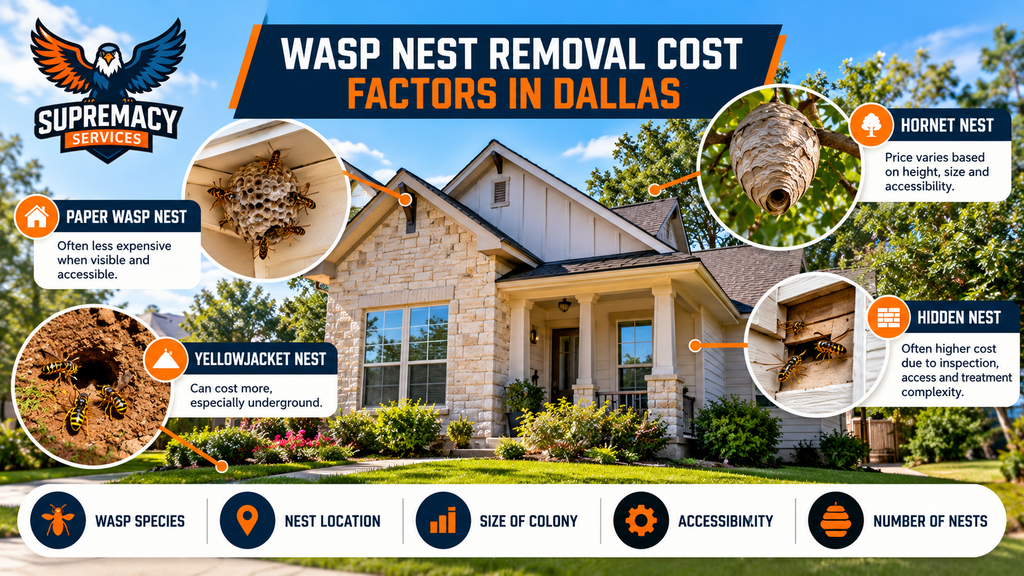
For Dallas homeowners, a useful 2026 market benchmark is approximately $309–$722 for professional wasp nest removal, with an average around $541 according to current Dallas-specific pricing data from Angi. These are market estimates rather than regulated prices or a Supremacy Services price list.
National cost guides provide a similar benchmark. HomeAdvisor reports a typical professional range of roughly $300–$700, while HomeGuide also places average removal around $300–$700.
| Removal situation | Useful 2026 market benchmark |
|---|---|
| Small/simple accessible nest | May begin around $100–$150 nationally |
| Typical professional removal | $300–$700 |
| Dallas reported range | $309–$722 |
| Dallas reported average | About $541 |
| Difficult yellowjacket removal | Can exceed the normal range |
| Hidden wall/attic nest | Often higher because of access complexity |
These figures should be treated as planning estimates rather than quotes. A technician needs to identify the insect and determine exactly where the colony is located before an accurate price can be established.
Why can two wasp nests have very different prices?
Imagine one small paper-wasp comb hanging beneath a first-floor porch roof and another colony disappearing through a gap beneath a second-story soffit.
Both homeowners might say, “I have a wasp nest.”
They are not necessarily the same job.
The first colony is visible and readily accessible. The second may extend into a concealed structural void, requiring additional investigation, treatment and access precautions.
That difference is why nest location and accessibility often matter as much as visible size.
Not sure whether the nest is exposed or hidden inside your home? See how professional wasp and hornet nest removal in Dallas works before attempting to disturb it.
Wasp Removal Cost by Type
The species matters because different wasps have different nesting habits and defensive behavior.
Current consumer pricing guides report substantial variation between paper-wasp, hornet and yellowjacket jobs. For example, HomeGuide reports paper-wasp removal at roughly $150–$350 nationally while more difficult yellowjacket work can run considerably higher. These are third-party market estimates, not fixed Dallas rates.
Paper wasps
Paper wasps commonly construct an exposed, open-cell paper nest beneath sheltered surfaces.
Texas A&M AgriLife describes paper-wasp nests as open underneath rather than surrounded by a papery envelope. They commonly nest under eaves and other protected locations.
Because the nest may be visible and accessible, a straightforward paper-wasp job can fall toward the lower end of professional removal pricing.
However, accessibility still matters. A nest beneath a two-story roofline is a different safety problem from one attached to an easily reached fence.
Yellowjackets
Yellowjackets can make removal substantially more complicated.
Texas A&M notes that southern yellowjackets may establish colonies underground, in walls or even indoors. They can sting repeatedly, and their concealed nesting behavior means homeowners may see only an entrance rather than the actual colony.
Consequently, underground and structural-void yellowjacket colonies can cost more to address than a small exposed paper-wasp nest.
Hornets and aerial nests
Some social wasps construct enclosed aerial nests in trees or beneath building surfaces. Height, colony activity and the equipment required to reach the nest safely can all affect the service scope.
Mud daubers and solitary wasps
Not every intimidating wasp around a Dallas home represents an aggressive social colony.
Many solitary wasps have very different behavior. University Extension guidance notes that solitary wasps generally do not defend their nests in the same way yellowjackets do. Mud-dauber nests, for example, may sometimes simply be removed when inactive.
Correct identification can therefore prevent homeowners from paying for — or attempting — treatment that is unnecessary.
What Affects Wasp Nest Removal Cost?
Six factors usually have the greatest effect on what a wasp-removal job costs.
1. Nest location
Location is one of the strongest pricing factors.
An exposed nest beneath a first-floor eave is normally easier to inspect and access than one located:
- inside a wall void;
- behind siding;
- beneath a roof or soffit;
- inside an attic;
- underground;
- inside a chimney;
- high in a tree or roofline.
Hidden nests can require a different treatment approach because the visible opening may not be where the colony itself is located.
2. Height and accessibility
Second-story rooflines, steep roofs and confined areas can increase the amount of equipment, time and safety preparation required.
Avoid thinking of a high nest as simply “the same nest with a taller ladder.” Working at height while dealing with defensive stinging insects introduces another hazard.
3. Wasp species
Paper wasps, yellowjackets and solitary wasps do not behave identically.
Identification helps determine:
- whether treatment is actually necessary;
- how defensive the colony may be;
- where the nest is likely located;
- the appropriate treatment strategy;
- whether physical nest removal is possible.
4. Colony and nest size
A newly developing exposed nest and a mature colony are different service calls.
Social-wasp colonies begin with queens establishing nests and increase as workers are produced. Texas A&M documents the seasonal colony development of common Texas wasps, making early identification useful before a nest becomes larger and more active.
5. One nest vs. multiple nests
A property inspection may reveal more than the nest that originally attracted attention.
Porches, sheds, fences, eaves and other sheltered areas can provide multiple potential nesting locations.
Ask whether the estimate covers:
- one nest only;
- inspection of the surrounding structure;
- additional nests discovered during service;
- nest removal after treatment;
- follow-up treatment if activity remains.
6. Structural access or repairs
A colony behind siding or inside a wall may require more than exterior treatment.
If opening and subsequently repairing part of a structure is necessary, clarify whether that work is included in the pest-control quote or handled separately.
Why Hidden Wasp Nests Can Cost More
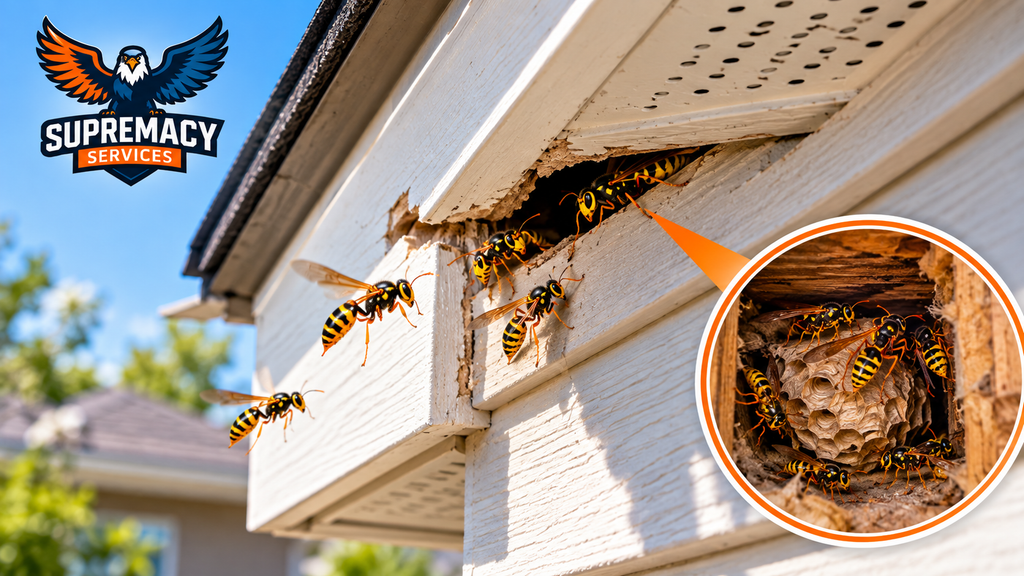
A hidden nest is usually more difficult because technicians must determine where the colony is located without relying solely on the visible entry point.
Yellowjackets can establish nests in wall voids, attics and other cavities. Extension guidance specifically describes hidden yellowjacket colonies inside buildings as more challenging to control and generally better suited to professional pest management.
One particularly important mistake to avoid is immediately sealing an active entry hole.
If insects are still using a structural cavity, blocking their normal route does not necessarily eliminate the colony. Extension guidance warns against sealing the opening until yellowjacket activity has been eliminated because displaced insects may seek another exit.
Signs the nest may be inside the structure
Look for repeated wasp traffic entering and leaving:
- a soffit gap;
- siding;
- an attic vent;
- a crack around exterior trim;
- a wall penetration;
- a roof intersection;
- another small structural opening.
Seeing individual wasps indoors can also warrant further investigation, particularly when repeated activity occurs near the same wall or ceiling area.
If wasps are repeatedly entering a wall, soffit or roof opening, avoid sealing the opening until the colony has been assessed. Schedule a wasp-nest inspection with Supremacy Services to determine where the activity is coming from.
How to Tell What Kind of Wasp Nest You Have
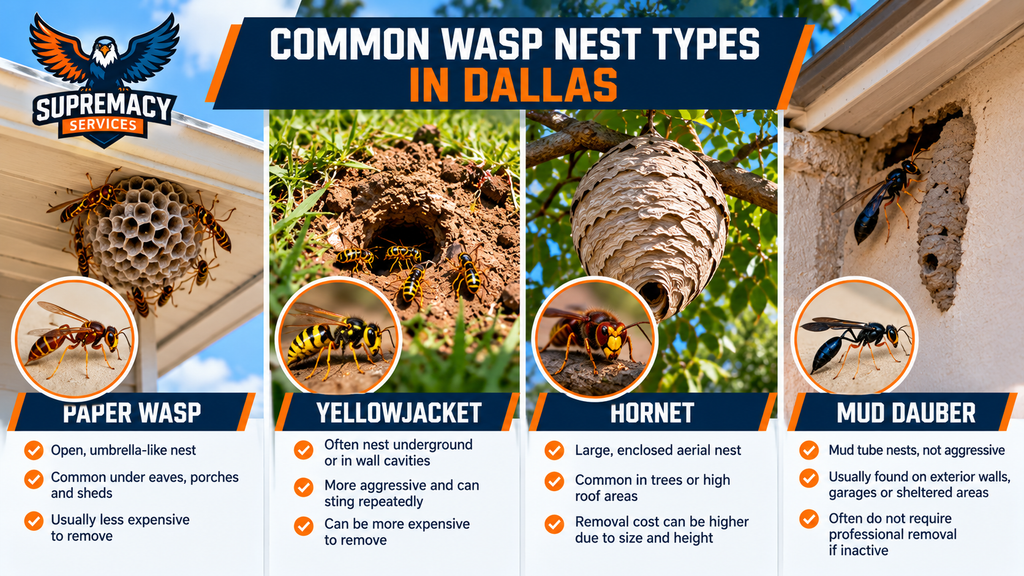
Identification matters because homeowners often use “wasp,” “hornet,” “yellowjacket” and even “bee” interchangeably.
| What you see | Possible identification | Typical nesting pattern |
|---|---|---|
| Open umbrella-like paper comb | Paper wasp | Eaves, porches, sheltered structures |
| Heavy traffic through a ground opening | Yellowjacket | Underground cavity |
| Repeated traffic through siding/soffit | Yellowjacket or another cavity-nesting wasp | Structural void |
| Enclosed paper aerial nest | Social wasp/hornet-type colony | Tree, shrub or structure |
| Mud tubes/cells | Mud dauber | Sheltered wall, garage or eave |
| Hairier insects entering wax-comb colony | Possibly honey bees | Tree or structural cavity |
Texas A&M notes that honey bees tend to have hairier bodies, while wasps generally appear smoother and have more distinct narrow waists. Their nests also differ: honey bees construct wax comb, while social wasps construct paper-like nests.
Don’t automatically treat bees as wasps
A cluster of flying insects entering a building does not prove that you have yellowjackets.
If the insects appear to be honey bees, proper identification should come first. Texas A&M specifically recommends identifying the insects before deciding how a colony should be managed.
DIY vs. Professional Wasp Nest Removal
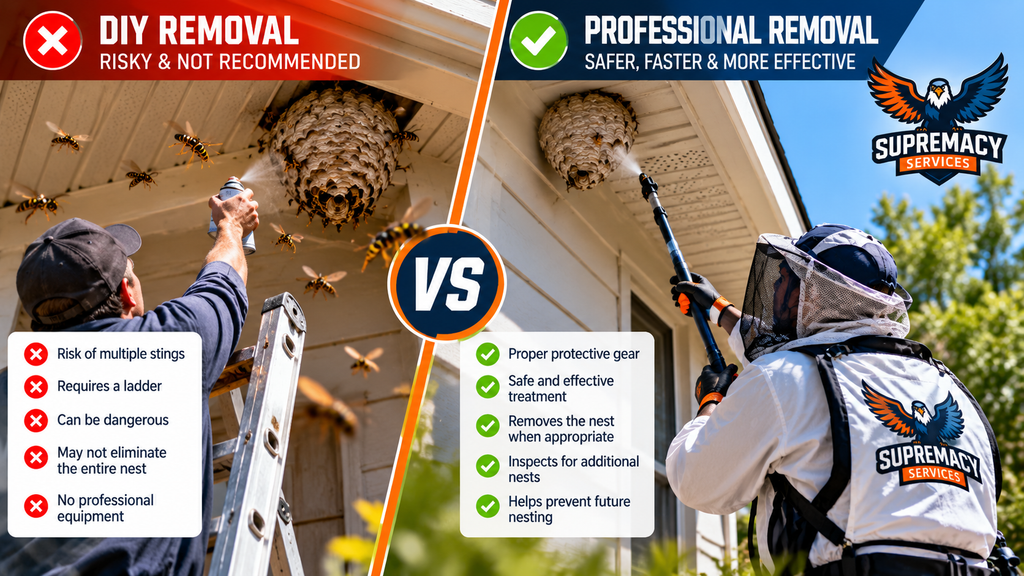
A small, readily accessible nest is very different from an active colony inside a wall or underground.
| Situation | DIY consideration | Professional service |
|---|---|---|
| Small, accessible exposed nest | Retail products may exist for labeled applications | Optional depending on risk |
| High roof/eave nest | Fall and sting risk increase | Strongly preferable |
| Underground yellowjacket colony | Difficult to judge colony position/size | Strongly preferable |
| Nest inside wall/attic | Hidden colony complicates treatment | Recommended |
| Multiple active nests | Harder to assess extent | Recommended |
| Known sting allergy | Avoid disturbing nest | Professional assistance appropriate |
| Uncertain insect identification | Avoid unnecessary treatment | Identification first |
Anyone considering a pesticide should read and follow the product label exactly.
The Texas Department of Agriculture regulates structural pest-control businesses and professionals who provide pest-control services for compensation. TDA states that structural pest-control businesses must be licensed and have appropriately certified personnel for the categories in which they operate.
When DIY becomes a bad trade-off
The cost of an aerosol can is not the only variable.
Consider whether reaching the nest requires you to:
- climb a ladder;
- approach a highly active colony;
- work near a doorway used by family members;
- enter an attic;
- disturb a concealed nest;
- identify an insect you are uncertain about.
When several of those conditions apply, professional service is less about buying a stronger spray and more about managing access, identification and exposure safely.
What Does Professional Wasp Removal Include?
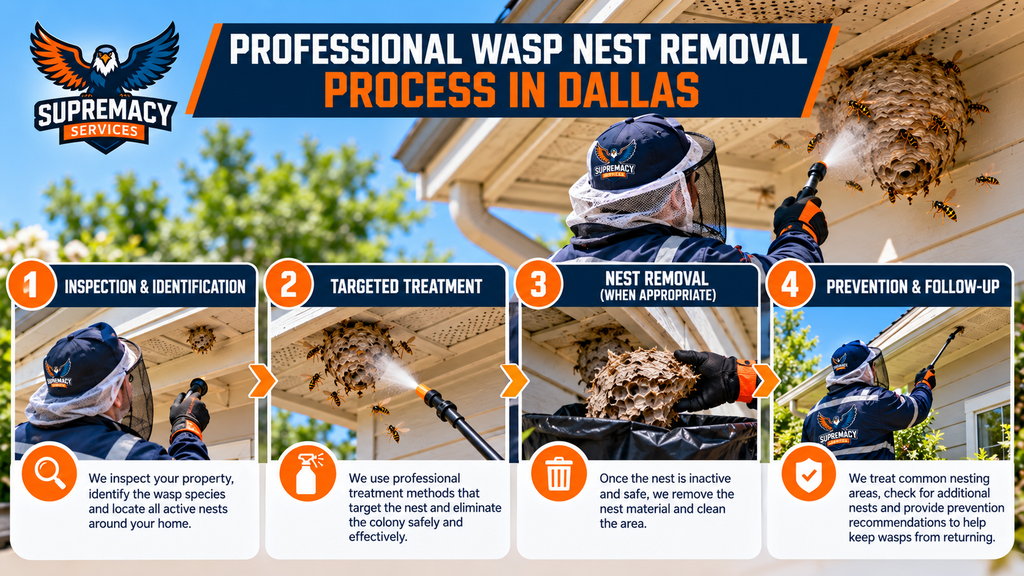
The exact scope varies with the company and nest, so homeowners should ask what is included in the estimate.
A thorough service may involve:
1. Inspection and identification
The technician determines what insect is present and searches for active nesting locations.
2. Nest-location assessment
Visible nests are straightforward. Hidden activity may require tracing flight patterns to identify entry points and likely nesting cavities.
3. Appropriate treatment
The treatment method should match the species, nest location and pesticide label.
4. Confirmation of reduced activity
Physical nest removal should occur only when it can be performed safely.
5. Nest removal when appropriate
Accessible nest material may be removed after the colony has been controlled.
6. Inspection for additional activity
Nearby eaves, porches, rooflines and sheltered surfaces can be checked for additional nests.
7. Prevention recommendations
The technician may identify structural gaps or recurring nesting areas that can be addressed after active colonies have been eliminated.
Supremacy Services’ dedicated Dallas wasp and hornet service describes a process involving property and roofline inspection, targeted treatment, physical nest removal and preventative spot treatment.
Is Wasp Removal Included With Regular Pest Control?
It depends on the pest-control plan.
This is worth asking because prevention and emergency nest removal are not necessarily identical services.
Supremacy Services’ current Perimeter Pest Control program includes exterior inspection and high-reach sweeping of wasp nests and spider webs around windows and eaves.
That type of routine exterior service can help address small developing nests, while an established, concealed or difficult stinging-insect colony may require dedicated removal.
This distinction is useful when comparing quotes: ask whether you are buying one-time active-nest removal, ongoing exterior pest prevention, or both.
Dallas and DFW Wasp Considerations
North Texas homeowners can encounter several kinds of social and solitary wasps, including paper wasps and yellowjackets.
Rather than relying on calendar dates alone, pay attention to actual activity around the structure.
Repeated flight into the same opening is more informative than occasionally seeing a wasp cross the yard.
Common inspection points around Dallas-area homes include:
- roof eaves;
- soffits;
- patio covers;
- porch ceilings;
- sheds;
- fences;
- attic and roof vents;
- exterior light fixtures;
- wall penetrations;
- landscaping near high-traffic areas.
The concern becomes greater when an active nest is close to a doorway, patio, children’s play area or another location where people repeatedly pass near it.
How to Prevent Wasps From Returning
Prevention starts with making the property less attractive for nesting and detecting new nests early.
Inspect sheltered areas regularly
Look beneath eaves, porch roofs, patio structures and other protected surfaces for early nest construction.
Repair appropriate exterior gaps
After confirming that no active colony remains inside, repair openings that could provide access to wall or attic cavities.
Keep waste covered
Outdoor garbage and food residues can attract scavenging yellowjackets. Extension guidance recommends keeping food covered and using tightly closed garbage containers when yellowjackets are active.
Watch recurring nesting areas
If wasps repeatedly establish nests beneath the same porch or roofline, include that location in routine exterior pest inspections.
Consider perimeter pest management
Homeowners who repeatedly deal with insects around eaves, windows and the foundation may benefit from treating the problem as part of a broader exterior pest-management strategy rather than waiting for each individual infestation.
When Should You Call a Professional for a Wasp Nest?
Professional help is particularly appropriate when the nest is hidden, high, difficult to reach, aggressively defended or located where people cannot safely avoid it.
Consider calling a professional when:
- wasps are entering a wall or soffit;
- you suspect an underground yellowjacket colony;
- the nest requires a ladder to reach;
- activity is concentrated beside a doorway or patio;
- multiple nests are present;
- the species cannot be identified confidently;
- wasps are appearing repeatedly inside the house;
- someone who may encounter the nest has a history of severe sting reactions.
University Extension guidance similarly recommends professional pest management for difficult hidden nests and warns people with sting allergies not to attempt nest management themselves.
What Should You Ask Before Hiring a Wasp Exterminator?
Price matters, but the lowest number is difficult to compare unless the scope is identical.
Ask:
- Is inspection included?
- Does the quote cover treatment and physical nest removal?
- Is the price for one nest or the entire inspected area?
- What happens if another nest is discovered?
- Is follow-up included?
- Does the estimate include high-access work?
- Are structural repairs separate?
- What prevention work is included?
- Is the pest-control business properly licensed in Texas?
Texas requires businesses performing structural pest control for hire to meet state licensing requirements.
A written estimate that clearly defines the work is more useful than comparing headline prices without knowing what each company includes.
Frequently Asked Questions
How much does wasp nest removal cost in Dallas?
Current 2026 Dallas market data puts typical professional wasp removal around $309–$722, with an average near $541. Small accessible nests may cost less, while concealed or difficult colonies can cost more.
What is the cheapest type of wasp nest to remove?
A small, exposed and easily accessible paper-wasp nest is generally among the simpler removal situations. Species, height and accessibility still affect the final quote.
Why does yellowjacket removal cost more?
Yellowjackets frequently establish colonies underground or inside structural cavities. Those concealed locations and the colony’s defensive behavior can make treatment more complicated than removing a visible paper-wasp nest.
Does the exterminator remove the actual nest?
It depends on accessibility and the service scope. Ask specifically whether physical nest removal is included rather than assuming treatment and removal mean the same thing.
Can I remove a wasp nest myself?
Some small, exposed nests may be manageable with a product specifically labeled for that application, but high, concealed, underground or aggressively defended nests present substantially greater risk. Anyone with a known serious sting allergy should not attempt removal.
Should I seal the hole where wasps are entering my wall?
Not while an active colony is still using it. Extension guidance warns that prematurely sealing an active yellowjacket entrance can cause insects to seek another exit, potentially toward the building interior.
Are wasps and yellowjackets the same thing?
Yellowjackets are a type of social wasp. Their nesting behavior differs from common paper wasps: many yellowjackets use underground or enclosed cavities, while paper wasps commonly build exposed open-comb nests.
What if I actually have honey bees?
Get the insect identified before treatment. Honey bees and wasps differ in appearance, nesting material and colony behavior, so the appropriate management approach may be different.
Is routine pest control enough to prevent wasp nests?
Routine exterior inspection can help catch developing nests early. Supremacy’s perimeter program currently includes exterior nest and web sweeping, while an established or concealed colony may require dedicated wasp-removal service.
Get a Dallas Wasp Nest Assessed Before It Gets Harder to Ignore
A visible nest beneath an accessible eave may be relatively straightforward. A stream of yellowjackets disappearing behind siding, into a soffit or underground can represent a much more complicated problem.
The most useful first step is determining what insect is present, where the colony is located and what the removal actually requires.
For homeowners across Dallas and the DFW Metroplex, Supremacy Services provides dedicated wasp and hornet nest removal alongside broader exterior pest-control services.

