
Dallas Raccoon Removal : Safe and Humane Wildlife Control
Dealing with wildlife in your home can be a nightmare. For professional raccoon removal in Dallas, TX, turn to Supremacy Service. We are your premier provider of safe, humane, and permanent wildlife control. If you are hearing thumping, scratching, or rolling sounds in your attic at night, you likely have uninvited guests. Raccoons are highly intelligent and destructive pests that seek the warmth and security of your home to den and raise their young.
While they may look cute, raccoons in Dallas pose significant risks to your property and your family’s health. From tearing through roof decking to contaminating insulation with feces and urine, the damage escalates quickly.
Do not attempt to handle these wild animals yourself. Raccoons can be aggressive and carry diseases like Rabies and Raccoon Roundworm. For fast, safe, and guaranteed raccoon removal in Dallas, trust the licensed experts at Supremacy Service.
Raccoons in Dallas: A Growing Problem for Homeowners
Raccoons are highly adaptable and have found a perfect urban environment in Dallas. Whether you live in a historic home in Lakewood or a newer build in North Dallas, your attic provides a warm, safe, and quiet place for raccoons to nest, especially during breeding season (January through March).
Beyond the noise and sleepless nights, raccoons cause significant damage to Dallas properties. They tear through roof vents, chew electrical wiring, and contaminate insulation with feces and urine, which poses serious health risks like Roundworm and Salmonella to your family and pets.
Common attractions around Dallas properties include:
- Open garbage or unsecured trash
- Pet food left outdoors
- Fallen fruit from trees
- Compost and food waste
- Accessible attics
- Damaged soffits and fascia
- Unscreened roof vents
- Open chimneys
- Gaps around roof penetrations
- Crawl spaces and sheds
- Dense vegetation near structures
The important point for homeowners is that removing the raccoon without correcting the attraction or entry point can leave the property vulnerable to another wildlife intrusion.
Signs You May Have Raccoons in Your Dallas Home
Raccoons are predominantly nocturnal, so homeowners frequently notice evidence before they actually see the animal.
1. Scratching or Heavy Movement at Night
One of the most common indications of a raccoon inside a Dallas home is repeated noise coming from the attic, ceiling or roof area after dark.
Raccoons are predominantly nocturnal and have excellent night vision and hearing. They are also considerably larger and heavier than many animals that commonly enter attics, so their movement can produce noticeably heavier sounds. Texas Parks and Wildlife describes raccoons as agile climbers that have adapted well to developed environments.
A homeowner may hear:
- Heavy footsteps above the ceiling
- Scratching against wood or roofing materials
- Thumping or bumping sounds
- Movement across attic insulation
- Sounds coming from a soffit or roof vent
- Repeated activity around the same section of the roof
- Chattering, vocalizations or fighting sounds
- Movement that becomes noticeably louder after sunset
The timing and character of the noise matter. Light scratching during the day could indicate rodents, birds or squirrels, while heavier intermittent movement at night may be more consistent with a larger nocturnal animal such as a raccoon.
However, sound alone cannot positively identify the animal. Squirrels, opossums and other wildlife can occupy similar areas and produce overlapping noises.
Why repeated nighttime noise matters
If the same noises continue for several nights, the issue may be more than a wild animal simply passing across the roof.
Repeated activity in one location can indicate that the animal has found a sheltered access point or denning location. Once a raccoon discovers that an attic provides protection from weather and predators, it may continue returning to that location.
Texas Parks and Wildlife specifically warns that raccoons occupying attics and outbuildings can become destructive and difficult to remove.
Do not open an attic access panel or reach into an unknown nesting area to investigate the animal yourself. A cornered raccoon may defend itself, particularly if young are present.
2. Damaged Soffits, Fascia or Roof Areas
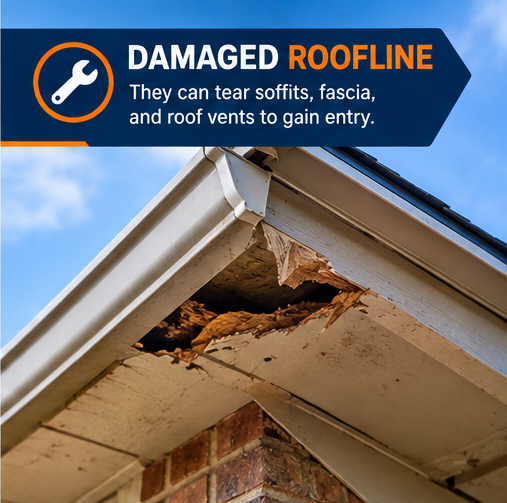
A second major warning sign is fresh or unexplained damage around the roofline.
Raccoons are strong climbers and use their front paws to manipulate objects and investigate potential openings. Their ability to climb and adapt to buildings makes rooflines particularly important areas to inspect.
Look carefully for:
- Torn or displaced soffit panels
- Damaged fascia boards
- Bent or missing vent screens
- Gaps beneath roof edges
- Damaged attic vents
- Loose roofing materials
- Disturbed chimney covers
- Torn screening
- Gaps around roof penetrations
- Scrape marks near suspected entry points
- Insulation or nesting material protruding from an opening
A particularly important clue is damage that appears concentrated around one access point.
For example, if a soffit has been pulled away from the structure and you are also hearing heavy movement in the attic at night, the two observations may be related.
Why roof damage should not simply be patched
One of the biggest mistakes homeowners can make is repairing the visible hole before determining whether the animal is still inside.
If a raccoon is occupying the attic, sealing the opening prematurely can trap the animal inside or separate a mother from dependent young.
The better approach is to determine:
- Whether wildlife is currently inside
- Which animal is responsible
- Whether young are present
- Which opening is being used
- Whether there are additional access points
Only after the wildlife situation has been properly addressed should permanent exclusion repairs be considered.
3. Droppings or Strong Odors
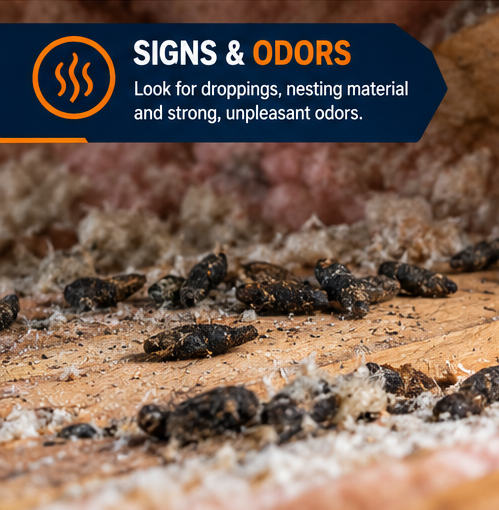
Unusual odors are another important indication of established wildlife activity.
A raccoon that repeatedly uses an attic, crawl space or enclosed structure can leave behind feces, urine, nesting material and other organic debris.
Instead of finding a single dropping, homeowners may notice a concentrated accumulation in one area.
Possible indicators include:
- Strong animal odors
- Persistent ammonia-like smells
- Droppings concentrated in an attic
- Urine staining
- Contaminated insulation
- Nesting debris mixed with waste
- Odors becoming stronger in warm weather
- Odors coming from a ceiling or wall cavity
A persistent odor is especially significant when it occurs alongside nighttime movement or visible entry damage.
Why odors can become worse in Dallas heat
Dallas-area summer temperatures can make odors from accumulated animal waste substantially more noticeable.
An attic that remains hot for long periods can intensify unpleasant smells and make previously unnoticed wildlife contamination obvious to occupants below.
That is one reason homeowners should not simply mask the odor with air fresheners.
The odor may be coming from contaminated insulation or a concentrated wildlife den, rather than from the animal itself.
Droppings should be treated carefully
Homeowners should avoid handling wildlife feces or contaminated nesting material without appropriate precautions.
If the material is extensive, professional wildlife cleanup may be appropriate after the animal has been removed and the area is safe to access.
It is also important not to assume that every dropping found in an attic belongs to a raccoon. Rodents and other wildlife can leave different types of waste, so identification should be based on the overall evidence rather than one isolated sample.
4. Nesting Material
Another strong indication of an established wildlife presence is disturbed or newly arranged nesting material.
Raccoons may use protected spaces to rest and raise young. In a home, that can mean an attic, crawl space, chimney, shed or another sheltered location.
A homeowner may discover:
- Pulled-apart insulation
- Shredded paper or cardboard
- Leaves and plant material
- Fabric or other soft materials
- Displaced attic insulation
- Concentrated debris in one corner
- A flattened area within insulation
- Nesting material near a roof or soffit opening
The location of the material can be particularly useful.
If nesting debris is concentrated directly beneath a roof penetration or damaged soffit, it may help identify the area being used to enter or exit the structure.
Be especially cautious if babies may be present
A den containing young raccoons requires additional care.
Texas Parks and Wildlife reports that female raccoons can produce litters of up to four young, and that the young remain with their mothers well beyond the earliest weeks of life.
That means a homeowner who hears small repetitive noises in addition to the movement of a larger animal should not assume that there is only one raccoon.
Possible signs of a den with young can include:
- Repeated adult movement
- Smaller vocalizations
- Activity concentrated in one protected location
- A mother repeatedly entering and leaving the same opening
- Nesting material concentrated in an enclosed space
This is one reason professional inspection should precede exclusion work.
Sealing an active entry point without determining whether young are inside can create an animal-welfare problem and potentially leave the mother outside while the young remain inside.
5. Daytime Raccoon Activity
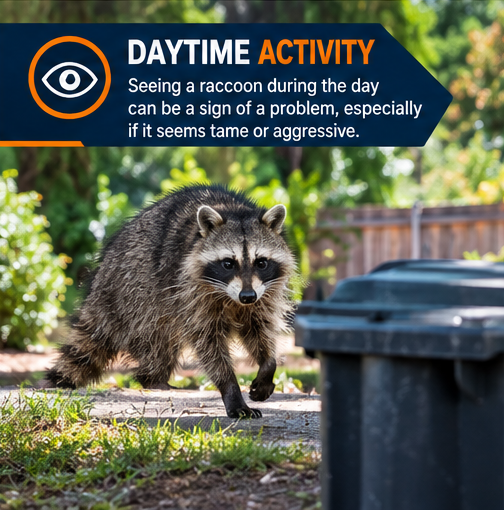
Seeing a raccoon during the day deserves attention, but it requires context rather than panic.
Texas Parks and Wildlife describes raccoons as almost exclusively nocturnal.
Texas Department of State Health Services also lists unusual daytime activity by normally nocturnal wildlife—including raccoons—as one of the behaviors that can be associated with rabies and advises people not to handle wildlife.
However, a raccoon being visible during daylight does not by itself prove that the animal has rabies.
There can be other explanations for daytime activity, including:
- The animal being disturbed from its den
- Searching for food
- A mother caring for young
- Environmental disturbance
- Competition with another animal
- An animal that has become accustomed to human food sources
The concern increases when daytime activity is accompanied by abnormal behavior.
Watch for signs such as:
- Unusual aggression
- Unusual tameness or lack of fear
- Staggering or difficulty walking
- Disorientation
- Repeated circling
- Apparent paralysis
- Difficulty swallowing
- Excessive or abnormal vocalization
- Unprovoked attempts to approach or attack people or pets
Texas DSHS advises avoiding contact with wildlife, and CDC guidance similarly recommends staying away from wild animals that appear sick, injured or unusually active during the day.
What to do if a raccoon behaves abnormally
Do not attempt to capture, corner, feed or handle the animal.
Keep children and pets away from the area and contact the appropriate local animal-control or wildlife authority.
If a person or pet has been bitten or scratched, the wound should be washed immediately with soap and water and medical or veterinary advice should be obtained promptly. Texas DSHS identifies raccoons among wildlife species for which rabies exposure can require testing and public-health evaluation.
CDC also emphasizes that rabies is preventable when appropriate post-exposure care is provided before symptoms develop.
When Several Signs Appear Together
One sign by itself may not prove that raccoons are inside your Dallas home.
The evidence becomes much stronger when multiple signs occur in the same location.
For example:
Nighttime heavy movement + damaged soffit + disturbed insulation + strong odor
is considerably more concerning than simply seeing a raccoon walking across the backyard.
Likewise:
Roof damage + nesting material + repeated animal sounds
may indicate an established den rather than occasional wildlife activity.
This is why a professional wildlife inspection should look at the whole pattern of evidence, rather than relying on a single observation.
A practical homeowner checklist
| Sign | What it may indicate |
|---|---|
| Heavy nighttime movement | Larger nocturnal wildlife may be inside |
| Damaged soffit/fascia | Possible entry point |
| Torn vent screening | Wildlife access to attic |
| Strong persistent odor | Established wildlife activity or contamination |
| Disturbed insulation | Movement or nesting |
| Concentrated droppings | Repeated use of an area |
| Nesting material | Denning activity |
| Repeated daytime activity | Requires additional behavioral assessment |
| Aggressive/disoriented behavior | Potential health/public-safety concern |
The key takeaway
Don’t wait until you actually see the raccoon to investigate.
In many Dallas homes, the animal itself may remain hidden while the evidence around it becomes increasingly obvious.
Early identification of sounds, roof damage, odors, nesting material and behavioral changes gives homeowners an opportunity to address the entry point before the problem develops into more extensive attic contamination or structural damage.
Why Raccoons in the Attic Are a Serious Problem
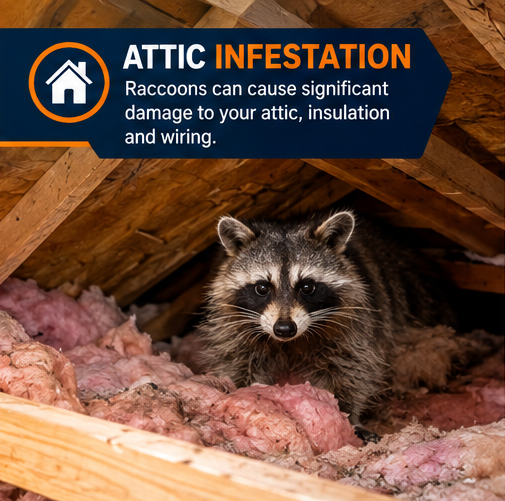
A raccoon den inside a home can create several separate problems at once.
Structural Damage
Raccoons are highly destructive creatures with significant physical strength and manual dexterity. Once they breach an attic, they can rapidly compromise the building’s integrity. They may rip apart soffits, chew through roof vents, and tear holes in the exterior walls to create entry points and ventilation. Inside the attic, their constant digging, nesting, and movement can displace roofing materials and damage support beams. Over time, this concentrated activity can weaken the overall structure of the roof and walls, leading to expensive repairs and potentially compromising the safety of the entire home..
Insulation Damage
The attic insulation serves as a primary target for raccoons seeking nesting materials and comfort. These animals will trample, flatten, and tear up insulation batting, significantly reducing its thermal efficiency (R-value) and increasing the home’s heating and cooling costs. Beyond physical destruction, raccoons often use the insulation as a latrine, soaking large areas with urine and feces. Contaminated insulation loses its insulating properties entirely, emits terrible odors, and becomes a breeding ground for parasites, posing a significant health hazard and necessitating complete removal and replacement.
Electrical and Building-System Risks
Raccoons are omnivores and possess a natural instinct to chew and investigate their environment. This behavior creates severe, immediate risks when directed at attic infrastructure. They frequently chew on electrical wiring, stripping the protective casing and exposing live wires, which creates a very high risk of short circuits and electrical fires. Furthermore, they can damage HVAC ductwork, vent pipes, and plumbing lines, leading to water leaks, inefficient climate control, and the spread of contaminated air throughout the home.
Odors and Contamination
A raccoon den is not merely a place to sleep; it becomes a central hub for all their life functions. Accumulations of urine, feces, food remnants (including decaying animal carcasses), and nesting debris create overwhelming and pervasive odors. This foul stench can quickly permeate the living spaces below, making the home unpleasant and often unbearable to inhabit. The contamination is more than just odorous; raccoon scat commonly contains roundworm eggs (
BaylisascarisprocyonisBaylisascarisprocyonis) which, if inhaled or ingested by humans, can cause severe, permanent neurological damage and disease.
Family and Pet Safety
The presence of raccoons in an attic creates a direct and unacceptable risk to the household occupants. Raccoons are wild animals that can be fiercely aggressive, especially females with kits (cubs). They will not hesitate to defend their territory and young, attacking humans or pets that venture too close to their den. They are also vectors for several serious zoonotic diseases, including rabies, leptospirosis, and distemper. While direct attacks in living spaces are rare, the risk is elevated if a cornered or rabid raccoon enters the main part of the house, or if pets access the attic area.
Raccoon Breeding and Baby Raccoons in Dallas
One of the most important considerations during raccoon removal is determining whether dependent young are present.
Female raccoons may establish dens in protected areas such as attics, chimneys, wall voids, crawl spaces and other sheltered locations.
If a mother and babies are present, simply sealing the visible opening can create a much bigger problem.
A professional inspection should determine:
- Whether an adult raccoon is present
- Whether dependent young are present
- Where the den is located
- How the animal is entering and exiting
- Whether additional entry points exist
The objective should be to resolve the wildlife problem without unnecessarily separating dependent young from their mother.
Professional Raccoon Removal Dallas Process

Effective raccoon control is not simply about putting a trap somewhere near the house.
A professional approach begins with understanding the animal’s behavior and the structure of the property.
01 — Inspect
The first step is a detailed inspection of the property.
We examine areas such as:
- Rooflines
- Soffits
- Fascia
- Roof vents
- Chimneys
- Attic spaces
- Crawl spaces
- Garages
- Foundations
- Exterior walls
- Potential nesting locations
The goal is to identify both the active wildlife problem and the route being used to access the structure.
02 — Identify
Not every animal making noise in an attic is a raccoon.
Squirrels, opossums, rodents and other wildlife can produce similar signs.
Correct identification helps determine the appropriate control strategy and prevents homeowners from spending money treating the wrong animal.
03 — Remove
Once the situation is understood, appropriate wildlife-control measures can be implemented.
Raccoon handling requires particular care because of the potential for bites, scratches and disease exposure.
Texas regulations also matter. Raccoons are classified as fur-bearing animals, and Texas has specific restrictions concerning the transport and relocation of live raccoons.
That means professional wildlife work should follow applicable Texas requirements rather than treating relocation as an informal step.
04 — Exclude
Removing the animal is only half the solution.
The next step is identifying and securing the entry point.
Depending on the structure, exclusion may involve repairing or reinforcing:
- Soffit openings
- Roof vents
- Fascia gaps
- Chimney openings
- Roof penetrations
- Attic vents
- Crawl-space openings
- Other vulnerable exterior locations
The goal is to make the structure substantially harder for another raccoon to enter.
Why Trapping Alone Does Not Solve a Raccoon Problem
One of the biggest mistakes homeowners can make is treating wildlife removal as a simple trapping exercise.
Imagine a raccoon is caught and removed but the damaged soffit remains open.
Another raccoon may eventually discover the same shelter.
That is why a complete wildlife-control strategy should connect inspection + removal + exclusion + cleanup.
Supremacy’s broader wildlife-removal service follows this same principle by combining wildlife removal with entry-point sealing and attic cleanup.
For homeowners dealing with several types of wildlife, our broader Wildlife Trapping and Removal in Dallas service can address raccoons, squirrels, opossums, skunks and other nuisance wildlife.
How to Prevent Raccoons From Returning
Once an active raccoon problem has been addressed, prevention becomes extremely important. Raccoons are creatures of habit and possess strong spatial memory. If they successfully utilized your home as a den site, they—or other raccoons in the area—will continually attempt to regain access. Successful, long-term prevention requires a multi-layered strategy that combines habitat modification with proactive structural defense. The goal is to make your property an uninviting and difficult target, encouraging wildlife to move on to more suitable, natural territories.
Secure Your Trash
Use secure lids and avoid leaving exposed food waste accessible overnight.
Raccoons are consummate urban foragers, and unsecured trash is their primary food magnet. A standard plastic lid is no match for a raccoon’s strength and manual dexterity; they can easily pry or lift lids to access a smorgasbord of decomposing waste. Simply placing a heavy rock on top of a bin is often insufficient. To truly secure your trash, you must use bins with locking mechanisms or latching lids that require thumbs to operate. If locking bins are unavailable, store garbage cans inside a closed garage or shed until the morning of pickup. For external storage, consider weighted bins or investing in a secure outdoor enclosure. Never set bagged trash outside overnight, as this constitutes an open invitation for foraging animals.
Remove Outdoor Food Sources
Bring pet food indoors and clean up fallen fruit when possible.
Your property can provide significant, unintended nutritional subsidies that act as a siren call for local wildlife. Pet food bowls left on a porch or deck overnight are a major attractant, not only for raccoons but also for skunks, opossums, and coyotes. Always feed pets indoors, or immediately remove bowls after designated feeding times. In addition to pet food, bird feeders are a frequent and often overlooked source. Seed and suet attract birds during the day, but the spilled waste below attracts raccoons at night. Cease bird feeding if a raccoon problem is suspected. Lastly, if you have fruit trees, regularly harvest ripe fruit and clean up all dropped produce from the ground, as fermenting fruit is a high-value food item for these animals.
Inspect Your Roofline
Regularly check soffits, fascia, vents, roof penetrations and other areas where wildlife could gain access.
The roofline is the perimeter of your home’s upper defenses. Raccoons are agile climbers capable of exploiting even the smallest gaps. A seasonal roof inspection is critical for identifying potential breach points before they become active entryways. Walk the perimeter of your home with binoculars, or carefully use a ladder, to inspect for compromised areas. Look for loose or rotted fascia boards, gaps in the soffit where the roof overhangs the walls, and any damage around plumbing vents and electrical conduits. These structural weaknesses are often enlarged by raccoons or squirrels to create access to the warm, dry attic space. Early detection and repair of these vulnerabilities are key to preventing costly wildlife infestations.
Protect Roof Vents
Damaged or unscreened vents can create opportunities for wildlife intrusion.
Standard roof and gable vents are among the most common entry points for raccoons. Many vents are constructed with light-gauge plastic or flimsy metal screens that are easily torn or ripped off by a persistent raccoon. Older, unscreened vents offer no resistance at all. To fortify these critical points, all roof vents (especially ridge vents and gable louvers) should be covered with heavy-duty, galvanized steel screening or specialized raccoon-proof vent guards. These reinforced covers allow for proper airflow while creating an impenetrable barrier against wildlife. Do not rely on the pre-existing vent structure alone; installing these protective measures is a vital preventative upgrade.
Keep Tree Limbs Trimmed
Branches that provide easy access to the roof can make your home easier for wildlife to reach.
Raccoons are arboreal by nature and prefer to travel via an aerial route. A large tree limb that overhangs or even just touches your roof acts as a highway, allowing wildlife to bypass ground defenses and reach your roofline effortlessly. By maintaining a substantial gap between all tree limbs and your house, you remove this direct, easy access. The general recommendation is to trim branches so they are at least 6 to 8 feet away from the structure. This not only deters raccoons but also protects your roof from abrasion and reduces the likelihood of other pests like rats and carpenter ants from using the tree as a bridge. Consult with a professional arborist for significant tree trimming.
Do Not Feed Raccoons
Feeding wildlife can reduce their natural fear of humans and encourage them to remain around residential properties. Texas Parks and Wildlife specifically notes that raccoons accustomed to being fed may move closer to homes in search of food.
This is arguably the most important rule of wildlife coexistence. Feeding raccoons—whether intentionally or unintentionally—disrupts their natural behavior and survival instincts. When raccoons associate humans with a steady food supply, they lose their innate fear and become habituated, often leading to aggressive behavior and demands for food. This habituation inevitably causes them to become “problem animals” that frequent patios, decks, and windows. Such behavior increases the risk of direct conflict, potential bites, and the transmission of diseases like rabies. As noted by wildlife agencies, feeding wildlife does them a disservice by making them dependent and putting them at greater risk of being trapped or euthanized. Respecting wildlife means allowing them to remain wild and self-sufficient.
What to Do If You See a Raccoon in Your Yard
Seeing a raccoon outside does not automatically mean you need wildlife removal.
If the animal is simply passing through, the safest response is generally to give it space.
Do not approach it, corner it, feed it or attempt to capture it.
The situation becomes more concerning when a raccoon:
- Enters the home
- Establishes an attic or crawl-space den
- Damages the roof or exterior
- Repeatedly returns to the property
- Appears injured or sick
- Acts unusually aggressive or tame
- Has direct contact with a person or pet
If a raccoon bites or scratches a person, seek medical advice promptly and notify the appropriate local animal-control or public-health authority. CDC guidance emphasizes urgent medical evaluation after possible rabies exposure.
Raccoon Removal in Dallas vs. DIY Trapping
DIY wildlife control can look straightforward until the animal is actually inside the structure.
The biggest challenges are usually not the trap itself.
They include:
- Correct animal identification
- Locating the actual den
- Determining whether young are present
- Safe animal handling
- Avoiding unnecessary exposure
- Finding secondary entry points
- Repairing the structure afterward
- Complying with Texas wildlife regulations
A trap that catches one animal does not necessarily solve the underlying access problem.
For homeowners, the more useful question is not:
“How do I catch this raccoon?”
It is:
“Why did this raccoon enter my home, and how do I prevent another one from doing the same thing?”
Why Choose Supremacy Services for Raccoon Removal?
Supremacy approaches wildlife problems as a property-protection issue, not simply an animal-removal job.
Our Dallas wildlife service is built around:
Complete Property Inspection
We investigate the roofline, exterior and potential denning areas rather than relying only on where the animal was seen.
Humane Wildlife Handling
The objective is to resolve the wildlife problem responsibly while minimizing unnecessary harm.
Entry-Point Exclusion
Once the active problem is addressed, vulnerable access points can be identified and secured.
Attic & Nest Cleanup
Wildlife can leave behind nesting material, waste and odors. Addressing the contaminated area is an important part of restoring the space.
DFW Local Knowledge
Dallas-area homes vary significantly in construction, roof design, landscaping and age. Wildlife entry points can therefore look very different from property to property.
Raccoon Removal Service Areas
Supremacy Services serves Dallas and surrounding DFW communities, including:
Dallas • Plano • Frisco • McKinney • Allen • Richardson • Carrollton • Southlake • Grapevine • Colleyville • Coppell • Flower Mound • Rockwall • University Park
Our existing wildlife service page also identifies these communities within the broader DFW service area.
Frequently Asked Questions About Raccoon Removal Dallas
How do I know if a raccoon is living in my attic?
Common indicators include nighttime scratching or heavy movement, damaged roofline components, disturbed insulation, nesting materials, droppings, odors and visible entry damage.
A professional inspection is the most reliable way to determine whether the activity is actually caused by a raccoon.
Are raccoons dangerous?
Raccoons can bite or scratch when threatened, and raccoons are among the wildlife species associated with rabies surveillance in the United States.
That does not mean every raccoon is rabid. It does mean homeowners should avoid direct contact with wild raccoons.
Can I remove a raccoon myself?
DIY wildlife removal can expose homeowners to bites, scratches and contaminated nesting material. It can also fail to address the entry point.
For an established attic or structural intrusion, professional wildlife control is the safer approach.
Will a raccoon come back after removal?
It can if the original entry point remains accessible.
That is why exclusion is an important part of long-term raccoon control.
Is raccoon relocation legal in Texas?
Texas has specific rules governing nuisance fur-bearing animals and the transportation of live raccoons. Texas DSHS states that transporting live raccoons is restricted, with exemptions for certain authorized individuals and entities.
Wildlife removal should therefore be performed in accordance with applicable Texas requirements rather than assuming unrestricted relocation is permitted.
What should I do if a raccoon bites me?
Wash the wound immediately and seek urgent medical advice. CDC guidance recommends prompt medical evaluation after possible rabies exposure.
Report the incident to the appropriate local animal-control or public-health authority so the animal can be handled according to applicable rabies protocols.
Can raccoons damage my roof?
Yes. Raccoons can exploit and enlarge weak points around rooflines and other exterior components when attempting to enter a structure.
Damage around soffits, vents, fascia and roof penetrations should be inspected rather than simply patched from the outside.
What is the difference between raccoon removal and raccoon exclusion?
Removal addresses the active wildlife problem.
Exclusion addresses how the animal gained access and reinforces those vulnerable areas to reduce the chance of another animal entering.
A complete wildlife-control strategy should consider both.
Final Thoughts: Raccoon Removal Is More Than Catching the Animal
A raccoon inside your Dallas home is rarely just an animal problem.
It can indicate a weakness somewhere in the building envelope, whether that is a damaged soffit, open vent, roof gap, chimney opening or another vulnerable point.
The most effective long-term approach is therefore to identify the animal, understand how it entered, address the active problem responsibly, inspect for damage and secure the property against future wildlife intrusion.
If you are hearing movement in your attic, finding evidence of raccoon activity or seeing repeated raccoon activity around your Dallas property, do not wait until the animal causes significant damage.
Start with a professional inspection and address the underlying access point.
Supremacy Services provides wildlife trapping, removal and entry-point sealing for Dallas and surrounding DFW communities.
Learn more about Supremacy’s Dallas wildlife removal service

