
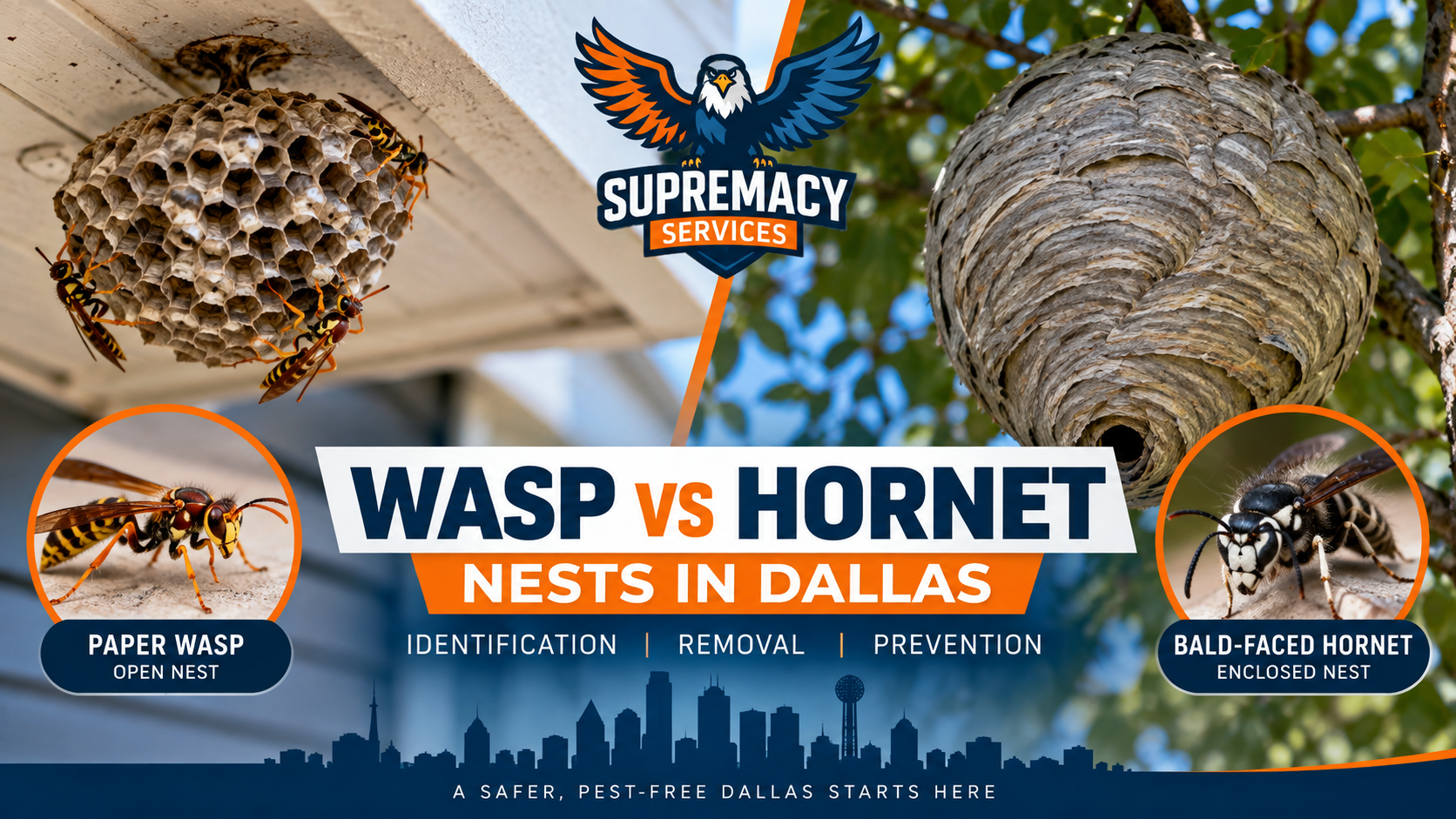
If you find a papery nest under a roof eave, hanging from a tree or tucked into another protected area around your Dallas home, the shape and location of the nest can provide important clues about whether you are dealing with paper wasps, a bald-faced hornet colony or another stinging insect.
Paper wasps commonly build exposed, umbrella-shaped combs with visible hexagonal cells. Bald-faced hornets build larger, enclosed gray or brown paper nests, usually above ground. Yellowjackets can be especially confusing because their nests are enclosed and may occur underground, inside structural voids or above ground.
Correct identification matters. Social wasps defend their colonies, and disturbing an active nest can result in multiple stings. Before spraying, knocking down or sealing a nest, identify what is living there—and whether the nest actually needs to be removed.
Table of Contents
- Wasp vs. Hornet Nests: What’s the Difference?
- What Does a Paper Wasp Nest Look Like?
- What Does a Hornet Nest Look Like?
- Could It Be a Yellowjacket Nest?
- Where Do Wasps and Hornets Build Nests Around Dallas Homes?
- Does Every Wasp or Hornet Nest Need Removal?
- Can You Remove a Wasp Nest Yourself?
- What Does Professional Nest Removal Involve?
- How Can You Help Prevent Wasp Nests?
- Frequently Asked Questions
Wasp vs. Hornet Nests: What’s the Difference?
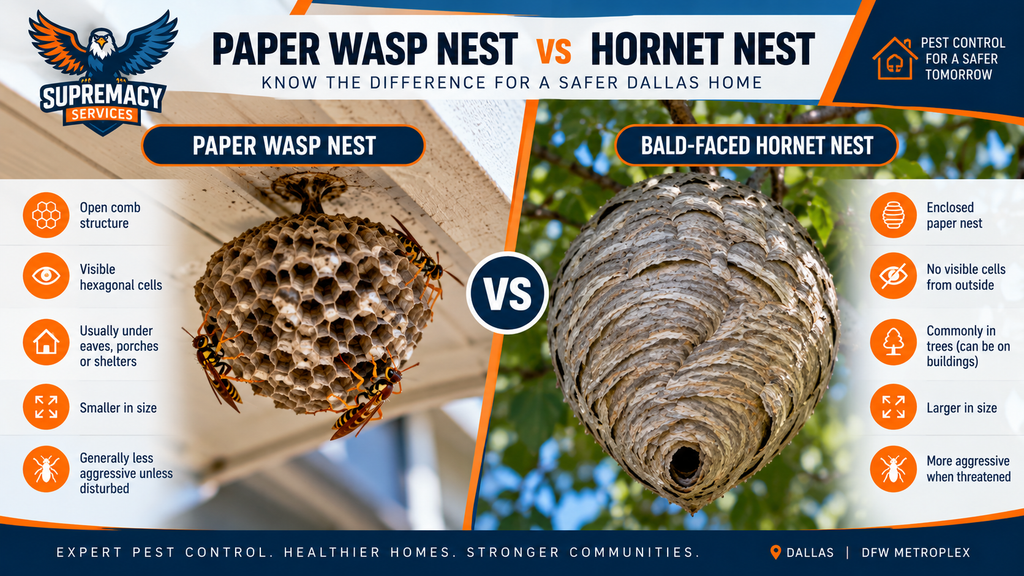
The easiest way to distinguish many common wasp vs. hornet nests is to examine the nest’s structure from a safe distance.
Paper wasps generally make an open comb, while bald-faced hornets construct an enclosed paper envelope around their combs. Nest location also helps with identification.
| Feature | Paper Wasp Nest | Bald-Faced Hornet Nest | Yellowjacket Nest |
|---|---|---|---|
| Overall shape | Umbrella-like/open comb | Rounded, oval or pear-shaped | Enclosed; shape depends on location |
| Cells visible? | Yes | No from outside | Usually no |
| Outer paper covering | No | Yes | Yes |
| Typical location | Eaves and protected structures | Trees; sometimes buildings | Often underground; also voids or protected structures |
| Typical height | Frequently attached to structures | Usually above ground | Ground level to structural/aerial sites |
| Best clue | Exposed hexagonal cells | Large enclosed paper nest | Activity around a small entrance can reveal a hidden nest |
Texas A&M AgriLife identifies paper wasps as among the most common wasps found around homes and buildings in Texas. Their nests are made from chewed wood fibers and usually consist of a single exposed tier of hexagonal cells.
One particularly useful Texas-specific fact is that the bald-faced hornet is the only insect commonly identified as a hornet reported in Texas, according to Texas A&M resources. It is actually closely related to yellowjackets.
That distinction matters because homeowners frequently use “hornet” as a general name for almost any large or intimidating wasp.
What Does a Paper Wasp Nest Look Like?
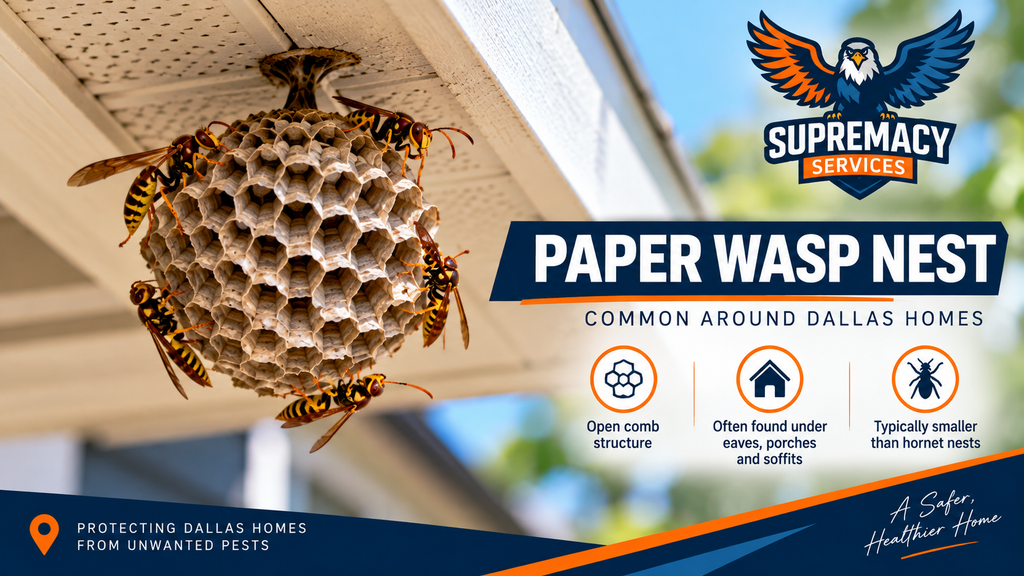
A paper wasp nest looks like a small upside-down umbrella made from paper, with exposed hexagonal cells facing downward.
Paper wasps construct the comb by chewing wood fibers into a paper-like material. The nest hangs from a single attachment point rather than being completely enclosed.
Around a Dallas-area home, look for them in protected locations such as:
- beneath roof eaves;
- porch ceilings and beams;
- garages and storage buildings;
- sheds and barns;
- protected shrubs or vegetation;
- other sheltered exterior surfaces.
The insects themselves are generally slender-bodied. Texas A&M describes common paper wasps as roughly 3/4 to 1 inch long, with colors ranging from reddish-orange to dark brown and sometimes yellow markings.
The most reliable identification clue
Do not rely on color alone.
Look at the nest architecture.
If you can see an exposed comb of individual hexagonal cells with adult wasps standing directly on it, a paper wasp colony is a strong possibility.
Why paper wasps build around houses
Roof overhangs, porch structures and similar protected locations give a developing nest shelter and a secure attachment point. This is why homeowners often first discover small nests while walking around the exterior of the house or doing seasonal maintenance.
Paper wasps are also predators of other insects. Their presence away from frequently occupied parts of the property therefore does not automatically mean they need to be eliminated.
What Does a Hornet Nest Look Like?
A bald-faced hornet nest is an enclosed, grayish or brown paper structure that can become round, oval or pear-shaped and is commonly suspended above ground.
Unlike the exposed cells of a paper wasp nest, the combs are hidden behind a protective paper envelope.
Texas A&M reports that bald-faced hornet nests are commonly found in trees, although they can occasionally be attached to buildings. The entrance is typically located toward the lower portion of the nest.
Paper wasp vs. hornet nest at a glance
Think of the difference this way:
Paper wasp: exposed umbrella-shaped comb.
Bald-faced hornet: enclosed paper shell.
If you are looking at a large enclosed nest hanging from a tree branch, do not assume it should immediately be disturbed. Texas A&M notes that nests in remote locations where they pose little threat to people may be better left alone.
The situation changes when a colony is close to a doorway, patio, children’s play area, walkway or another frequently occupied location.
Could It Be a Yellowjacket Nest?
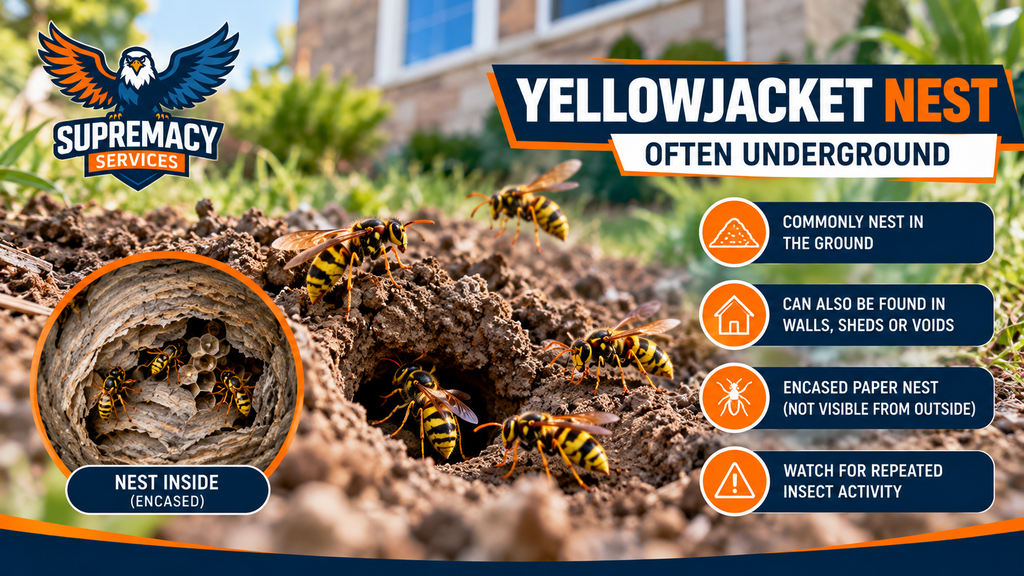
Yes. Yellowjackets are frequently mistaken for both paper wasps and hornets, and their nests may be much less obvious.
Yellowjackets construct enclosed paper nests. In Texas they frequently nest underground, but nests can also occur in trees, wall voids, garages, sheds and other protected locations.
A homeowner may therefore see repeated insect traffic without seeing the nest itself.
Watch for wasps consistently entering and leaving:
- a hole in the soil;
- a gap in siding or trim;
- an opening around a building component;
- a protected cavity;
- another small, concentrated entry point.
Do not block a suspected active structural entrance simply because insects are disappearing into it. Identification and colony management should come first.
Where Do Wasps and Hornets Build Nests Around Dallas Homes?
Around homes, social wasps generally choose locations that provide attachment, shelter and access to the surrounding environment. The exact location depends heavily on the species.
For Dallas and DFW homeowners, useful inspection points include:
Roof eaves and soffit areas
Paper wasps commonly use protected overhead surfaces. Look upward when inspecting porches, garages and rooflines rather than concentrating only on the yard.
Porch and patio structures
Covered outdoor living spaces contain beams, corners and sheltered surfaces that can provide nest sites.
Garages and sheds
Structures that remain open for part of the day can give wasps access to protected nesting locations.
Trees and shrubs
Bald-faced hornets commonly construct aerial nests in trees. Paper wasps may also use vegetation and other protected outdoor locations.
Wall and structural voids
Repeated insects entering a small opening may indicate a concealed colony rather than an exposed paper-wasp nest.
Soil and landscaped areas
Yellowjackets can nest below ground. A stream of wasps repeatedly entering a hole in the soil deserves considerably more caution than an isolated insect flying across the lawn.
Why homeowners notice more activity during the warm season
Paper wasp colonies begin when overwintered queens establish new nests in spring. Workers subsequently take over nest construction, foraging and brood care. Reproductive females are produced later in the season, while the remaining workers eventually die as the colony cycle ends.
This makes early nest detection particularly useful. A tiny developing paper-wasp nest and a mature active colony are very different situations.
Does Every Wasp or Hornet Nest Need Removal?
No. A nest does not necessarily require removal simply because it exists. Location, species, colony activity and the likelihood of human contact should guide the decision.
Many wasps are beneficial predators of other insects, and solitary wasps generally present much less defensive risk than social species.
A remote nest that people and pets are unlikely to disturb may be left alone in some circumstances.
Removal becomes much more reasonable when an active nest is:
- beside a frequently used entrance;
- under a low porch or patio;
- next to children’s outdoor areas;
- near a pool or entertainment space;
- positioned where landscaping or maintenance will disturb it;
- located inside or immediately against the structure;
- difficult to avoid during normal use of the property;
- associated with repeated wasp activity in a high-traffic area.
When identification is uncertain
Do not assume every flying yellow-and-black insect is a yellowjacket, or that every large wasp is a hornet.
If the nest cannot be safely observed from a distance—or insects appear to be entering a concealed structural space—professional identification can help determine what is actually present.
Need an active nest assessed near an entryway, roofline or outdoor living space? Supremacy Services provides [professional wasp and hornet nest removal in Dallas and DFW] for nests that require treatment and removal.
Can You Remove a Wasp Nest Yourself?
Small, accessible situations may sometimes be manageable by homeowners, but an active social-wasp nest can defend itself aggressively when disturbed. Height, nest location, colony size and allergy risk can make DIY removal unsafe.
The biggest mistake is treating nest removal as simply a matter of knocking down the paper structure.
The insects are the primary hazard.
Avoid DIY removal when:
- the nest requires climbing a ladder;
- it is high on a second-story roofline;
- the colony is large or highly active;
- insects are entering a wall or concealed cavity;
- the nest is underground and species identification is uncertain;
- people cannot stay clear of the area;
- anyone nearby has a known history of severe reactions to stings;
- you cannot identify what insect occupies the nest.
Social wasps can sting repeatedly. Disturbing a nest can also trigger defensive behavior from multiple colony members.
Never improvise pesticide use
If a pesticide is used, follow the product label. Do not exceed labeled rates or use a product in a location or manner not permitted by its directions.
For paid structural pest-control work in Texas, the Texas Department of Agriculture regulates and licenses structural pest-management businesses and applicators.
For a nest in a difficult location, the safer homeowner decision is often to keep people and pets away and arrange an inspection rather than repeatedly approaching it.
What Does Professional Wasp and Hornet Nest Removal Involve?
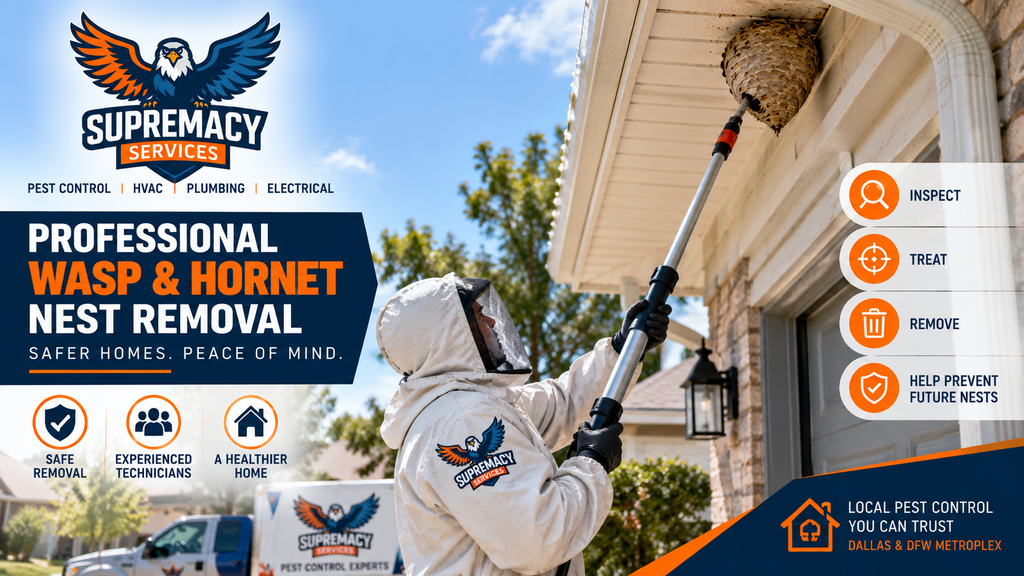
Professional service should begin with identification and inspection rather than indiscriminate spraying. The technician needs to determine the pest, nest location, activity level and safest treatment approach.
A typical service may involve:
1. Inspecting and identifying the nest
The technician determines whether the problem involves paper wasps, yellowjackets, bald-faced hornets or another insect and looks for additional activity around the property.
2. Assessing access and risk
A nest under a first-story eave presents a different problem from one high in a tree or inside a structural cavity.
3. Selecting an appropriate control method
Treatment depends on species, nest configuration, location and the pesticide label or other control method being used.
4. Managing the active colony
Where treatment is warranted, the objective is to address the active insects safely before physical nest removal is attempted.
5. Removing accessible nest material where appropriate
For exposed nests, physical removal may follow once activity has been controlled.
6. Looking for conditions that encourage repeat nesting
Eaves, protected corners, openings and recurring nest sites can be identified during the inspection.
Supremacy’s dedicated Wasp & Hornet Nest Removal service describes its process as inspection, targeted colony treatment, physical nest removal and preventive attention to the affected area.
If you are seeing concentrated wasp traffic or have found an active nest in a high-risk location, request a [wasp and hornet nest inspection and removal service] rather than attempting to reach it from a ladder.
How Much Does Wasp or Hornet Nest Removal Cost in Dallas?
There is no responsible single Dallas price that applies to every wasp or hornet nest. The scope depends on the species, nest location, accessibility, activity and treatment required.
Rather than publishing an unsupported price range, homeowners should expect the estimate to consider factors such as:
| Cost factor | Why it matters |
|---|---|
| Nest location | High or difficult-to-access nests can require different equipment |
| Exposed vs. concealed | Wall-void nests can require a different approach from an exposed comb |
| Species | Nesting behavior and treatment strategy differ |
| Colony activity | A small developing nest differs from a mature colony |
| Number of nests | Multiple active areas expand inspection and treatment scope |
| Structural access | Rooflines, soffits and enclosed cavities can complicate access |
| Follow-up/prevention | Additional preventive work may affect service scope |
How Can You Help Prevent Wasp Nests Around Your Home?
Wasp prevention works best when homeowners detect new nest construction early, reduce attractive nesting opportunities and correct accessible exterior gaps where appropriate.
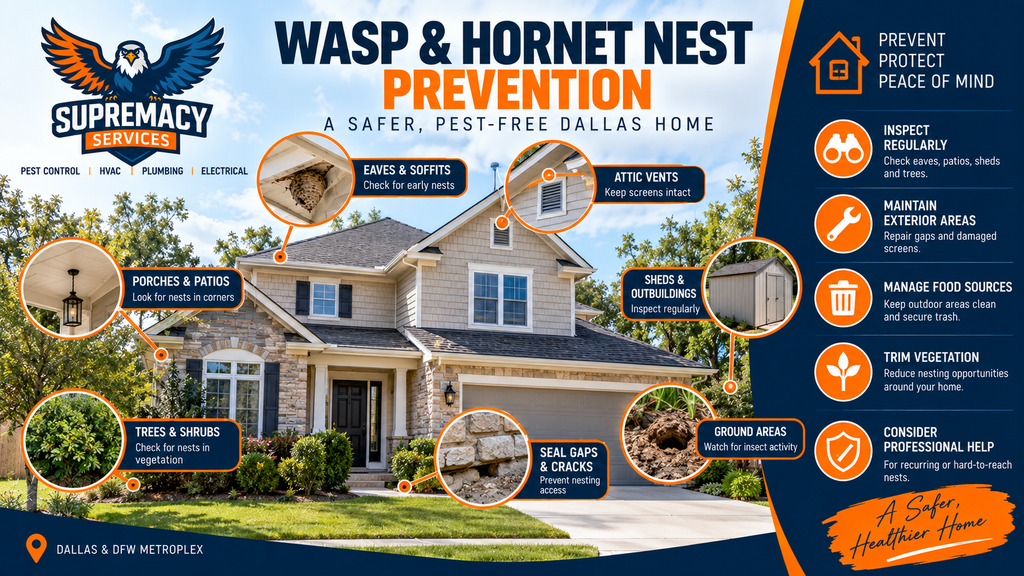
Inspect protected areas periodically
Check:
- eaves;
- porch ceilings;
- patio beams;
- sheds;
- garages;
- play structures;
- exterior fixtures;
- shrubs near occupied areas.
A developing nest is easier to recognize before it becomes heavily populated.
Watch for repeated flight patterns
A single wasp feeding on flowers is not evidence of a nest.
Multiple insects repeatedly traveling to the same eave, opening, tree or ground hole are much more informative.
Address appropriate exterior gaps
After confirming that an opening does not contain an active colony, repair suitable gaps and openings that provide access to protected structural spaces.
Manage outdoor food and waste
Yellowjackets can scavenge around human food and waste. Keep outdoor garbage properly contained and clean food residues around patios and gathering areas.
Include rooflines in routine pest inspections
Supremacy’s perimeter pest-control process already includes exterior inspection and web/nest sweeping around areas such as eaves and window sills. This creates a useful internal connection between routine exterior pest management and early detection of developing nests.
For homeowners who repeatedly find small nests around eaves and exterior living areas, [perimeter pest control in Dallas] can be discussed as part of a broader exterior pest-management strategy rather than as a substitute for treatment of a mature active nest.
Wasp, Hornet or Bee? Don’t Treat Them as the Same Pest
A common identification mistake is assuming that any stinging insect around a house should be treated the same way.
Wasps and bees are different groups, and nest management decisions can differ substantially.
Likewise, solitary wasps such as mud daubers do not behave like highly defensive social colonies. Texas A&M notes that many solitary wasps rarely sting people and are beneficial predators.
Before deciding on treatment, answer three questions:
- What insect is it?
- Where is the nest?
- Does its location create a realistic risk to people or pets?
Those questions are more useful than reacting to the insect’s size or color alone.
Quick Homeowner Checklist: What to Do When You Find a Nest
Found a suspected wasp or hornet nest?
- Keep children and pets away.
- Observe it only from a safe distance.
- Note whether the cells are exposed or enclosed.
- Look at where the nest is located.
- Watch for a concentrated entrance if the nest itself is hidden.
- Do not shake, strike or deliberately disturb an active nest.
- Avoid ladder-based removal around active insects.
- Decide whether its location actually requires control.
- If identification or safe access is uncertain, contact a licensed pest professional.
Frequently Asked Questions
What is the easiest way to tell a wasp nest from a hornet nest?
Look at the structure. Paper wasps typically build an exposed umbrella-like comb with visible hexagonal cells. Bald-faced hornets construct an enclosed gray or brown paper nest, commonly above ground.
Are there true hornets in Dallas?
Texas A&M describes the bald-faced hornet as the only “hornet” reported in Texas, although biologically it belongs to the yellowjacket group. The word “hornet” is commonly used more broadly for several types of wasps.
What kind of wasp builds nests under house eaves?
Paper wasps commonly build their exposed paper combs under eaves and in other sheltered areas around buildings. Identification should still be based on the insect and nest rather than location alone.
What insect makes a large paper nest hanging from a tree?
A large enclosed gray or brown paper nest suspended in a tree may belong to bald-faced hornets. Avoid approaching an active nest merely to confirm the identification.
Are yellowjacket nests always underground?
No. Yellowjackets commonly nest underground, but Texas A&M also documents nests in aerial locations, wall voids, garages, sheds and other protected areas.
Will wasps reuse an old paper-wasp nest?
Texas A&M reports that paper-wasp colonies die off and their abandoned nests are not reused by a new colony the following year. However, suitable protected locations can still attract new nest construction.
Should I knock down a small wasp nest?
Do not knock down an occupied nest without considering the insects present, your distance from the colony and whether the nest can be approached safely. Disturbing social wasps can provoke defensive stinging.
When should I call a professional for a wasp nest?
Professional help is particularly appropriate when a nest is high, concealed, difficult to access, close to frequently occupied areas, highly active or cannot be confidently identified.
How can I keep wasps from nesting under my eaves?
Regularly inspect sheltered exterior areas, identify developing nests early and address appropriate gaps after confirming they are not being used by an active colony. Routine exterior pest inspections can also help identify developing activity.
Regularly inspect sheltered exterior areas, identify developing nests early and address appropriate gaps after confirming they are not being used by an active colony. Routine exterior pest inspections can also help identify developing activity.
Need Help With an Active Wasp or Hornet Nest in Dallas?
Knowing the difference between a paper wasp nest, bald-faced hornet nest and yellowjacket colony can help you make a safer decision about what to do next.
An isolated nest far from people may not require immediate control. A colony beside a doorway, patio, play area or frequently used part of your home is a different situation—especially when the nest is high, concealed or difficult to identify.
For an active nest that needs professional attention, contact Supremacy Services for [wasp and hornet nest removal in Dallas and the DFW Metroplex]. A technician can identify the stinging insect, inspect the nesting location and recommend the appropriate treatment and removal approach.

