
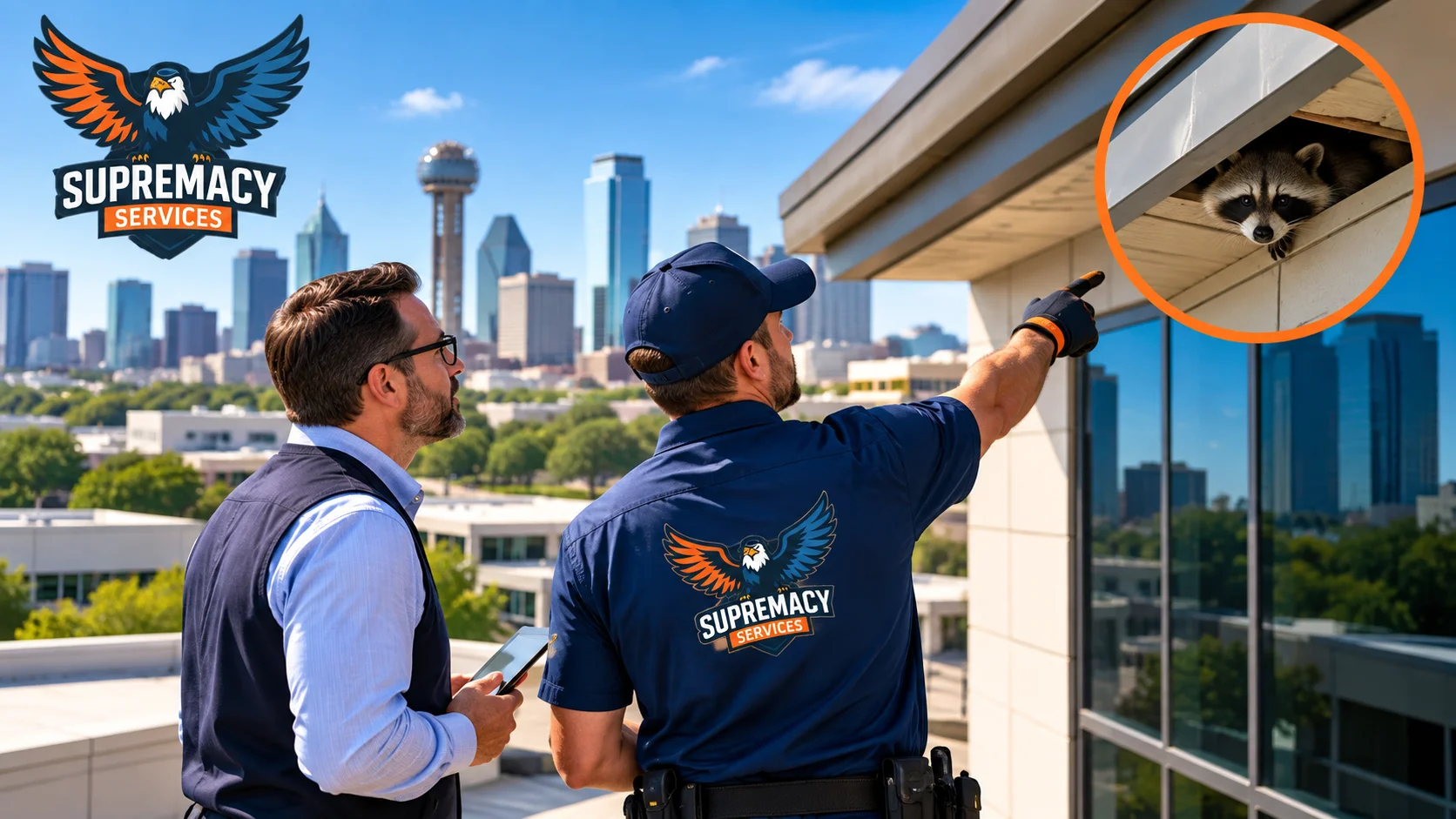
Wildlife inside an apartment community, office, warehouse, retail center or other commercial property is more than an inconvenient animal sighting. Property managers may need to determine where the animal entered, whether people or pets have been exposed, whether the building has been damaged and how the entry point can be corrected without creating another problem.
Professional commercial wildlife removal in Dallas should therefore be approached as a property-management problem rather than simply a trapping job. Depending on the species and situation, the response can involve inspection, appropriate removal or exclusion, identification of entry points, contamination assessment and structural prevention.
Texas rules also matter. Different wildlife species are subject to different requirements, and Texas maintains specific restrictions on the transportation of several animals associated with rabies risk.
For a property manager, the objective is straightforward: resolve the immediate wildlife problem while identifying why the building became accessible in the first place.
Table of Contents
- What Is Commercial Wildlife Removal?
- Why Wildlife Problems Matter to Property Managers
- Common Wildlife Problems in Dallas Commercial Properties
- Warning Signs Property Managers Should Investigate
- What to Do When Wildlife Is Reported
- What Professional Wildlife Removal Includes
- Trapping vs. Exclusion
- DIY vs. Professional Wildlife Removal
- Texas Wildlife Rules Property Managers Should Know
- How to Prevent Wildlife Problems
- Choosing a Wildlife Removal Provider
- Frequently Asked Questions
What Is Commercial Wildlife Removal?
Commercial wildlife removal is the process of identifying, controlling and preventing nuisance wildlife activity at a business, apartment community, managed property or other non-residential facility.
The important distinction is that effective wildlife management does not end when an animal disappears.
A commercial response may need to answer five separate questions:
- What species is involved?
- Where is it entering?
- Is an animal currently inside?
- Has it damaged or contaminated part of the building?
- What building correction will reduce the likelihood of recurrence?
That last question is particularly important for property managers responsible for multiple buildings or recurring maintenance calls.
A raccoon removed from an attic, for example, does not repair the opening that allowed it into the structure.
Dealing with wildlife inside a managed property? Explore Supremacy Services’ professional wildlife trapping and removal options for Dallas and the DFW Metroplex.
Why Wildlife Problems Matter to Property Managers
A wildlife complaint should be investigated according to its actual risk rather than treated automatically as an ordinary pest-control ticket.
Building damage
Animals can exploit or enlarge vulnerable building openings around soffits, vents, roof edges and other penetrations.
Once access is established, the immediate removal problem and the building-envelope problem become two separate maintenance issues.
Tenant and customer concerns
A scratching sound above an apartment ceiling may initially affect one tenant.
An animal appearing in a common hallway, customer area or occupied office is a different situation and may require a faster response.
The property’s response procedure should therefore distinguish between:
- wildlife observed outdoors;
- noises inside a wall or ceiling;
- animals in unoccupied service areas;
- animals inside occupied spaces;
- possible human or pet contact.
Contamination
Nesting material, feces, urine and animal remains can create cleanup concerns in attics, roof cavities and other concealed areas.
Property managers should avoid assuming that removing an animal automatically resolves contamination associated with the infestation.
Recurring maintenance costs
Repeated trapping without correcting accessible entry points can leave a property vulnerable to additional wildlife.
That makes exclusion an important part of long-term wildlife management.
Common Wildlife Problems in Dallas Commercial Properties
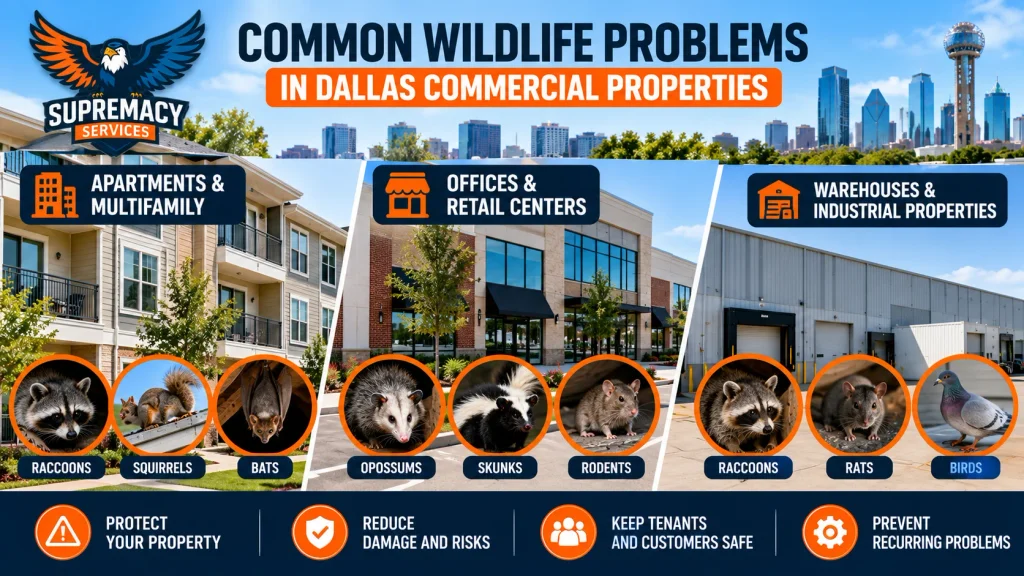
Different species require different responses. Identification should come before trapping, exclusion or structural repairs.
| Wildlife | Common property concern | Areas worth inspecting |
|---|---|---|
| Raccoons | Entry into roof/attic areas, disturbance around waste | Roof edges, vents, soffits, dumpsters |
| Squirrels | Activity in attic/roof cavities | Rooflines, vents, tree-adjacent areas |
| Opossums | Shelter beneath or around structures | Crawlspaces, decks, service areas |
| Bats | Roosting in structural openings | Rooflines, gaps and upper building areas |
| Skunks | Denning and odor complaints | Ground-level voids and sheltered exterior areas |
| Rodents | Interior activity and structural entry | Utility penetrations, doors, roofs and service areas |
This table is a diagnostic starting point, not a species-identification substitute.
Apartments and multifamily communities
Multifamily properties add complexity because complaints may originate from one unit even though the access point is elsewhere.
Managers may need to coordinate access to occupied units, attics, utility spaces, roofs and exterior areas.
Warehouses and distribution properties
Large exterior perimeters, loading areas and utility penetrations create many locations that may require inspection.
Wildlife management should be coordinated with broader rodent and pest prevention where appropriate.
Offices and retail centers
Suspended ceilings, roof penetrations and shared structural spaces can make the location of an animal difficult to determine from the complaint alone.
In multi-tenant buildings, documenting exactly where noises or sightings occur can make inspection substantially more efficient.
Restaurants and food-service properties
Waste areas and exterior food sources deserve particular attention.
Wildlife activity should also be distinguished from conventional rodent or insect problems requiring a commercial pest-management program.
Warning Signs Property Managers Should Investigate
Repeated noises, droppings, damaged exterior openings, strong unexplained odors and direct wildlife sightings are all reasons to investigate a commercial property.
Look for:
- scratching, movement or thumping above ceilings;
- recurring tenant reports from the same building area;
- droppings in attics or mechanical spaces;
- nesting material;
- damaged vents or screening;
- gaps around roof edges or soffits;
- disturbed insulation;
- animal tracks around service areas;
- persistent unexplained odors;
- repeated activity around dumpsters;
- visible wildlife entering or leaving a structural opening.
The location and timing of observations can help narrow the inspection.
For example, a manager should document whether noises occur during daylight or overnight, which floor is affected and whether the complaint is near a roof, exterior wall or utility area.
What Should a Property Manager Do When Wildlife Is Reported?
First isolate the immediate risk, document what was observed and avoid handling the animal. Then determine whether there has been human or pet contact before arranging appropriate professional inspection or animal-control assistance.
Step 1: Document the report
Record:
- building and unit/suite;
- date and time;
- animal description if observed;
- location;
- photographs or video when safely available;
- sounds reported;
- known entry point;
- possible contact with a person or pet.
This gives the wildlife professional considerably more useful information than a work order that simply says “animal in attic.”
Step 2: Keep people away from the animal
Do not encourage maintenance staff or tenants to capture wildlife by hand.
Texas DSHS advises people not to handle wildlife, whether it appears healthy or sick.
Step 3: Treat possible exposure differently
A wildlife sighting and an animal bite are not equivalent maintenance events.
If a person may have been bitten or exposed to saliva from a potentially rabid animal, follow public-health guidance rather than treating the event solely as a wildlife-removal call.
Texas DSHS advises washing a bite thoroughly with soap and water and obtaining medical advice promptly.
Step 4: Identify the species and access point
Species identification affects both the appropriate control strategy and the rules that may apply.
Step 5: Do not prematurely seal an active opening
An opening should not simply be closed without determining whether animals remain inside and whether dependent young could be present.
This is particularly important with bats. TPWD currently discourages bat exclusion from May 1 through August 15 because young bats may be unable to fly and can become trapped.
Step 6: Correct the building vulnerability
Once removal or exclusion is appropriately completed, address the structural condition that provided access.
That converts a reactive wildlife call into preventive property maintenance.
What Does Professional Commercial Wildlife Removal Include?
A professional wildlife-control visit should begin with inspection and identification before a removal method is selected.
The exact scope depends on the species and property, but a comprehensive process may involve:
1. Property inspection
The technician investigates reported activity and potential entry locations.
2. Species identification
Treatment decisions should be based on the actual animal involved rather than assumptions from noises alone.
3. Entry-point assessment
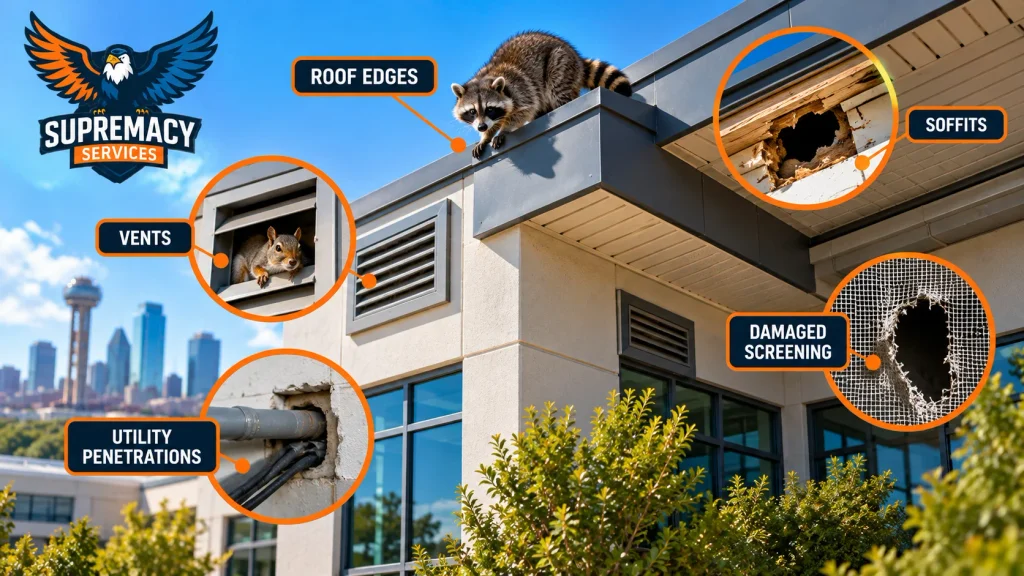
Likely vulnerabilities may include vents, roof transitions, damaged screening, soffits and utility penetrations.
4. Removal or exclusion strategy
The appropriate technique varies by species, building and applicable regulations.
5. Follow-up inspection
The property may require confirmation that activity has stopped before final repairs are completed.
6. Entry sealing and prevention
Structural vulnerabilities are addressed where appropriate so the property is less accessible to future animals.
7. Contamination assessment
If nesting or waste is present, cleanup requirements can be evaluated separately from removal.
Supremacy’s existing wildlife service page describes its process as including trapping/removal, cleanup of nesting messes and exterior entry sealing.
Managing an apartment community, office, retail property or other DFW facility? Request a wildlife inspection to identify the animal, entry points and appropriate removal or exclusion strategy.
Wildlife Trapping vs. Exclusion: What Is the Difference?
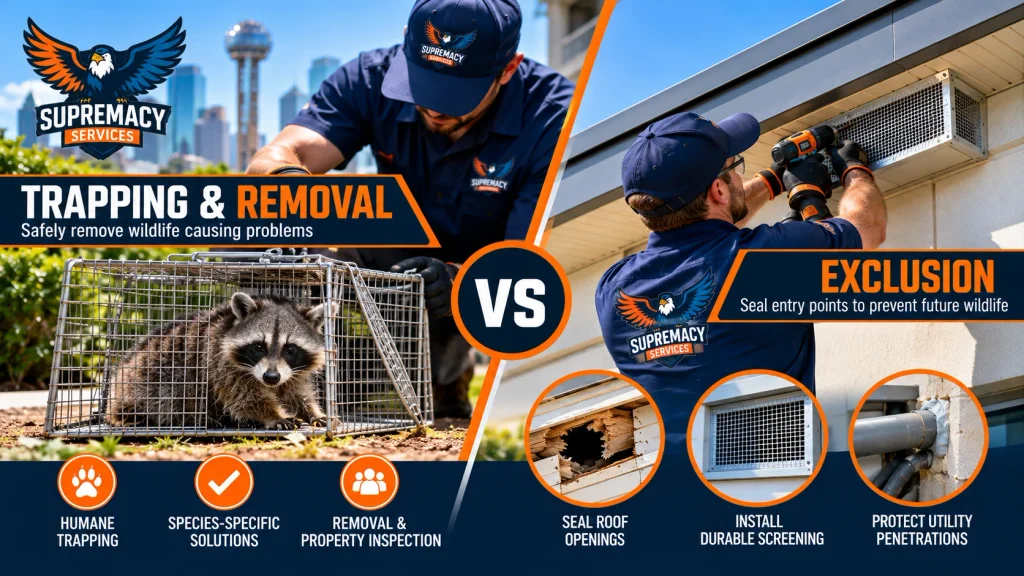
Trapping addresses an animal; exclusion addresses access to the building. A commercial wildlife plan may require one or both depending on the species and circumstances.
| Trapping/removal | Exclusion |
|---|---|
| Addresses wildlife currently present | Addresses how wildlife enters |
| Species-specific | Building-focused |
| May require monitoring/follow-up | May involve sealing or screening |
| Subject to wildlife rules | Primarily preventive |
| Does not inherently repair an opening | Designed to reduce future access |
This distinction is especially important for property managers comparing contractor proposals.
A bid for “animal removal” and a bid for “removal + exclusion + cleanup” may describe very different scopes of work.
What Affects Commercial Wildlife Removal Cost?
There is no responsible single Dallas price that applies to every commercial wildlife problem.
Pricing can depend on:
- species;
- number of animals;
- building size and complexity;
- height and roof access;
- location of the animal;
- number of entry points;
- trapping or exclusion method;
- required follow-up;
- contamination;
- structural repairs;
- number of buildings;
- after-hours or operational constraints.
For property managers, the better procurement question is therefore not simply “How much per animal?”
Ask what the quote actually includes.
Commercial wildlife proposal checklist
| Question | Why it matters |
|---|---|
| What species was identified? | Determines appropriate response |
| Where is the entry point? | Helps prevent recurrence |
| Is trapping or exclusion proposed? | Clarifies methodology |
| How many follow-up visits are included? | Affects total scope |
| Is entry sealing included? | Removal alone may leave access |
| Is cleanup included? | Contamination may be separate |
| Are structural repairs included? | Avoids comparing unequal quotes |
| How will occupied areas be handled? | Important for tenant operations |
| What documentation is provided? | Useful for property records |
| Are applicable wildlife rules considered? | Species requirements differ |
DIY vs. Professional Wildlife Removal for Commercial Properties
Property staff can perform prevention and documentation, but capture, handling and relocation should not be improvised when wildlife regulations, potential rabies exposure or occupied-building risks are involved.
Maintenance teams can appropriately help by:
- documenting sightings;
- inspecting obvious building damage;
- securing waste;
- correcting sanitation conditions;
- keeping exterior doors closed;
- repairing routine building-envelope defects once appropriate;
- trimming vegetation where property policy permits;
- reporting new activity.
The risk increases when staff attempt to:
- grab or corner an animal;
- handle bats;
- relocate trapped wildlife without understanding transport rules;
- seal an opening while animals remain inside;
- work around potentially contaminated nesting areas without appropriate precautions.
For a commercial property, professional assistance becomes especially appropriate when wildlife is inside occupied areas, the species is uncertain, there is potential human/pet exposure, activity keeps recurring or the access point cannot be identified.
Texas Wildlife Rules Dallas Property Managers Should Know
Wildlife removal in Texas is species-specific. Property managers should not assume that every nuisance animal can simply be trapped and driven somewhere else.
Raccoons, skunks, foxes and coyotes
Texas DSHS maintains statewide transport restrictions on live raccoons, foxes, skunks and coyotes because of rabies concerns. The state identifies specific exemptions, including certain appropriately licensed pest-management professionals and authorized entities. Release under an applicable exemption is also geographically restricted.
That makes “we’ll catch it and release it somewhere else” an inadequate property-management plan unless the person handling the animal is operating within applicable requirements.
Bats
Bats have specific protections and considerations under Texas wildlife regulations. TPWD states that bats generally may not be hunted, killed or possessed, while providing exceptions involving bats inside or on human-occupied buildings. TPWD also discourages building exclusion between May 1 and August 15 because non-flying young may become trapped.
Rabies exposure
Texas DSHS identifies bats, coyotes, foxes, raccoons and skunks among wildlife of particular rabies concern and advises against handling wild animals.
Property managers should establish a clear escalation procedure for suspected bites or exposures instead of treating these incidents as routine maintenance tickets.
Important: Wildlife regulations can change and circumstances differ by species. Verify current TPWD/DSHS requirements for the animal and situation rather than relying solely on a general property policy.
Wildlife Removal vs. Rodent Control vs. Commercial Pest Control
Not every scratching noise requires the same contractor scope.
| Problem | Primary service |
|---|---|
| Raccoon in attic | Wildlife removal/exclusion |
| Squirrel entering roof | Wildlife removal/exclusion |
| Bat colony/entry | Species-appropriate wildlife exclusion |
| Rats inside warehouse | Rodent control and exclusion |
| Cockroaches in break room | Commercial pest management |
| Ants around building perimeter | Pest-control program |
| Wildlife repeatedly exploiting structural opening | Wildlife exclusion/building correction |
How Can Property Managers Prevent Wildlife Problems?
Wildlife prevention focuses on reducing access, shelter and attractants around the property.
Inspect rooflines
Include vents, roof transitions, soffits and visible exterior openings in routine building inspections.
Maintain waste areas
Keep dumpster and waste-management areas appropriately maintained and address recurring spillage.
Check utility penetrations
Inspect areas where pipes, cables and mechanical services pass through exterior walls.
Maintain doors and loading areas
Large commercial doors and loading areas should close correctly when operations allow.
Manage landscaping
Vegetation should not unnecessarily obstruct inspection of the building perimeter or create easy pathways to vulnerable areas.
Document previous wildlife incidents
Keep records of:
- species;
- building;
- entry point;
- corrective work;
- dates;
- recurring complaints.
For multi-property managers, those records can reveal patterns that isolated work orders do not.
A Practical Wildlife Response Plan for Property Managers
A standardized procedure makes wildlife calls easier for maintenance, tenants and vendors.
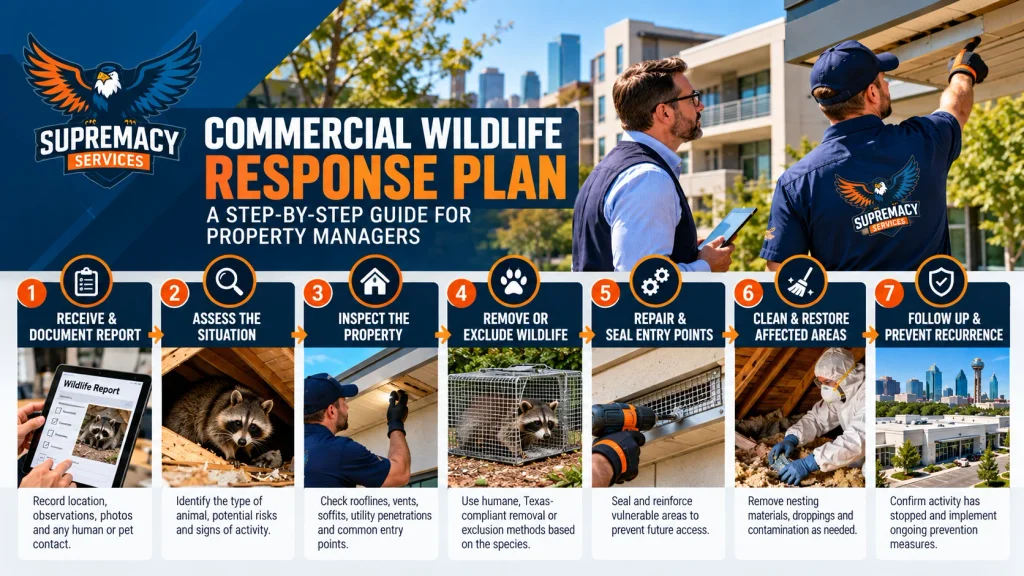
Report → Assess exposure → Document → Identify → Inspect → Remove/exclude → Repair → Verify → Record
A work-order template might capture:
| Field | Record |
|---|---|
| Property/building | Exact location |
| Unit/suite | If applicable |
| Date/time | When activity occurred |
| Animal description | Species if confirmed |
| Photo/video | If safely obtained |
| Human/pet contact | Yes / No / Unknown |
| Interior location | Ceiling, attic, office, etc. |
| Suspected entry | Location |
| Vendor findings | Diagnosis |
| Removal method | Documented response |
| Exclusion repairs | Completed/pending |
| Follow-up | Date/result |
That is far more useful operationally than repeatedly creating generic “wildlife problem” work orders.
How Should Property Managers Choose a Wildlife Removal Company?
Evaluate the scope and process, not merely the initial trapping charge.
Ask prospective providers:
- How will you identify the species?
- Will you inspect for entry points?
- Is exclusion included?
- How are follow-up visits handled?
- How will you work around tenants or customers?
- What happens if dependent young are present?
- How is contamination handled?
- Which structural repairs are included?
- What documentation will management receive?
- How do you comply with species-specific Texas requirements?
Supremacy already positions its commercial pest program around customized planning, discreet scheduling and reporting, while its wildlife page emphasizes removal plus entry sealing. Those existing pages make appropriate conversion destinations from this guide rather than duplicating their sales content here.
When Should a Dallas Property Manager Call for Wildlife Removal?
Arrange professional assessment when:
- an animal is inside an occupied building;
- repeated noises suggest animals inside ceilings or walls;
- wildlife repeatedly enters the same structure;
- roof or exterior damage suggests an entry point;
- tenants repeatedly report wildlife activity;
- an animal appears trapped or inaccessible;
- the species cannot be confidently identified;
- bats are inside or roosting in the structure;
- contamination is present;
- a bite or potential exposure has occurred.
Possible human or pet exposure should be handled according to appropriate public-health/animal-control guidance, not merely scheduled as an ordinary service appointment.
Frequently Asked Questions
What is commercial wildlife removal?
Commercial wildlife removal identifies and addresses nuisance wildlife at apartments, offices, warehouses, retail properties and other managed facilities. Effective service may combine inspection, removal or exclusion, entry-point identification and preventive repairs.
What animals commonly require wildlife removal from commercial buildings?
Problems can involve raccoons, squirrels, opossums, bats, skunks and other wildlife. Rats and mice are normally handled through rodent-control and exclusion programs rather than being treated identically to larger wildlife.
Can a Dallas property manager relocate a trapped raccoon?
Do not assume that a trapped raccoon can simply be transported elsewhere. Texas maintains statewide restrictions on transporting live raccoons and several other rabies-risk species, with specified exemptions and conditions.
Should maintenance staff remove a bat?
Staff should avoid handling bats directly. Texas has species-specific rules for bats, and possible human exposure also raises public-health considerations.
Can you seal a wildlife entry hole immediately?
Not necessarily. First determine whether animals remain inside and whether dependent young may be present. Premature sealing can trap animals within the structure.
What’s the difference between wildlife removal and wildlife exclusion?
Removal addresses the animal currently creating the problem. Exclusion addresses structural access points so animals are less likely to enter again.
Does commercial wildlife removal include repairs?
That depends on the contractor and proposal. Property managers should specifically determine whether trapping/removal, exclusion, cleanup and structural repairs are included or quoted separately.
How can apartment managers prevent recurring wildlife problems?
Track previous entry points, maintain rooflines and exterior openings, manage waste areas, inspect utility penetrations and correct structural access after wildlife activity is resolved.
Is commercial wildlife removal the same as commercial pest control?
No. They can overlap, but wildlife management often involves species-specific trapping or exclusion and building repairs, while conventional commercial pest management typically addresses insects and rodents through monitoring, sanitation, exclusion and targeted controls.
Get Commercial Wildlife Help in Dallas & DFW
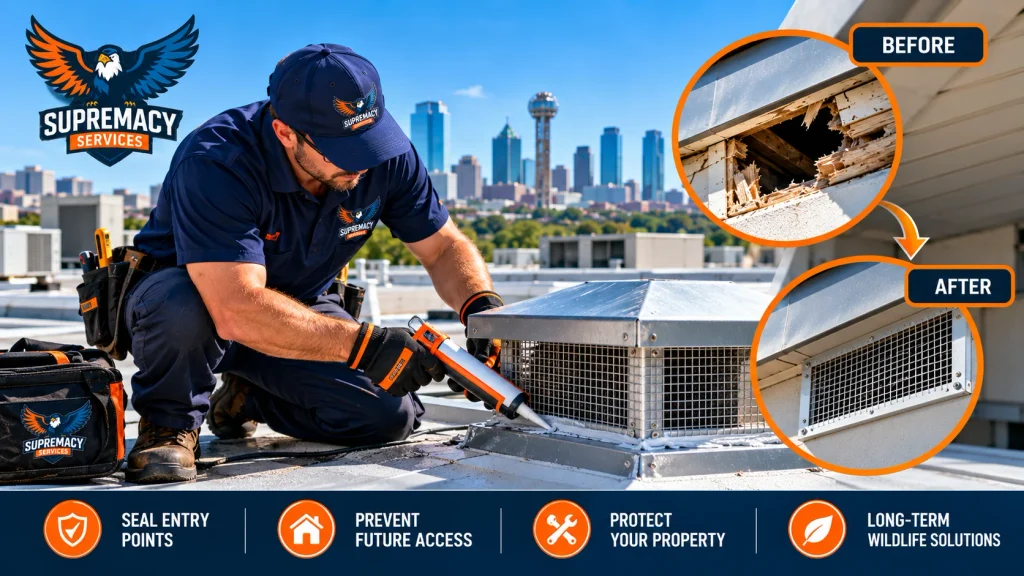
Wildlife management is most effective when the property manager solves both sides of the problem: the animal currently creating the complaint and the building condition that allowed access.
If you manage apartments, offices, retail properties, warehouses or other commercial facilities in Dallas or across the DFW Metroplex, Supremacy Services can inspect the property, identify wildlife activity and determine an appropriate removal and exclusion strategy.

