10400 Clarence Drive, Frisco, TX 75033
Support 24/7: 945-777-3345
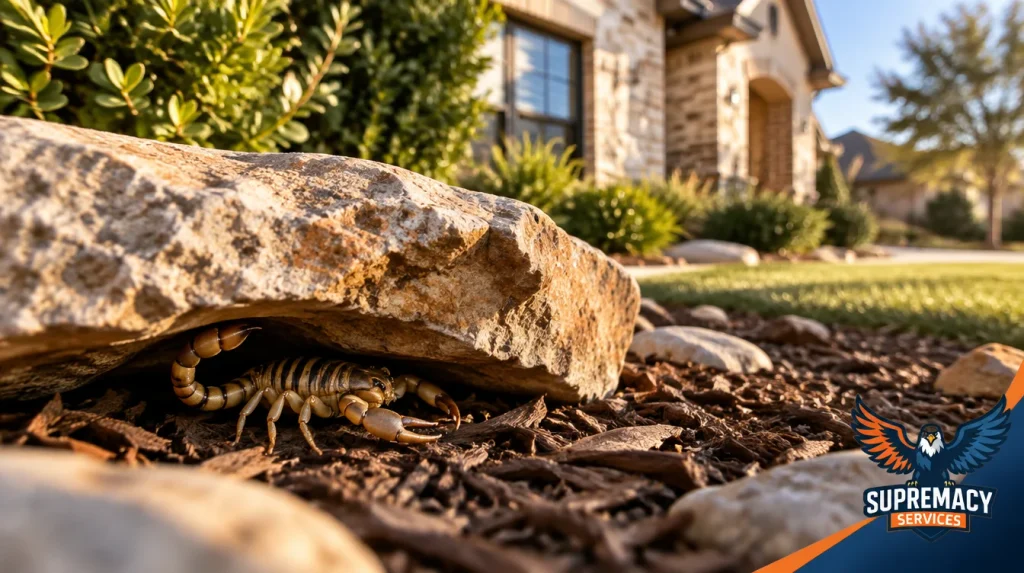
Striped bark scorpion hiding beneath a landscaping stone beside a North Texas home

Where Do Scorpions Hide Around North Texas Homes?

Scorpions around North Texas homes usually hide in dark, protected, relatively undisturbed spaces during the day. Outdoors, that can mean beneath rocks, boards, firewood, landscape debris and other objects lying on the ground. Around the structure, inspect garages, foundation edges, cracks, storage areas and sheltered landscaping. Indoors, scorpions may turn up in attics, closets, garages and other quiet spaces.

Texas A&M AgriLife reports that scorpions are nocturnal and that their flattened bodies allow them to shelter in small cracks and beneath stones, bark, wood and other objects. The striped bark scorpion—one of the scorpions North Texas homeowners may encounter—is also capable of climbing trees and walls and may occur in attics.

The practical takeaway for Dallas-Fort Worth homeowners is simple: don’t inspect only the room where you found the scorpion. Start outside and work toward the house.

Table of Contents

  1. Why Scorpions Hide During the Day
  2. Where Scorpions Hide Outside
  3. Where Scorpions Hide Around the Structure
  4. Where Scorpions Hide Inside
  5. Why Scorpions Hide in Garages
  6. Can Scorpions Hide in Attics?
  7. How to Inspect Your Property
  8. What Makes a Hiding Place Attractive?
  9. How to Reduce Scorpion Hiding Places
  10. DIY vs. Professional Control
  11. North Texas Considerations
  12. FAQs

Why Do Scorpions Hide During the Day?

Scorpions are primarily nocturnal, so they typically spend daylight hours in protected hiding places and become more active after dark.

Texas A&M AgriLife explains that hiding during the day helps scorpions manage temperature and water balance. Their relatively flat bodies also make narrow cracks and spaces beneath objects useful shelter.

That behavior explains an experience familiar to many homeowners: you may see no scorpions during a daytime walk around the property, then discover one crossing the garage or patio later that night.

Rather than looking only for visible scorpions, look for potential harborage—the protected places where one could spend the day.

Where Do Scorpions Hide Outside?
Scorpion hiding near rocks, firewood and yard debris outside a North Texas home
Rocks, firewood, boards and other sheltered areas can provide daytime hiding places for scorpions.

For a North Texas home, the outdoor inspection should generally come first.

Texas A&M specifically identifies rocks, boards, debris, dead vegetation and fallen logs as locations associated with striped bark scorpions. Its management guidance also recommends removing trash, logs, boards, stones, bricks and similar objects from around structures.

1. Under rocks and landscape stones

Decorative stone can create narrow, shaded spaces at ground level.

Pay particular attention to:

  • loose landscape rocks;
  • stones bordering flower beds;
  • stacked stone;
  • objects resting directly on soil;
  • gaps within retaining or decorative walls.

The goal isn’t to eliminate every rock from a landscaped property. It is to recognize that protected gaps near the house deserve more attention than exposed, frequently disturbed ground.

2. Beneath boards, lumber and construction materials

A board sitting undisturbed against the ground creates exactly the kind of covered space worth checking.

Inspect unused lumber, fence materials, leftover construction supplies and stacked boards—especially when they are stored close to the structure.

3. In and around firewood

Firewood deserves special attention because pieces of wood create numerous protected gaps.

Texas A&M advises against bringing firewood indoors unless it is going directly onto the fire.

For homeowners, that means stored firewood should be treated as a potential pest-harboring material rather than ordinary indoor storage.

4. Under yard debris

Dead vegetation, discarded materials and other undisturbed debris can provide cover.

Reducing unnecessary clutter around the perimeter makes the property easier to inspect and removes potential shelter—not only for scorpions but also for some of the arthropods they prey on.

5. Around vegetation touching the home

Vegetation itself does not prove scorpions are present, but dense, protected areas can make inspection more difficult.

Texas A&M recommends keeping grass near structures mowed and pruning bushes and overhanging tree branches away from buildings. It specifically notes that branches can provide scorpions with a route toward the roof.


Where Do Scorpions Hide Around the Structure?
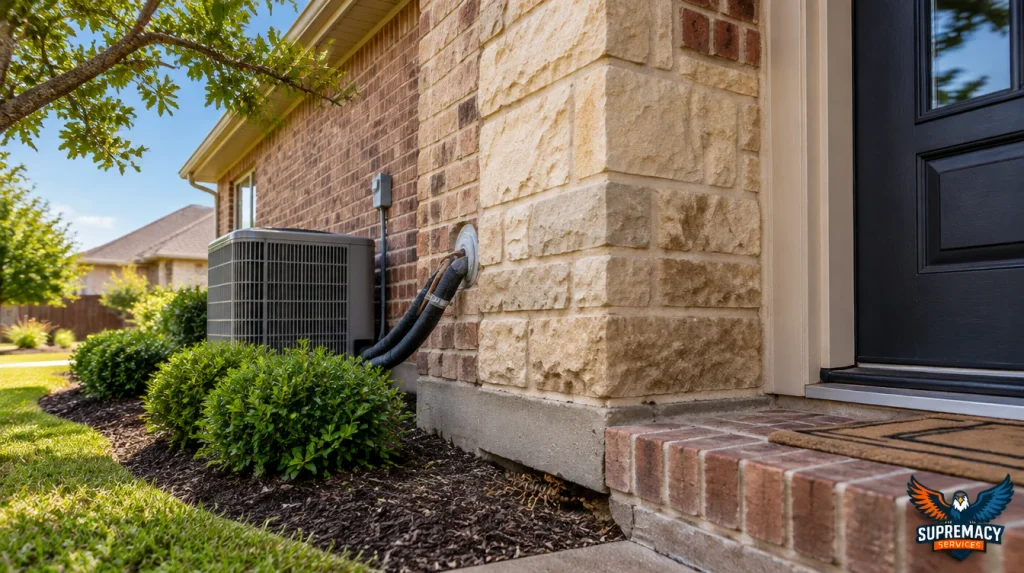
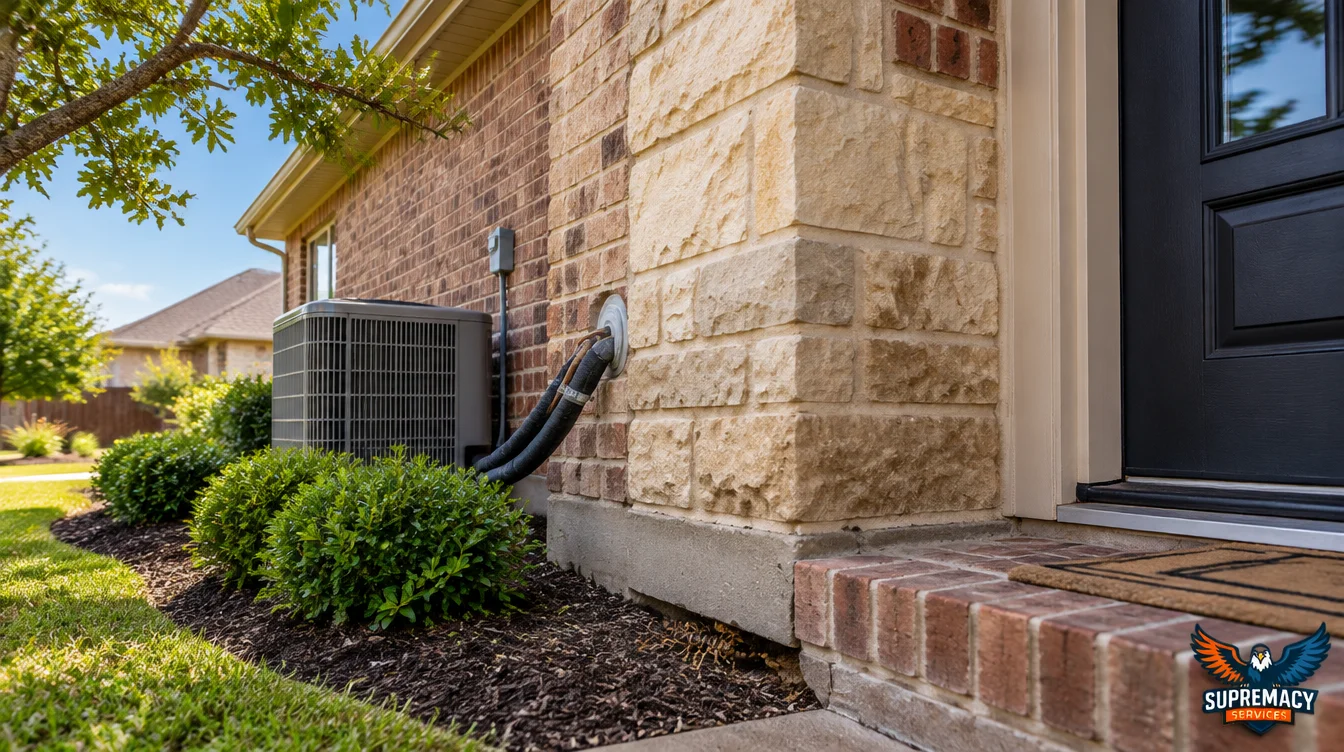
North Texas home exterior showing foundation cracks and common scorpion entry areas
Small gaps around foundations, doors and utility penetrations can give scorpions pathways into a home.

Once the yard has been checked, move inward toward the building.

Foundation edges and structural gaps

Inspect protected joints and cracks around the foundation and exterior walls.

Scorpions can use small crevices for shelter, and those same openings may become pathways toward the interior.

Door thresholds

Exterior doors—and especially the transition between an attached garage and outdoors—deserve close inspection.

Look for:

  • visible daylight under doors;
  • deteriorated sweeps;
  • gaps at corners;
  • damaged weatherstripping;
  • cracks adjacent to the frame.

Utility penetrations

Air-conditioning lines, plumbing, electrical conduit and other services pass through the exterior envelope.

The objective isn’t to seal openings blindly. Instead, identify inappropriate gaps around penetrations that could provide pest access and determine the correct material or repair for that building component.

Brick and stone veneer

Gaps and crevices around masonry deserve inspection, but homeowners should be careful about indiscriminately filling intentional building openings.

Texas A&M’s scorpion guidance discusses exclusion around structural openings. Any modification should still preserve the building’s required drainage and ventilation functions.

Eaves, rooflines and upper walls

Don’t limit your search to ground level.

Striped bark scorpions are capable climbers. Texas A&M reports that they can climb trees and walls and are often found in attics.

That makes roof-adjacent branches, wall surfaces and upper structural openings relevant when sightings continue without an obvious ground-level explanation.


Where Do Scorpions Hide Inside a House?

Inside a home, inspect quiet, protected and low-disturbance spaces first rather than open living areas.

Likely inspection zones include:

AreaWhat to inspect
GarageStored boxes, corners, wall-floor joints and door edges
AtticProtected areas near possible exterior access points
ClosetsFloor edges and items that remain undisturbed
Storage roomsBeneath and behind stored materials
CabinetsDark, quiet voids and nearby cracks
Utility areasGaps around penetrations and equipment areas
Shoes/clothingItems left undisturbed, especially near exterior-access areas
BoxesUnderneath boxes and around floor-level storage

A scorpion found in the middle of a room at night may have been moving rather than hiding there. That is why the discovery location isn’t necessarily the source location.

If your main question is why scorpions are entering the house in the first place, see Supremacy Services’ separate guide to why scorpions appear indoors.


Why Do Scorpions Hide in Garages?

Garages combine exterior access with numerous protected storage areas, making them an important place to inspect when scorpions are repeatedly found around a home.
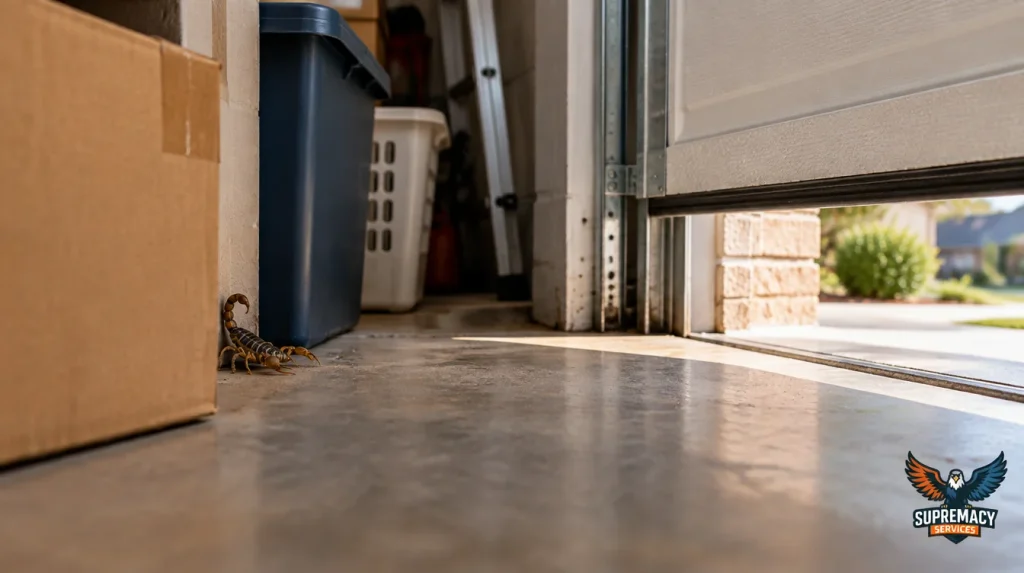
Striped bark scorpion hiding beside storage boxes in a North Texas garage
Garages can give scorpions access to dark, protected spaces around boxes, walls and door thresholds.

A garage can contain:

  • gaps beneath the overhead door;
  • exterior wall penetrations;
  • cardboard boxes;
  • stored lumber;
  • equipment sitting undisturbed;
  • wall-floor joints;
  • cluttered corners;
  • insects that may serve as prey.

Finding a scorpion in a garage therefore doesn’t automatically mean scorpions are established throughout the house.

Instead, inspect the garage as a transition zone between the outdoor environment and conditioned living space.

If boxes are stored directly on the floor, carefully inspect beneath and around them before moving them indoors.

Can Scorpions Hide in Attics?

Yes. Striped bark scorpions can climb, and Texas A&M specifically reports that they are often found in home attics.

This is one reason a scorpion problem should not always be approached strictly from ground level.

Check for conditions such as:

  • branches contacting or overhanging the roof;
  • openings around eaves;
  • gaps associated with exterior penetrations;
  • pest activity in upper structural areas.

Texas A&M also notes that during hot weather, scorpions may move from attics into living areas to escape high attic temperatures.

Attic inspection can involve fall, electrical and heat hazards, so homeowners should avoid entering areas that cannot be inspected safely.


How to Inspect Your Property for Scorpions

A systematic inspection is more useful than randomly moving objects around the yard.
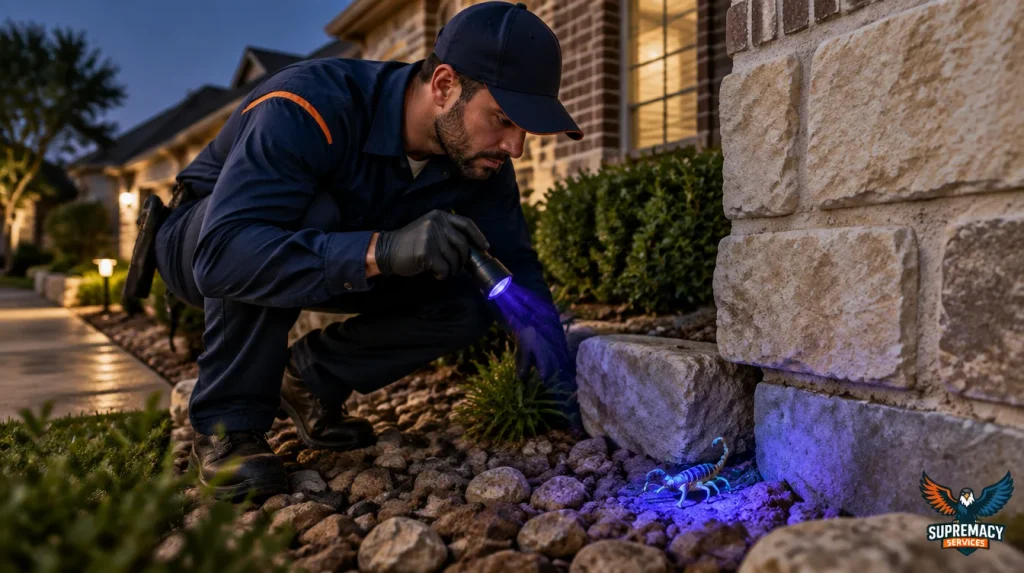
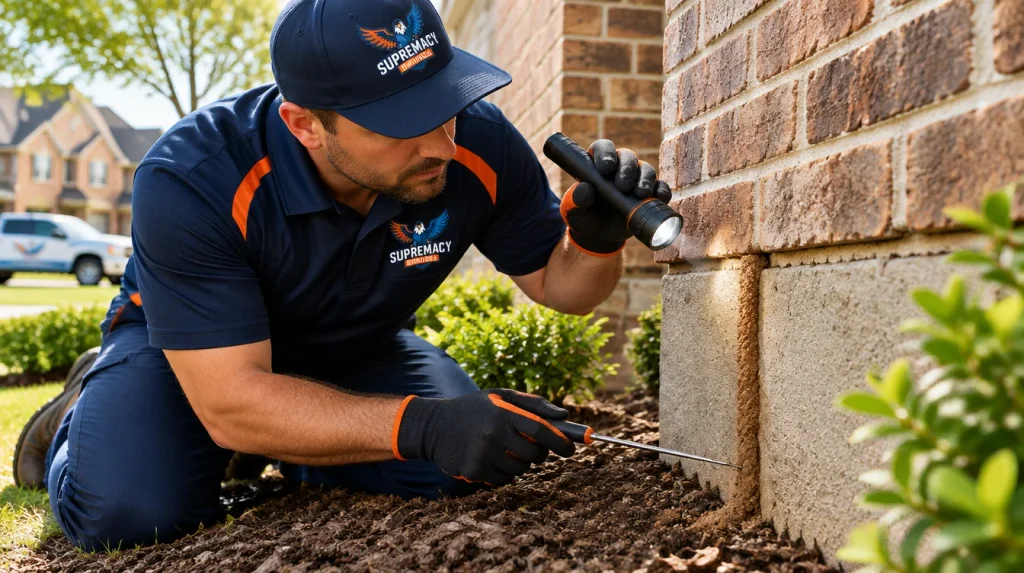
Pest control technician using a UV blacklight to inspect for scorpions outside a North Texas home
Scorpions fluoresce under ultraviolet light, which can make nighttime inspections more effective.

Step 1: Start away from the building

Identify obvious shelter:

  • wood piles;
  • stacked boards;
  • rocks;
  • debris;
  • bricks;
  • dead vegetation;
  • stored construction materials.

Step 2: Move toward the foundation

Check the transition between landscaping and the building.

Look for protected cracks, clutter, dense vegetation and areas where objects rest directly against or beside the structure.

Step 3: Inspect doors and penetrations

Check door sweeps, weatherstripping, window conditions and gaps around utilities.

EPA pest-management guidance likewise recommends closing off places where pests can enter and hide, including sealing appropriate cracks and gaps around penetrations.

Step 4: Check the garage

Pay attention to stored materials and the perimeter of the room rather than inspecting only the center of the floor.

Step 5: Consider upper access routes

Look for vegetation contacting the roof, exterior wall routes and appropriate attic/eave inspection points.

Step 6: Record where sightings occur

Write down:

  • date;
  • approximate time;
  • indoor or outdoor location;
  • nearby door/window;
  • nearby stored materials;
  • whether other insects are abundant.

Patterns are more useful than isolated observations.


What Makes a Good Scorpion Hiding Place?

A useful way to inspect a property is to stop thinking in terms of specific objects and instead recognize the characteristics of good harborage.

Scorpions tend to benefit from places offering some combination of:

Protection. Narrow spaces shield them from disturbance and daytime conditions.

Low disturbance. Materials that remain untouched for long periods are more useful shelter than frequently moved objects.

Access to prey. Scorpions are predators. Texas A&M lists small insects, spiders, centipedes, earthworms and other scorpions among their prey.

Access to the structure. Shelter immediately beside doors, walls or other potential entry routes is more relevant to an indoor scorpion problem than similar shelter far from the house.

This is why controlling only the scorpion you see can miss the larger issue.

Seeing recurring scorpion activity around the foundation, garage or living areas? Supremacy’s professional scorpion-control service can evaluate exterior harborage, pest pressure and potential entry areas around your DFW property.


How to Reduce Scorpion Hiding Places

Texas A&M states that scorpions can be difficult to control with insecticides alone and identifies modification of the area surrounding a structure as the first management strategy.

Exterior checklist

  • Remove unnecessary boards, logs, bricks, stones and debris beside the house.
  • Avoid allowing firewood to become indoor storage.
  • Keep grass near the structure maintained.
  • Trim vegetation and branches away from the building where practical.
  • Repair damaged screens.
  • Address appropriate cracks and gaps around the structure.
  • Maintain suitable weatherstripping around doors and windows.
  • Inspect stored materials before bringing them indoors.

Don’t forget the prey

A property with abundant insects can provide scorpions with food.

Crickets, cockroaches, spiders and other arthropods around exterior lighting, landscaping or garages may therefore be relevant to the overall problem.

This is one reason scorpion management often works better as part of a broader pest-management strategy than as a hunt for individual scorpions.


DIY vs. Professional Scorpion Control
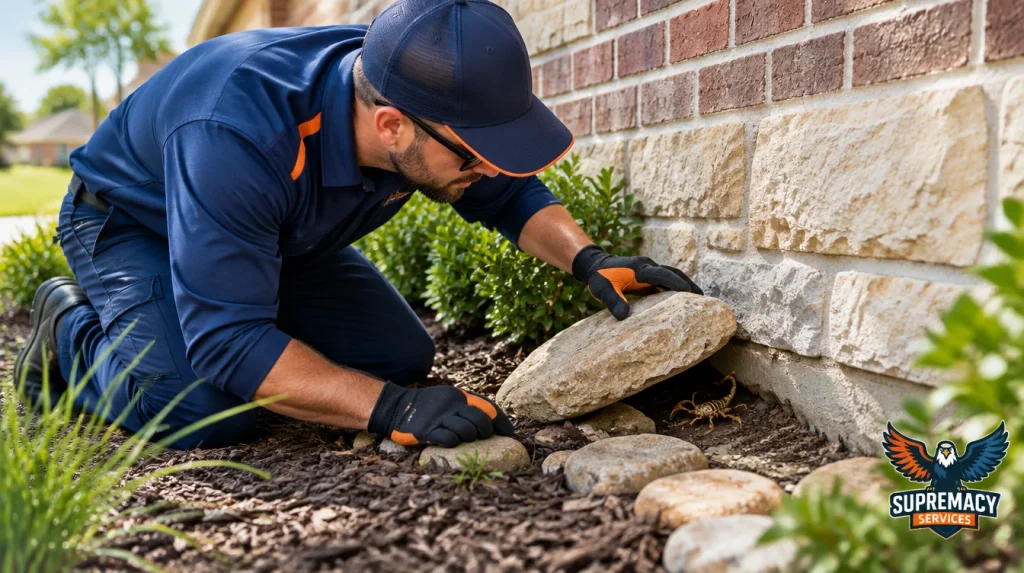
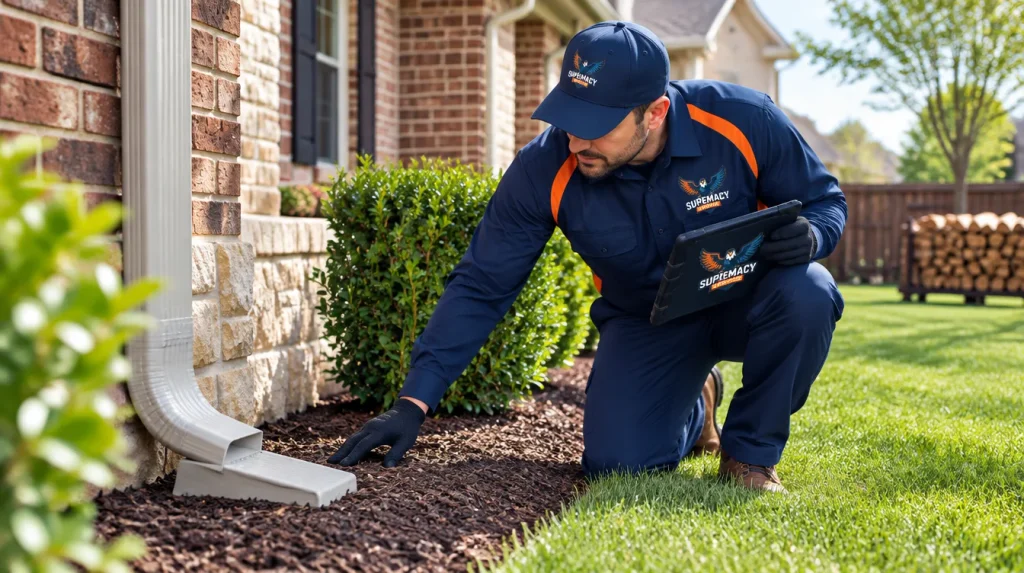
Pest control technician inspecting rocks and foundation gaps for scorpions at a North Texas home
A professional inspection can identify scorpion harborage, entry points and conditions around the home that may contribute to activity.

A single scorpion sighting does not necessarily require professional treatment.

For occasional activity, homeowners can start with:

  1. inspecting likely hiding areas;
  2. reducing unnecessary exterior clutter;
  3. improving appropriate exclusion;
  4. checking door seals and screens;
  5. reducing broader pest activity;
  6. monitoring for recurring sightings.

EPA’s Integrated Pest Management approach similarly emphasizes understanding the pest and combining appropriate management methods rather than relying automatically on pesticide application.

What about DIY pesticide treatment?

Pesticides should not replace inspection and habitat reduction.

If homeowners choose to use a pesticide, the EPA advises selecting a product intended for the particular pest and following the product label, including directions, precautions and storage requirements.

Never assume that applying more product will provide better control.

When does professional service make sense?

Consider professional inspection when:

  • sightings happen repeatedly;
  • scorpions appear in multiple areas;
  • you regularly find them in the garage;
  • sightings occur near bedrooms or frequently occupied areas;
  • you cannot determine where they are coming from;
  • substantial exterior harborage exists;
  • other insect activity is heavy;
  • exclusion improvements haven’t reduced activity;
  • likely hiding places cannot be inspected safely.

Texas regulates structural pest-control services. The Texas Department of Agriculture states that businesses and individuals performing structural pest control for compensation are subject to licensing requirements.

If you’re finding scorpions repeatedly, professional scorpion control can shift the investigation from “Where was this one scorpion?” to “Where is activity originating, what is supporting it, and how is it reaching the structure?”


What Does Professional Scorpion Control Involve?

A useful scorpion service should begin with inspection rather than treating every part of the property indiscriminately.

Depending on the property and findings, the process may involve:

  1. identifying likely exterior harborage;
  2. examining foundations and structural transitions;
  3. checking door and garage entry areas;
  4. examining relevant utility penetrations;
  5. assessing landscaping and stored materials;
  6. identifying significant prey-insect activity;
  7. recommending habitat and exclusion improvements;
  8. applying appropriately labeled treatments where warranted;
  9. monitoring areas where activity continues.

Supremacy’s dedicated DFW scorpion-control page describes a property-specific process focused on active areas, exterior hiding locations, entry areas and insect pressure.


North Texas Scorpion Considerations

The striped bark scorpion (Centruroides vittatus) is particularly relevant when discussing Texas homes. Texas A&M describes it as the most common scorpion species in Texas and notes that it occurs throughout the state.

It is particularly important from a home-inspection perspective because it can:

  • occupy indoor and outdoor habitats;
  • shelter beneath rocks, boards and debris;
  • associate with dead vegetation and fallen logs;
  • climb trees and walls;
  • occur in attics.

For Dallas-Fort Worth homeowners, those behaviors mean a useful inspection should cover the yard, building perimeter, garage and appropriate upper structural areas, rather than focusing exclusively on interior baseboards.


Scorpions vs. Other Pest Activity

Finding something moving quickly at night does not always mean you have identified the underlying pest problem correctly.

Scorpions are arachnids, not insects. They have eight legs and recognizable pincers and a segmented tail ending in a stinger.

But the presence of crickets, cockroaches, spiders and other arthropods can still matter because those organisms can form part of the food supply available to scorpions.

If you’re seeing several different pests around the same exterior areas, the more useful question may be:

What conditions around this property are supporting so much pest activity?

That broader approach can uncover shelter, access and prey conditions that treating individual pests misses.


Frequently Asked Questions

Where do scorpions hide during the day?

Scorpions generally spend daylight hours in protected locations. Outdoors, inspect beneath rocks, boards, wood and debris. Around homes, garages, cracks, storage areas and attics may also provide shelter.

Where do scorpions hide outside a house?

Common places worth inspecting include beneath rocks, boards, firewood, debris, bricks and other objects near the ground. Texas A&M specifically recommends reducing these materials around structures as part of scorpion management.

Where do scorpions hide inside homes?

Check garages, attics, closets, storage spaces, cracks, utility areas and beneath stored objects. Focus on quiet, protected locations rather than open areas.

Why do I keep finding scorpions in my garage?

Garages combine exterior access, door gaps and protected storage areas. Repeated garage sightings justify inspecting the garage perimeter, stored materials, door seals and nearby exterior conditions.

Can scorpions live in attics?

Striped bark scorpions are capable climbers, and Texas A&M reports that they are often found in attics.

Do wood piles attract scorpions?

Wood piles can provide protected hiding spaces. Texas A&M specifically identifies wood, boards and debris as scorpion harborage and advises against bringing firewood indoors unless it is going directly onto a fire.

Does one scorpion mean more are hiding nearby?

Not necessarily. One sighting alone does not establish a larger indoor population. Repeated sightings, however, make a systematic inspection of exterior harborage and entry points worthwhile.

Why are scorpions hiding near my house?

The area may provide protected shelter, access to prey or routes toward the structure. Rocks, boards, debris, stored materials and other undisturbed areas are worth checking.

Should I spray everywhere if I find scorpions?

Broad, indiscriminate spraying should not replace inspection and prevention. Texas A&M emphasizes environmental modification, while EPA guidance recommends nonchemical measures and requires pesticide users to follow product labels.

When should I call pest control for scorpions?

Professional inspection becomes more useful when sightings recur, scorpions appear in several areas, you cannot locate likely entry or hiding zones, or habitat reduction and exclusion have not reduced activity.


Make Your Property Less Hospitable to Scorpions

Finding a scorpion on the floor tells you where that animal ended up—not necessarily where it spent the day.

For North Texas homeowners, the more useful investigation starts outside: rocks, firewood, boards, debris, landscaping and other protected spaces → foundation and structural openings → garage and storage areas → appropriate interior and attic inspection.

Reducing harborage, managing the insects scorpions feed on and addressing appropriate entry points can provide a more complete strategy than repeatedly eliminating individual scorpions.

If scorpions keep appearing around your Dallas-Fort Worth property, schedule a scorpion-control inspection with Supremacy Services to evaluate likely hiding areas, exterior pest pressure and potential pathways into the home.

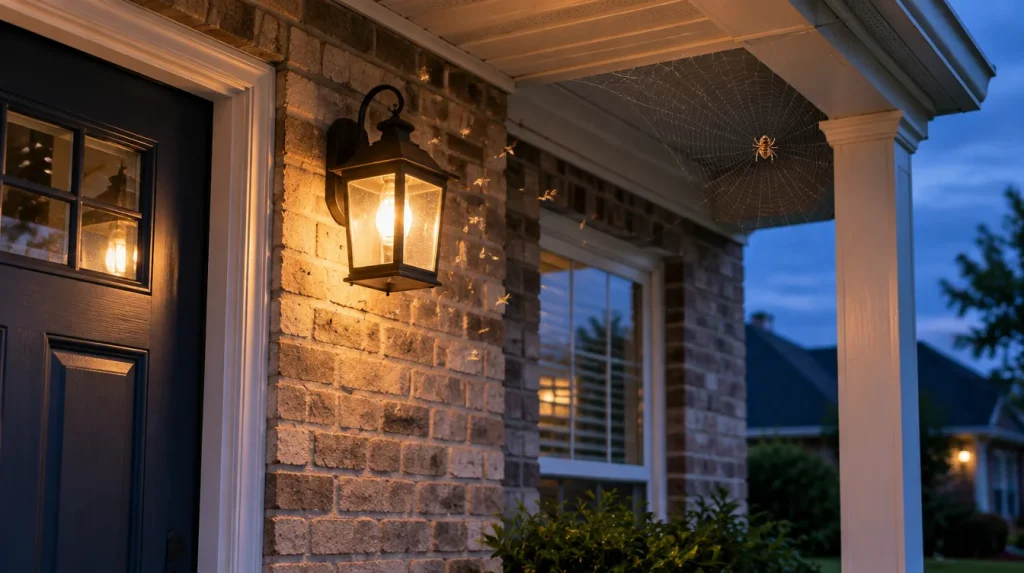
Spider web near the porch of a Dallas home with exterior lights attracting insects

Why Are There So Many Spiders Around My House?

If you are suddenly seeing spiders around your porch, windows, eaves, garage or exterior walls, your house probably offers them three things: food, shelter and good places to build webs or hunt.

Spiders are predators. A property with plenty of moths, flies, mosquitoes and other small insects gives them a dependable food supply. Exterior lights can concentrate those insects near doors and windows, while landscaping, clutter, gaps and protected corners provide shelter.

For Dallas and DFW homeowners, seeing a few outdoor spiders does not automatically mean there is an infestation inside the house. Most spiders are beneficial predators. But repeated webs, numerous spiders around entry points, spiders appearing indoors or the presence of potentially medically significant species deserve a closer look.

Table of Contents

  1. Why are there so many spiders around my house?
  2. What attracts spiders to a house?
  3. Why are spiders gathering around porch lights?
  4. Does having spiders mean you have another pest problem?
  5. Where do spiders hide around Dallas homes?
  6. Are spiders around your house dangerous?
  7. How to reduce spiders around your house
  8. DIY spider control vs. professional pest control
  9. What professional spider control should address
  10. When should you call pest control?
  11. Frequently asked questions

Why Are There So Many Spiders Around My House?

A large number of spiders usually means the property provides enough prey insects, shelter and suitable hunting or web-building locations to support them.

Spiders do not typically gather around a home because they are interested in the building itself. They are predators. If insects repeatedly collect around a porch, landscape bed, garage or exterior wall, spiders have a reason to stay.

Texas A&M AgriLife Extension describes spiders as beneficial predators that help control flies, plant-feeding insects and other arthropods. Most spiders encountered around Texas homes are not considered dangerous to people.

That distinction matters.

The goal should not necessarily be to eliminate every spider from an entire property. Instead, homeowners can reduce excessive spider activity where it becomes a nuisance or increases the chance of spiders entering living spaces.

The six most common reasons spiders gather around homes

CauseWhy It Encourages SpidersCommon Areas
Lots of insectsProvides preyPorch, patio, landscaping
Exterior lightingConcentrates flying insects after darkDoors, windows, garage
Protected spacesGives spiders places to hide or build websEaves, soffits, corners
Dense vegetationSupports insects and provides coverShrubs, foundation beds
Clutter and debrisCreates undisturbed shelterGarage, shed, woodpile
Building gapsAllows wandering spiders and insects insideDoors, windows, utility penetrations

The important point is that a spider problem can sometimes be a symptom of broader pest pressure.

If dozens of insects are gathering around the structure every night, simply removing individual spiders may not solve the underlying problem.


Seeing spiders repeatedly around doors, windows or the foundation? Learn how Supremacy’s perimeter pest control in Dallas targets the broader pest activity that can support spiders around the home.

What Attracts Spiders to Your House?

1. A dependable supply of insects

Food is one of the biggest factors.

Spiders prey on insects and other arthropods. A porch or landscape full of potential prey gives spiders a reason to establish themselves nearby.

This is also why homeowners sometimes keep removing webs only to see new ones appear.

Removing the web addresses what you can see. It does not necessarily change the conditions that made that location productive for the spider.

2. Porch and exterior lights

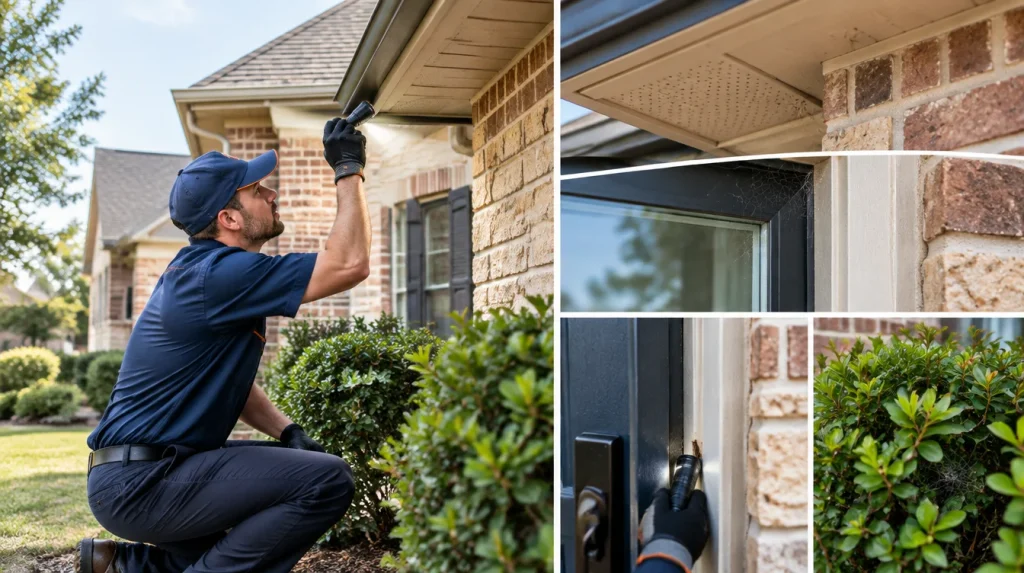
est control technician inspecting eaves, windows, doors, and landscaping for spider activity
Eaves, window frames, doorways, and landscaping provide sheltered areas where spiders may build webs or hide.

Outdoor lighting can indirectly create excellent spider-hunting locations.

The light itself is not necessarily attracting the spider in the same way it attracts many flying insects. Instead, insects gather near the light, and spiders take advantage of the concentrated food supply.

That is why webs frequently appear around:

  • porch lights;
  • garage lights;
  • illuminated doorways;
  • window frames;
  • security lights;
  • patio fixtures.

Extension guidance recommends reducing unnecessary exterior lighting or modifying lighting practices as part of outdoor spider management because doing so can reduce the insects that encourage spiders.

Why Do Spiders Keep Building Webs Around My Porch Lights?

Porch lights can create reliable feeding areas because insects gather around illuminated surfaces at night. Spiders then build webs or hunt nearby where prey is concentrated.

If the same doorway develops new webs every few days, look beyond the web itself.

Ask:

  • Is the exterior light running all night?
  • Are moths and other flying insects gathering around it?
  • Are webs protected from rain and wind by the porch roof?
  • Are there gaps around the door or nearby window?
  • Are shrubs or vines touching the structure?

Correcting those conditions can make the location less attractive over time.

3. Eaves, soffits and covered corners

Spiders benefit from locations protected from weather and disturbance.

Exterior corners, soffits, eaves, covered patios and window recesses can provide attachment points for webs while shielding spiders from rain and wind.

These locations are especially noticeable because abandoned webs can accumulate even after the original spider is gone.

4. Landscaping close to the house

Shrubs, flowers and other landscaping naturally support insects and spiders.

That is not necessarily a problem.

The concern is when dense vegetation directly touches siding, covers windows or creates a sheltered transition from the landscape to the structure.

Keeping vegetation appropriately maintained and away from the building can reduce these pathways while improving access for inspection.

5. Woodpiles, boxes and outdoor clutter

Undisturbed objects provide excellent hiding locations.

Potential spider harborage includes:

  • firewood;
  • unused planters;
  • stacked lumber;
  • cardboard boxes;
  • patio furniture that rarely moves;
  • storage sheds;
  • piles of landscape material;
  • cluttered garages.

Texas A&M specifically notes that medically significant spiders such as black widows and brown recluses favor protected or relatively undisturbed locations.

6. Cracks and gaps around the structure

Outdoor spiders occasionally wander indoors.

Gaps around doors, windows, foundations, screens and utility penetrations can provide access for both spiders and the insects they hunt.

If spider sightings are occurring primarily inside rather than outside, exclusion deserves particular attention.

Does Having Lots of Spiders Mean You Have Another Pest Problem?

Sometimes. Persistent spider activity can indicate that enough insects or other arthropods are present to provide a reliable food supply.

One spider on a patio does not prove that your home has an insect infestation.

However, consistently high spider activity—especially around doors, windows, lights or a garage—should prompt homeowners to look for the insects supporting them.

Common prey may include flies, moths and other small insects.

This is one reason integrated pest management is more useful than treating spiders in isolation. EPA describes Integrated Pest Management, or IPM, as an approach that combines knowledge of pests with appropriate management techniques rather than relying solely on pesticide applications.

Signs that broader pest pressure may be involved

Check for:

  • numerous flying insects around exterior lights;
  • ants or cockroaches near the foundation;
  • insects entering around doors and windows;
  • persistent moisture;
  • overflowing or poorly managed waste areas;
  • dense vegetation touching the structure;
  • repeated spider webs shortly after removal.

If you reduce the available prey, the property becomes less productive for many spiders.

Where Do Spiders Commonly Hide Around a House?

Pest control technician inspecting eaves, windows, doors, and landscaping for spider activity
Eaves, window frames, doorways, and landscaping provide sheltered areas where spiders may build webs or hide.

Outdoor spider activity is commonly concentrated in quiet, protected areas.

Around the exterior

Look around:

  • eaves and soffits;
  • window frames;
  • door frames;
  • porch ceilings;
  • patio furniture;
  • garages;
  • sheds;
  • utility boxes;
  • foundation edges;
  • landscaping;
  • woodpiles.

Inside the home

Wandering or established spiders may be encountered in:

  • garages;
  • closets;
  • storage areas;
  • attics;
  • crawl spaces;
  • behind stored objects;
  • utility areas;
  • other quiet corners.

Frequent indoor sightings deserve more attention than an occasional outdoor orb-weaver or garden spider because they can indicate accessible entry points, prey insects or suitable indoor harborage.

Are Spiders Around Dallas Homes Dangerous?

Most spiders around Texas homes are not considered medically significant. Texas A&M identifies widow spiders and recluse spiders as the two medically significant spider groups in Texas.

That does not mean homeowners should try to identify a questionable spider by handling it.

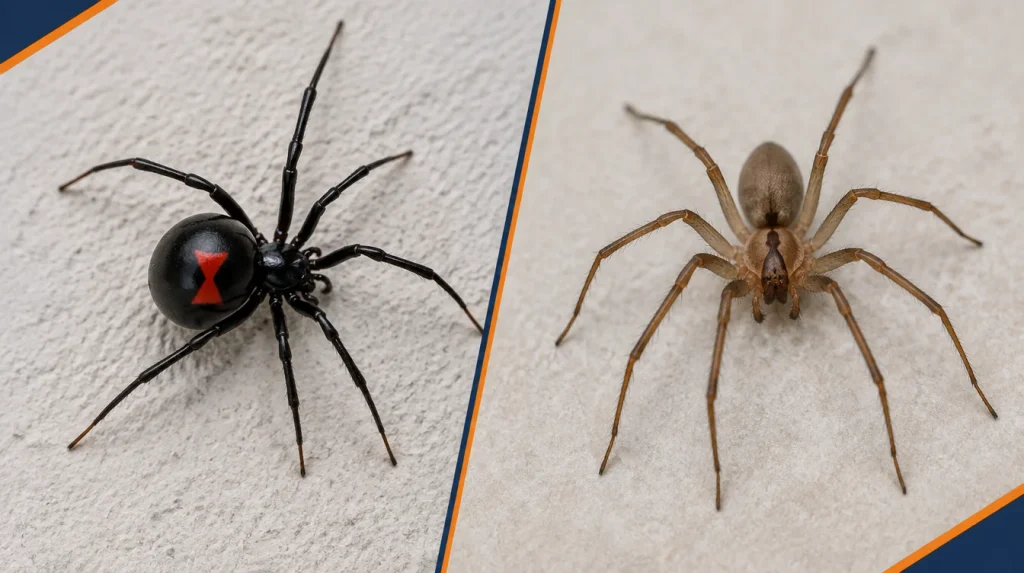
Black widow and brown recluse spiders shown for identification by Texas homeowners
Black widow and brown recluse spiders are two medically significant spider groups found in Texas.

Black widow spiders

Widow spiders often use protected, relatively undisturbed locations. Texas A&M notes that they may occur around homes, gardens and sheltered outdoor spaces.

Avoid reaching blindly into areas such as:

  • woodpiles;
  • storage boxes;
  • unused outdoor furniture;
  • meter or utility areas;
  • debris piles.

Brown recluse spiders

Brown recluses tend to favor quiet, undisturbed locations and are nocturnal hunters rather than conspicuous web builders.

Texas A&M lists locations such as cluttered closets, garages, crawl spaces, attics and storage areas among places where they may occur.

Don’t identify a brown recluse by color alone

Many harmless brown spiders are mistakenly called brown recluses.

A suspected medically significant spider should be identified using reliable characteristics or by a knowledgeable professional rather than by body color alone.

If you believe someone has suffered a medically significant spider bite or is experiencing serious symptoms, seek appropriate medical advice rather than relying on pest-control guidance for diagnosis.


How to Reduce Spiders Around Your House

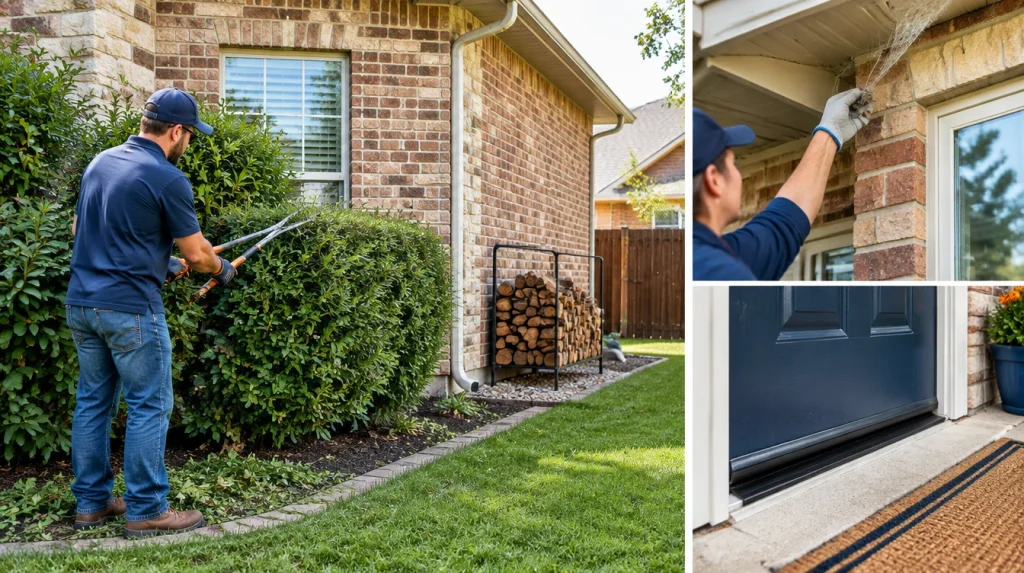
Spider prevention around a Dallas home by trimming shrubs, removing webs, sealing gaps, and moving firewood
Reducing shelter, prey insects, and entry points can make the area around your home less attractive to spiders.

The most effective prevention strategy addresses spiders, their prey and the conditions supporting both.

Step 1: Remove accessible webs

Use a broom, vacuum or other appropriate method to remove webs from reachable areas.

Pay attention to:

  • porch ceilings;
  • eaves;
  • window corners;
  • garage corners;
  • door frames.

Removing webs also makes it easier to see how quickly activity returns.

Step 2: Reduce unnecessary nighttime lighting

Turn off exterior lights when they are not needed.

Where lighting is required for safety, consider placement and fixture choices that reduce the concentration of insects immediately beside entrances.

Step 3: Reduce insect activity

Look for the reason insects are gathering around the house.

Depending on the pest, that could involve:

  • improving sanitation;
  • managing trash;
  • repairing moisture problems;
  • maintaining screens;
  • addressing pest-specific infestations;
  • reducing conditions that attract insects.

Step 4: Trim vegetation away from the structure

Avoid letting shrubs and other plants create dense, protected contact with the building.

The goal is not to remove landscaping. It is to prevent vegetation from creating unnecessary bridges and sheltered pest habitat directly against the structure.

Step 5: Reduce clutter and harborage

Move firewood and unnecessary debris away from the house where practical.

Keep garages and storage spaces organized so spiders have fewer undisturbed hiding locations.

Step 6: Seal entry points

Inspect:

  • door sweeps;
  • weatherstripping;
  • window screens;
  • utility penetrations;
  • foundation gaps;
  • openings around pipes and cables.

Physical exclusion helps reduce both wandering spiders and the insects they follow.

Step 7: Monitor what comes back

After cleaning and exclusion, watch where webs or spiders return.

Repeated activity in the same location is useful information.

It often points toward an unresolved food source, entry point or harborage area.

DIY Spider Control vs. Professional Pest Control

Pest control technician inspecting the exterior of a Dallas home for spiders and pest entry points
Persistent spider activity may require an inspection for prey insects, hiding places, and possible entry points.
SituationDIY/Prevention May Be ReasonableProfessional Inspection Becomes More Useful
Occasional outdoor spider✓
A few porch webs✓
Vegetation touching house✓
Damaged screen or door sweep✓
Repeated webs immediately after removal✓
Numerous spiders appearing indoors✓
Persistent insect activity around structure✓
Suspected widow or recluse activity✓
Spider activity in difficult-to-access areas✓
Prevention efforts are not reducing activity✓

For occasional nuisance spiders, sanitation, exclusion and web removal may be enough.

Repeated activity is different.

If spiders continually return because the house supports a larger insect population, treating one visible spider at a time does little to change the underlying conditions.


If spiders keep returning around your Dallas home, Supremacy Services can inspect the exterior pest pressure, likely entry areas and conditions supporting activity. Explore Dallas perimeter pest control for an exterior-focused approach.

What Should Professional Spider Control Include?

Professional spider management should begin with inspection rather than simply spraying every visible surface.

A useful assessment considers:

Spider activity

Where are spiders or webs concentrated?

Prey insects

Are ants, roaches, moths, flies or other pests creating a food source?

Harborage

Are clutter, vegetation, woodpiles or protected structural areas supporting spider activity?

Entry points

Are damaged screens, door gaps or structural openings allowing spiders and prey indoors?

Web removal

Removing accessible webs and egg sacs can complement other control measures.

Targeted treatment when appropriate

When pesticides are warranted, they should be selected and applied according to their labels and the pest and location being treated.

The EPA’s IPM guidance supports combining prevention, monitoring and appropriate control measures instead of automatically relying on pesticides alone.

In Texas, businesses providing structural pest-control services are regulated by the Texas Department of Agriculture’s Structural Pest Control Service.

When Should You Call Pest Control for Spiders?

Consider a professional inspection when:

  • spiders repeatedly appear inside living areas;
  • webs return quickly after removal;
  • activity is concentrated around several entrances;
  • you are also seeing substantial insect activity;
  • suspected widow or recluse spiders are present;
  • spiders are appearing in difficult-to-access areas;
  • exclusion and sanitation have not reduced the problem;
  • you want to identify what is supporting persistent activity.

Professional service is especially useful when the objective is not merely killing visible spiders but reducing the conditions that keep attracting them.

Dallas/DFW Spider Prevention Checklist

Before scheduling treatment, walk around the property and check:

☐ Porch and garage lights for heavy insect activity
☐ Webs around windows and door frames
☐ Eaves and soffits for repeated web building
☐ Torn or poorly fitted screens
☐ Gaps underneath exterior doors
☐ Shrubs touching siding or windows
☐ Firewood stored immediately against the house
☐ Clutter in garages and sheds
☐ Moist areas supporting other insects
☐ Recurring ants, roaches, flies or other prey insects
☐ Indoor spider sightings
☐ Suspected widow or recluse spiders

This inspection can help distinguish an occasional outdoor spider from persistent pest pressure around the structure.


Frequently Asked Questions

Why do I suddenly have so many spiders outside my house?

Spiders may become more noticeable when insect prey is abundant or when favorable web-building and shelter locations exist around the home. Increased visibility does not necessarily mean spiders suddenly established a major infestation.
Do spiders around my house mean I have bugs?

Not automatically, but spiders require prey. Persistent spider activity can be a clue that insects or other arthropods are plentiful enough to support them.

Why are there so many spiders around my porch?

Porches combine several spider-friendly features: protected corners, attachment points for webs and often exterior lighting that concentrates flying insects.

Why do spiders keep coming back after I remove their webs?

The location may still offer food and shelter. Removing a web eliminates the visible evidence but does not remove insects, lighting conditions, harborage or structural features that made the site attractive.

Should I kill spiders outside my house?

Not every outdoor spider requires control. Many spiders are beneficial predators. Management is more appropriate when activity becomes excessive near entrances, spiders repeatedly enter the home or potentially medically significant species are present.

What attracts spiders to windows?

Windows can offer protected corners for webs, while interior or exterior lighting can result in insects gathering near the glass. Gaps around frames can also provide entry points.

Does leaving porch lights on attract spiders?

Exterior lighting primarily attracts or concentrates insects. Spiders can then take advantage of those insects, which is why webs often develop near illuminated areas.

How do I keep spiders from entering my house?

Reduce prey insects, repair screens, improve door seals, seal appropriate gaps, remove unnecessary clutter, maintain vegetation and routinely remove webs from problem areas.

What spiders should Dallas homeowners be cautious around?

Texas A&M identifies widow spiders and recluse spiders as the medically significant spider groups in Texas. Avoid handling spiders you cannot confidently identify.

When is professional spider control worth it?

Professional inspection is useful when spiders repeatedly appear indoors, webs return rapidly, suspected medically significant spiders are present or DIY prevention has failed to address persistent activity.


The Bottom Line

Having spiders around your Dallas home usually tells you something about the environment around the property.

There may be plenty of prey insects. Porch lights may be concentrating them. Landscaping or clutter may provide shelter. Protected eaves and window frames may provide ideal web locations. Gaps may also be allowing spiders and other pests indoors.

Instead of focusing only on the spider you can see, focus on why that location keeps supporting spiders.

Reducing insects, removing webs, managing exterior lighting, trimming vegetation, eliminating unnecessary harborage and sealing entry points can substantially improve prevention.

When spiders continue returning despite those changes—or when you are concerned about widow or recluse activity—a professional inspection can help identify the broader pest conditions involved.


Spiders keep returning around your Dallas or DFW home? Explore Supremacy Services’ perimeter pest control to address spiders, the pests they hunt and the exterior conditions contributing to recurring activity.

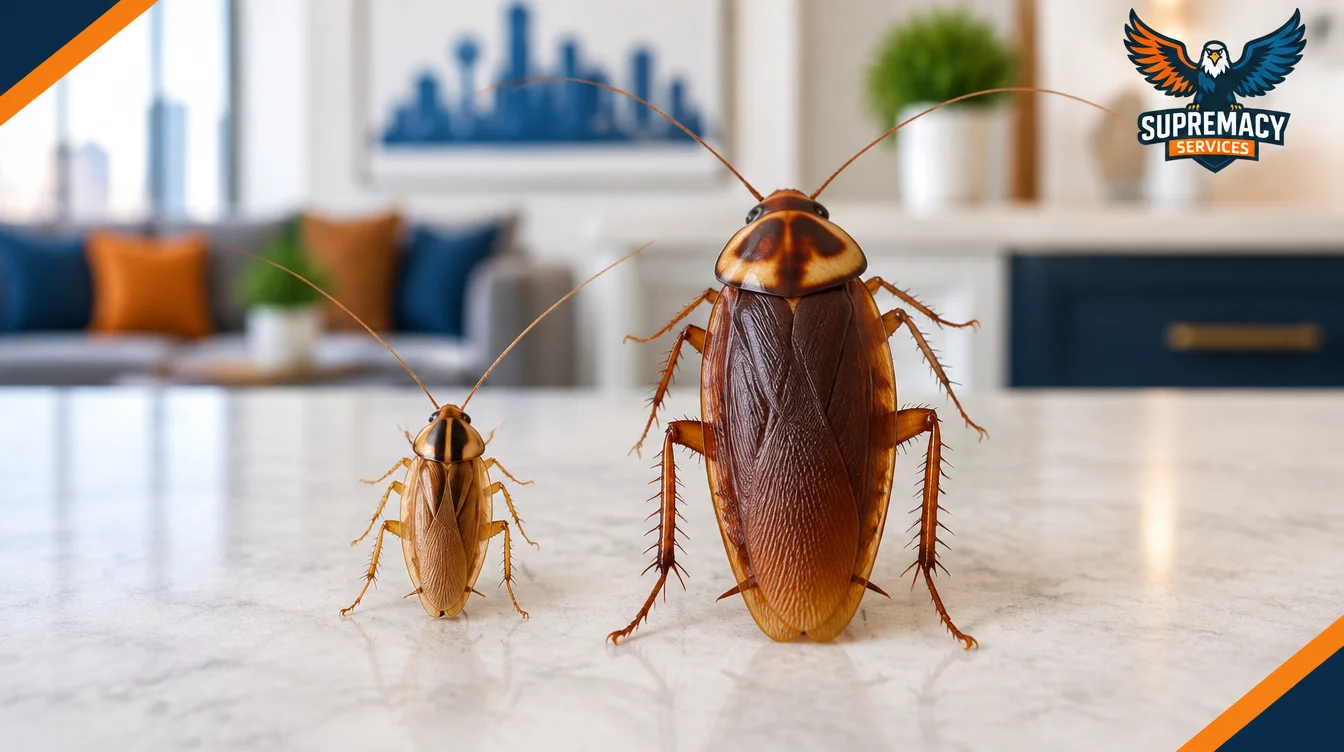
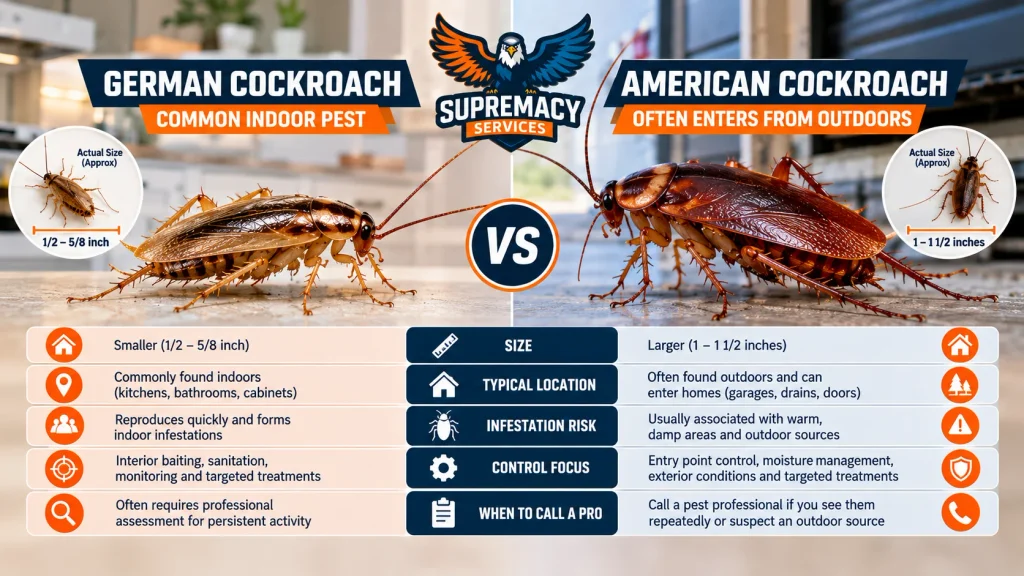
German cockroach and American cockroach side by side showing differences in size, color and markings

German Cockroach vs. American Cockroach: How to Tell the Difference

If you find a cockroach in your Dallas home, its size, color, markings and location can usually give you a good idea whether you’re dealing with a German cockroach or an American cockroach.

German cockroaches are small—usually about 1/2 to 5/8 inch long—and light brown or tan with two dark parallel stripes behind the head. American cockroaches are considerably larger, often around 1½ inches long, reddish brown, and have a pale yellowish border behind the head.

The distinction matters because the two species behave differently. German cockroaches are strongly associated with indoor infestations, particularly kitchens and bathrooms, while American cockroaches are frequently associated with damp areas, drains, sewers, crawl spaces and other moisture-rich environments.

Table of Contents

  1. German vs. American Cockroach: Quick Comparison
  2. What Does a German Cockroach Look Like?
  3. What Does an American Cockroach Look Like?
  4. Where Are You Finding the Cockroaches?
  5. Which Cockroach Is More Likely to Infest Your Home?
  6. Why Cockroach Identification Matters
  7. Signs You May Have More Than One Cockroach
  8. What Attracts Cockroaches to Dallas Homes?
  9. What Should You Do If You Find Cockroaches?
  10. DIY vs. Professional Cockroach Control
  11. How Professional Cockroach Control Works
  12. How to Prevent Cockroaches
  13. Frequently Asked Questions

German Cockroach vs. American Cockroach: Quick Comparison

The easiest distinction is size and markings. German cockroaches are small and have two dark stripes behind their heads. American cockroaches are roughly three times as long, reddish brown and have a lighter border around the area behind the head.

FeatureGerman CockroachAmerican Cockroach
Scientific nameBlattella germanicaPeriplaneta americana
Adult sizeAbout 1/2–5/8 inchAbout 1½ inches, sometimes larger
ColorTan to light brownReddish brown
Key markingTwo dark parallel stripes behind headPale/yellowish border behind head
Common indoor locationsKitchens, bathrooms, cabinets, appliancesDrains, basements, crawl spaces, utility areas
Moisture preferenceWarm, humid areasWarm, damp, dark areas
Typical entry patternOften introduced in boxes, bags or other items; can spread within buildingsCan enter from outdoors, drains, sewers and structural openings
Indoor breedingStrongly associated with indoor infestationsCan establish indoors, especially where moisture and shelter are available
WingsAdults have wings but generally do not flyAdults have developed wings and are capable of flight

These are identification clues rather than absolute rules. Nymphs are smaller than adults, and lighting can make coloration difficult to judge.


What Does a German Cockroach Look Like?

Close-up of German cockroach showing two dark parallel stripes behind its head
German cockroaches are small, light brown and recognizable by two dark parallel stripes behind the head.

A German cockroach is a small, tan or light-brown cockroach with two dark parallel stripes running lengthwise on the shield-like area directly behind its head.

Adults typically measure approximately 1/2 to 5/8 inch long. University and extension guidance consistently identifies those two dark stripes as one of the most useful visual characteristics for homeowners.

Look for these characteristics:

  • relatively small body;
  • tan or light-brown coloration;
  • two distinct dark lines behind the head;
  • long antennae;
  • adults with developed wings;
  • smaller, darker wingless nymphs.

Their small size also allows German cockroaches to hide in extremely narrow cracks and crevices.

Where German Cockroaches Usually Hide

German cockroaches favor places where food, warmth and moisture occur close together.

Common locations include:

  • beneath kitchen sinks;
  • behind refrigerators;
  • around dishwashers;
  • behind or beneath stoves;
  • inside cabinet cracks and hinges;
  • around plumbing fixtures;
  • near garbage and food-storage areas;
  • in bathrooms;
  • around heat-producing equipment.

Finding several small cockroaches around a refrigerator, dishwasher or kitchen cabinet is therefore much more suggestive of German cockroaches than American cockroaches.

Seeing small roaches around your Dallas kitchen or appliances? Explore Supremacy Services’ pest-control options for help identifying the infestation and determining the appropriate treatment.


What Does an American Cockroach Look Like?

Large reddish-brown American cockroach with pale yellow marking behind its head
American cockroaches are much larger than German cockroaches and typically have reddish-brown bodies with pale markings behind the head.

An American cockroach is a large reddish-brown cockroach with a lighter yellowish or pale margin around the shield behind its head.

Adults are approximately 1½ inches long, making them dramatically larger than adult German cockroaches. Their wings cover the abdomen, and adults are capable of flight.

Look for:

  • a large body;
  • reddish-brown coloration;
  • pale or yellowish edging behind the head;
  • long antennae;
  • long, developed wings.

If the insect is considerably longer than an inch, an adult German cockroach can effectively be ruled out based on size alone.

Where American Cockroaches Usually Hide

American cockroaches favor dark, warm and damp environments.

They may be encountered around:

  • floor drains;
  • plumbing chases;
  • crawl spaces;
  • utility areas;
  • basements where present;
  • sewer systems;
  • bathrooms;
  • garbage areas;
  • commercial kitchens;
  • other damp service areas.

Extension guidance notes that American cockroaches can occur around sewer systems and may enter buildings through drains or other pathways.

That means seeing one large cockroach does not automatically tell you that a breeding population exists inside your kitchen. The source and surrounding conditions still need to be investigated.


Where Are You Finding the Cockroaches?

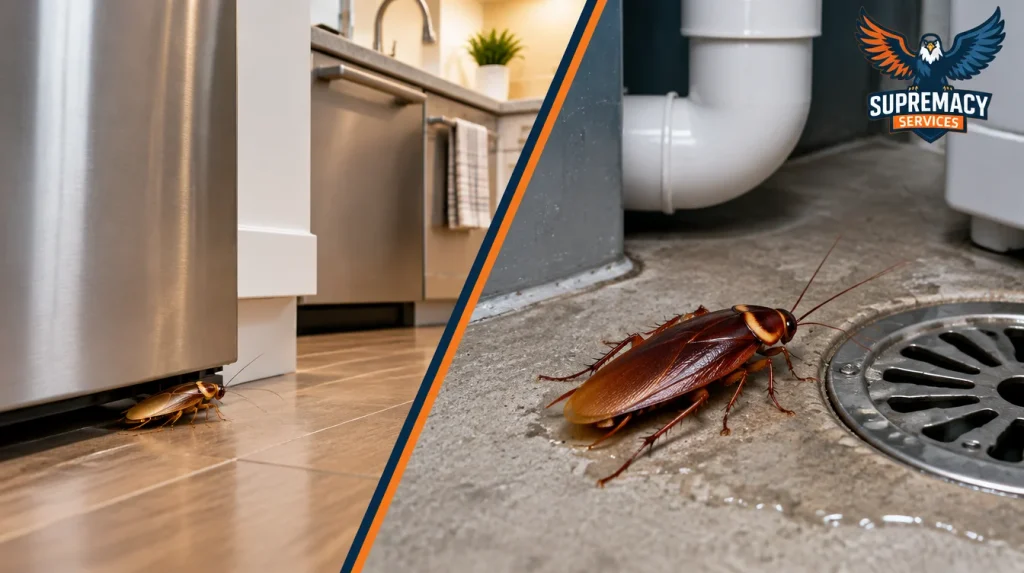
German cockroach near kitchen appliances and American cockroach near a drain in a Dallas home
German cockroaches commonly hide around kitchens and appliances, while American cockroaches are often associated with drains and other warm, damp areas.

Location is one of the strongest identification clues after size and markings.

Small roaches around the refrigerator or dishwasher

German cockroaches should be high on the list of possibilities.

These areas combine warmth, moisture, food residue and tight hiding spaces.

Large roach near a floor drain

An American cockroach becomes more plausible, particularly if the insect is reddish brown and well over an inch long.

Small roaches inside kitchen cabinets

German cockroaches are more likely.

Look carefully around hinges, cracks, shelf edges and plumbing penetrations rather than inspecting only open surfaces.

Large roach in a garage or utility area

This pattern may point toward an outdoor or moisture-associated cockroach entering the structure.

Identification should still be based on physical characteristics rather than location alone.


Which Cockroach Is More Likely to Infest Your Home?

German cockroaches are particularly concerning when multiple individuals are repeatedly found inside kitchens or bathrooms because this species readily lives and reproduces inside buildings.

Penn State Extension describes the German cockroach as one of the most common cockroach species in houses, apartments, restaurants, hotels and similar buildings. Females carry their egg capsules until close to hatching, and the species has substantial reproductive potential.

American cockroaches can also establish indoor populations, but their ecology is different. They are strongly associated with warm, moist locations such as drains, pipe chases, sewer environments and utility spaces.

The practical takeaway:

Multiple tiny roaches in a kitchen can indicate a very different problem from an occasional large roach entering through a drain or structural opening.


Why Cockroach Identification Matters

Correct identification determines where you should inspect, what conditions you need to correct and which control strategy makes sense.

Treating every cockroach exactly the same can overlook the actual source.

For example:

German cockroach problem:
The investigation may concentrate heavily on kitchens, appliances, cabinetry, plumbing and adjacent wall voids.

American cockroach problem:
Inspection may need to expand toward drains, crawl spaces, plumbing systems, utility areas and exterior entry points.

This is one reason Integrated Pest Management begins with understanding the pest and the conditions supporting it rather than relying solely on pesticide application.

The EPA defines Integrated Pest Management, or IPM, as an approach that combines information about pests and their environment with appropriate management methods while seeking to minimize unnecessary hazards to people, property and the environment.


Signs You May Have More Than One Cockroach

Seeing one cockroach does not reveal the size of an infestation.

Look for additional evidence such as:

  • repeated nighttime sightings;
  • cockroaches scattering when kitchen lights are switched on;
  • nymphs or very small cockroaches;
  • egg cases;
  • droppings or spotting in harborages;
  • cockroaches caught on monitoring traps;
  • activity beneath appliances;
  • recurring sightings near plumbing;
  • activity in several rooms.

Why Seeing Baby Cockroaches Matters

Nymphs are immature cockroaches.

Repeatedly finding nymphs indoors is important because it may indicate that cockroaches are developing somewhere in or near the structure rather than every insect simply wandering indoors.

For German cockroaches in particular, multiple life stages concentrated around kitchens or bathrooms warrant closer investigation.


What Attracts Cockroaches to Dallas Homes?

Cockroaches need access to food, water and shelter.

The EPA specifically recommends reducing these resources as part of effective pest prevention. That includes sealing food, removing garbage, avoiding pet food left out overnight and repairing plumbing leaks.

Common contributing conditions include:

Moisture

Check:

  • leaking faucets;
  • pipes beneath sinks;
  • dishwasher connections;
  • refrigerator drip areas;
  • condensation;
  • damp cabinets;
  • drains and utility areas.

Food

Cockroaches can survive on surprisingly small amounts of available material.

Pay attention to:

  • crumbs beneath appliances;
  • grease around cooking equipment;
  • pet food;
  • dirty dishes;
  • open pantry products;
  • spills;
  • garbage.

Shelter

Cockroaches prefer concealed spaces.

Clutter, cardboard, cabinet gaps, wall penetrations and appliance voids can provide hiding areas.

Entry Points

Larger cockroaches may enter around doors, utility penetrations and other structural openings.

German cockroaches can also be transported into buildings in items such as bags and boxes.


Are Cockroaches a Health Concern?

Cockroaches are more than an unpleasant sight.

The EPA identifies cockroaches as pests of public-health importance in connection with allergy, asthma and food contamination concerns.

This makes established activity particularly important around:

  • kitchens;
  • food-storage areas;
  • restaurants;
  • apartments;
  • childcare environments;
  • other sensitive facilities.

The goal should therefore be to correct the infestation and the conditions sustaining it—not simply kill whichever cockroaches happen to be visible.


What Should You Do If You Find Cockroaches?

Start with identification and inspection rather than immediately spraying every visible surface.

Step 1: Identify the cockroach

Check:

  1. size;
  2. color;
  3. markings behind the head;
  4. location where it was found;
  5. whether adults, nymphs or both are present.

Step 2: Inspect the surrounding area

For suspected German cockroaches, examine:

  • refrigerator;
  • stove;
  • dishwasher;
  • sink cabinet;
  • pantry;
  • cabinet hinges and cracks;
  • plumbing penetrations.

For suspected American cockroaches, expand the inspection to:

  • drains;
  • plumbing chases;
  • utility spaces;
  • crawl spaces where applicable;
  • exterior doors;
  • foundation penetrations;
  • damp exterior areas.

Step 3: Remove food and moisture

Clean crumbs and grease, secure food, empty garbage regularly and repair plumbing leaks.

Step 4: Use monitoring traps strategically

Sticky monitors can help determine where cockroach activity is concentrated and whether activity continues after corrective measures.

Place monitoring devices according to their directions, particularly along edges and near suspected harborages.

Step 5: Decide whether professional treatment is warranted

Repeated sightings, nymphs, widespread activity or persistent kitchen infestations are strong reasons to obtain a professional inspection.

If cockroaches keep appearing after cleaning and basic prevention, request a Dallas pest-control assessment from Supremacy Services to identify the species, locate activity and determine the appropriate control strategy.


DIY vs. Professional Cockroach Control

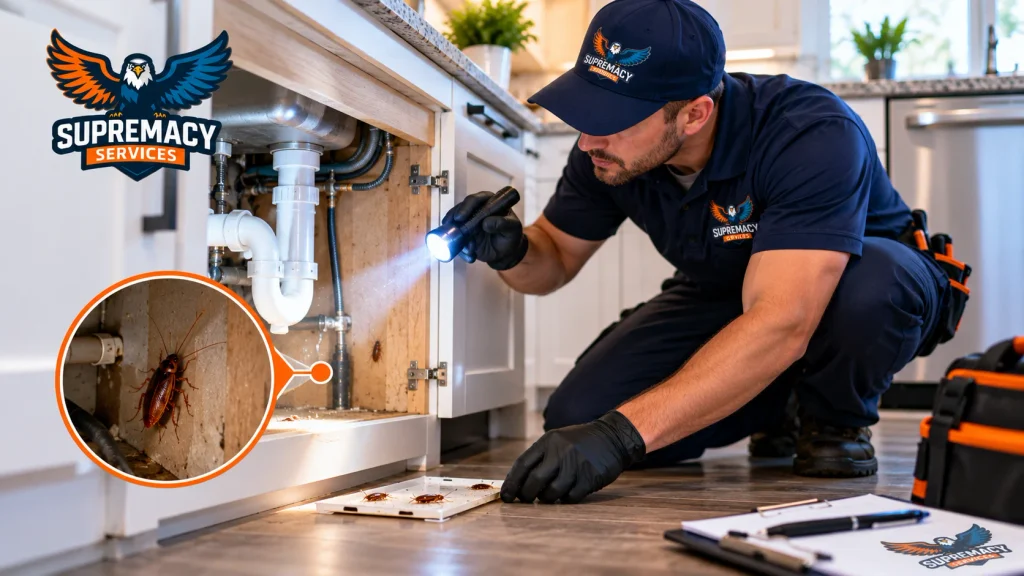
Pest control technician inspecting beneath kitchen appliances for cockroach activity in a Dallas home
A professional cockroach inspection can help identify the species, locate harborages and determine where activity is occurring.

Minor prevention work is absolutely appropriate for homeowners. Established infestations can be much harder to solve without correctly locating the harborages.

DIY homeowner actionWhen professional help makes sense
Clean food residueRepeated live cockroach sightings
Store food securelyGerman cockroaches in kitchen appliances/cabinets
Repair small leaksNymphs repeatedly appearing indoors
Reduce clutterActivity spreading into multiple rooms
Seal appropriate openingsSource cannot be identified
Monitor activityCockroaches persist after reasonable corrective measures
Improve garbage managementMulti-unit/shared-wall infestation suspected

Be Careful With indiscriminate Spraying

More pesticide does not automatically mean better cockroach control.

EPA IPM guidance emphasizes combining prevention, identification, monitoring and appropriate treatment instead of depending exclusively on pesticide applications.

Any pesticide used by a homeowner should be used only according to its label.

Professional structural pest-control work in Texas is regulated by the Texas Department of Agriculture. TDA states that businesses and individuals providing structural pest-control services for hire are subject to licensing requirements.


What Does Professional Cockroach Control Include?

A professional cockroach program should start with identification and inspection.

Depending on the property and infestation, the process may include:

1. Species identification

German and American cockroaches require different inspection priorities.

2. Locating harborages

The technician looks for areas where cockroaches are hiding, feeding and obtaining moisture.

3. Identifying conducive conditions

These may include:

  • plumbing leaks;
  • food residue;
  • garbage;
  • clutter;
  • cracks;
  • appliance voids;
  • structural openings;
  • moisture around drains.

4. Monitoring

Strategically positioned monitoring devices can reveal where activity is concentrated.

5. Targeted control

The appropriate treatment depends on the species, infestation and site conditions.

6. Prevention recommendations

Homeowners may be advised to repair moisture problems, improve sanitation or seal appropriate entry points.

7. Follow-up

Established infestations may require reassessment rather than assuming the problem has been resolved because visible activity temporarily declined.

This inspection-based approach is consistent with the broader IPM principle of addressing the conditions allowing pests to survive.


Dallas and DFW Cockroach Considerations

Dallas homeowners should think about both indoor breeding conditions and outdoor entry pressure.

Dallas/Fort Worth climate normals show very warm summers, with normal July and August highs around the mid-90s Fahrenheit.

But climate alone does not tell you why cockroaches are inside a particular house.

Property-specific factors matter more:

  • plumbing leaks;
  • drains;
  • food availability;
  • garbage storage;
  • gaps around exterior openings;
  • shared walls in apartments or townhomes;
  • deliveries and cardboard;
  • appliance harborages;
  • damp utility areas.

In attached or multi-family housing, cockroach management may also require looking beyond a single kitchen because pests can move through structural and utility pathways.


Could It Be Another Type of Cockroach?

Yes.

German and American cockroaches are not the only cockroaches homeowners can encounter.

For example, brown-banded cockroaches are also relatively small but differ from German cockroaches in their markings and preferred hiding locations. Brown-banded cockroaches have characteristic bands across the body and often occupy warmer, drier, elevated areas.

Oriental cockroaches are darker—often dark brown to nearly black—and favor cool, damp locations.

That is why color alone is unreliable.

Use size + markings + location + behavior together.


How to Prevent Cockroaches in Your Dallas Home

Clean Dallas kitchen with sealed food, repaired plumbing and sealed gaps to help prevent cockroaches
Reducing food, water, shelter and entry points can make a home less attractive to cockroaches.

Prevention works best when you make the structure less hospitable and reduce opportunities for entry.

Kitchen

  • Clean crumbs and grease beneath appliances.
  • Avoid leaving dirty dishes overnight.
  • Store dry food in closed containers.
  • Empty garbage regularly.
  • Clean beneath refrigerators and stoves.
  • Avoid leaving pet food out overnight.

Plumbing

  • Repair leaking faucets.
  • Inspect pipes beneath sinks.
  • Address persistent moisture.
  • Check dishwasher and refrigerator water connections.

Structure

  • Seal appropriate cracks and penetrations.
  • Maintain door sweeps.
  • Inspect openings around utility lines.
  • Correct gaps that allow outdoor pests inside.

Storage

  • Reduce unnecessary cardboard.
  • Avoid excessive clutter.
  • Inspect boxes and secondhand items before bringing them into living spaces.

Monitoring

If your home has had previous cockroach activity, occasional monitoring can help detect recurrence before a population becomes widespread.


German vs. American Cockroach: The Bottom Line

If the cockroach is small, tan and has two dark stripes behind its head, it is likely a German cockroach.

If it is much larger, reddish brown and has a pale yellowish border behind the head, an American cockroach is more likely.

Where you find it provides another clue:

German cockroach: think kitchens, bathrooms, appliances and cabinets.

American cockroach: think drains, utility areas, plumbing systems, crawl spaces and other damp environments.

Identification matters because the source of the problem—not simply the visible cockroach—determines the most effective management strategy.

If you’re repeatedly finding cockroaches in your Dallas or DFW home, particularly small cockroaches or nymphs around kitchens and bathrooms, the next step should be determining where they are harboring and what is sustaining the infestation.

Need Help Identifying or Controlling Cockroaches in Dallas?

Supremacy Services provides pest-control services throughout Dallas and the DFW Metroplex.

Explore Supremacy Services’ Dallas pest-control options or request an assessment if cockroaches continue appearing inside your home.


Frequently Asked Questions

What is the easiest way to tell a German cockroach from an American cockroach?

Size is the quickest clue. Adult German cockroaches are roughly 1/2–5/8 inch long and have two dark stripes behind the head. American cockroaches are much larger—around 1½ inches—and reddish brown with pale edging behind the head.

Are small cockroaches worse than large cockroaches?

Size does not determine whether a cockroach is inherently “worse,” but numerous small German cockroaches inside a kitchen can indicate an established indoor population. Multiple nymphs are especially worth investigating.

Are German cockroaches common in kitchens?

Yes. German cockroaches strongly favor warm, humid areas close to food and water and are commonly found around sinks, refrigerators, dishwashers, stoves and kitchen cabinets.

Do American cockroaches come through drains?

They can. American cockroaches are associated with sewers, drains and other warm, damp areas, so plumbing and drain systems should be considered when investigating large cockroaches indoors.

Can American cockroaches fly?

Adult American cockroaches have developed wings and are capable of flight, although how often they fly depends on conditions.

Do German cockroaches fly?

Adults have wings, but German cockroaches generally do not fly.

Does seeing one German cockroach mean there are more?

One sighting cannot establish infestation size. However, because German cockroaches live and reproduce indoors, finding one—especially around kitchens or bathrooms—justifies inspecting and monitoring nearby harborages.

Why do cockroaches keep appearing in a clean house?

Clean homes can still provide cockroaches with moisture, concealed harborages or entry routes. Cockroaches can also be introduced in boxes, bags and other items. Sanitation is important, but it is only one component of prevention.

When should I call pest control for cockroaches?

Consider professional inspection when cockroaches appear repeatedly, nymphs are present, activity occurs in multiple rooms, a suspected German cockroach population is established around the kitchen, or reasonable sanitation and prevention measures have not resolved the problem.

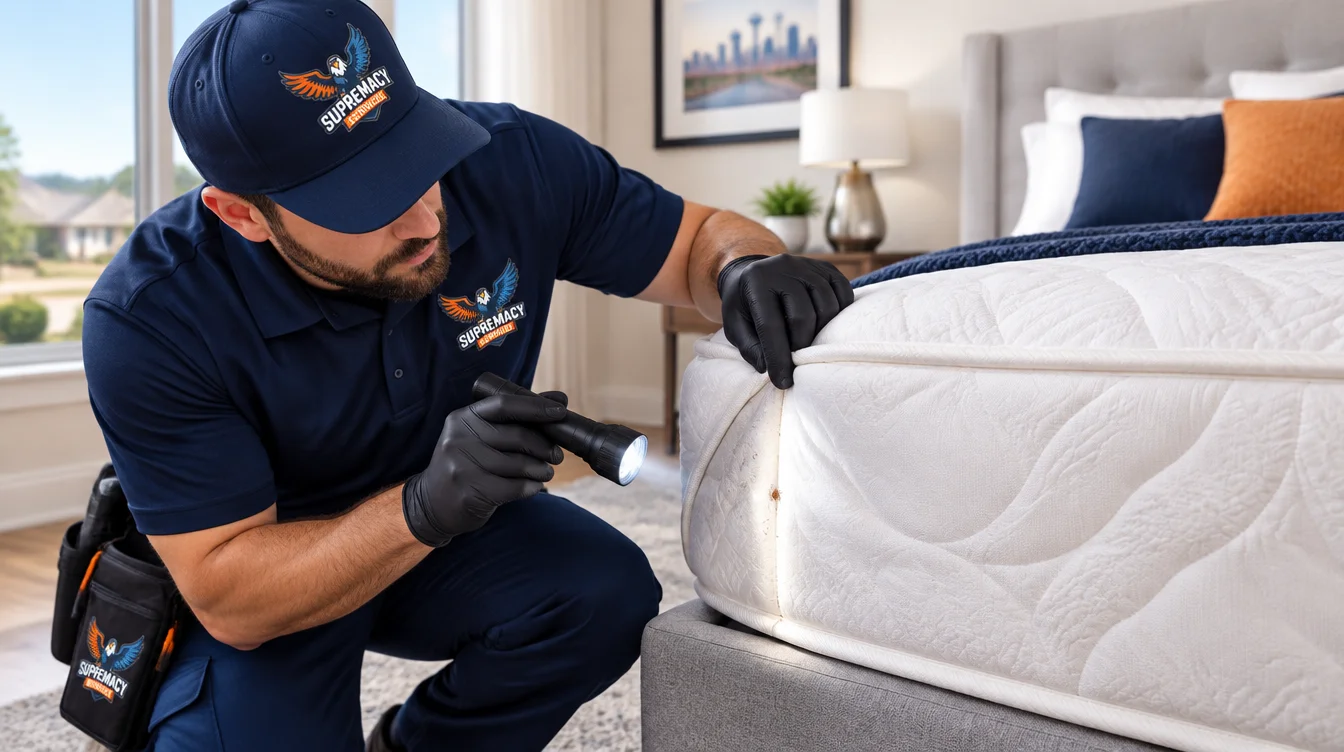
Pest control technician inspecting mattress seams for bed bugs in a Dallas home

Should I Throw Away My Mattress If I Have Bed Bugs?

Short answer: usually, no. Finding bed bugs does not automatically mean you need to throw away your mattress.

In many cases, a mattress can remain in the home and be incorporated into a properly planned bed bug treatment. Bed-bug-proof encasements can also help eliminate hiding places and trap bugs already inside. The U.S. Environmental Protection Agency specifically advises homeowners not to discard furniture when bed bugs can be safely eliminated from it.

For Dallas and DFW homeowners, the more important question is not simply “Are there bed bugs on my mattress?” but:

Can the mattress be effectively treated, monitored and safely kept as part of a whole-room or whole-home bed bug control plan?

Throwing the mattress away without addressing the rest of the infestation can cost you money without solving the actual problem.


Table of Contents

  1. Do You Have to Throw Away a Mattress With Bed Bugs?
  2. Why Throwing Away the Mattress Usually Doesn’t Solve the Problem
  3. When Should You Consider Throwing the Mattress Away?
  4. Can Bed Bugs Live Inside a Mattress?
  5. Can a Bed Bug Mattress Encasement Save the Mattress?
  6. How Professionals Treat Mattresses for Bed Bugs
  7. What Should You Do With Bedding and Clothes?
  8. What If You Decide to Throw the Mattress Away?
  9. Should You Buy a New Mattress Immediately?
  10. DIY vs. Professional Bed Bug Treatment
  11. Bed Bugs in Dallas and DFW Homes
  12. What to Do If You Find Bed Bugs on Your Mattress
  13. FAQs

Do You Have to Throw Away a Mattress With Bed Bugs?

Close-up of mattress seams showing common signs of bed bug activity
Mattress seams and folds are important places to inspect for bed bugs, shed skins, eggs and dark spotting.

No. A mattress with bed bugs does not automatically need to be thrown away.

The EPA recommends mattress and box-spring encasements as part of bed bug management and advises against discarding furniture when the infestation can be safely eliminated.

Whether your mattress can be kept depends on several factors:

FactorMattress May Be Worth KeepingDisposal May Be Considered
Physical conditionMattress is structurally soundBadly torn or deteriorated
InfestationTreatment can reach affected areasMattress cannot be effectively treated
EncasementProper encasement can be installedDamage prevents effective encasement
Replacement needMattress is relatively newMattress already needs replacement
Professional assessmentTreatment plan includes mattressPest professional recommends disposal

The presence of bed bugs alone is therefore not a reason to automatically replace the mattress.

Don’t move the mattress through the house unnecessarily

Moving an infested mattress from room to room can potentially move bed bugs or eggs to additional locations.

Before dragging a mattress through hallways, stairways or other bedrooms, determine how the infestation will actually be treated.

Not sure whether your mattress can be saved? Learn how professional [bed bug thermal treatment in DFW] can treat mattresses, furniture and other hiding areas as part of a broader bed bug control plan.


Why Throwing Away the Mattress Usually Doesn’t Solve the Problem

One of the biggest misconceptions about bed bugs is that they live only in mattresses.

They don’t.

Bed bugs can hide around:

  • mattress seams and folds;
  • box springs;
  • bed frames;
  • headboards;
  • bedside furniture;
  • baseboards;
  • upholstered furniture;
  • cracks and crevices;
  • luggage and belongings.

EPA guidance specifically identifies mattresses, box springs, headboards and surrounding furniture as important places to inspect and manage.

That means removing the mattress may remove one hiding location while leaving the infestation behind.

You could then bring a brand-new mattress into the same infested bedroom.

A mattress is often only part of the infestation

Suppose you find bed bugs along a mattress seam.

It is tempting to assume:

Bed bugs on mattress → mattress is the problem → remove mattress → problem solved.

Unfortunately, bed bug control isn’t usually that simple.

The insects may also be hiding in the bed frame, box spring, headboard or nearby furniture. A successful strategy therefore focuses on the infested environment, not simply the most obvious object.


When Should You Consider Throwing the Mattress Away?

Although many mattresses can potentially be treated, there are situations where replacement may make sense.

1. The mattress is already badly damaged

A heavily torn or deteriorated mattress may contain numerous difficult-to-access folds, openings and damaged areas.

If the mattress already needed replacement before the infestation occurred, investing additional effort in preserving it may make little practical sense.

2. It cannot be treated effectively

Some possessions may not be practical to treat.

EPA guidance recommends discarding furniture responsibly when bed bugs cannot safely be eliminated from it, rather than automatically throwing furniture away whenever an infestation occurs.

3. A pest management professional recommends disposal

A professional inspection can determine whether keeping the mattress fits the treatment strategy.

The decision should ideally happen after inspection, rather than before it.

4. The mattress cannot support a secure encasement

A bed-bug-proof encasement must remain intact.

Large tears, broken components or other severe deterioration could make effective encasement impractical.


Can Bed Bugs Live Inside a Mattress?

Bed bugs commonly hide around mattress seams, folds and similar protected areas, but the mattress is only one potential harboring location.

EPA inspection guidance recommends checking:

  • mattress seams;
  • box springs;
  • headboards;
  • furniture;
  • baseboards;
  • cracks and other protected spaces.

Signs to inspect around your mattress

Look for more than bites.

Possible signs include:

  • live bed bugs;
  • dark spotting or droppings;
  • shed skins;
  • eggs;
  • small blood stains.

EPA materials identify droppings, blood staining and shed skins among the signs homeowners may encounter.

Finding one of these signs warrants further investigation, but identification matters. Not every unexplained skin reaction or bedroom insect proves that you have bed bugs.


Can a Bed Bug Mattress Encasement Save the Mattress?

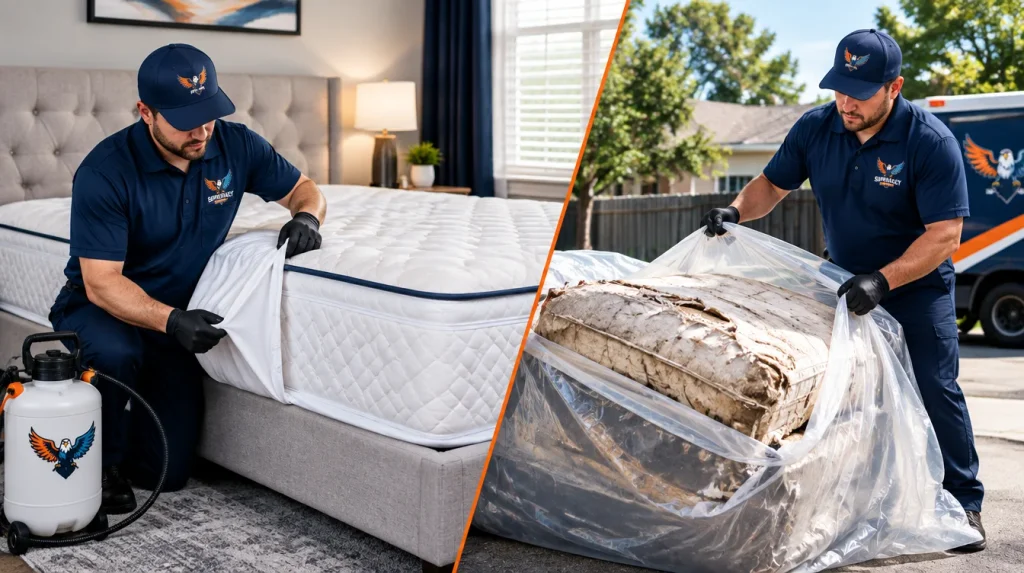
Bed bug mattress encasement being securely fitted around a mattress
A purpose-built mattress encasement can reduce hiding places and help protect an otherwise usable mattress as part of a broader treatment plan.

A properly designed bed bug encasement can be an important part of keeping an otherwise usable mattress.

An encasement completely surrounds the mattress or box spring.

According to EPA guidance, encasements can trap bed bugs inside and reduce hiding places, while their light-colored exterior can make future bed bug activity easier to notice.

EPA recommends sturdy encasements designed for bed bugs and advises keeping them in place for an extended period.

An encasement is not the same as complete treatment

This distinction matters.

Putting a cover around the mattress does not address bed bugs hiding elsewhere in the room.

An encasement works best as one component of a broader strategy that may include:

  • inspection;
  • laundering and heat-drying appropriate fabrics;
  • vacuuming;
  • reducing clutter;
  • treating appropriate items;
  • monitoring;
  • professional pest control where necessary.

EPA recommends an integrated approach rather than relying on one technique alone.


How Professionals Treat Mattresses for Bed Bugs

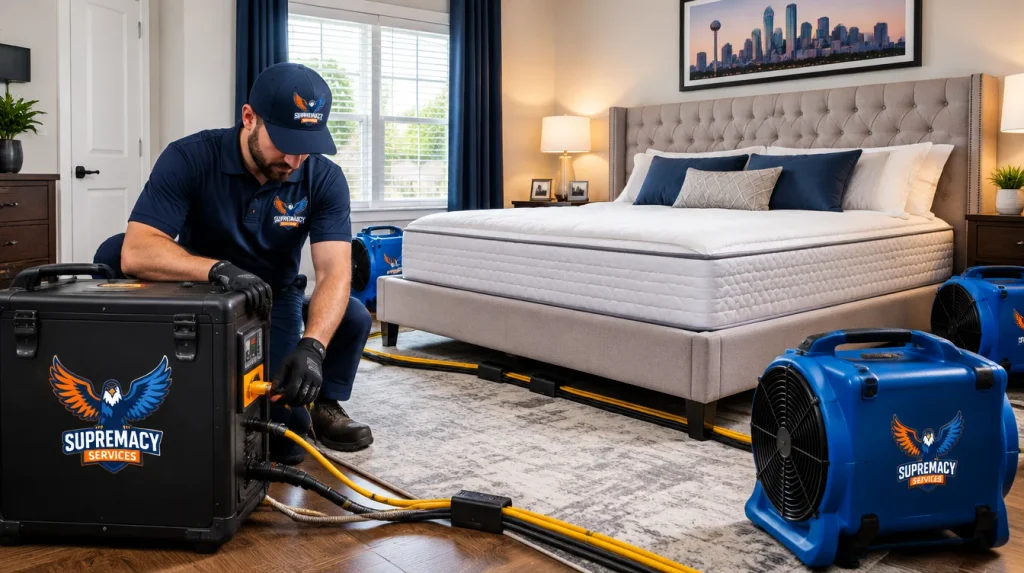
Supremacy Services technician setting up thermal treatment equipment around a mattress in a DFW bedroom
Professional bed bug treatment addresses mattresses, furniture and other potential hiding areas rather than simply removing the bed.

The exact process depends on the treatment method, the extent of the infestation and the conditions inside the property.

One professional option is thermal treatment.

Supremacy Services’ existing DFW bed bug service uses specialized heating equipment and air circulation intended to bring targeted areas to controlled treatment temperatures. The company’s current service page describes treatment of mattresses, furniture, baseboards and other potential hiding areas rather than simply removing the bed.

This is an important distinction:

Professional bed bug treatment targets the infestation—not just the mattress.

What homeowners should expect

Depending on the selected treatment strategy, preparation may include:

  1. confirming bed bug activity;
  2. inspecting bedrooms and nearby areas;
  3. identifying belongings requiring special handling;
  4. preparing laundry or other appropriate items;
  5. treating the affected environment;
  6. protecting or encasing mattresses where appropriate;
  7. monitoring for continued activity afterward.

The exact preparation instructions should come from the pest professional performing the treatment.

Be careful with pesticides on mattresses

Do not assume that any household insecticide can be sprayed onto a mattress.

EPA guidance states that pesticide labels specify where a product may legally and safely be applied, including whether mattress application is permitted. Products must be used according to their labels.

Never use an outdoor pesticide indoors simply because the label mentions insects.


What Should You Do With Bedding and Clothes?

Finding bed bugs does not mean you need to throw away your sheets, blankets and clothing either.

EPA guidance recommends regularly washing and heat-drying appropriate bedding and clothing that may be involved in an infestation.

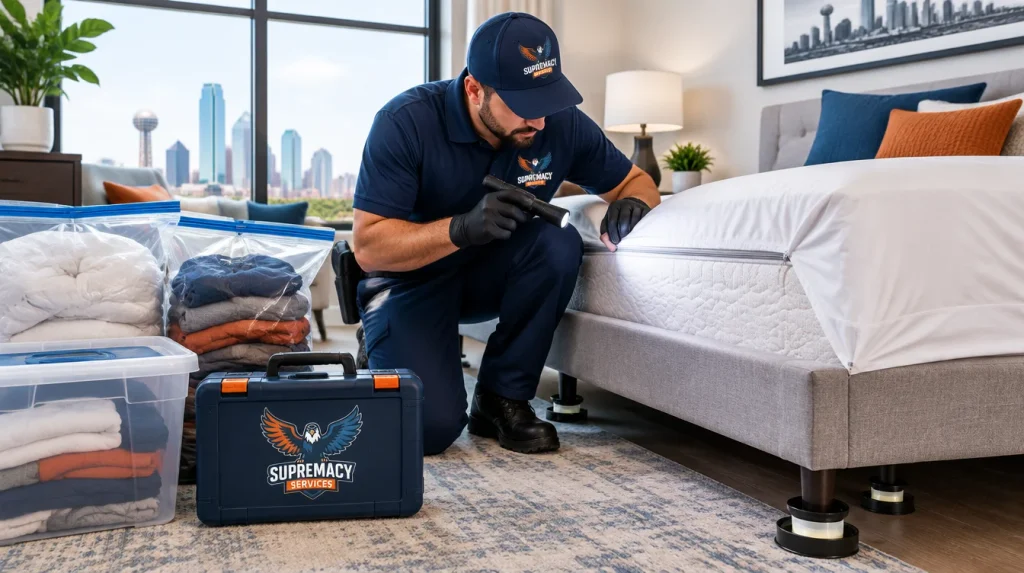
When dealing with potentially infested laundry:

  • avoid carrying loose items unnecessarily through the home;
  • use bags or containers to contain items during transport;
  • follow appropriate laundering and drying instructions;
  • place cleaned items into clean containers or bags when necessary;
  • keep untreated and treated belongings separated.

The EPA also recommends using new bags when bringing treated laundry back into an infested residence so cleaned items are not immediately exposed again.


What If You Decide to Throw the Mattress Away?

If the mattress truly cannot be saved, disposal should be handled carefully.

Simply placing an intact infested mattress at the curb creates another problem: someone may pick it up and bring the infestation into another home.

EPA guidance recommends making discarded infested furniture unusable and clearly identifying it as bed-bug-infested before arranging prompt disposal.

Responsible disposal checklist

If disposal is necessary:

  1. Confirm that disposal is actually needed.
  2. Follow local waste collection requirements.
  3. Avoid dragging the uncovered mattress through unaffected areas.
  4. Make discarded furniture unusable.
  5. Clearly mark it as containing bed bugs.
  6. Arrange removal promptly.
  7. Continue treating and monitoring the property.

Most importantly:

Do not assume disposing of the mattress ends the infestation.

Treatment of the remaining environment is still necessary.


Should You Buy a New Mattress Immediately?

Usually, buying a replacement mattress should not be your first response.

If active bed bugs remain elsewhere in the bedroom, a new mattress can become another place for them to hide.

A better sequence is:

Confirm → inspect → treat → monitor → replace if necessary.

Replacement makes more sense when the existing mattress is physically damaged, cannot reasonably be treated, or was already approaching the end of its useful life.

Otherwise, treating and protecting the existing mattress may avoid an unnecessary expense.


DIY vs. Professional Bed Bug Treatment

Some bed bug management steps can be performed by homeowners, but established infestations can be difficult to eliminate completely.

ApproachAppropriate UseLimitation
VacuumingReducing visible bugs/debrisDoes not reliably reach every hiding location
Laundry/heat dryingTreating appropriate washable/dryable itemsDoes not treat the room
Mattress encasementTrapping bugs and reducing mattress hiding areasDoes not eliminate bugs elsewhere
InterceptorsMonitoring activity around bedsMonitoring tool, not whole-home treatment
PesticidesOnly where product labeling permitsIncorrect use can create safety risks
Professional treatmentEstablished or difficult infestationsRequires proper preparation and professional assessment

EPA recommends combining multiple strategies through integrated pest management, rather than expecting one technique to solve the infestation.

When to call a professional

Professional assessment becomes particularly useful when:

  • bed bugs are found in multiple rooms;
  • you repeatedly find bugs after DIY attempts;
  • you cannot determine the extent of the infestation;
  • multiple mattresses or upholstered items are involved;
  • you live in an apartment or other multi-unit building;
  • you are considering disposing of expensive furniture;
  • you need help determining which belongings can be treated.

Texas regulates structural pest control businesses and individuals performing pest control services for hire through the Texas Department of Agriculture’s Structural Pest Control Service.

Before replacing an expensive mattress or bedroom set, have the infestation evaluated. Explore Supremacy Services’ [DFW bed bug thermal treatment options] to understand how professional treatment can address mattresses, furniture and other hiding areas.


Bed Bugs in Dallas and DFW Homes

The basic biology of bed bugs does not change because a home is in Dallas.

However, the way infestations move between properties can depend heavily on human activity.

Bed bugs are effective hitchhikers. EPA guidance notes that they can move between locations on furniture, bedding, luggage, boxes and clothing.

That makes prevention especially relevant after:

  • traveling;
  • moving;
  • bringing used furniture into the home;
  • hosting overnight guests;
  • moving between apartments or shared housing.

Apartments and multi-family properties

Bed bug management becomes particularly important in multi-family housing because treating only one item or one immediate hiding place may not address the full situation.

EPA guidance advises residents of multi-family housing to take additional precautions and recommends contacting the landlord when bed bugs are discovered in an apartment setting.

If you rent in Dallas or elsewhere in DFW, communicate promptly with property management and avoid independently moving potentially infested furniture through common areas.


What to Do If You Find Bed Bugs on Your Mattress

Technician inspecting a mattress with contained laundry, mattress encasement and bed bug monitoring devices nearby
Inspecting, containing belongings, protecting the mattress and monitoring activity are important steps after discovering possible bed bugs.

If you discover what appears to be a bed bug, use this sequence.

Step 1: Confirm what you found

Do not rely solely on unexplained bites.

Capture a specimen safely when possible so it can be identified.

Step 2: Don’t immediately throw away the mattress

A treatable mattress may not need replacement.

Step 3: Inspect the surrounding bed area

Check:

  • mattress seams;
  • box spring;
  • headboard;
  • bed frame;
  • nearby furniture;
  • baseboards and nearby cracks.

Step 4: Contain potentially affected belongings

Avoid casually moving bedding, clothing or furniture into other rooms.

Step 5: Heat-dry appropriate fabrics

Follow fabric-care instructions and established bed bug laundering guidance.

Step 6: Consider an appropriate encasement

Use a durable product specifically designed for bed bug management.

Step 7: Determine the extent of the infestation

Finding bugs in multiple locations may indicate a broader problem than the mattress alone.

Step 8: Choose a treatment strategy

EPA recommends integrated bed bug management involving appropriate combinations of physical controls, monitoring and, where needed, correctly selected pest-control measures.

Step 9: Continue monitoring

Do not assume the problem is over simply because you no longer see bugs on the mattress.


How to Reduce the Risk of Bringing Bed Bugs Home

Bed bugs often spread by hitchhiking rather than entering homes in the same way as common outdoor pests.

Useful precautions include:

  • inspect secondhand furniture before bringing it inside;
  • inspect luggage and travel belongings;
  • reduce bedroom clutter;
  • vacuum regularly;
  • use suitable mattress and box-spring encasements;
  • be careful when transporting laundry from an infested home;
  • monitor suspicious activity rather than waiting for a severe infestation.

These measures align with EPA bed bug prevention recommendations.


The Bottom Line: Keep the Mattress or Throw It Away?

If your mattress is still in good physical condition and can be effectively incorporated into treatment, you usually should not throw it away solely because you found bed bugs.

A better approach is to determine:

  • whether bed bugs are actually present;
  • how widespread the infestation is;
  • whether the mattress can be treated;
  • whether an encasement is appropriate;
  • whether other furniture and rooms are affected.

If the mattress is badly damaged or cannot be effectively treated, disposal may be appropriate—but the rest of the infestation still needs to be addressed.

Replacing the mattress without eliminating bed bugs elsewhere can simply give the surviving insects a new place to hide.

Found bed bugs in your mattress or bedroom? Before throwing away furniture, schedule an inspection and determine whether your belongings can be treated. Supremacy Services provides bed bug thermal treatment for homeowners across Dallas and the DFW Metroplex.


Frequently Asked Questions

Should I throw away my mattress if I find one bed bug?

Not automatically. First confirm the insect and inspect the mattress, box spring, bed frame and surrounding area. EPA guidance recommends treating and preserving furniture when bed bugs can safely be eliminated.

Can a mattress be saved after bed bugs?

Often, yes. Whether it can be saved depends on its condition and the treatment strategy. Bed-bug-proof encasements can also trap bugs and reduce mattress hiding places.

Will buying a new mattress get rid of bed bugs?

No. Bed bugs may also be hiding in the box spring, frame, headboard, furniture and surrounding cracks. Replacing only the mattress does not address those locations.

Can bed bugs get through a mattress cover?

A properly constructed bed bug encasement is designed to completely enclose the mattress or box spring. It should have a secure closure and remain intact; EPA recommends using a durable product specifically intended for bed bugs.

How long should a bed bug mattress encasement stay on?

EPA guidance recommends leaving appropriate bed bug encasements in place for at least one year.

Should I throw away my box spring too?

Not automatically. Box springs can provide substantial hiding space, but whether yours can be treated or encased should be determined as part of the overall treatment plan.

Can I sleep on a mattress after finding bed bugs?

Whether and when you should continue using the mattress depends on the treatment strategy being followed. Avoid moving into another bedroom simply to escape the insects without considering how doing so could affect the infestation. Follow the preparation and post-treatment instructions provided for your specific situation.

Can bed bugs survive away from a mattress?

Yes. Bed bugs do not depend on living inside mattresses. They can hide in furniture, cracks and other protected locations, and EPA notes that they can survive for extended periods without feeding.

Can I spray my mattress for bed bugs?

Only use a pesticide on a mattress if the product’s EPA-approved labeling specifically permits that application, and follow all label directions. Never assume a general insect spray is suitable for bedding or mattresses.

Should I call pest control before throwing away my mattress?

That is often sensible when the mattress is valuable or the extent of the infestation is uncertain. An inspection can help determine whether treatment, encasement, disposal or a combination of measures is appropriate.

Pest control technician inspecting a Dallas-area home foundation during termite season in North Texas

When Is Termite Season in North Texas? A Dallas Homeowner’s Guide

Termite season in North Texas is most noticeable during spring, when mature subterranean termite colonies release winged reproductives called swarmers. March and April are particularly important months to watch, although weather and termite species can shift the exact timing. Termites themselves, however, can remain active and feed inside or around a home outside the spring swarming period.

Texas A&M AgriLife reports that subterranean termite swarmers are generally active in early spring and that colonies release swarmers during spring and early summer. Another Texas A&M resource notes that subterranean termite workers can be present year-round, while swarmers are commonly encountered around March and April in Texas.

For Dallas–Fort Worth homeowners, that distinction matters: termite season is better understood as the period when termites become easier to detect—not the only time they can damage a home.

Table of Contents

  1. When Is Termite Season in North Texas?
  2. Why Do Termites Swarm in Spring?
  3. Are Termites Active All Year in Texas?
  4. What Does a Termite Swarm Look Like?
  5. Termites vs. Flying Ants
  6. What Should You Do If You See a Termite Swarm?
  7. Where Should Dallas Homeowners Check for Termites?
  8. How Can You Reduce Termite Risk?
  9. DIY vs. Professional Termite Control
  10. When Should You Schedule a Termite Inspection?
  11. FAQs

When Is Termite Season in North Texas?

For most homeowners, spring is the main termite swarm season in North Texas.

Texas A&M AgriLife describes termite swarmers as usually active in early spring and says subterranean termite swarmers leave established colonies in large numbers during spring and early summer. Timing varies across Texas because temperature, moisture, daylight and termite species affect when a colony swarms.

Texas A&M’s Insects in the City resource gives homeowners an even narrower reference point: subterranean termite workers can occur year-round, while swarmers are commonly encountered during March and April in Texas.

That makes late winter through spring a sensible time for Dallas-area homeowners to become especially observant, without treating any specific date as the beginning or end of termite activity.

A practical North Texas termite calendar

North Texas termite season timeline showing increased swarming activity during spring
Termite activity can occur year-round, but swarmers are especially noticeable during the North Texas spring season.
Time of yearWhat homeowners should know
January–FebruaryColonies may still be active out of sight. Begin checking moisture problems and foundation conditions before spring.
March–AprilImportant swarming period for common subterranean termites in Texas. Watch for winged termites and discarded wings.
May–early summerSwarming can continue depending on species and environmental conditions.
SummerLack of visible swarmers does not prove termites are gone. Hidden workers can remain active.
FallContinue watching for mud tubes, damaged wood and moisture conditions.
WinterReduced visible activity does not equal a termite-free structure. Prevention and inspection remain relevant.

This is a general homeowner calendar rather than a prediction for a particular property. Weather and termite species affect actual swarm timing.

Why Do Termites Swarm in Spring?

A termite swarm is a reproductive event.

A mature subterranean termite colony eventually produces winged adults called swarmers or alates. Male and female swarmers leave an established colony, pair up and attempt to establish new colonies.

Texas A&M identifies heat, moisture and other environmental factors as triggers for swarmer emergence.

That is why homeowners may suddenly notice flying insects during favorable spring weather even though they saw nothing unusual around the property a few days earlier.

Why rain matters

Subterranean termites depend heavily on moisture. Appropriate moisture and temperature conditions can help trigger swarming behavior.

The important takeaway is not that every rainstorm produces termites. Instead, rainfall and favorable temperatures can contribute to the environmental conditions associated with swarm activity.

If winged termites suddenly appear around your home during spring weather, photograph them before cleaning them up and note exactly where they appeared.

Are Termites Active All Year in Texas?

Yes. Termite colonies can remain active even when homeowners do not see swarmers.

The swarm is only one visible stage of the colony’s life cycle. Worker termites—the caste responsible for feeding on cellulose-containing material—remain largely concealed in soil, wood, walls and protected passageways.

Texas A&M specifically notes that subterranean termite workers can be found year-round.

This distinction prevents one of the most common homeowner mistakes:

No swarm does not mean no termites.

A Dallas homeowner who sees nothing unusual in July, October or January should not assume that a colony detected during spring has simply disappeared.

Termite season vs. termite activity

TermWhat it means
Termite swarm seasonPeriod when winged reproductive termites become especially visible
Termite activityColony feeding, movement and survival that may continue without visible swarms
Termite infestationTermites are established in or affecting the structure/property
Termite inspectionExamination for termites, evidence of activity, damage and conducive conditions

This is why professional termite protection focuses on the colony and structure, not simply on killing the insects visible during a swarm.

If you have seen swarmers, mud tubes or other suspicious activity around your Dallas-area home, learn how Supremacy Services approaches [termite protection in Dallas] rather than waiting for another swarm.

What Does a Termite Swarm Look Like?

Termite swarmers and discarded wings on a windowsill inside a North Texas home
Discarded wings near windows and doors can be an important sign that termite swarmers have entered or emerged inside a home.

A termite swarm may look like a sudden cloud or concentration of small, winged insects.

You may find them:

  • near windows or glass doors;
  • around exterior walls;
  • near the foundation;
  • around doors;
  • near other sources of light;
  • or emerging from a specific crack, wall area or structural opening.

After landing, reproductive termites shed their wings. A collection of similar-looking discarded wings can therefore be an important clue even if the insects themselves have disappeared.

Texas A&M describes termite swarmers as dark brown to blackish and notes that their wings may be shed shortly after emergence.

Is a termite swarm automatically proof that my house is infested?

Location matters.

A swarm outdoors can originate from a colony somewhere in the surrounding environment. Swarmers emerging inside a house are more concerning.

Texas A&M states that finding termite swarmers indoors is a reliable indication of infestation.

The Texas Department of Agriculture likewise notes that subterranean termites are often detected during spring swarming but can otherwise be difficult to detect.

Termites vs. Flying Ants

Side-by-side comparison of a termite swarmer and flying ant showing differences in wings, antennae and body shape
Equal-sized wings and a broad waist can help distinguish termite swarmers from winged ants.

Termite swarmers are frequently mistaken for winged ants.

FeatureTermite swarmerWinged ant
WaistBroad, relatively uniform bodyNoticeably pinched waist
AntennaeRelatively straightElbowed/bent
WingsFront and rear wings approximately equal in sizeFront wings noticeably larger
Why it mattersMay indicate a wood-destroying termite colonyIdentification and treatment strategy differs

The EPA specifically recommends distinguishing termite swarms from ant swarms when checking for termite activity.

Do not rely solely on an online photograph when the insects were found inside the structure. Save a few specimens if practical or take close, well-lit photographs for identification.

What Should You Do If You See a Termite Swarm?

Document where the insects appeared, save a specimen if possible and arrange an inspection rather than simply spraying the visible swarmers.

The swarmers themselves are only the reproductive members leaving an established colony. Killing visible flying insects does not establish whether workers remain active in the structure or soil.

Step 1: Photograph the insects

Take close photographs before vacuuming or cleaning them away.

Include the location where they appeared.

Step 2: Save several specimens if practical

The Texas Department of Agriculture specifically suggests preserving several swarmers for inspection when termites are swarming inside a home.

Step 3: Look for discarded wings

Check nearby windowsills, floors, doors and other surfaces.

Step 4: Check for additional evidence

Look for:

  • mud shelter tubes;
  • suspiciously damaged or hollowed wood;
  • blistered-looking wood surfaces;
  • soil in cracks or structural joints;
  • recurring discarded wings.

Do not aggressively break open walls or structural wood simply to search for termites.

Step 5: Arrange professional identification

A qualified inspection can determine whether the insects are termites, look for evidence of active infestation and identify conditions that may be helping termites reach the structure.

Found winged termites inside your home? Schedule a Dallas-area termite inspection before choosing a treatment. A professional inspection can determine whether the swarm is connected to activity in or around the structure.

Where Should Dallas Homeowners Check for Termites?

Supremacy Services technician inspecting a termite mud tube on a Dallas home foundation
Mud tubes along a foundation can indicate subterranean termite activity and should be professionally evaluated.

Subterranean termites usually remain protected from open air, so inspections focus on places where soil, moisture and structural materials interact.

Pay particular attention to:

Foundation edges

Look for mud tubes extending from soil toward the structure.

Plumbing penetrations and moisture-prone areas

Persistent leaks and damp conditions deserve attention because moisture management is an important part of termite prevention.

Wood close to soil

Fence components, landscaping timbers, wood debris and structural wood close to or touching soil can create favorable termite conditions.

Crawlspaces

Where present, crawlspaces can contain wood, moisture and hidden access routes that homeowners rarely inspect.

Garages and slab penetrations

Expansion joints, cracks and utility penetrations deserve inspection because termite activity can remain concealed.

Exterior landscaping

Mulch itself should not automatically be treated as proof of an infestation. Instead, focus on excessive moisture, buried wood, stumps, firewood and other cellulose sources near the structure.

How Can You Reduce Termite Risk Around a North Texas Home?

Technician inspecting drainage and foundation conditions to reduce termite risk at a North Texas home
Managing moisture, drainage and wood-to-soil contact can help reduce conditions that attract subterranean termites.

Termite prevention focuses heavily on moisture management, reducing wood-to-soil contact and maintaining the building envelope.

The EPA recommends keeping soil around foundations properly drained, repairing leaks, reducing openings around foundations and utilities, avoiding firewood or wood debris directly beside the house and periodically inspecting the property.

Homeowner termite-prevention checklist

  • Repair plumbing and exterior water leaks.
  • Maintain gutters and downspouts.
  • Direct drainage away from the foundation where appropriate.
  • Avoid unnecessary wood-to-soil contact.
  • Keep firewood away from the structure.
  • Remove buried wood and construction debris where practical.
  • Monitor foundation areas for mud tubes.
  • Check windowsills for discarded wings during spring.
  • Seal appropriate foundation and utility openings.
  • Have suspicious termite evidence professionally identified.

These measures can reduce conducive conditions, but they cannot prove that an existing colony has been eliminated.

DIY vs. Professional Termite Control

Supremacy Services technician checking a termite monitoring station at a Dallas-area home
Professional termite inspections can identify evidence of activity that may be difficult for homeowners to detect.

Basic prevention is appropriate for homeowners. Treating an established structural termite infestation is different.

Reasonable DIY prevention

Homeowners can:

  • repair leaks;
  • improve drainage;
  • remove wood debris;
  • reduce wood-to-soil contact;
  • monitor for wings and mud tubes;
  • photograph suspicious insects;
  • maintain gutters and landscaping.

Where professional service becomes appropriate

Consider professional inspection when:

  • swarmers appear indoors;
  • mud tubes are present on the foundation;
  • termite damage is suspected;
  • termites are found in structural wood;
  • unexplained wings repeatedly appear indoors;
  • you are unsure whether insects are termites or ants;
  • the property has a previous termite history.

EPA lists several structural termite treatment approaches, including liquid soil-applied termiticides, termite baits and certain wood treatments. EPA also notes that termiticide applications often require trained pest-management professionals.

Texas also regulates structural pest-control work. The Texas Department of Agriculture requires licensing for businesses and individuals performing structural pest control for hire, and termite/wood-destroying-insect control is a specific licensing category.

What Should Professional Termite Service Include?

The exact recommendation should depend on the inspection and the property—not simply on the calendar.

A professional evaluation may involve:

  1. identifying the insect;
  2. checking the foundation and accessible structural areas;
  3. looking for mud tubes and other activity;
  4. identifying moisture or wood-to-soil conditions;
  5. determining where activity appears to be concentrated;
  6. discussing suitable treatment or monitoring options;
  7. explaining follow-up requirements.

When a Texas pest-control company provides an estimate or proposal for termite treatment, TDA requires specified disclosure information, including a treatment diagram, warranty or guarantee terms, the chemical label and information about the proposed liquid termiticide concentration or minimum number of bait systems, depending on the treatment.

That gives homeowners useful information to review before authorizing treatment.

When Should You Schedule a Termite Inspection in Dallas?

You do not need to wait for termite season to schedule an inspection.

Spring is useful because swarm activity may make previously hidden colonies easier to discover. But suspected mud tubes, damaged wood or indoor swarmers warrant attention whenever they appear.

A practical approach is:

Before spring: Correct drainage, leaks and obvious wood-to-soil issues.

During spring: Watch closely for swarmers and discarded wings.

After a swarm: Document the evidence and arrange identification/inspection.

Any time suspicious evidence appears: Do not wait for the next termite season.

For home buyers and sellers, a separate wood-destroying-insect inspection may also be appropriate. Supremacy maintains a dedicated Real Estate WDI Inspections DFW service for that purpose.

What Problems Can Be Confused With Termites?

Not every damaged piece of wood or flying insect means termites.

Common look-alikes or alternative explanations include:

Flying ants

Probably the most frequent swarm-season identification problem. Body shape, antennae and wing proportions help separate ants from termites.

Carpenter ants

Carpenter ants can be associated with damaged or moisture-affected wood, but unlike termites, they do not consume wood as food.

Wood-boring insects

Other insects can leave holes or damage in wooden components.

Moisture damage

Rot, plumbing leaks and prolonged moisture can weaken or discolor wood without termites being responsible.

This is why identifying the cause before selecting treatment is important.


Frequently Asked Questions

What month is termite season in Texas?

Spring is the principal period for visible subterranean termite swarms. Texas A&M resources commonly identify early spring and roughly March–April as important periods, although actual timing varies by location, species and weather.

When do termites swarm in North Texas?

Expect the greatest attention around spring. Warmth, moisture and other environmental cues affect the exact date, so there is no fixed annual “termite day.”

Do termites come out after rain?

Moisture is one of the environmental factors associated with subterranean termite swarming. Warm, favorable conditions combined with soil moisture can contribute to swarm emergence.

Are termites active in winter in Texas?

A lack of winter swarmers does not prove a property is termite-free. Subterranean workers can be found year-round, and most colony activity remains hidden.

Does seeing flying termites mean I have an infestation?

Finding swarmers inside a home is especially significant. Texas A&M describes indoor swarmers as a reliable indication of infestation. Outdoor swarmers can originate from colonies elsewhere nearby.

Should I spray termite swarmers?

Removing visible swarmers does not address the underlying colony. Photograph or preserve specimens first and investigate where they came from.

How can I tell flying ants from termites?

Termite swarmers generally have a broad waist, relatively straight antennae and two pairs of approximately equal-sized wings. Winged ants have a pinched waist, elbowed antennae and larger front wings.

When is the best time for a termite inspection?

Any time you discover suspicious activity is appropriate. A preventive inspection before or during spring can also be useful because this is when swarms can make hidden colonies easier to detect.

Can I prevent termites myself?

You can reduce conducive conditions by correcting leaks, improving drainage, reducing wood-to-soil contact and removing wood debris. Existing structural infestations generally warrant professional evaluation.

Do termites disappear after spring?

No. The end of visible swarming does not mean the colony has disappeared. Workers can remain concealed and active after swarm season.

Final Takeaway: Termite Season Is a Warning Window, Not an Activity Deadline

For Dallas–Fort Worth homeowners, spring is the most important time to watch for visible termite swarms, with March and April particularly relevant for common subterranean termites in Texas.

But the calendar should never be used as proof that a home is safe.

Termites spend most of their lives concealed. A spring swarm may simply be the moment an established colony finally becomes visible.

Watch for swarmers, discarded wings, mud tubes and suspicious wood damage. Reduce moisture and wood-to-soil conditions throughout the year. And when evidence appears—especially swarmers inside the home—have the source properly identified rather than waiting to see whether the insects return.


If you have found swarmers, mud tubes or suspicious termite activity around your Dallas–Fort Worth home, explore Supremacy Services’ [Termite Vault Security in Dallas] to learn about professional inspection, monitoring and termite-protection options.


Squirrel approaching a roofline and attic entry point on a Dallas home

How Do Squirrels Get Into Attics? Common Roof Entry Points

How do Squirrels usually get into attics? Often through vulnerable areas along the roofline—including damaged soffits, loose fascia boards, unscreened vents, gaps around eaves and openings where different roof sections meet. They may use an existing opening or enlarge a weak spot by gnawing.

For Dallas–Fort Worth homeowners, the first challenge is not simply getting the squirrel out. It is finding how the squirrel is getting into the attic and correcting that opening without accidentally trapping an animal—or young squirrels—inside.

If you have heard scratching overhead or seen squirrels repeatedly disappearing around your roof, here are the areas worth checking first.

Table of Contents

  1. Why Squirrels Enter Attics
  2. 8 Common Squirrel Roof Entry Points
  3. How Squirrels Reach Your Roof
  4. Signs of a Squirrel Entry Point
  5. Squirrel vs. Rat or Raccoon
  6. Should You Seal the Hole Yourself?
  7. What Professional Squirrel Exclusion Includes
  8. How to Prevent Squirrels From Returning
  9. FAQs

Why Do Squirrels Enter Attics?

Squirrels may enter an attic because it offers a sheltered location away from weather and predators and can provide a suitable nesting space.

Texas Parks and Wildlife identifies the eastern fox squirrel as Texas’ most common squirrel and notes that fox squirrels naturally use tree cavities or leaf-and-twig nests. They are generally most active early in the morning and late in the afternoon.

An attic can become an attractive substitute when a squirrel discovers an accessible opening in a house.

The important distinction is that squirrels do not necessarily create every entry point from scratch. A house may already have:

  • deteriorated wood;
  • a damaged soffit;
  • an uncovered vent;
  • a construction gap;
  • storm-damaged roof components; or
  • an opening previously used by another animal.

Once a squirrel finds a vulnerable area, gnawing can enlarge or worsen the opening.


8 Common Squirrel Roof Entry Points

Common squirrel attic entry points around the roof of a Dallas home
Soffits, fascia gaps, vents, eaves and other roof openings can provide squirrels with access to an attic.

1. Damaged or Loose Soffits

Soffits are one of the first areas to inspect when squirrels repeatedly appear near the edge of a roof.

The soffit covers the underside of the roof overhang. Loose panels, deteriorated wood or openings where the soffit meets adjoining components can provide access to the space above.

Look for:

  • displaced soffit panels;
  • broken or rotting wood;
  • dark openings at corners;
  • chew marks;
  • staining around an opening; and
  • squirrels repeatedly visiting the same section of roof.

Simply pushing a loose panel back into place is not sufficient if an animal is already inside.

2. Fascia and Roof-Edge Gaps

Squirrel entering attic through damaged soffit and fascia gap
Damaged soffits and gaps behind fascia boards are common places for squirrels to gain attic access.

The fascia runs along the edge of the roof and helps close the area around the ends of the rafters.

Deterioration or separation between fascia, soffit and roofing components can expose an opening into the roof structure.

These areas can be difficult to evaluate from the ground because a small-looking exterior defect may connect to a larger cavity behind it.

3. Attic, Gable and Roof Vents

An attic vent can become a wildlife entry point when its screen or cover is missing, loose or damaged.

Attics need ventilation, so vents cannot simply be sealed shut. Instead, the objective is to maintain their intended airflow while preventing wildlife from passing through.

University extension guidance specifically recommends protecting attic vents and similar openings with durable screening or hardware cloth appropriate for wildlife exclusion.

Squirrel near damaged attic vent screen on Dallas home
Loose or damaged vent screens can create vulnerable openings that allow squirrels into an attic.

Inspect:

  • gable vents;
  • roof vents;
  • turbine vents;
  • vent screens; and
  • surrounding roof material.

A bent screen or damaged vent assembly deserves attention if squirrels are active on the roof.

4. Gaps Around Eaves

Eaves contain multiple transitions between roofing, fascia, soffits and wall materials.

Those intersections can develop gaps as materials age, shift or deteriorate.

A squirrel moving along the roof edge can investigate these protected areas and repeatedly return once it finds an accessible cavity.

5. Roof Intersections and Construction Gaps

Complex rooflines contain valleys, dormers and intersections where one roof section meets another.

Not every gap is a defect, but poorly sealed or damaged transitions can create sheltered openings that are difficult to see from ground level.

This is one reason a proper wildlife inspection should evaluate the entire roofline, rather than patching only the first obvious hole.

6. Chimney and Flashing Areas

A chimney creates several potential areas of concern:

  • an uncapped chimney opening;
  • damaged chimney screening;
  • gaps near flashing;
  • deteriorated trim; or
  • openings where the chimney meets the roof structure.

Chimney caps and properly maintained surrounding materials can reduce wildlife access while still allowing the chimney system to function as designed.

7. Damaged Roofing or Roof Deck Openings

Missing or damaged roofing materials can expose vulnerable sections underneath.

A squirrel may also exploit deterioration near roof edges or other areas where damaged materials provide access to the underlying structure.

Seeing a squirrel on the shingles does not necessarily mean it is entering through the shingles themselves. Watch where the animal goes immediately before it disappears.

That location often provides a much better clue.

8. Utility and Exterior Penetrations Near the Roofline

Homes contain penetrations for cables, pipes and other building systems.

Where those components enter the structure, poorly sealed openings may provide access into wall or attic cavities.

University of Missouri Extension specifically recommends checking openings created for utility pipes and electrical wiring as part of squirrel-proofing a building.


How Do Squirrels Reach the Roof?

Finding an opening is only half of the investigation. You should also ask:

How is the squirrel reaching that part of the house?

Common access routes include:

Overhanging Tree Branches

Tree squirrels are exceptionally comfortable moving through elevated environments.

Branches extending toward a house can provide convenient access to the roof.

Trees do not need to touch the building for squirrels to investigate nearby roof areas, so pruning decisions should consider the overall route rather than only branches physically resting against shingles.

Fences and Nearby Structures

Fences, pergolas, sheds and other structures can create elevated travel routes around a property.

Utility Lines

Squirrels can also move along overhead lines.

Never attempt to modify electrical or utility lines yourself. Any work involving utility infrastructure should be handled by the appropriate utility or qualified professional.


What Does a Squirrel Entry Point Look Like?

A squirrel entry point may look like a hole, but sometimes the clues are subtler.

Watch for:

Exterior clueWhat it may indicate
Chewed woodAn opening may have been enlarged
Loose soffitPossible access behind the roof edge
Damaged vent screenPotential attic access
Repeated squirrel activityA frequently used route may be nearby
Nesting material near an openingPossible active nesting area
Worn or disturbed openingRepeated animal movement
Damaged fasciaPossible access to roof cavity

The strongest clue is often repeated behavior.

From a safe location, observe where squirrels travel. If the same animal repeatedly approaches one section of the roof and disappears beneath an edge, vent or soffit, that area deserves closer inspection.

Avoid climbing onto a steep roof simply to investigate wildlife activity.


What Are the Signs of Squirrels in an Attic?

Common signs can include:

  • scratching or scurrying overhead;
  • activity that is especially noticeable during daylight hours;
  • gnaw marks;
  • disturbed attic insulation;
  • nesting material;
  • droppings;
  • damage around a roof opening; and
  • squirrels repeatedly traveling to and from the same roof area.

Texas Parks and Wildlife notes that fox squirrels are commonly active early in the morning and late in the afternoon. That makes the timing of noises a useful clue, although timing alone cannot confirm which animal is present.

If you can safely observe the exterior, watch the roof around the time you normally hear activity.


Is It a Squirrel, Rat or Raccoon in the Attic?

Several animals can produce scratching noises above a ceiling.

ClueSquirrelRat/MouseRaccoon
Typical activity clueOften daytime, especially morning/late afternoonMore commonly noticed at nightOften noticed at night
SoundRunning, scratching, gnawingLight scratching/scurryingHeavier movement or thumping
Entry areaRoofline, vents, soffits, eavesSmall gaps throughout structureLarger roof/soffit openings
Potential damageGnawing, insulation disturbanceGnawing, contaminationTorn materials, larger disturbance

These are diagnostic clues—not guarantees.

A homeowner hearing scratching should avoid assuming every attic noise is caused by squirrels. Rats, mice, raccoons, birds and other wildlife can occupy similar spaces.


Can Squirrels Damage an Attic?

Yes. Once inside, squirrels can disturb insulation and gnaw building materials.

University extension resources specifically identify damage to walls, insulation and electrical wiring as potential consequences of squirrels entering buildings.

Electrical wiring deserves particular attention. Visible animal-damaged wiring should be evaluated by a qualified electrical professional rather than taped over or treated as a wildlife repair.

The longer-term problem is also the opening itself. Removing an animal without addressing the route it used leaves the structure vulnerable to another animal.


Should You Seal a Squirrel Hole Yourself?

Do not permanently close a suspected active squirrel entry point until you know animals are no longer inside.

This is one of the most important steps in squirrel exclusion.

Penn State Extension specifically warns homeowners to make sure squirrels are not locked inside when attic openings are closed.

That becomes especially important when young squirrels may be present.

Closing the obvious entrance too early can create several problems:

  • an adult may attempt to force its way back inside;
  • an animal trapped indoors may cause additional damage trying to escape;
  • dependent young may remain in the attic; and
  • another unnoticed opening may continue to provide access.

For an old, clearly inactive opening, straightforward maintenance may be reasonable.

For an active infestation, removal and exclusion should be coordinated.

If squirrels are actively entering your attic, Supremacy Services can inspect the roofline, identify wildlife entry points and determine the appropriate removal and exclusion approach for your Dallas–Fort Worth home.


Why Spray Foam Alone Is Not a Squirrel-Proof Repair

Wildlife exclusion is different from ordinary gap filling.

Squirrels are rodents and can gnaw. A repair should therefore address the underlying structural opening using materials appropriate for that part of the building.

University extension guidance recommends durable barriers such as hardware cloth for appropriate openings and repair of damaged soffit/eave materials.

The correct repair depends on whether the opening involves:

  • ventilation;
  • roofing;
  • wood trim;
  • flashing;
  • masonry;
  • utility infrastructure; or
  • another building component.

The objective is not simply to make the hole disappear. The repair needs to prevent re-entry without interfering with drainage, ventilation or another intended building function.


What Does Professional Squirrel Exclusion Include?

Wildlife technician inspecting Dallas home roof for squirrel attic entry points
A professional wildlife inspection can identify hidden squirrel entry points around soffits, fascia, vents and rooflines.

A thorough wildlife service should begin by determining both what animal is present and how it entered.

A typical process may involve:

1. Exterior and Roofline Inspection

The technician evaluates likely entry areas including:

  • soffits;
  • fascia;
  • eaves;
  • vents;
  • roof transitions;
  • chimney areas;
  • penetrations; and
  • other visible exterior defects.

2. Attic Inspection

Where accessible and appropriate, the attic is checked for signs such as nesting material, disturbed insulation, droppings, gnawing and travel paths.

3. Identification of Active Entry Points

The goal is to distinguish an active entrance from unrelated building damage.

4. Wildlife Removal or Exclusion

The appropriate approach depends on the species, conditions and whether young animals are present.

5. Entry-Point Repair

Once exclusion can be completed safely, vulnerable openings are repaired or protected with materials appropriate for the location.

6. Follow-Up Inspection

The property should be checked to confirm that activity has stopped and repaired areas remain secure.


If you are seeing squirrels repeatedly enter the same roof area, schedule a wildlife inspection and entry-point assessment before closing the opening.


How Can Dallas Homeowners Prevent Squirrels From Getting Into the Attic?

Prevention is primarily an exclusion and maintenance problem.

Technician sealing squirrel entry point in soffit on Dallas home
Wildlife exclusion repairs help close vulnerable roof openings and reduce the risk of squirrels returning to the attic.

Inspect the roofline periodically

Look for:

  • loose soffits;
  • deteriorating fascia;
  • damaged vent screens;
  • openings around roof transitions;
  • missing or damaged chimney protection; and
  • obvious exterior gaps.

Repair deterioration early

Small exterior defects are generally easier to correct before wildlife begins using them.

Protect ventilation openings correctly

Do not eliminate required attic ventilation. Instead, use appropriately designed wildlife-resistant screening or vent protection where needed.

Manage easy roof access

Evaluate branches and nearby structures that provide squirrels with convenient roof access.

University of Missouri Extension recommends trimming overhanging branches as part of squirrel prevention.

Do not rely on repellents instead of repairs

Making an attic unpleasant does not correct the opening that allowed an animal inside.

Physical exclusion and building maintenance address the actual access route.

Reinspect previously repaired areas

A house can develop new vulnerabilities over time. Roof work, storms, aging materials and repairs can all change exterior conditions.


Dallas–Fort Worth Considerations

Squirrels are a normal part of the North Texas environment.

Texas Parks and Wildlife describes the eastern fox squirrel as Texas’ most common squirrel and notes that it adapts to a variety of habitats. Fox squirrels are also among the urban wildlife documented by TPWD.

That means seeing squirrels in a Dallas neighborhood is not itself a pest problem.

The problem begins when wildlife gains access to the structure.

Homes with mature trees and complicated rooflines deserve particular attention because squirrels can move through elevated environments and multiple roof intersections create more locations that need to be checked during an exclusion inspection.

The practical goal is not eliminating squirrels from your property. It is keeping the boundary between the outdoor habitat and your attic intact.


Squirrel Attic Inspection Checklist

If you suspect an attic problem, use this checklist from ground level where possible:

  • Watch where squirrels travel across the roof.
  • Note where they disappear from view.
  • Check soffits for loose or damaged sections.
  • Look for fascia deterioration.
  • Inspect visible vent covers/screens.
  • Check chimney protection.
  • Look for gnawing or disturbed materials.
  • Note nearby tree branches and elevated access routes.
  • Listen for the time of day attic activity occurs.
  • Do not close an active opening until occupancy is resolved.
  • Arrange professional inspection when the entry point cannot be safely identified.

Frequently Asked Questions

How do squirrels usually get into attics?

Squirrels commonly exploit vulnerable roofline areas such as damaged soffits, fascia gaps, vents, eaves and other exterior openings. They may use an existing defect or enlarge a weak area by gnawing.

Can squirrels enter through roof vents?

Yes. A damaged, loose or inadequately protected roof or attic vent can provide access. Ventilation should be maintained while the opening is protected with an appropriate wildlife-resistant barrier.

Can squirrels chew through soffits?

Squirrels can gnaw vulnerable materials and enlarge existing weak points. Damaged or deteriorated soffit areas should therefore be inspected rather than simply covered temporarily.

What time of day are squirrels most active in an attic?

Tree squirrels are generally active during daylight. Texas Parks and Wildlife notes that fox squirrels are commonly active early in the morning and late in the afternoon. Activity timing is useful evidence but should not be used as the only identification method.

Should I seal the hole if I see a squirrel enter my attic?

Not immediately. First determine whether squirrels or dependent young remain inside. Sealing an active entrance prematurely can trap animals in the structure.

How do I find a squirrel’s entry point?

Observe the roof from a safe location and watch for repeated travel to one area. Then inspect accessible soffits, fascia, vents, eaves, chimney areas and roof transitions for damage, gnawing or openings.

Are squirrels in the attic dangerous?

The main structural concerns include damage to insulation and building materials and possible gnawing of electrical wiring. Avoid direct handling of wildlife and have damaged electrical components professionally evaluated.

Will squirrels leave an attic on their own?

An animal leaving temporarily does not mean the problem is resolved. If the entry point remains available, the attic can continue to be used. The long-term solution is appropriate removal or exclusion followed by repair of the access point.

How do I keep squirrels from returning?

Correct the entry points, maintain roofline materials, protect vents appropriately and reduce easy roof access where practical. Exclusion works by removing access rather than simply trying to repel squirrels.


Stop the Entry Point, Not Just the Noise

Hearing a squirrel leave the attic does not mean your house is protected.

The real solution is determining how the squirrel entered, confirming that the attic is clear and securing vulnerable roof openings so the problem does not repeat.

If you are hearing scratching, seeing squirrels disappear beneath the roofline or finding damage around your attic, Supremacy Services provides wildlife inspection, removal and exterior entry sealing throughout Dallas and the DFW Metroplex.

Striped bark scorpion near the doorway of a Dallas-area home

Why Am I Finding Scorpions Inside My House? A Dallas Homeowner’s Guide

Why are scorpions in my house?
Finding a scorpion inside your house usually means it found an opening from outdoors and entered while searching for shelter, moisture or prey. Scorpions can squeeze through cracks and crevices, climb exterior surfaces and hide in protected areas around homes. Texas A&M AgriLife reports that scorpions are common across much of Texas and specifically notes that they can enter structures through cracks and crevices. Texas A&M AgriLife Extension Service

For Dallas–Fort Worth homeowners, seeing one scorpion does not automatically prove there is a large indoor infestation. But repeated sightings are worth investigating because they can point to accessible entry points, favorable hiding places around the property or abundant insects that provide food.

The most effective response is usually broader than simply killing the scorpion you found. You need to determine where scorpions are coming from, what is allowing them close to the house and how they are getting inside.

Table of Contents

  1. Why are scorpions getting inside?
  2. What attracts scorpions to a house?
  3. How are scorpions getting inside?
  4. Where do scorpions hide indoors?
  5. Does one scorpion mean there are more?
  6. How to inspect your home
  7. How to keep scorpions out
  8. DIY vs. professional control
  9. What professional scorpion control involves
  10. Dallas and DFW considerations
  11. Frequently asked questions

Why Are Scorpions Getting Inside My House?

Scorpions generally enter homes accidentally or while seeking favorable shelter, water or prey. An accessible crack, poorly sealed door, utility penetration or other small opening can turn an outdoor scorpion into an indoor visitor.

The striped bark scorpion is especially relevant in Texas. Texas A&M describes it as occurring throughout the state and notes that scorpions are nocturnal, can climb trees and house exteriors, and can enter homes through cracks and crevices. Texas A&M AgriLife Extension Service

If scorpions repeatedly appear inside your Dallas-area home, investigate three things:

  • Entry: Where can they physically get inside?
  • Harborage: Where can they hide around the house?
  • Prey: Are other insects providing a reliable food source?

That approach is more useful than treating every sighting as an isolated incident.

What Attracts Scorpions to Your House?

Your house itself is not necessarily attracting scorpions. More often, the property provides shelter, access to prey or favorable hiding places.

1. Other insects around your home

Scorpions are predators. A property supporting plenty of insects can consequently provide feeding opportunities.

This is one reason scorpion prevention overlaps with general pest management: reducing insect activity around a structure can make the surrounding environment less favorable.

2. Protected hiding places

Texas A&M recommends removing trash, logs, boards, stones, bricks and similar objects around structures as part of scorpion management. It also specifically identifies wood piles, stored boards and firewood as favored areas. Texas A&M AgriLife Extension Service

Common hiding areas include:

OutsideInside
Firewood pilesClosets
Landscape stonesGarages
Boards and construction materialAttics
Debris near foundationsStorage areas
Dense vegetationWall or cabinet voids
Objects resting on soilDark undisturbed corners

3. Easy access into the structure

A house can have very little scorpion activity indoors until an entry point becomes available.

Potential access areas include gaps around exterior doors, damaged screens, cracks around utility lines and plumbing penetrations, gaps around eaves and openings associated with masonry construction.

4. Vegetation touching the structure

Texas A&M advises pruning bushes and overhanging tree branches away from structures because branches can provide scorpions with a route toward a roof. Texas A&M AgriLife Extension Service

That makes landscaping part of the inspection—not just the foundation.


How Do Scorpions Get Inside a House?

Common exterior openings where scorpions can enter a Dallas home
Gaps beneath doors, foundation cracks and utility penetrations can provide possible routes for scorpions to get indoors.

Scorpions can enter through surprisingly small structural openings rather than needing an obvious hole.

Check these locations first:

Exterior doors

Inspect the bottom and sides of garage doors, patio doors and exterior doors.

Look for daylight underneath the door when viewed from inside. Damaged or missing weather-stripping can create an accessible route.

Windows and screens

Loose screens, damaged frames and gaps around windows deserve inspection.

Texas A&M recommends keeping screens in good repair and ensuring they fit tightly. Texas A&M AgriLife Extension Service

Plumbing and utility penetrations

Look where:

  • water lines enter walls;
  • electrical or communications lines penetrate siding;
  • HVAC refrigerant lines enter the house;
  • pipes pass through cabinets or walls.

Small gaps around penetrations can provide pest entry routes.

Cracks and exterior gaps

Inspect the transition between the foundation and exterior wall, masonry joints, siding gaps and openings around trim.

EPA pest-management guidance similarly recommends closing entryways and caulking cracks and crevices as part of an integrated pest-management approach. US EPA

Items brought indoors

Firewood, boxes and stored materials can occasionally transport pests indoors.

Texas A&M specifically advises against bringing firewood indoors unless it is going directly onto the fire. Texas A&M AgriLife Extension Service


Where Do Scorpions Hide Inside a House?

Firewood, rocks and landscaping creating scorpion hiding places near a Dallas home
Firewood, rocks, debris and dense vegetation can provide sheltered areas for scorpions around a home.

Scorpions usually prefer protected, relatively undisturbed locations rather than open living areas.

Check:

  • closets;
  • garages;
  • storage rooms;
  • attics;
  • underneath stored objects;
  • around plumbing;
  • cabinets;
  • cracks and wall gaps;
  • shoes or clothing left undisturbed;
  • boxes stored on floors.

Scorpions are primarily active at night. Texas A&M notes their nocturnal behavior, which explains why homeowners may discover one moving across a floor at night even though it remained hidden during the day. Texas A&M AgriLife Extension Service

Can a blacklight help find scorpions?

Yes. Scorpions fluoresce under ultraviolet light, which can make nighttime inspection easier. This can help determine whether you’re dealing with a single incidental visitor or recurring activity around specific exterior areas. Texas A&M AgriLife Extension Service

Use a flashlight as well, wear closed shoes and avoid placing your hands blindly beneath rocks, lumber or other potential hiding areas.


Does Finding One Scorpion Mean There Are More?

Not necessarily. One scorpion can simply have wandered inside. Repeated sightings, however, justify a more thorough inspection.

Unlike social insects such as ants, finding one scorpion should not automatically be interpreted as evidence of a large colony somewhere inside your walls.

Instead, look at the pattern.

SituationWhat it may suggest
One isolated sightingAccidental entry is possible
Several sightings near one doorEntry gap may be present
Repeated garage sightingsExterior access or nearby harborage
Scorpions plus many insectsProperty may provide abundant prey
Frequent sightings in several roomsBroader inspection is warranted
Outdoor sightings around debrisExterior harborage may be contributing

The frequency and location of sightings are often more informative than one encounter.


How to Find Where Scorpions Are Coming From

Instead of immediately spraying the room where you found the scorpion, perform a structured inspection.

Step 1: Record where you found it

Note the room, approximate time and nearest exterior wall, door or window.

If another appears, patterns may emerge.

Step 2: Inspect the closest exterior wall

Go outside and examine the corresponding area.

Look for cracks, pipe penetrations, vegetation, stacked materials and other protected spaces.

Step 3: Check door seals

Inspect exterior and garage doors for visible gaps.

Step 4: Examine landscaping

Move unnecessary boards, stones, debris and similar hiding places away from the structure.

Keep vegetation from creating direct pathways onto the building.

Step 5: Check screens and penetrations

Inspect window screens and gaps around cables, pipes and HVAC lines.

Step 6: Inspect after dark

Scorpion glowing under ultraviolet light during a nighttime home inspection
Scorpions fluoresce under ultraviolet light, which can make nighttime inspections useful for locating activity.

Because scorpions are nocturnal, a nighttime exterior inspection can reveal activity that is invisible during daylight.

A UV flashlight can make scorpions considerably easier to spot.

Step 7: Look for other pest activity

Crickets, roaches and other insects around the structure can indicate that the property is supporting a broader pest population.

That matters because successful scorpion management often requires dealing with the surrounding pest ecosystem rather than only individual scorpions.


How Do You Keep Scorpions Out of Your House?

Sealing exterior gaps and improving home maintenance to help prevent scorpions
Sealing entry points and reducing outdoor hiding places are important parts of long-term scorpion prevention.

The best long-term strategy combines exclusion, habitat modification and control of other pests rather than relying exclusively on indoor pesticide applications.

Texas A&M specifically notes that scorpions can be difficult to manage with insecticides alone and recommends first modifying conditions surrounding the structure. Texas A&M AgriLife Extension Service

Scorpion-Prevention Checklist

Around the exterior

  • Remove unnecessary boards, bricks, stones and debris.
  • Keep firewood away from the immediate house perimeter.
  • Trim vegetation away from walls and rooflines.
  • Keep grass maintained near the structure.
  • Inspect foundation and exterior-wall gaps.
  • Reduce unnecessary insect activity around the house.

Doors and windows

  • Replace worn weather-stripping.
  • Install or repair door sweeps.
  • Repair damaged window screens.
  • Seal appropriate cracks around frames.

Utility penetrations

  • Inspect gaps around plumbing.
  • Inspect HVAC penetrations.
  • Check electrical and communications lines.
  • Seal appropriate openings with suitable building materials.

EPA guidance similarly recommends preventing pest problems by eliminating access to food, water and shelter and sealing entryways rather than depending solely on pesticide applications. US EPA

Should you seal weep holes?

Be careful here.

Some pest-prevention guidance discusses screening openings, but masonry weep holes serve a building-envelope function and generally should not simply be sealed shut with ordinary caulk.

If an opening needs pest exclusion, use an approach that preserves its intended drainage and ventilation function.

That distinction is important in brick homes.


DIY Scorpion Control vs. Professional Pest Control

Pest control technician inspecting a Dallas home for scorpion entry points
Repeated scorpion sightings may justify a detailed inspection of exterior entry points and pest activity around the home.
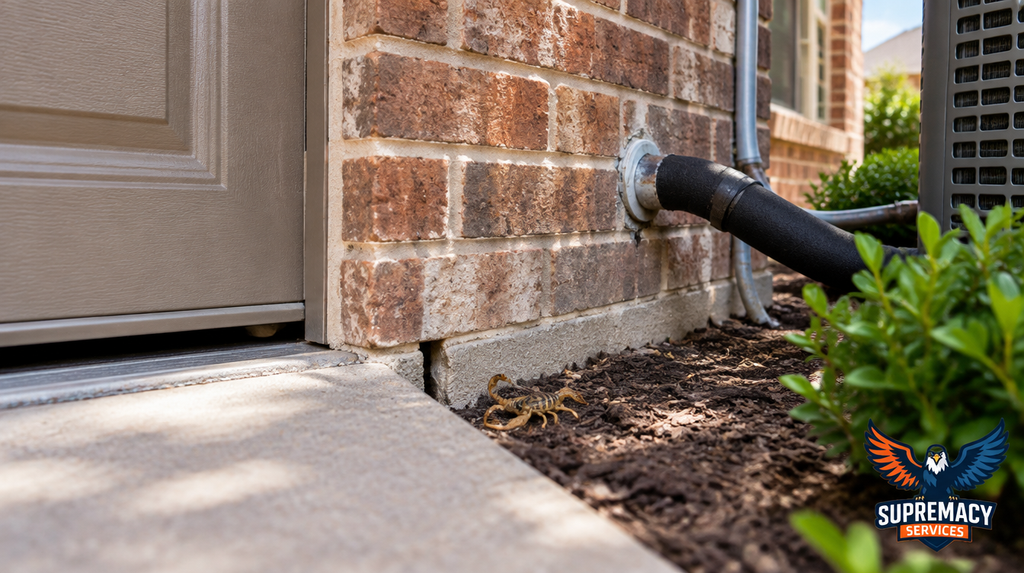
A single scorpion does not automatically require professional treatment.

Homeowners can often make meaningful improvements through exclusion and habitat reduction.

DIY may be reasonable when…Professional inspection becomes useful when…
You found one isolated scorpionScorpions keep appearing
An obvious door gap existsYou cannot identify the entry point
Exterior clutter can easily be correctedActivity occurs in several rooms
Screens or weather-stripping need repairExterior populations appear substantial
You can safely reduce hiding areasOther pest activity is also significant

What about store-bought pesticides?

Treat pesticides as one tool rather than the entire strategy.

EPA recommends identifying the pest, correcting the source of the problem, using pesticides only as directed by their labels and targeting treatments rather than indiscriminately spraying rooms. US EPA

Texas A&M likewise emphasizes environmental modification before chemical control for scorpions. Texas A&M AgriLife Extension Service

Seeing scorpions repeatedly? Learn how Supremacy’s perimeter pest control for Dallas homes targets pest activity around common exterior entry zones before pests move indoors.

Supremacy’s existing pest-control material identifies scorpions among the pests included in its standard perimeter protection. Supremacy Services


What Does Professional Scorpion Control Include?

A sound scorpion-control program should begin with inspection and identification, not indiscriminate spraying.

Depending on the property and findings, professional service may involve:

  1. inspecting exterior scorpion activity;
  2. identifying potential entry points;
  3. locating harborage around the property;
  4. checking doors, windows and utility penetrations;
  5. identifying other insect activity;
  6. recommending habitat modifications;
  7. using appropriately labeled targeted treatments where warranted;
  8. monitoring recurring activity.

Supremacy’s existing perimeter service specifically describes inspection of foundations, plumbing penetrations, doors and windows followed by targeted exterior treatment. Supremacy Services

Why exterior control matters

If scorpions originate outdoors, repeatedly killing individual scorpions after they cross your floor does nothing to address the route they used to enter.

An exterior-focused approach instead asks:

Where are they living → why are they approaching the structure → where are they entering → what can be changed?

That is much closer to integrated pest management.

Finding scorpions in more than one part of your home? Schedule a Dallas pest inspection with Supremacy Services to identify likely entry areas and exterior pest pressure.


Are Scorpions Common Around Dallas and North Texas?

Scorpions occur across Texas, including the species most commonly encountered around homes.

Texas A&M identifies the striped bark scorpion (Centruroides vittatus) as occurring throughout Texas. It is brownish with darker longitudinal stripes, generally relatively small, nocturnal and capable of climbing exterior surfaces. Texas A&M AgriLife Extension Service

That does not mean every Dallas home has a scorpion problem.

Property-level conditions matter considerably.

A house with accessible cracks, stored materials against exterior walls and abundant insect prey can present very different conditions from a tightly sealed, well-maintained neighboring property.

Why garages deserve special attention

DFW garages often create an easy transition between outdoors and conditioned living space.

Inspect:

  • the bottom garage-door seal;
  • corners around the door frame;
  • boxes stored directly on the floor;
  • exterior penetrations;
  • the door between the garage and house.

Reducing garage access can sometimes eliminate the route through which homeowners are seeing scorpions deeper inside the home.
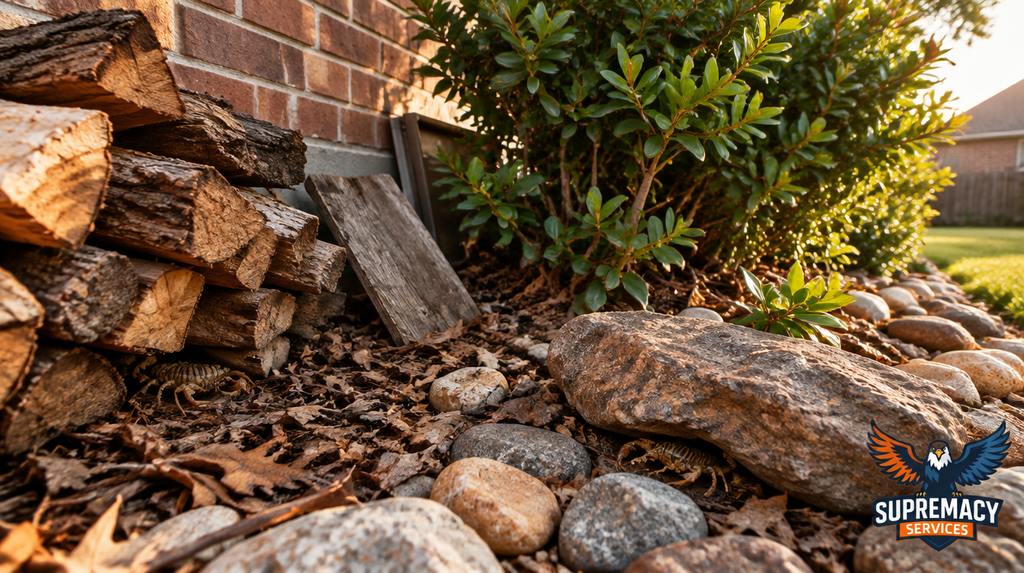

What Should You Do If You Find a Scorpion Indoors?

First, avoid handling it with bare hands.

If it can be done safely, remove or capture the scorpion without direct contact. Then inspect the surrounding room and nearby exterior entry points.

Afterward:

  1. check shoes, clothing and bedding before use if the scorpion was found nearby;
  2. inspect door and window gaps;
  3. look for nearby exterior hiding areas;
  4. record the location of the sighting;
  5. monitor for additional activity;
  6. arrange professional inspection if sightings continue.

What if someone is stung?

Texas A&M reports that Texas scorpion stings generally cause immediate pain and that individual reactions can vary. Persistent pain or swelling and especially breathing difficulty warrant medical attention. Texas A&M AgriLife Extension Service

For medical advice after a sting—particularly when symptoms are significant—contact an appropriate medical professional or poison-control resource rather than relying on pest-control guidance.


Scorpions vs. Other Pests You May Find Indoors

Scorpions can sometimes be part of a broader pest problem.

For example, seeing crickets, roaches, spiders and scorpions around the same property may indicate that the exterior environment offers abundant shelter and prey.

That changes the question from:

“How do I kill this scorpion?”

to:

“Why does my property support so much pest activity?”

Addressing entry points, hiding areas and the underlying insect population generally provides a more complete solution.


When Should You Call a Pest-Control Professional?

Consider professional inspection when:

  • you find scorpions repeatedly;
  • scorpions appear in multiple rooms;
  • you find them around bedrooms or children’s areas;
  • you see substantial nighttime activity outside;
  • you cannot identify their entry point;
  • exclusion improvements have not stopped sightings;
  • your home also has significant cricket, roach or other insect activity;
  • you are uncomfortable safely inspecting likely hiding areas.

Texas regulates structural pest-control businesses and applicators. The Texas Department of Agriculture states that businesses and individuals performing structural pest control for hire are subject to licensing requirements. Texas Agriculture

Keep Scorpions Outside Where They Belong

If scorpions keep appearing inside your Dallas or DFW home, treating each one individually may leave the underlying entry route untouched.

Schedule pest-control service with Supremacy Services to have your property evaluated for exterior pest pressure and likely entry areas.


Frequently Asked Questions

Why am I suddenly finding scorpions in my house?

A scorpion may have found an accessible opening while moving around outdoors. Repeated sightings can indicate persistent entry points or favorable hiding and feeding conditions around the property.

Does one scorpion mean there are more in my house?

No. One sighting does not prove that numerous scorpions are living indoors. Multiple sightings over a short period, however, justify inspecting the home and exterior more carefully.

What attracts scorpions to a home?

Shelter, hiding areas and available prey can make the area around a house favorable to scorpions. Firewood, boards, stones, debris and other protected locations are especially worth inspecting.

Where do scorpions hide during the day?

Scorpions generally seek dark, protected areas. Outdoors this can include beneath wood, rocks and debris. Indoors, inspect garages, closets, storage areas, attics and undisturbed spaces.

Can scorpions climb walls?

Yes. Texas A&M notes that scorpions can climb trees and the sides of homes, so inspection should not be limited to ground-level foundation cracks.

Do scorpions glow under blacklight?

Yes. Scorpions fluoresce under ultraviolet light, making a UV flashlight useful for nighttime inspection.

Should I spray my entire house if I find a scorpion?

Usually that should not be the first response. EPA guidance favors identifying the pest, correcting access and habitat conditions and using targeted pesticide applications according to label instructions when pesticides are necessary.

How can I prevent scorpions from entering my Dallas home?

Seal appropriate cracks, repair door seals and screens, inspect utility penetrations, remove unnecessary exterior hiding materials, trim vegetation away from the structure and reduce other pest activity around the home.
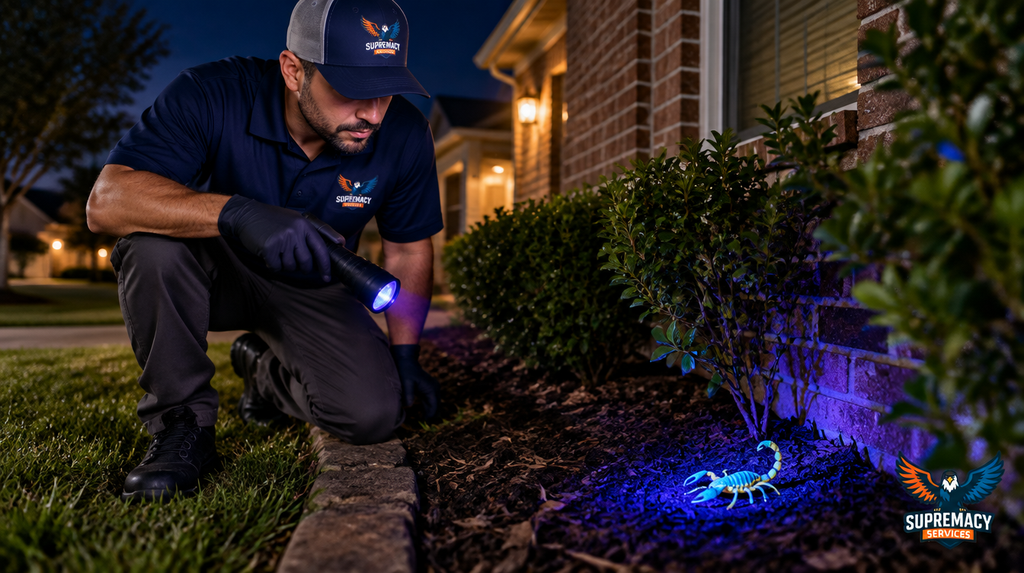

When should I call pest control for scorpions?

Professional inspection makes sense when sightings are recurring, activity occurs in several areas, the entry point cannot be found or DIY exclusion efforts have not solved the problem.

Supremacy Services technician inspecting a mattress seam for signs of bed bugs in a Dallas home.
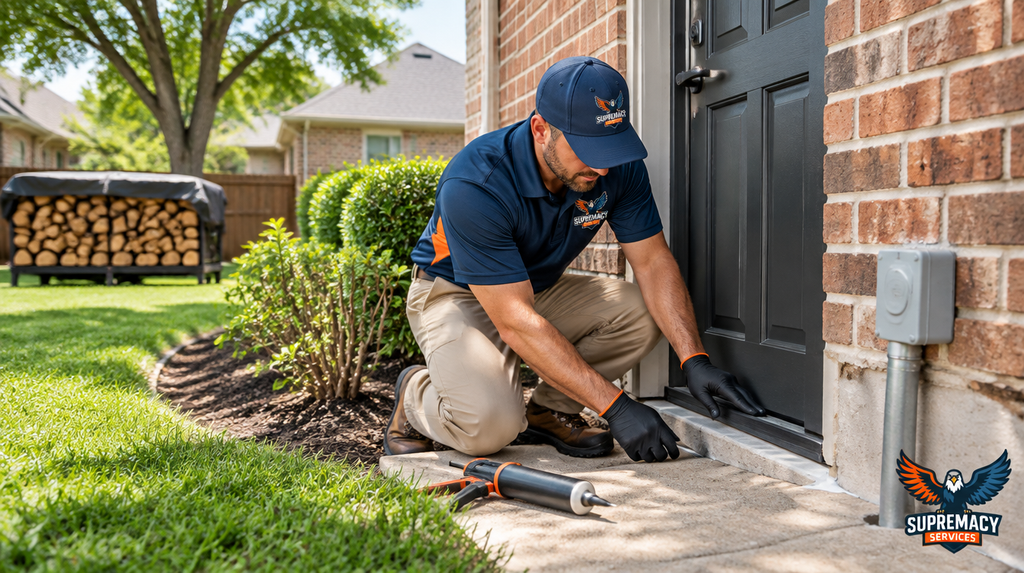
What Are the Signs of Bed Bugs Besides Bites?

Bed bug bites are not the most reliable way to determine whether bed bugs are in your home. Signs of bed bugs besides bites include dark fecal spots, rusty or reddish stains on bedding, shed skins, tiny eggs or eggshells, live bugs and, in heavier infestations, a noticeable musty odor.

That distinction matters for Dallas and DFW homeowners because bite reactions vary significantly. Some people develop itchy marks while others may show no visible reaction. The EPA specifically describes bites as a poor indicator of a bed bug infestation and recommends looking for physical evidence instead.

If you suspect bed bugs, concentrate your inspection around the mattress, box spring, bed frame and headboard before expanding outward to nearby furniture and cracks.

Table of Contents

  1. What Are the Most Reliable Signs of Bed Bugs Besides Bites?
  2. Dark or Black Fecal Spots
  3. Rusty or Reddish Stains on Bedding
  4. Shed Bed Bug Skins
  5. Tiny Bed Bug Eggs and Eggshells
  6. Live Bed Bugs
  7. A Sweet or Musty Odor
  8. Evidence in Mattress and Furniture Crevices
  9. Where Should You Look for Bed Bugs?
  10. Can You Have Bed Bugs Without Seeing Bites?
  11. What Can Be Mistaken for Bed Bugs?
  12. What Should You Do If You Find Signs?
  13. DIY Inspection vs. Professional Inspection
  14. How Professional Bed Bug Treatment Works
  15. How to Reduce the Risk of Bringing Bed Bugs Home
  16. Frequently Asked Questions

What Are the Most Reliable Signs of Bed Bugs Besides Bites?

Close-up comparison of bed bug fecal spots, rusty stains and shed skins on bedding and mattress fabric.
Dark fecal spots, reddish stains and shed skins are physical clues that can indicate bed bug activity.

The strongest evidence of bed bugs is physical evidence of the insects themselves or the traces they leave where they hide.

Look for:

SignWhat to look forCommon locations
Fecal spotsTiny dark brown or black marksMattress seams, bed frames, headboards
Rust-colored stainsSmall reddish or rusty marksSheets, pillowcases, mattress surfaces
Shed skinsPale, empty bug-shaped shellsMattress seams, cracks, furniture
Eggs or eggshellsTiny pale or whitish objectsProtected seams and crevices
Live bugsFlat, oval insects; adults are reddish-brownMattress piping, box springs, frames
Musty odorUnusual sweet/musty smell, generally associated with heavier activitySleeping areas and infested furniture
Clusters of evidenceSeveral of the above signs togetherEstablished hiding areas

Finding one suspicious mark does not automatically prove that you have bed bugs. Finding a live specimen or several characteristic signs in the same hiding area is much stronger evidence.

The EPA recommends physical inspection because skin reactions alone can resemble mosquito bites, flea bites, rashes, eczema and other conditions.

1. Dark or Black Fecal Spots

Tiny dark spots around mattress seams and other hiding places can be bed bug excrement.

The EPA describes these spots as dark marks that may bleed into fabric in a manner similar to ink from a marker.

Pay particular attention to concentrated spotting around:

  • mattress seams and piping;
  • mattress labels and stitching;
  • box-spring edges;
  • joints in the bed frame;
  • cracks around the headboard;
  • upholstered furniture seams.

A random dark speck is not enough to diagnose an infestation. Look for repeated spotting or additional evidence such as cast skins, eggs or live insects.

Do bed bug fecal spots wipe away?

Appearance varies according to the surface. On absorbent materials, fecal material may soak into the fibers rather than behaving like ordinary loose dirt. Avoid relying on a single “wipe test” to identify an infestation.

Instead, inspect the surrounding crevices carefully.

2. Rusty or Reddish Stains on Bedding

Small rusty or reddish stains on sheets or mattresses are another recognized sign of possible bed bug activity.

According to the EPA, these marks can occur when bed bugs are crushed.

Check light-colored bedding especially carefully when changing your sheets. Examine:

  • fitted sheets;
  • mattress protectors;
  • pillowcases;
  • mattress seams;
  • areas where bedding contacts the bed frame.
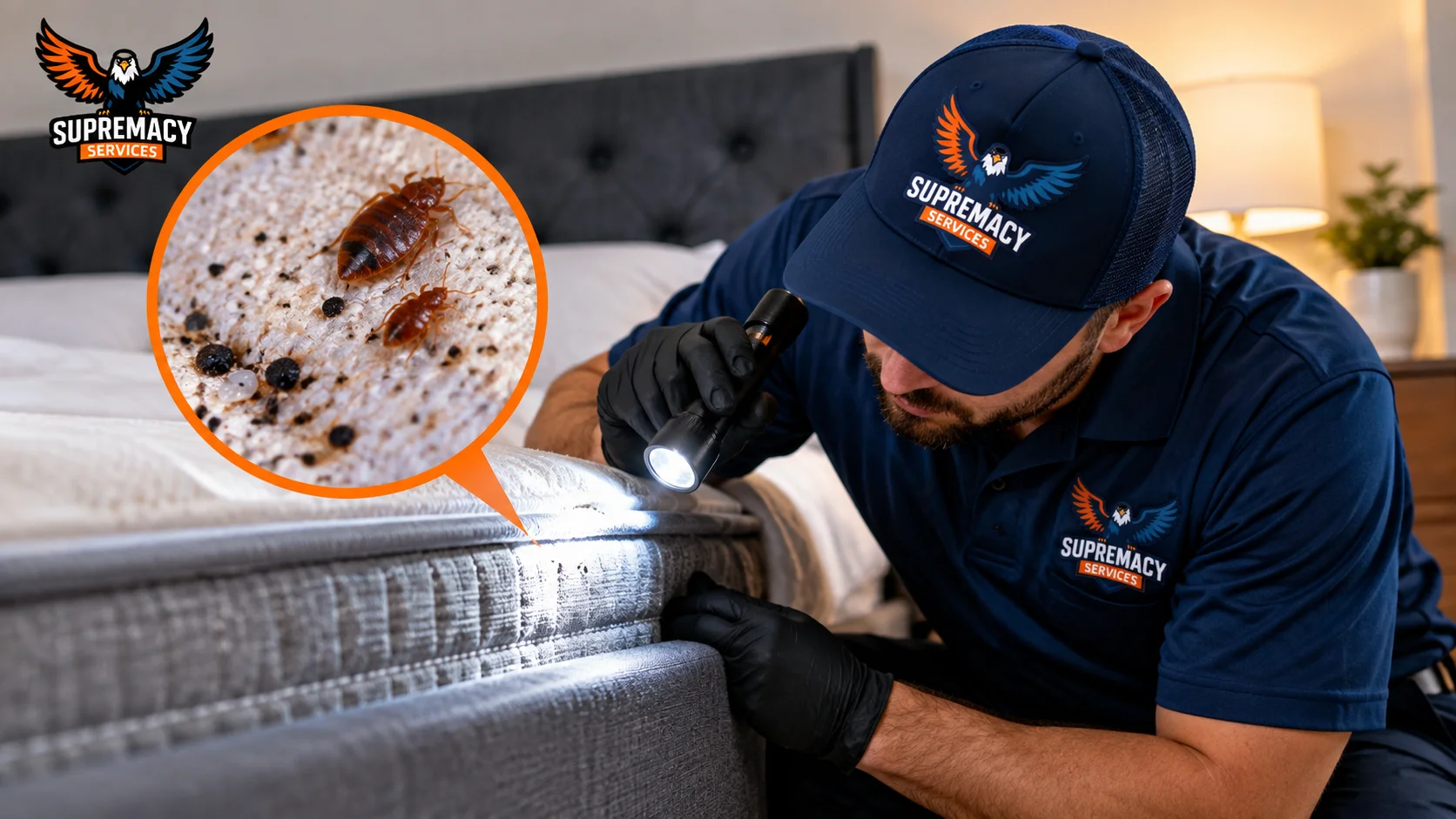
Blood-colored stains can have many causes, so they should be treated as a reason to inspect—not proof by themselves.

If unexplained stains repeatedly appear together with dark spotting or insect evidence, a more thorough bed bug inspection is appropriate.
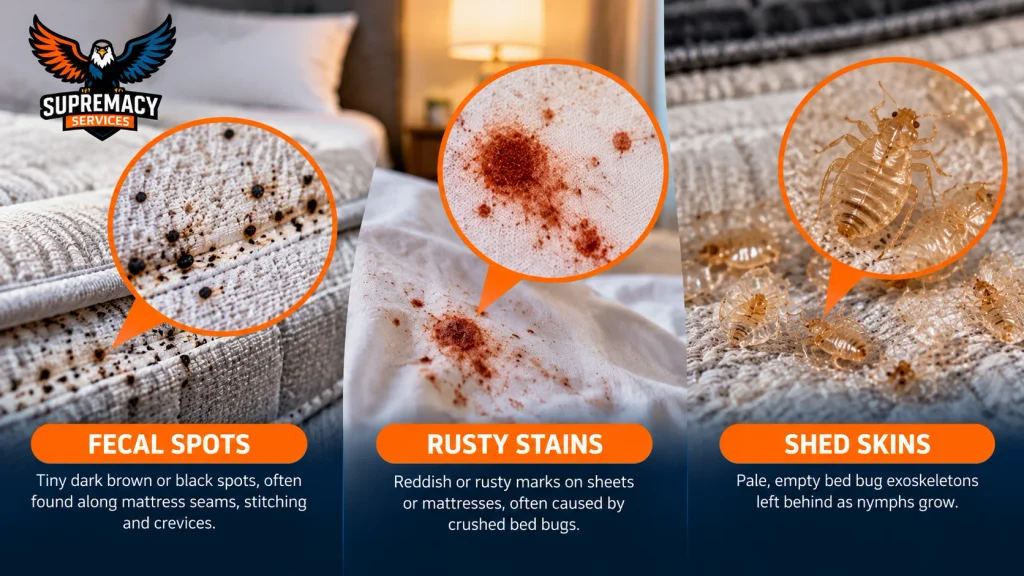
3. Shed Bed Bug Skins
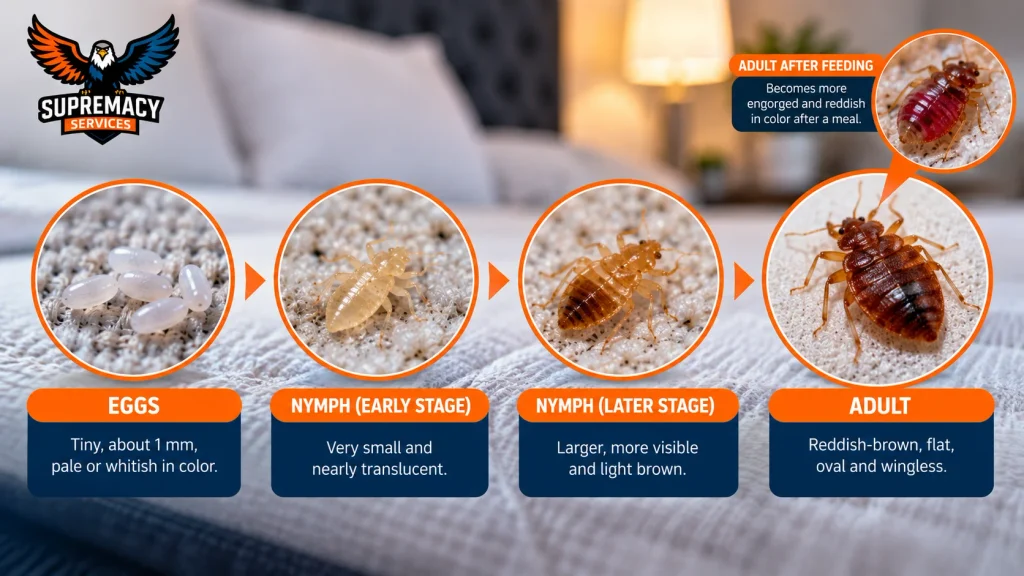
Bed bugs shed their outer skins as immature bugs develop, so empty exoskeletons can indicate that bed bugs have been living and developing nearby.

Young bed bugs, called nymphs, pass through multiple developmental stages before becoming adults.

Their cast skins can look like pale, translucent or yellowish versions of a bed bug.

Because these skins do not move, homeowners sometimes mistake them for dried insects, crumbs or debris.

Look for them inside protected areas such as mattress folds, box-spring crevices, bed-frame joints and behind headboards.

Finding several cast skins concentrated in one area is more concerning than finding a single unidentified fragment.

4. Tiny Bed Bug Eggs and Eggshells

Visual comparison of bed bug eggs, pale nymphs and reddish-brown adult bed bugs on mattress fabric.
Bed bug eggs and young nymphs are much smaller and harder to identify than mature adults.

Bed bug eggs are extremely small and can be difficult to spot without careful inspection.

The EPA describes bed bug eggs as approximately 1 millimeter in size. They are pale and are typically found in protected hiding places.

Potential locations include:

  • mattress and box-spring seams;
  • cracks in bed frames;
  • furniture joints;
  • narrow crevices close to sleeping areas.

Their small size makes visual identification difficult.

Do not assume every white speck on your mattress is a bed bug egg. Fabric fibers, dust and other household debris can look similar to an untrained eye.

When eggs occur alongside fecal spotting, cast skins or live insects, however, the evidence becomes much stronger.

5. Live Bed Bugs

Finding and correctly identifying a live bed bug is one of the clearest ways to confirm an infestation.

Adult bed bugs are small, flat, wingless and reddish-brown. Younger nymphs are smaller and can be much paler.

Bed bugs’ flattened bodies allow them to hide in remarkably narrow spaces.

Start by examining the areas closest to where people sleep rather than searching randomly throughout the entire house.

What do bed bugs look like?

Adult bed bugs have:

  • a flattened, oval body;
  • six legs;
  • no functional wings;
  • a reddish-brown appearance;
  • a body shape that becomes more swollen after feeding.

If you capture a suspicious insect, keep it in a sealed container or clear bag if this can be done safely. A pest professional can often identify a specimen more reliably than identification based on a skin reaction or internet photo alone.

6. A Sweet or Musty Odor

A noticeable sweet or musty odor can occur with bed bug infestations, particularly when activity is substantial.

The CDC includes a sweet, musty odor among signs that may accompany an infestation.

Odor alone, however, is not a reliable diagnostic test.

Bedrooms can develop unusual smells from humidity, laundry, mattresses, pets, mold and many other sources.

Treat odor as supporting evidence rather than confirmation. If it occurs together with spotting, cast skins or live insects, inspect the area more closely.

7. Evidence in Mattress and Furniture Crevices

Sometimes the most important sign is not a single object but a concentration of bed bug evidence in a protected hiding place.

Bed bugs generally remain close to areas where people rest and sleep.

That makes mattress seams, box springs, bed frames and headboards logical places to begin an inspection.

As infestations become more established, evidence may also occur in nearby upholstered furniture, drawers, curtains, cracks and other sheltered spaces.


Where Should You Look for Bed Bugs?

Bedroom inspection diagram highlighting bed bug hiding places around mattress seams, bedding, box spring, headboard and bed frame.
Start your inspection around the bed, paying close attention to seams, joints, cracks and other protected hiding places.

Start with the bed and gradually work outward.

The EPA identifies mattress seams and tags, box springs, bed frames and headboards as important inspection areas. With heavier infestations, bed bugs may also be found in chairs, couches, drawer joints, curtains and other cracks and crevices.

A practical bed bug inspection checklist

Use a bright flashlight and inspect systematically.

1. Remove the bedding

Check sheets and pillowcases for unexplained reddish stains or dark spotting.

2. Inspect the mattress

Pay close attention to seams, piping, labels, stitching, handles and folds.

3. Examine the box spring

Look along edges, seams, corners and protected structural areas.

4. Check the bed frame

Inspect screw holes, joints, cracks and areas where different materials meet.

5. Inspect the headboard

Look behind it as well as around brackets and mounting points.

6. Move to nearby furniture

Check nightstands, upholstered chairs and couches—especially seams and joints.

7. Document suspicious evidence

Take clear photographs or preserve a suspected insect for professional identification when practical.

Avoid immediately carrying suspected infested furniture through the house. Moving belongings without a plan can potentially relocate hidden insects.

Can You Have Bed Bugs Without Seeing Bites?

Yes. The absence of visible bites does not rule out bed bugs.

People respond differently to bed bug bites, and the CDC notes that reactions can range from no physical signs to noticeable marks. Bite marks may also take time to become visible.

That is why checking the home for physical evidence is more useful than asking whether everyone in the household has been bitten.

One person in a household may develop obvious marks while another person may show little or no visible reaction.

Conversely, unexplained itchy marks do not automatically prove bed bugs are responsible.

What Can Be Mistaken for Bed Bugs?

Comparison of a bed bug, carpet beetle, booklouse and cockroach nymph to help distinguish similar household pests.
Several household insects can be mistaken for bed bugs, making correct identification important before treatment.

Carpet beetles and other small household insects can be mistaken for bed bugs, while skin reactions from other insects or dermatological conditions can be mistaken for bed bug bites.

The EPA specifically warns that incorrect identification can delay effective treatment.

Bed bugs vs. other possible problems

What you noticeBed bugs may be possibleOther explanations can include
Itchy skin marksYesMosquitoes, fleas, other arthropods or skin conditions
Tiny insect near bedYesCarpet beetles or other household insects
Dark mattress spotsYesDirt, mold or unrelated stains
Red marks on sheetsYesOther sources of blood or fabric staining
Small pale debrisEggs or shed skins are possibleDust, lint or fabric particles
Musty bedroom smellPossible with infestationHumidity, mold, laundry or other household sources

Texas A&M AgriLife emphasizes that many arthropod bites can look similar and that confirmation of bed bugs should be based on finding and identifying the insect rather than diagnosing the pest from a bite alone.

What Should You Do If You Find Signs?

If you discover convincing bed bug evidence, the next priority is confirmation and containment—not panic-driven disposal of your belongings.

1. Preserve evidence

If possible, photograph the evidence or safely capture a specimen for identification.

2. Avoid moving items between rooms

Moving bedding, furniture, clothing or other belongings from a suspected room to an unaffected area can make inspection and treatment more complicated.

3. Reduce unnecessary clutter

Clutter provides additional hiding places and makes inspection harder. Do not randomly distribute items elsewhere in the home while decluttering.

4. Arrange a professional inspection when evidence is convincing

Bed bugs can occupy extremely small spaces and low-level infestations can be difficult to locate.

If you have found dark spotting, cast skins, eggs or a suspicious insect around your bed, schedule a professional bed bug inspection in Dallas/DFW before the problem has more time to spread.

DIY Inspection vs. Professional Inspection

Supremacy Services pest control technician inspecting a bed frame and mattress for bed bug activity.
A professional bed bug inspection can help confirm suspicious evidence and identify where activity is occurring.

A careful homeowner can identify obvious bed bug evidence, but finding every hiding area is considerably more difficult.

DIY inspectionProfessional inspection
Useful for initial screeningUseful when evidence is uncertain or activity persists
Low costInvolves professional service
Can identify obvious bugs or stainsTechnician can examine likely harborages systematically
Easy to miss small or hidden populationsExperience helps distinguish bed bugs from look-alike pests
Does not itself eliminate an infestationCan lead directly to an appropriate treatment plan

DIY inspection is most useful for answering, “Do I see anything suspicious?”

Professional inspection becomes more valuable when the question is, “Is this actually a bed bug infestation, where is the activity located, and what treatment is appropriate?”

When Is Professional Bed Bug Service Appropriate?

Consider professional help when:

  • you find a live suspected bed bug;
  • you repeatedly find fecal spotting or cast skins;
  • evidence appears in more than one sleeping area;
  • activity continues despite DIY measures;
  • you cannot confidently identify the insect;
  • bed bugs may have spread into upholstered furniture;
  • the infestation involves an apartment, rental or other multi-unit environment;
  • you need an appropriate treatment plan rather than continued inspection.

In Texas, structural pest-control businesses and professionals performing regulated pest-control work are subject to licensing requirements administered by the Texas Department of Agriculture.

Found convincing evidence? Learn how bed bug thermal treatment in DFW works and what homeowners should expect before treatment.

How Professional Bed Bug Treatment Works

Treatment should follow a proper inspection rather than being selected solely because someone has unexplained skin marks.

The exact approach depends on the property, extent and location of activity and treatment method being used.

Supremacy Services’ dedicated bed bug service focuses on professional thermal treatment. The service page describes a process that includes inspection, treatment setup, temperature monitoring and controlled heat circulation throughout targeted spaces.

That commercial page—not this identification guide—should remain the primary page for homeowners ready to investigate or schedule treatment.

What should homeowners expect before service?

Preparation requirements vary by treatment method and property.

A professional may need to know:

  • where evidence has been found;
  • which rooms are affected;
  • whether furniture has recently been moved;
  • whether occupants have recently traveled;
  • whether used furniture has entered the property;
  • whether previous treatments have been attempted.

Follow the pest professional’s preparation instructions rather than improvising a treatment plan.

How Do Bed Bugs Get Into Dallas Homes?

Bed bugs are primarily a transportation and hitchhiking problem, not evidence that a house is dirty.

The CDC notes that they can travel in luggage, overnight bags, folded clothing, bedding, furniture and other belongings.

That means exposure can occur in many environments where people and belongings move between locations.

For Dallas-Fort Worth households, practical risk situations can include travel, overnight guests, moving between residences and bringing secondhand furniture into a home.

Cleanliness alone does not determine whether bed bugs appear in a property.

Are Bed Bugs a Health Risk?

The CDC states that bed bugs are not known to spread disease to people.

They can still create health and quality-of-life problems. Bites may cause itching, and scratching can contribute to secondary skin infections. Some people can experience allergic reactions.

If you have severe swelling, signs of infection or another significant medical reaction, seek appropriate medical advice rather than relying on pest-control guidance for diagnosis.

Pest professionals address the infestation; healthcare professionals address medical symptoms.

How to Reduce the Risk of Bringing Bed Bugs Home

Prevention centers largely on recognizing how bed bugs hitchhike and inspecting belongings after potential exposure.

Practical precautions include:

  • inspect secondhand beds and upholstered furniture carefully before bringing them inside;
  • check luggage after travel;
  • inspect mattress seams when staying away from home;
  • avoid placing luggage directly on beds when traveling;
  • remain alert for unexplained spotting, cast skins or insects after travel;
  • investigate suspicious signs early rather than waiting for bite reactions.

Early identification is particularly valuable because smaller infestations are generally easier to locate and address than established ones.

Bed Bugs in Dallas Apartments and Multi-Unit Buildings

Bed bugs can occur in houses, apartments, hotels, dormitories and other places where people sleep.

Multi-unit properties can make investigation more complicated because determining where activity is occurring may require inspection beyond a single piece of furniture.

Renters who find convincing evidence should document what they see and follow the appropriate property-management reporting process while avoiding actions that could unnecessarily move potentially infested belongings into shared areas.

For treatment involving regulated structural pest-control services in Texas, homeowners and property managers can verify licensing information through the Texas Department of Agriculture.

What Does Bed Bug Treatment Cost?

There is no responsible single price that applies to every Dallas property.

Cost can vary according to factors such as:

  • size of the treatment area;
  • number of affected rooms;
  • extent of the infestation;
  • treatment method;
  • amount and type of furniture;
  • preparation requirements;
  • whether follow-up service is needed.

A property-specific inspection or assessment is therefore more useful than relying on an unsupported online price range.

If pricing is your primary concern, see Supremacy Services’ related guide to bed bug heat treatment cost in Dallas for the cost-focused search intent.


Frequently Asked Questions

What is usually the first physical sign of bed bugs?

Dark fecal spotting, small rusty stains, cast skins or an actual insect around mattress seams can provide early clues. There is no single sign that will always appear first.

What do bed bug droppings look like?

Bed bug fecal evidence can appear as tiny dark spots. The EPA notes that these marks may bleed into fabric similarly to marker ink.

Do bed bugs leave blood stains on sheets?

Rusty or reddish stains on sheets and mattresses are recognized signs of possible bed bug activity. They can occur when bugs are crushed, but stains alone do not confirm an infestation.

What do bed bug eggs look like?

Bed bug eggs are tiny and pale, making them difficult to see. The EPA describes them as approximately 1 millimeter in size.

Can you have bed bugs without bites?

Yes. Some people show no physical reaction to bed bug bites, so the absence of visible bite marks cannot rule out an infestation.

Where do bed bugs hide during the day?

Common hiding places include mattress seams, box springs, bed frames, headboards and nearby cracks. More established infestations can also involve upholstered furniture and other protected crevices.

Does seeing one bed bug mean you have an infestation?

One correctly identified bed bug warrants a thorough inspection. It does not tell you how extensive the problem is, but it should not be ignored.

Do bed bugs only live in dirty houses?

No. The CDC states that cleanliness does not determine whether bed bugs are present. They commonly spread by hitchhiking on luggage, clothing, bedding, furniture and other belongings.

What bugs are commonly mistaken for bed bugs?

Carpet beetles and other small household insects can sometimes be mistaken for bed bugs. Identification of the actual insect is more reliable than diagnosing an infestation from bites.

When should I call a bed bug professional?

Professional inspection is appropriate when you find a suspected live bug, repeated fecal spotting, shed skins or eggs; when activity appears in multiple locations; or when you cannot confidently determine what you are seeing.


Think You Found Bed Bugs in Your Dallas Home?

Bites alone cannot reliably tell you whether bed bugs are present.

Instead, look for the evidence they leave behind: dark fecal spotting, rusty stains, shed skins, tiny eggs and live insects concentrated around sleeping areas.

If you find multiple signs—or simply cannot determine whether the insect or evidence you found is actually from bed bugs—professional identification can prevent you from treating the wrong pest.

Found signs of bed bugs? Schedule a Dallas/DFW bed bug inspection with Supremacy Services and get a treatment recommendation based on what is actually happening in your home.

Cockroach in a kitchen while a pest control technician inspects a Dallas-area home

Why Do Cockroaches Keep Coming Back After Treatment?

If cockroaches keep coming back after treatment, it usually means the conditions supporting the infestation—or the infestation itself—have not been completely eliminated. Hidden egg cases, untreated harborages, available food or moisture, new cockroaches entering from outdoors or neighboring units, poor bait placement, and relying on short-term sprays can all contribute to recurring activity.

Seeing a cockroach shortly after treatment also does not automatically mean the treatment failed. Some control methods take time, and cockroaches that were hidden behind appliances, inside cabinets, around plumbing penetrations or within wall voids may remain visible while the population declines.

For Dallas and DFW homeowners, the important question isn’t simply “Why are the roaches back?” It’s “Where are they coming from, what is allowing them to survive, and is the population actually declining?”

Table of Contents

  1. Why Cockroaches Come Back After Treatment
  2. Does Seeing Roaches After Treatment Mean It Failed?
  3. The 8 Most Common Reasons Cockroaches Keep Returning
  4. German vs. American Cockroaches
  5. How to Tell Whether Treatment Is Working
  6. What Homeowners Should Do After Treatment
  7. DIY vs. Professional Cockroach Control
  8. What Professional Cockroach Control Should Address
  9. How to Prevent Cockroaches From Returning
  10. When to Call a Pest Professional
  11. Frequently Asked Questions

Why Cockroaches Come Back After Treatment

Cockroaches usually return because treatment killed some of the visible insects without fully addressing the population, its hiding places, its resources or its route into the building.

Effective cockroach management therefore involves more than spraying the cockroach you can see.

The EPA recommends an Integrated Pest Management approach that reduces the food, water and shelter pests need while combining prevention with appropriate control methods. UC’s Integrated Pest Management program similarly notes that sanitation and exclusion are important because pesticides alone will not solve many cockroach problems.

That distinction explains why two homes receiving what appears to be the same “roach treatment” can have very different outcomes.

A home where leaks are repaired, food is protected, entry points are addressed and hidden populations are targeted is fundamentally different from a home where exposed surfaces are repeatedly sprayed while the underlying infestation remains undisturbed.

Does Seeing Roaches After Treatment Mean It Failed?

Not necessarily. A few cockroach sightings after treatment can occur while the treatment is working, particularly when bait-based control is being used. The more useful measure is whether activity consistently declines over time.

Some cockroach baits are deliberately slow acting. Cockroaches must locate and consume the bait before it can affect them. University of California IPM guidance notes that bait programs may require seven days or longer before homeowners notice fewer cockroaches.

You should therefore distinguish between:

SituationWhat It May Mean
Occasional sightings shortly after treatmentExisting hidden cockroaches may still be active
Fewer roaches appearing each weekPopulation may be declining
Small nymphs appearingReproduction or previously deposited egg cases may be involved
Activity remains unchangedTreatment strategy or contributing conditions may need reassessment
Activity increases after initially decliningReinfestation, untreated harborages or new entry may be occurring
Roaches repeatedly appear in the same areaA nearby food, water, entry or harborage source should be investigated

Instead of judging treatment by one sighting, monitor frequency, location, size and overall trend.

The 8 Most Common Reasons Cockroaches Keep Returning

1. The Treatment Didn’t Reach the Main Harborage

Common cockroach hiding places behind appliances, inside cabinets, under sinks and along baseboards
Cockroaches often hide in protected areas behind appliances, cabinets, plumbing and structural gaps.

Cockroaches spend much of their time concealed.

Depending on the species and building, hiding areas can include cracks and crevices, cabinet voids, areas behind refrigerators and dishwashers, plumbing penetrations, utility spaces and other protected locations.

Killing insects crossing an exposed floor does not necessarily affect the cockroaches concealed nearby.

This is one reason inspection matters.

If sightings repeatedly occur around one kitchen cabinet, appliance, bathroom vanity or utility penetration, the pattern can provide more useful information than simply counting how many insects were killed.

If recurring roach activity suggests pests are entering from outside or exploiting exterior gaps, explore Supremacy Services’ Dallas pest control options to understand how inspection, prevention and targeted treatment can work together.

2. Egg Cases or Young Cockroaches Remain

Cockroach life cycle showing egg case, nymph, developing cockroach and adult stages
Understanding the cockroach life cycle helps explain why young roaches may appear even after an initial treatment.

A treatment can reduce active cockroaches without instantly eliminating every stage of the population.

Cockroach reproduction complicates control because eggs are protected inside egg cases, called oothecae. The biology differs among species, which is one reason correct identification matters.

If small cockroach nymphs continue appearing, don’t assume they are simply new adults entering the home. Their presence can indicate that an established population still needs to be addressed.

The appropriate response is not automatically to spray more pesticide. It is to reassess where the insects are breeding and whether the control program is reaching those areas.

3. Food Is Still Available

Cockroaches don’t need a forgotten dinner plate to survive.

Food residues can accumulate:

  • beneath appliances;
  • along cabinet edges;
  • under toasters and microwaves;
  • behind stoves;
  • around pet feeding areas;
  • inside trash areas;
  • beneath children’s high chairs;
  • in pantry spills;
  • around grease deposits.

EPA guidance recommends sealing food, removing food scraps and regularly taking out garbage as part of pest prevention.

The objective is not to maintain an unrealistically spotless house. It is to make alternative food sources less competitive with the pest-management strategy being used.

4. A Water Source Hasn’t Been Corrected

Moisture can be just as important as food.

Check for dripping faucets, leaking supply connections, moisture beneath sinks, refrigerator or dishwasher leaks, condensation, damp cabinets and other persistent water sources.

EPA specifically recommends fixing leaking plumbing and eliminating unnecessary water sources as part of pest prevention.

A cockroach treatment may therefore be undermined by something as simple as a slow plumbing leak hidden beneath the kitchen sink.

5. The Wrong Treatment Method Is Being Used

Comparison of repeated cockroach spraying with professional inspection, targeted treatment, sanitation and exclusion
Long-term cockroach management addresses hiding places, food, moisture and entry points instead of relying only on repeated spraying.

One of the biggest mistakes in recurring cockroach control is assuming that more pesticide automatically means better control.

It doesn’t.

UC IPM advises against relying on foggers, bombs and aerosol sprays for cockroach management. These treatments may fail to reach the cracks and crevices where cockroaches hide, and some sprays can disperse cockroaches into other areas.

EPA also recommends targeted pesticide use rather than indiscriminately spraying an entire room and encourages the use of baits and crack-and-crevice treatments where appropriate.

This is especially important when using cockroach bait.

Applying other products around bait locations can potentially interfere with the baiting strategy. Homeowners should follow every product label exactly rather than combining multiple treatments in an attempt to accelerate results.

6. Cockroaches Are Re-Entering From Outdoors

Not every cockroach problem originates inside the kitchen.

Some cockroach species primarily live outdoors and occasionally enter buildings. Entry points can include gaps beneath doors, damaged weather stripping, openings around utilities, cracks and other exterior vulnerabilities.

That makes species identification important.

If an outdoor species is repeatedly entering the house, concentrating exclusively on interior surfaces may treat the symptom rather than the route of entry.

Exterior sanitation, exclusion and targeted perimeter management may be more important.

For Dallas homeowners dealing with repeated outdoor pest entry, this is where perimeter pest control and structural prevention become relevant rather than simply scheduling another indoor spray.

7. Cockroaches Are Moving Between Units

Recurring cockroach activity can be particularly challenging in apartments, townhomes and other connected buildings.

Cockroaches may move through plumbing penetrations, utility pathways, wall voids and other connections between neighboring spaces.

A homeowner or tenant can improve sanitation and treat one area successfully yet continue experiencing new activity if the broader source remains untreated.

If you live in a multi-unit property, record where and when cockroaches appear and notify the appropriate property manager when activity appears to involve multiple units or common building areas.

8. Nobody Is Monitoring the Results

Cockroach control should not end when pesticide is applied.

Monitoring helps determine whether the infestation is actually shrinking.

Sticky monitoring traps can be placed in appropriate locations along walls, beneath appliances, inside cabinets or near suspected activity zones. Their purpose is not necessarily to eliminate an infestation by themselves; they help reveal where cockroaches are active and whether activity changes over time.

UC IPM recommends traps for identifying activity and tracking populations.

Without monitoring, homeowners often fall into a frustrating cycle:

See roach → spray roach → see another roach → spray again.

That provides very little information about whether the underlying population is improving.

German vs. American Cockroaches: Why Identification Matters

German cockroach and American cockroach comparison showing size, habitat and control differences
Identifying the cockroach species helps determine whether activity is primarily an indoor infestation or involves pests entering from outside.

Different cockroach species can require different strategies.

CharacteristicGerman CockroachAmerican Cockroach
General sizeSmallerConsiderably larger
Common patternOften associated with indoor infestationsOften associated with warm, damp areas and can invade from outside
Typical concernReproduction within the structureInterior activity may involve outdoor or structural sources
Strategy emphasisInterior inspection, sanitation, monitoring and targeted baitingEntry-point investigation, moisture management, exterior conditions and targeted control
Why identification mattersTreating only exterior entry may miss an established indoor populationTreating only kitchen surfaces may miss the exterior source

Texas A&M AgriLife specifically recommends understanding the species and biology involved before choosing control methods.

If you cannot identify the cockroach, photograph it or capture a specimen safely for identification rather than assuming every large or small roach represents the same problem.

How to Tell Whether Cockroach Treatment Is Working

Look for a downward trend, not necessarily immediate zero activity.

Useful indicators include:

Fewer sightings. You should eventually encounter fewer live cockroaches.

Lower monitoring counts. Sticky monitors should show declining activity.

Fewer locations affected. Activity that once occurred throughout the kitchen may become concentrated in one remaining area.

Less evidence. Droppings, egg cases and other signs should stop accumulating.

No continuing spread. New rooms should not begin developing activity.

If sightings remain frequent, spread to additional areas or rebound after declining, the problem should be reassessed.

The question becomes: Is there an untreated population, continuing food or moisture, an exterior source, neighboring-unit activity, poor bait placement or another condition sustaining the infestation?

What Homeowners Should Do After Cockroach Treatment

A successful treatment program usually requires cooperation between the control method and the conditions inside the home.

After treatment:

  1. Follow the technician’s or product label’s instructions exactly.
  2. Do not spray additional insecticide over or near bait unless the product directions or pest professional specifically allow it.
  3. Remove accessible food residues.
  4. Store pantry foods securely.
  5. Clean grease and crumbs beneath appliances.
  6. Empty trash regularly.
  7. Avoid leaving pet food out overnight.
  8. Repair plumbing leaks and other moisture sources.
  9. Reduce unnecessary cardboard and clutter.
  10. Monitor known activity areas.
  11. Seal appropriate gaps and entry points.
  12. Record continuing sightings by location and date.

This information becomes extremely useful if a follow-up visit is needed.

DIY vs. Professional Cockroach Control

Minor or isolated activity can sometimes be addressed through sanitation, exclusion, monitoring and properly labeled consumer products.

A widespread or persistent infestation is different.

DIY May Be Reasonable WhenProfessional Assessment Is More Appropriate When
You see an occasional outdoor invaderCockroaches appear repeatedly
The source is obviousYou cannot locate the source
Activity is limitedSeveral rooms are affected
Monitoring shows little activityTraps repeatedly catch cockroaches
Entry gaps can be correctedActivity appears to originate inside walls or inaccessible areas
There is no evidence of reproductionNymphs and multiple life stages are present
Activity decreases steadilyTreatment produces little or temporary improvement
Detached home with isolated activityConnected/multi-unit structure with recurring activity

Whatever approach you use, follow pesticide labels precisely.

The EPA recommends using only products approved for their intended setting and following all label instructions and safety warnings.

Why Repeated Bug Bombs Aren’t a Good Long-Term Strategy

Total-release foggers—commonly called bug bombs—should not be treated as a shortcut for locating and addressing a cockroach infestation.

EPA warns that foggers can create fire, explosion and exposure hazards when used improperly. UC IPM additionally notes that foggers may fail to reach cockroach hiding places and can disperse insects without producing effective long-term control.

The better question is not, “What can I spray everywhere?”

It is, “Where is the population living, and why can it continue surviving here?”

What Professional Cockroach Control Should Address

Pest control technician inspecting under a kitchen sink for cockroaches, moisture and hidden activity
A professional cockroach inspection looks beyond visible pests to identify harborages, moisture, entry points and continuing activity.

Professional cockroach management should begin with diagnosis.

A useful inspection should help determine:

1. Which cockroach is present?
Species influences likely harborages, entry routes and management methods.

2. Where is activity concentrated?
Monitoring and inspection can identify hotspots.

3. Is the infestation established indoors?
This helps distinguish reproduction inside the structure from occasional outdoor invaders.

4. What food, water or shelter is supporting the population?
Treatment alone may be undermined if these resources remain abundant.

5. How are cockroaches moving through the property?
Doors, plumbing penetrations, utility openings, wall voids and other pathways may matter.

6. Which targeted control measures are appropriate?
Depending on the situation, this can involve baiting, monitoring, crack-and-crevice treatment, dusts in appropriate inaccessible locations, exterior control or other label-compliant methods.

7. What needs to happen after treatment?
Follow-up monitoring is essential for persistent infestations.

If you’ve already treated your home but roaches continue appearing, consider scheduling a professional pest inspection in Dallas rather than simply repeating the same treatment. Identifying the species, source and conditions supporting the infestation can determine what needs to change.

Why Dallas and DFW Homes Can Experience Recurring Roach Activity

North Texas homes can experience both established indoor cockroach infestations and cockroaches entering from outdoor environments.

Rather than attributing every recurrence simply to “Texas weather,” look at the property itself.

Important areas to investigate include:

  • exterior doors and garage entrances;
  • plumbing and utility penetrations;
  • kitchens and pantries;
  • bathroom vanities;
  • irrigation or moisture near the structure;
  • trash storage areas;
  • cardboard storage;
  • cracks and protected exterior areas;
  • connected walls in apartments or townhomes.

A detached Dallas home where large outdoor cockroaches occasionally enter through a garage requires a different approach from a kitchen supporting an established population of smaller German cockroaches.

That distinction is exactly why inspection and identification should come before repeated treatment.

How to Prevent Cockroaches From Returning

Long-term prevention is about making the home difficult to enter and difficult to live in.

Food

Keep food sealed, clean crumbs and grease from difficult-to-reach areas, manage trash and avoid leaving pet food available overnight.

Water

Repair leaks, investigate unexplained moisture and dry areas where water routinely accumulates.

Shelter

Reduce unnecessary cardboard, paper bags and clutter in cockroach-prone areas.

Entry Points

Repair damaged screens and door sweeps and address appropriate gaps around exterior penetrations.

Monitoring

Keep monitoring high-risk areas after activity appears to stop. Early detection is easier to address than another established infestation.

Exterior Conditions

Where outdoor cockroaches are involved, investigate moisture, debris, trash storage and structural entry routes around the home.

This prevention-first approach aligns with EPA Integrated Pest Management guidance: remove the conditions pests depend on while using targeted control where necessary.

When Should You Call a Pest Professional?

Consider professional evaluation when cockroaches continue appearing despite sanitation and properly performed treatment, when multiple rooms are affected, when small nymphs indicate continuing reproduction, or when you cannot identify where the insects are coming from.

Professional help is also useful when:

  • activity returns repeatedly after temporary improvement;
  • cockroaches are regularly seen during the day;
  • several life stages are present;
  • neighboring units may be involved;
  • activity is occurring in inaccessible structural areas;
  • DIY sprays and foggers have not solved the problem;
  • you need help distinguishing indoor infestation from outdoor invasion.

Texas regulates structural pest-control businesses and applicators. The Texas Department of Agriculture’s Structural Pest Control Service oversees licensing for professionals providing structural pest-control services.

When choosing a provider, ask what the inspection includes, how the pest will be identified, what conditions need correction, how results will be monitored and what follow-up is included.


Frequently Asked Questions

Why am I still seeing roaches after pest control?

Some cockroaches may remain active while treatment takes effect, especially with slow-acting baits. Persistent or unchanged activity, however, can indicate untreated harborages, reproduction, continuing food or water sources, or reinfestation.

How long should I see cockroaches after treatment?

There is no universal timeline because treatment method, species and infestation severity differ. Some bait programs may take seven days or longer before noticeable reductions occur. Monitor the overall trend rather than relying on a single sighting.

Does seeing baby roaches mean treatment failed?

Not automatically. Young cockroaches may emerge from egg cases that were already present. Continued nymph activity over time can, however, indicate an established population requiring further assessment.

Why do cockroaches come back after spraying?

Spraying visible cockroaches may not reach insects hidden inside cracks, cabinets, wall voids or other harborages. Some sprays can also interfere with broader management strategies. Long-term control normally requires identifying and correcting the conditions supporting the infestation.

Can cockroaches become resistant to insecticides?

Cockroach populations can develop resistance to some insecticides. This is one reason repeatedly applying the same type of treatment without monitoring results is not a sound strategy. Persistent activity should be reassessed rather than automatically treated with more of the same product.

Should I use a bug bomb if roaches keep returning?

Foggers are generally not a preferred solution for persistent cockroach infestations. They may fail to reach hidden harborages, and improper use can create exposure, fire or explosion hazards. Targeted management is usually more appropriate.

Can roaches come through drains?

Cockroaches can be associated with drains, plumbing areas and other moist environments, but seeing one near a drain does not prove that the drain itself is the source. Inspect plumbing penetrations, moisture and nearby harborages before drawing that conclusion.

Why do I have roaches when my house is clean?

Clean homes can still experience cockroach activity. Cockroaches may enter from outdoors, arrive in packages, migrate from neighboring units or find moisture and shelter in places that are difficult to inspect. Sanitation helps control them, but cleanliness alone cannot eliminate every entry route or hidden infestation.

What attracts cockroaches to a house?

Food, moisture and protected hiding areas are major factors. Crumbs, grease, pet food, garbage, leaking plumbing, clutter and structural gaps can all contribute depending on the cockroach species involved.

When should I call an exterminator for roaches?

Professional assessment becomes especially useful when activity persists after treatment, multiple areas are affected, young cockroaches continue appearing, the infestation is established indoors or you cannot identify the source.


Stop Treating the Sightings and Find the Source

When cockroaches keep coming back after treatment, repeating the same spray is rarely the most informative next step.

Determine which cockroach is present, where it is hiding, what food or moisture supports it, how it is entering or moving through the building, and whether the population is actually declining.

That turns cockroach control from repeated reaction into a measurable pest-management strategy.

For Dallas and DFW homeowners dealing with recurring roaches, Supremacy Services can inspect the property, identify likely pest pressure and recommend an appropriate prevention and control plan.

Explore pest control services in Dallas and DFW or request an inspection if cockroach activity continues after previous treatment.

Pest control technician inspecting a North Texas home foundation for visible signs of termite activity.

Signs of Termite Activity North Texas Homeowners Shouldn’t Ignore

Termites can be active inside a North Texas home long before a homeowner sees insects crawling across a floor. Some of the most important signs of termites in a house are subtle: narrow mud tubes along the foundation, discarded wings near windows, wood that sounds hollow, damaged trim, unexplained blistering, or a sudden swarm of winged insects.

For Dallas–Fort Worth homeowners, finding one of these signs does not automatically prove that extensive structural damage has occurred. It does mean the area deserves closer inspection.

The Texas Department of Agriculture notes that termites can be difficult to detect because they often work from inside wood or concealed areas. A professional inspection can help determine whether suspicious evidence represents active termites, old damage, or another wood-destroying organism.

Table of Contents

  1. What are the most common signs of termites?
  2. Mud tubes along the foundation
  3. Termite swarmers around your home
  4. Discarded termite wings
  5. Hollow or damaged wood
  6. Blistering or unusual wood surfaces
  7. Termite damage around doors and trim
  8. Soil or mud appearing inside cracks
  9. Termite droppings or pellets
  10. Termites discovered during remodeling
  11. Termites vs. ants
  12. Where should North Texas homeowners look?
  13. What attracts termites to a home?
  14. What should you do if you find termite activity?
  15. DIY vs. professional termite inspection
  16. What happens during a professional termite inspection?
  17. How can you reduce termite risk?
  18. Frequently Asked Questions

What Are the Most Common Signs of Termites?

The most common warning signs include mud tubes, termite swarmers, piles of discarded wings, hollow or damaged wood, blistered wood surfaces and visible damage to structural or decorative wood.

Texas regulators specifically identify shelter tubes, weak or broken structural members, blistered wood and soil in cracks as possible evidence of subterranean termites.

Here is a quick homeowner checklist:

Warning signWhat you may noticeWhy it matters
Mud tubesPencil-width or irregular soil tubesPossible subterranean termite travel route
SwarmersGroups of winged insectsReproductive termites may be establishing colonies
Discarded wingsSmall piles near windows or doorsCan remain after a swarm
Hollow woodThin surface over damaged interiorTermites may have consumed internal wood
BlisteringRaised or irregular wood surfaceCan accompany concealed damage
Damaged trimSoft, weak or crumbling woodRequires investigation
Soil in cracksMud-like material in structural gapsCan be associated with subterranean activity
PelletsSmall dry particles near woodMay indicate certain termite species
Hidden galleriesChannels exposed during repairsEvidence may become visible when wood is opened

No single homeowner test should be used to determine the extent of an infestation.

1. Mud Tubes Along the Foundation

Subterranean termite mud tubes running from the soil onto the brick and concrete foundation of a home.
Mud tubes along a foundation are an important warning sign of possible subterranean termite activity.

Mud or shelter tubes are one of the most recognizable signs associated with subterranean termites.

Look along:

  • slab and foundation edges;
  • foundation walls;
  • plumbing penetrations;
  • piers and supports;
  • masonry joints;
  • cracks and expansion joints; and
  • locations where soil is close to the structure.

Subterranean termites generally live in the soil and construct protected passageways between the colony and a food source. The Texas Department of Agriculture specifically lists shelter tubes on walls, joists, piers, chimneys, plumbing and other fixtures as a potential sign of termite activity.

A dried or damaged tube should not automatically be interpreted as proof that the infestation is gone. Determining whether activity is current and locating other concealed entry points requires a more complete inspection.

Found suspicious mud tubes around your foundation? Learn how Supremacy Services approaches termite inspection and structural protection through our Termite Vault Security service.

2. Termite Swarmers Around Your Home

A sudden appearance of winged termites—called swarmers or alates—is one of the clearest reasons to investigate a possible termite problem.

Swarmers are reproductive members of a mature colony. The Texas Department of Agriculture notes that subterranean termites are often detected during swarming.

Pay particular attention when winged insects appear:

  • inside the house;
  • around windows;
  • around exterior doors;
  • near lights;
  • around foundation walls; or
  • in significant numbers immediately beside the structure.

A swarm outdoors does not necessarily prove that termites are damaging your house. Swarmers emerging from inside the structure, however, deserve prompt investigation.

If possible, save several specimens in a sealed container or plastic bag for identification rather than immediately discarding everything. Texas regulators specifically suggest preserving swarmers for the pest-control operator who performs the inspection.

3. Discarded Termite Wings

After swarmers find a suitable location, their wings can be shed.

Homeowners may consequently discover small piles of wings around:

  • windowsills;
  • door frames;
  • sliding doors;
  • baseboards;
  • vents; or
  • other light sources.

The wings alone do not tell you how extensive an infestation may be, but unexplained piles of similar-sized wings are worth investigating.

Termite wings vs. flying ants

Termites and flying ants are frequently confused.

EPA recommends distinguishing termite swarms from ant swarms when investigating suspected termite activity. If you cannot confidently identify the insects, save a specimen for professional identification rather than assuming that every winged insect is a termite.

4. Hollow or Damaged Wood

Close-up of termites and concealed galleries inside severely damaged structural wood.
Termites can consume wood internally, allowing significant damage to remain concealed beneath the surface.

Wood that sounds hollow, feels unusually soft or breaks easily can indicate internal deterioration, including possible termite damage.

Termites may consume wood internally while leaving a relatively thin exterior surface intact. That is one reason significant activity can remain concealed.

Potential areas to inspect include:

  • baseboards;
  • window and door trim;
  • exposed framing;
  • garage framing;
  • crawlspace components where applicable;
  • wooden posts;
  • sill areas; and
  • wood close to soil.

EPA suggests examining accessible exposed wood for hollow areas as one way homeowners can look for possible termite activity.

Avoid aggressively puncturing finished walls, structural members or electrical/plumbing areas merely to search for termites. A visual check of safely accessible material is a better starting point.

5. Blistering or Unusual Wood Surfaces

Blistered, raised or irregular wood can sometimes accompany termite activity, although moisture and other building problems can produce similar symptoms.

Texas regulators list blistered wood among potential evidence of subterranean termite activity.

The important point is not to diagnose termites based on appearance alone.

Blistered wood may also be associated with:

  • water leaks;
  • high moisture;
  • deteriorating finishes;
  • wood rot;
  • installation problems; or
  • other insects.

If the affected area is close to the foundation, plumbing, an exterior wall or another potential termite access point, include it in the inspection.

6. Termite Damage Around Doors and Trim

A door that suddenly becomes difficult to close is not automatically a termite problem. Humidity, foundation movement, normal wood expansion and installation issues can all affect doors and windows.

The warning becomes more significant when sticking doors or distorted trim occur alongside evidence such as:

  • mud tubes;
  • visible galleries;
  • soft wood;
  • discarded wings; or
  • swarmers.

Look for combinations of evidence rather than relying on one nonspecific symptom.

7. Soil or Mud Appearing Inside Cracks

Unexplained soil-like material in structural cracks or around wood can be another reason to investigate subterranean termites.

The Texas Department of Agriculture lists soil in cracks among possible evidence of subterranean termite activity.

Check accessible areas around:

  • slab penetrations;
  • plumbing;
  • foundation cracks;
  • attached garages;
  • masonry;
  • expansion joints; and
  • locations where wooden construction components approach the soil.

Do not seal suspicious tubes or cracks before documenting what you found. Photographing the location first can give the inspector useful context.

8. Termite Droppings or Pellets

Small piles of pellet-like material can be associated with drywood termites, which behave differently from subterranean termites.

Texas A&M AgriLife identifies fecal pellets and indoor swarming among evidence associated with drywood termite infestation.

This distinction matters because different termite species can require different inspection and treatment strategies.

Do not assume that every pile resembling sawdust is termite waste. Carpenter ants, wood-boring insects, construction debris and ordinary household material can create similar-looking evidence.

9. Termites Discovered During Remodeling

Sometimes the first obvious evidence of termite activity appears only after drywall, trim, flooring or another building component is removed.

You may find:

  • damaged internal wood;
  • galleries or channels;
  • mud inside concealed spaces;
  • live termites; or
  • older repaired damage.

EPA notes that homeowners may remain unaware of termites until a swarm occurs or damage is encountered during construction.

If suspicious damage is uncovered during remodeling, document the area before removing more material when practical. The exposed area may help an inspector determine what happened and where additional inspection is needed.


Can You Have Termites Without Seeing Any Signs?

Yes. A home can have termite activity without obvious visible evidence.

This is one of the most important things homeowners should understand about termites.

The Texas Department of Agriculture specifically warns that an absence of visible termite signs does not necessarily mean a property is termite-free because termites can remain concealed.

That means a quick walk around the house cannot provide the same information as a systematic inspection of accessible risk areas.

This is particularly relevant when:

  • buying or selling a property;
  • unexplained wood damage appears;
  • neighboring structures have had termite problems;
  • previous termite evidence exists;
  • conditions around the structure favor termite access; or
  • swarmers appear indoors.

Termites vs. Ants: How Can You Tell the Difference?

Side-by-side comparison of a termite swarmer and flying ant showing differences in antennae, wings and body shape.
Termite swarmers have different antennae, wing proportions and body shapes than flying ants.

Winged termites and flying ants can look surprisingly similar from a distance, but they are different insects and require different control strategies.

FeatureTermite swarmerFlying ant
BodyBroad, less constricted waistNarrow/constricted waist
AntennaeGenerally straighterElbowed
WingsTwo pairs of roughly similar lengthFront pair noticeably larger
Meaning indoorsPossible termite colony activityPossible ant nesting/activity

Do not make a treatment decision from an internet photograph alone. If you find swarmers, preserving a few specimens gives an inspector a much better opportunity to identify them correctly.


Where Should North Texas Homeowners Look for Termite Activity?

North Texas home diagram highlighting foundation, garage, plumbing, windows, attic and exterior wood areas to check for termite signs.
Termite warning signs can appear around foundations, plumbing penetrations, garages, windows, exterior wood and other parts of the home.

Start with the places where termites could gain concealed access to the structure or where moisture and wood are present.

Around the foundation

Walk around the perimeter and look for:

  • mud tubes;
  • cracks with soil-like material;
  • wood touching soil;
  • damaged trim;
  • moisture problems; and
  • suspicious activity around utility penetrations.

Inside the garage

Attached garages can provide several accessible places to examine slab edges, wall bases, trim and stored wood products.

Around plumbing

Look around safely accessible plumbing penetrations and areas with persistent leaks or moisture.

Around exterior wood

Check wooden features close to the house, particularly where wood remains damp or touches the soil.

Around windows and doors

Look for discarded wings, swarmers and unexplained wood deterioration.

The objective is not to dismantle your home. It is to recognize visible evidence and conditions that justify professional evaluation.


Why Are Termites a Concern in North Texas?

Texas A&M AgriLife identifies Texas as one of the states at significant risk for termite infestation, and subterranean termites are an important structural pest in the state.

North Texas homeowners therefore benefit from understanding the difference between general household pest prevention and termite-specific structural protection.

Termites are not simply another insect that happens to enter the kitchen. Their food source can include cellulose-containing structural materials, and their activity may remain concealed.

That is why Supremacy’s general perimeter pest control page and dedicated Termite Vault Security page should remain separate. General perimeter pest management targets common household invaders, while termite inspection, monitoring and treatment require termite-specific methods.


What Conditions Can Increase Termite Risk Around a Home?

Termites need food, and subterranean termites are closely associated with soil and moisture.

Practical risk-reduction efforts include addressing conditions such as:

Wood-to-soil contact

Wood touching soil can create an easier concealed route between the ground and a food source.

Examples include:

  • buried wood scraps;
  • landscape timbers against the structure;
  • wooden siding extending too close to grade;
  • posts contacting soil; and
  • construction debris left near the foundation.

Persistent moisture

Leaks and drainage problems deserve attention even when termites are not present.

Check for:

  • leaking outdoor faucets;
  • plumbing leaks;
  • drainage that keeps the foundation perimeter persistently wet;
  • damaged gutters or downspouts; and
  • other chronic moisture sources.

EPA’s broader pest-management guidance recommends eliminating sources of food, water and shelter as part of preventing pest problems.

Hidden foundation access

Cracks and utility penetrations can make termite evidence harder for homeowners to recognize.

The goal of prevention is not to assume that every crack means termites are entering. Instead, maintain the building so suspicious activity is easier to identify.


What Should You Do If You Find Signs of Termite Activity?

Document the evidence, avoid unnecessarily disturbing it, correct obvious moisture problems where appropriate, and arrange an inspection if the evidence is credible or unexplained.

Step 1: Photograph what you found

Take close and wider photographs showing the evidence and its location.

Step 2: Save insect specimens

If you find swarmers, preserve several specimens for identification.

Step 3: Do not assume the problem is isolated

The visible location may not represent the full extent of activity.

Step 4: Avoid covering the evidence immediately

Painting, caulking, replacing trim or removing tubes before an inspection can eliminate useful clues.

Step 5: Schedule a termite inspection

A termite professional can evaluate accessible areas, identify evidence and determine whether treatment is warranted.

If you have found mud tubes, swarmers or suspicious wood damage, schedule a termite inspection before covering or repairing the affected area. Explore Supremacy Services’ Termite Vault Security options for Dallas–Fort Worth homes.


Can You Inspect for Termites Yourself?

Homeowners can look for visible warning signs, but a DIY check cannot reliably rule out concealed termite activity.

A homeowner inspection is useful for spotting:

  • obvious tubes;
  • swarms;
  • wings;
  • accessible wood damage;
  • moisture problems; and
  • wood-to-soil contact.

It becomes less reliable when activity is concealed behind walls, beneath floors or in other inaccessible building components.

The Texas Department of Agriculture explicitly cautions that termites are often difficult to detect and recommends professional inspection when homeowners need to determine whether visible termite infestation is present.

What about DIY termite pesticides?

Be especially careful here.

EPA explains that termiticides intended to protect structures have specific registered uses and labels, and notes that in most cases proper application requires a trained pest-management professional.

Improper treatment can also make an infestation more difficult to evaluate without providing adequate structural protection.


What Happens During a Professional Termite Inspection?

Supremacy Services technician inspecting a home foundation and termite monitoring station for signs of activity.
Professional termite inspections can evaluate suspicious areas and help determine whether additional termite treatment or monitoring is appropriate.

A termite inspection should focus on identifying visible evidence, accessible damage and conditions that may contribute to termite activity.

Depending on the property and purpose of the inspection, the inspector may evaluate areas such as:

  • foundation perimeter;
  • accessible structural wood;
  • plumbing penetrations;
  • garages;
  • crawlspaces where present and accessible;
  • attic areas where relevant;
  • interior areas associated with suspicious evidence; and
  • exterior conditions conducive to infestation.

If treatment is recommended in Texas, consumers have specific protections.

The Texas Department of Agriculture says a termite-treatment proposal must include written disclosure information such as a diagram showing areas to be treated and active or previous activity, warranty or guarantee terms, the chemical label when applicable, and information about liquid termiticide concentration or the minimum number of bait stations to be installed.

This documentation gives homeowners something concrete to compare rather than choosing a treatment based only on a verbal sales pitch.


What Termite Treatments May Be Recommended?

Treatment depends on the termite species, construction and location of activity; there is no single treatment that is automatically appropriate for every house.

EPA identifies several termite-management approaches, including:

  • liquid soil-applied termiticides;
  • termite bait systems;
  • treated building materials; and
  • wood treatments.

Two common strategies for subterranean termites are soil barrier treatments and baiting systems.

A professional recommendation should be based on inspection findings and the product label—not simply on whichever treatment is easiest to sell.

What should termite treatment cost?

There is no responsible single price to quote without knowing the home’s construction, size, extent and location of activity, treatment method, warranty terms and other site conditions.

Instead of publishing an unsupported Dallas price range in this article, homeowners should compare written proposals on the same basis:

Cost factorWhy it matters
Structure size/perimeterInfluences inspection and treatment scope
Treatment typeBaiting, liquid applications and other approaches differ
Location of activityAccess requirements vary
ConstructionSlab, crawlspace and other features can affect treatment
Extent of treatmentPartial and broader treatment scopes differ
MonitoringSome systems require ongoing inspection
WarrantyCoverage, renewal terms and exclusions vary

Texas regulators specifically warn that treatment specifications, warranties and guarantees can vary widely between providers.


How Can North Texas Homeowners Reduce Termite Risk?

Termite prevention starts with making the property less conducive to concealed termite access and easier to inspect.

Homeowner termite-prevention checklist

  • Repair persistent plumbing leaks.
  • Address drainage problems around the structure.
  • Avoid unnecessary wood-to-soil contact.
  • Remove buried or abandoned wood debris near the foundation.
  • Keep accessible foundation areas visible enough to inspect.
  • Investigate swarmers rather than assuming they are ants.
  • Check suspicious wood damage instead of simply painting over it.
  • Preserve records from previous termite treatments.
  • Review warranty requirements if your home already has termite protection.
  • Arrange an inspection when credible warning signs appear.

Prevention reduces risk; it does not prove that a home is termite-free.


When Should You Call a Termite Professional?

Consider professional inspection when you find:

  • mud tubes on or entering the structure;
  • termite swarmers indoors;
  • unexplained piles of wings;
  • wood containing galleries or live insects;
  • suspicious structural wood deterioration;
  • recurring termite evidence;
  • evidence exposed during renovation; or
  • multiple warning signs that cannot be explained by moisture or another building problem.

You should also consider inspection when you need greater certainty than a homeowner visual check can provide.


Frequently Asked Questions

What is usually the first sign of termites?

There is no universal first sign. Homeowners commonly discover swarmers, discarded wings, mud tubes or damaged wood. Termites can also remain concealed without producing obvious early warning signs.

Are mud tubes always proof of active termites?

Mud tubes are important evidence associated with subterranean termites, but a tube alone does not tell you whether the activity is currently active or how extensive it is. Have suspicious tubes evaluated rather than assuming the problem has disappeared.

What do termite swarmers look like?

Termite swarmers are winged reproductive termites. They have a relatively broad body and two pairs of wings of roughly similar length. Flying ants have different body and wing proportions and are commonly mistaken for termites.

Why am I finding termite wings near my windows?

Swarmers are attracted to light, so discarded wings may accumulate near windows and other bright areas. Finding a pile indoors warrants investigation.

Can termites live in a brick house?

Yes. Brick or masonry on the exterior does not mean the structure contains no cellulose-based materials. Termites can use concealed routes to reach wooden structural or interior components.

Does seeing termites mean my house has major structural damage?

Not necessarily. Visible termites establish a reason for inspection, but the extent of damage cannot be determined simply from seeing a few insects.

Can I have termites without mud tubes?

Yes. Not every infestation presents the same visible evidence, and some activity remains concealed. The absence of tubes is not proof that the structure is termite-free.

Should I spray termite swarmers myself?

Killing visible swarmers does not establish that the underlying colony or structural infestation has been eliminated. EPA recommends using pesticides only according to their labels, and structural termite treatment often requires professional application.

Are termites and carpenter ants the same problem?

No. Both can be associated with wood, but they are different insects with different behavior. Correct identification should come before treatment.

How do I know whether termite treatment is necessary?

A professional inspection should identify visible evidence and relevant conditions before treatment is recommended. In Texas, termite-control businesses must meet state licensing requirements, and written termite-treatment proposals carry specific disclosure requirements.


Protect Your North Texas Home by Acting on the Evidence

The most useful response to possible termite activity is neither panic nor ignoring the problem.

Look for combinations of credible evidence: mud tubes, swarmers, discarded wings, hollow or weakened wood, unusual soil in cracks, blistering and concealed damage discovered during repairs.

Then determine what the evidence actually means before making major repairs or choosing a treatment.

Because termites frequently remain hidden, an absence of obvious warning signs does not guarantee that a structure is termite-free.

Seeing possible termite activity around your Dallas–Fort Worth home? Schedule a professional termite inspection with Supremacy Services and explore Termite Vault Security options designed for structural termite protection.