
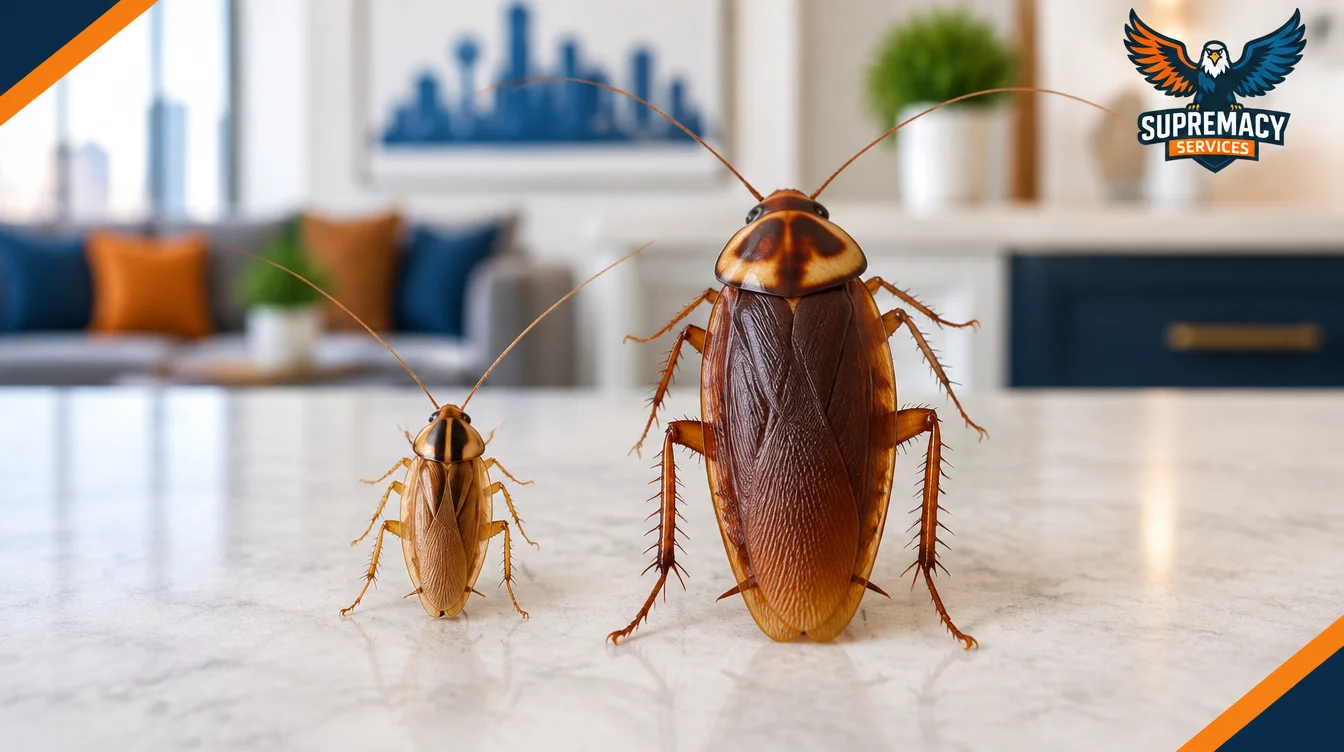
If you find a cockroach in your Dallas home, its size, color, markings and location can usually give you a good idea whether you’re dealing with a German cockroach or an American cockroach.
German cockroaches are small—usually about 1/2 to 5/8 inch long—and light brown or tan with two dark parallel stripes behind the head. American cockroaches are considerably larger, often around 1½ inches long, reddish brown, and have a pale yellowish border behind the head.
The distinction matters because the two species behave differently. German cockroaches are strongly associated with indoor infestations, particularly kitchens and bathrooms, while American cockroaches are frequently associated with damp areas, drains, sewers, crawl spaces and other moisture-rich environments.
Table of Contents
- German vs. American Cockroach: Quick Comparison
- What Does a German Cockroach Look Like?
- What Does an American Cockroach Look Like?
- Where Are You Finding the Cockroaches?
- Which Cockroach Is More Likely to Infest Your Home?
- Why Cockroach Identification Matters
- Signs You May Have More Than One Cockroach
- What Attracts Cockroaches to Dallas Homes?
- What Should You Do If You Find Cockroaches?
- DIY vs. Professional Cockroach Control
- How Professional Cockroach Control Works
- How to Prevent Cockroaches
- Frequently Asked Questions
German Cockroach vs. American Cockroach: Quick Comparison
The easiest distinction is size and markings. German cockroaches are small and have two dark stripes behind their heads. American cockroaches are roughly three times as long, reddish brown and have a lighter border around the area behind the head.
| Feature | German Cockroach | American Cockroach |
|---|---|---|
| Scientific name | Blattella germanica | Periplaneta americana |
| Adult size | About 1/2–5/8 inch | About 1½ inches, sometimes larger |
| Color | Tan to light brown | Reddish brown |
| Key marking | Two dark parallel stripes behind head | Pale/yellowish border behind head |
| Common indoor locations | Kitchens, bathrooms, cabinets, appliances | Drains, basements, crawl spaces, utility areas |
| Moisture preference | Warm, humid areas | Warm, damp, dark areas |
| Typical entry pattern | Often introduced in boxes, bags or other items; can spread within buildings | Can enter from outdoors, drains, sewers and structural openings |
| Indoor breeding | Strongly associated with indoor infestations | Can establish indoors, especially where moisture and shelter are available |
| Wings | Adults have wings but generally do not fly | Adults have developed wings and are capable of flight |
These are identification clues rather than absolute rules. Nymphs are smaller than adults, and lighting can make coloration difficult to judge.
What Does a German Cockroach Look Like?
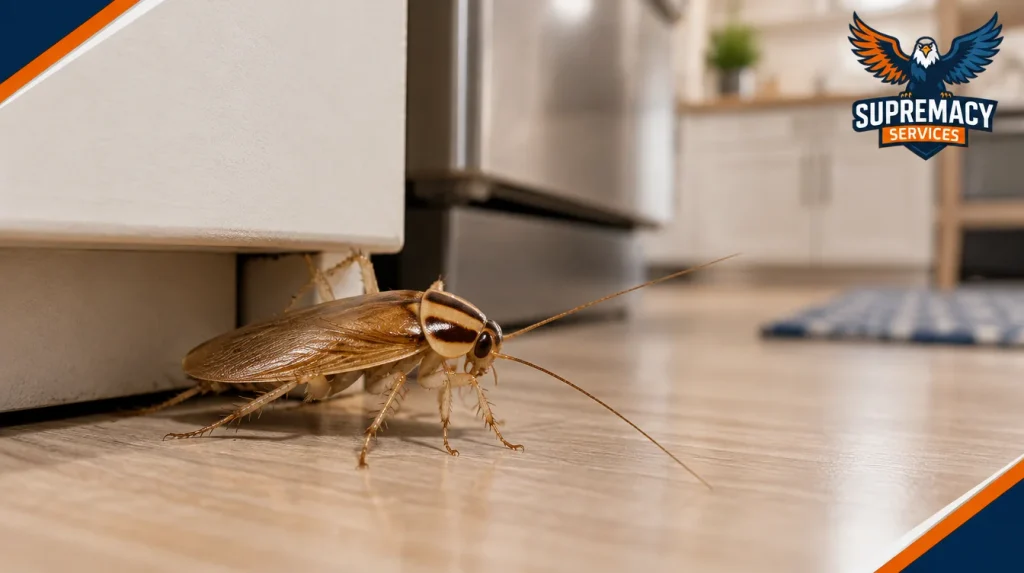
A German cockroach is a small, tan or light-brown cockroach with two dark parallel stripes running lengthwise on the shield-like area directly behind its head.
Adults typically measure approximately 1/2 to 5/8 inch long. University and extension guidance consistently identifies those two dark stripes as one of the most useful visual characteristics for homeowners.
Look for these characteristics:
- relatively small body;
- tan or light-brown coloration;
- two distinct dark lines behind the head;
- long antennae;
- adults with developed wings;
- smaller, darker wingless nymphs.
Their small size also allows German cockroaches to hide in extremely narrow cracks and crevices.
Where German Cockroaches Usually Hide
German cockroaches favor places where food, warmth and moisture occur close together.
Common locations include:
- beneath kitchen sinks;
- behind refrigerators;
- around dishwashers;
- behind or beneath stoves;
- inside cabinet cracks and hinges;
- around plumbing fixtures;
- near garbage and food-storage areas;
- in bathrooms;
- around heat-producing equipment.
Finding several small cockroaches around a refrigerator, dishwasher or kitchen cabinet is therefore much more suggestive of German cockroaches than American cockroaches.
Seeing small roaches around your Dallas kitchen or appliances? Explore Supremacy Services’ pest-control options for help identifying the infestation and determining the appropriate treatment.
What Does an American Cockroach Look Like?
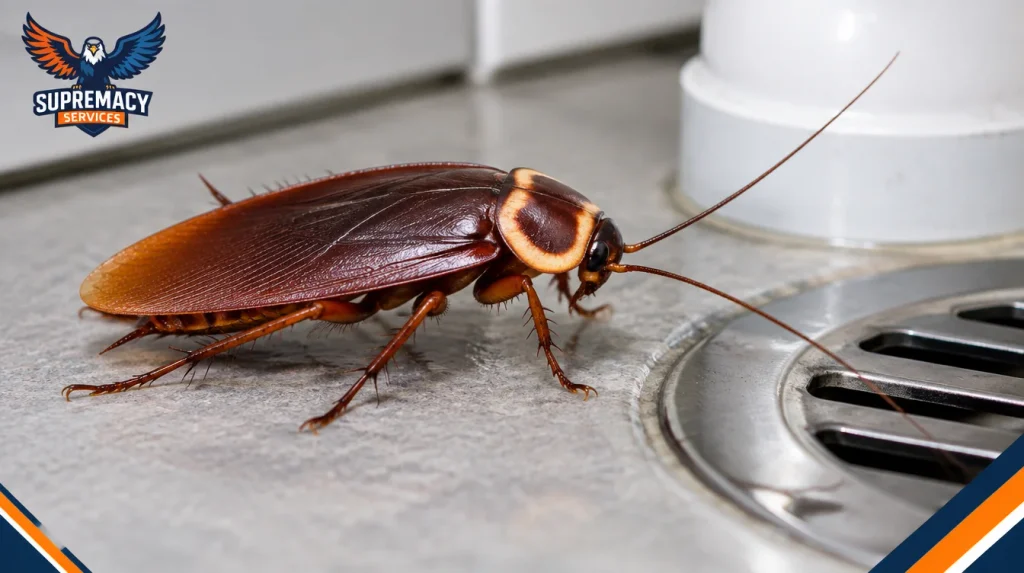
An American cockroach is a large reddish-brown cockroach with a lighter yellowish or pale margin around the shield behind its head.
Adults are approximately 1½ inches long, making them dramatically larger than adult German cockroaches. Their wings cover the abdomen, and adults are capable of flight.
Look for:
- a large body;
- reddish-brown coloration;
- pale or yellowish edging behind the head;
- long antennae;
- long, developed wings.
If the insect is considerably longer than an inch, an adult German cockroach can effectively be ruled out based on size alone.
Where American Cockroaches Usually Hide
American cockroaches favor dark, warm and damp environments.
They may be encountered around:
- floor drains;
- plumbing chases;
- crawl spaces;
- utility areas;
- basements where present;
- sewer systems;
- bathrooms;
- garbage areas;
- commercial kitchens;
- other damp service areas.
Extension guidance notes that American cockroaches can occur around sewer systems and may enter buildings through drains or other pathways.
That means seeing one large cockroach does not automatically tell you that a breeding population exists inside your kitchen. The source and surrounding conditions still need to be investigated.
Where Are You Finding the Cockroaches?
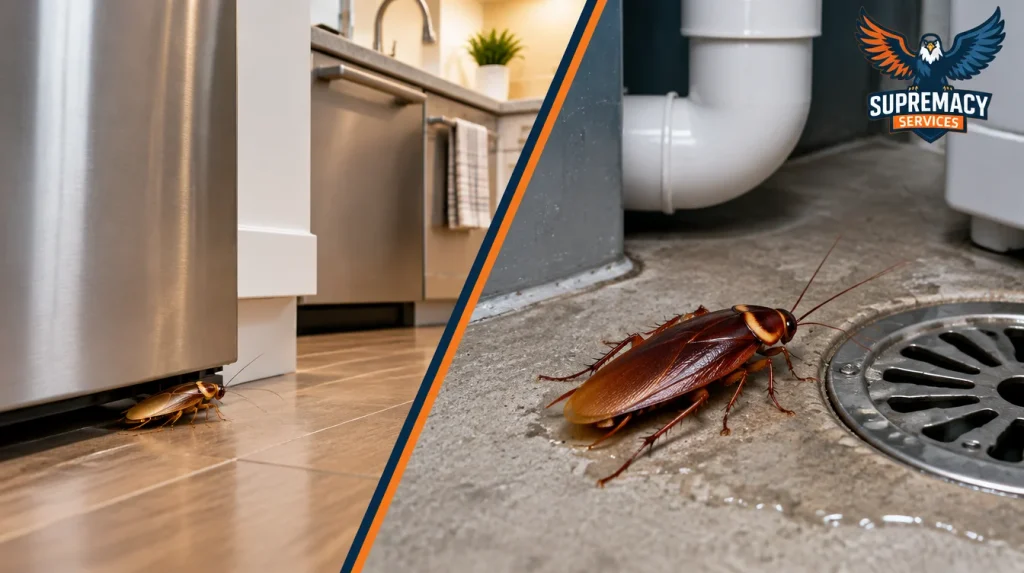
Location is one of the strongest identification clues after size and markings.
Small roaches around the refrigerator or dishwasher
German cockroaches should be high on the list of possibilities.
These areas combine warmth, moisture, food residue and tight hiding spaces.
Large roach near a floor drain
An American cockroach becomes more plausible, particularly if the insect is reddish brown and well over an inch long.
Small roaches inside kitchen cabinets
German cockroaches are more likely.
Look carefully around hinges, cracks, shelf edges and plumbing penetrations rather than inspecting only open surfaces.
Large roach in a garage or utility area
This pattern may point toward an outdoor or moisture-associated cockroach entering the structure.
Identification should still be based on physical characteristics rather than location alone.
Which Cockroach Is More Likely to Infest Your Home?
German cockroaches are particularly concerning when multiple individuals are repeatedly found inside kitchens or bathrooms because this species readily lives and reproduces inside buildings.
Penn State Extension describes the German cockroach as one of the most common cockroach species in houses, apartments, restaurants, hotels and similar buildings. Females carry their egg capsules until close to hatching, and the species has substantial reproductive potential.
American cockroaches can also establish indoor populations, but their ecology is different. They are strongly associated with warm, moist locations such as drains, pipe chases, sewer environments and utility spaces.
The practical takeaway:
Multiple tiny roaches in a kitchen can indicate a very different problem from an occasional large roach entering through a drain or structural opening.
Why Cockroach Identification Matters
Correct identification determines where you should inspect, what conditions you need to correct and which control strategy makes sense.
Treating every cockroach exactly the same can overlook the actual source.
For example:
German cockroach problem:
The investigation may concentrate heavily on kitchens, appliances, cabinetry, plumbing and adjacent wall voids.
American cockroach problem:
Inspection may need to expand toward drains, crawl spaces, plumbing systems, utility areas and exterior entry points.
This is one reason Integrated Pest Management begins with understanding the pest and the conditions supporting it rather than relying solely on pesticide application.
The EPA defines Integrated Pest Management, or IPM, as an approach that combines information about pests and their environment with appropriate management methods while seeking to minimize unnecessary hazards to people, property and the environment.
Signs You May Have More Than One Cockroach
Seeing one cockroach does not reveal the size of an infestation.
Look for additional evidence such as:
- repeated nighttime sightings;
- cockroaches scattering when kitchen lights are switched on;
- nymphs or very small cockroaches;
- egg cases;
- droppings or spotting in harborages;
- cockroaches caught on monitoring traps;
- activity beneath appliances;
- recurring sightings near plumbing;
- activity in several rooms.
Why Seeing Baby Cockroaches Matters
Nymphs are immature cockroaches.
Repeatedly finding nymphs indoors is important because it may indicate that cockroaches are developing somewhere in or near the structure rather than every insect simply wandering indoors.
For German cockroaches in particular, multiple life stages concentrated around kitchens or bathrooms warrant closer investigation.
What Attracts Cockroaches to Dallas Homes?
Cockroaches need access to food, water and shelter.
The EPA specifically recommends reducing these resources as part of effective pest prevention. That includes sealing food, removing garbage, avoiding pet food left out overnight and repairing plumbing leaks.
Common contributing conditions include:
Moisture
Check:
- leaking faucets;
- pipes beneath sinks;
- dishwasher connections;
- refrigerator drip areas;
- condensation;
- damp cabinets;
- drains and utility areas.
Food
Cockroaches can survive on surprisingly small amounts of available material.
Pay attention to:
- crumbs beneath appliances;
- grease around cooking equipment;
- pet food;
- dirty dishes;
- open pantry products;
- spills;
- garbage.
Shelter
Cockroaches prefer concealed spaces.
Clutter, cardboard, cabinet gaps, wall penetrations and appliance voids can provide hiding areas.
Entry Points
Larger cockroaches may enter around doors, utility penetrations and other structural openings.
German cockroaches can also be transported into buildings in items such as bags and boxes.
Are Cockroaches a Health Concern?
Cockroaches are more than an unpleasant sight.
The EPA identifies cockroaches as pests of public-health importance in connection with allergy, asthma and food contamination concerns.
This makes established activity particularly important around:
- kitchens;
- food-storage areas;
- restaurants;
- apartments;
- childcare environments;
- other sensitive facilities.
The goal should therefore be to correct the infestation and the conditions sustaining it—not simply kill whichever cockroaches happen to be visible.
What Should You Do If You Find Cockroaches?
Start with identification and inspection rather than immediately spraying every visible surface.
Step 1: Identify the cockroach
Check:
- size;
- color;
- markings behind the head;
- location where it was found;
- whether adults, nymphs or both are present.
Step 2: Inspect the surrounding area
For suspected German cockroaches, examine:
- refrigerator;
- stove;
- dishwasher;
- sink cabinet;
- pantry;
- cabinet hinges and cracks;
- plumbing penetrations.
For suspected American cockroaches, expand the inspection to:
- drains;
- plumbing chases;
- utility spaces;
- crawl spaces where applicable;
- exterior doors;
- foundation penetrations;
- damp exterior areas.
Step 3: Remove food and moisture
Clean crumbs and grease, secure food, empty garbage regularly and repair plumbing leaks.
Step 4: Use monitoring traps strategically
Sticky monitors can help determine where cockroach activity is concentrated and whether activity continues after corrective measures.
Place monitoring devices according to their directions, particularly along edges and near suspected harborages.
Step 5: Decide whether professional treatment is warranted
Repeated sightings, nymphs, widespread activity or persistent kitchen infestations are strong reasons to obtain a professional inspection.
If cockroaches keep appearing after cleaning and basic prevention, request a Dallas pest-control assessment from Supremacy Services to identify the species, locate activity and determine the appropriate control strategy.
DIY vs. Professional Cockroach Control
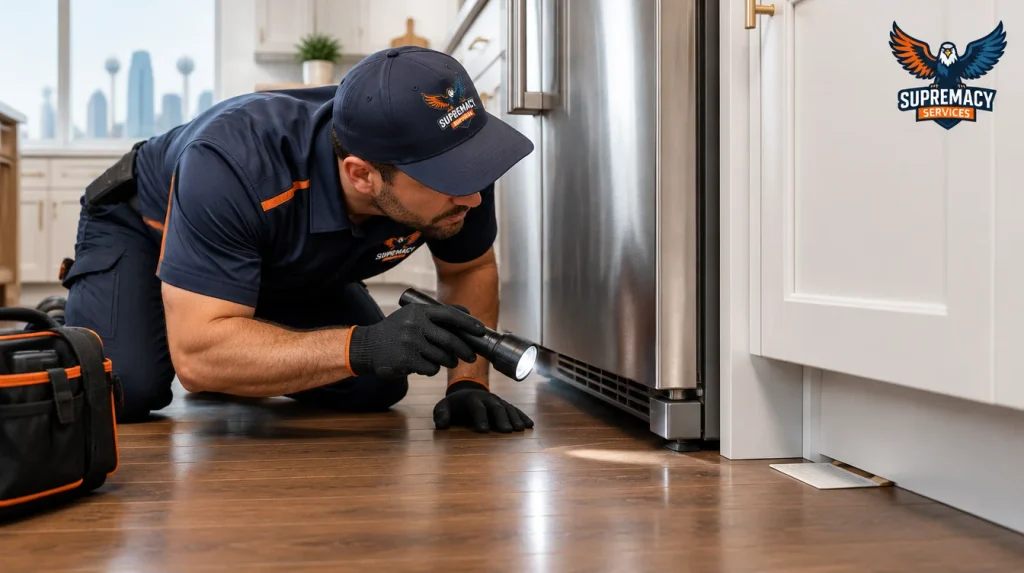
Minor prevention work is absolutely appropriate for homeowners. Established infestations can be much harder to solve without correctly locating the harborages.
| DIY homeowner action | When professional help makes sense |
|---|---|
| Clean food residue | Repeated live cockroach sightings |
| Store food securely | German cockroaches in kitchen appliances/cabinets |
| Repair small leaks | Nymphs repeatedly appearing indoors |
| Reduce clutter | Activity spreading into multiple rooms |
| Seal appropriate openings | Source cannot be identified |
| Monitor activity | Cockroaches persist after reasonable corrective measures |
| Improve garbage management | Multi-unit/shared-wall infestation suspected |
Be Careful With indiscriminate Spraying
More pesticide does not automatically mean better cockroach control.
EPA IPM guidance emphasizes combining prevention, identification, monitoring and appropriate treatment instead of depending exclusively on pesticide applications.
Any pesticide used by a homeowner should be used only according to its label.
Professional structural pest-control work in Texas is regulated by the Texas Department of Agriculture. TDA states that businesses and individuals providing structural pest-control services for hire are subject to licensing requirements.
What Does Professional Cockroach Control Include?
A professional cockroach program should start with identification and inspection.
Depending on the property and infestation, the process may include:
1. Species identification
German and American cockroaches require different inspection priorities.
2. Locating harborages
The technician looks for areas where cockroaches are hiding, feeding and obtaining moisture.
3. Identifying conducive conditions
These may include:
- plumbing leaks;
- food residue;
- garbage;
- clutter;
- cracks;
- appliance voids;
- structural openings;
- moisture around drains.
4. Monitoring
Strategically positioned monitoring devices can reveal where activity is concentrated.
5. Targeted control
The appropriate treatment depends on the species, infestation and site conditions.
6. Prevention recommendations
Homeowners may be advised to repair moisture problems, improve sanitation or seal appropriate entry points.
7. Follow-up
Established infestations may require reassessment rather than assuming the problem has been resolved because visible activity temporarily declined.
This inspection-based approach is consistent with the broader IPM principle of addressing the conditions allowing pests to survive.
Dallas and DFW Cockroach Considerations
Dallas homeowners should think about both indoor breeding conditions and outdoor entry pressure.
Dallas/Fort Worth climate normals show very warm summers, with normal July and August highs around the mid-90s Fahrenheit.
But climate alone does not tell you why cockroaches are inside a particular house.
Property-specific factors matter more:
- plumbing leaks;
- drains;
- food availability;
- garbage storage;
- gaps around exterior openings;
- shared walls in apartments or townhomes;
- deliveries and cardboard;
- appliance harborages;
- damp utility areas.
In attached or multi-family housing, cockroach management may also require looking beyond a single kitchen because pests can move through structural and utility pathways.
Could It Be Another Type of Cockroach?
Yes.
German and American cockroaches are not the only cockroaches homeowners can encounter.
For example, brown-banded cockroaches are also relatively small but differ from German cockroaches in their markings and preferred hiding locations. Brown-banded cockroaches have characteristic bands across the body and often occupy warmer, drier, elevated areas.
Oriental cockroaches are darker—often dark brown to nearly black—and favor cool, damp locations.
That is why color alone is unreliable.
Use size + markings + location + behavior together.
How to Prevent Cockroaches in Your Dallas Home

Prevention works best when you make the structure less hospitable and reduce opportunities for entry.
Kitchen
- Clean crumbs and grease beneath appliances.
- Avoid leaving dirty dishes overnight.
- Store dry food in closed containers.
- Empty garbage regularly.
- Clean beneath refrigerators and stoves.
- Avoid leaving pet food out overnight.
Plumbing
- Repair leaking faucets.
- Inspect pipes beneath sinks.
- Address persistent moisture.
- Check dishwasher and refrigerator water connections.
Structure
- Seal appropriate cracks and penetrations.
- Maintain door sweeps.
- Inspect openings around utility lines.
- Correct gaps that allow outdoor pests inside.
Storage
- Reduce unnecessary cardboard.
- Avoid excessive clutter.
- Inspect boxes and secondhand items before bringing them into living spaces.
Monitoring
If your home has had previous cockroach activity, occasional monitoring can help detect recurrence before a population becomes widespread.
German vs. American Cockroach: The Bottom Line
If the cockroach is small, tan and has two dark stripes behind its head, it is likely a German cockroach.
If it is much larger, reddish brown and has a pale yellowish border behind the head, an American cockroach is more likely.
Where you find it provides another clue:
German cockroach: think kitchens, bathrooms, appliances and cabinets.
American cockroach: think drains, utility areas, plumbing systems, crawl spaces and other damp environments.
Identification matters because the source of the problem—not simply the visible cockroach—determines the most effective management strategy.
If you’re repeatedly finding cockroaches in your Dallas or DFW home, particularly small cockroaches or nymphs around kitchens and bathrooms, the next step should be determining where they are harboring and what is sustaining the infestation.
Need Help Identifying or Controlling Cockroaches in Dallas?
Supremacy Services provides pest-control services throughout Dallas and the DFW Metroplex.
Explore Supremacy Services’ Dallas pest-control options or request an assessment if cockroaches continue appearing inside your home.
Frequently Asked Questions
What is the easiest way to tell a German cockroach from an American cockroach?
Size is the quickest clue. Adult German cockroaches are roughly 1/2–5/8 inch long and have two dark stripes behind the head. American cockroaches are much larger—around 1½ inches—and reddish brown with pale edging behind the head.
Are small cockroaches worse than large cockroaches?
Size does not determine whether a cockroach is inherently “worse,” but numerous small German cockroaches inside a kitchen can indicate an established indoor population. Multiple nymphs are especially worth investigating.
Are German cockroaches common in kitchens?
Yes. German cockroaches strongly favor warm, humid areas close to food and water and are commonly found around sinks, refrigerators, dishwashers, stoves and kitchen cabinets.
Do American cockroaches come through drains?
They can. American cockroaches are associated with sewers, drains and other warm, damp areas, so plumbing and drain systems should be considered when investigating large cockroaches indoors.
Can American cockroaches fly?
Adult American cockroaches have developed wings and are capable of flight, although how often they fly depends on conditions.
Do German cockroaches fly?
Adults have wings, but German cockroaches generally do not fly.
Does seeing one German cockroach mean there are more?
One sighting cannot establish infestation size. However, because German cockroaches live and reproduce indoors, finding one—especially around kitchens or bathrooms—justifies inspecting and monitoring nearby harborages.
Why do cockroaches keep appearing in a clean house?
Clean homes can still provide cockroaches with moisture, concealed harborages or entry routes. Cockroaches can also be introduced in boxes, bags and other items. Sanitation is important, but it is only one component of prevention.
When should I call pest control for cockroaches?
Consider professional inspection when cockroaches appear repeatedly, nymphs are present, activity occurs in multiple rooms, a suspected German cockroach population is established around the kitchen, or reasonable sanitation and prevention measures have not resolved the problem.

