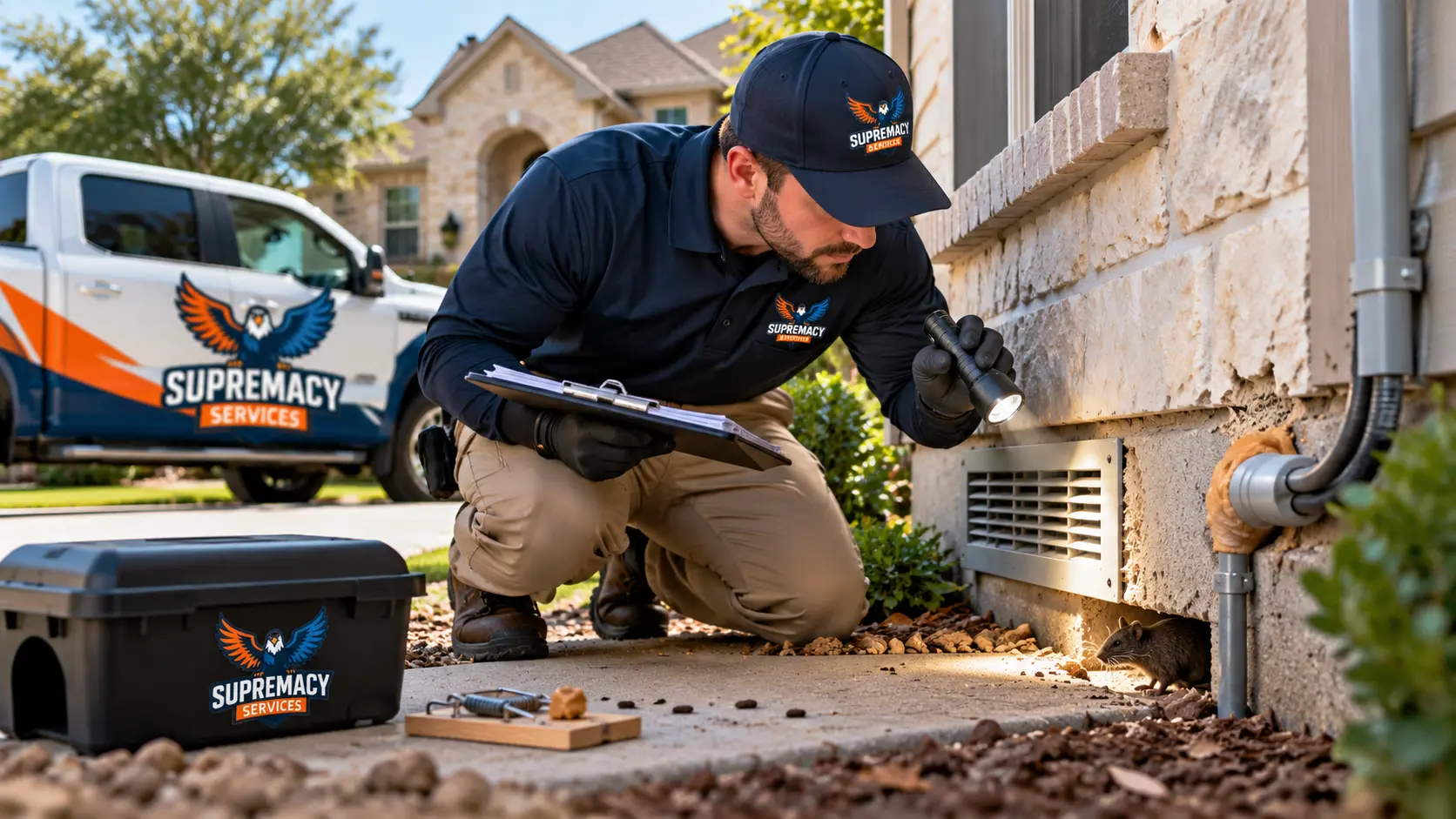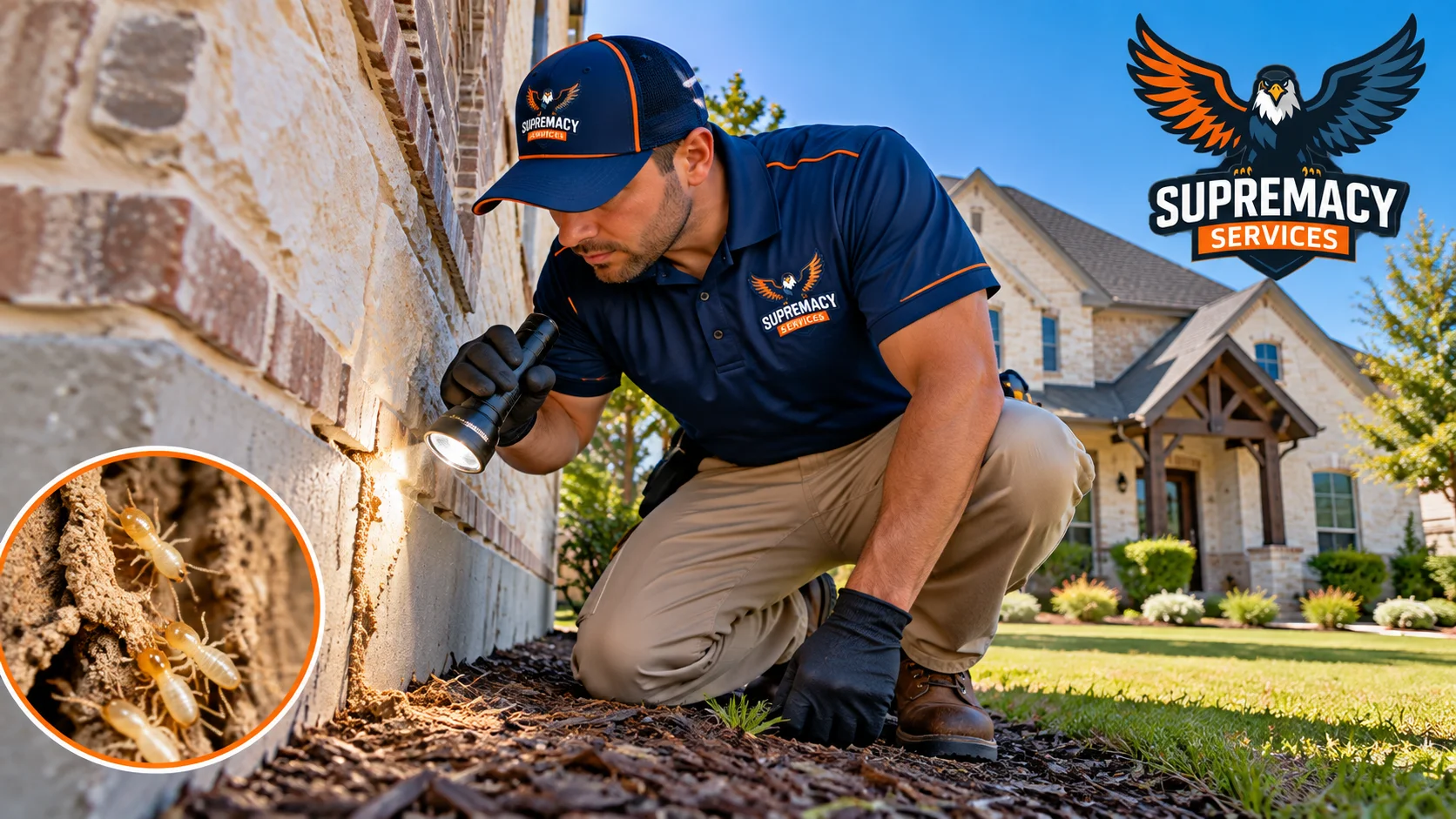
Termites can be active inside a North Texas home long before a homeowner sees insects crawling across a floor. Some of the most important signs of termites in a house are subtle: narrow mud tubes along the foundation, discarded wings near windows, wood that sounds hollow, damaged trim, unexplained blistering, or a sudden swarm of winged insects.
For Dallas–Fort Worth homeowners, finding one of these signs does not automatically prove that extensive structural damage has occurred. It does mean the area deserves closer inspection.
The Texas Department of Agriculture notes that termites can be difficult to detect because they often work from inside wood or concealed areas. A professional inspection can help determine whether suspicious evidence represents active termites, old damage, or another wood-destroying organism.
Table of Contents
- What are the most common signs of termites?
- Mud tubes along the foundation
- Termite swarmers around your home
- Discarded termite wings
- Hollow or damaged wood
- Blistering or unusual wood surfaces
- Termite damage around doors and trim
- Soil or mud appearing inside cracks
- Termite droppings or pellets
- Termites discovered during remodeling
- Termites vs. ants
- Where should North Texas homeowners look?
- What attracts termites to a home?
- What should you do if you find termite activity?
- DIY vs. professional termite inspection
- What happens during a professional termite inspection?
- How can you reduce termite risk?
- Frequently Asked Questions
What Are the Most Common Signs of Termites?
The most common warning signs include mud tubes, termite swarmers, piles of discarded wings, hollow or damaged wood, blistered wood surfaces and visible damage to structural or decorative wood.
Texas regulators specifically identify shelter tubes, weak or broken structural members, blistered wood and soil in cracks as possible evidence of subterranean termites.
Here is a quick homeowner checklist:
| Warning sign | What you may notice | Why it matters |
|---|---|---|
| Mud tubes | Pencil-width or irregular soil tubes | Possible subterranean termite travel route |
| Swarmers | Groups of winged insects | Reproductive termites may be establishing colonies |
| Discarded wings | Small piles near windows or doors | Can remain after a swarm |
| Hollow wood | Thin surface over damaged interior | Termites may have consumed internal wood |
| Blistering | Raised or irregular wood surface | Can accompany concealed damage |
| Damaged trim | Soft, weak or crumbling wood | Requires investigation |
| Soil in cracks | Mud-like material in structural gaps | Can be associated with subterranean activity |
| Pellets | Small dry particles near wood | May indicate certain termite species |
| Hidden galleries | Channels exposed during repairs | Evidence may become visible when wood is opened |
No single homeowner test should be used to determine the extent of an infestation.
1. Mud Tubes Along the Foundation
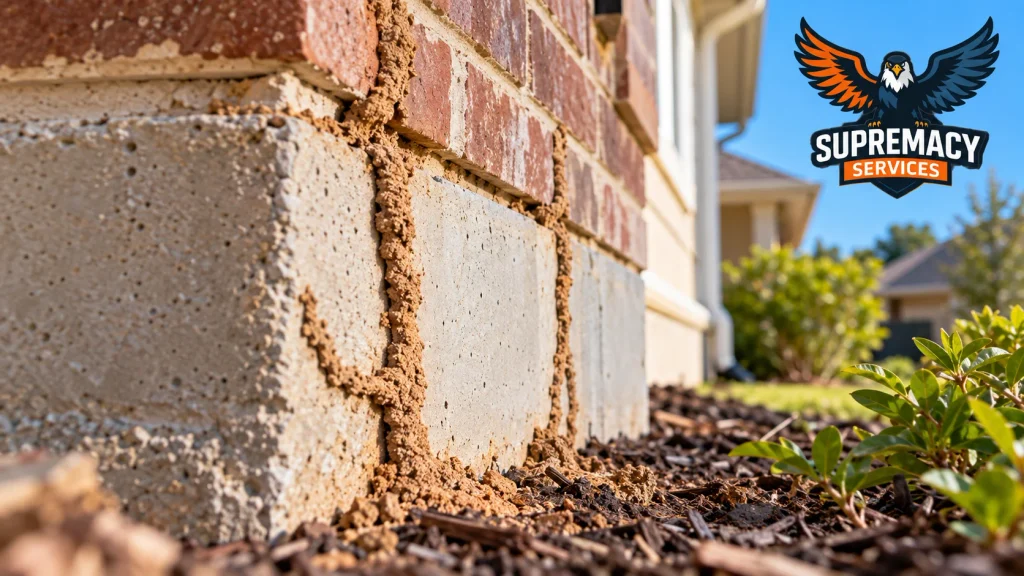
Mud or shelter tubes are one of the most recognizable signs associated with subterranean termites.
Look along:
- slab and foundation edges;
- foundation walls;
- plumbing penetrations;
- piers and supports;
- masonry joints;
- cracks and expansion joints; and
- locations where soil is close to the structure.
Subterranean termites generally live in the soil and construct protected passageways between the colony and a food source. The Texas Department of Agriculture specifically lists shelter tubes on walls, joists, piers, chimneys, plumbing and other fixtures as a potential sign of termite activity.
A dried or damaged tube should not automatically be interpreted as proof that the infestation is gone. Determining whether activity is current and locating other concealed entry points requires a more complete inspection.
Found suspicious mud tubes around your foundation? Learn how Supremacy Services approaches termite inspection and structural protection through our Termite Vault Security service.
2. Termite Swarmers Around Your Home
A sudden appearance of winged termites—called swarmers or alates—is one of the clearest reasons to investigate a possible termite problem.
Swarmers are reproductive members of a mature colony. The Texas Department of Agriculture notes that subterranean termites are often detected during swarming.
Pay particular attention when winged insects appear:
- inside the house;
- around windows;
- around exterior doors;
- near lights;
- around foundation walls; or
- in significant numbers immediately beside the structure.
A swarm outdoors does not necessarily prove that termites are damaging your house. Swarmers emerging from inside the structure, however, deserve prompt investigation.
If possible, save several specimens in a sealed container or plastic bag for identification rather than immediately discarding everything. Texas regulators specifically suggest preserving swarmers for the pest-control operator who performs the inspection.
3. Discarded Termite Wings
After swarmers find a suitable location, their wings can be shed.
Homeowners may consequently discover small piles of wings around:
- windowsills;
- door frames;
- sliding doors;
- baseboards;
- vents; or
- other light sources.
The wings alone do not tell you how extensive an infestation may be, but unexplained piles of similar-sized wings are worth investigating.
Termite wings vs. flying ants
Termites and flying ants are frequently confused.
EPA recommends distinguishing termite swarms from ant swarms when investigating suspected termite activity. If you cannot confidently identify the insects, save a specimen for professional identification rather than assuming that every winged insect is a termite.
4. Hollow or Damaged Wood
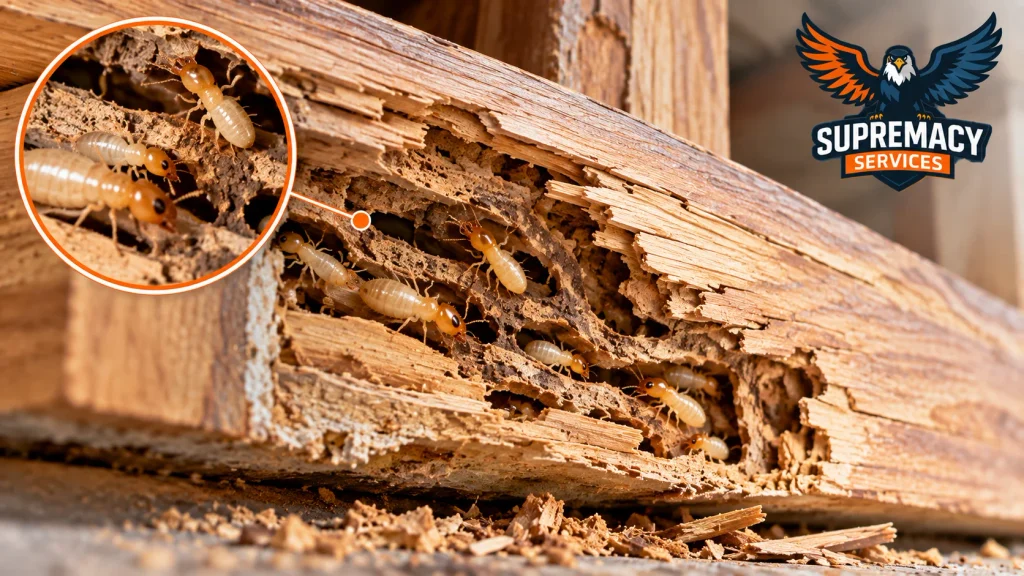
Wood that sounds hollow, feels unusually soft or breaks easily can indicate internal deterioration, including possible termite damage.
Termites may consume wood internally while leaving a relatively thin exterior surface intact. That is one reason significant activity can remain concealed.
Potential areas to inspect include:
- baseboards;
- window and door trim;
- exposed framing;
- garage framing;
- crawlspace components where applicable;
- wooden posts;
- sill areas; and
- wood close to soil.
EPA suggests examining accessible exposed wood for hollow areas as one way homeowners can look for possible termite activity.
Avoid aggressively puncturing finished walls, structural members or electrical/plumbing areas merely to search for termites. A visual check of safely accessible material is a better starting point.
5. Blistering or Unusual Wood Surfaces
Blistered, raised or irregular wood can sometimes accompany termite activity, although moisture and other building problems can produce similar symptoms.
Texas regulators list blistered wood among potential evidence of subterranean termite activity.
The important point is not to diagnose termites based on appearance alone.
Blistered wood may also be associated with:
- water leaks;
- high moisture;
- deteriorating finishes;
- wood rot;
- installation problems; or
- other insects.
If the affected area is close to the foundation, plumbing, an exterior wall or another potential termite access point, include it in the inspection.
6. Termite Damage Around Doors and Trim
A door that suddenly becomes difficult to close is not automatically a termite problem. Humidity, foundation movement, normal wood expansion and installation issues can all affect doors and windows.
The warning becomes more significant when sticking doors or distorted trim occur alongside evidence such as:
- mud tubes;
- visible galleries;
- soft wood;
- discarded wings; or
- swarmers.
Look for combinations of evidence rather than relying on one nonspecific symptom.
7. Soil or Mud Appearing Inside Cracks
Unexplained soil-like material in structural cracks or around wood can be another reason to investigate subterranean termites.
The Texas Department of Agriculture lists soil in cracks among possible evidence of subterranean termite activity.
Check accessible areas around:
- slab penetrations;
- plumbing;
- foundation cracks;
- attached garages;
- masonry;
- expansion joints; and
- locations where wooden construction components approach the soil.
Do not seal suspicious tubes or cracks before documenting what you found. Photographing the location first can give the inspector useful context.
8. Termite Droppings or Pellets
Small piles of pellet-like material can be associated with drywood termites, which behave differently from subterranean termites.
Texas A&M AgriLife identifies fecal pellets and indoor swarming among evidence associated with drywood termite infestation.
This distinction matters because different termite species can require different inspection and treatment strategies.
Do not assume that every pile resembling sawdust is termite waste. Carpenter ants, wood-boring insects, construction debris and ordinary household material can create similar-looking evidence.
9. Termites Discovered During Remodeling
Sometimes the first obvious evidence of termite activity appears only after drywall, trim, flooring or another building component is removed.
You may find:
- damaged internal wood;
- galleries or channels;
- mud inside concealed spaces;
- live termites; or
- older repaired damage.
EPA notes that homeowners may remain unaware of termites until a swarm occurs or damage is encountered during construction.
If suspicious damage is uncovered during remodeling, document the area before removing more material when practical. The exposed area may help an inspector determine what happened and where additional inspection is needed.
Can You Have Termites Without Seeing Any Signs?
Yes. A home can have termite activity without obvious visible evidence.
This is one of the most important things homeowners should understand about termites.
The Texas Department of Agriculture specifically warns that an absence of visible termite signs does not necessarily mean a property is termite-free because termites can remain concealed.
That means a quick walk around the house cannot provide the same information as a systematic inspection of accessible risk areas.
This is particularly relevant when:
- buying or selling a property;
- unexplained wood damage appears;
- neighboring structures have had termite problems;
- previous termite evidence exists;
- conditions around the structure favor termite access; or
- swarmers appear indoors.
Termites vs. Ants: How Can You Tell the Difference?
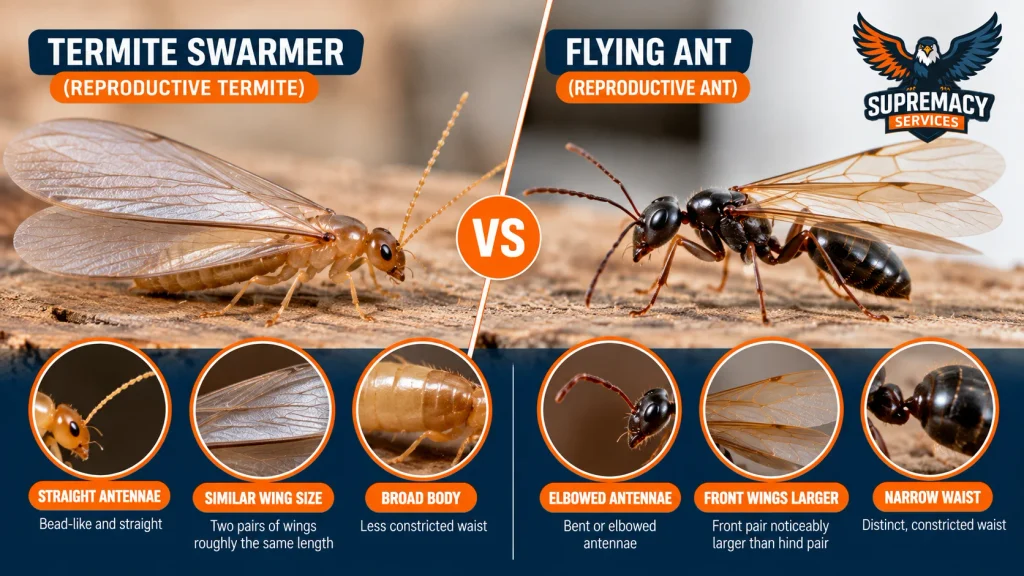
Winged termites and flying ants can look surprisingly similar from a distance, but they are different insects and require different control strategies.
| Feature | Termite swarmer | Flying ant |
|---|---|---|
| Body | Broad, less constricted waist | Narrow/constricted waist |
| Antennae | Generally straighter | Elbowed |
| Wings | Two pairs of roughly similar length | Front pair noticeably larger |
| Meaning indoors | Possible termite colony activity | Possible ant nesting/activity |
Do not make a treatment decision from an internet photograph alone. If you find swarmers, preserving a few specimens gives an inspector a much better opportunity to identify them correctly.
Where Should North Texas Homeowners Look for Termite Activity?

Start with the places where termites could gain concealed access to the structure or where moisture and wood are present.
Around the foundation
Walk around the perimeter and look for:
- mud tubes;
- cracks with soil-like material;
- wood touching soil;
- damaged trim;
- moisture problems; and
- suspicious activity around utility penetrations.
Inside the garage
Attached garages can provide several accessible places to examine slab edges, wall bases, trim and stored wood products.
Around plumbing
Look around safely accessible plumbing penetrations and areas with persistent leaks or moisture.
Around exterior wood
Check wooden features close to the house, particularly where wood remains damp or touches the soil.
Around windows and doors
Look for discarded wings, swarmers and unexplained wood deterioration.
The objective is not to dismantle your home. It is to recognize visible evidence and conditions that justify professional evaluation.
Why Are Termites a Concern in North Texas?
Texas A&M AgriLife identifies Texas as one of the states at significant risk for termite infestation, and subterranean termites are an important structural pest in the state.
North Texas homeowners therefore benefit from understanding the difference between general household pest prevention and termite-specific structural protection.
Termites are not simply another insect that happens to enter the kitchen. Their food source can include cellulose-containing structural materials, and their activity may remain concealed.
That is why Supremacy’s general perimeter pest control page and dedicated Termite Vault Security page should remain separate. General perimeter pest management targets common household invaders, while termite inspection, monitoring and treatment require termite-specific methods.
What Conditions Can Increase Termite Risk Around a Home?
Termites need food, and subterranean termites are closely associated with soil and moisture.
Practical risk-reduction efforts include addressing conditions such as:
Wood-to-soil contact
Wood touching soil can create an easier concealed route between the ground and a food source.
Examples include:
- buried wood scraps;
- landscape timbers against the structure;
- wooden siding extending too close to grade;
- posts contacting soil; and
- construction debris left near the foundation.
Persistent moisture
Leaks and drainage problems deserve attention even when termites are not present.
Check for:
- leaking outdoor faucets;
- plumbing leaks;
- drainage that keeps the foundation perimeter persistently wet;
- damaged gutters or downspouts; and
- other chronic moisture sources.
EPA’s broader pest-management guidance recommends eliminating sources of food, water and shelter as part of preventing pest problems.
Hidden foundation access
Cracks and utility penetrations can make termite evidence harder for homeowners to recognize.
The goal of prevention is not to assume that every crack means termites are entering. Instead, maintain the building so suspicious activity is easier to identify.
What Should You Do If You Find Signs of Termite Activity?
Document the evidence, avoid unnecessarily disturbing it, correct obvious moisture problems where appropriate, and arrange an inspection if the evidence is credible or unexplained.
Step 1: Photograph what you found
Take close and wider photographs showing the evidence and its location.
Step 2: Save insect specimens
If you find swarmers, preserve several specimens for identification.
Step 3: Do not assume the problem is isolated
The visible location may not represent the full extent of activity.
Step 4: Avoid covering the evidence immediately
Painting, caulking, replacing trim or removing tubes before an inspection can eliminate useful clues.
Step 5: Schedule a termite inspection
A termite professional can evaluate accessible areas, identify evidence and determine whether treatment is warranted.
If you have found mud tubes, swarmers or suspicious wood damage, schedule a termite inspection before covering or repairing the affected area. Explore Supremacy Services’ Termite Vault Security options for Dallas–Fort Worth homes.
Can You Inspect for Termites Yourself?
Homeowners can look for visible warning signs, but a DIY check cannot reliably rule out concealed termite activity.
A homeowner inspection is useful for spotting:
- obvious tubes;
- swarms;
- wings;
- accessible wood damage;
- moisture problems; and
- wood-to-soil contact.
It becomes less reliable when activity is concealed behind walls, beneath floors or in other inaccessible building components.
The Texas Department of Agriculture explicitly cautions that termites are often difficult to detect and recommends professional inspection when homeowners need to determine whether visible termite infestation is present.
What about DIY termite pesticides?
Be especially careful here.
EPA explains that termiticides intended to protect structures have specific registered uses and labels, and notes that in most cases proper application requires a trained pest-management professional.
Improper treatment can also make an infestation more difficult to evaluate without providing adequate structural protection.
What Happens During a Professional Termite Inspection?
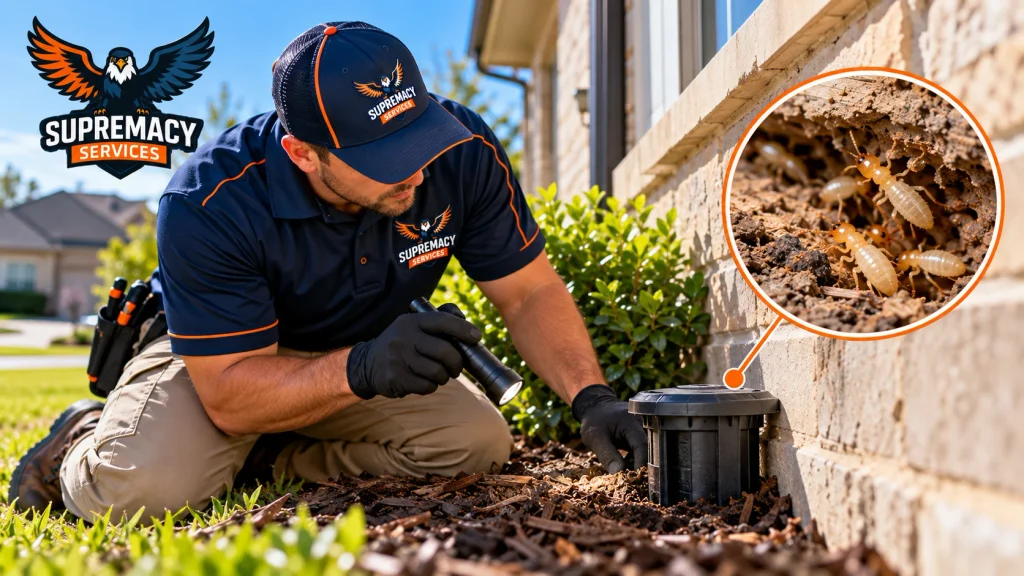
A termite inspection should focus on identifying visible evidence, accessible damage and conditions that may contribute to termite activity.
Depending on the property and purpose of the inspection, the inspector may evaluate areas such as:
- foundation perimeter;
- accessible structural wood;
- plumbing penetrations;
- garages;
- crawlspaces where present and accessible;
- attic areas where relevant;
- interior areas associated with suspicious evidence; and
- exterior conditions conducive to infestation.
If treatment is recommended in Texas, consumers have specific protections.
The Texas Department of Agriculture says a termite-treatment proposal must include written disclosure information such as a diagram showing areas to be treated and active or previous activity, warranty or guarantee terms, the chemical label when applicable, and information about liquid termiticide concentration or the minimum number of bait stations to be installed.
This documentation gives homeowners something concrete to compare rather than choosing a treatment based only on a verbal sales pitch.
What Termite Treatments May Be Recommended?
Treatment depends on the termite species, construction and location of activity; there is no single treatment that is automatically appropriate for every house.
EPA identifies several termite-management approaches, including:
- liquid soil-applied termiticides;
- termite bait systems;
- treated building materials; and
- wood treatments.
Two common strategies for subterranean termites are soil barrier treatments and baiting systems.
A professional recommendation should be based on inspection findings and the product label—not simply on whichever treatment is easiest to sell.
What should termite treatment cost?
There is no responsible single price to quote without knowing the home’s construction, size, extent and location of activity, treatment method, warranty terms and other site conditions.
Instead of publishing an unsupported Dallas price range in this article, homeowners should compare written proposals on the same basis:
| Cost factor | Why it matters |
|---|---|
| Structure size/perimeter | Influences inspection and treatment scope |
| Treatment type | Baiting, liquid applications and other approaches differ |
| Location of activity | Access requirements vary |
| Construction | Slab, crawlspace and other features can affect treatment |
| Extent of treatment | Partial and broader treatment scopes differ |
| Monitoring | Some systems require ongoing inspection |
| Warranty | Coverage, renewal terms and exclusions vary |
Texas regulators specifically warn that treatment specifications, warranties and guarantees can vary widely between providers.
How Can North Texas Homeowners Reduce Termite Risk?
Termite prevention starts with making the property less conducive to concealed termite access and easier to inspect.
Homeowner termite-prevention checklist
- Repair persistent plumbing leaks.
- Address drainage problems around the structure.
- Avoid unnecessary wood-to-soil contact.
- Remove buried or abandoned wood debris near the foundation.
- Keep accessible foundation areas visible enough to inspect.
- Investigate swarmers rather than assuming they are ants.
- Check suspicious wood damage instead of simply painting over it.
- Preserve records from previous termite treatments.
- Review warranty requirements if your home already has termite protection.
- Arrange an inspection when credible warning signs appear.
Prevention reduces risk; it does not prove that a home is termite-free.
When Should You Call a Termite Professional?
Consider professional inspection when you find:
- mud tubes on or entering the structure;
- termite swarmers indoors;
- unexplained piles of wings;
- wood containing galleries or live insects;
- suspicious structural wood deterioration;
- recurring termite evidence;
- evidence exposed during renovation; or
- multiple warning signs that cannot be explained by moisture or another building problem.
You should also consider inspection when you need greater certainty than a homeowner visual check can provide.
Frequently Asked Questions
What is usually the first sign of termites?
There is no universal first sign. Homeowners commonly discover swarmers, discarded wings, mud tubes or damaged wood. Termites can also remain concealed without producing obvious early warning signs.
Are mud tubes always proof of active termites?
Mud tubes are important evidence associated with subterranean termites, but a tube alone does not tell you whether the activity is currently active or how extensive it is. Have suspicious tubes evaluated rather than assuming the problem has disappeared.
What do termite swarmers look like?
Termite swarmers are winged reproductive termites. They have a relatively broad body and two pairs of wings of roughly similar length. Flying ants have different body and wing proportions and are commonly mistaken for termites.
Why am I finding termite wings near my windows?
Swarmers are attracted to light, so discarded wings may accumulate near windows and other bright areas. Finding a pile indoors warrants investigation.
Can termites live in a brick house?
Yes. Brick or masonry on the exterior does not mean the structure contains no cellulose-based materials. Termites can use concealed routes to reach wooden structural or interior components.
Does seeing termites mean my house has major structural damage?
Not necessarily. Visible termites establish a reason for inspection, but the extent of damage cannot be determined simply from seeing a few insects.
Can I have termites without mud tubes?
Yes. Not every infestation presents the same visible evidence, and some activity remains concealed. The absence of tubes is not proof that the structure is termite-free.
Should I spray termite swarmers myself?
Killing visible swarmers does not establish that the underlying colony or structural infestation has been eliminated. EPA recommends using pesticides only according to their labels, and structural termite treatment often requires professional application.
Are termites and carpenter ants the same problem?
No. Both can be associated with wood, but they are different insects with different behavior. Correct identification should come before treatment.
How do I know whether termite treatment is necessary?
A professional inspection should identify visible evidence and relevant conditions before treatment is recommended. In Texas, termite-control businesses must meet state licensing requirements, and written termite-treatment proposals carry specific disclosure requirements.
Protect Your North Texas Home by Acting on the Evidence
The most useful response to possible termite activity is neither panic nor ignoring the problem.
Look for combinations of credible evidence: mud tubes, swarmers, discarded wings, hollow or weakened wood, unusual soil in cracks, blistering and concealed damage discovered during repairs.
Then determine what the evidence actually means before making major repairs or choosing a treatment.
Because termites frequently remain hidden, an absence of obvious warning signs does not guarantee that a structure is termite-free.
Seeing possible termite activity around your Dallas–Fort Worth home? Schedule a professional termite inspection with Supremacy Services and explore Termite Vault Security options designed for structural termite protection.