
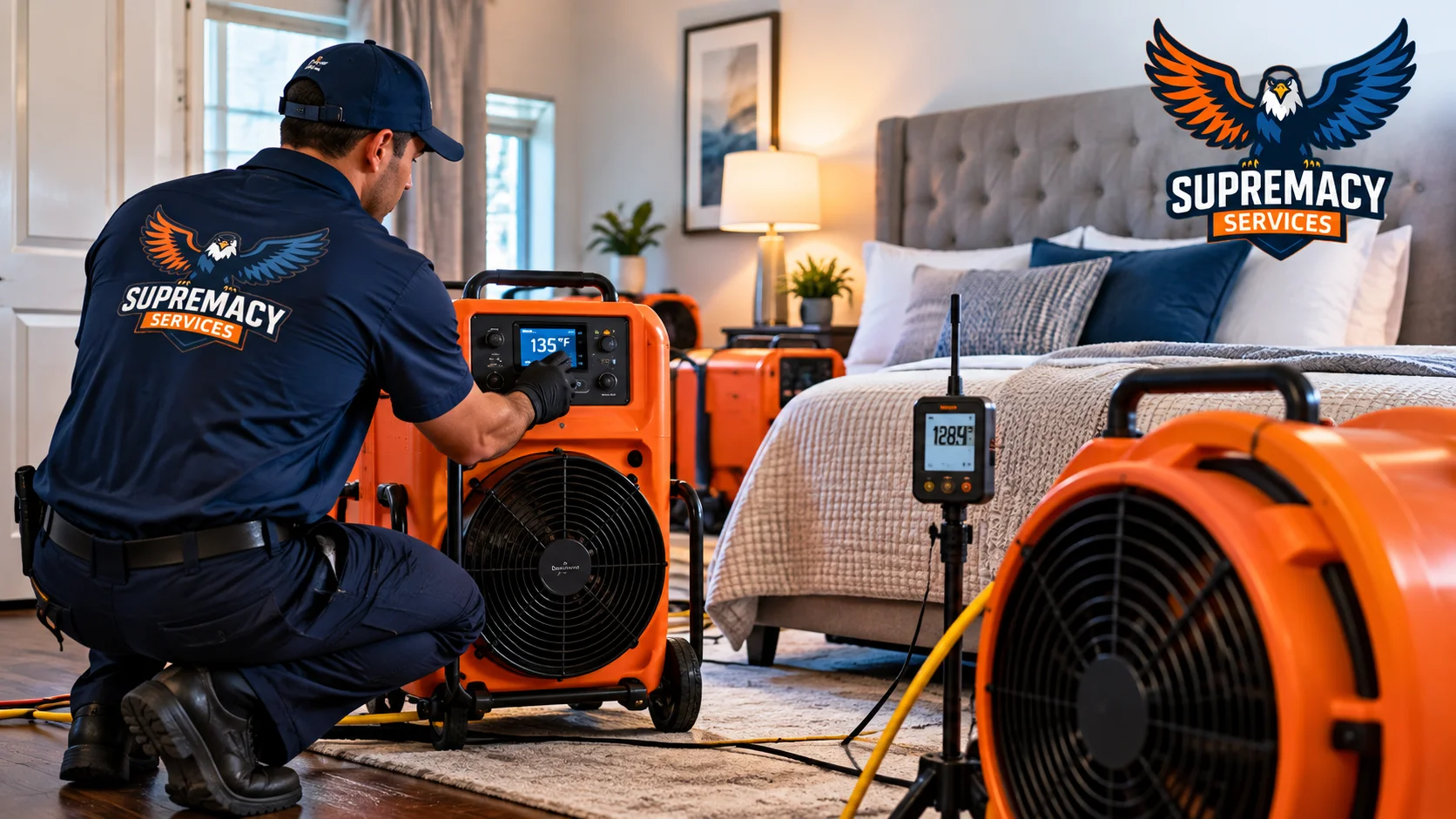
Bed bug heat treatment in Dallas can be an effective professional treatment because sustained heat can kill bed bugs at every life stage, including eggs, when lethal temperatures reach their hiding places. The U.S. Environmental Protection Agency (EPA) recommends heating infested areas to at least 120°F for 90 minutes to ensure eggs are killed, while professional systems commonly operate at higher ambient temperatures so that cracks, furniture and other cooler areas reach lethal conditions.
Cost is less straightforward. Published 2026 consumer pricing data places professional bed bug extermination broadly around $1,000–$4,000 per home, while heat treatment is commonly estimated at approximately $1–$3 per square foot. These figures are national planning estimates—not Supremacy Services pricing or guaranteed Dallas rates. Your actual Dallas bed bug heat treatment cost depends on the size and layout of the property, how far the infestation has spread, preparation requirements and the treatment plan recommended after inspection.
If you are trying to decide whether heat treatment is worth the investment, here’s what Dallas and DFW homeowners should know before requesting a quote.
Table of Contents
- How Much Does Bed Bug Heat Treatment Cost in Dallas?
- What Affects the Cost?
- Does Bed Bug Heat Treatment Actually Work?
- How Does Professional Heat Treatment Work?
- Heat Treatment vs. Chemical Treatment
- Signs You May Have Bed Bugs
- Can You Heat-Treat Bed Bugs Yourself?
- How to Prepare for Treatment
- Can Bed Bugs Return After Heat Treatment?
- Choosing a Bed Bug Treatment Company in Dallas
- Frequently Asked Questions
How Much Does Bed Bug Heat Treatment Cost in Dallas?
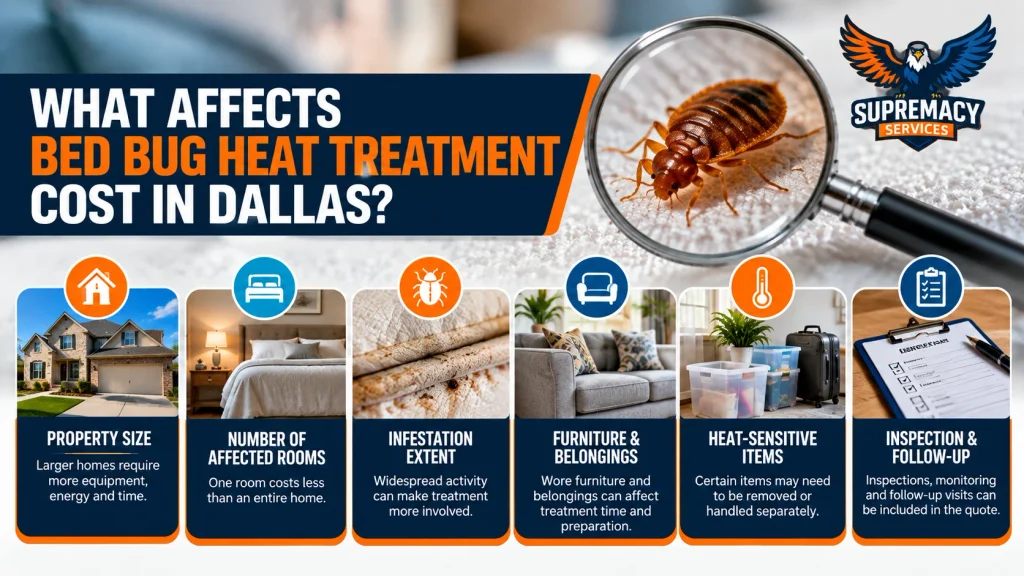
There is no reliable single flat price for every Dallas property. As a national planning benchmark, Angi’s 2026 cost data places professional bed bug extermination around $1,000–$4,000 for a home and lists heat treatment at roughly $1–$3 per square foot. Actual Dallas quotes can fall outside these ranges.
Treat those figures as budgeting information rather than a quote.
| Cost consideration | How it can affect your quote |
|---|---|
| Square footage | Larger treatment areas require more equipment, energy and technician time |
| Number of affected rooms | An infestation limited to one area differs from activity throughout a home |
| Infestation extent | Widely dispersed bed bugs can make treatment more involved |
| Home layout | Closets, furnishings and difficult-to-heat spaces can affect the treatment plan |
| Preparation | Heat-sensitive possessions and clutter can require additional preparation |
| Treatment approach | Heat-only and integrated treatment programs are not priced identically |
| Inspection/follow-up | Ask whether these are included in the quoted program |
| Multi-unit property | Apartments and attached units may require additional investigation or coordination |
A very low quote should therefore not automatically be treated as the best value. Ask what areas will be treated, how temperatures will be monitored, what preparation is required and what post-treatment verification is included.
Not sure how much of your home needs treatment? Schedule a professional bed bug inspection in Dallas and DFW before comparing treatment options.
What Affects Bed Bug Heat Treatment Cost?
1. Size of the treatment area
Heating a bedroom is different from heating several bedrooms or an entire home. Professional treatment requires sufficient equipment and airflow to raise temperatures throughout the target area rather than merely warming the air near a heater.
2. How far the infestation has spread
Bed bugs can hide in mattress seams, bed frames, upholstered furniture, baseboards and small cracks and crevices.
That makes the distribution of an infestation important. A professional inspection should establish where activity is present before determining the treatment scope.
3. Furniture and belongings
Heat needs to reach the places where bed bugs are hiding.
A heavily furnished room can therefore require more planning than an open room of the same size. Drawers, closets and furniture may need to be arranged according to the pest professional’s preparation instructions.
4. Heat-sensitive belongings
Some belongings should not remain in an area undergoing professional heat treatment. EPA specifically recommends properly handling heat-sensitive items that could be damaged.
Your provider should give you a preparation list rather than expecting you to guess what needs to be removed.
5. Inspection and follow-up
When comparing Dallas bed bug treatment quotes, ask:
- Is inspection included?
- Is the quote for one room or the entire affected area?
- Is temperature monitoring included?
- Are follow-up inspections included?
- What happens if activity is detected afterward?
- Are any additional pest-control methods part of the treatment plan?
Compare the complete treatment program—not simply the headline price.
Does Bed Bug Heat Treatment Actually Work?
Yes. Properly performed heat treatment can kill bed bugs, including eggs. The key is achieving a lethal temperature inside the actual hiding locations, not simply making the room feel hot.
EPA guidance states that infested articles or areas can be heated to at least 120°F for 90 minutes to ensure eggs are killed. University of Minnesota Extension guidance gives minimum professional control conditions of approximately 118°F for 72 minutes or 122°F for less than a minute.
That does not mean a technician merely sets the room thermostat to 120°F.
Mattresses, furniture, wall-floor junctions and cracks can heat at different rates. Professional treatment therefore relies on specialized heating equipment, air circulation and temperature monitoring.
Why temperature monitoring matters
Consider a bedroom where the open air is hot enough but a dense piece of furniture remains substantially cooler inside.
A bed bug hiding deep within that cooler location may not receive the same heat exposure as one sitting on an exposed surface.
Successful thermal remediation therefore depends on getting sufficient heat where the insects are actually hiding.
How Does Professional Bed Bug Heat Treatment Work?
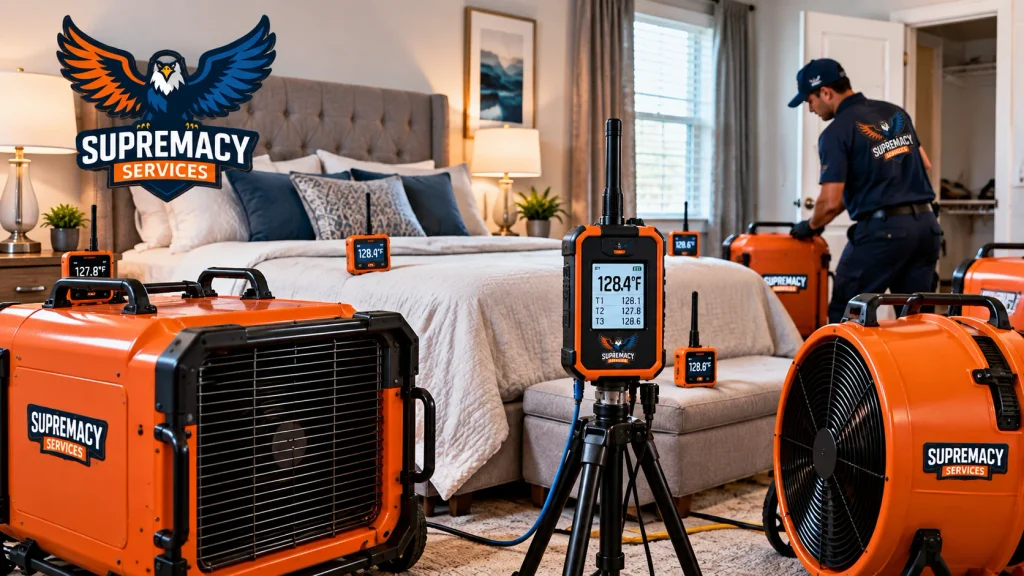
A professional treatment generally follows several stages.
Step 1: Inspection
The technician first confirms evidence of bed bugs and determines which areas are affected.
Common inspection locations include:
- mattress seams;
- box springs;
- headboards;
- bed frames;
- upholstered furniture;
- baseboards;
- nearby cracks and crevices; and
- furniture close to sleeping areas.
Correct identification matters because bites alone do not prove that bed bugs are responsible.
Step 2: Preparation
The homeowner follows a preparation checklist.
Items vulnerable to elevated temperatures may need to be removed or handled separately. The exact instructions should come from the treatment company because moving belongings incorrectly can spread bed bugs into previously unaffected areas.
Step 3: Heating and air circulation
Specialized heaters raise the temperature while professional air-moving equipment circulates heated air throughout the treatment area.
Step 4: Temperature monitoring
Sensors or other temperature-monitoring equipment help technicians determine whether important areas have reached the treatment target.
This is one of the major differences between professional thermal remediation and trying to heat a room yourself.
Step 5: Cooling and post-treatment evaluation
After the required exposure has been achieved, the property is allowed to cool according to the treatment company’s procedures.
Monitoring afterward is important because heat does not provide residual protection against future bed bug introductions.
If bed bugs have been confirmed in your home, learn how Supremacy’s professional bed bug thermal treatment works across Dallas and the DFW Metroplex.
Heat Treatment vs. Chemical Treatment for Bed Bugs
Neither method should be chosen solely because it sounds more powerful. The appropriate strategy depends on the infestation, property and professional assessment.
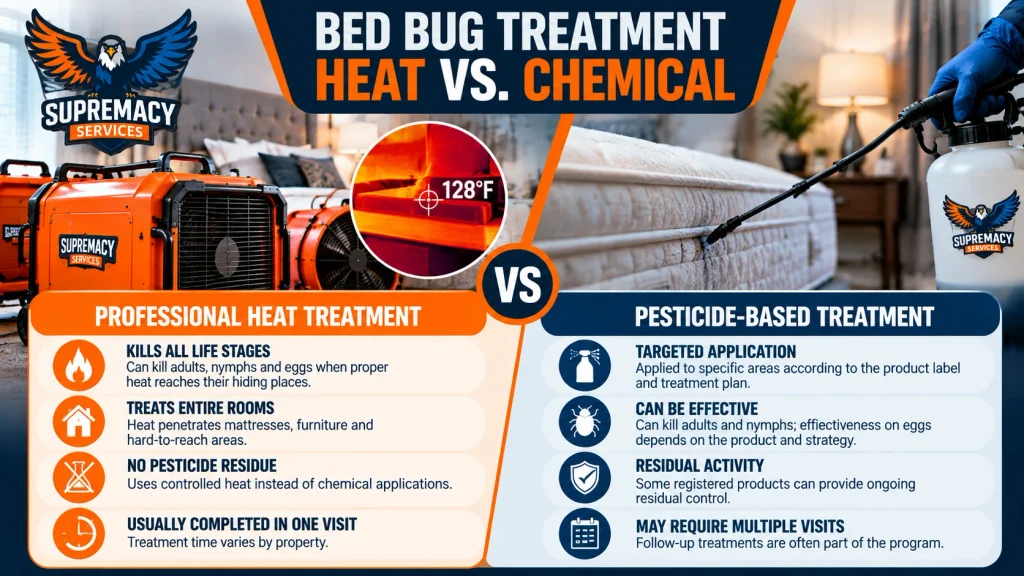
| Factor | Professional heat | Pesticide-based treatment |
|---|---|---|
| Can kill adults and nymphs? | Yes, with adequate exposure | Depends on product and correct application |
| Can kill eggs? | Yes, when lethal heat reaches them | Depends on product/treatment strategy |
| Residual activity | No | Some registered products can provide residual activity |
| Whole-room capability | Yes | Usually targeted according to product label and treatment plan |
| Preparation required | Yes | Yes |
| Specialized equipment | Extensive | Application equipment varies |
| Repeat treatment possible | Yes, if needed | Multiple visits may be part of the program |
| Best use | Depends on property and infestation | Depends on property and infestation |
EPA recommends approaching bed bug control through integrated pest management (IPM) rather than assuming one technique is universally best.
An IPM strategy may combine inspection, monitoring, vacuuming, heat, encasements and appropriately selected pesticides.
Signs You May Have Bed Bugs
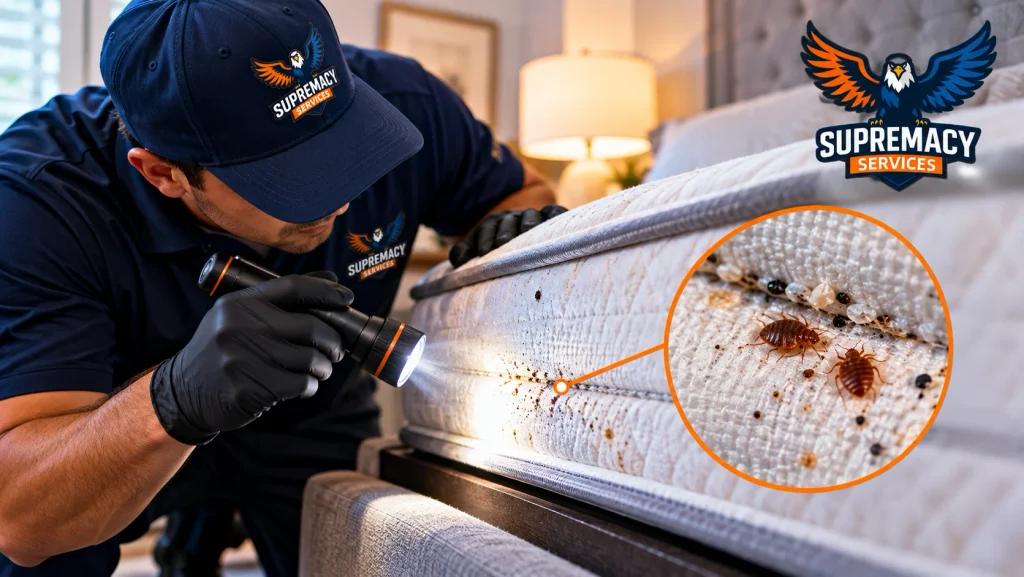
Do not schedule expensive treatment based solely on unexplained skin irritation.
Look for physical evidence such as:
- live bed bugs;
- small eggs or eggshells;
- shed skins;
- dark spotting or fecal evidence around hiding areas; and
- bugs concealed around mattresses, bed frames or nearby furniture.
Bed bugs are small and can be difficult to identify, especially during the early stages of an infestation.
What can be confused with bed bugs?
Other insects or household problems can occasionally be mistaken for bed bugs. Fleas, carpet beetles and other small insects may cause confusion, while skin reactions have many possible causes.
That is another reason inspection should come before treatment.
Can You Heat-Treat Bed Bugs Yourself?
Trying to heat an entire room or home yourself is not recommended.
EPA specifically warns that turning up the thermostat or using space heaters will not reliably eliminate bed bugs. Improvised heating can also create serious safety hazards.
Professional whole-room treatment uses equipment specifically designed to create and monitor controlled treatment conditions.
Homeowners can, however, use heat safely for certain washable belongings. EPA notes that clothing and bedding can be placed in a dryer at high temperature for 30 minutes to kill bed bugs; washing alone generally will not.
Other useful homeowner measures can include:
- reducing unnecessary clutter;
- vacuuming affected areas carefully;
- using appropriate mattress and box-spring encasements;
- using bed bug interceptors for monitoring; and
- storing cleaned belongings in sealed bags where appropriate.
These measures can support a larger control strategy, but they should not be mistaken for professional whole-home heat remediation.
How to Prepare for Bed Bug Heat Treatment

Always follow the preparation instructions provided by your pest professional because treatment protocols vary.
A typical preparation process may involve:
Confirm what must leave the treatment area
Ask specifically about:
- pets;
- plants;
- medications;
- pressurized containers;
- candles and wax products;
- heat-sensitive possessions; and
- other items identified by the treatment provider.
Avoid moving infested belongings around the home
Moving bedding or furniture from an infested bedroom into another room can spread the problem.
EPA recommends using sealed plastic bags when transporting potentially infested items.
Dry appropriate fabrics
Bedding, clothing and other dryer-safe materials can be treated according to professional instructions. EPA recommends high dryer heat for 30 minutes for appropriate items.
Reduce clutter carefully
Removing unnecessary clutter can make inspection and treatment easier, but avoid carrying unbagged possessions from an infested area into another part of the property.
Follow the re-entry instructions
People and pets should remain outside the treatment area for the period specified by the provider and return only after the company says conditions are appropriate.
Do You Have to Throw Away Your Mattress?
Not automatically.
Discovering bed bugs does not mean every mattress, sofa or piece of furniture must be discarded.
Professional treatment and properly installed encasements may allow many items to remain in the home. Unnecessarily moving infested furniture outside can also spread bed bugs through common areas or expose other people to infested items.
Have the item evaluated before deciding to replace it.
If infested furniture must be discarded, follow local disposal requirements and make it obvious that the item should not be reused.
Can Bed Bugs Return After Heat Treatment?
Yes. Heat can kill bed bugs present during successful treatment, but it does not create lasting protection against a new introduction.
EPA specifically notes that heat treatments have no residual effect.
That distinction matters.
A successful treatment addresses the infestation present at the time. It cannot stop a bed bug from later hitchhiking into the property on luggage, furniture, clothing or other belongings.
Post-treatment monitoring can help identify renewed activity.
Dallas and DFW Considerations
Bed bugs are fundamentally an indoor hitchhiking pest, so Dallas’s outdoor climate is less important to treatment decisions than it is for mosquitoes, ants or many perimeter pests.
For DFW homeowners, more practical considerations include:
- whether the property is detached or multi-unit;
- the number of rooms involved;
- whether neighboring units may require inspection;
- the amount of furniture and belongings;
- where residents travel or stay overnight; and
- whether used furniture has recently entered the property.
Apartments, condominiums and other attached housing deserve particular attention because treatment planning may involve property management and potentially adjacent areas.
Texas licensing considerations
Texas regulates structural pest-control work. The Texas Department of Agriculture’s Structural Pest Control Service licenses and regulates pest-management professionals who perform structural pest-control services involving regulated pesticide work.
If pesticides are included in a bed bug program, homeowners should verify that the company and applicators meet applicable Texas requirements.
How to Reduce the Risk of Bringing Bed Bugs Home
Bed bug prevention is mostly about reducing opportunities for hitchhiking.
Useful habits include:
- inspect secondhand upholstered furniture before bringing it indoors;
- inspect luggage after travel;
- keep travel bags away from beds when possible;
- examine mattress seams and sleeping areas when you suspect activity;
- use protective encasements where appropriate;
- reduce clutter around sleeping areas; and
- respond promptly when physical evidence appears.
Do not rely on cleanliness alone. Bed bugs are attracted to hosts rather than dirty homes.
Choosing a Bed Bug Treatment Company in Dallas
Before hiring a provider, ask more than “How much does it cost?”
Ask:
- How do you confirm that the property actually has bed bugs?
- Which rooms or areas will be treated?
- Why are you recommending heat for this infestation?
- How will temperatures be monitored?
- What preparation is required?
- What items must be removed?
- How long should occupants remain away?
- Is follow-up inspection included?
- What happens if activity is found afterward?
- Are pesticides also being proposed, and if so, why?
- What exactly is included in the written quote?
A professional should be able to explain the treatment plan rather than simply promise that making the house hot will solve the problem.
Is Bed Bug Heat Treatment Worth It?
For an appropriate property and a confirmed infestation, professional heat treatment can be a practical option because properly delivered lethal heat can kill adults, nymphs and eggs without depending solely on pesticide applications.
Its limitations matter too. Heat requires specialized equipment and careful preparation, can affect heat-sensitive possessions, and leaves no residual protection against reinfestation.
The right comparison is therefore not simply “heat versus chemicals.”
It is:
Which professionally designed treatment program gives this particular infestation the best chance of effective control?
Frequently Asked Questions
How much does bed bug heat treatment cost in Dallas?
Published 2026 consumer cost data places professional bed bug treatment broadly around $1,000–$4,000 for a home, with heat treatment estimates around $1–$3 per square foot. These are national market estimates, not Dallas quotes. Property size, infestation extent and treatment scope determine the actual cost.
Does heat treatment kill bed bug eggs?
Yes, when the eggs receive sufficient heat exposure. EPA recommends heating infested areas or articles to at least 120°F for 90 minutes to ensure eggs are killed.
Can bed bugs survive heat treatment?
Bed bugs can survive an inadequately performed treatment if their hiding location never reaches lethal conditions for sufficient time. This is why professional temperature monitoring and air circulation matter.
Is one heat treatment enough for bed bugs?
A properly performed heat treatment can potentially address all life stages during the treatment, but no responsible treatment plan should assume success without considering inspection and monitoring. The infestation’s scope and treatment conditions matter.
How long does professional bed bug heat treatment take?
Treatment time varies with the property and system used. Time is required to set up equipment, raise the structure and hiding areas to target conditions, maintain appropriate exposure and allow the property to cool. Ask your provider for a property-specific schedule.
Do I need to throw away my mattress?
Usually not automatically. Many mattresses and furnishings can potentially be treated. Have a pest professional inspect the item before deciding to discard it.
Can I stay home during heat treatment?
Occupants and pets should follow the treatment provider’s instructions and remain out of the treatment area during professional whole-room heating. Return only when the provider says it is appropriate.
Is heat treatment better than spraying?
Not universally. Heat offers whole-area penetration and can kill all life stages when properly performed, while certain pesticide treatments can provide residual activity. EPA recommends an integrated approach based on the individual infestation.
Will bed bugs come back after heat treatment?
They can be reintroduced. Heat has no residual effect, so a later bed bug brought into the property can begin another infestation. Monitoring and prevention remain important.
Need a Professional Bed Bug Inspection in Dallas?
If you have found live bed bugs, eggs, shed skins or other convincing evidence around sleeping areas, start by determining how far the infestation has spread.
Supremacy Services provides professional bed bug thermal treatments across Dallas and the DFW Metroplex, using controlled heating and temperature monitoring to target bed bugs hidden in mattresses, furniture and other difficult areas.

