
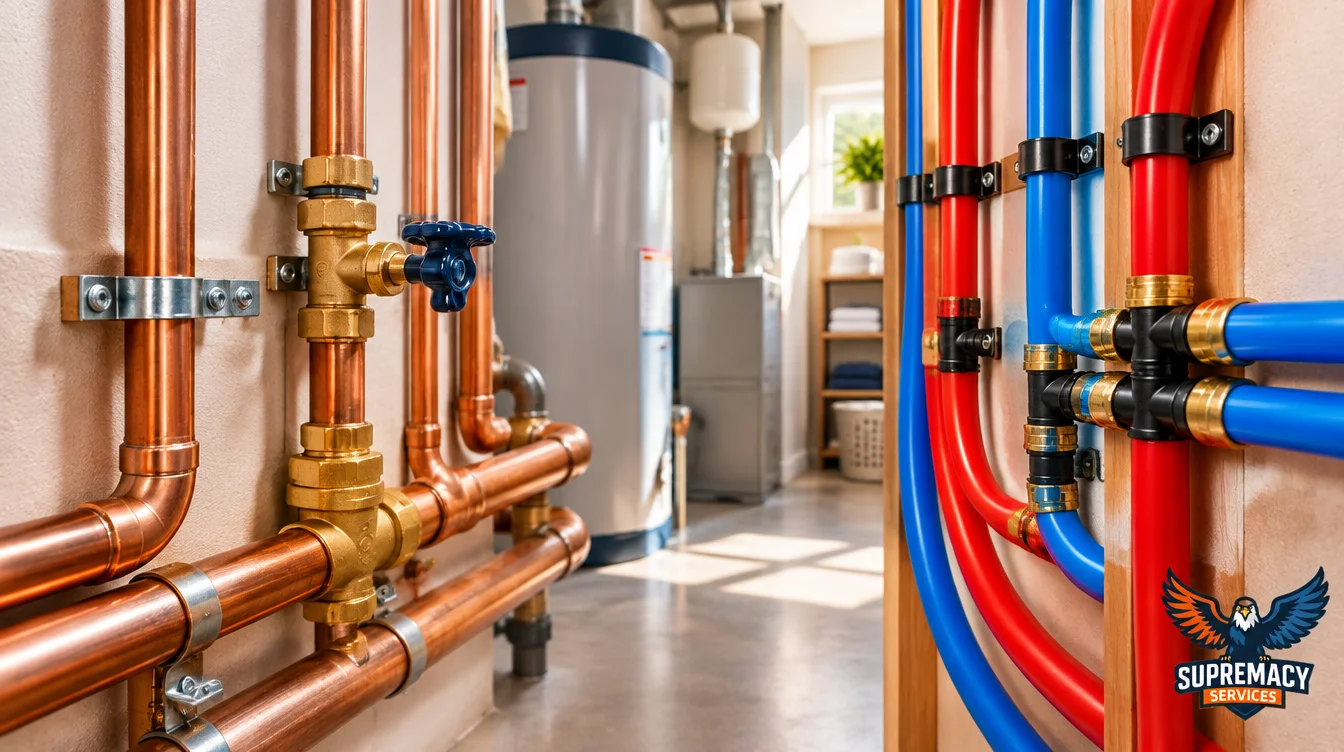
PEX is often the more practical choice for North Texas homeowners who want flexible, cost-conscious water supply piping, while copper remains a strong option for those who prefer rigid metal plumbing and have suitable water conditions. Neither material is automatically better for every Dallas home.
When comparing copper vs. PEX water pipes, the right decision depends on where the pipes will be installed, the condition of your existing plumbing, water chemistry, exposure to sunlight, freeze protection, and the total cost of installation.
For homes throughout Dallas, Plano, Frisco, Allen, Richardson, Garland, and the surrounding DFW Metroplex, understanding these differences can help homeowners avoid unnecessary replacements and choose a piping system suited to their property.
Table of Contents
- What Are Copper and PEX Water Pipes?
- Copper vs. PEX: Side-by-Side Comparison
- Which Material Lasts Longer?
- Which Is Better for North Texas Weather?
- Which Is Better for Slab Foundations?
- Copper vs. PEX Installation Costs
- Are Copper and PEX Safe for Drinking Water?
- When Should You Replace Existing Pipes?
- Can You Replace Copper Pipes With PEX?
- Dallas Plumbing Codes and Requirements
- Which Material Should You Choose?
- Frequently Asked Questions
What Are Copper and PEX Water Pipes?
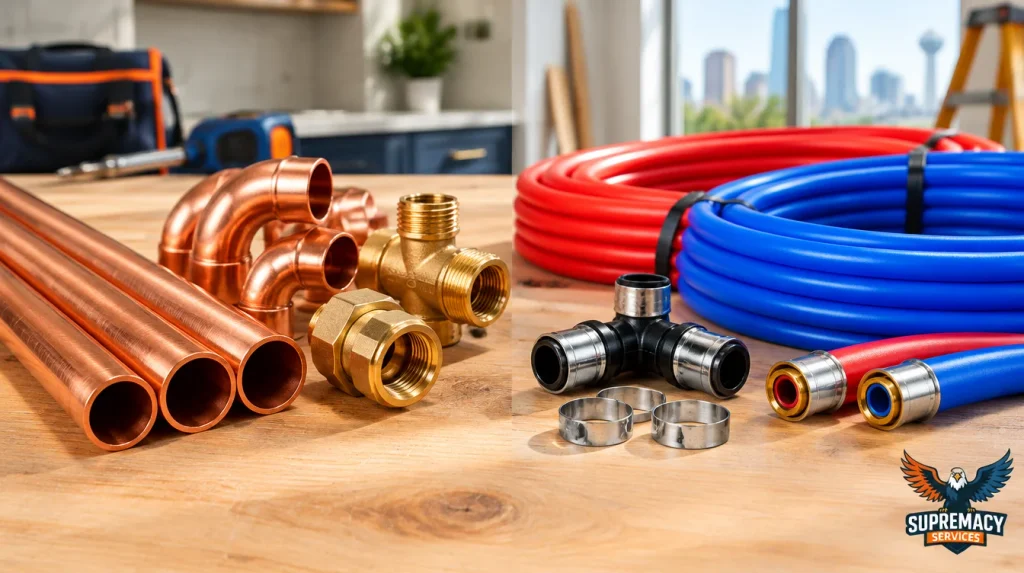
Copper and PEX are two commonly used materials for residential potable-water supply lines. Both can carry hot and cold water when the specific product is rated and installed for that purpose, but they differ in flexibility, connection methods, and installation requirements.
What are copper water pipes?
Copper water pipes are rigid or flexible metal tubes used to distribute drinking water throughout a home.
Residential copper tubing is commonly identified by types such as K, L, and M, which differ in wall thickness and intended applications.
Copper offers several practical advantages:
- Rigid construction and dimensional stability
- Good resistance to ultraviolet light compared with PEX
- A long history of residential plumbing use
- Compatibility with appropriately selected soldered or mechanical connections
- Suitability for exposed installations where approved
However, copper is not immune to corrosion, freezing damage, or installation defects.
Water chemistry, pipe condition, installation practices, and environmental exposure can influence its service life.
What are PEX water pipes?
PEX stands for cross-linked polyethylene. It is a flexible plastic piping material widely used for residential hot and cold water distribution.
Unlike rigid copper, PEX can bend around many obstacles, reducing the number of elbows required in some plumbing layouts.
Its advantages include:
- Flexible routing through walls and ceilings
- Fewer fittings in some installations
- Typically lower material and installation costs
- Resistance to corrosion associated with metal piping
- Some ability to expand during freezing conditions
- Compatibility with approved crimp, clamp, or expansion connection systems
PEX must be protected from inappropriate UV exposure and installed according to its product-specific requirements.
The NSF guidance on residential plumbing materials identifies both copper and PEX as residential plumbing options and explains the importance of selecting products certified for drinking-water contact.
Copper vs. PEX: Side-by-Side Comparison
Both materials can provide reliable residential plumbing when properly selected and installed. Their differences become more important when considering repairs, remodeling, and whole-home repiping.
| Feature | Copper | PEX |
|---|---|---|
| Material | Metal | Cross-linked polyethylene |
| Flexibility | Mostly rigid | Flexible |
| Typical installation cost | Higher | Lower |
| Corrosion | Can corrode | Does not undergo metal corrosion |
| Freeze resistance | Can split when frozen | More forgiving, but can still fail |
| UV resistance | Good | Requires UV protection |
| Fittings | Soldered or approved mechanical | Crimp, clamp, expansion or other approved systems |
| Installation in tight spaces | More joints may be required | Often easier to route |
| Water quality considerations | Susceptible to certain water chemistry conditions | Requires certified potable-water products |
| Long-term reliability | Depends on conditions and installation | Depends on conditions and installation |
Quick takeaway: PEX is frequently attractive for whole-home repiping and difficult-to-access interior runs. Copper can be preferable where exposed metal piping is appropriate or where a particular installation calls for a rigid material.
Neither option should be selected solely because it is marketed as longer-lasting.
Which Material Lasts Longer: Copper or PEX?
Both copper and PEX can remain in service for decades, but there is no universally reliable lifespan that applies to every installation.
How long do copper pipes last?
Copper piping has an extensive history of use in residential plumbing. However, service life varies according to water chemistry, pipe wall thickness, flow conditions, workmanship, and exposure to corrosive environments.
Copper pipes may deteriorate prematurely when corrosion produces localized pitting or pinhole leaks.
How long do PEX pipes last?
PEX is designed for long-term water distribution when operated within its temperature and pressure ratings.
Its durability depends on the tubing formulation, compatibility with water-treatment chemicals, installation conditions, and protection from UV exposure and physical damage.
Which is the better long-term investment?
A properly installed PEX system may be a better investment when reducing installation complexity and avoiding copper corrosion are priorities.
Copper may make sense when its physical properties better suit the installation and the water conditions are appropriate.
A professional assessment is especially useful when an older home has already developed repeated leaks.
Which Is Better for North Texas Weather?
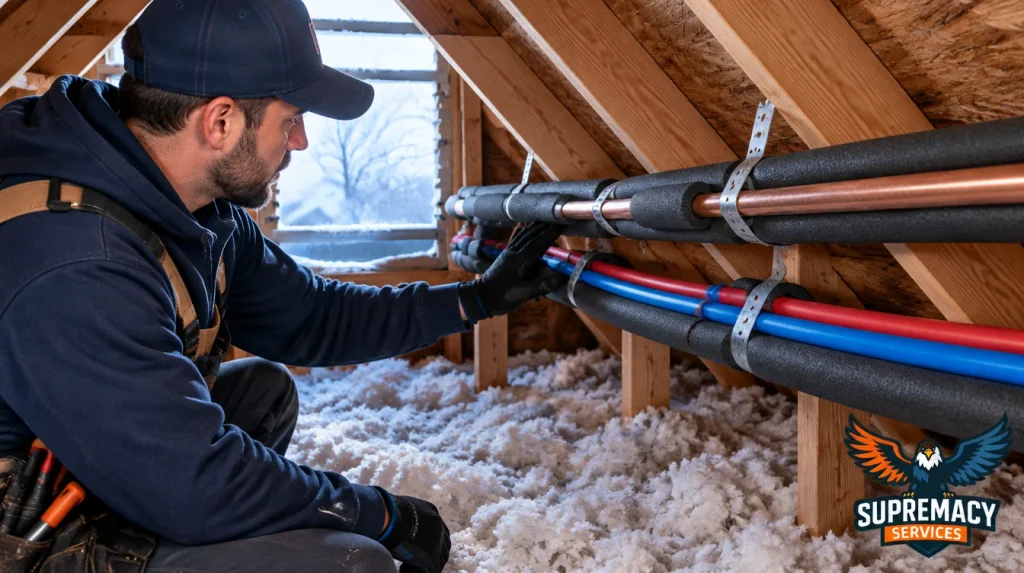
PEX generally offers an advantage in flexibility during freezing conditions, but neither copper nor PEX should be considered freeze-proof.
Dallas homeowners should pay attention to occasional winter freezes, particularly where plumbing runs through attics, exterior walls, garages, or other inadequately heated areas.
How does copper handle freezing temperatures?
When water freezes inside a copper pipe, expanding ice can create pressure that damages the pipe or its connections.
The resulting leak may not become visible until the ice thaws and water begins flowing again.
Can PEX pipes freeze and burst?
Yes. PEX can freeze, and its fittings or tubing can still be damaged.
PEX tubing is more flexible than copper and may tolerate some expansion, but that does not eliminate the risk of a burst pipe.
Proper insulation, routing, and protection from freezing conditions remain essential.
What about extreme Texas summer heat?
Both materials must be used within their applicable temperature and pressure ratings.
PEX should not be installed where prolonged direct sunlight or excessive heat exposure violates the manufacturer’s instructions.
For attic installations, a plumber should consider expected temperatures, insulation, support, and routing.
Homeowner tip: If your water lines are installed in an unconditioned attic, their location and insulation may matter more for freeze protection than whether the pipes are copper or PEX.
Which Is Better for Slab Foundations in Dallas Homes?
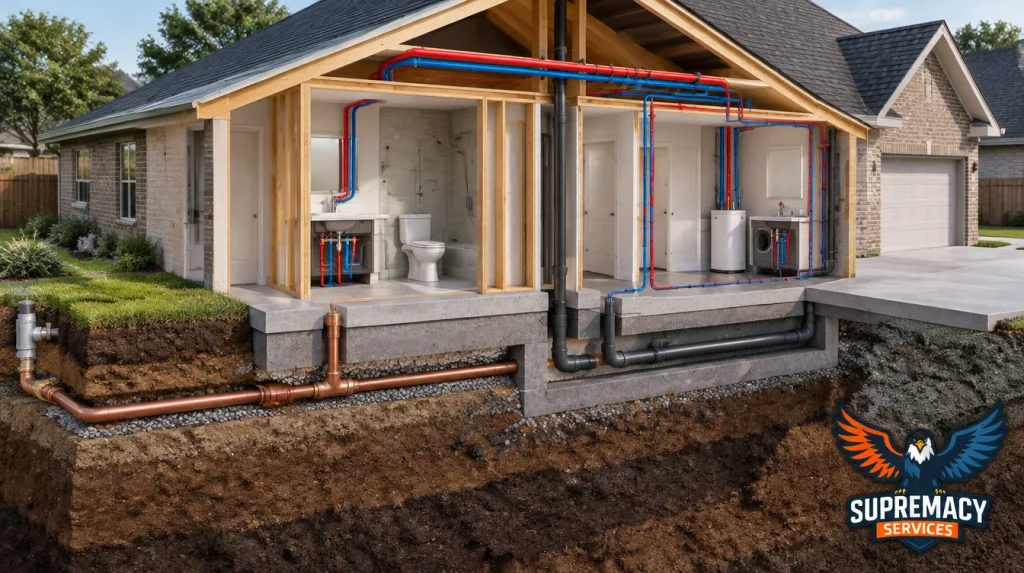
PEX can be advantageous when rerouting water supply lines around or above a slab foundation because its flexibility allows long runs with fewer directional fittings.
However, the best solution depends on the existing plumbing layout, access, and applicable installation requirements.
Why slab foundations affect pipe replacement
Many Dallas-area homes are built on concrete slab foundations.
Some have water supply lines routed beneath or through the slab. When an underground pipe develops a leak, reaching it may require specialized leak detection, excavation, or an alternative pipe route.
Possible options include:
- Repairing an accessible damaged section
- Rerouting an affected line through walls or ceilings
- Replacing a deteriorated piping system
- Using an approved alternative route to avoid unnecessary slab demolition
Is PEX better for rerouting water lines?
PEX is often practical for rerouting because it bends around obstacles and can reduce the number of fittings required.
That does not mean every under-slab application should automatically use PEX.
The correct tubing, fittings, sleeves, protection, and installation details must match the site conditions and applicable code.
Can copper pipes cause slab leaks?
Copper does not inherently cause slab leaks, but copper piping can develop leaks from corrosion, damage, poor installation, or other site-specific factors.
Homeowners should investigate unexplained water use, damp flooring, warm spots, or reduced water pressure rather than assuming the pipe material is responsible.
If your Dallas home has recurring underground leaks, Supremacy Services can help you evaluate whether a targeted repair or a more extensive water line replacement is appropriate. A professional assessment can help avoid replacing functional piping unnecessarily.
Copper vs. PEX Installation Costs in Dallas
PEX is generally less expensive to install than copper in many residential projects, particularly when a plumber can take advantage of its flexibility and reduced fitting requirements.
However, the total cost of a project depends on far more than the pipe material.
Why does copper usually cost more?
Copper typically involves higher material costs and can require additional labor for cutting, routing, joining, and securing rigid sections.
Projects with numerous turns or difficult access may involve more fittings and installation time.
Why can PEX be more affordable?
PEX tubing is flexible and often easier to route through existing building cavities.
For certain layouts, this reduces the number of fittings and the time needed to complete the installation.
However, PEX projects still require appropriate tools, compatible connections, proper supports, testing, and code compliance.
What affects the total cost of repiping?
| Cost factor | Why it matters |
|---|---|
| Home size | Larger homes generally require more piping |
| Number of bathrooms | More fixtures increase piping complexity |
| Pipe material | Copper and PEX have different material and installation costs |
| Accessibility | Finished walls and tight spaces increase labor |
| Existing damage | Corrosion, leaks, or damaged fittings can expand the scope |
| Pipe routing | Attic, wall, and slab routes have different requirements |
| Drywall restoration | Access openings may require repairs |
| Permits and inspections | Requirements depend on the jurisdiction and project |
| Fixture and valve condition | Additional components may need replacement |
How much does PEX repiping cost in Dallas?
A dependable quote requires an inspection or sufficiently detailed project information. Published national price ranges should not be treated as verified Dallas contractor pricing.
For a meaningful comparison, request written estimates that specify the same work scope, including pipe material, fitting system, access, testing, permits where applicable, and restoration.
Planning a plumbing upgrade? Contact Supremacy Services to discuss your home’s water line condition and compare repair, rerouting, and replacement options before choosing a pipe material.
Are Copper and PEX Safe for Drinking Water?
Both copper and PEX can be suitable for drinking-water systems when the products are certified for potable-water contact and installed correctly.
Neither material guarantees good water quality by itself.
Copper pipes and drinking-water quality
Copper can enter drinking water through corrosion of plumbing materials.
According to the U.S. Environmental Protection Agency, water chemistry and plumbing conditions affect the release of metals into drinking water.
Blue-green staining, unusual taste, or recurring pinhole leaks may justify additional investigation, although these signs alone do not establish unsafe copper levels.
PEX pipes and drinking-water quality
PEX does not release copper through metal corrosion, but potable-water PEX products must still meet applicable drinking-water safety requirements.
Homeowners should look for recognized certification, including NSF/ANSI/CAN 61 where applicable, and use tubing and fittings approved for the intended installation.
Which material is healthier?
There is no sound basis for declaring all copper systems healthier than all PEX systems, or vice versa.
The specific product, certification, installation quality, water chemistry, and maintenance matter more than broad material claims.
When Should You Replace Existing Copper or PEX Pipes?
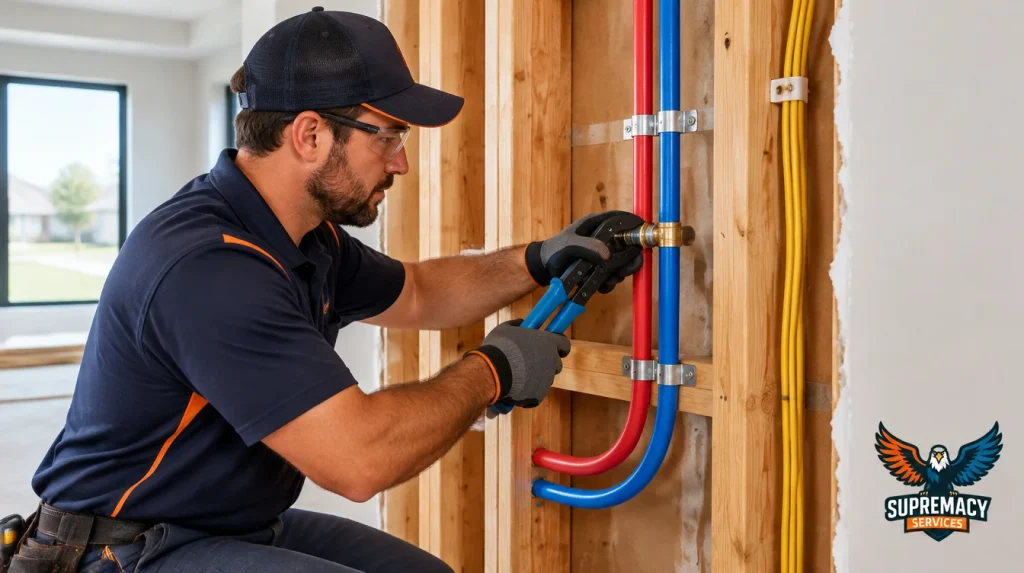
You do not need to replace functioning pipes simply because a different material is available.
Replacement becomes more reasonable when there is evidence of widespread deterioration, repeated leaks, or significant system defects.
Warning signs that deserve professional attention
- Recurring pinhole leaks in copper lines
- Visible corrosion or damaged fittings
- Unexplained increases in water consumption
- Persistent low water pressure
- Water stains on ceilings, walls, or flooring
- Multiple repairs in a short period
- Known freezing damage
- Deteriorating or incompatible plumbing connections
These symptoms can also result from a failed valve, hidden fixture leak, pressure problem, or damaged service line.
Repair or replace?
A single isolated leak may justify a localized repair.
Repeated failures throughout the system may make partial or complete replacement more economical over time.
Before committing to repiping, identify whether the problem affects an individual pipe, a group of lines, or the entire distribution system.
Can You Replace Copper Pipes With PEX?
Yes. Existing copper water supply pipes can often be replaced with PEX, provided the selected material and installation method comply with applicable codes and manufacturer requirements.
A complete replacement is not always necessary.
What does professional repiping involve?
A typical project may include:
- Inspecting the existing plumbing and identifying problem areas.
- Reviewing pipe routes, fixture locations, and access limitations.
- Selecting approved pipe sizes, materials, and fitting systems.
- Confirming applicable permit and inspection requirements.
- Isolating and draining the affected water lines.
- Installing the new piping and approved connections.
- Supporting and protecting the piping as required.
- Pressure-testing and checking for leaks.
- Flushing the system and restoring service.
- Completing required inspections and arranging any necessary surface restoration.
Can homeowners install PEX themselves?
PEX may appear easier to install than copper, but potable-water plumbing still involves sizing, compatible connections, pressure testing, and code requirements.
Incorrectly assembled fittings, inadequate supports, or poor routing can create concealed leaks.
For substantial repiping, concealed connections, or work involving permits, using a properly licensed plumbing professional is the safer approach.
Dallas Plumbing Codes and Requirements
Homeowners should verify local plumbing requirements before choosing a material or beginning a repiping project.
The City of Dallas identifies the 2021 International Plumbing Code and International Residential Code, with local amendments, among its adopted construction codes.
Specific requirements depend on the installation and the jurisdiction.
A property in Dallas may be subject to different administrative procedures than one in Plano, Frisco, Allen, or another DFW municipality.
Important questions include:
- Is the chosen pipe approved for this application?
- Are the fittings and connections compatible?
- Does the work require a permit or inspection?
- Are there special requirements for concealed or underground piping?
- Does the proposed route meet support, protection, and accessibility requirements?
Do not assume that an installation method accepted in one North Texas city is automatically acceptable throughout the Metroplex.
Which Material Should You Choose for Your North Texas Home?
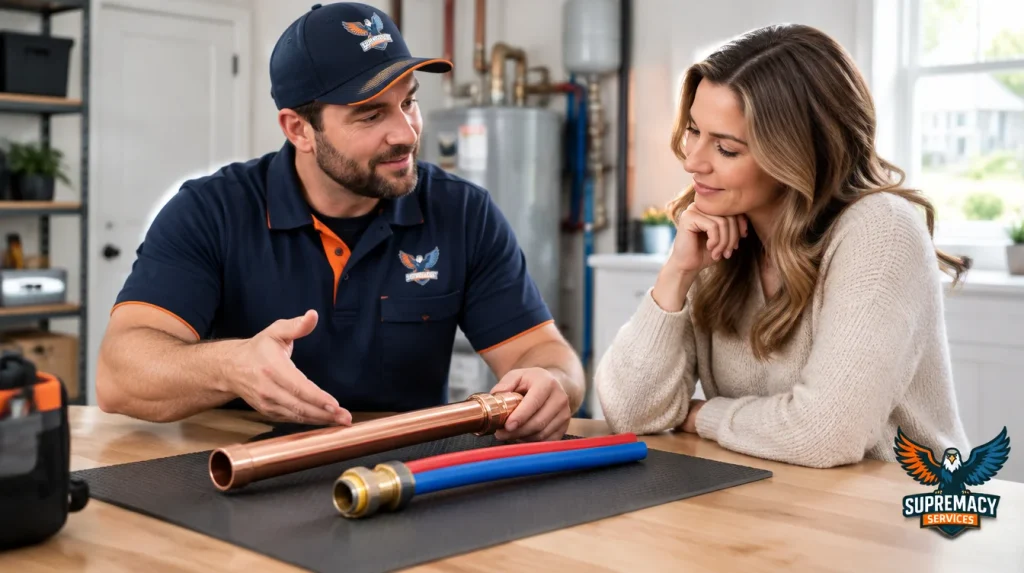
For many interior residential repiping projects, PEX is a practical first option to evaluate because of its flexibility, installation efficiency, and resistance to metal corrosion.
Copper remains a reasonable choice when the installation benefits from rigid metal piping, the water chemistry is suitable, and the higher installation cost is justified.
Choose PEX when:
- You are considering whole-home interior repiping.
- Existing pipe routes are difficult to access.
- Reducing unnecessary fittings is beneficial.
- Copper corrosion has been a recurring problem.
- The installation can be protected from UV and other prohibited exposures.
Choose copper when:
- Exposed rigid piping is desirable.
- The project has specific material or installation requirements.
- Water conditions are suitable for copper.
- The budget accommodates the installation method.
- The plumber determines copper is appropriate for the location.
Consider a combination of materials when:
Certain projects may use copper in one area and PEX in another, with approved transition fittings.
This can be appropriate when repairing part of an existing system rather than replacing every water line.
The decision should follow the home’s actual conditions rather than a one-size-fits-all preference.
Final recommendation for Dallas homeowners
Before replacing your pipes, determine why the existing system is failing.
If the problem is isolated, repair may be sufficient. If deterioration affects multiple locations, rerouting or repiping may offer better long-term value.
Concerned about aging copper pipes, recurring water leaks, or the cost of switching to PEX? Contact Supremacy Services to discuss professional water line inspection, repair, and replacement options for your Dallas or DFW home. Get guidance based on your plumbing system before making a major investment.
Frequently Asked Questions
1. Is PEX better than copper for Texas homes?
PEX is often a practical choice for interior repiping because it is flexible, generally less expensive to install, and resistant to metal corrosion. Copper may be preferable for certain exposed or specialized applications.
2. Does PEX last longer than copper?
Neither material has a guaranteed longer service life in every home. Copper can be affected by corrosion, while PEX durability depends on temperature, water chemistry, UV protection, and installation quality.
3. Is PEX cheaper than copper?
Generally, yes. PEX usually has lower material costs and can require less labor in many residential installations. Actual savings depend on access, pipe routing, fittings, and restoration work.
4. Can PEX pipes burst during a Texas freeze?
Yes. PEX is more flexible than copper and may tolerate some freezing-related expansion, but it can still rupture or develop damaged connections. Both materials require proper freeze protection.
5. Can PEX be used under a concrete slab?
Certain PEX systems can be used in approved concealed or concrete-related installations, subject to applicable code and manufacturer instructions. The specific routing, joints, sleeves, and protection must be evaluated.
6. Should I replace all my copper pipes with PEX?
Not necessarily. If copper pipes are functioning properly, replacement may offer little immediate benefit. Repeated leaks, extensive corrosion, or a major renovation may justify evaluating repiping.
7. Does PEX affect drinking-water taste?
Some homeowners report temporary taste or odor changes with new plumbing materials. Potable-water-certified products and proper installation are important. Persistent concerns should be evaluated through appropriate water testing.
8. Is copper better for hot water lines?
Both appropriately rated copper and PEX can carry residential hot water. The choice depends on the specific product ratings, operating conditions, installation location, and plumbing design.
9. Can copper and PEX pipes be connected together?
Yes. Approved transition fittings can connect copper and PEX. The connection method must be compatible with both materials and installed according to manufacturer instructions.
10. Do I need a permit to replace water pipes in Dallas?
Permit requirements depend on the nature and scope of the work. Homeowners should confirm current requirements with Dallas Planning and Development or the relevant municipality before starting a repiping project.

