
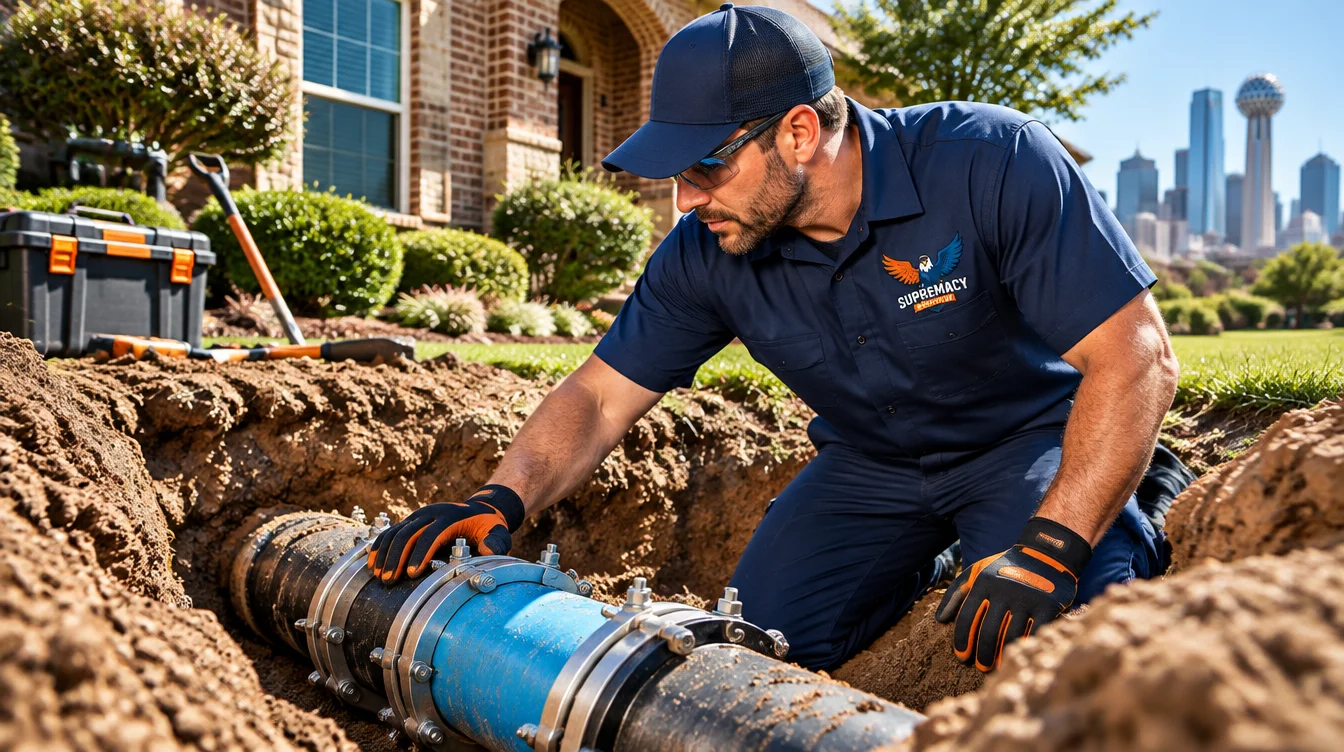
A main water line repair in Dallas may take a few hours of on-site work for an accessible, localized leak, while a more complicated underground repair can take a full day or longer. If the entire water service line needs replacement, the project may require several days once utility locating, approvals, excavation, installation, testing, and restoration are considered.
The important distinction is between the time spent physically repairing the pipe and the total time required to complete the project. Your household’s water may be turned off for only part of that process.
For Dallas and DFW homeowners dealing with unexplained low water pressure, soggy landscaping, or a suspected underground leak, understanding the repair timeline can make it easier to plan and prevent further damage.
Table of Contents
- How long does a main water line repair usually take?
- What affects the repair timeline?
- What happens during a professional water line repair?
- How long will your water be shut off?
- Repair vs. replacement: Which takes longer?
- What can delay repairs in Dallas?
- How much does repair time affect the cost?
- What should homeowners do while waiting?
- Can homeowners repair the line themselves?
- How can you prevent future problems?
- Frequently asked questions
- Schedule a water line inspection in Dallas
How Long Does Main Water Line Repair Take?

For planning purposes, a straightforward repair may be completed within a working day after the necessary preparations are finished. Extensive excavation, difficult access, or full-line replacement can make the process substantially longer.
The following ranges are illustrative, not published local averages or firm contractor commitments.
| Type of work | Illustrative on-site work time | What homeowners should know |
|---|---|---|
| Accessible connection or fitting repair | 2–4 hours | Assumes the problem is located and readily accessible |
| Localized underground pipe repair | 4–8 hours | Excavation and safe access may add time |
| Difficult or extensive underground repair | 1–2 days or more | Obstacles, multiple leaks, and testing affect completion |
| Full service-line replacement | 1–3 days or more | Preparation, approvals, and restoration may extend the overall project |
| Repair beneath concrete or a driveway | Highly variable | Surface removal and restoration may require additional visits |
These are broad scheduling examples rather than guaranteed repair durations. A plumber can give a more meaningful estimate after locating the damaged section and assessing site conditions.
Why a small leak can still take several days to resolve
A small crack in a buried water line might take relatively little time to repair once exposed. However, the work may require underground utility marking, coordination with the water provider, excavation, and testing.
For planned excavation, Texas811 requires notification at least two business days before digging, excluding weekends and holidays. That preparation can affect the overall schedule even when the actual pipe repair is relatively quick.
Need help estimating your repair timeline? Supremacy Services offers water line repair and replacement services in Dallas and Fort Worth. A professional inspection can establish what needs repairing and whether excavation or replacement is necessary.
What Factors Affect How Long a Main Water Line Repair Takes?
The biggest factors are the leak’s location, the condition of the pipe, accessibility, and whether the damaged section can be repaired independently.
1. Where the damaged pipe is located
A leak near an accessible connection is usually easier to reach than one buried beneath a driveway, patio, or landscaped area.
A buried line may require careful excavation, especially when electrical cables, gas lines, or other utilities are nearby.
2. The pipe material and condition
Copper, PVC, PEX, and older metallic pipes require different repair techniques and compatible fittings.
A single damaged connection may be suitable for a localized repair. A pipe with widespread deterioration or repeated failures may require a more extensive solution.
3. The severity of the leak
A localized leak and a severely damaged line do not necessarily require the same repair.
A plumber must determine whether the affected pipe can safely remain in service after repair or whether replacement is the more reliable option.
4. Soil and ground conditions
North Texas has areas with expansive clay soils. Changes in soil moisture can cause movement that affects buried infrastructure and foundations.
However, soil movement should not automatically be blamed for every water line leak. Pipe age, installation quality, corrosion, accidental damage, and connection failures may also contribute.
Wet, unstable, or obstructed excavation conditions can slow access to the damaged line.
5. The number of damaged sections
A repair that initially appears localized may reveal additional deterioration once the pipe is exposed.
When several weak sections are discovered, the plumber may recommend replacing a longer section rather than making multiple isolated repairs.
6. Utility locating and permits
Underground work may require utility locating, permits, inspections, or coordination with the water provider, depending on the location and scope.
The Texas State Board of Plumbing Examiners recommends checking with the municipal plumbing inspection department to establish applicable permit and inspection requirements.
7. Availability of parts and equipment
The required pipe size, fittings, excavation equipment, and access arrangements may affect scheduling.
Ask whether all materials and equipment will be available before the work begins.
What Happens During a Professional Main Water Line Repair?
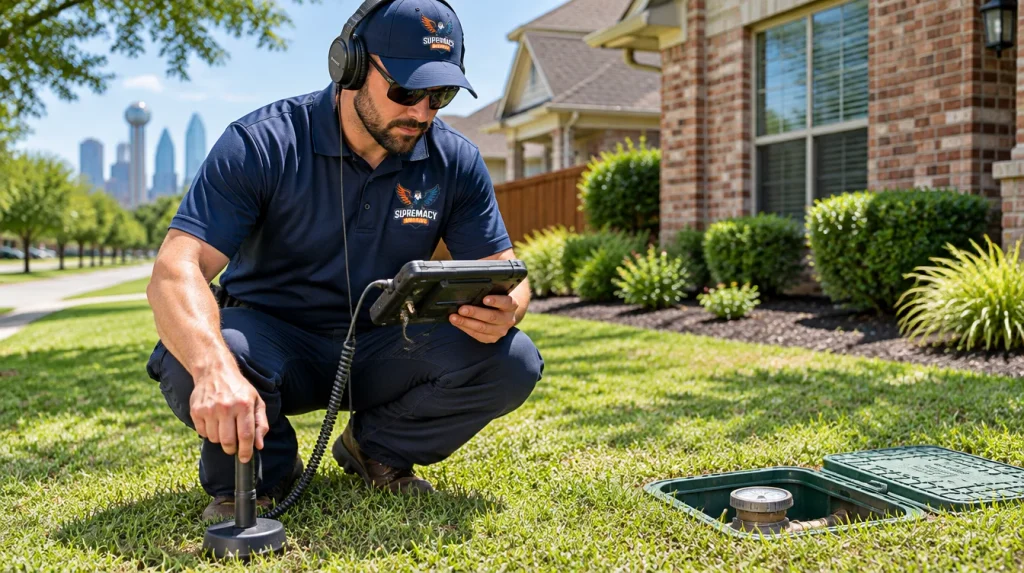
A professional repair generally follows six stages, although the exact sequence depends on the property and the damaged pipe.
Step 1: Inspection and leak diagnosis
The plumber reviews symptoms, checks accessible plumbing, and uses appropriate testing methods to identify the likely source of water loss.
Step 2: Locate the damaged section
Leak detection, pipe tracing, or targeted inspection helps narrow the repair area. The technician also evaluates nearby utilities and site access.
Step 3: Prepare and expose the pipe
After the required utility locating and authorizations, the damaged area is accessed using a suitable excavation or other approved method.
Step 4: Repair or replace the pipe
The damaged fitting or pipe section is repaired or replaced using materials appropriate for the water supply system.
Step 5: Test the completed work
The repaired system is checked for leakage and appropriate operation. Required flushing, disinfection, or inspection procedures are completed before normal use.
Step 6: Backfill and restore the work area
The excavation is closed after required checks. Landscaping, concrete, or other surface restoration may follow separately.
Does leak detection require digging?
Not always. Specialized leak detection can help narrow the suspected location before excavation.
However, detecting a leak and physically repairing it are different tasks. An underground pipe may still need to be exposed or accessed through an appropriate replacement method.
What should the plumber explain before starting?
Homeowners should understand the proposed repair method, expected water shutoff, anticipated duration, utility-locating requirements, restoration scope, and what might cause the estimate to change.
How Long Will Your Water Be Shut Off During a Main Line Repair?
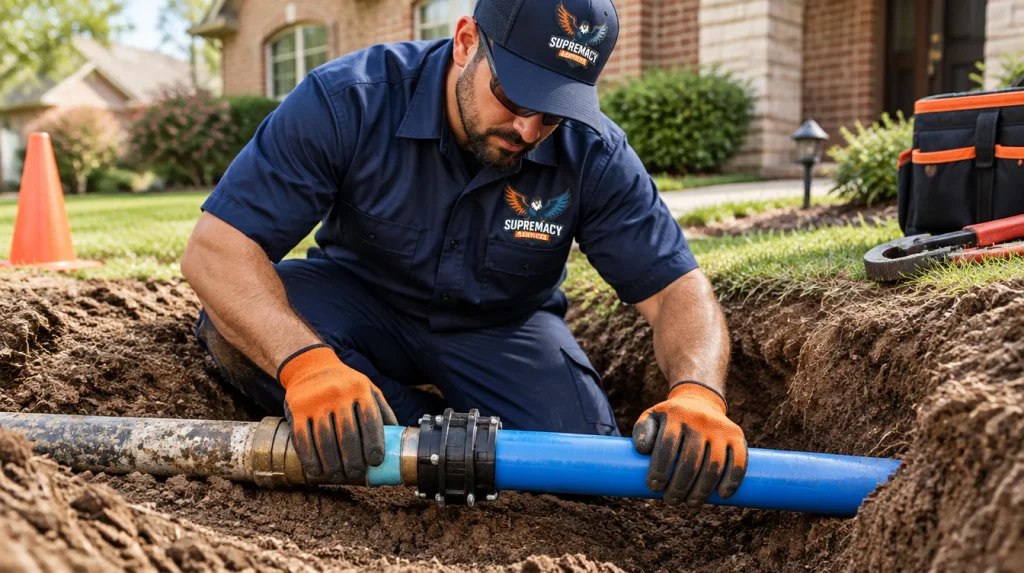
Your water may be off for several hours during a localized repair, but longer interruptions are possible if the work is complicated. The shutoff period is not necessarily the same as the total project duration.
A plumber may be able to complete preparatory tasks while the water remains available. The service is typically isolated when the damaged section must be opened, removed, or connected.
Can you use your toilets and faucets during the repair?
If the main supply is shut off, faucets, showers, washing machines, and other fixtures cannot receive their normal incoming water supply.
Some toilets may have one remaining tank flush, but homeowners should not depend on normal plumbing operation while the service is disconnected.
Before work begins, ask the plumber:
- When will the water be turned off?
- Is the entire house affected?
- When is service expected to return?
- Will the water need flushing before normal use?
- Could a second shutoff be necessary for testing?
Can you stay in your house during the repair?
Often, yes. A residential water line repair does not automatically require moving out.
However, a prolonged water interruption, extensive excavation, unsafe site conditions, or limited access to essential facilities may affect whether staying is practical.
Main Water Line Repair vs. Replacement: Which Takes Longer?
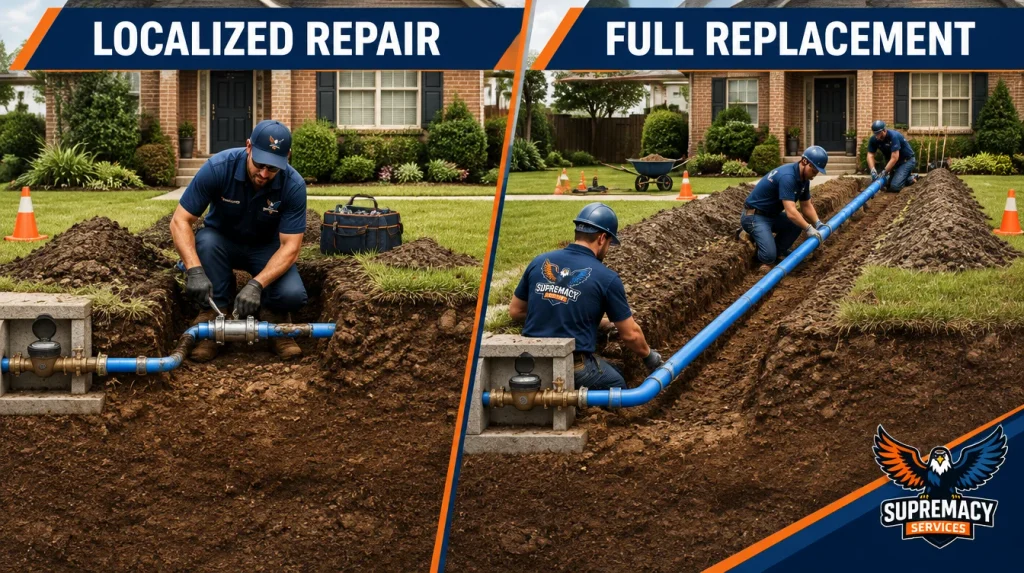
A localized repair is generally faster when the rest of the pipe is in good condition. Full replacement involves more work but may be preferable when deterioration extends beyond one isolated section.
| Consideration | Localized repair | Full replacement |
|---|---|---|
| Typical scope | One damaged area | Most or all of the affected service line |
| Work duration | Usually shorter | Usually longer |
| Excavation | Often limited | Depends on installation method |
| Material requirements | Repair section and fittings | New pipe and connections |
| Best suited for | Isolated, repairable damage | Extensive deterioration or recurring leaks |
| Future reliability | Depends on remaining pipe condition | Removes more of the deteriorated pipe |
Is trenchless water line replacement faster?
It can be, particularly when it reduces the need for extensive surface excavation. However, trenchless installation is not suitable for every property.
Pipe alignment, material, access points, nearby utilities, and the chosen installation method determine feasibility.
Trenchless installation should not be confused with a guaranteed no-dig or same-day repair.
When does replacement make more sense?
Replacement deserves consideration when the line has multiple leaks, widespread deterioration, recurring failures, or pipe materials that require special treatment.
If an older line may contain lead, the decision involves drinking-water safety as well as repair convenience. The EPA provides guidance on planning and conducting lead service line replacement and cautions against routine partial lead service line replacement.
Not sure whether your pipe needs repair or replacement? Request an evaluation through Supremacy Services’ Dallas-area underground water line repair and replacement service before committing to extensive excavation.
What Can Delay a Main Water Line Repair in Dallas?
Several circumstances can extend the timeline beyond the physical pipe repair.
Utility marking before excavation
Texas811 requires advance notification for planned digging. The normal two-business-day notice period excludes weekends and holidays, and affected utility operators must respond before excavation proceeds.
Emergency procedures may differ, but an urgent leak does not mean homeowners should bypass safe excavation requirements.
A leak near the meter or municipal connection
A leak near the water meter may involve a different responsibility or shutoff procedure than a leak on the private service line.
Do not assume that every pipe between the street and house is homeowner-owned. Ask the applicable water provider to identify the responsibility boundary.
Water beneath a driveway or sidewalk
Concrete removal, excavation, repair, backfilling, and surface restoration may require separate work stages.
A homeowner might have running water again before the concrete or landscaping is fully restored.
Heavy rainfall or difficult excavation conditions
Wet soil, standing water, and unstable excavations can slow work and introduce safety concerns.
Additional damage discovered during excavation
A technician may uncover corroded fittings, multiple damaged sections, or a pipe that is unsuitable for a localized repair.
These findings can change both the repair scope and completion estimate.
Permit or inspection scheduling
Requirements vary by jurisdiction and project scope. Work in Dallas, Plano, Frisco, and other DFW municipalities should be evaluated against the applicable local rules rather than assuming one regional process.
How Much Does Repair Time Affect the Cost of a Main Water Line Repair?
Labor time is one part of the total cost, but excavation, materials, equipment, access conditions, permits, and restoration can have a greater impact than the number of hours spent joining the pipe.
A straightforward accessible repair and a damaged line beneath a concrete driveway may have very different costs even when the pipe defect itself is similar.
What can increase the final bill?
| Cost factor | Why it matters |
|---|---|
| Leak detection | Locating a hidden failure may require additional diagnostic work |
| Excavation | Depth, soil conditions, and obstacles affect labor and equipment |
| Pipe material | Pipe type, diameter, and fittings affect material requirements |
| Repair extent | Multiple failures may require longer replacement sections |
| Emergency scheduling | After-hours availability may affect pricing |
| Restoration | Concrete, paving, and landscaping may need separate work |
| Permits and inspections | Applicable requirements vary by municipality |
There is no reliable fixed price for every Dallas water line repair. An on-site assessment and written estimate are more useful than a generic online price range.
The Texas State Board of Plumbing Examiners recommends obtaining written estimates that explain the work, payment arrangements, and applicable warranties.
What Should You Do While Waiting for Main Water Line Repair?
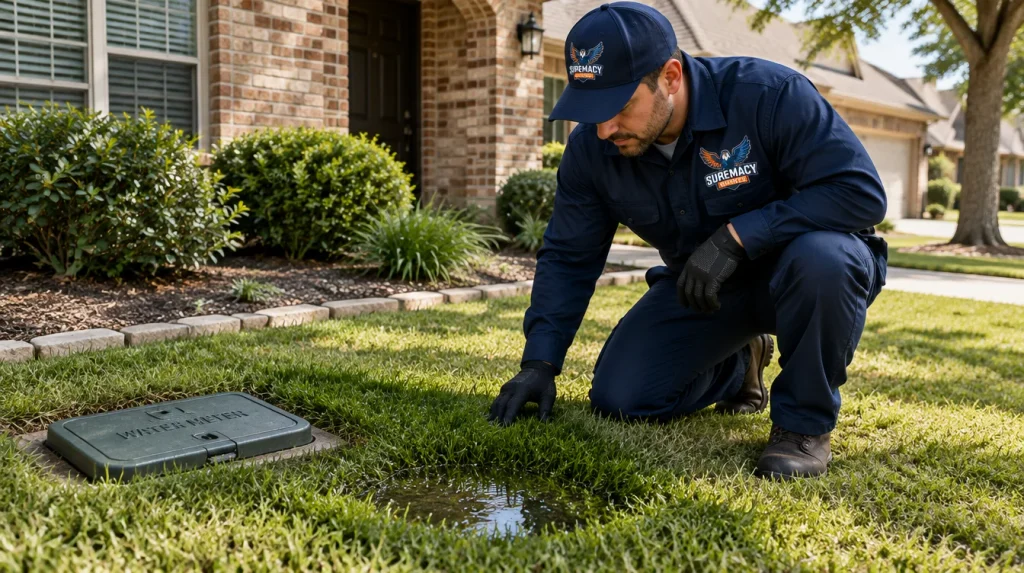
If you suspect a broken underground water supply line, the priority is to limit water loss and prevent additional property damage.
Signs that justify prompt investigation
- An unexplained drop in water pressure across multiple fixtures
- A persistent wet patch in the yard during dry weather
- Water flowing or pooling near the meter
- A water meter indicating usage when all known fixtures are off
- A sudden, unexplained increase in water consumption
- Unusual sounds of running water when no fixtures are being used
These symptoms do not prove that the main water service line is leaking. Irrigation problems, interior plumbing leaks, and municipal supply issues can produce similar symptoms.
Homeowner checklist
Before the repair begins
0 of 7 completedCheck whether the problem affects one fixture or the entire house.Look for visible water pooling without digging.If safe and accessible, shut off the homeowner-controlled main valve when an active leak is suspected.Keep people away from saturated ground, open excavations, and electrical hazards.Contact a plumbing professional or the water utility, as appropriate.Document visible damage and keep relevant billing information.Ask about the expected shutoff period and restoration plan.
Reset checklist
Do not operate a utility-owned meter valve, break a meter seal, or enter an unsafe excavation. Contact the water provider when utility-side isolation is needed.
Can Homeowners Repair a Main Water Line Themselves?
Simple observations, such as checking fixtures, monitoring the water meter, or locating an accessible homeowner shutoff valve, may help identify a suspected leak.
However, excavating and repairing a buried pressurized drinking-water line is substantially more complex.
Incorrect repairs can lead to renewed leakage, contamination risks, damage to adjacent utilities, or unsafe excavation conditions.
For buried supply-line repairs, homeowners should use appropriately licensed plumbing professionals and confirm local permit requirements.
You can consult the Texas State Board of Plumbing Examiners’ consumer guidance to learn how to verify plumbing credentials.
How Can Dallas Homeowners Reduce the Risk of Future Water Line Problems?
Not every underground pipe failure is preventable, but homeowners can reduce the likelihood of an unnoticed leak becoming a larger problem.
Monitor water consumption. Review utility bills and investigate unexplained changes rather than waiting for visible flooding.
Address recurring pressure problems. Have unusual or persistently high water pressure evaluated by a professional.
Protect underground utilities. Request utility marking before excavation and make sure private lines are identified where necessary.
Keep records of previous repairs. Pipe material, installation dates, repair locations, and past leaks can help a plumber assess future problems.
Investigate recurring wet spots. Do not assume unexplained moisture is caused by irrigation or rainfall.
Evaluate aging plumbing when repairs become frequent. Repeated leaks may justify a broader assessment of the service line’s condition.
Frequently Asked Questions About Main Water Line Repair in Dallas
1. Can a main water line be repaired in one day?
Yes. A localized repair may be completed in one day when the leak is identified, the damaged section is accessible, and required preparations are complete. Complicated underground repairs may take longer.
2. How long does it take to locate an underground water leak?
The time varies with pipe location, property conditions, and the available testing methods. Some leaks can be narrowed down during an initial visit; others require more extensive investigation.
3. Will my water be shut off for the entire repair?
Not necessarily. Water service may remain available during parts of the diagnostic and preparation process. The plumber should explain when the supply must be isolated and when it is expected to return.
4. Can a broken water line be fixed without digging up the entire yard?
Sometimes. Targeted excavation or suitable trenchless replacement methods may reduce disruption. The available options depend on the line’s condition, location, and configuration.
5. How long does a complete main water line replacement take?
The physical installation may take one or more working days, while the overall project can take longer because of utility locating, approvals, inspections, and restoration.
6. Does homeowners insurance cover main water line repairs?
Coverage depends on the policy, cause of damage, and whether optional service-line coverage applies. Homeowners should review their policy and ask their insurer about applicable exclusions and deductibles.
7. Who is responsible for a leaking water line near the meter?
Responsibility depends on the water provider’s service boundary and the location of the damaged pipe. Contact the applicable utility before assuming the leak is entirely a homeowner responsibility.
8. Can a water line leak damage my foundation?
A persistent underground leak can saturate surrounding soil and contribute to moisture-related property problems. Whether it has affected a particular foundation requires an assessment of the site and damage.
9. What should I do if my main water line breaks at night?
If safe, shut off the homeowner-controlled main valve to limit water loss. Avoid flooded areas with electrical hazards, and contact an emergency plumbing service or water utility as appropriate.
10. Is it better to repair or replace an old main water line?
A localized repair may be appropriate for an otherwise sound pipe. Repeated leaks, extensive corrosion, or widespread deterioration may make replacement a better long-term option.
Schedule a Main Water Line Inspection in Dallas
A leaking main water line can interrupt daily routines, waste water, and create expensive property problems when left unresolved.
The fastest practical solution begins with an accurate diagnosis—not automatically digging up the yard or replacing the entire pipe.
Supremacy Services provides water line inspection, leak detection, repair, and replacement services for Dallas and the DFW Metroplex.
If you have noticed unexplained water loss, reduced pressure throughout your home, or persistent wet areas around your property, arrange an inspection before the damage becomes more extensive.
Schedule your Dallas water line repair consultation with Supremacy Services

