
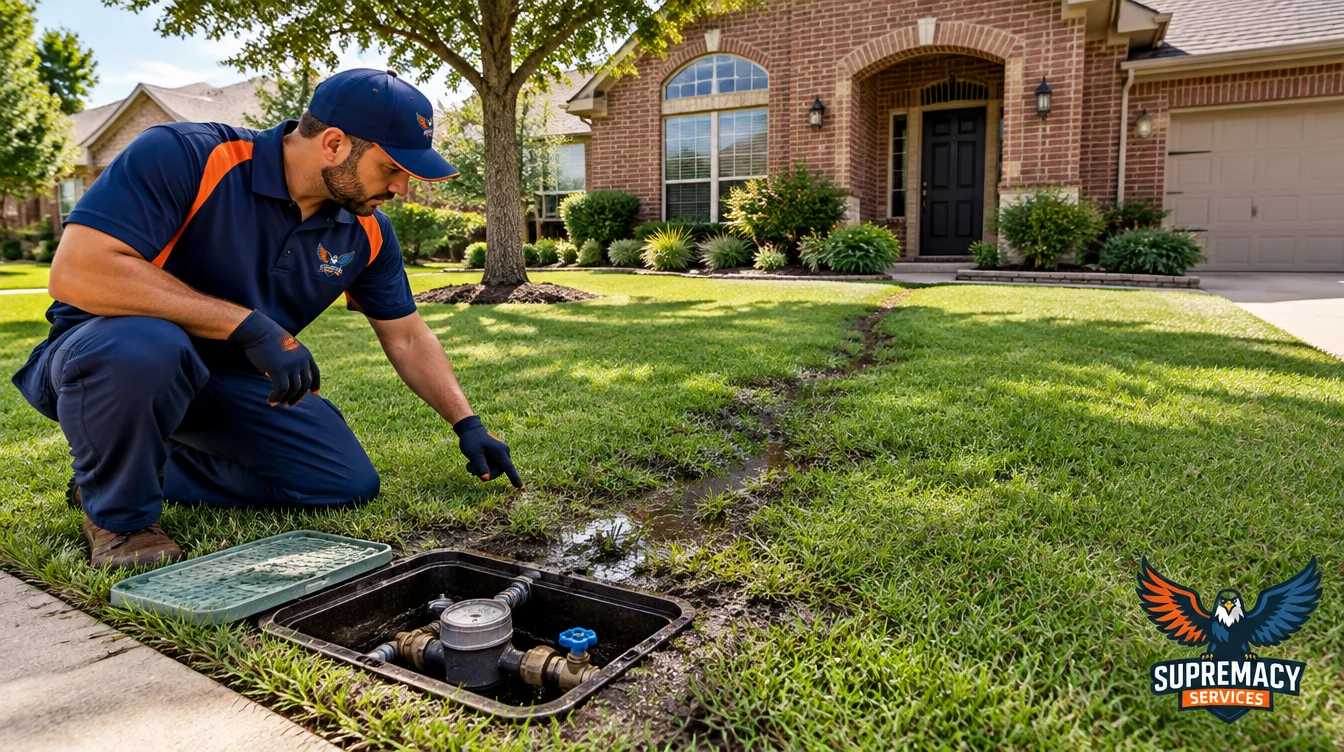
Water Line Leak Between Meter and House? In Dallas, Texas, the homeowner is generally responsible for repairing a water line leak between the meter and the house. Dallas Water Utilities maintains the public water main, the service connection leading to the meter, and the meter itself. The property owner is responsible for the private service line running from the meter toward the home.
This distinction matters because a leak in your front yard can still be your responsibility, even if the pipe is underground and close to the street.
According to Dallas Water Utilities’ service line guidance, the private portion of the water service line belongs to the property owner’s maintenance responsibility.
However, if water is leaking directly from the meter, its connections, or the public side of the system, contact Dallas Water Utilities before arranging private repairs. The exact leak location should be confirmed before deciding who pays.
Table of Contents
- Who Is Responsible for the Water Line From the Meter to the House?
- Where Does the City’s Responsibility End?
- How Can You Tell Which Side of the Meter Is Leaking?
- What Are the Warning Signs of an Underground Water Line Leak?
- What Causes Water Lines to Leak Between the Meter and House?
- What Should You Do If You Discover a Leak?
- How Much Does It Cost to Repair a Water Line Leak?
- Will Dallas Water Utilities Adjust Your Water Bill?
- Should You Repair or Replace the Water Line?
- How Can You Prevent Future Water Line Leaks?
- Frequently Asked Questions
- Get Professional Water Line Help in Dallas
Who Is Responsible for the Water Line From the Meter to the House?
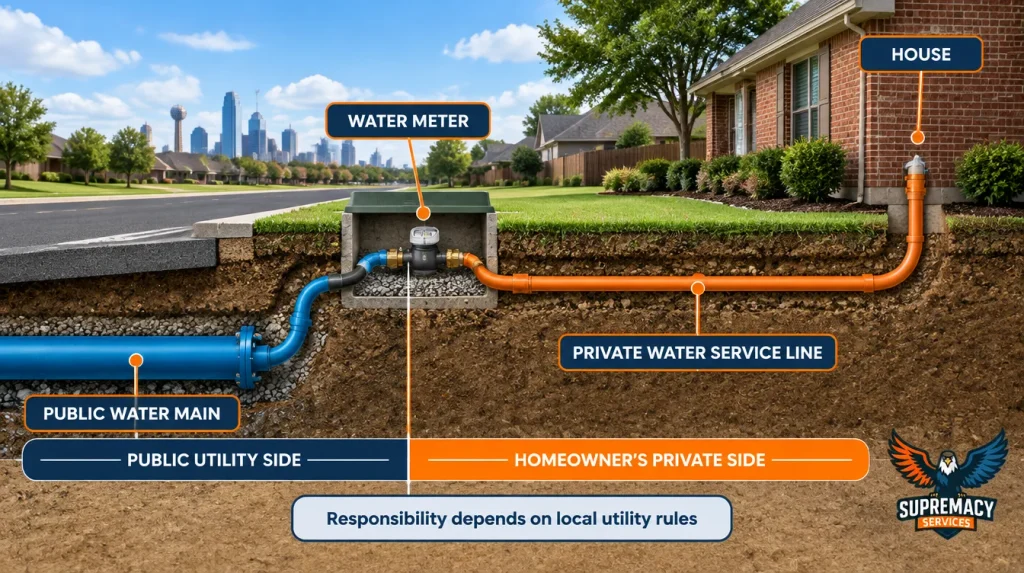
The property owner is generally responsible for the water service line running from the customer side of the meter to the home. The water utility is responsible for its public infrastructure, including the meter and the public-side service connection.
For Dallas Water Utilities customers, this division is described in Dallas City Code Section 49-24, which establishes the city’s responsibility for maintaining the water service connection from the main to the meter.
Water line responsibility at a glance
| Water system component | Generally responsible party |
|---|---|
| Public water main beneath the street | Water utility |
| Service connection from main to meter | Water utility |
| Water meter itself | Water utility |
| Private service line from meter to house | Property owner |
| Household plumbing after the service line enters the home | Property owner |
| Leak at an uncertain meter connection | Utility should inspect and determine responsibility |
These rules apply to Dallas Water Utilities customers. Other DFW municipalities and water districts may have different policies, so homeowners in Plano, Frisco, Allen, Irving and surrounding communities should confirm the responsibility boundary with their water provider.
Does the homeowner own the water line even if it is underground?
Generally, yes.
Being underground does not automatically make a pipe the city’s responsibility.
The relevant questions are who owns the section of pipe, where it connects to the water system, and which side of the service boundary contains the leak.
For example, if a buried pipe breaks halfway between your front-yard meter and your foundation, that pipe is ordinarily part of the private service line.
The homeowner would generally arrange and pay for the repair.
Where Does the City’s Responsibility End?
For Dallas Water Utilities customers, the water meter is the primary dividing point between public and private water service responsibilities.
The city maintains the public-side connection and meter, while the homeowner maintains the private-side service line.
What if the leak is inside the water meter box?
A leak inside the meter box does not automatically establish responsibility.
The leak could originate from:
- The water meter itself.
- A connection on the utility side.
- A customer-side connection.
- A damaged private pipe immediately after the meter.
Because these components are close together, water can accumulate in the same meter box regardless of which part has failed.
If you notice standing water, bubbling or continuous flow inside the meter box, report the problem to Dallas Water Utilities before attempting repairs.
Dallas residents can report meter leaks, water main breaks and emergency water shutoff requests through 311, or 214-670-3111 when calling from outside city limits.
What if the leak is near the sidewalk or street?
Location alone does not determine ownership.
A private service line may cross a yard, sidewalk area or another section of property before reaching the home.
Similarly, a public service connection may be located near the property’s frontage.
The correct approach is to establish where the leak originates in relation to the meter and applicable utility ownership boundary.
Do not excavate near the meter or public infrastructure without appropriate utility coordination.
How Can You Tell Which Side of the Meter Is Leaking?
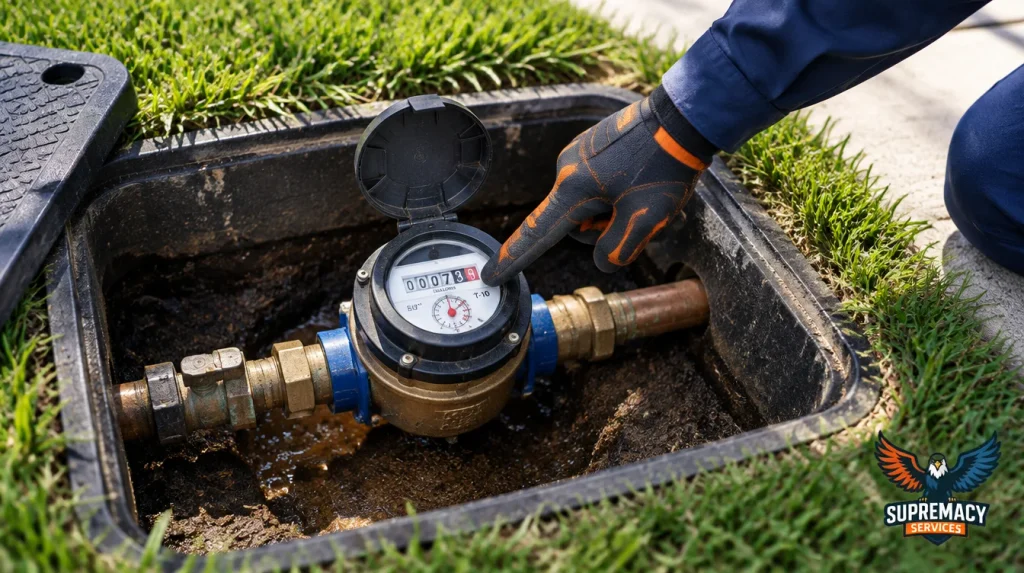
A homeowner can perform a basic water meter observation to identify unexplained water use. However, a meter test alone cannot always determine whether the leak is in the yard, inside the house or at a particular connection.
Step 1: Turn off water-consuming fixtures
Make sure nobody is using water.
Check faucets, toilets, washing machines, dishwashers, irrigation systems and other connected equipment.
Step 2: Observe the water meter
If the meter is safely accessible, check whether its leak indicator or consumption display shows water use while everything is turned off.
Continued registered consumption may indicate a leak downstream of the meter.
Different meter models display flow differently, so consult the utility’s instructions if the reading is unclear.
Step 3: Isolate the house plumbing, if possible
If your property has an accessible, functioning house-side shutoff valve, turn it off without forcing it.
Observe the meter again.
If consumption continues while the house plumbing is isolated, a leak may exist between the meter and that shutoff valve, or on another connected branch that remains supplied.
This test is not conclusive if the shutoff valve leaks internally, irrigation branches remain connected, or the plumbing layout is unusual.
Step 4: Check the ground along the service-line route
Look for:
- Persistent wet patches when it has not rained.
- Unusual puddles near the front yard.
- Soft or sinking soil.
- Water surfacing around the meter box.
- Unexpectedly green areas of grass.
- Erosion around the driveway or walkway.
These symptoms can help narrow the investigation, but they do not confirm the exact location.
Step 5: Arrange professional leak detection
A qualified plumber can evaluate the water meter observations, isolate parts of the plumbing system, perform appropriate pressure or flow tests and locate the likely leak before excavation.
If the problem appears to be on the private service line, Supremacy Services provides water line repair and replacement services in Dallas and Fort Worth.
An accurate diagnosis helps avoid paying for excavation in the wrong location.
What Are the Warning Signs of an Underground Water Line Leak?
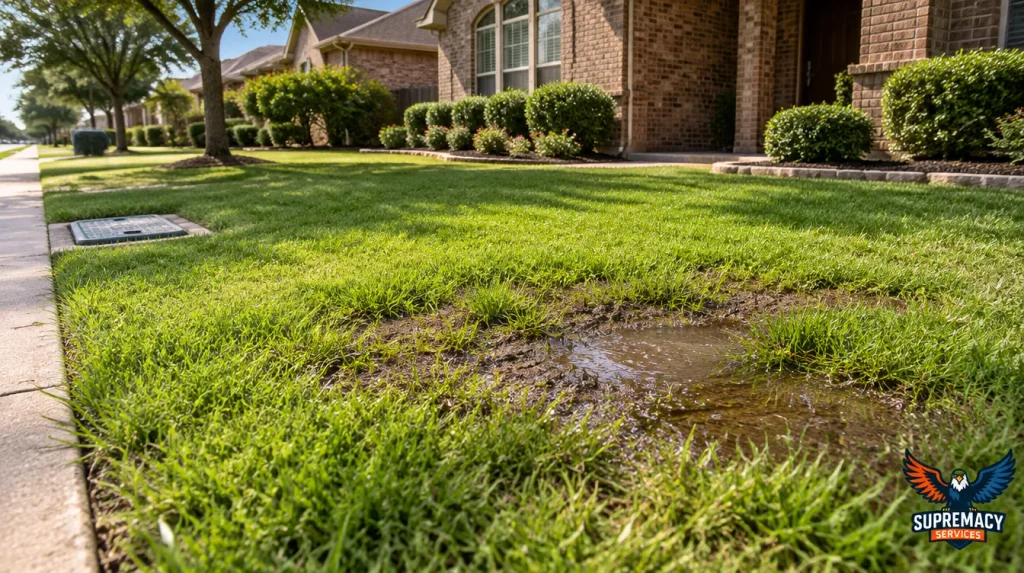
Underground service-line leaks may remain hidden until water loss becomes substantial or damage appears above ground.
Common warning signs include:
| Warning sign | What it may indicate |
|---|---|
| Unexplained increase in water bill | Continuous water loss somewhere in the metered system |
| Water meter registering usage with fixtures off | Possible downstream leak |
| Wet soil in the front yard | Buried pipe, irrigation or drainage problem |
| Low water pressure throughout the home | Possible supply-line leak, restriction or utility pressure issue |
| Unusual water sounds near plumbing | Water flowing unexpectedly |
| Soil erosion or sinking ground | Water movement beneath the surface |
| Repeated wet areas near the meter | Meter connection or nearby service-line issue |
Could the problem be something other than the main water line?
Yes. Not every wet yard or high water bill is caused by a damaged main water service line.
Possible alternatives include irrigation-system leaks, running toilets, outdoor faucet leaks, drainage problems, rainwater accumulation and plumbing leaks beneath the slab.
A sewer leak can also create wet ground, but sewage odors, recurring drain backups and slow fixtures suggest a different problem.
Identifying the source first prevents unnecessary repairs.
What Causes Water Lines to Leak Between the Meter and House?
Water service lines can deteriorate or become damaged for several reasons.
Aging or deteriorating pipe materials
Older piping may develop corrosion, weak joints or material-related deterioration.
The condition depends on the pipe material, installation quality, water chemistry and surrounding environment.
Soil movement and changing moisture conditions
North Texas properties can experience significant soil moisture changes.
Expansive clay soils, where present, may shrink or swell as moisture conditions change. Movement around buried piping can place additional stress on vulnerable joints or poorly supported pipe sections.
Soil movement alone does not prove the cause of a leak; the damaged pipe must be examined.
Tree roots and nearby landscaping
Tree roots can exploit existing pipe defects or place pressure on vulnerable connections.
Landscaping excavation can also damage underground lines.
Accidental digging damage
Fence installation, landscaping, trenching and other construction work can damage buried utilities.
Texas811 requires advance notification before excavation so participating utility operators can mark their underground facilities.
Private lines may require additional locating services.
Excessive pressure or installation problems
Pressure fluctuations, unsupported pipe sections, inadequate joint connections and improper installation can contribute to service-line failures.
A plumber should investigate the cause rather than assuming every leak is the result of pipe age.
What Should You Do If You Discover a Leak?
If you suspect a leak between the water meter and your Dallas home, take the following steps.
1. Reduce water use and assess the urgency.
If water is actively flooding the property, approaching electrical equipment or undermining a structure, keep people away from the affected area.
2. Use an accessible private shutoff if appropriate.
If you can safely isolate the affected plumbing using your own shutoff valve, do so. Avoid forcing damaged valves or operating utility-owned equipment without authorization.
3. Determine whether the leak may involve the meter.
If the meter itself, public connection or utility-owned equipment appears to be leaking, contact Dallas Water Utilities.
4. Document the evidence.
Take photographs of visible water, meter readings and damaged areas. Keep copies of unusually high bills.
5. Arrange professional diagnosis if the leak appears private.
Ask a qualified plumber to identify the leak location and recommend a suitable repair.
6. Confirm utility locations before excavation.
Texas811 states that the person responsible for excavation must submit a locate request at least two business days before digging, excluding weekends and holidays.
When a contractor performs the excavation, the contractor is responsible for the required notification.
7. Retain repair documentation.
Keep invoices, photographs, work descriptions and dates. These may be needed for insurance inquiries or a water-bill adjustment request.
When should you call the city instead of a plumber?
Contact Dallas Water Utilities first if the water meter itself appears damaged, water is flowing from a public main, or the source appears to be on the utility side.
For a suspected leak in the private service line between the meter and house, contact a qualified plumber.
When the location is uncertain, the utility can help determine whether its equipment requires inspection.
How Much Does It Cost to Repair a Water Line Leak?
The cost of repairing a water line between the meter and house depends on the leak location, pipe condition, accessibility and repair method.
There is no single reliable price that applies to every Dallas property.
A small, accessible pipe repair may require much less work than replacing a long service line beneath landscaping or concrete.
Factors that affect the repair cost
| Cost factor | Why it matters |
|---|---|
| Leak location | A leak near an accessible connection may require less excavation |
| Pipe depth | Deeper lines can require additional labor and excavation precautions |
| Pipe material | Different materials require different repair methods |
| Length of damaged pipe | Extensive deterioration may favor replacement |
| Concrete or driveway access | Surface removal and restoration can increase cost |
| Utility conflicts | Nearby buried infrastructure can complicate excavation |
| Permit requirements | Requirements vary by municipality and work scope |
| Landscaping restoration | Sod, planting beds and hardscaping may need repair |
| Emergency conditions | Urgent work can affect scheduling and overall project cost |
Does homeowners insurance cover underground water line repairs?
Standard homeowners insurance does not automatically cover the cost of repairing or replacing a buried service line.
Some policies may cover certain resulting damage, while optional service-line coverage may apply to eligible underground pipe failures.
Coverage depends on policy wording, exclusions, the cause of damage and any endorsements.
Before authorizing extensive repairs, ask your insurance provider whether service-line coverage is included.
Can you get a quote before digging?
A plumber can usually begin with an inspection and explain the diagnostic work needed.
Depending on the evidence, additional locating or limited excavation may be necessary before a final repair scope can be established.
Homeowners should request a written estimate identifying the work included, excavation requirements, restoration responsibilities and any permit-related items.
For homeowners facing a suspected private water line failure, Supremacy Services’ Dallas water line repair team can assess repair and replacement options.
Will Dallas Water Utilities Adjust Your Water Bill?
Dallas Water Utilities has a leak adjustment process for qualifying hidden leaks that cause a substantial increase in water consumption.
However, a water bill adjustment is not the same as reimbursement for the plumbing repair.
Under Dallas City Code Section 49-9, qualifying adjustments require documentation showing that the leak was not reasonably detectable from the surface, that it has been repaired, and what repairs were performed.
Dallas Water Utilities’ published leak adjustment form also specifies:
- Repairs must be completed before an adjustment is considered.
- Requests should be submitted within 90 days of the repair date.
- An approved adjustment may cover a maximum of three months.
- Generally, only one adjustment is available within a 12-month period.
- Approval is not guaranteed.
The city’s form states that repair expenses and water loss remain the customer’s responsibility.
Homeowners should retain a paid invoice or repair receipt and review the official Dallas Water Utilities leak adjustment request.
Do not assume that every visible or underground leak qualifies for an adjustment.
Should You Repair or Replace the Water Line?
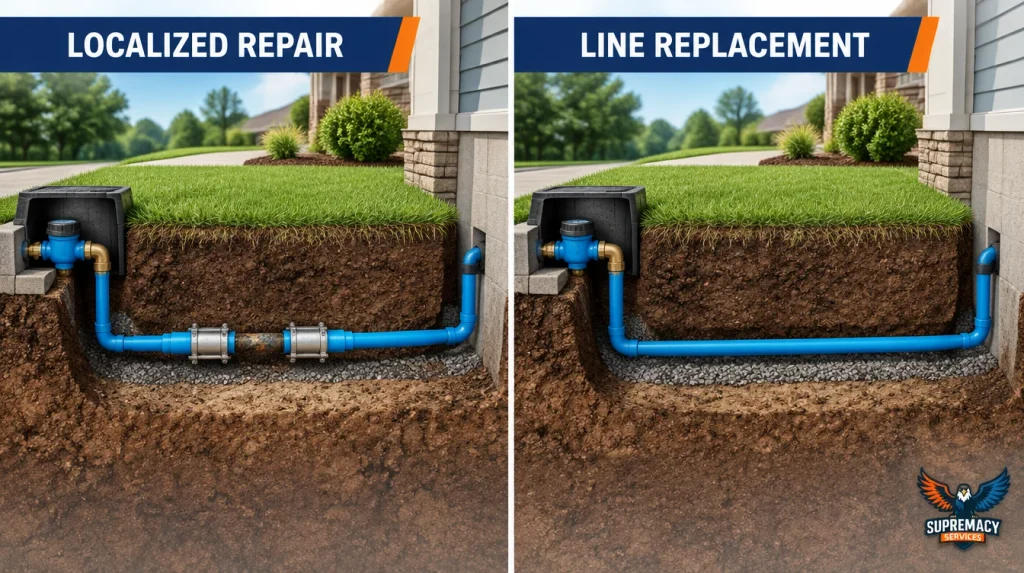
Repair is often worth considering when the damaged section is limited and the remaining pipe is in satisfactory condition.
Replacement may be more appropriate when the line has extensive deterioration, repeated failures or multiple weak sections.
| Consideration | Localized repair | Water line replacement |
|---|---|---|
| Single isolated defect | Often suitable | May be unnecessary |
| Multiple recurring leaks | May provide only temporary relief | Often worth evaluating |
| Extensive corrosion | May leave other weak areas | May be more appropriate |
| Pipe in otherwise good condition | Often practical | Not always justified |
| Long-term reliability concerns | Depends on overall pipe condition | Addresses the replaced section |
| Excavation needs | Often localized | Depends on route and installation method |
What does professional water line repair involve?
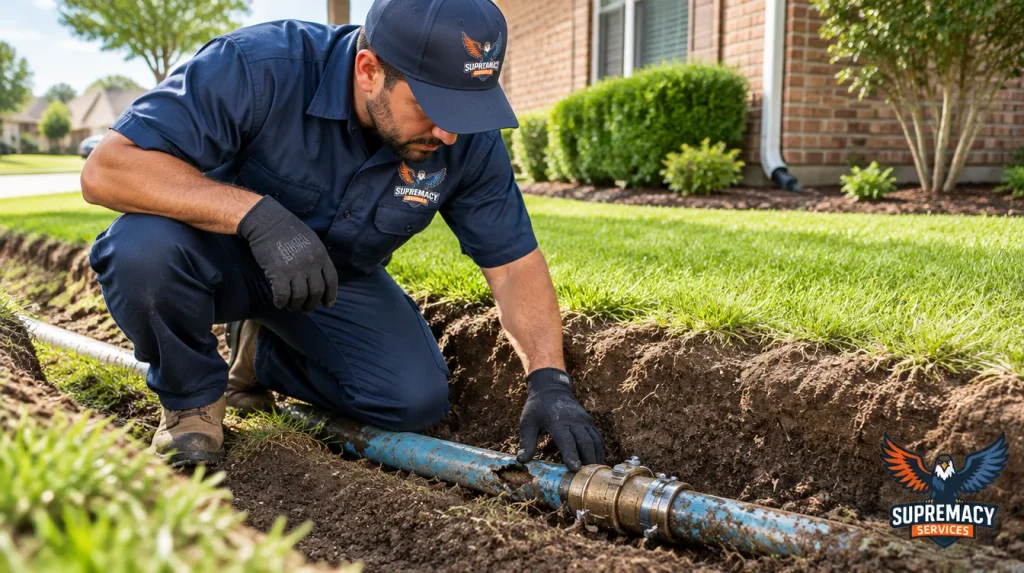
A professional service typically includes:
- Reviewing the symptoms and water consumption history.
- Determining whether the issue is likely on the private or public side.
- Isolating and testing the affected plumbing.
- Locating the suspected leak.
- Assessing the pipe material and condition.
- Explaining repair versus replacement options.
- Coordinating utility locating and required permits.
- Completing the approved repair.
- Testing the system and restoring water service.
- Documenting the work and identifying any restoration needs.
Some properties may be candidates for trenchless replacement methods, while others require traditional excavation.
The correct method depends on pipe material, layout, access and site conditions.
How Can You Prevent Future Water Line Leaks?
Not every underground leak is preventable, but homeowners can reduce avoidable risks.
- Monitor water consumption. Investigate unexplained changes rather than waiting for visible flooding.
- Check the meter when water use is unexpectedly high. An unusual reading can provide an early warning.
- Know where the private service line runs. Keep available plumbing records and installation drawings.
- Request utility locating before digging. Do not rely on assumptions about pipe depth or position.
- Address pressure concerns. Have persistent or unusual pressure problems evaluated.
- Investigate repeated wet spots. Avoid assuming that moisture is always caused by irrigation or rainfall.
- Keep repair records. Document pipe materials, past failures and replaced sections.
Homeowners in Dallas and surrounding North Texas communities should pay particular attention to underground utilities when planning landscaping, fence installation or major yard renovations.
Frequently Asked Questions
1. Who pays for a water line leak between the meter and house in Dallas?
The property owner generally pays for repairs to the private water service line between the meter and house. Dallas Water Utilities maintains the public-side connection and meter. Responsibility should be confirmed when the leak is at the meter boundary.
2. Is the city responsible for a water line leak in my front yard?
Not necessarily. A water line in your front yard may be privately owned. Responsibility depends on which section of the water system is leaking, not simply whether the pipe is underground or near the street.
3. What if water is leaking inside the meter box?
Contact your water utility. The leak could involve the meter, a public-side connection or the customer’s private connection. An inspection may be necessary to establish responsibility.
4. Can a water leak between the meter and house increase my bill?
Yes. Water escaping from a metered private service line can register as consumption and increase your bill, even if the water never reaches the house.
5. How do I know if my underground water line is leaking?
Warning signs include unexplained water consumption, wet ground, reduced water pressure and meter activity when fixtures are off. Professional testing may be necessary to confirm the location.
6. Does Dallas Water Utilities pay for private water line repairs?
Generally, no. The property owner is responsible for maintaining the private service line. A qualifying hidden leak may be eligible for a water bill adjustment, but that does not mean the city pays for the pipe repair.
7. Can I repair the water line myself?
Minor above-ground plumbing tasks may be manageable for some homeowners, but underground service-line repairs can involve excavation hazards, utility conflicts, code requirements and water-system connections. A qualified plumber is generally the safer choice.
8. How long does it take to repair a water line between the meter and house?
Not necessarily. Texas811 notifies participating utility operators to mark their facilities. Privately owned lines may require a separate private utility locator. Contact Texas811 before excavation and confirm whether additional locating is needed.
10. Does the same water line responsibility rule apply in Plano, Frisco and Allen?
Many water utilities distinguish between public-side and customer-side service lines, but exact ownership and maintenance rules can differ. Homeowners should verify their specific municipality’s or water district’s policy.
Get Professional Water Line Help in Dallas
If you suspect a water line leak between the meter and your home, the first priority is identifying the leak’s location and determining whether the affected pipe is privately owned.
For Dallas Water Utilities customers, a leak on the private side of the meter is generally the homeowner’s responsibility.
If the source is uncertain or appears to involve the meter, contact the utility first.
If the problem is confirmed on your private service line, Supremacy Services provides water line diagnostics, repair and replacement services throughout Dallas and the DFW Metroplex.
Schedule a water line inspection with Supremacy Services to discuss the cause, available repair methods and next steps before the problem causes further damage.

