

Yes, a slab leak can damage your home’s foundation. When a plumbing pipe leaks beneath a concrete slab, escaping water can change the moisture content of the supporting soil, contribute to uneven foundation movement, and damage flooring and other building materials.
For Dallas homeowners, the concern is especially relevant because some North Texas properties sit on expansive clay soils that swell when wet and shrink when dry. A persistent underground leak can create uneven moisture conditions beneath the home.
However, not every slab leak causes structural damage, and not every foundation crack means you have a slab leak. The severity depends on the leak’s location, duration, soil conditions, foundation design, and whether the underlying plumbing problem is corrected promptly.
Understanding the warning signs can help you decide when to call a plumber, when a structural evaluation may be necessary, and how to prevent additional damage.
Table of Contents
- What Is a Slab Leak?
- How Can a Slab Leak Damage Your Foundation?
- What Are the Warning Signs?
- Why Are Dallas Foundations Vulnerable?
- How Quickly Can Damage Develop?
- Slab Leak or Foundation Problem?
- What Should You Do?
- How Do Professionals Detect Slab Leaks?
- Can Foundation Damage Be Repaired?
- What Does Repair Cost?
- How Can You Prevent Damage?
- Frequently Asked Questions
What Is a Slab Leak?
A slab leak is a plumbing leak that develops in a pipe located beneath or within a home’s concrete slab foundation.
Many slab-on-grade homes have water supply or drainage piping routed beneath the floor. When one of these pipes develops a crack, corrosion-related opening, failed connection, or other defect, water can escape into the surrounding soil or building materials.
Because the damaged pipe is concealed, homeowners may not immediately notice the problem.
Common causes of slab leaks
Slab leaks can develop for several reasons:
- Pipe corrosion: Certain metal pipes deteriorate over time, depending on their material, installation, and exposure conditions.
- Pipe movement: Soil movement or structural displacement can place stress on buried plumbing.
- Installation defects: Improper pipe support, damaged fittings, or inadequate protection can contribute to premature failure.
- Abrasion: Pipes that rub against concrete, rocks, or other hard surfaces may eventually develop wear.
- Aging plumbing systems: Older pipes may become more susceptible to deterioration and leakage.
A slab leak may involve a pressurized supply line or a drainage pipe. The symptoms and appropriate testing methods can differ considerably.
How Can a Slab Leak Damage Your Foundation?
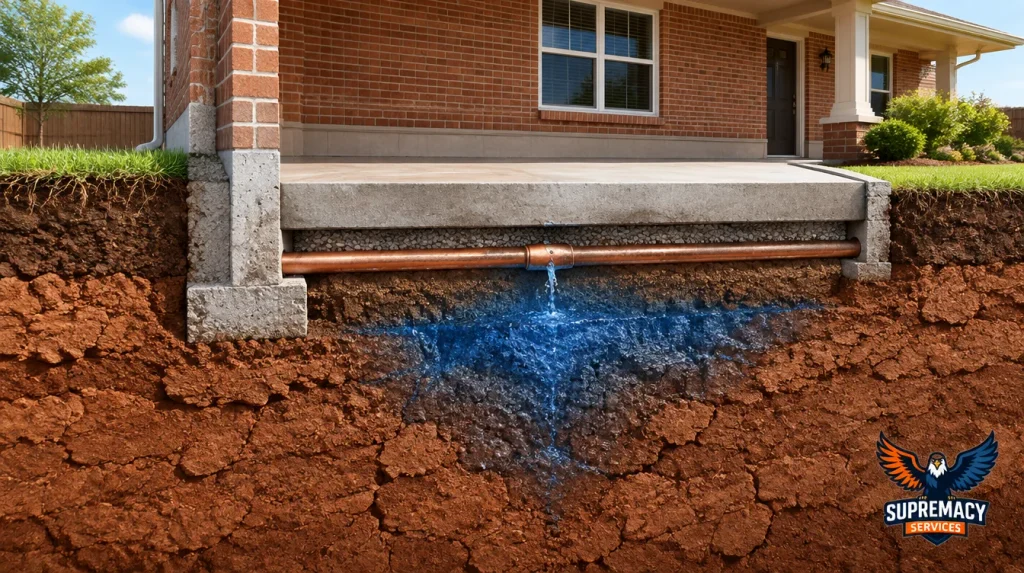
A slab leak can affect a foundation by changing the moisture conditions and support characteristics of the soil beneath it. In some cases, the result is uneven movement that creates cracks or distortion in the foundation and surrounding building materials.
1. Expansive soil can swell beneath the foundation
Some North Texas clay soils expand as they absorb water.
If a pipe leaks beneath one part of a home, the surrounding soil may become wetter than soil beneath other areas.
This uneven moisture distribution can cause differential soil expansion, potentially pushing one section of the foundation upward relative to another.
Engineers refer to upward movement associated with swelling soil as heave.
2. Soil erosion or loss of support can contribute to settlement
Under certain conditions, flowing water can transport loose soil particles or contribute to void formation.
Where soil support is lost, portions of a foundation may settle or become unevenly supported.
This mechanism depends heavily on the soil composition, drainage pathways, and leak characteristics. It should not be assumed that every underground leak washes away supporting soil.
3. Uneven movement can produce cracks
When different sections of a foundation move by different amounts, stress can develop in the slab and the structure above it.
Possible symptoms include:
- Cracks in concrete flooring
- Cracks in interior drywall
- Separation around doors and windows
- Changes in floor level
- Gaps between walls and trim
A crack alone does not establish that plumbing is responsible. Concrete shrinkage, thermal effects, construction details, and ordinary soil movement can also produce cracks.
4. Persistent moisture can damage interior materials
Even when a leak does not cause measurable structural movement, moisture migrating through or around the slab can damage flooring, adhesives, baseboards, and other moisture-sensitive materials.
The U.S. Environmental Protection Agency identifies plumbing leaks and moisture intrusion as important building-maintenance concerns.
Homeowner takeaway: The foundation itself may remain structurally sound while flooring or interior finishes suffer water damage. Both situations warrant investigation, but they do not necessarily require the same repairs.
What Are the Warning Signs of Slab Leak Foundation Damage?
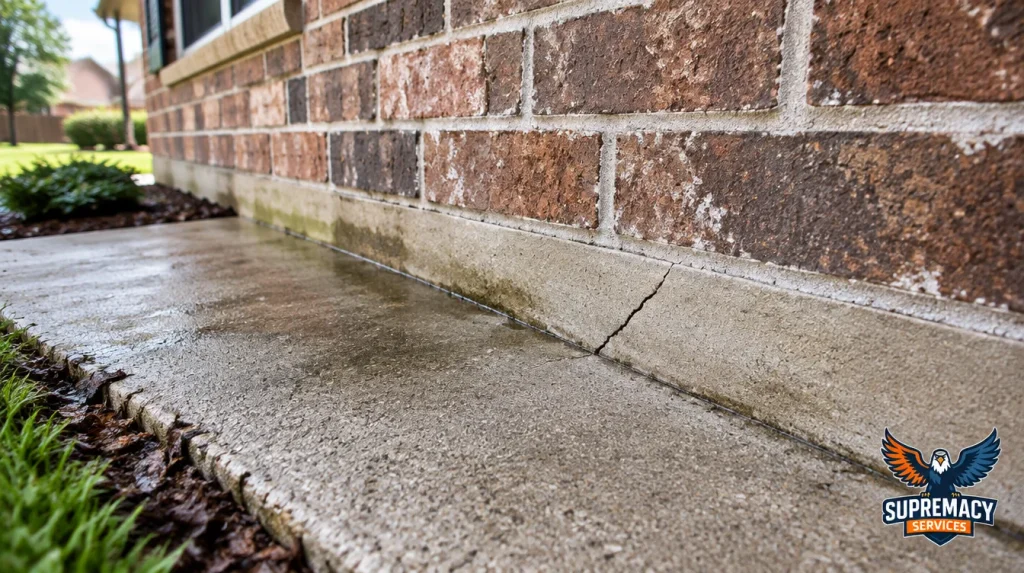
The strongest warning signs are combinations of unexplained plumbing symptoms and new moisture or structural changes.
| Warning sign | What it may indicate | What to do |
|---|---|---|
| Unexplained increase in water usage | Possible pressurized supply-line leak | Check the meter and arrange leak testing |
| Warm patch on the floor | Possible leaking hot-water line | Request plumbing diagnostics |
| Damp carpet or discolored flooring | Moisture entering the floor assembly | Investigate the moisture source promptly |
| New or widening foundation cracks | Possible structural movement | Document changes and seek an evaluation |
| Doors suddenly sticking | Possible movement or distortion | Check for other movement indicators |
| Persistent musty odor | Moisture trapped in building materials | Find and correct the source |
| Running-water sound when fixtures are off | Possible concealed supply leak | Check water usage and plumbing |
| Unexplained low water pressure | Possible leak or another supply issue | Have the water system assessed |
Which symptoms deserve the most attention?
A sudden increase in water usage combined with damp flooring or an unexplained warm area is a particularly useful reason to investigate the plumbing system.
If those symptoms occur alongside new cracks, uneven floors, or sticking doors, it is sensible to investigate both the plumbing and the foundation.
However, foundation movement can also occur without a plumbing leak.
Noticing unexplained moisture or rising water usage? Supremacy Services provides water leak detection in Dallas and Fort Worth to help identify hidden plumbing problems before deciding on repairs.
Why Are Dallas Foundations Vulnerable to Slab Leaks?
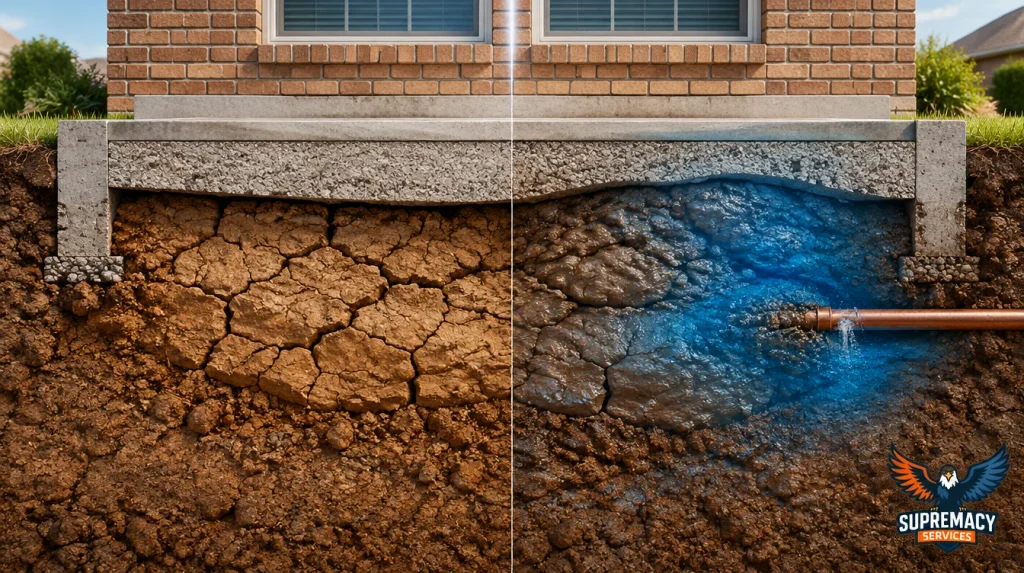
Dallas-area foundations can be sensitive to changes in soil moisture, particularly where expansive clay is present.
Expansive clay and changing moisture conditions
Clay-rich soils can swell when moisture increases and shrink when moisture decreases.
This means the moisture conditions beneath a foundation can affect its movement over time.
A plumbing leak can create a localized source of additional water, while dry weather may reduce moisture elsewhere around the foundation.
The resulting difference in soil moisture can contribute to uneven movement.
Texas government hazard-planning materials recognize expansive soils as a source of structural damage and explain that differential soil expansion is especially important.
Seasonal conditions in North Texas
North Texas experiences periods of hot, dry weather as well as heavy rainfall.
Those changes can influence soil moisture, especially near foundation edges, drainage areas, and landscaping.
A persistent underground leak may introduce a separate moisture problem that continues regardless of rainfall.
Foundation design matters
Not every Dallas-area home has the same foundation design or soil conditions.
The potential consequences depend on factors including:
- Soil type and depth
- Foundation engineering and reinforcement
- Plumbing layout
- Drainage around the property
- Previous soil movement
- Location and duration of the leak
Homes in Dallas, Plano, Frisco, Allen, Richardson, and surrounding communities should be evaluated according to their actual site conditions rather than assumptions based only on their ZIP code.
How Quickly Can a Slab Leak Damage a Foundation?
There is no reliable universal timeline for foundation damage caused by a slab leak.
A large leak may produce noticeable water damage quickly, while a smaller leak may remain concealed for an extended period.
Structural movement can develop gradually, and some leaks never cause significant foundation movement.
What determines how quickly damage develops?
The most important variables include the rate of water loss, soil type, drainage conditions, foundation design, and the leak’s location.
For example, a leak beneath moisture-sensitive clay may create a different risk from a similar leak beneath well-draining soil.
It is also important to distinguish between water damage and structural damage.
Moisture-sensitive flooring can deteriorate before any measurable foundation movement occurs.
The EPA recommends drying water-damaged materials promptly, generally within 24–48 hours, to reduce the likelihood of mold growth. This is moisture-control guidance, not a prediction of when structural damage will occur.
Do not wait for a foundation crack before investigating a suspected slab leak. Early plumbing diagnosis may reduce the amount of water entering the property.
Slab Leak or Foundation Problem: How to Tell the Difference
A slab leak and a foundation problem can produce overlapping symptoms, but they are not the same condition.
A slab leak is a plumbing failure. Foundation movement is a structural or geotechnical issue that may have several causes.
| Indicator | Possible slab leak | Possible non-plumbing foundation issue |
|---|---|---|
| Unexplained water meter movement | More suggestive of a supply leak | Not typical |
| Warm floor area | Possible hot-water pipe leak | Not typical |
| Damp flooring | Possible | May also have other moisture causes |
| Wall cracks | Possible secondary symptom | Common possible symptom |
| Sticking doors | Possible secondary symptom | Common possible symptom |
| Movement following seasonal drying | Not specific to a leak | May suggest soil-moisture effects |
| Pressure test confirms pipe leakage | Strong evidence | Does not by itself establish structural damage |
Can foundation movement cause a slab leak instead?
Yes. The relationship can work in both directions.
Foundation or soil movement can stress buried plumbing, potentially contributing to pipe failure.
A plumbing leak can then alter surrounding moisture conditions and potentially worsen movement.
This is why determining the sequence of events matters.
Other problems that can resemble a slab leak
Homeowners may mistake several issues for under-slab plumbing leaks:
- Leaking irrigation pipes near the foundation
- Poor yard drainage
- Roof runoff collecting near the house
- Air-conditioning condensate leaks
- Failed shower waterproofing
- Sewer or drain-line leakage
- Moisture entering through an exterior opening
If wastewater symptoms, repeated drain backups, or sewer odors are present, the investigation may involve the home’s drainage system rather than a pressurized water line.
Supremacy Services also offers sewer line repair and replacement for problems involving damaged sewer piping.
What Should You Do If You Suspect a Slab Leak?
If you suspect a slab leak, the priority is to identify the source of the water, limit further damage, and arrange the appropriate inspection.
Step 1: Check for unexplained water usage
Turn off water-using fixtures and appliances.
Observe your water meter to see whether usage continues when no water should be flowing.
A meter that continues registering flow can indicate a leak, although it does not identify where the leak is located.
The EPA provides homeowner guidance on checking water meters and identifying hidden leaks.
Step 2: Look for moisture and flooring changes
Check for damp areas, discolored flooring, unusual warmth, or persistent musty odors.
Document what you find, including dates and photographs.
Avoid removing flooring or breaking concrete before the source has been investigated.
Step 3: Limit water loss when appropriate
If you identify an active water-supply leak and can safely operate the appropriate shutoff valve, turning off the water can help limit further damage.
Be aware that shutting off the main supply may interrupt water service to the entire home.
Do not operate unfamiliar valves or disturb electrical equipment in wet areas.
Step 4: Arrange professional leak detection
A plumber can investigate whether a concealed supply or drainage pipe is leaking.
Depending on the system, this may involve pressure testing, acoustic detection, thermal imaging, or drainage-system inspection.
Step 5: Arrange a structural evaluation if necessary
If the home has significant new cracking, visible displacement, or other indications of structural movement, consult an appropriately qualified structural engineer.
A plumber can diagnose and repair plumbing. A structural engineer can assess whether the foundation itself has been damaged and recommend structural remediation where needed.
Quick homeowner checklistCheck the water meter with fixtures offPhotograph new cracks and moisture damageLocate the main water shutoffKeep people away from unsafe wet or damaged areasSchedule plumbing leak detectionRequest structural evaluation if significant movement is visible
0 of 6 completed Copy checklist
How Do Professionals Detect Slab Leaks?
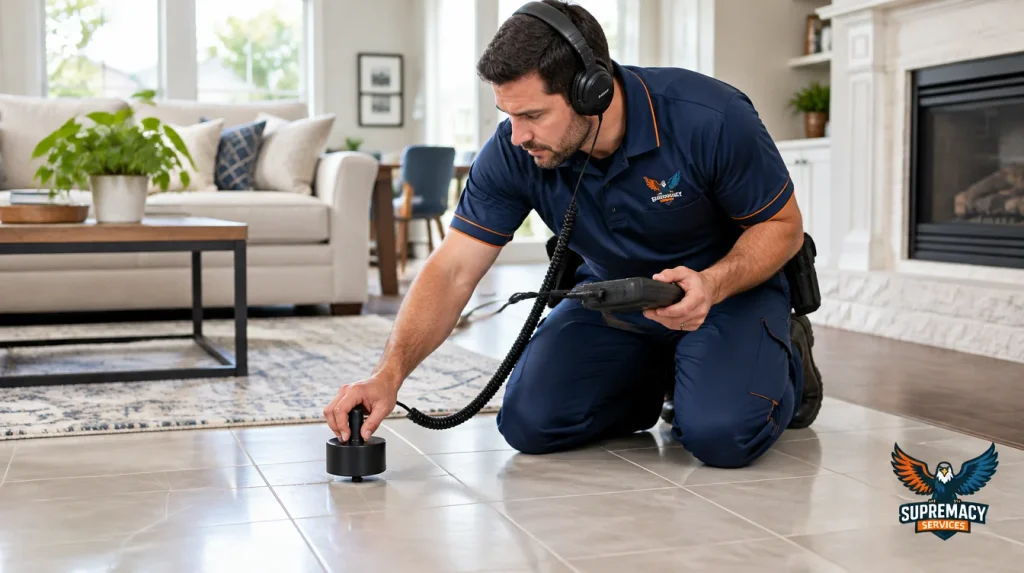
Professional slab leak detection typically starts with confirming that a plumbing leak exists before attempting to pinpoint its location.
1. Plumbing system assessment
The plumber reviews symptoms, water usage, pipe routing, and accessible plumbing components.
This helps narrow down the affected system.
2. Pressure testing
Pressure testing can help determine whether a water supply line or isolated portion of the plumbing system is losing pressure.
Results must be interpreted alongside the system configuration and other observations.
3. Acoustic leak detection
Specialized listening equipment can sometimes detect sounds generated by water escaping from a pressurized pipe.
Its effectiveness depends on pipe material, pressure, surrounding noise, and other conditions.
4. Thermal imaging
Thermal cameras can identify temperature differences that may help locate certain hot-water leaks.
They detect surface temperature patterns, not water directly. A thermal image alone does not confirm a leak.
5. Drain-line inspection
Where a drainage leak is suspected, plumbers may use appropriate camera inspection and testing methods.
A drain camera does not ordinarily locate a concealed pressurized supply-line leak through solid concrete.
Will plumbers have to break the concrete?
Not necessarily.
Many diagnostic methods can be performed without initially opening the slab.
However, some repairs require access through concrete or other building materials. The most suitable approach depends on the location of the damaged pipe and the repair method.
Suspect water is escaping beneath your floor? Explore Supremacy Services’ plumbing and leak-detection services to arrange an assessment of the problem and discuss the next steps.
Can Foundation Damage From a Slab Leak Be Repaired?
Yes, foundation damage associated with a slab leak may be repairable, but fixing the plumbing does not automatically correct structural movement that has already occurred.
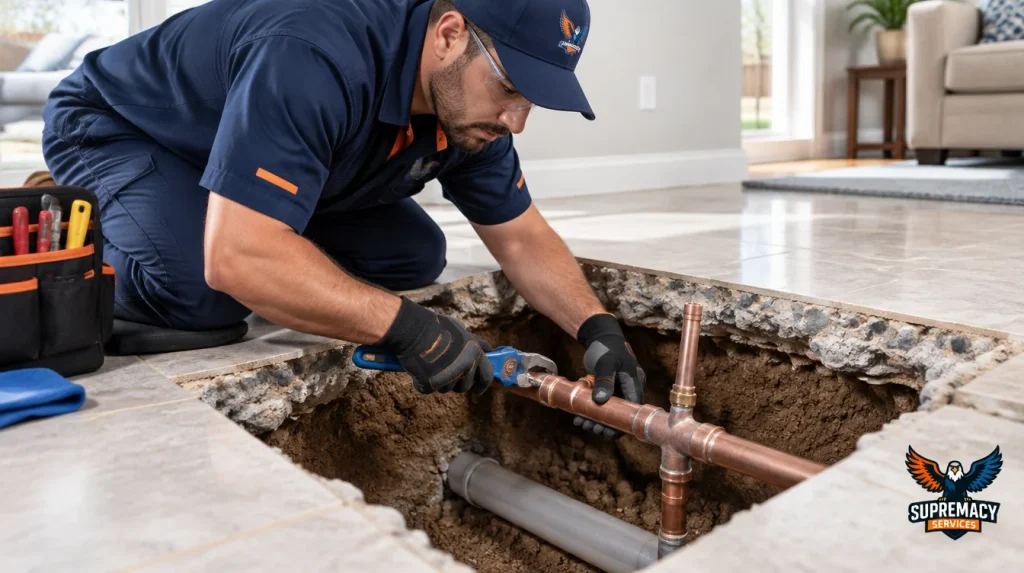
The appropriate solution depends on whether the home has experienced moisture damage, foundation displacement, loss of soil support, or a combination of problems.
First: Repair the plumbing leak
Depending on the pipe’s condition and accessibility, possible repairs include:
- Direct repair of an accessible damaged pipe section
- Replacement of the affected pipe
- Rerouting a water supply line around the slab
- Repiping a larger portion of the plumbing system
- Other appropriately engineered access or replacement methods
The right method depends on the specific piping system.
Second: Evaluate the foundation
If there are signs of structural damage, a qualified structural engineer can assess whether the foundation needs stabilization or another form of repair.
Potential recommendations may involve monitoring, moisture management, soil-related work, or engineered structural repairs.
Not every crack requires foundation underpinning or extensive reconstruction.
Third: Restore damaged building materials
Once the leak has been stopped and moisture conditions addressed, damaged flooring, drywall, insulation, and other materials can be evaluated for drying, cleaning, or replacement.
Restoration should not conceal an unresolved moisture source.
What Does Slab Leak and Foundation Repair Cost?
The cost depends on the scope of the plumbing problem and whether any separate structural or restoration work is necessary.
There is no dependable single price for a combined slab leak and foundation repair without inspecting the property.
| Cost component | Main factors affecting cost |
|---|---|
| Leak detection | Testing required, pipe accessibility, diagnostic complexity |
| Plumbing repair | Pipe material, leak location, access method |
| Pipe rerouting or repiping | Length of new piping, routing, wall and ceiling access |
| Concrete or flooring restoration | Area opened, finish materials, repair complexity |
| Moisture remediation | Amount of affected material, drying and removal requirements |
| Structural engineering | Inspection scope, testing, reporting needs |
| Foundation repair | Type and extent of confirmed structural problems |
Is repairing the leak cheaper than repairing the foundation?
A plumbing repair and a structural repair address different problems, so their costs are not directly interchangeable.
A relatively localized pipe repair may be less extensive than major engineered foundation remediation, but this cannot be assumed for every home.
The important financial consideration is that delaying a confirmed leak can increase the amount of water damage and potentially complicate restoration.
What should a repair estimate include?
Ask for a written explanation of the diagnosed problem, proposed repair method, access requirements, restoration exclusions, and any additional evaluation needed.
If structural work is recommended, request a separate engineering-based assessment rather than assuming the plumbing contractor’s estimate covers foundation stabilization.
Homeowners should also review their insurance policy and discuss coverage questions with their insurer. Coverage depends on policy wording, cause of loss, and other circumstances.
How Can You Prevent Slab Leak Foundation Damage?
Not every underground pipe failure is preventable, but early detection and good moisture management can reduce the risk of an unnoticed leak causing extensive damage.
Monitor water usage
Review your water bills for unexplained changes.
If your water utility offers unusual-usage alerts, consider enabling them.
Address leaks promptly
Do not ignore persistent warm floor areas, damp flooring, or sounds of running water when fixtures are off.
Maintain drainage around the foundation
Keep gutters, downspouts, and surface drainage functioning so water is not unnecessarily concentrated near the house.
The EPA recommends checking exterior drainage and monitoring foundation areas for moisture problems.
Investigate recurring foundation movement
If cracks or floor-level changes continue developing, consider an independent structural assessment.
Where plumbing leakage is suspected, arrange appropriate leak testing as part of the investigation.
Keep maintenance records
Save photographs, inspection reports, plumbing repair invoices, and previous foundation evaluations.
These records can help professionals distinguish longstanding conditions from recent changes.
Frequently Asked Questions About Slab Leaks and Foundation Damage
1. Can a slab leak cause cracks in your foundation?
Yes. A slab leak can change soil moisture beneath a foundation and contribute to uneven movement that produces cracks. However, cracks can also result from soil shrinkage, concrete behavior, or other structural conditions. Plumbing testing and structural assessment may be needed to establish the cause.
2. Can a slab leak make your house sink?
A slab leak can contribute to settlement under certain soil and drainage conditions, particularly if soil support is lost. In expansive clay, increased moisture can instead contribute to upward movement. The actual response depends on the site and foundation.
3. Will fixing a slab leak stop foundation movement?
Repairing the leak removes a source of unwanted water, but it does not guarantee that existing foundation movement will stop or reverse. Soil moisture may continue adjusting, and structural repairs may still be necessary.
4. Can a slab leak cause a house to become unsafe?
Severe structural damage can create safety concerns, but a slab leak does not automatically make a home unsafe. Significant displacement, sudden structural changes, or other apparent hazards warrant prompt professional assessment.
5. Can a slab leak happen without visible water?
Yes. Water may remain beneath the slab or migrate through soil without immediately appearing on the floor. Unexplained water usage, pressure loss, or other plumbing symptoms may be the first clues.
6. Can a slab leak cause mold under flooring?
Yes. Moisture reaching susceptible flooring materials can create conditions favorable to mold growth. The risk depends on the materials, duration of wetting, and environmental conditions.
7. Is a slab leak always an emergency?
Not every suspected slab leak requires emergency structural work, but an active leak should be investigated promptly. Rapid water loss, significant flooding, or apparent safety hazards call for more urgent action.
8. Can homeowners detect a slab leak themselves?
Homeowners can identify warning signs and check for unexplained water usage. However, locating the precise damaged pipe generally requires professional diagnostic methods.
9. Should I call a plumber or a foundation specialist first?
If there are clear plumbing symptoms, such as unexplained water usage or warm flooring, start with a plumber. If there is significant cracking, displacement, or structural concern, a qualified structural engineer should also evaluate the property. Both may be needed.
Protect Your Dallas Home From Hidden Slab Leak Damage
A slab leak can be more than a plumbing inconvenience. When water escapes beneath a foundation, it can change surrounding soil conditions, damage interior materials, and sometimes contribute to structural movement.
The most effective response is to identify the water source, repair the damaged plumbing, and assess any resulting foundation concerns separately.
If you have noticed unexplained water usage, damp flooring, or other signs of a concealed leak, Supremacy Services can help investigate the plumbing problem.
Schedule a plumbing inspection with Supremacy Services or call 945-777-3345 to discuss suspected slab leaks in Dallas and the DFW Metroplex.

