A commercial rooftop HVAC unit typically reaches the point where replacement planning becomes important at around 15 years, although actual service life can be shorter or considerably longer depending on the equipment, operating hours, maintenance history, installation quality and building conditions.
ASHRAE’s public service-life database reports a median service life of about 16 years for packaged rooftop DX units in its dataset. The U.S. Department of Energy likewise warns that rooftop units more than 15 years old often provide reduced service and can waste substantial energy. Neither number should be treated as an automatic expiration date. A well-maintained RTU can remain economically useful beyond that point, while a neglected or heavily loaded system may become unreliable much earlier.
For commercial buildings in Dallas and the DFW Metroplex, age matters because rooftop equipment works through a long cooling season. National Weather Service climate normals for Dallas/Fort Worth show about 2,825 annual cooling degree days and roughly 20 days per year reaching at least 100°F, reinforcing why cooling equipment performance deserves close attention in North Texas.
Table of Contents
- How many years should a commercial rooftop unit last?
- Why rooftop HVAC lifespan varies
- How North Texas conditions affect RTUs
- Signs an RTU is approaching the end of its useful life
- Repair or replace an aging rooftop unit?
- Can preventive maintenance extend RTU life?
- What a professional RTU assessment should include
- How to plan replacement before failure
- Frequently asked questions
How Many Years Should a Commercial Rooftop Unit Last?
For planning purposes, about 15 years is a useful point to begin evaluating a commercial rooftop unit more critically rather than assuming it should continue operating indefinitely.
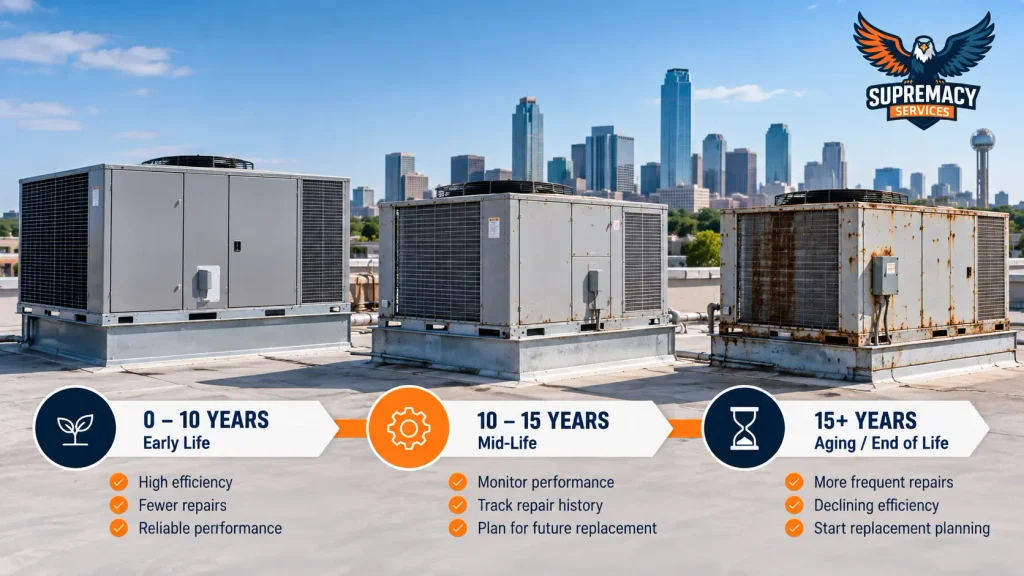
ASHRAE’s service-life database contains reported data for hundreds of buildings and thousands of pieces of HVAC equipment. For packaged rooftop DX units, the reported median is approximately 16 years. That is a statistical reference point—not a manufacturer’s promise and not a mandatory replacement age.
A commercial RTU’s real lifespan may look more like this:
| Equipment condition | Practical interpretation |
|---|---|
| Under 10 years | Usually still within an earlier or middle lifecycle phase if properly maintained |
| 10–15 years | Increasingly important to track repair history, efficiency and component condition |
| 15+ years | Replacement planning deserves serious consideration |
| 20+ years | Continued operation may be possible, but reliability, parts availability and lifecycle cost deserve close review |
The important distinction is between physical life and economic life.
A unit may still start, cool and heat after 18 or 20 years. That does not necessarily mean keeping it is the best business decision. Repeated repairs, declining capacity, comfort complaints, energy use and the consequences of an unexpected outage may make replacement sensible before complete mechanical failure.
The Department of Energy specifically encourages owners and facility teams to consider proactive replacement instead of automatically waiting for older RTUs to fail.
Why Rooftop HVAC Lifespan Varies
Two identical RTUs installed in the same year can reach very different conditions a decade later.
1. Operating hours and building use
A lightly occupied office that operates primarily during business hours does not place the same demand on an RTU as a restaurant, retail location, medical facility or building with extended operating schedules.
More compressor cycles, fan runtime and heating or cooling hours generally mean more component wear.
2. Preventive maintenance
Maintenance does not make equipment immortal, but it can help prevent minor operating problems from becoming major failures.
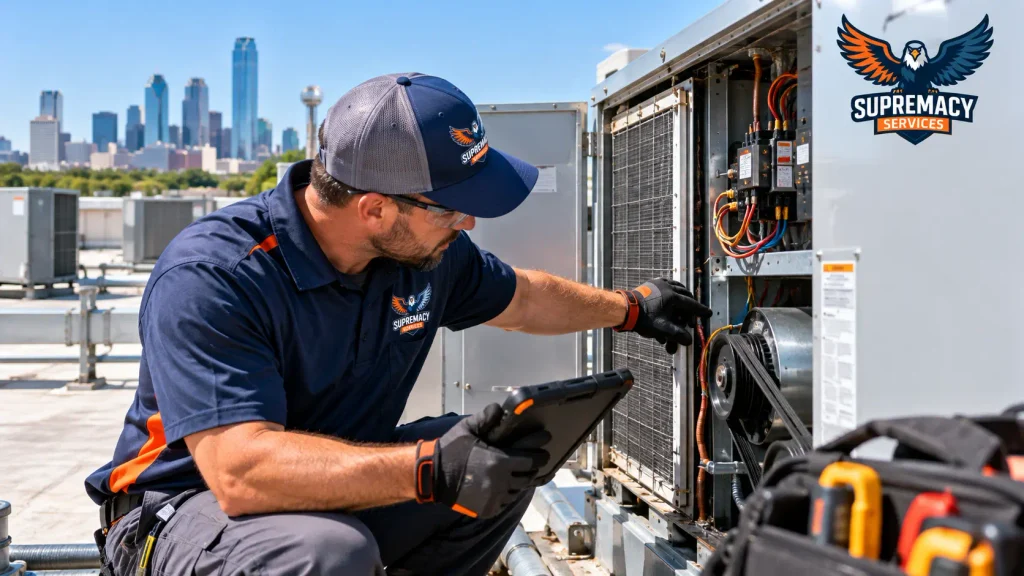
DOE guidance for unitary HVAC equipment emphasizes effective operations and maintenance to maximize efficiency, maintain occupant comfort and reduce failures.
Depending on equipment and manufacturer requirements, commercial HVAC maintenance may involve inspecting or servicing items such as:
- filters;
- condenser and evaporator coils;
- belts and pulleys;
- blower assemblies;
- drains;
- electrical connections;
- contactors and capacitors;
- refrigerant-system performance;
- economizer operation;
- controls and sensors;
- heating components;
- cabinet condition and weather exposure.
The correct schedule and procedures should follow the equipment manufacturer’s documentation and the actual building conditions.
3. Installation and commissioning quality
RTU lifespan begins with installation.
Problems involving airflow, electrical supply, curb fit, duct transitions, drainage, control setup or equipment sizing can affect performance from the beginning.
Commissioning is the process of verifying that HVAC systems are installed and operating according to their intended design criteria. DOE notes that commissioning can uncover equipment faults and control problems that waste energy and affect indoor comfort.
4. Equipment sizing
Bigger is not automatically better.
An oversized unit may cycle differently than intended and may not provide the best part-load performance or humidity control. An undersized unit can struggle during peak loads.
When replacing an RTU, the correct approach is not automatically to copy the tonnage of the old nameplate. Changes to insulation, windows, lighting, occupancy, ventilation, tenant layout and other building loads may justify a new load evaluation.
5. Maintenance history before you owned the property
Commercial property buyers and new facility managers sometimes inherit equipment with little documentation.
A 12-year-old RTU with a detailed maintenance record may present a very different risk than a 12-year-old unit that has experienced years of deferred maintenance.
If records are unavailable, physical inspection and operating data become more important.
How North Texas Conditions Affect RTUs
North Texas does not create a special universal RTU lifespan, but local operating conditions can influence how hard commercial cooling equipment works.
Long cooling demand
Dallas/Fort Worth’s 1991–2020 normals show approximately 2,825 cooling degree days annually. July and August each account for more than 640 normal cooling degree days, illustrating how concentrated summer cooling demand can become.
That matters because a rooftop unit serving a Dallas commercial building may spend long periods operating under high cooling loads.
Hot summer days
DFW averages roughly 20 days per year with temperatures reaching at least 100°F under current climate normals.
During those conditions, a marginal RTU that seems acceptable in April or October may reveal problems with cooling capacity, airflow, condenser performance or controls.
Outdoor rooftop exposure
Unlike equipment located in protected mechanical rooms, RTUs live outdoors.
Their cabinets, condenser sections, wiring, seals and exposed components experience sun, rain, wind, airborne debris and temperature swings.
That does not mean rooftop equipment is unsuitable for Texas—it is designed for outdoor installation—but inspection and maintenance remain especially important because the equipment is continuously exposed.
Signs an RTU Is Approaching the End of Its Useful Life
Age alone should not determine replacement. A pattern of age plus declining reliability, performance or operating economics is more meaningful.
Watch for the following.
Repairs are becoming more frequent
One isolated repair does not automatically justify replacement.
A better warning sign is a trend:
- compressor trouble followed by fan or electrical failures;
- repeated refrigerant-related service;
- recurring control faults;
- repeated belt, motor or bearing problems;
- multiple service calls during peak cooling season.
Review the total repair history, not just the latest invoice.
The unit can no longer maintain conditions reliably
An aging RTU may run but still fail to meet the building’s needs.
Possible symptoms include:
- occupied spaces staying too warm;
- unusually long runtime;
- inconsistent temperatures between zones;
- complaints increasing during afternoon peak heat;
- system recovery taking longer after setbacks;
- cooling performance deteriorating under high outdoor temperatures.
Those symptoms can also be caused by ductwork, controls, sensors, economizers, airflow restrictions or building-envelope problems, so diagnosis should come before replacement.
Energy use is rising without an obvious operational explanation
Higher utility bills do not prove the RTU is failing. Weather, occupancy, operating hours, utility rates and other equipment can all change consumption.
However, an older RTU that shows deteriorating performance while energy consumption rises deserves further evaluation.
DOE’s Advanced RTU resources specifically identify aging, inefficient rooftop units as candidates for proactive evaluation and replacement.
Major components are failing late in the unit’s life
A relatively minor repair on a 15-year-old unit is different from a major compressor or heat-exchanger problem on the same unit.
When a major component fails, evaluate the repair in the context of:
- RTU age;
- condition of the rest of the system;
- repair history;
- replacement-part availability;
- remaining expected service life;
- business downtime risk;
- efficiency of replacement options.
Parts are becoming difficult to source
A mechanically repairable unit may still create operational problems if important components are obsolete or have long lead times.
For businesses where cooling or heating is mission-critical, parts availability becomes part of lifecycle planning.
Downtime is becoming expensive
For some commercial properties, the biggest cost of an HVAC failure is not the repair invoice.
It may be:
- lost retail traffic;
- tenant complaints;
- uncomfortable staff;
- spoiled temperature-sensitive products;
- cancelled operations;
- emergency portable cooling;
- after-hours service;
- expedited equipment or crane scheduling.
That is why planned replacement and failure-driven replacement should be evaluated differently.
If your rooftop equipment is entering the 12–15+ year range and service calls are becoming more frequent, schedule a commercial rooftop HVAC assessment before deciding whether another repair or planned replacement makes more sense.
Repair or Replace an Aging Rooftop Unit?
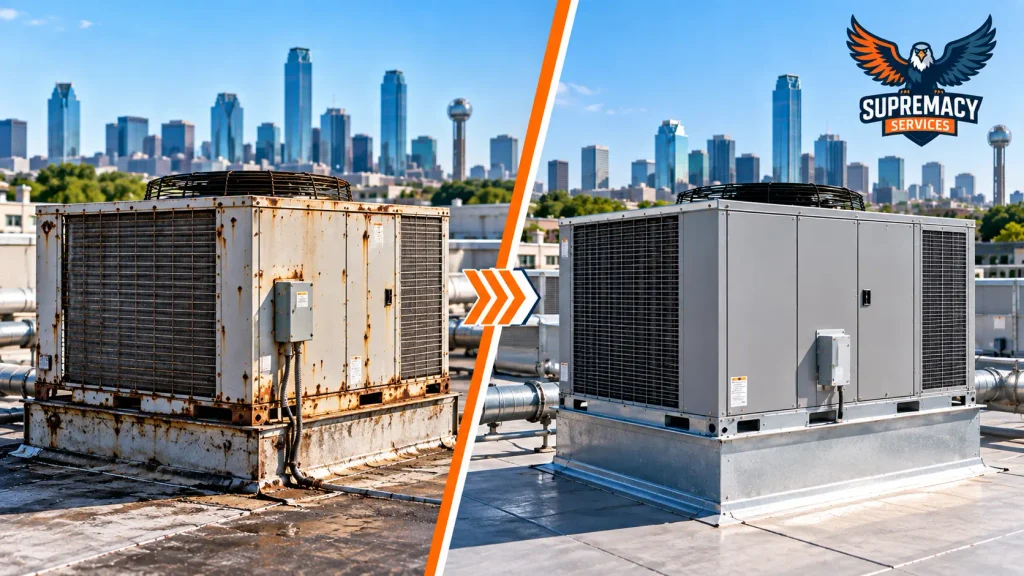
There is no responsible one-number formula that can make this decision for every commercial building.
Instead, compare the remaining value of the existing unit against the total consequences of keeping it.
| Keep repairing when… | Start replacement planning when… |
|---|---|
| The unit is otherwise in good condition | The RTU is well into its later service life |
| Failure is isolated and economically reasonable | Major components are failing |
| Parts remain readily available | Parts availability is deteriorating |
| Performance still meets the building’s needs | Comfort or capacity is becoming unreliable |
| Repair history is limited | Repair frequency is accelerating |
| Energy performance remains acceptable | Operating performance has declined |
| Failure would create manageable disruption | Unexpected downtime would significantly affect the business |
Do not base the decision only on age
A 16-year-old RTU with good performance and a limited repair history may deserve continued service.
A 10-year-old RTU with a damaged coil, serious compressor problems, installation deficiencies and repeated downtime may justify a different decision.
Do not base it only on the latest repair price
Lifecycle decisions should include more than repair cost.
Consider:
Repair cost + expected future repairs + operating performance + downtime risk + remaining useful life
versus:
Replacement project cost + expected operating performance + warranty + reduced failure risk + building needs
The correct answer depends on the actual equipment and business.
What about replacement cost?
Commercial rooftop replacement pricing varies widely enough that this lifespan article should not attempt to duplicate a full pricing guide.
Factors can include:
- RTU tonnage and configuration;
- heat type;
- efficiency level;
- curb compatibility;
- duct transitions;
- electrical modifications;
- controls;
- ventilation requirements;
- crane access;
- roof access;
- structural considerations;
- permits and inspections where applicable;
- commissioning;
- project phasing.
For detailed budgeting factors, see Supremacy Services’ Rooftop AC Replacement Cost in Dallas: 2026 RTU Pricing Guide.
Considering replacement? Review Supremacy Services’ rooftop AC installation options in Dallas, or request an on-site assessment so the existing RTU, curb, ductwork, electrical requirements and building load can be evaluated before equipment is selected.
Can Preventive Maintenance Extend RTU Life?
Preventive maintenance can help rooftop equipment remain reliable and efficient for longer, but it cannot reverse advanced wear or guarantee a specific lifespan.
The strongest maintenance programs do more than respond when the building becomes uncomfortable.
They track equipment condition over time.
A practical commercial RTU maintenance program can include
Filters and airflow
Restricted airflow can reduce system performance and place unnecessary stress on equipment.
Filter service should be based on the correct filter type, building use and manufacturer’s recommendations rather than an arbitrary universal interval.
Coil condition
Dirty or damaged coils can interfere with heat transfer.
Outdoor condenser coils are particularly exposed to rooftop debris and environmental conditions.
Belts, bearings and blower components
Wear in the air-moving system can affect airflow and eventually create secondary problems if ignored.
Electrical components
Loose or deteriorating electrical connections, contactors, capacitors and motors can lead to intermittent faults or shutdowns.
Economizers and outside-air controls
Economizers can improve operation under suitable conditions, but dampers and controls must function correctly.
DOE specifically recommends checking outside-air dampers and controls where HVAC systems use economizers or demand-controlled ventilation.
Refrigerant-system performance
Low capacity can result from many causes. Refrigerant-related diagnosis should be performed by qualified HVAC personnel rather than assuming that adding refrigerant is routine maintenance.
Drainage
Blocked drains or poor drainage can cause leaks and moisture problems around the unit and building.
Controls and sensors
A mechanically sound RTU can still operate poorly if sensors, schedules or control sequences are incorrect.
What Can a Building Owner Safely Check?
Commercial building staff can often perform useful observation without opening energized equipment.
Reasonable checks include:
- note unusual noises or vibration;
- record recurring comfort complaints;
- watch for unexpected runtime;
- inspect accessible filters according to facility procedures;
- look for obvious exterior damage;
- keep roof drains and the surrounding roof area clear where this can be done safely;
- document service calls and component replacements;
- compare energy use with weather and occupancy patterns.
Do not open electrical compartments, bypass safety controls, handle refrigerant systems or attempt internal repairs unless qualified to do so.
Texas regulates air-conditioning and refrigeration contracting. TDLR states that contractors installing, repairing or maintaining air-conditioning, refrigeration or heating systems must meet state licensing requirements.
What a Professional RTU Assessment Should Include
When an older rooftop unit becomes a replacement candidate, a good assessment should examine more than whether the compressor starts.
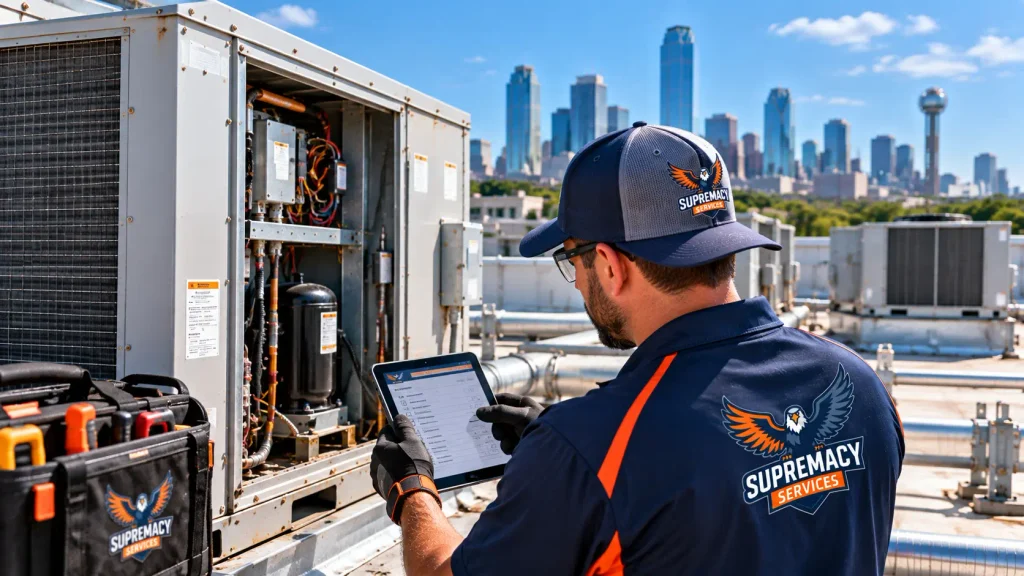
1. Equipment identification
Document:
- manufacturer;
- model;
- serial number;
- approximate installation date;
- nominal capacity;
- heating type;
- refrigerant type;
- control configuration.
2. Maintenance and repair history
Look for patterns instead of isolated events.
An RTU that has required increasingly frequent repairs should be evaluated differently from one that has operated reliably.
3. Current operating condition
Depending on equipment and scope, technicians may evaluate:
- temperature performance;
- airflow;
- blower condition;
- electrical operation;
- coil condition;
- controls;
- heating operation;
- economizer function;
- refrigerant-system performance;
- visible cabinet deterioration.
4. Curb and duct compatibility
Replacing an RTU is not always a simple matter of lifting away one box and installing another.
Existing roof curbs, duct openings, adapters, roof conditions and unit dimensions have to be evaluated.
Supremacy’s existing Rooftop AC Unit Installation in Dallas service page should be the commercial destination for readers who move from lifecycle research to installation planning.
5. Building load and usage
Before assuming that the replacement should match the old equipment exactly, assess whether the building has changed.
Questions include:
- Has occupancy increased?
- Has the tenant layout changed?
- Have operating hours changed?
- Has insulation been upgraded?
- Have windows or doors changed?
- Has ventilation demand changed?
- Has lighting density changed?
- Have heat-producing appliances or equipment been added?
6. Replacement timing
A proactive replacement can be scheduled around business operations.
An emergency replacement happens on the failed unit’s schedule.
That difference may affect:
- equipment availability;
- crane scheduling;
- tenant coordination;
- temporary cooling;
- project phasing;
- procurement options.
How to Plan Replacement Before Failure
For a portfolio of rooftop units, do not treat every RTU as an isolated emergency.
Create an equipment lifecycle plan.
Step 1: Build an RTU inventory
Record each unit’s:
- location;
- model and serial number;
- capacity;
- installation year;
- served area;
- service history.
Step 2: Rank units by condition and business risk
A 17-year-old unit serving a storage room does not necessarily carry the same risk as a 17-year-old unit serving a restaurant dining room, medical office or critical retail space.
Step 3: Identify the highest-risk units
Prioritize units with combinations of:
- advanced age;
- expensive repairs;
- poor performance;
- scarce parts;
- high operating hours;
- critical spaces;
- recurring downtime.
Step 4: Evaluate replacement options before peak season
Early evaluation creates time to compare equipment, efficiency levels, curb requirements, controls and project scheduling.
Step 5: Replace strategically rather than automatically
Not every old unit needs to be replaced simultaneously.
The DOE’s proactive RTU replacement guidance is built around evaluating equipment inventories and identifying units where replacement makes economic and operational sense.
Does a New RTU Automatically Reduce Energy Costs?
No.
Newer commercial equipment can offer improved efficiency and control capabilities, but actual energy performance depends on more than equipment age.
Results are influenced by:
- equipment efficiency;
- correct sizing;
- building loads;
- controls;
- ventilation;
- operating schedules;
- duct condition;
- commissioning;
- maintenance;
- weather;
- occupancy.
DOE’s commercial rooftop resources encourage owners to evaluate high-efficiency replacement as part of a lifecycle strategy rather than simply replacing old equipment with an identical unit.
Related Problems That Can Look Like a Failing RTU
Before condemning an aging unit, rule out problems elsewhere in the system.
Duct leakage or airflow restrictions
Poor airflow can make a functional unit appear undersized or weak.
Control or thermostat problems
Incorrect schedules, sensors or building controls can cause comfort issues unrelated to major equipment failure.
Economizer problems
A stuck or improperly controlled outside-air damper can significantly affect performance.
Building-envelope changes
Doors, windows, insulation, roofing or tenant modifications can change the load the RTU has to handle.
Ventilation changes
More occupants or revised ventilation requirements can alter system demand.
Electrical problems
Voltage or electrical-distribution issues can create intermittent HVAC symptoms and should be investigated appropriately.
The goal of diagnosis is to determine whether the problem is the RTU itself, another part of the HVAC system, the building or a combination of factors.
Supremacy services
Frequently Asked Questions
How long does a commercial rooftop HVAC unit usually last?
A useful planning benchmark is around 15 years. ASHRAE’s service-life database reports a median of approximately 16 years for packaged rooftop DX units, but actual service life varies significantly with maintenance, operating hours, installation and equipment condition.
Can a rooftop HVAC unit last 20 years?
Yes. Some RTUs remain operational beyond 20 years. However, continued operation does not automatically mean continued operation is economical. Reliability, efficiency, parts availability and repair history should be reviewed.
Should I replace a 15-year-old commercial RTU?
Not automatically. Fifteen years is a good point for closer lifecycle evaluation. If the unit remains reliable and economical to operate, continued service may be reasonable. Frequent repairs or declining performance can strengthen the case for replacement.
What shortens the life of a rooftop HVAC unit?
Poor maintenance, heavy operating hours, airflow problems, installation deficiencies, control problems and unresolved mechanical or electrical issues can all contribute to premature deterioration.
Does Dallas heat reduce rooftop AC lifespan?
There is no authoritative rule assigning Dallas RTUs a specific shorter lifespan. However, Dallas/Fort Worth has substantial annual cooling demand and frequent very hot summer days, which means commercial cooling systems can experience long operating periods.
Is it better to replace an RTU before it fails?
For some businesses, yes. Planned replacement provides more control over equipment selection, scheduling, procurement and downtime. DOE guidance specifically encourages evaluation of proactive replacement for aging and inefficient rooftop equipment.
How can I tell if my commercial RTU is losing efficiency?
Possible indicators include longer runtime, declining cooling capacity, increasing comfort complaints and energy use that rises after accounting for weather and building operation. A professional evaluation is needed to identify the actual cause.
Can maintenance make an RTU last longer?
Good maintenance can reduce failures and help equipment operate more effectively, but it cannot guarantee a specific lifespan or eliminate normal mechanical wear.
Should a replacement RTU be the same tonnage as the existing one?
Not automatically. Building use, occupancy, envelope improvements, ventilation and internal loads may have changed since the old unit was installed. Replacement planning should confirm the current load rather than relying only on the old nameplate.
Final Takeaway: Use Age as a Planning Trigger, Not an Expiration Date
Commercial rooftop HVAC systems do not fail according to a calendar.
For Dallas and DFW building owners, around 15 years should be viewed as a lifecycle-review point. At that stage, examine repair frequency, operating performance, major component condition, parts availability, business-critical downtime and the economics of continued repairs.
An older unit that remains reliable may still have useful service ahead of it. An RTU with repeated failures, declining performance and escalating downtime may be better replaced before the next peak-cooling emergency.
If you’re managing an aging commercial rooftop unit in Dallas or the DFW Metroplex, schedule a rooftop HVAC assessment with Supremacy Services. The existing equipment, roof curb, ductwork, controls, electrical requirements and building needs can be evaluated before you decide whether to repair, plan a replacement or continue monitoring the system.