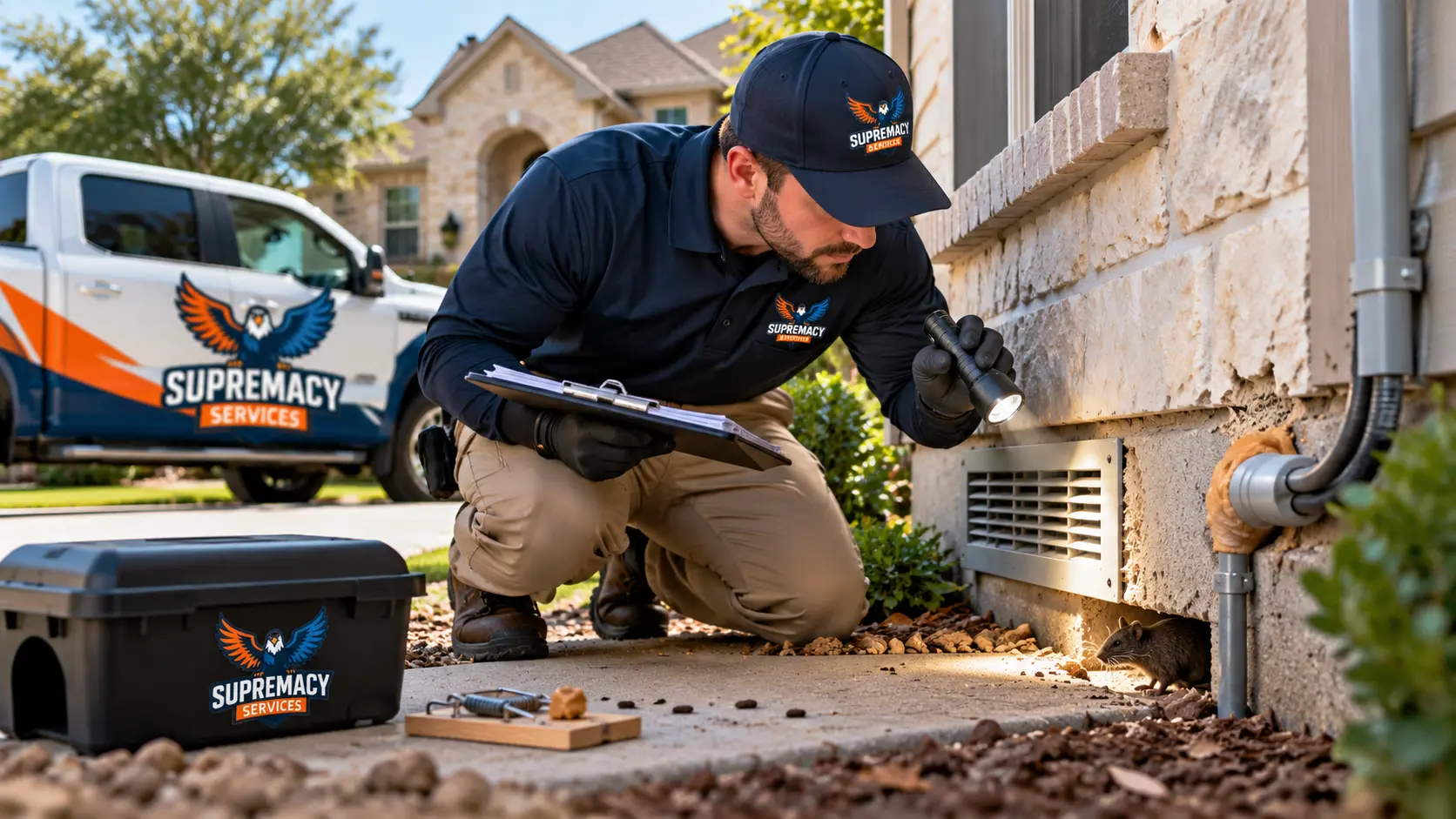
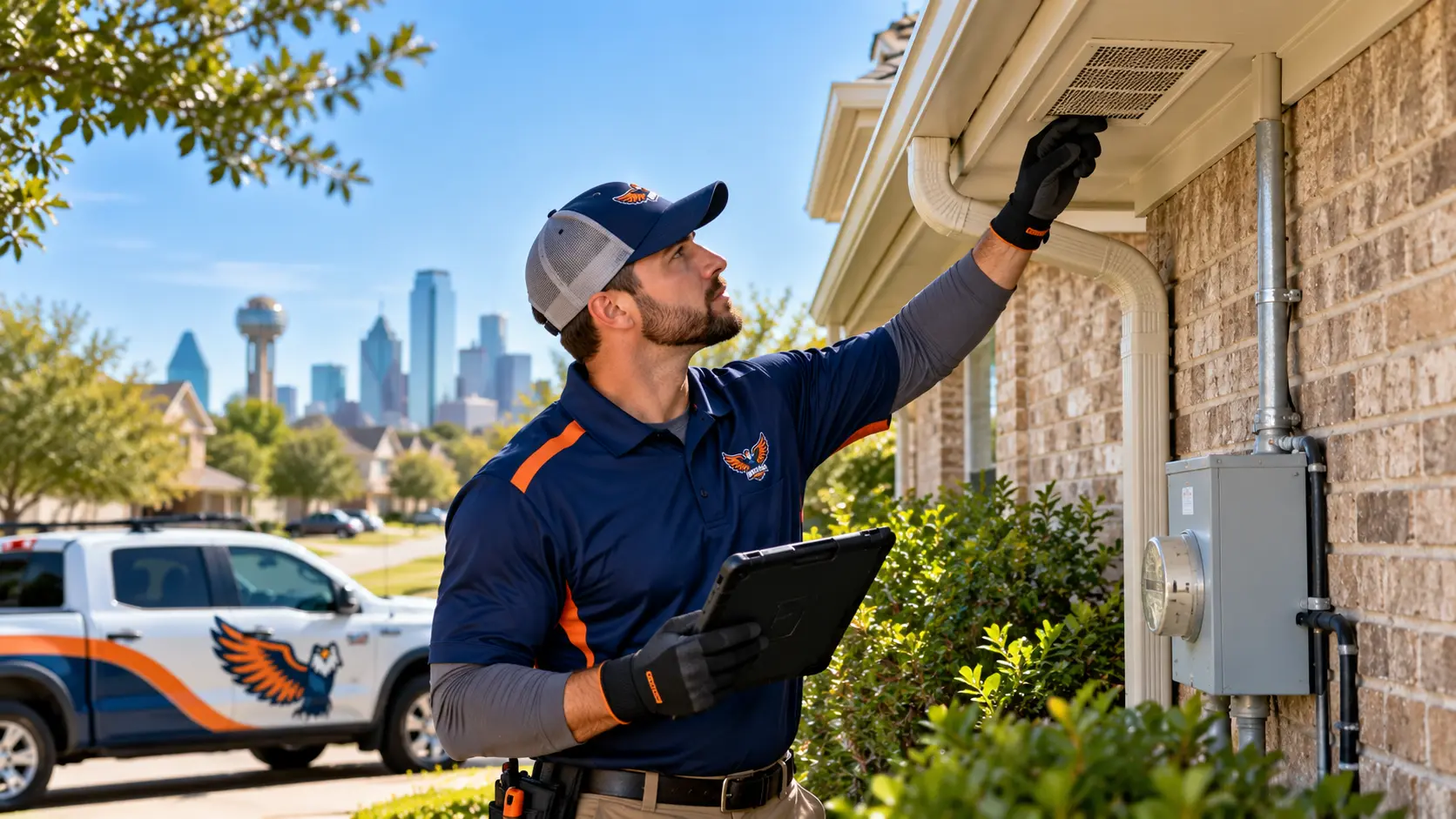
Rats usually get into North Texas homes through small structural gaps around the roofline, soffits, vents, utility penetrations, foundations and garage doors. They do not necessarily need an obvious hole. A damaged vent screen, separated roof edge, deteriorated seal around a pipe or gap beneath a door may provide enough access.
For Dallas-area homeowners, the location of the activity provides an important clue. Texas A&M AgriLife notes that roof rats commonly nest in attics and wall spaces, while Norway rats are more closely associated with burrows beneath foundations, floors and accumulated materials. Roof rats are also skilled climbers, making upper-level openings particularly important to inspect.
Finding the entry point matters just as much as removing the rats already inside. If the opening remains accessible, trapping a few animals may address the current activity without solving how rodents are entering the structure.
Table of Contents
- How Small an Opening Can a Rat Get Through?
- Roof, Eave and Soffit Gaps
- Attic and Roof Vents
- Gaps Around Utility Lines and Pipes
- Garage Doors and Exterior Doors
- Foundation and Crawlspace Openings
- Chimneys, Flashing and Roof Intersections
- Damaged Fascia, Siding and Exterior Materials
- Openings Reached From Trees, Fences and Utility Routes
- How Do You Find a Rat Entry Point?
- Should You Seal a Rat Hole Immediately?
- DIY Rat-Proofing vs. Professional Exclusion
- How to Make Your North Texas Home Less Attractive to Rats
- Frequently Asked Questions
How Small an Opening Can a Rat Get Through?
Some rats can use openings roughly 1/2 to 3/4 inch wide, depending on the species and animal, while mice can use even smaller openings.
CDC rodent-exclusion guidance recommends inspecting and sealing small gaps throughout a home, particularly around roofs, eaves, soffits, vents, doors, foundations and utility penetrations. Texas A&M guidance likewise recommends covering rodent-accessible openings with rat-resistant materials.
This is why a home can appear well sealed from the driveway yet still have a rodent-access problem.
A rat also may not need to find a perfectly sized opening. Rodents gnaw, and existing deterioration can sometimes be enlarged enough to improve access. Texas A&M identifies gnaw marks, droppings, tracks, grease smears and established runways as useful signs when investigating rodent activity.
Roof rats vs. Norway rats: where should you look first?
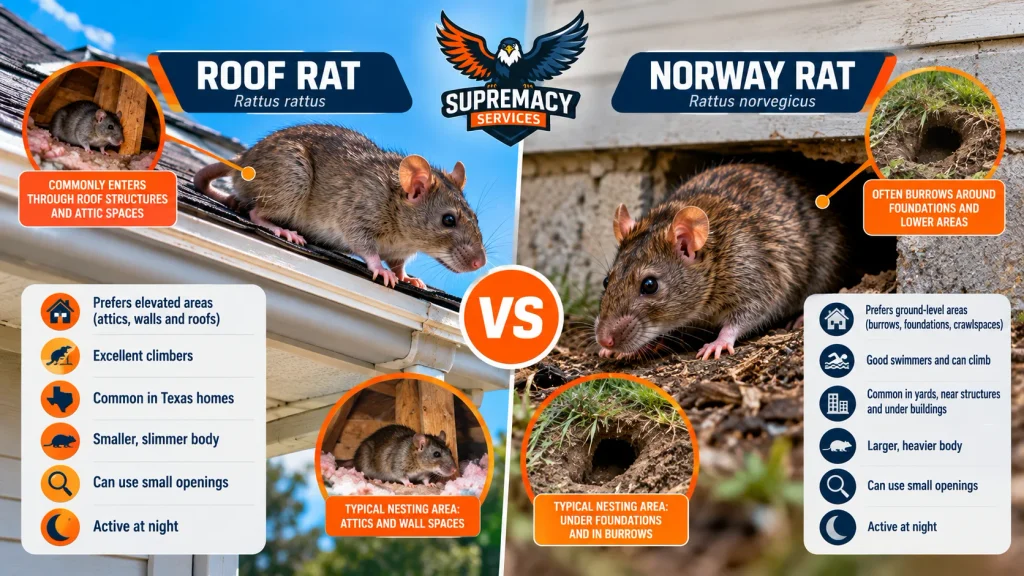
| Clue | Roof rat | Norway rat |
|---|---|---|
| Typical nesting tendency | Elevated areas, walls and attics | Burrows and lower areas |
| Climbing ability | Excellent | Capable, but more ground-oriented |
| First exterior areas to inspect | Roofline, soffits, vents, upper openings | Foundation, ground-level openings, crawlspace |
| Attic noises | Strong clue | Possible, but less characteristic |
| Burrows near foundation | Less characteristic | Stronger clue |
Texas A&M describes roof rats as the rat most commonly encountered in Texas homes and notes their ability to enter around roofs and soffits.
1. Roof, Eave and Soffit Gaps
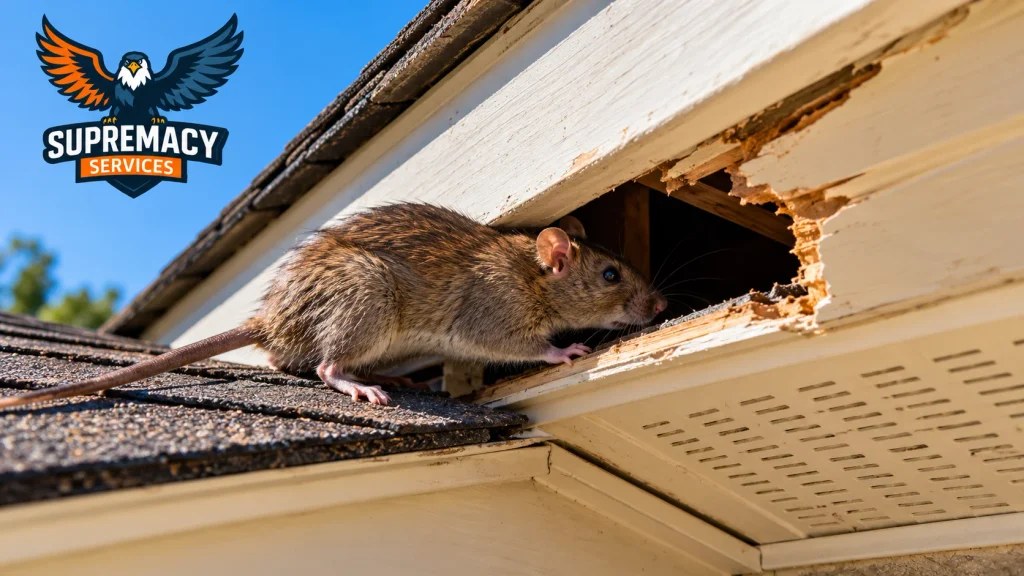
Roof edges, eaves and soffits are among the first places to inspect when rats are active in an attic.
A soffit does not need to be completely missing. Look for:
- separated soffit panels;
- deteriorated corners;
- gaps where different roof sections meet;
- openings behind fascia;
- damaged trim;
- construction gaps;
- previous repair areas that have reopened.
Roof rats are particularly relevant here because of their climbing behavior and preference for elevated nesting areas.
A homeowner hearing movement above the ceiling at night should therefore inspect the exterior roofline rather than assuming the animal entered somewhere near ground level.
Do not climb onto a steep or high roof simply to look for a rat hole. Much of the initial inspection can be performed safely from the ground with binoculars or a camera with zoom.
Hearing activity in the attic but cannot locate the opening? A professional rodent inspection can trace likely travel routes from the attic to exterior roofline vulnerabilities.
2. Attic and Roof Vents
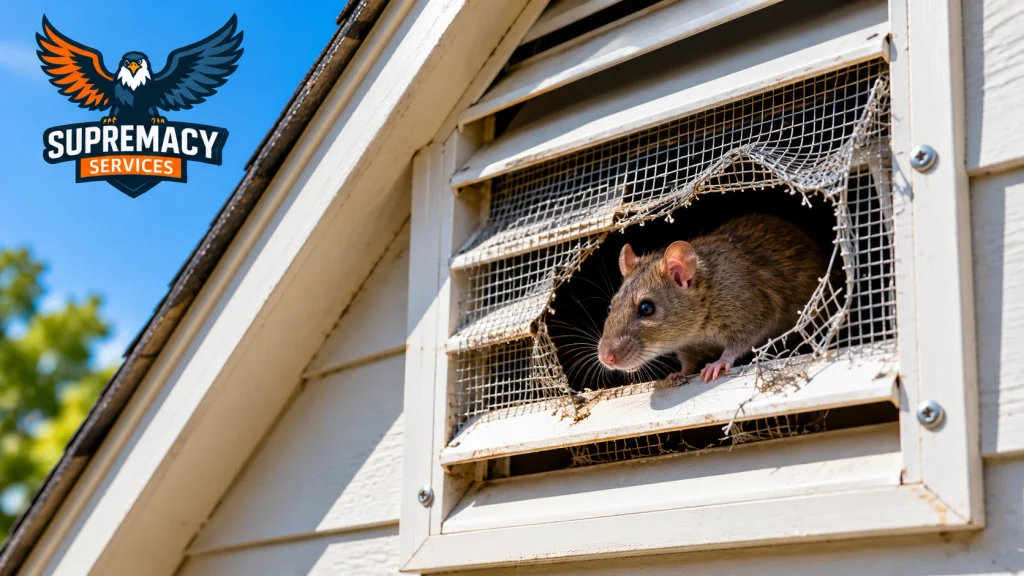
Damaged, unscreened or poorly fitted vents can provide direct access to attic spaces.
Check:
- attic vents;
- gable vents;
- roof vents;
- crawlspace vents;
- vent screens;
- gaps around vent housings.
CDC specifically recommends checking attic and crawlspace vents when rodent-proofing a structure.
The important distinction is between blocking airflow and excluding rodents. A ventilation opening still needs to perform its intended function. Appropriate pest-resistant screening or another properly designed exclusion method should preserve necessary ventilation while preventing animal access.
If you see bent screening, gnawing, dark rub marks or an opening along the vent perimeter, inspect the surrounding attic area for additional evidence.
3. Gaps Around Utility Lines and Pipes
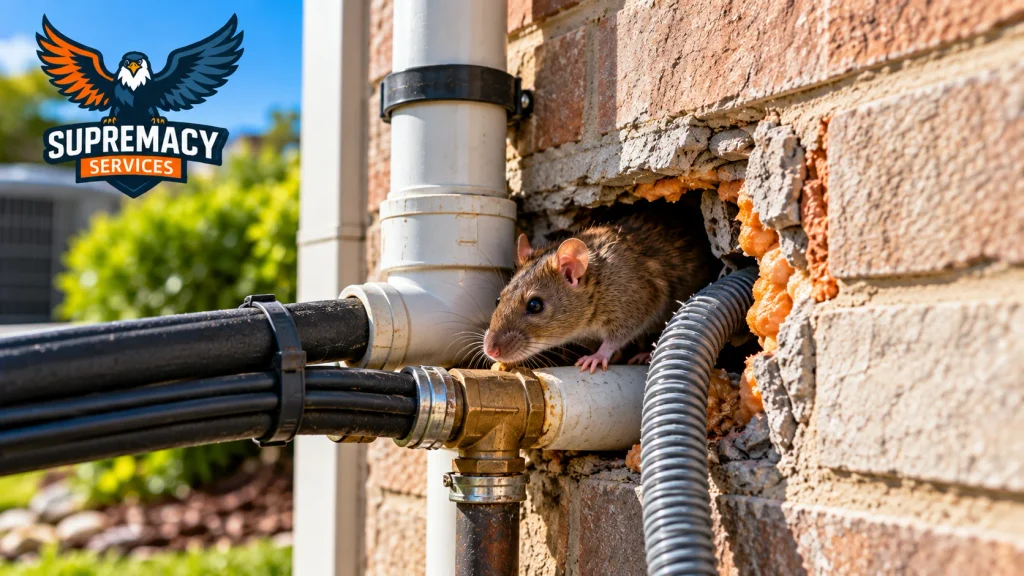
The openings created where plumbing, electrical, cable, HVAC or gas lines pass through an exterior wall are common places for rodents to exploit.
Construction requires penetrations through walls and foundations. If the finished opening is larger than the line passing through it—or if an old seal deteriorates—a usable gap can remain.
CDC specifically advises checking around:
- electrical lines;
- water lines;
- gas lines;
- sewer lines;
- pipes beneath sinks;
- water-heater and furnace piping;
- cable penetrations.
Walk slowly around the outside of the house and examine every place where a line disappears through brick, siding, masonry or another exterior material.
Pay particular attention to penetrations hidden behind landscaping or equipment. These can be easy to miss during a quick inspection.
What does an active entry point look like?
An opening becomes more suspicious when you also find:
- dark or greasy rub marks;
- fresh gnawing;
- droppings nearby;
- disturbed insulation inside;
- a worn travel path;
- nesting material;
- repeated sounds from the corresponding wall or ceiling.
One clue alone does not prove that a particular hole is active. Multiple signs in the same location make the case stronger.
4. Garage Doors and Exterior Doors
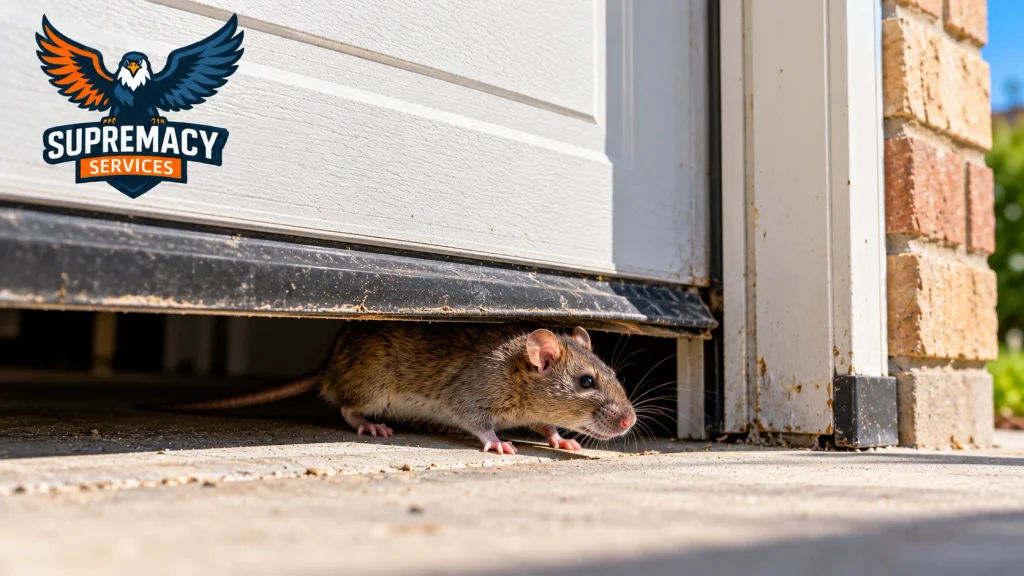
A gap beneath or beside a garage or exterior door can function like an open entrance for rodents.
Check the door while it is completely closed.
Look for daylight beneath the bottom seal and inspect:
- worn garage-door weather seals;
- damaged corners;
- gaps at door jambs;
- poorly fitting side doors;
- warped exterior doors;
- missing weather stripping.
CDC includes exterior doors and areas without effective weather stripping among the places homeowners should inspect for rodent access.
Garages deserve particular attention because they often contain stored pet food, bird seed, grass seed, cardboard boxes or other materials that can provide food or shelter.
A rat that reaches the garage may subsequently find another opening leading into a wall, ceiling or living area.
5. Foundation and Crawlspace Openings
Rats can enter through gaps where the foundation meets the structure, damaged crawlspace vents and other low-level openings.
These locations are especially important when the evidence appears closer to ground level.
Texas A&M notes that Norway rats typically burrow beneath foundations, floors, stored materials and rubbish rather than nesting primarily in high attic spaces.
Inspect for:
- foundation penetrations;
- damaged crawlspace screening;
- openings beneath siding;
- gaps around plumbing;
- burrows near slabs or walls;
- deteriorated masonry;
- openings beneath porches or additions.
A burrow does not automatically prove that rats have entered the house, but burrowing activity adjacent to a structure deserves closer inspection.
6. Chimneys, Flashing and Roof Intersections
Complex roof intersections can create hidden openings that are difficult to see from ground level.
Pay attention to areas around:
- chimney flashing;
- roof-to-wall intersections;
- roof valleys;
- dormers;
- loose shingles;
- roof penetrations;
- remodeling transitions.
Texas A&M specifically recommends checking entry points around chimneys and loose shingles when excluding rodents from homes.
These locations are particularly relevant to roof rats because an animal capable of reaching the roof does not need a ground-level entrance.
The actual opening may also be several feet from where the homeowner hears the animal. Once inside an attic or wall system, rodents can travel within concealed structural spaces.
7. Damaged Fascia, Siding and Exterior Materials
Rot, storm damage, previous construction work and ordinary deterioration can expose gaps that were not originally accessible.
Inspect the exterior for:
- loose fascia;
- separated trim;
- broken siding;
- rotted wood;
- gaps from previous cable or plumbing work;
- missing exterior covers;
- deteriorated patches.
Rodents are persistent gnawers. Texas A&M reports that rats and mice can damage wood, doors, walls, pipes and other building materials.
That means a marginal weakness in the exterior should not be ignored simply because it does not initially look large enough.
Materials used for exclusion should be selected for the opening and building component involved. Texas A&M recommends rodent-resistant materials such as hardware cloth, steel wool, sheet metal or concrete in appropriate applications. CDC similarly recommends metal, hardware cloth, cement and other durable materials for larger holes.
8. Openings Reached From Trees, Fences and Utility Routes
Tree branches, vines, fences and structural features can help climbing rats reach upper portions of a house—but the final problem is still an opening in the building.
A tree touching a roof does not by itself create an infestation. It can, however, provide a route toward an accessible roofline opening.
Roof rats are strong climbers and favor elevated locations. Texas A&M’s rodent-management guidance describes roof rats as using elevated nesting sites such as attics, walls and roofs.
Look around the house for:
- branches touching or overhanging the roof;
- dense vines against exterior walls;
- fences connecting with the structure;
- utility routes leading toward upper walls;
- shrubs that conceal lower-level openings.
The goal is not simply to remove vegetation. It is to understand how a rat reaches the building and where it crosses the building envelope.
Quick Rat Entry-Point Inspection Checklist
| Area | What to check |
|---|---|
| Roofline | Gaps, separated materials, gnawing |
| Soffits/eaves | Loose panels, damaged corners |
| Attic vents | Broken or missing screening |
| Chimney | Flashing and perimeter gaps |
| Utility lines | Oversized or deteriorated penetrations |
| Garage | Bottom and corner door gaps |
| Foundation | Cracks, penetrations, burrows |
| Crawlspace | Damaged vents or screening |
| Siding/fascia | Rot, gaps, loose materials |
| Landscaping | Routes toward roof or concealed openings |
How Do You Find a Rat Entry Point?
Start where you have evidence inside the house, then trace outward to the nearest exterior vulnerabilities.
A systematic inspection is more useful than randomly filling holes.
Step 1: Identify where activity is strongest
Record where you hear scratching, find droppings or see gnawing.
If the evidence is concentrated in an attic, begin with the roofline and upper exterior. If it is concentrated near a garage, kitchen or crawlspace, inspect nearby lower-level penetrations first.
Step 2: Inspect the corresponding exterior area
Look at the outside of the wall, ceiling or attic zone where activity occurs.
Check vents, roof edges, pipes, cables, door seals and construction transitions.
Step 3: Look for evidence of repeated use
Texas A&M identifies droppings, tracks, gnawing, greasy smears and established runways as indicators of rodent activity.
Step 4: Inspect the entire building envelope
Do not stop after finding the first suspicious hole.
There may be more than one entry point.
A proper exclusion inspection should work from the roofline to the foundation, because sealing one opening accomplishes little if another remains accessible.
If you are finding several possible openings—or rats keep returning after trapping—schedule a complete rodent exclusion inspection to identify active entry routes and vulnerabilities from the roofline to the foundation.
Should You Seal a Rat Hole Immediately?
Not always. If rats are already inside, blindly closing an active opening can leave animals trapped within the structure.
Exclusion needs to be coordinated with control of the animals already indoors.
CDC recommends checking how rodents entered, sealing openings and trapping rodents that remain inside.
This is one reason a significant infestation can be more complicated than simply applying expanding foam to a visible gap.
You need to answer three questions:
- Is the opening actually being used?
- Are rodents still inside?
- Are there additional entrances elsewhere?
Closing the wrong opening at the wrong stage can leave the underlying infestation unresolved.
DIY Rat-Proofing vs. Professional Exclusion
Small, accessible maintenance issues may be reasonable for a homeowner to correct. A deteriorated door sweep, for example, is very different from an active opening at a second-story soffit.
| Situation | DIY may be reasonable | Professional inspection is more appropriate |
|---|---|---|
| Worn door sweep | ✓ | |
| Simple accessible utility gap with no activity | ✓ | |
| Repeated attic noises | ✓ | |
| Multiple possible entry points | ✓ | |
| High roofline opening | ✓ | |
| Active infestation | ✓ | |
| Rats returning after trapping | ✓ | |
| Extensive droppings/nesting | ✓ | |
| Uncertain animal identification | ✓ |
What should professional rodent exclusion include?
A thorough service should focus on both the animals and the structure.
Depending on the property and infestation, that can include:
- inspecting the attic and interior evidence;
- identifying whether rats, mice or another animal are responsible;
- tracing likely travel routes;
- inspecting the roofline, vents, utility penetrations, doors and foundation;
- identifying active and potential entry points;
- controlling rodents already inside;
- sealing appropriate openings with durable exclusion materials;
- evaluating whether contamination or nesting material requires cleanup;
- reassessing activity after control measures are installed.
Supremacy Services’ current Rodent Control & Exclusion service describes a similar sequence: property inspection, targeted trapping, exterior exclusion and follow-up/sanitation.
How to Make Your North Texas Home Less Attractive to Rats
Exclusion works best when rats also have fewer reasons to remain around the property.
CDC recommends reducing access to food, water and shelter around homes.
Practical steps include:
- keep garbage containers closed;
- avoid leaving pet food outside overnight;
- clean spilled bird seed and animal feed;
- address accessible water sources and leaks;
- remove unnecessary clutter;
- keep storage organized;
- clean around outdoor cooking areas;
- reduce dense vegetation immediately against the structure;
- inspect garages and sheds as well as the main house.
These measures do not replace exclusion when rats are already entering the structure. They reduce the conditions that make the property attractive while structural access points are being addressed.
Are Rats Really the Animal Making the Noise?
Not every attic sound is a rat.
North Texas homes can also be entered by mice, squirrels and larger wildlife. The timing, location, type of sound, droppings and physical damage can help narrow the possibilities.
Roof rats tend to be active after dark, and Texas A&M notes that noises in attics or ceilings at night can indicate roof-rat activity.
Daytime movement may raise suspicion of squirrels, although timing alone should not be treated as definitive identification.
If you cannot identify the animal, avoid choosing a control strategy solely from the noise.
Frequently Asked Questions
What is the most common way rats get into a house?
There is no single entry point for every house. Common vulnerabilities include roof and soffit gaps, vents, utility penetrations, door gaps and foundation openings. In Texas homes with roof-rat activity, upper roofline openings deserve particular attention.
Can rats get into a house through the roof?
Yes. Roof rats are skilled climbers and commonly use elevated nesting areas. Gaps around soffits, eaves, vents, flashing and other roof components can provide access to an attic.
Can rats enter through attic vents?
They can enter through damaged, unscreened or poorly protected vent openings. Ventilation should not simply be blocked; appropriate rodent-resistant screening should preserve the vent’s intended function.
Can rats come in under a garage door?
Yes. A sufficiently large gap beneath or around a garage door can provide access. Check worn bottom seals, corners and side weather stripping.
How do I know where rats are getting in?
Start near the area with the strongest indoor evidence and inspect the corresponding exterior. Look for openings accompanied by gnawing, grease marks, droppings, tracks or disturbed materials.
Can rats climb walls?
Roof rats are particularly capable climbers. They can use vegetation and structural features to reach elevated portions of buildings, which is why attic infestations should trigger an inspection of the entire roofline.
Should I use spray foam to close a rat hole?
Foam alone should not automatically be considered a durable rodent barrier. CDC and Texas A&M recommend rodent-resistant materials such as metal, hardware cloth and other durable materials depending on the opening.
Should I seal a hole if a rat is already inside?
The infestation and exclusion process should be coordinated so rodents are not inadvertently trapped inside inaccessible parts of the structure. Identify active entrances and address the animals already indoors as part of the plan.
Why do rats keep coming back after I trap them?
Trapping removes individual animals but does not necessarily eliminate structural access. If exterior openings remain, other rodents can enter later.
When should I call a professional?
Professional help is particularly useful when rats are active in an attic or walls, several entry points are possible, openings are located on a difficult roofline, the infestation persists after trapping, or you cannot safely determine where animals are entering.
Stop the Entry Point, Not Just the Rat
Finding a rat indoors answers only half of the problem.
The more important question is:
How did it get inside?
For North Texas homeowners, that investigation should cover the entire exterior—from roof vents, soffits and chimney flashing to utility penetrations, garage doors, crawlspaces and foundation gaps.
Removing active rodents without correcting access can allow the problem to return. Likewise, sealing random gaps without understanding whether animals remain inside can create a different problem.
A successful approach combines identification, removal or trapping, structural exclusion and prevention.
Hearing rats in your attic or finding droppings, gnaw marks or suspected entry holes? Supremacy Services provides rodent inspections, targeted control and exterior exclusion throughout Dallas and the DFW Metroplex. Schedule a rodent inspection to find where they are getting in and develop a plan to close the access points.