Repair a commercial rooftop HVAC unit when a confirmed fault can be corrected reliably and the rest of the equipment still meets your building’s needs. Consider replacement when major problems accumulate, breakdowns disrupt the business, or the unit no longer provides suitable performance.
For Dallas businesses, rooftop HVAC repair vs replacement should come down to equipment condition, complete project costs, and the consequences of another interruption. Age is useful context, but it cannot make the decision by itself.
A rooftop unit, often called an RTU, packages cooling and, where equipped, heating components in an outdoor cabinet and distributes conditioned air through ductwork. The most useful comparison starts with that whole system, including the spaces it serves.
Table of contents
- Should you repair or replace your rooftop HVAC unit?
- What should be diagnosed before you approve major work?
- How should you compare repair and replacement costs?
- What makes the decision different in Dallas and DFW?
- Does the refrigerant type mean you need a new RTU?
- What should a professional assessment and quote include?
- How can you reduce the next breakdown?
- Frequently asked questions
- Get a clear plan for your building
Should you repair or replace your rooftop HVAC unit?
Repair is a stronger option when the fault is isolated and the remaining equipment is sound. Replacement becomes more attractive when several major deficiencies, unreliable service, or a mismatch with the building make further repairs poor value.
The DOE rooftop unit decision framework considers condition, age, size, field evaluation, and projected economics before selecting a retrofit or replacement. www1.eere.energy.gov
Use the following comparison to guide the discussion with your contractor.
| Finding | Repair is more attractive when | Replacement deserves evaluation when |
|---|---|---|
| Failed component | One repair has a clear cause and defined scope | Several expensive components have deteriorated |
| Overall condition | Coils, cabinet, and other major assemblies remain serviceable | Widespread deterioration remains after the proposed repair |
| Reliability | Service records show occasional, unrelated problems | Repeat failures keep interrupting the same operation |
| Parts and support | Compatible parts and technical support are available | Delays or unavailable parts make recovery impractical |
| Building performance | The system can meet the actual load after correction | Equipment selection or configuration no longer suits the space |
| Business plans | Repair supports an acceptable period of continued use | A planned upgrade fits the building’s longer-term needs |
When another repair can be sensible
A failed control, fan component, or other replaceable part does not automatically justify discarding the whole unit. Even a compressor replacement can be reasonable if the surrounding equipment is sound, the failure’s cause is addressed, and the complete repair proposal is competitive.
Ask what the repair restores and which existing components remain a concern. A new compressor does not renew the rest of an aging RTU.
For age and maintenance context, read our guide to commercial rooftop HVAC lifespan in North Texas.
When to investigate replacement or a targeted upgrade
Repeated failures, several unresolved defects, or equipment that cannot meet the current building load justify a complete replacement proposal. An identified unsafe condition requires prompt professional attention; the assessment should establish whether a safe, durable repair remains practical.
There may also be a useful middle option: repair serviceable equipment and improve compatible controls, airflow, or economizer operation. An economizer manages outdoor-air cooling when conditions allow. A targeted improvement deserves consideration when the main equipment remains worth keeping.
What should be diagnosed before you approve major work?
Confirm what failed, why it failed, and whether the proposed work will correct the complaint. A hot building, high bill, or leaking ceiling is a symptom, not a complete diagnosis.
For example, Trane’s rooftop equipment troubleshooting guidance identifies airflow, filters, coils, refrigerant, electrical conditions, and controls among the issues technicians may need to distinguish. The exact checks depend on the equipment model.

| What the business notices | What the assessment should distinguish |
|---|---|
| Weak cooling throughout the space | Equipment faults, restricted airflow, dirty coils, refrigerant problems, or an unsuitable load match |
| One consistently warm area | Duct distribution, control zones, unusual heat gains, or airflow balance |
| Frequent starts and stops | Control behavior, operating conditions, safety trips, or equipment sizing |
| Water near a ceiling or roof penetration | Condensate drainage problems, duct condensation, or a separate roof leak |
| A higher electricity bill | Actual consumption changes, weather, operating hours, electricity rates, and equipment performance |
Persistent hot spots may justify a duct inspection and airflow assessment before equipment replacement is approved. In a restaurant or renovated tenant space, ask whether exhaust, outdoor-air needs, or layout changes are contributing to the complaint.
Service records are especially useful when a problem keeps returning. PNNL’s commercial HVAC maintenance guidance recommends recording diagnostic findings, corrective work, and downtime to identify recurring or system-wide problems. PNNL
Before authorizing a major repair, arrange an HVAC diagnostic evaluation and ask for a written explanation of the fault and the remaining condition of the system.
How should you compare repair and replacement costs?
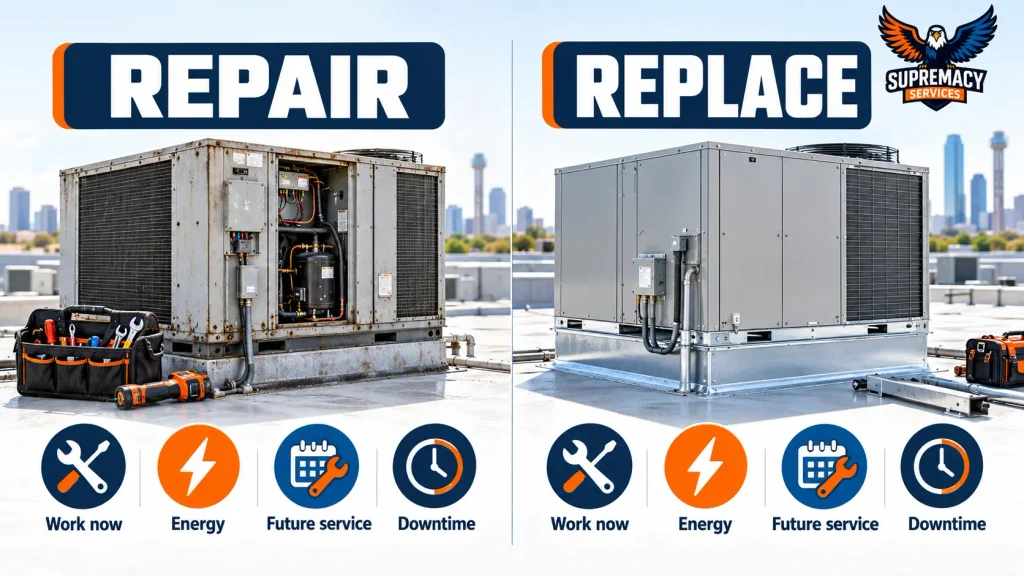
Compare complete written proposals over the same planning period. Include the work needed now, ongoing costs, likely later work, and disruption to your business.
A component price and a fully installed replacement price describe different scopes. Ask what each proposal includes before comparing the totals.
Build a comparison using your own quotes
Choose a planning period that fits your property and occupancy plans. Then complete these categories for both options.
| Cost category | Repair and keep the unit | Replace the unit |
|---|---|---|
| Work now | Diagnosis, parts, labor, and associated corrective work | Equipment and the complete installation scope |
| Roof and access work | Access equipment and any related roof work | Lift, curb or adapter, connections, and roof coordination |
| Future equipment work | Forecast repairs and replacement if needed within the period | Forecast repairs and any major work within the same period |
| Maintenance | Service needed for retained equipment | Service required by the new equipment |
| Energy | Expected use after the repair | Expected use under the same weather and operating assumptions |
| Business interruption | Repair downtime and plausible repeat-outage exposure | Planned changeover and any temporary arrangements |
| Financial adjustments | Applicable financing costs and remaining asset value | Applicable financing costs and remaining asset value |
For the project items that shape the installed price, see our Dallas rooftop AC replacement cost guide.
A crucial question is whether the repair is likely to carry the unit through your comparison period. If replacement is expected during that period, include it in the repair option. Otherwise, the comparison can make keeping the old unit look artificially inexpensive.
Past invoices help reveal reliability problems, but money already spent should not be counted again as a future expense. Ask for a reasonable range of future outcomes instead of treating a guessed failure date as certain.
Examine energy savings and downtime separately
PNNL’s Rooftop Unit Comparison Calculator can help screen equipment options using local climate, building use, and performance at different loads. It provides estimates; the actual building still needs an appropriate equipment selection and project evaluation.
Ask what supports any promised savings. Useful inputs include utility records, operating schedules, existing equipment condition, and the proposed unit’s performance. An increased bill alone does not prove that replacement will pay for itself.
For downtime, identify which spaces would lose cooling, how long the business can tolerate that condition, and the cost of temporary arrangements. Use your actual operating exposure rather than a generic lost-revenue figure. Check warranty coverage carefully: parts coverage, labor, refrigerant, access work, and response arrangements may have different terms.
Treat an age-times-repair-price formula or a fixed repair percentage as a prompt for closer review. Neither captures all the costs and operational consequences of a commercial rooftop project.
Considering a change-out? Review Supremacy Services’ rooftop AC installation options in Dallas and request an assessment of your equipment and building requirements.
What makes the decision different in Dallas and DFW?
Summer cooling performance, roof access, building use, and the permitting jurisdiction all deserve attention. Their importance depends on the property.
Hot-weather performance and changing building loads
Dallas-Fort Worth climate normals put July’s average daily high at 95.6°F and August’s at 95.8°F. That makes hot-weather operation relevant to a Dallas cooling assessment; those monthly averages are not equipment-sizing design temperatures. Normals, Means, and Extremes
Ask whether the building has changed since the existing unit was selected. More occupants, different operating hours, a restaurant build-out, or a revised floor plan can change the assessment. DOE guidance on rooftop unit sizing calls for calculating the heating and cooling load of the spaces served before equipment selection.
Roof conditions and project access
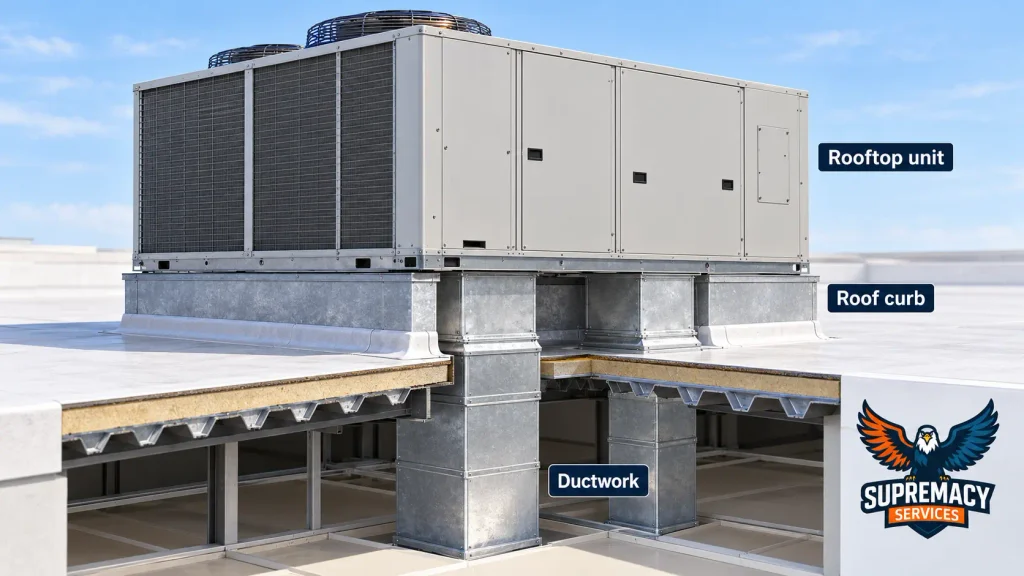
Have the replacement proposal address the existing roof curb, which supports the unit and interfaces with the roof and ducts. Check compatibility, support requirements, roof condition, electrical supply, and gas connections where applicable.
Crane access and weather can affect the work plan. Confirm staging space, protection of occupied areas, roof access, and coordination with the building owner or roofer. If the project requires public-way restrictions, have the contractor establish the applicable approvals before scheduling the lift.
Permits and property responsibilities
Have the contractor confirm Dallas permit requirements and exemptions for the actual scope. The city’s published code includes exemptions for some mechanical work, so neither “every replacement needs a permit” nor “same-size equipment never needs one” is a reliable blanket answer.
For properties in Plano, Frisco, Allen, Garland, or another DFW municipality, confirm requirements with that jurisdiction. Tenants should also establish who can approve the project and who pays under the property agreement before accepting a proposal.
If the building has several RTUs, prioritize them by condition and the importance of the spaces they serve. Replacing the most problematic unit first may be a practical phased approach if the building’s systems allow it.
Does the refrigerant type mean you need a new RTU?
An existing unit does not automatically need replacement simply because it uses R-410A or R-22. Serviceability and compliance for proposed new equipment are separate questions.
EPA’s guidance on existing HFC equipment distinguishes equipment already in use from restrictions on new products and systems. Its guidance also explains that refrigerants such as R-32 and R-454B cannot be used in systems that were not designed for them.
EPA’s guidance for existing R-22 equipment permits continued operation and servicing with available lawful supplies. A leak, an expensive repair, or difficulty sourcing compatible components can still make replacement the better business choice.
Ask the contractor to identify the refrigerant, explain the repair options, and verify current requirements for any proposed replacement. Do not approve a refrigerant substitution on the assumption that it is a simple drop-in upgrade.
What should a professional assessment and quote include?
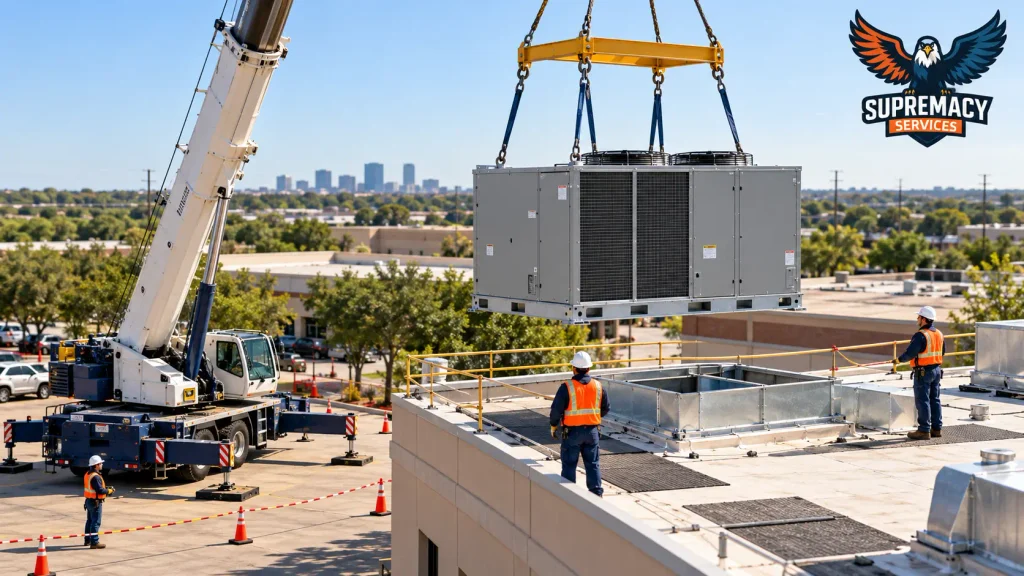
Ask for enough written information to understand both the repair and the replacement. A useful scope should address the following:
- Equipment identity and condition. Model, capacity, refrigerant, service history, and the condition of major assemblies.
- Diagnosis. The confirmed fault, relevant measurements, probable cause, and what remains uncertain.
- Repair scope. Parts and labor, related corrective work, expected availability, exclusions, and warranty terms.
- Replacement design. Load assessment, suitable equipment, roof and utility compatibility, controls, and applicable approvals.
- Schedule and disruption. Equipment lead time, onsite work, the expected period without heating or cooling, and contingency arrangements.
- Completion checks. Startup and commissioning records, airflow and controls verification, required inspections, operating instructions, and a maintenance plan.
Check Texas HVAC contractor licensing requirements and verify the contractor’s active license. Refrigerant work must also meet the applicable EPA Section 608 certification requirements.
What can your staff safely do first?
Gather service invoices, operating schedules, utility records, and a list of affected rooms. Check thermostat settings and note when problems occur. Use equipment information already available in your records.
Roof access, electrical testing, refrigerant handling, gas work, and opening equipment panels should follow the site’s safety procedures and be handled by appropriately qualified personnel. Do not bypass safety controls or repeatedly reset a unit that trips.
How can you reduce the next breakdown?
Use a maintenance plan tied to the equipment manufacturer’s instructions and the building’s operating conditions. The rooftop unit maintenance guide covers filters, coils, drains, controls, and other serviceable components while emphasizing manufacturer-specific requirements.
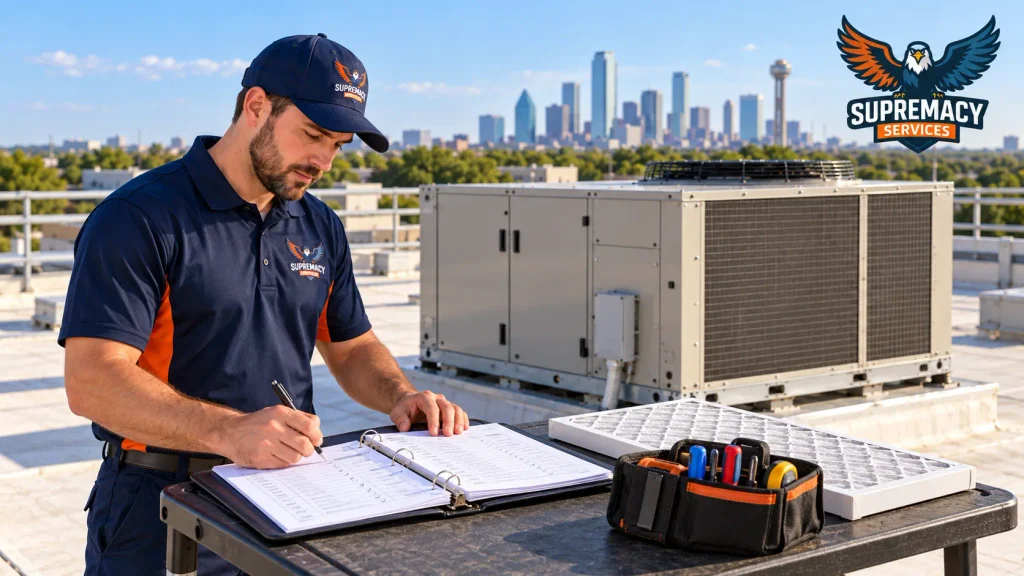
Keep a record for each unit showing service dates, findings, repairs, downtime, and unresolved recommendations. For sites with several RTUs, identify each unit consistently so recurring problems are easy to track.
Ask your provider which tasks your staff may perform and which require professional service. Revisit the maintenance plan after a major repair, equipment replacement, or a significant change in building use.
Frequently asked questions
Is replacing a rooftop compressor worth it?
It can be, if the failure is isolated, its cause is corrected, and the remaining unit is in good condition. Compare the complete repair price, warranty coverage, parts availability, and other unresolved defects with a complete replacement proposal.
Should a 15-year-old rooftop unit automatically be replaced?
No. Age should prompt a closer condition and reliability review. A serviceable unit with a limited repair may be worth keeping; one with recurring failures and several deteriorated assemblies may justify replacement. Use inspection findings alongside age.
Will a larger rooftop unit fix hot spots?
Not necessarily. Hot spots can involve duct distribution, controls, airflow balance, or heat gains in a particular area. Ask for a building-load and airflow assessment before approving greater capacity.
Is my R-410A rooftop unit illegal to keep using?
No. EPA’s technology-transition restrictions do not automatically require retirement of equipment already in use. Have the contractor evaluate repair practicality and verify the requirements for any new equipment being proposed.
Can we replace one rooftop unit at a time?
Often a phased project is worth evaluating. The contractor should check how the units serve different areas and whether shared controls, ventilation, or other building systems affect sequencing. Base the order on condition and operational importance.
How long will the business be without heating or cooling?
Ask for an equipment-delivery timeline and a separate onsite shutdown plan. Roof access, curb work, utilities, weather, inspections, and commissioning affect the schedule. The proposal should identify the affected spaces and any temporary arrangements.
Can a commercial tenant approve replacement?
Confirm the approval and payment responsibilities in the property’s agreement before signing. The owner or property manager may need to coordinate roof access and building work. A service estimate alone does not establish a tenant’s authority to approve the project.
Will a new rooftop unit lower our energy bill?
It may, but the result depends on equipment performance, controls, maintenance, building use, and utility costs. Ask for the assumptions behind the estimate. Avoid treating a rated efficiency improvement as a guaranteed reduction in the whole building’s bill.
Get a clear plan for your building
The next step is a diagnosis and a comparison you can use. Bring your service history, operating hours, affected spaces, and any existing repair proposal to the assessment.
Request a rooftop HVAC assessment from Supremacy Services to discuss a defined repair scope and a complete replacement proposal for your Dallas or DFW property.