10400 Clarence Drive, Frisco, TX 75033
Support 24/7: 945-777-3345
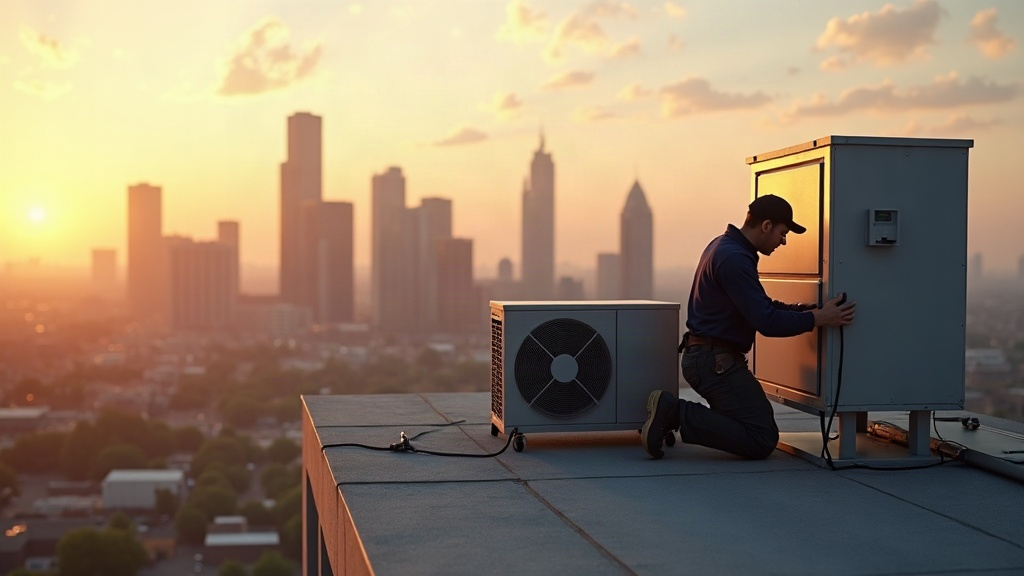
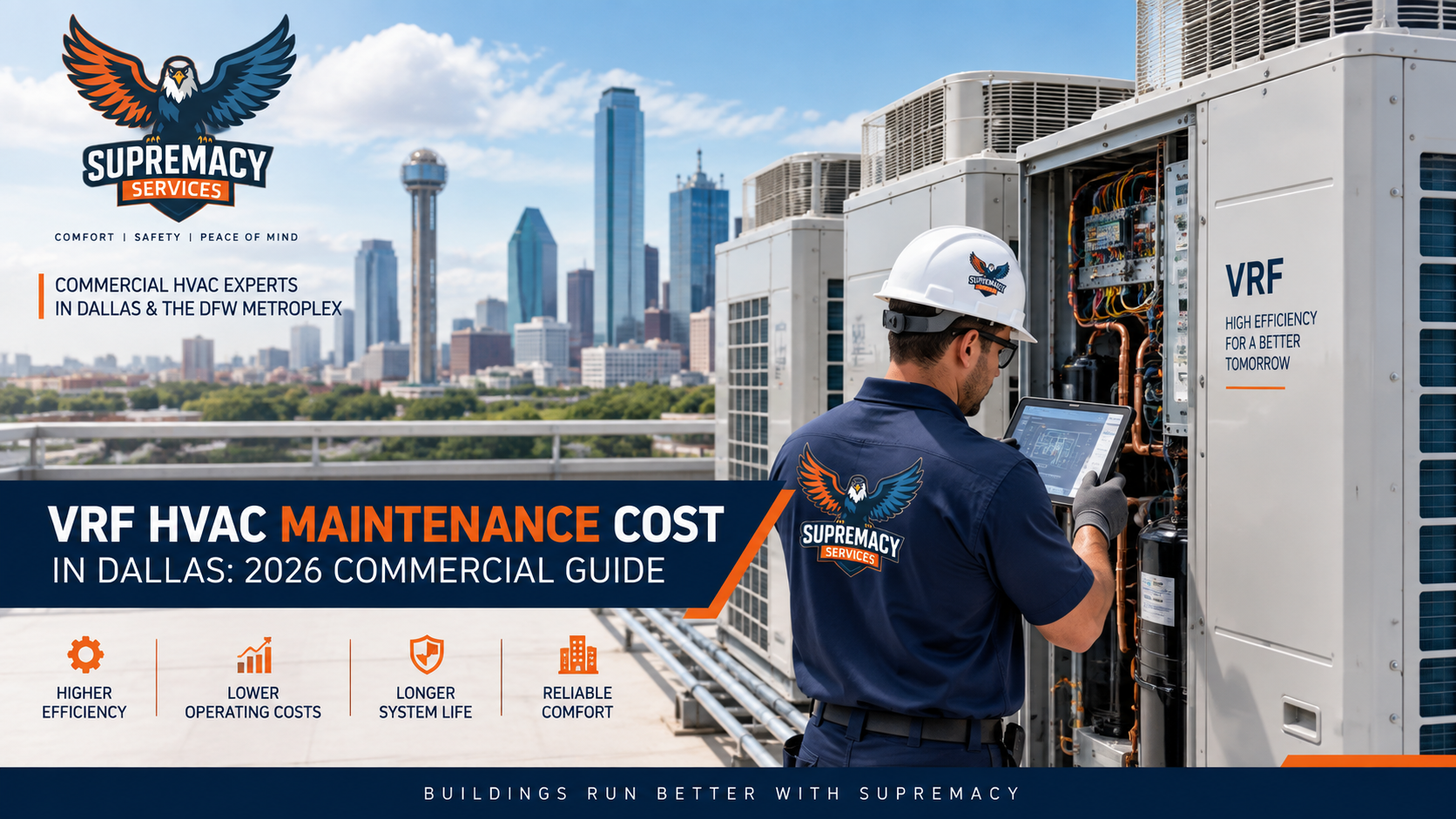
VRF HVAC maintenance cost Dallas Commercial HVAC technician performing VRF system maintenance on rooftop equipment in Dallas

VRF HVAC Maintenance Cost in Dallas: 2026 Commercial Guide

VRF HVAC maintenance cost in Dallas varies considerably because commercial VRF systems are not priced like a single conventional rooftop unit. The number of indoor units, outdoor modules, system capacity, controls, accessibility, maintenance frequency and condition of the refrigerant network can all affect what a Dallas business ultimately pays.

For budgeting purposes, published 2026 Dallas-area commercial HVAC maintenance pricing commonly runs from several hundred dollars per conventional unit annually, while larger buildings and complex systems such as VRF may cost several thousand dollars per year to maintain. One Dallas-area source places annual maintenance for office buildings with four to eight RTUs or VRF equipment at approximately $2,000–$5,000, while another DFW commercial contractor lists general planned maintenance agreements at roughly $420–$1,150 per conventional unit per year. These figures are market references—not Supremacy Services pricing—and a VRF system should normally be quoted after the contractor inventories the actual equipment.

That distinction matters. A building with one outdoor VRF module and several indoor units is fundamentally different from a multi-floor property with multiple outdoor modules, dozens of fan coils, branch controllers and centralized controls.

For Dallas property owners and facility managers, the more useful question is therefore:

What will it cost to properly maintain this specific VRF system—and what does that maintenance include?

This guide explains how to build that budget.

What Is VRF HVAC Maintenance?
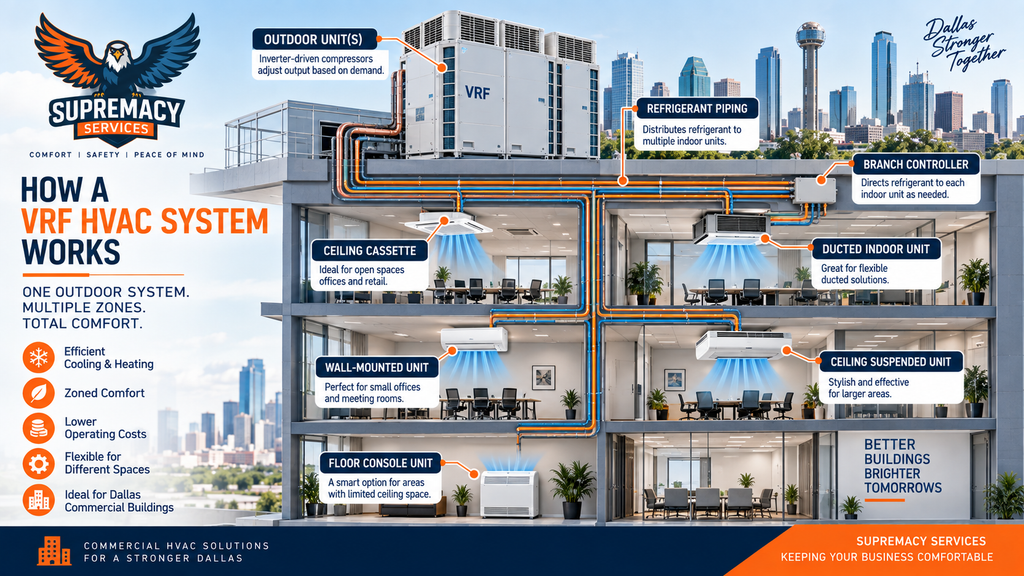
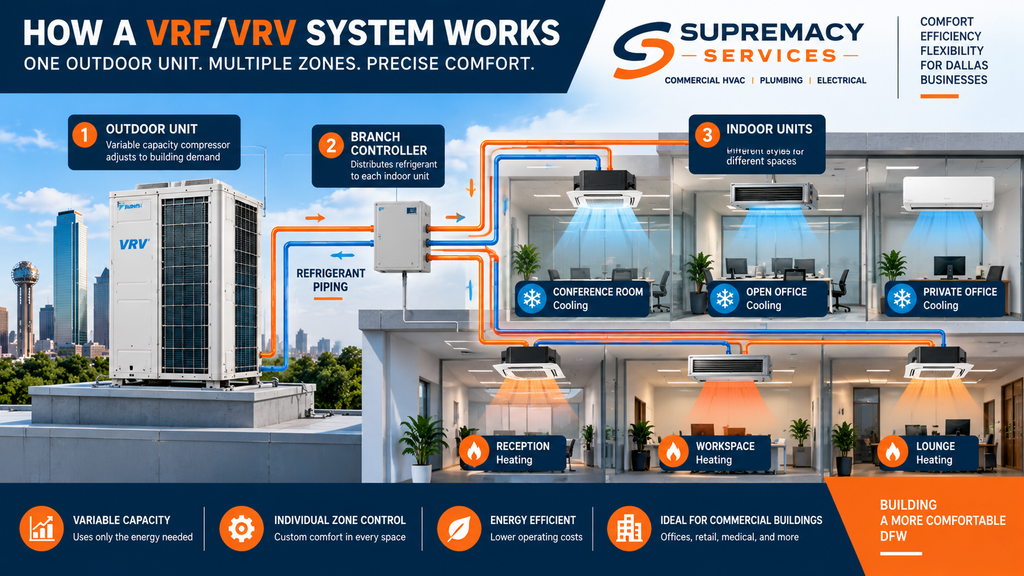
Diagram showing VRF outdoor units, refrigerant piping, branch controller and multiple indoor HVAC zones
A VRF system connects outdoor equipment to multiple independently conditioned indoor zones through refrigerant piping and system controls.

VRF maintenance is the scheduled inspection, cleaning, testing and performance verification of a Variable Refrigerant Flow HVAC system.

VRV—Variable Refrigerant Volume—is Daikin’s terminology for its version of the technology, while VRF is the broader industry term.

Unlike a basic single-zone system, VRF equipment may connect one or more inverter-driven outdoor units to numerous indoor units through an interconnected refrigerant and controls network.

That means proper maintenance can involve much more than replacing filters.

Depending on the equipment and manufacturer requirements, service may include:

  • inspecting indoor-unit filters;
  • cleaning indoor and outdoor heat exchangers where needed;
  • checking condensate drains, pans and pumps;
  • examining refrigerant piping and insulation;
  • inspecting electrical connections;
  • checking temperature sensors;
  • reviewing compressor operation;
  • checking electronic expansion valves;
  • investigating refrigerant leaks;
  • reviewing fault histories and operating data;
  • testing communication between indoor and outdoor components; and
  • verifying centralized controls and zone operation.

Daikin documentation, for example, specifically provides procedures for cleaning or replacing VRV indoor-unit filters, while commercial VRF maintenance programs commonly include refrigerant, compressor, condensate, electrical and sensor inspections.

How Much Does VRF HVAC Maintenance Cost in Dallas in 2026?

There is no reliable one-price-fits-all Dallas VRF maintenance rate. Commercial systems need to be priced according to their equipment inventory and service scope.

For planning—not quoting—the following published market data provides useful context:

Maintenance scenarioPublished 2026 planning rangeImportant limitation
Dallas commercial HVAC PM, per conventional unit/year$420–$1,150General commercial HVAC, not VRF-specific
DFW single RTU inspection$150–$350/visitRTU benchmark only
DFW 5–10-unit commercial contract$2,000–$6,000/yearGeneral HVAC benchmark
DFW 10,000–25,000 sq. ft. office with 4–8 RTUs or VRF$2,000–$5,000/yearMarket planning estimate
Published VRF contract benchmark outside Texas$1,200–$2,400/outdoor unit/yearUseful VRF complexity benchmark, not Dallas pricing

Dallas/DFW figures above come from commercial contractors publishing local planning ranges. The VRF-specific figure is from another U.S. market and should not be presented as a Dallas quote.

The practical takeaway

A small commercial VRF installation may require a relatively straightforward maintenance program. A multi-story office, hotel, medical property, restaurant, school or mixed-use building with many indoor units can require substantially more technician time.

The best way to price VRF maintenance is through an equipment inventory rather than square footage alone.

A contractor should ideally determine:

  1. Number of outdoor modules
  2. Number and type of indoor units
  3. Manufacturer and model families
  4. System capacity
  5. Number of refrigerant circuits
  6. Controller configuration
  7. Accessibility
  8. Filter quantity and type
  9. Condensate-system configuration
  10. Current fault or repair history
  11. Required maintenance frequency
  12. Whether maintenance occurs during normal or after-hours periods

That produces a far more meaningful commercial maintenance estimate than simply multiplying the building’s square footage by a generic rate.


What Factors Affect VRF Maintenance Cost?
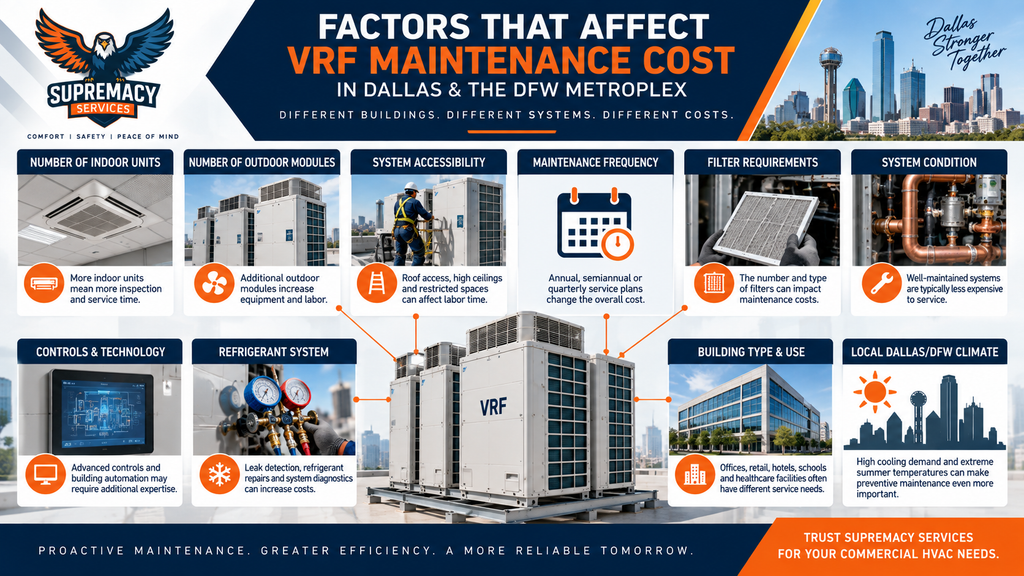
Infographic showing factors that affect commercial VRF maintenance costs in Dallas and DFW
Indoor-unit count, outdoor modules, accessibility, service frequency, controls and system condition can all influence VRF maintenance costs.
1. Number of Indoor Units

This is one of the biggest differences between VRF and conventional commercial HVAC.

A VRF network may serve numerous zones, each with its own cassette, ducted fan coil, wall-mounted unit or other indoor terminal.

Every additional indoor unit can add inspection and maintenance time.

For example, technicians may need to inspect its filter, coil, drain pan, condensate pathway, fan operation, thermistors and controller communication.

A building with 30 indoor units therefore presents a very different maintenance workload from one with six.

2. Number of Outdoor Modules

Larger VRF installations frequently use multiple outdoor modules.

These contain important components such as inverter-driven compressors, heat exchangers, fans, sensors and control electronics.

Additional modules increase the amount of equipment that needs to be inspected and documented.

3. System Accessibility

Accessibility can materially affect labor.

An indoor cassette accessible from an ordinary ceiling grid is different from equipment positioned above a high ceiling or in a restricted mechanical space.

Outdoor equipment may likewise be located at ground level, on a roof or in another area requiring special access procedures.

When requesting bids, property managers should tell contractors about access restrictions rather than comparing proposals based only on the number of units.

4. Maintenance Frequency

Two visits per year and quarterly preventive maintenance are not equivalent contracts.

Buildings with demanding operating schedules may need more frequent inspection than lightly occupied properties.

Maintenance frequency should ultimately reflect the manufacturer’s instructions, equipment condition, building use and operating environment rather than an arbitrary calendar rule.

5. Filter Requirements

Filters are relatively simple components, but a commercial building may have many of them.

Daikin documentation shows that some VRV indoor units use washable or long-life filters and provides specific filter-maintenance instructions. Different indoor-unit types and applications can have different requirements.

A proposal should therefore make clear whether filter cleaning or replacement is included—and whether replacement filters are included in the contract price.

6. Coil Condition

Dirty heat exchangers restrict heat transfer.

DOE guidance identifies coil cleaning as an important HVAC preventive-maintenance activity and notes that proper operations and maintenance can improve commercial HVAC performance and reduce energy waste.

VRF outdoor heat exchangers deserve particular attention because outdoor equipment in a commercial environment can accumulate dust, vegetation and other debris.

7. Refrigerant-System Problems

A basic preventive-maintenance visit is different from refrigerant leak diagnosis and repair.

VRF installations can contain substantial interconnected refrigerant piping. Diagnosing a leak may require additional testing and technician time beyond normal preventive maintenance.

A good proposal should clearly distinguish:

routine refrigerant-system inspection from leak detection, repair, evacuation and corrective refrigerant work.

8. Controls and Communication Problems

Modern VRF equipment depends heavily on sensors, communication wiring, control boards and centralized controls.

A zone that appears to have a mechanical cooling problem may actually have a sensor, controller, address or communication problem.

Troubleshooting these issues can require manufacturer-specific diagnostic tools and additional labor.

9. Existing System Condition

A clean, documented system that has received regular service is usually easier to maintain than equipment with:

  • unresolved fault codes;
  • clogged coils;
  • recurring drain problems;
  • deteriorated insulation;
  • undocumented repairs;
  • intermittent communication faults; or
  • suspected refrigerant leakage.

An initial baseline inspection may therefore cost more than subsequent scheduled maintenance visits.

Why VRF Maintenance Matters in Dallas

Dallas commercial HVAC systems operate in a cooling-intensive climate.

National Weather Service climate normals for Dallas/Fort Worth show approximately 2,825 annual cooling degree days, with July and August accounting for the highest monthly cooling-degree-day totals. DFW also averages about 20 days per year with temperatures reaching at least 100°F.

That does not automatically mean every VRF system requires the same maintenance schedule.

It does mean Dallas facility managers should pay particular attention to cooling-season readiness.

A sensible maintenance strategy should consider performing important inspections and corrective work before sustained summer demand exposes an existing problem.


What Should Professional VRF Maintenance Include?
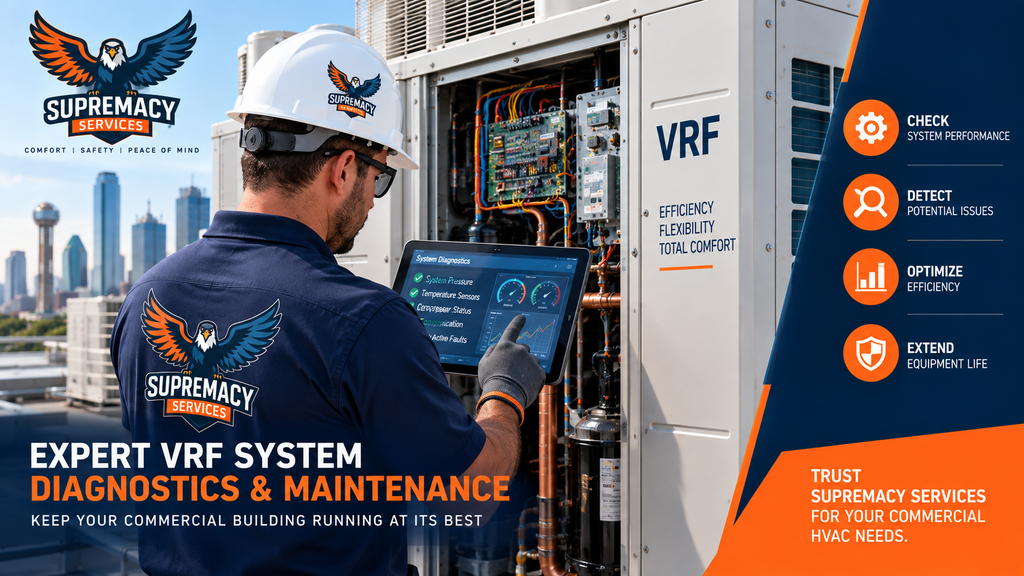
Commercial HVAC technician using diagnostic equipment to inspect a VRF system in Dallas
Professional VRF diagnostics help technicians evaluate system performance, controls and potential equipment problems.

A useful VRF maintenance proposal should specify tasks rather than simply promise a “tune-up.”

Indoor Units

Typical inspection points can include:

  • filters;
  • evaporator coils;
  • fan/blower condition;
  • condensate pans;
  • drain lines;
  • condensate pumps where installed;
  • thermistors;
  • abnormal noise or vibration;
  • airflow;
  • controller operation; and
  • visible signs of leakage or deterioration.
Outdoor Units

Depending on manufacturer procedures and system design, service may include:

  • condenser/heat-exchanger inspection;
  • coil cleaning where required;
  • fan inspection;
  • compressor operating checks;
  • electrical inspection;
  • sensor checks;
  • refrigerant-system observations;
  • abnormal vibration/noise inspection; and
  • fault-history review.
Refrigerant Distribution System

The technician may inspect accessible:

  • refrigerant piping;
  • insulation;
  • branch components;
  • supports;
  • joints;
  • evidence of oil staining or leakage; and
  • operating conditions indicating a possible refrigerant problem.
Controls and Communications

A VRF system should also be evaluated as a network.

That may include checking:

  • zone controllers;
  • centralized controllers;
  • communication errors;
  • sensor readings;
  • equipment addressing;
  • schedules;
  • operating modes;
  • stored fault codes; and
  • communication between indoor and outdoor equipment.

This is one reason hiring a contractor familiar with the installed VRF manufacturer matters.

Preventive Maintenance vs. VRF Repair

Preventive maintenanceRepair/diagnostic work
ScheduledTriggered by a problem
Filter inspectionFailed component diagnosis
Coil inspection/cleaningControl-board repair
Drain inspectionCondensate-pump replacement
Electrical inspectionCommunication fault diagnosis
Operating-data reviewRefrigerant leak repair
Sensor checksEEV/component replacement
Identify developing issuesCorrect existing failures

The two should not be confused.

A maintenance agreement generally helps identify developing conditions, but it does not mean every repair, replacement component or refrigerant issue is automatically included.

Before signing a commercial maintenance agreement, ask exactly what is included and what becomes separately billable repair work.


Warning Signs Your VRF System Needs Service

Facility managers should consider professional diagnosis when they notice:

  • one or more zones failing to cool or heat;
  • repeated fault codes;
  • multiple indoor units unexpectedly going offline;
  • water leaking from a cassette or fan coil;
  • persistent condensate problems;
  • unexplained compressor shutdowns;
  • unusual noise or vibration;
  • reduced airflow;
  • inconsistent temperatures;
  • unexplained increases in HVAC energy use; or
  • recurring controller/communication errors.

The presence of one symptom does not automatically identify the failed component.

For example, a warm room could result from an airflow problem, controller setting, thermistor issue, electronic expansion valve problem, refrigerant issue or another system condition.

Proper diagnosis should come before component replacement.

Can Building Staff Maintain a VRF System?

Building personnel can handle some basic facility-management tasks when permitted by the equipment documentation and company procedures.

That may include:

  • keeping outdoor equipment clear of obvious debris;
  • monitoring controller alarms;
  • documenting comfort complaints;
  • maintaining service records; and
  • cleaning approved washable filters according to manufacturer instructions.

But refrigeration, electrical and technical diagnostic work should be handled by qualified personnel.

Texas regulates air-conditioning and refrigeration contracting. TDLR states that contractors who install, repair or maintain covered air-conditioning, refrigeration or heating systems must hold the applicable license, and Texas distinguishes Class A and Class B contractor privileges.

Facility managers should verify licensing and confirm that the contractor has experience with the specific VRF/VRV manufacturer installed at the property.

How Often Should Commercial VRF Equipment Be Maintained?

There is no universal schedule that should override the equipment manufacturer’s instructions.

Maintenance frequency can depend on:

  • manufacturer requirements;
  • building operating hours;
  • indoor-unit quantity;
  • environmental conditions;
  • filtration;
  • occupancy;
  • system age;
  • equipment condition; and
  • criticality of the conditioned spaces.

Commercial preventive-maintenance programs are commonly structured around semiannual or quarterly inspections, while certain tasks may occur at different intervals.

The important distinction is that maintenance frequency and maintenance scope are not the same thing.

A quarterly visual inspection does not necessarily mean every coil receives deep cleaning four times per year.

The maintenance plan should define which tasks occur at each interval.

Is a VRF Maintenance Contract Worth It?

For commercial properties, a structured maintenance agreement can make HVAC spending more predictable and create a service history for the equipment.

DOE commercial-building guidance says effective HVAC maintenance can improve performance, decrease operating costs, extend equipment service life and reduce failure risk. DOE’s Better Buildings resources also cite estimates that O&M best practices can reduce organizational energy bills by approximately 5%–20%, although that is a broad commercial-building estimate and should not be interpreted as a guaranteed VRF savings percentage.

The strongest reason for a maintenance agreement is therefore not a promised percentage of savings.

It is systematic equipment management.

For a VRF property, that means having a documented process for monitoring filters, coils, condensate systems, compressors, controls, refrigerant circuits and developing faults.

What Should You Ask Before Signing a VRF Maintenance Agreement?

Use this checklist when comparing Dallas commercial HVAC proposals:

  • How many indoor and outdoor units does the quote cover?
  • Are all VRF components listed by model or equipment ID?
  • How many visits are included?
  • What work occurs during each visit?
  • Are filters cleaned, replaced or only inspected?
  • Are replacement filters included?
  • Is coil cleaning included?
  • Are condensate drains and pumps inspected?
  • Are system fault codes downloaded and documented?
  • Are controls and communication networks tested?
  • Is refrigerant leak inspection included?
  • What constitutes separately billable leak detection?
  • Are repair parts included?
  • Is repair labor included?
  • Is after-hours work included?
  • Are service reports provided?
  • Does the contractor have experience with your VRF manufacturer?
  • Is the contractor appropriately licensed in Texas?

Two quotes that appear far apart in price may actually include very different scopes.

Compare scope against scope, not just annual price.

VRF Maintenance vs. Conventional Commercial HVAC Maintenance
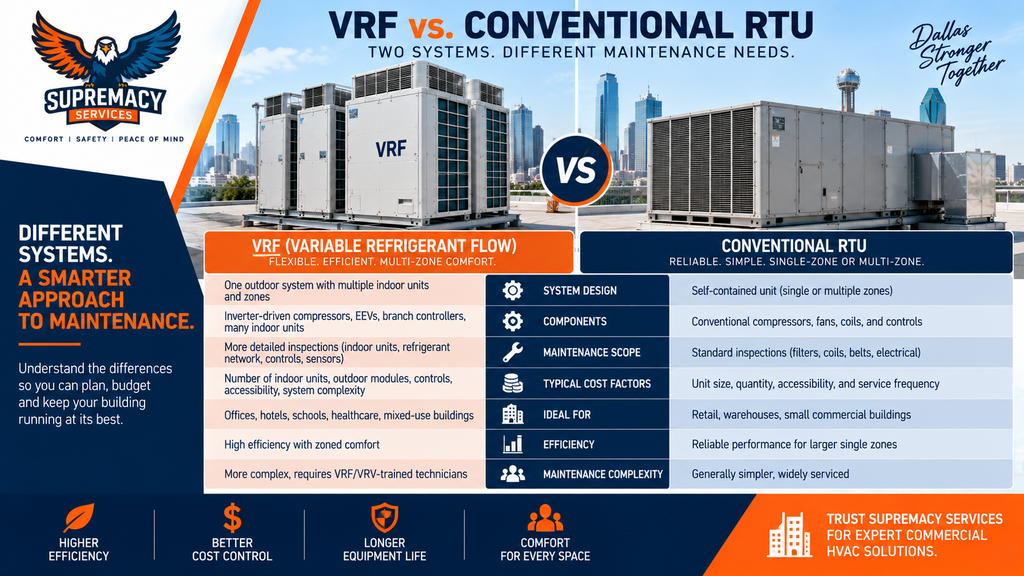
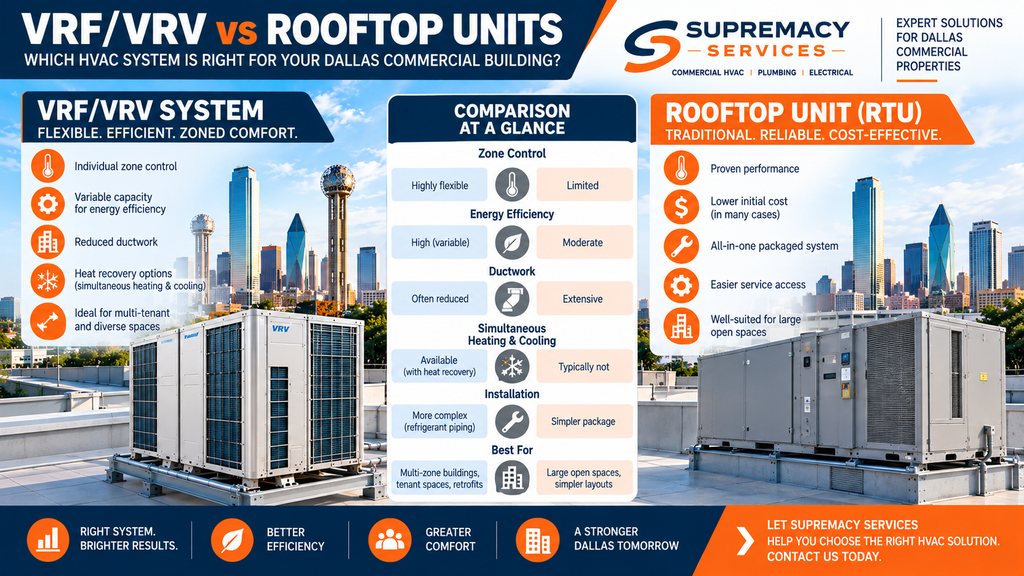
VRF HVAC system compared with a conventional rooftop unit for commercial building maintenance
VRF and conventional rooftop HVAC systems have different components, configurations and preventive-maintenance requirements.

VRF systems require a different maintenance mindset from conventional packaged equipment.

FactorConventional RTUVRF/VRV
ZonesUsually limitedPotentially many
Indoor unitsGenerally centralizedNumerous possible
Compressor controlConventional/staged or variable depending on equipmentInverter-driven system architecture
Refrigerant networkRelatively localizedCan serve many connected zones
ControlsOften comparatively straightforwardHighly integrated
Electronic expansion valvesSystem-dependentImportant part of VRF refrigerant control
Communication networkLess extensive in many systemsCritical to system operation
Maintenance pricingOften quoted per unitBetter based on complete system inventory

This complexity is why an inexpensive generic commercial “AC tune-up” should not automatically be treated as equivalent to specialized VRF preventive maintenance.

Dallas VRF Maintenance: Repair, Maintain or Replace?

Maintenance is appropriate when equipment is fundamentally operational and the objective is to preserve performance, correct minor deficiencies and detect developing problems.

Repair becomes appropriate when testing identifies a failed component or system fault.

Replacement or major modernization deserves consideration when the property faces broader problems such as repeated major failures, obsolete components, major refrigerant-system issues, inadequate capacity or a system that no longer serves the building’s operational requirements.

Those decisions should be based on diagnostics, equipment age and condition, repair history, parts availability, operating costs and the economics of the specific building—not an arbitrary age cutoff.

If your property is considering an entirely new VRF/VRV system rather than maintaining the existing equipment, Supremacy’s VRV System Installation in Dallas service provides a separate path for system design and installation.

How to Get an Accurate VRF Maintenance Quote in Dallas

The most useful commercial quote starts with an equipment survey.

Before requesting pricing, gather:

  1. Property address
  2. Building use
  3. Approximate operating hours
  4. Manufacturer
  5. Outdoor-unit model numbers
  6. Indoor-unit count
  7. Controller type
  8. Current alarms or fault codes
  9. Existing maintenance records
  10. Known refrigerant or condensate problems
  11. Access restrictions
  12. Preferred service frequency

The contractor can then build a maintenance scope around the actual system rather than applying generic commercial HVAC pricing.

Supremacy Services provides VRV/VRF system service and maintenance in Dallas and the DFW Metroplex, including system diagnostics, refrigerant and EEV analysis, coil and airflow maintenance, sensor evaluation and controls work.

For a commercial property, request an equipment-specific maintenance assessment so the proposed scope reflects the number of indoor units, outdoor modules, controls and actual operating condition of your system.

Frequently Asked Questions

How much does VRF HVAC maintenance cost in Dallas?

There is no standard Dallas price because VRF systems vary substantially in size and complexity. Published Dallas commercial HVAC benchmarks range from hundreds of dollars per conventional unit annually to several thousand dollars for larger commercial properties. VRF systems should generally be quoted after an equipment inventory.

Why can VRF maintenance cost more than a conventional AC tune-up?

A VRF network may contain numerous indoor units, inverter compressors, electronic expansion valves, refrigerant branches, sensors and networked controls. More components and zones can mean more inspection and diagnostic time.

How often should a commercial VRF system be serviced?

Follow the manufacturer’s requirements and a maintenance schedule appropriate for the building. Semiannual or quarterly professional inspections are common commercial arrangements, but individual tasks may have different intervals.

Is VRV the same as VRF?

They refer to the same general variable-refrigerant technology. VRV is Daikin’s terminology; VRF is the broader industry term.

What should be included in VRF preventive maintenance?

Depending on the system, maintenance can include filters, coils, condensate systems, electrical components, sensors, compressor operation, refrigerant-system inspection, fault codes, controllers and communication networks.

Does VRF maintenance include refrigerant?

Not necessarily. Routine inspection and corrective refrigerant work should be treated separately unless the maintenance agreement explicitly states otherwise.

Can my building maintenance staff service VRF equipment?

Facility personnel may be able to perform approved basic tasks such as monitoring alarms or maintaining certain filters. Refrigeration, electrical and technical diagnostic work should be performed by appropriately qualified personnel.

How can I compare VRF maintenance contracts?

Compare equipment coverage, service frequency, included tasks, filters, coil cleaning, controls diagnostics, refrigerant inspection, reporting, repair exclusions and emergency-service terms—not just the annual price.

Should VRF maintenance include diagnostic reports?

For a commercial system, documented readings, fault histories, findings and recommendations can be particularly useful because they allow facility managers to track changes over time and plan corrective work.

Schedule Commercial VRF/VRV Maintenance in Dallas

If you manage a Dallas–Fort Worth commercial property with VRF or VRV equipment, start with an accurate equipment inventory and system assessment rather than relying on generic per-unit pricing.

Request VRV/VRF service and maintenance from Supremacy Services to establish the condition of your equipment, identify maintenance requirements and build an appropriate service plan for your property.
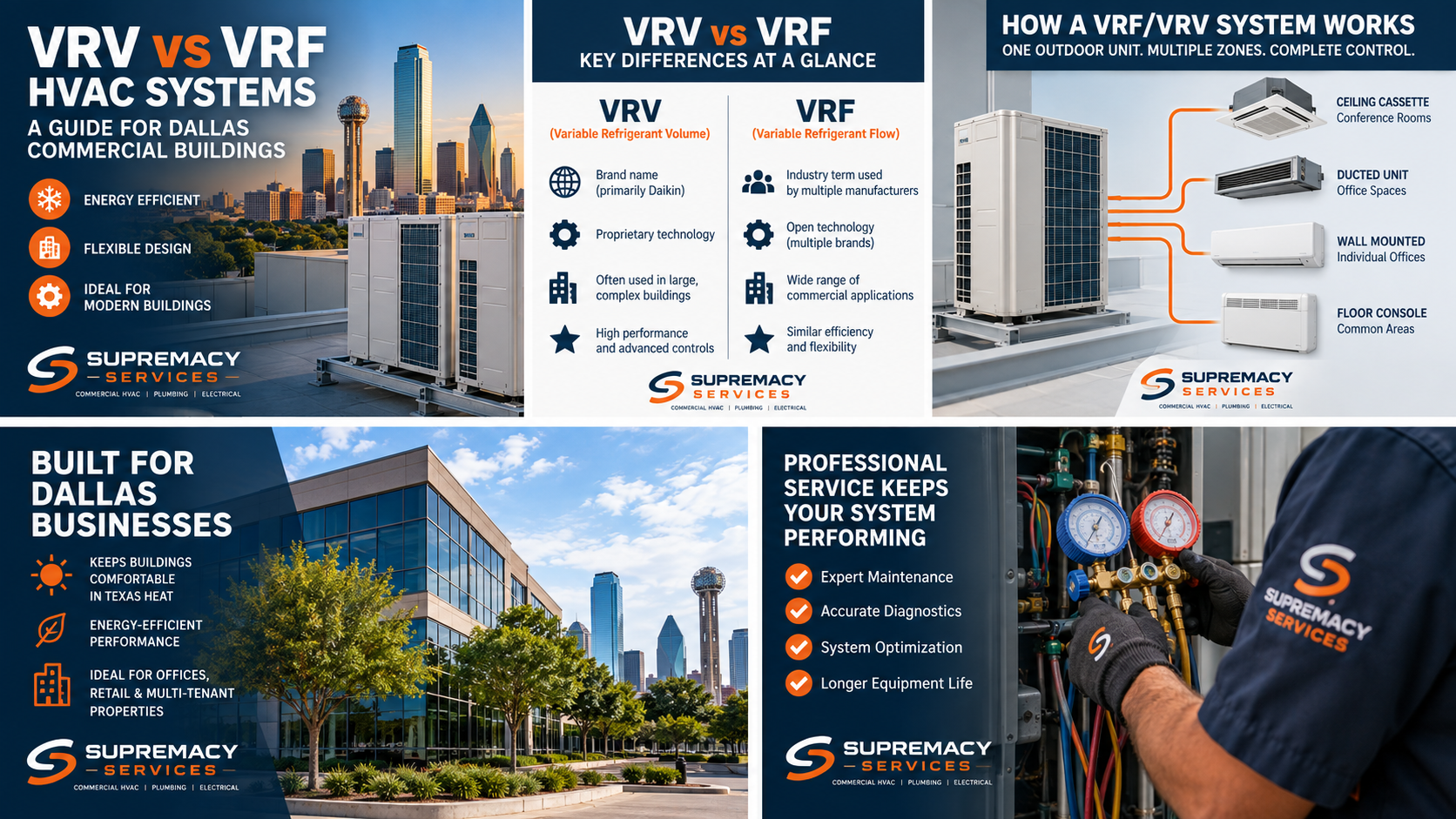
VRV and VRF HVAC systems on a Dallas commercial building rooftop

VRV vs VRF HVAC Systems: Dallas Commercial Building Guide

VRV vs VRF HVAC systems are essentially the same type of variable-refrigerant technology. VRF, or Variable Refrigerant Flow, is the generic industry term. VRV, or Variable Refrigerant Volume, is Daikin’s trademarked name for its version of the technology.

For Dallas commercial property owners, facility managers and developers, the more important question is therefore not simply VRV vs VRF. It is whether variable-refrigerant technology is appropriate for the building, and if so, whether the project requires a heat-pump, heat-recovery or other VRF configuration.

A properly designed VRF system can provide individual zone control, modulate capacity as building loads change and reduce the amount of conventional ductwork required. But VRF is not automatically the best HVAC system for every commercial building. Ventilation, humidity management, refrigerant requirements, controls, piping layout, serviceability and lifecycle cost all need to be considered before equipment is selected.

This guide explains what Dallas/DFW commercial property decision-makers should know.

VRV vs VRF: What Is the Difference?

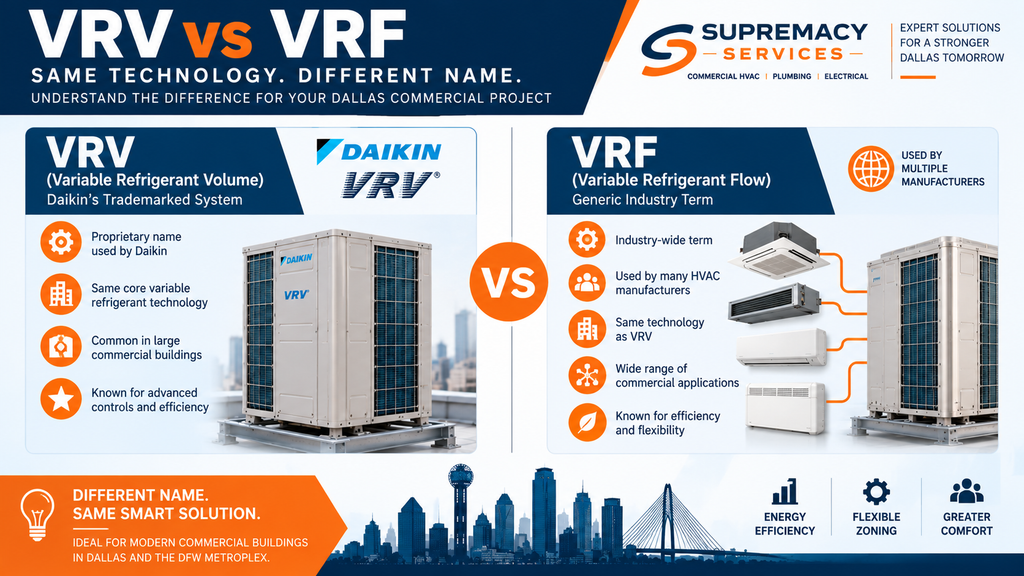
VRV vs VRF comparison explaining Daikin VRV terminology and the general VRF HVAC category
VRV and VRF use the same core variable-refrigerant technology; VRV is Daikin’s trademarked terminology, while VRF is the general industry term.

The simplest answer is:

VRF is the generic technology. VRV is Daikin’s trademarked terminology for its variable refrigerant system.

TermMeaningWhat You Should Know
VRFVariable Refrigerant FlowGeneric industry term
VRVVariable Refrigerant VolumeDaikin trademark
Basic technologyVariable-capacity, multi-zone direct-expansion HVACBoth regulate refrigerant according to zone demand
Commercial applicationsOffices, hotels, retail, multifamily, education and other multi-zone buildingsSuitability depends on project design
Main decisionNot simply VRV versus VRFCompare system configuration, manufacturer, controls, ventilation, service support and lifecycle requirements

The U.S. Department of Energy defines commercial VRF equipment as split-system equipment using one or more outdoor units, variable-capacity compressors and multiple individually controlled indoor fan-coil units connected through common refrigerant piping and controls.

In practical terms, the outdoor equipment does not simply operate at full capacity and stop whenever a thermostat is satisfied. The system can adjust capacity as individual zones require more or less heating or cooling.

That modulation is one of the fundamental differences between VRF technology and many conventional constant-capacity HVAC arrangements.


How Does a VRF HVAC System Work?

A Variable Refrigerant Flow HVAC system controls how much refrigerant is delivered to multiple indoor zones according to their individual heating or cooling loads.

Commercial VRF HVAC system diagram showing outdoor unit, refrigerant piping and multiple indoor comfort zones
A VRF/VRV system varies refrigerant flow to serve multiple indoor zones from shared outdoor equipment.

A typical commercial system contains:

  • one or more outdoor units;
  • inverter-driven or variable-capacity compressors;
  • refrigerant piping;
  • multiple indoor fan-coil units;
  • electronic expansion/control devices;
  • individual zone controls;
  • a communications network; and
  • centralized controls or building-management integration where specified.

Each indoor zone communicates its demand to the system.

Instead of conditioning every part of the building identically, the system adjusts its output according to the load being experienced by individual spaces.

Consider a Dallas office building at 3 p.m. The west-facing conference room may experience a substantial solar load while an interior office has much less cooling demand. A properly designed variable-refrigerant system can respond differently to those zones instead of treating the entire floor as one thermal space.

That is why VRF is particularly relevant to buildings with varying occupancy, exposures and operating schedules.

VRF Heat Pump vs Heat Recovery: An Important Distinction

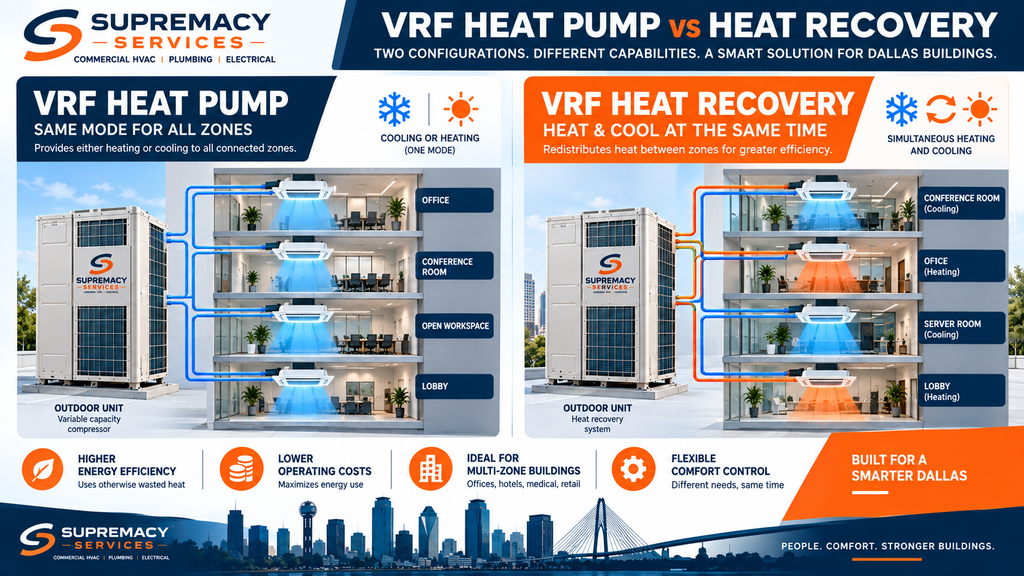
VRF heat pump vs heat recovery system showing single-mode and simultaneous heating and cooling zones
VRF heat-pump systems generally serve connected zones in one operating mode, while heat-recovery configurations can support simultaneous heating and cooling.

There are two major configurations commercial building owners frequently encounter.

VRF Heat Pump Systems

A VRF heat-pump system provides both heating and cooling, but connected zones generally operate in the same overall mode.

It can make sense for buildings where thermal requirements across the connected zones are relatively similar.

VRF Heat Recovery Systems

A heat-recovery VRF system can allow some zones to cool while other zones heat at the same time, depending on the system design.

Rather than simply rejecting all heat removed from a cooling zone outdoors, heat-recovery technology can redistribute useful heat to another zone that requires heating.

This can be particularly valuable in buildings with very different simultaneous loads, including:

  • offices with perimeter and interior zones;
  • hotels;
  • medical and professional buildings;
  • mixed-use facilities;
  • multifamily buildings;
  • educational buildings; and
  • properties with different solar exposures.

For example, a south- or west-facing office may require cooling while an interior or shaded zone requires heat. Heat-recovery technology can accommodate those competing requirements when the system is designed for simultaneous operation.

VRF vs Traditional Commercial HVAC

There is no universal winner. The right technology depends on the building.

ConsiderationVRF/VRVConventional Rooftop or Ducted System
Zone controlHighly granularDepends on zoning design
Capacity controlVariable/modulatingDepends on equipment
DuctworkOften reducedUsually more extensive
Refrigerant pipingMore extensiveGenerally more centralized
Simultaneous heating/coolingAvailable with heat-recovery configurationsDepends on system design
Individual tenant controlStrong potentialVaries
VentilationOften requires separate designFrequently integrated into air system
ControlsCan be sophisticatedVaries widely
InstallationRequires VRF-specific design and commissioning expertiseMore familiar to many contractors
Best applicationMulti-zone buildings with diverse loadsBroad range of commercial buildings

VRF should therefore be treated as one HVAC architecture among several, not as an automatic upgrade from conventional equipment.

A rooftop-unit system, split system, heat pump, chilled-water system or another commercial HVAC design may be more appropriate depending on building size, ventilation load, redundancy requirements, budget and existing infrastructure.


Why Dallas Commercial Buildings May Consider VRF

Dallas and the broader DFW Metroplex contain a wide range of commercial properties: office buildings, medical suites, restaurants, retail centers, hotels, schools, multifamily properties and tenant-improvement projects.

Several characteristics of these buildings can make zone-level HVAC control attractive.

1. Different Solar Loads

A building’s east, south, west and interior zones do not experience identical loads throughout the day.

Variable-capacity zoning allows the HVAC system to respond to those differences more precisely.

2. Long Cooling Seasons

Cooling performance is a major design consideration in North Texas.

That makes equipment sizing, part-load performance, heat rejection, refrigerant piping and controls particularly important when evaluating a VRF application.

3. Changing Occupancy

Conference rooms, private offices, lobbies, retail areas and other spaces can have very different occupancy schedules.

A system capable of responding independently to zone demand can help avoid treating an entire building as if every space has the same load.

4. Tenant Finish-Outs

Commercial tenant spaces may need independent comfort control while available ceiling and mechanical space is limited.

The smaller duct distribution requirements possible with VRF can make the technology worth evaluating during certain renovations and tenant improvements.

5. Mixed Thermal Loads

Perimeter zones exposed to outdoor conditions can behave very differently from interior zones.

Buildings with simultaneous heating and cooling demands may therefore be candidates for heat-recovery VRF.

Where Does VRF Work Best?

VRF tends to deserve serious consideration where independent zones, changing loads, limited duct space or simultaneous heating and cooling are important project requirements.

Potential applications include:

Office Buildings

Different floors, departments, conference rooms and perimeter offices can receive independent temperature control.

Hotels and Hospitality

Guest rooms naturally form individual HVAC zones with highly variable occupancy.

Medical and Professional Offices

Individual rooms may have different loads and operating schedules, although ventilation, filtration, pressurization and applicable healthcare requirements must be evaluated separately.

Retail and Mixed-Use Buildings

Different tenants can have substantially different operating schedules and internal loads.

Multifamily Buildings

Individual unit control makes variable-refrigerant systems a design option for certain multifamily projects.

Historic or Retrofit Buildings

Where large new duct shafts are impractical, smaller refrigerant piping can provide an architectural advantage.

That does not eliminate the need for ventilation air.

VRF Does Not Replace Proper Ventilation

This is one of the most important points for commercial building owners to understand.

Heating and cooling a room is not the same as ventilating it.

VRF indoor units primarily handle zone heating and cooling. Commercial buildings still require a ventilation strategy appropriate to occupancy, building use and applicable codes.

Depending on the project, designers may pair VRF with a Dedicated Outdoor Air System (DOAS) or another ventilation arrangement.

The ventilation system may need to address:

  • outdoor-air delivery;
  • filtration;
  • humidity;
  • exhaust;
  • building pressure; and
  • latent loads.

Treating VRF equipment and ventilation as a complete engineered system rather than isolated equipment selections is particularly important in commercial construction.

What Are the Advantages of VRF HVAC?

Individual Zone Control

Occupants or building controls can maintain different setpoints across different areas.

Variable Capacity

Inverter-driven compressors allow system output to respond to changing demand instead of relying solely on simple full-output cycling.

Heat Recovery

Appropriately configured systems can move heat between zones requiring cooling and zones requiring heating.

Reduced Ductwork

VRF still requires airflow at indoor units and usually a separate ventilation strategy, but extensive central supply and return duct networks may be reduced.

Flexible Indoor Units

Depending on the manufacturer and system, options can include:

  • ceiling cassettes;
  • concealed ducted units;
  • wall-mounted units;
  • floor-mounted units; and
  • other specialty configurations.
Centralized Controls

Commercial VRF systems can support centralized scheduling and monitoring and, where designed for it, integration with building automation systems.

What Are the Disadvantages of VRF?

VRF has significant advantages, but commercial buyers should also understand its limitations.

Higher Design Complexity

Refrigerant piping lengths, elevation differences, branch devices, equipment combinations and system controls must remain within manufacturer requirements.

This is not equipment that should be selected solely by matching a nominal tonnage to the building.

Ventilation Requires Separate Attention

A building can maintain the desired thermostat temperature and still have an inadequate ventilation or humidity-control strategy.

Refrigerant Management Matters

VRF places a distributed refrigerant network throughout a building. Refrigerant charge, occupied-space requirements, leak considerations and applicable codes therefore need to be addressed during design.

Specialized Service Knowledge

Troubleshooting can involve refrigerant circuits, electronic expansion valves, inverter technology, sensors, communications networks and proprietary controls.

Service capability should be evaluated before choosing a manufacturer—not after the building is occupied.

Controls Can Become a Weak Point

A sophisticated HVAC system with poorly configured controls can still perform poorly.

Commissioning, control sequences, sensor placement and operator training matter.


VRF System Cost in Dallas: What Determines the Price?

There is no responsible flat per-square-foot price for a commercial VRF project without knowing the building and scope.

Two Dallas buildings with the same floor area can require very different systems.

Important cost variables include:

Cost FactorWhy It Matters
Building cooling/heating loadsDetermines required equipment capacity
Number of zonesAffects indoor units and controls
Heat pump vs heat recoveryChanges equipment and piping architecture
Building size/layoutInfluences piping and installation complexity
Outdoor-unit locationAffects structural, electrical and access requirements
Indoor-unit typeCassettes, concealed ducted and other units have different installation needs
Ventilation systemDOAS or other outdoor-air equipment can materially affect project scope
Controls/BAS integrationAdds controls engineering and commissioning
Electrical workExisting service may require modifications
Existing HVAC removalDemolition can add labor and logistics
Crane/roof accessMay affect equipment-setting costs
Permits and inspectionsDepend on project and municipality
Refrigerant requirementsAffect equipment selection and design
Construction phasingOccupied buildings can require staged work

For that reason, a credible commercial proposal should begin with the building—not with an advertised equipment price.

What Should a Commercial VRF Assessment Include?

Before approving a VRF installation, owners should expect a qualified team to evaluate more than equipment tonnage.

1. Building Load Analysis

Heating and cooling loads should be determined by zone.

2. Zoning Strategy

The designer should identify which spaces genuinely require independent control and which can reasonably operate together.

3. Heat Pump vs Heat Recovery

Buildings with frequent simultaneous heating and cooling may justify heat-recovery architecture.

4. Ventilation and Humidity Strategy

The project must determine how outdoor air and latent loads will be handled.

5. Refrigerant Piping Design

Pipe lengths, elevations, branch locations and manufacturer limitations should be checked.

6. Refrigerant Safety Review

System charge and occupied-space considerations must be evaluated under applicable codes and manufacturer requirements.

7. Electrical Requirements

Outdoor units, indoor units, branch devices, controls and ventilation equipment all need coordinated electrical service.

8. Controls

Determine whether the property needs local controllers, centralized controls, scheduling, energy monitoring or BAS integration.

9. Service Access

Equipment should remain accessible for filter service, condensate maintenance, electrical diagnostics and refrigerant-system work.

10. Commissioning

Startup should verify refrigerant-system integrity, addressing, controls, airflow, drainage and operating performance.


What Dallas Building Owners Should Know About Permits and Licensing

Commercial HVAC work in Texas is regulated.

The Texas Department of Licensing and Regulation regulates air-conditioning and refrigeration contractors, and contractor license class affects the size of equipment on which a contractor can work.

For commercial projects, this distinction can matter considerably because TDLR states that a Class A license permits work on equipment of any size, while Class B is subject to capacity limits.

Dallas also has mechanical permitting and inspection requirements for commercial work.

A commercial VRF project may therefore involve coordination among the HVAC contractor, mechanical engineer, electrical contractor, general contractor, architect and local permitting authority depending on project scope.

Building owners should confirm the applicable requirements for the actual municipality in which the property is located. Dallas, Frisco, Plano, Fort Worth and other DFW jurisdictions do not necessarily have identical administrative procedures.

2026 Refrigerant Rules Make Equipment Selection More Important

Commercial HVAC refrigerants are undergoing an important regulatory transition.

Under the federal AIM Act framework, the EPA is restricting higher-global-warming-potential refrigerants across several HVAC equipment categories.

For variable refrigerant flow systems, EPA currently lists a 700 GWP limit with a January 1, 2027 installation compliance date, subject to specific provisions and transition conditions.

That makes refrigerant strategy an important part of a new VRF project in 2026.

Owners planning a long-lived commercial installation should ask:

  • Which refrigerant does the proposed equipment use?
  • What EPA transition rules apply to this project?
  • Are any transition provisions being relied upon?
  • How does the refrigerant affect equipment selection?
  • What safety requirements apply?
  • Are technicians trained for the refrigerant used?
  • What will long-term service support look like?

Equipment should not be selected from an old specification without confirming that it remains appropriate for the project’s procurement and installation timeline.

VRF vs Mini-Split: Are They the Same?

No.

Both technologies use direct-expansion refrigerant systems and inverter technology is common to both, but the terms are not interchangeable.

A ductless mini-split commonly connects one outdoor unit with one or a relatively small number of indoor units.

Commercial VRF is designed as a larger, integrated multi-zone system with sophisticated refrigerant management, controls and system architecture.

Think of VRF as a building-level multi-zone HVAC platform rather than simply a collection of wall-mounted mini-splits.

VRF vs Rooftop Units

VRF HVAC vs rooftop unit comparison for Dallas commercial buildings
VRF and rooftop HVAC systems serve different commercial-building needs, making zoning, ductwork, controls, installation and building layout important comparison factors.

Dallas commercial properties frequently use packaged rooftop units, or RTUs.

RTUs remain practical for many buildings because they consolidate major HVAC components into packaged equipment and can serve ducted zones efficiently.

VRF may become more attractive where:

  • many independent zones are required;
  • duct space is constrained;
  • tenant schedules vary significantly;
  • part-load operation is important; or
  • simultaneous heating and cooling is desirable.

RTUs may remain attractive where:

  • large open spaces dominate;
  • the existing duct system is suitable;
  • straightforward serviceability is a priority;
  • first-cost considerations favor packaged equipment; or
  • the building does not require extensive individual zoning.

A proper comparison should be based on the actual building rather than technology preference.

VRF vs Chilled-Water Systems

Chilled-water systems and VRF approach building conditioning differently.

A chiller creates chilled water that is circulated through a hydronic distribution system. VRF moves refrigerant through the building to indoor units.

Large facilities, campuses and buildings with substantial central-plant infrastructure may continue to favor chilled water.

VRF can be particularly attractive for smaller and midsize multi-zone buildings or projects where decentralized zone control and reduced ductwork are priorities.

The decision should consider first cost, energy modeling, maintenance capabilities, redundancy, refrigerant management, expected building life and future expansion.

Warning Signs an Existing VRF System Needs Professional Attention

Commercial VRF troubleshooting should be handled by technicians familiar with the particular equipment and controls.

Potential warning signs include:

  • repeated system fault codes;
  • multiple zones failing simultaneously;
  • one or more zones unable to maintain setpoint;
  • unexpected heating/cooling mode conflicts;
  • recurring condensate problems;
  • unusual compressor or outdoor-unit noise;
  • communication errors;
  • unexplained energy-use changes;
  • repeated refrigerant-related service issues; or
  • frequent resets required to restore operation.

Because multiple indoor units can share common outdoor equipment and communications, a problem visible in one room does not always originate at that indoor unit.

Can Building Staff Maintain a VRF System?

Building staff can handle certain routine facility-management tasks where permitted by the manufacturer and site procedures.

Examples may include monitoring alarms, keeping air paths unobstructed and arranging routine filter maintenance.

Refrigerant work, electrical diagnostics, inverter faults, compressor problems, leak diagnosis and system commissioning should be handled by appropriately qualified professionals.

In Texas, HVAC contracting and technician activities are subject to TDLR licensing and registration requirements.

How Should VRF Systems Be Maintained?

Maintenance requirements vary by manufacturer and application, but a commercial maintenance program may address:

  • indoor-unit filters;
  • coils;
  • condensate drains and pumps;
  • outdoor coils;
  • electrical connections;
  • refrigerant-system condition;
  • controls and communications;
  • sensors;
  • fault histories;
  • operating temperatures and pressures where appropriate;
  • ventilation equipment; and
  • overall system performance.

Maintenance should also account for the building’s operating environment.

A restaurant, medical office, hotel and conventional office building do not necessarily require identical maintenance strategies even when they use similar HVAC technology.

How to Decide Whether VRF Is Right for Your Dallas Building

Before selecting equipment, answer these questions:

How many genuinely independent zones does the building need?

If most spaces have identical loads and schedules, highly granular zoning may provide less value.

Do different areas frequently need heating and cooling at the same time?

If yes, heat recovery deserves evaluation.

How will outdoor ventilation air be delivered and conditioned?

VRF should not be specified without answering this.

Is ceiling or shaft space limited?

Reduced duct requirements can become a major design advantage.

Does the building have an existing BAS?

Confirm integration requirements before selecting controls.

Who will maintain the equipment?

Local technical support and parts availability matter over the life of the system.

What refrigerant does the proposed system use?

Verify current regulatory and safety implications.

What is the total lifecycle cost?

Compare installation, electrical work, ventilation equipment, controls, commissioning, energy consumption, maintenance and expected replacement requirements—not just outdoor-unit pricing.

What to Expect From a Professional Commercial HVAC Evaluation

A serious VRF evaluation should begin with questions rather than an immediate equipment recommendation.

The process may include:

  1. reviewing building plans and existing mechanical systems;
  2. documenting current comfort or operating problems;
  3. identifying occupancy schedules and tenant requirements;
  4. evaluating zone-by-zone loads;
  5. reviewing available electrical capacity;
  6. examining roof, mechanical and ceiling-space constraints;
  7. determining ventilation requirements;
  8. evaluating heat-pump versus heat-recovery configurations;
  9. coordinating refrigerant and condensate piping;
  10. reviewing controls/BAS requirements;
  11. considering applicable codes and permits; and
  12. developing an installation and commissioning plan.

For an existing occupied property, project phasing should also be considered so HVAC work does not unnecessarily disrupt tenants or business operations.

The Bottom Line: VRV vs VRF HVAC Systems

VRV and VRF do not represent two fundamentally different HVAC technologies. VRF is the generic term for Variable Refrigerant Flow, while VRV is Daikin’s trademarked Variable Refrigerant Volume terminology.

For Dallas commercial buildings, the bigger decision is whether variable-refrigerant technology fits the property’s loads, zoning, ventilation requirements, architecture, controls and long-term operating strategy.

VRF can be an excellent solution where a commercial building needs precise zone control, variable capacity, flexible equipment placement or simultaneous heating and cooling. But those advantages depend heavily on proper engineering, refrigerant piping, ventilation design, controls, installation and commissioning.

Before choosing equipment, evaluate the whole building system.

Planning a Commercial HVAC Project in Dallas–Fort Worth?

Supremacy Services can evaluate your commercial property’s HVAC requirements alongside the broader mechanical and building infrastructure involved in the project.

For a new construction project, tenant improvement, major HVAC replacement or multi-zone system evaluation, begin with a building-specific assessment rather than selecting equipment solely from nominal capacity.

Request a commercial HVAC assessment from Supremacy Services to discuss your Dallas/DFW project requirements.


Frequently Asked Questions

Is VRV better than VRF?

VRV and VRF are not competing technology categories. VRF is the generic term for Variable Refrigerant Flow, while VRV is Daikin’s trademarked terminology for its Variable Refrigerant Volume systems. Compare specific equipment, system architecture, controls, serviceability and project suitability instead.

What does VRF stand for in HVAC?

VRF stands for Variable Refrigerant Flow. The system varies refrigerant flow to multiple indoor units according to individual zone heating or cooling demand.

What does VRV stand for?

VRV stands for Variable Refrigerant Volume. It is terminology associated with Daikin’s variable-refrigerant HVAC technology and is a Daikin trademark.

Can VRF heat and cool at the same time?

Heat-recovery VRF systems can be designed to provide simultaneous heating and cooling to different zones. Standard heat-pump VRF configurations generally operate connected zones in the same heating or cooling mode.

Does VRF provide fresh air?

VRF indoor units should not automatically be assumed to satisfy a commercial building’s ventilation requirements. Projects often use separate outdoor-air equipment, such as a DOAS, depending on building design and code requirements.

Is VRF good for commercial buildings?

It can be. VRF is particularly worth evaluating for multi-zone buildings with varying loads, limited duct space, individual tenant requirements or simultaneous heating and cooling demands.

Is VRF the same as a mini-split?

No. The technologies share some principles, but commercial VRF systems typically serve substantially more zones and use more sophisticated refrigerant distribution, communications and centralized controls.

How much does a commercial VRF system cost in Dallas?

There is no reliable universal price without evaluating the project. Capacity, number of zones, ventilation equipment, heat-recovery requirements, piping, controls, electrical work, demolition, roof access, permitting and construction phasing can all materially change the installed cost.

Do VRF systems need ductwork?

Some VRF indoor units are ductless, while others use short duct runs. Separate ductwork may also be required for outdoor ventilation air. The answer depends on the indoor-unit and ventilation design.

Who can install a VRF system in Texas?

Texas regulates air-conditioning and refrigeration contracting through the Texas Department of Licensing and Regulation. Commercial property owners should verify that contractors have the licensing appropriate to the scope and equipment involved and comply with applicable local permitting requirements.

Rooftop Air Conditioning Installation in Dallas: Cost, Process & Benefits

Rooftop Air Conditioning Installation in Dallas: Cost, Process & Benefits

Why Rooftop AC Installation in Dallas Demands Expert Execution

Rooftop air conditioning installation in Dallas is not a DIY project. The intense Texas heat, unpredictable storms, and strict building codes make it a job for licensed HVAC professionals. Improper installation can lead to refrigerant leaks, electrical hazards, and a lifespan cut short by years.

Dallas commercial buildings rely on rooftop units (RTUs) for efficient cooling. These systems save valuable ground space and provide zone control for multi-tenant properties. But they must be sized, mounted, and connected with precision.

Supremacy Service has installed hundreds of rooftop AC units across Dallas-Fort Worth. Our team understands the unique challenges of the region, from crane logistics to code compliance. We ensure your investment delivers peak performance.

For a seamless installation, trust our rooftop AC unit installation Dallas experts. We handle every detail, from permits to final testing.

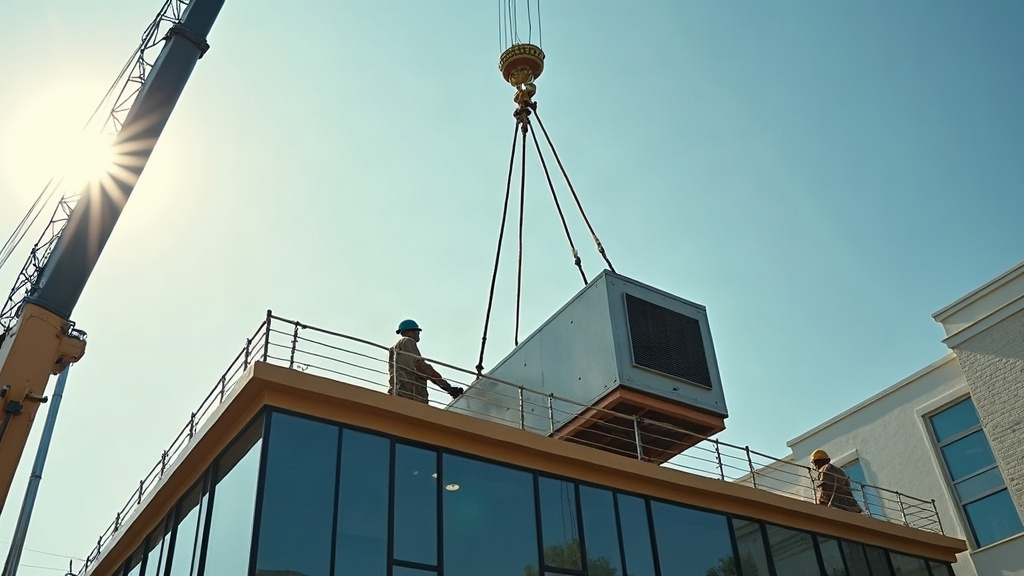
Crane lifting a rooftop HVAC unit for installation in Dallas
Rooftop AC installation in progress in Dallas

Rooftop Air Conditioning Installation Cost in Dallas: 2026 Breakdown

Understanding the cost of rooftop air conditioning installation in Dallas is crucial for budgeting. Prices vary based on unit size (tonnage), brand, building height, and required modifications. On average, you can expect to pay between $8,000 and $25,000 per unit, including labor and materials.

Key cost factors include:

  • Unit capacity: 5-ton to 25-ton packaged units.
  • Crane rental: $1,500 to $3,500 per day.
  • Electrical work: $1,000 to $5,000 for new circuits or panel upgrades.

  • Ductwork modifications: $800 to $3,000.
  • Permits and inspections: $300 to $1,200.

Below is a comparative table of typical costs for different building types in Dallas. Note that these are estimates; a site survey is required for an accurate quote.

Building Type Unit Size (Tons) Estimated Cost Range Installation Time
Small Retail (1,500 sq ft) 5-7.5 $8,000 – $12,000 1-2 days
Medium Office (5,000 sq ft) 10-15 $15,000 – $22,000 2-3 days
Large Warehouse (10,000+ sq ft) 20-25 $25,000 – $45,000 3-5 days

Investing in a high-efficiency unit can reduce long-term energy costs. Our team can help you calculate ROI based on Dallas energy rates.

For a detailed quote, contact us for HVAC installation Dallas TX services.

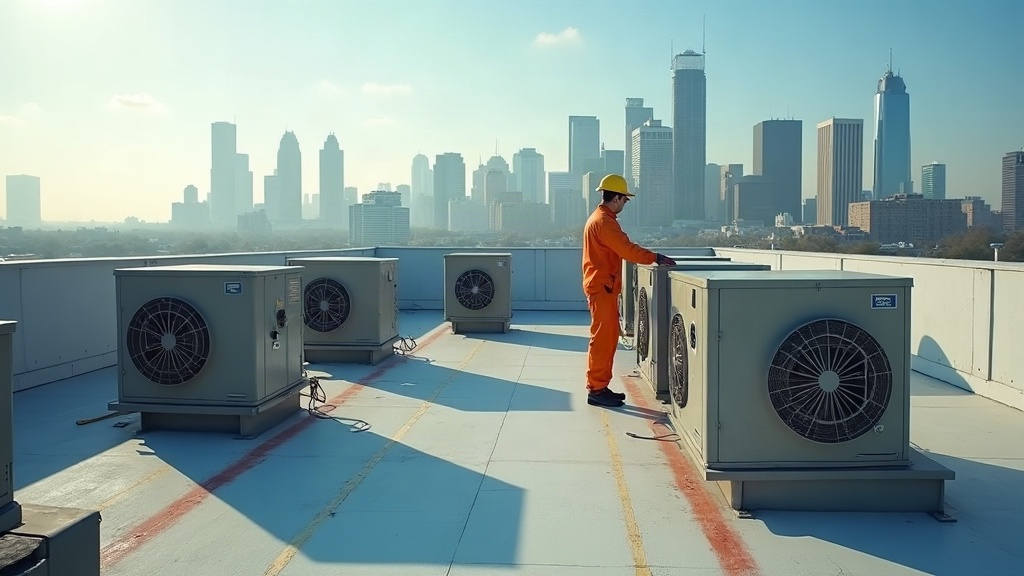
Technician inspecting rooftop AC units in Dallas
Rooftop AC units installed on a Dallas commercial building

The Step-by-Step Process of Rooftop AC Installation in Dallas

A professional rooftop AC installation in Dallas follows a rigorous process. First, we conduct a load calculation using Manual J to determine the correct tonnage. This prevents oversizing, which leads to short cycling and high humidity.

Next, we inspect the roof structure to ensure it can support the unit’s weight. Many Dallas roofs require curb adapters or reinforcement. We then coordinate crane delivery and set the unit in place.

Electrical connections must meet NEC and local Dallas codes. We run dedicated circuits and install disconnects. Ductwork is sealed and insulated to prevent leaks. Finally, we charge the system, test airflow, and calibrate controls.

Our team also handles permits and inspections, ensuring a hassle-free experience. For related services like ductwork, see our ductwork installation Dallas TX page.

Benefits of Rooftop Air Conditioning for Dallas Businesses

Rooftop AC units offer numerous advantages for Dallas commercial properties. They free up ground space for parking or expansion. They also provide better security, as units are less accessible to vandals.

Additionally, rooftop installation allows for zoned cooling, which can significantly cut energy costs. Modern RTUs often come with economizers that use outside air for free cooling during mild Dallas winters.

Maintenance is also easier and safer for technicians. With proper service, a rooftop unit can last 15-20 years, outperforming many ground-mounted systems.

For comprehensive commercial HVAC solutions, explore our commercial plumbing Dallas services. We offer a full range of building maintenance.

Business owner and HVAC contractor on a Dallas rooftop with new AC unit
Dallas business owner satisfied with new rooftop AC installation

Choosing the Right Rooftop AC Unit for Dallas Climate

Dallas summers are brutal, with temperatures often exceeding 100°F. Your rooftop AC must be sized correctly and have a high SEER rating (15+). Look for units with corrosion-resistant coils, as Dallas can have hail and heavy rain.

Variable-speed compressors are ideal for precise temperature control and humidity removal. Brands like Trane, Carrier, and Lennox are popular for their reliability in Texas.

We recommend Energy Star certified units to maximize savings. According to Energy Star, high-efficiency HVAC systems can reduce energy bills by up to 20%.

Our technicians are factory-trained on all major brands and can help you select the best model for your building.

Common Mistakes to Avoid in Rooftop AC Installation in Dallas

One major mistake is hiring unlicensed contractors. In Dallas, HVAC work requires a license and permits. Unpermitted work can lead to fines and insurance issues.

Another mistake is neglecting roof condition. Installing a heavy unit on a weak roof can cause leaks or collapse. Always have a structural assessment.

Improper duct sealing is also common. Leaky ducts waste up to 30% of cooled air, driving up costs. Ensure all connections are sealed with mastic or foil tape.

Lastly, skipping regular maintenance voids warranties. Schedule bi-annual tune-ups to keep your system running smoothly.

Maximize Efficiency: Maintenance Tips for Dallas Rooftop AC Units

Regular maintenance is key to prolonging the life of your rooftop AC. In Dallas, change filters monthly during peak cooling season. Keep the condenser coils clean and free of debris.

Check for refrigerant leaks annually. A certified technician should inspect electrical connections and lubricate moving parts. Consider a preventive maintenance plan, like our Membership for Supremacy, which includes priority service and discounts.

During winter, cover the unit to protect it from freeze damage, but ensure proper ventilation. Also, trim nearby trees to prevent debris buildup.

By following these tips, you can avoid costly breakdowns and extend your unit’s lifespan by years.

Need Expert Rooftop AC Installation in Dallas?

Call Supremacy Service today for a free consultation and a precise quote on your rooftop HVAC project.

Frequently Asked Questions

How long does rooftop AC installation take in Dallas?

Most installations take 1 to 3 days, depending on unit size, crane availability, and any necessary electrical or ductwork modifications.

What permits are required for rooftop AC installation in Dallas?

You need a mechanical permit and possibly an electrical permit from the City of Dallas. A licensed contractor will handle these for you.

How much does a rooftop AC unit cost in Dallas?

Costs range from $8,000 to $45,000+ per unit, including equipment, labor, crane, and modifications. Get a site-specific quote for accuracy.

Can I install a rooftop AC myself in Dallas?

No, it’s illegal and dangerous. Dallas requires licensed HVAC professionals for refrigerant handling, electrical work, and structural mounting.

What SEER rating is best for Dallas?

Aim for SEER 15 or higher. Higher SEER units cost more upfront but save significantly on cooling bills in Dallas’s hot climate.

Gas Line Repair in Dallas: Warning Signs, Safety & Repair Process

Gas Line Repair in Dallas: Warning Signs, Safety & Repair Process

Gas Line Repair in Dallas: Critical Warning Signs You Can’t Ignore

If you smell rotten eggs near your gas appliances, you have a potential gas leak, evacuate immediately and call 911. In Dallas, natural gas powers over 60% of homes, making prompt gas line repair in Dallas a life-saving service. Common warning signs include a sulfur odor, hissing sounds near gas lines, dead grass patches above buried lines, and unexplained spikes in your gas bill.

Physical symptoms like headaches, dizziness, nausea, and fatigue can indicate carbon monoxide exposure from a faulty gas appliance. If you experience these, seek fresh air and medical attention right away. A certified HVAC technician can perform gas leak detection in Dallas using electronic detectors and pressure tests to pinpoint leaks.

Never ignore minor leaks, they can escalate into explosions. Supremacy Service offers emergency gas line repair in Dallas with licensed plumbers and HVAC experts available 24/7.

Concerned homeowner checking gas stove for leaks in Dallas
Recognizing gas leak warning signs in Dallas

The Dangers of Delayed Gas Line Repair in Dallas

Delaying gas line repair in Dallas is not just risky, it’s potentially fatal. Natural gas is highly flammable, and a small leak can lead to a catastrophic explosion. In 2023, Dallas Fire-Rescue responded to over 1,200 gas leak calls, many due to aging infrastructure and corroded pipes.

Beyond explosions, chronic gas exposure causes respiratory issues and carbon monoxide poisoning. Homes with faulty gas lines also face higher energy bills and potential appliance damage. Regular HVAC repair in Dallas includes gas line inspections that can catch corrosion, loose fittings, and blockages early.

Supremacy Service uses advanced leak detection tools, including infrared cameras and combustible gas indicators, to ensure your home is safe. Our technicians follow strict safety protocols and Dallas building codes for every repair.

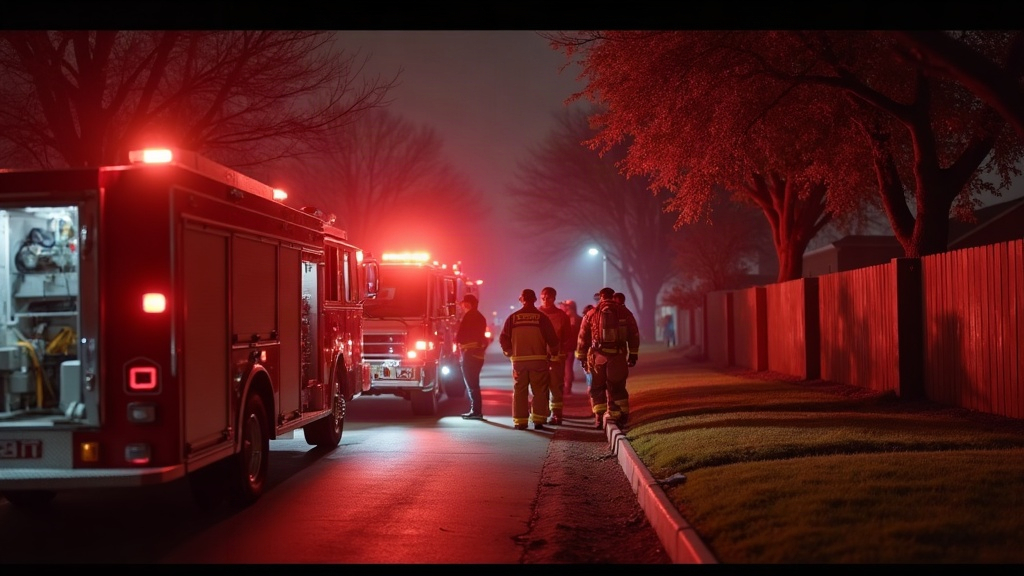
Emergency responders handling a gas leak in a Dallas neighborhood
Risks of ignoring gas line repairs in Dallas

Step-by-Step Gas Line Repair Process in Dallas

Professional gas line repair in Dallas follows a meticulous process. First, a licensed technician performs a thorough inspection using gas leak detection equipment to locate the leak. Next, the gas supply is shut off, and the affected section is isolated and repaired or replaced.

After repairs, the system undergoes pressure testing to ensure no leaks remain. Finally, the technician relights pilot lights and tests all gas appliances for proper operation. The entire process typically takes 2–4 hours, depending on the complexity.

Supremacy Service adheres to NFPA 54 and local Dallas codes, ensuring your repair is safe and up to standard. We also provide a detailed report and recommendations for preventive maintenance.

HVAC Gas Line Services: What Dallas Homeowners Should Expect

HVAC gas line service in Dallas encompasses more than just repairs. It includes installation of new gas lines for furnaces, water heaters, and ranges, as well as routine maintenance. A typical service call starts with a visual inspection of all gas connections and venting systems.

Technicians then use a combustible gas detector to scan for leaks. If a leak is found, they’ll repair or replace the faulty component, often a valve or connector. For furnaces, they’ll also check the heat exchanger for cracks that could leak carbon monoxide.

Regular HVAC inspections in Dallas are crucial, we recommend annual gas line checks, especially before winter. Supremacy Service offers comprehensive gas line services, from leak detection to full-line replacement.

HVAC technician performing gas leak detection on a furnace in Dallas
Expert HVAC gas line service in Dallas, TX

Preventing Gas Line Problems: Maintenance Tips for Dallas Residents

Prevention is key to avoiding gas line emergencies. Schedule annual inspections with a licensed Dallas HVAC company—they’ll check for corrosion, tighten connections, and test for leaks. Install carbon monoxide detectors on every level of your home and test them monthly.

Keep the area around gas appliances clear of flammable materials. Never store chemicals or paint near your furnace or water heater. If you’re doing yard work, call 811 before digging to avoid hitting buried gas lines.

Watch for signs like yellow flames on gas stoves (should be blue), soot buildup, or excessive condensation on windows—these indicate incomplete combustion and require immediate furnace repair in Dallas.

Why Choose Supremacy Service for Gas Line Repair in Dallas

Supremacy Service is Dallas’s trusted name for gas line repair and HVAC services. Our licensed technicians are available 24/7 for emergencies and use state-of-the-art leak detection technology. We’re fully insured and follow all local and national safety codes.

We offer transparent pricing, no hidden fees, and a 100% satisfaction guarantee. Whether you need emergency gas line repair or routine maintenance, our team responds quickly and works efficiently to restore safety.

Don’t wait, if you suspect a gas leak, call us immediately. We proudly serve Dallas, Plano, Irving, and surrounding areas.

Gas Line Repair Costs in Dallas: What to Expect

Gas line repair costs in Dallas vary based on the complexity and location of the leak. Minor repairs, such as tightening a fitting, may cost $150–$300. Replacing a section of pipe can range from $500 to $1,500. Emergency calls after hours may incur additional fees.

However, the cost of ignoring a gas leak is far greater, risk of explosion, property damage, and health issues. Most homeowner insurance policies may cover sudden gas line damage, so check your policy.

Supremacy Service provides free estimates and flexible financing options. We’ll assess your situation and give you a clear, upfront quote before any work begins.

Comparative Analysis: Professional vs. DIY Gas Line Repair

DIY gas line repair is extremely dangerous and illegal in Texas without a license. Professionals have the tools, training, and insurance to safely repair gas lines. Here’s a comparison:

Need Fast Gas Line Repair in Dallas?

Don’t risk a gas leak, call Supremacy Service today for 24/7 emergency gas line repair and HVAC safety inspections in Dallas.

Frequently Asked Questions

How do I know if I have a gas leak in my Dallas home?

Signs include a sulfur or rotten egg smell, hissing sounds near gas lines, dead vegetation above buried lines, and physical symptoms like dizziness or nausea. If you suspect a leak, evacuate and call 911, then contact a licensed gas line repair service in Dallas.

What should I do if I smell gas?

Immediately evacuate everyone from the building, don’t use any electrical switches or phones, and call 911 from a safe location. Then contact Supremacy Service for emergency gas line repair in Dallas.

How much does gas line repair cost in Dallas?

Costs vary from $150 for minor repairs to $1,500 for pipe replacement. Emergency calls may cost more. Supremacy Service offers free estimates and financing options.

Can I repair a gas line myself?

No. In Texas, gas line repair must be performed by a licensed professional. DIY attempts are illegal and extremely dangerous. Always hire a certified technician like those at Supremacy Service.

How often should gas lines be inspected?

Annual inspections are recommended for all gas appliances and lines. Supremacy Service offers comprehensive HVAC inspections in Dallas that include gas line checks.

Supremacy Services technician performing a professional HVAC inspection in Dallas, TX

How Often Should You Have Your HVAC Inspected in Dallas?

“How often should you have your HVAC inspected in Dallas?” is a common question especially because, your HVAC system works harder than almost any other system in your Dallas home. Through long stretches of intense Texas heat and the sudden temperature swings that arrive during the cooler months, your heating and cooling equipment has to deliver reliable comfort when you need it most.

So, how often should you have your HVAC system inspected in Dallas?

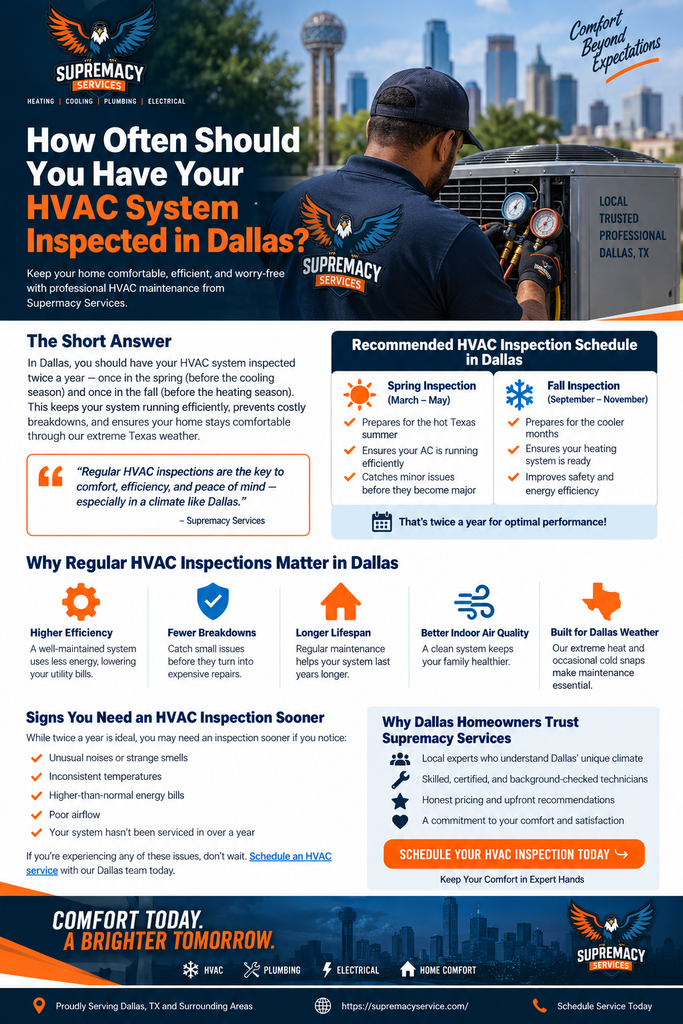
For most Dallas homeowners, the best schedule is twice a year:

  • Spring: Inspect and tune the air-conditioning system before peak cooling season.
  • Fall: Inspect the heating system before colder weather arrives.

ENERGY STAR recommends professional pre-season HVAC checkups, with cooling equipment serviced in spring and heating equipment checked in fall.

In Dallas, where dependable cooling is particularly important, this preventive schedule can help identify developing problems before they become an uncomfortable—and potentially expensive—emergency.

Supremacy Tip: Don’t wait until your AC stops cooling on a scorching Dallas afternoon to find out something was wrong. Preventive HVAC maintenance is designed to find those problems before peak demand exposes them.

Why Twice-a-Year HVAC Inspections Make Sense in Dallas

A generic national maintenance schedule doesn’t tell the whole story for North Texas.

Dallas HVAC systems face significant seasonal demands. During cooling season, your air conditioner may operate for extended periods, placing sustained loads on compressors, capacitors, motors, coils, electrical connections, and other components.

That makes spring HVAC maintenance in Dallas particularly valuable.

Then, before heating season, a second inspection allows a technician to evaluate your heating equipment and verify that the system is ready to operate reliably and safely.

Supremacy Services already recommends professional cooling service at least annually, ideally in early spring before intense Texas heat arrives.

For homeowners who want comprehensive year-round protection, however, the ideal schedule is:

SeasonRecommended ServicePrimary Purpose
SpringAC/cooling inspection and tune-upPrepare for Dallas summer
FallFurnace/heat-pump/heating inspectionPrepare for heating season
Dallas HVAC inspection schedule showing spring AC maintenance and fall heating maintenance
For most Dallas homes, schedule HVAC maintenance twice a year—cooling service in spring and heating service in fall.

What Does a Professional HVAC Inspection Include?

A quality HVAC inspection should be much more than a quick visual check.

ENERGY STAR’s maintenance guidance includes checking thermostat settings, electrical connections, motor voltage/current, moving components, and condensate drainage, among other system-specific maintenance tasks.

Depending on your equipment and its condition, a professional Dallas HVAC inspection may include checking:

Thermostat operation and controls. The technician verifies that your thermostat communicates properly with the heating and cooling equipment and maintains the intended temperature.

Electrical components and connections. Loose or deteriorating electrical connections can affect reliability and potentially shorten component life.

Airflow and filtration. Restricted airflow forces HVAC equipment to work harder. Filters, blower operation, return airflow, and related components should therefore be evaluated.

Indoor and outdoor coils. Dirty coils can interfere with heat transfer and overall cooling performance.

Condensate drainage. Drainage problems can contribute to water leakage and unwanted moisture around the HVAC equipment.

Refrigerant and cooling performance. Where applicable, technicians evaluate cooling performance and look for indications that further refrigerant-system diagnostics may be necessary.

Blower and motor operation. Motors and moving components are inspected for proper performance and signs of deterioration.

Ductwork and airflow problems. Uneven temperatures can sometimes originate outside the HVAC unit itself. Damaged, leaking, restricted, or poorly balanced ductwork may reduce comfort and system performance.

Supremacy’s Dallas HVAC approach focuses on root-cause diagnostics, including airflow, electrical performance, refrigerant-related issues, and duct integrity rather than simply replacing parts without determining why a failure occurred.

7 Reasons Regular HVAC Inspections Matter in Dallas

1. Reduce the Risk of Mid-Summer Breakdowns

Supremacy Services technician inspecting an outdoor HVAC system in Dallas to prevent costly breakdowns
Regular HVAC inspections can uncover developing problems before they turn into costly breakdowns during Dallas heat.

There are few worse times for an air conditioner to fail than during a Dallas heat wave.

HVAC components don’t always fail without warning. Electrical deterioration, restricted airflow, dirty components, drainage problems, and mechanical wear can develop progressively.

A pre-season inspection gives your technician an opportunity to identify those warning signs before the system enters its most demanding period.

If your AC has already stopped working, Supremacy offers dedicated air conditioner repair in Dallas.

2. Help Your HVAC System Operate Efficiently

Smart thermostat showing an energy-efficient home temperature during HVAC maintenance in Dallas
Routine HVAC maintenance helps your system operate efficiently while maintaining dependable home comfort.

Even when an HVAC system still heats or cools, it isn’t necessarily operating efficiently.

Restricted airflow, dirty heat-transfer surfaces, control problems, or deteriorating components can make the equipment work harder to achieve the same indoor temperature.

Routine maintenance helps keep heating and cooling equipment performing as intended. ENERGY STAR identifies proper maintenance as an important step in preventing problems and keeping systems operating at peak performance.

3. Catch Small Problems Before They Become Expensive Repairs

Supremacy Services technician inspecting an outdoor HVAC system in Dallas to prevent costly breakdowns
Regular HVAC inspections can uncover developing problems before they turn into costly breakdowns during Dallas heat.

Preventive HVAC maintenance isn’t about guaranteeing that your equipment will never fail.

It’s about improving the chances of discovering problems while they are still manageable.

A technician might identify an abnormal electrical reading, airflow restriction, deteriorating component, drainage issue, or unusual system behavior before it causes a more serious failure.

That’s especially valuable before Dallas’ peak cooling season.

4. Support a Longer HVAC Service Life

Well-maintained outdoor air conditioning system representing longer HVAC equipment life in Dallas
Preventive maintenance can reduce unnecessary system stress and support reliable HVAC performance for years to come.

An HVAC system represents a substantial investment in your home.

Preventive maintenance helps reduce unnecessary stress on critical components. When airflow is correct, electrical connections are sound, coils can transfer heat effectively, and the system is operating within appropriate parameters, the equipment is better positioned for reliable long-term operation.

Maintenance can’t stop normal aging, but neglect can accelerate it.

5. Improve Home Comfort

Well-maintained outdoor air conditioning system representing longer HVAC equipment life in Dallas
Preventive maintenance can reduce unnecessary system stress and support reliable HVAC performance for years to come.

Are some rooms noticeably warmer than others?

Does your HVAC system seem to run constantly?

Does the house feel humid even while the AC is operating?

Those symptoms can point to airflow, equipment, controls, ductwork, sizing, or other performance issues.

An inspection gives a qualified technician the opportunity to determine whether your HVAC equipment itself—or another part of the comfort system—is responsible.

For homes with suspected air-distribution problems, Supremacy also provides professional HVAC ductwork services in Dallas.

6. Prepare Your Heating System Before Dallas Gets Cold

Dallas may be famous for heat, but that doesn’t make heating maintenance optional.

The first cold night of the season shouldn’t also be the first time you discover your furnace or heat pump isn’t working correctly.

A fall inspection allows heating components, controls, airflow, and system performance to be evaluated before you rely heavily on the equipment.

7. Know When Maintenance Is No Longer Enough

Supremacy Services technician inspecting a furnace before colder weather arrives in Dallas
A fall HVAC inspection helps ensure your heating system is ready before Dallas temperatures drop.

Maintenance can improve the reliability of serviceable equipment, but it cannot make severely deteriorated equipment new again.

If your HVAC system experiences repeated failures, struggles to maintain temperature, has significant efficiency problems, or requires increasingly expensive repairs, an inspection can provide valuable information for a repair-versus-replacement decision.

When replacement makes more financial sense, proper equipment selection and installation are crucial. Supremacy’s Dallas installation process considers property characteristics, thermal loads, ductwork, efficiency, and system sizing rather than treating HVAC replacement as a simple equipment swap.

Signs You Should Schedule an HVAC Inspection Sooner

Twice-yearly preventive service is a strong baseline, but you shouldn’t wait for your next scheduled tune-up when your HVAC system is already showing signs of trouble.

Call a professional HVAC technician if you notice unusual noises, burning or musty odors, weak airflow, uneven room temperatures, unusually long operating cycles, frequent cycling, unexplained increases in energy consumption, water around HVAC equipment, inadequate cooling or heating, or repeated thermostat problems.

Supremacy’s Dallas repair guidance identifies issues such as electrical faults, refrigerant problems, frozen coils, airflow restrictions, zoning failures, and ductwork problems among the conditions professional diagnostics can uncover.

Ignoring symptoms can allow a manageable problem to become a larger repair.

When Is the Best Time to Schedule HVAC Maintenance in Dallas?

For most Dallas homes, aim for:

Spring HVAC Inspection: March–May

Have your cooling equipment inspected before sustained summer temperatures arrive.

Scheduling before peak season also means you’re not waiting until the system is already under maximum demand to discover a problem.

Fall HVAC Inspection: September–November

Have your heating equipment inspected before you begin relying on it regularly.

The exact month matters less than the principle: service the equipment before its primary operating season.

That approach aligns with ENERGY STAR’s recommendation to schedule cooling checkups in spring and heating checkups in fall.

Is Once-a-Year HVAC Maintenance Enough?

It depends on what you mean by “HVAC maintenance.”

If you’re talking specifically about an air conditioner, professional service at least once annually before cooling season is a sensible minimum and matches Supremacy’s existing guidance.

But if your home has both heating and cooling equipment—or a heat pump serving both functions—two seasonal appointments provide a more complete year-round maintenance strategy.

Think of it this way:

Spring = cooling readiness.
Fall = heating readiness.

Dallas homeowners with older equipment, heavy system usage, pets, significant indoor dust, previous HVAC problems, or specialized equipment may benefit from additional attention based on a technician’s recommendations.

What Can Dallas Homeowners Do Between Professional Inspections?

Professional maintenance doesn’t replace homeowner upkeep.

Between visits, periodically check your air filter and replace or clean it according to the filter and equipment manufacturer’s instructions. Keep supply and return vents unobstructed, watch for unusual noises or odors, keep the outdoor unit reasonably clear of leaves and debris, and pay attention to sudden changes in comfort or energy consumption.

EPA/ENERGY STAR guidance emphasizes both regular filter care and professional pre-season maintenance as important parts of HVAC upkeep.

Why Choose Supremacy for HVAC Service in Dallas?

Dallas HVAC maintenance shouldn’t be a checkbox exercise.

You want to know how your system is actually performing—and whether a developing issue could leave your home without cooling when temperatures climb.

Supremacy Services positions its Dallas HVAC work around detailed diagnostics, upfront pricing, trained and insured technicians, system-performance verification, and 24/7 support. The company serves Dallas and communities across the DFW Metroplex.

Whether you need routine maintenance, an urgent HVAC repair, ductwork diagnostics, or a complete high-efficiency replacement, the goal is the same:

Find the root cause. Engineer the right solution. Keep your home comfortable.

FAQ Section — Optimized for Rank Math FAQ Schema

How often should HVAC be inspected in Dallas?

For comprehensive year-round maintenance, Dallas homeowners should generally schedule two seasonal HVAC inspections per year: cooling equipment in spring and heating equipment in fall. ENERGY STAR recommends pre-season professional checkups for heating and cooling equipment.

What month is best for AC maintenance in Dallas?

March through May is an ideal window because it allows you to prepare your air conditioner before peak summer demand. The key is scheduling the inspection before your cooling system begins running heavily.

How often should I have my air conditioner serviced in Texas?

At minimum, have your AC professionally serviced once per year, preferably before cooling season. Supremacy’s existing Dallas AC guidance likewise recommends annual professional cooling maintenance, ideally in early spring.

Is HVAC maintenance really necessary?

Preventive maintenance helps identify developing problems, supports efficient system operation, and reduces the risk of unexpected equipment problems. ENERGY STAR recommends routine professional pre-season maintenance as part of keeping heating and cooling equipment operating effectively.

How do I know if my HVAC needs an inspection?

Schedule an inspection if you experience unusual noises, strange odors, weak airflow, inconsistent temperatures, abnormal cycling, poor cooling or heating, unexplained energy-use increases, or visible moisture around your HVAC equipment.

Should a heat pump be inspected twice a year?

Because a heat pump can provide both heating and cooling, spring and fall professional maintenance is particularly useful for checking its operation before each major seasonal workload.

Can HVAC maintenance prevent every breakdown?

No. No maintenance program can guarantee that mechanical or electrical equipment will never fail. However, routine inspection can reveal some developing problems before they lead to larger failures.

Why is my attic noisy

Why Is My Attic So Loud? Expert HVAC Diagnosis for Dallas Homes

Immediate Answers: Why Is My Attic Noisy Inside?

An excessively noisy attic spikes stress and signals lost efficiency. Why is my attic noisy inside? If you hear rattling, booming, or whistling above your ceiling, your HVAC ductwork or air handler is likely the culprit.

Airflow noise typically worsens when your HVAC system in Dallas is under the extreme load of a 100°F afternoon. High static pressure forces air through undersized or kinked flex ducts, producing whistles and whooshes.

In over 80% of Dallas service calls, attic noise stems from improper installation, loose components, or duct pressure imbalances. These are not just annoyances; they can reduce system efficiency by up to 20%.

Critical Diagnosis: HVAC Equipment vs. Ductwork Noise

Isolate the noise before calling for repair. First, stand in the attic with the system running. If the sound originates near the air handler or furnace, you face a mechanical issue. If it comes from the ducts themselves, search for a separation or a duct rubbing against a truss.

Contractor vs. Expanding Ducts

In Dallas, metallic ducts are common. When the furnace turns on, the metal heats and expands, creating a ticking or pinging. Flex ducts can rub against joists, causing a repetitive drumbeat. Conversely, a sharp crack often means a duct has come apart at a joint.

Professional duct inspections in Dallas always include a static pressure test to verify the duct design. Undersized return ducts are a chief cause of noise and premature blower failure.

Technician measuring static pressure in flex ducts to diagnose attic noise
Static pressure testing reveals why your attic ductwork is noisy

Top 10 Culprits Behind Attic HVAC Noise and Fixes

Trust your ears, but verify with these known offenders in Dallas homes. Each requires a different fix, from a simple screw to a full duct replacement.

Listen for a metal-on-metal rattle near the air handler: the blower wheel might be loose.

  • Squirrel or rodent infestations: Scratching, gnawing, and running sounds are common in older DFW attics. After a rodent exclusion service, reseal gaps around ducts.
  • Ductwork resting on trusses: Vibration transmitted directly to the structure. Use rubber isolators to re-hang and support horizontal runs.
  • Fuel line or refrigerant line contacting the duct: A buzzing or tinging occurs when the line vibrates against sheet metal. Insert felt or foam spacers.
  • Loose duct insulation: Unsecured fiberglass batts can flutter in the airflow and make a constant rustle.
  • Dirty blower wheel: A heavy thump or wobble means dirt creates an imbalance. Annual maintenance in Dallas prevents this.
  • Compressor vibration through the line set: When the outdoor unit cycles, you hear a low-frequency hum through the attic line set. Secure the line correctly.
  • Ice buildup on the coil: Hissing or crackling might indicate refrigerant issues. Turn the AC off and contact a technician for an AC repair.
  • Cracked heat exchanger: In heating, any sharp metallic pinging is dangerous. A cracked heat exchanger is a carbon monoxide hazard and is one reason your furnace blows cold air.
  • Oversized equipment: A short-cycling unit often has high airflow velocity through a small duct, creating a loud whoosh and inefficiency.
  • Unbalanced duct system: A prominent whistle or roar from one register can indicate a pressure imbalance, often from a misplaced damper.
Technician securing loose flex duct that causes attic noise
Securing ductwork eliminates vibration and noise in Dallas homes

Deadly Silence: When Attic Noise Signals Danger

Not all attic noise should be silenced immediately. A distinct metallic pop followed by a gas smell could mean a cracked heat exchanger. Know the dangerous indicators.

Smoke detectors, carbon monoxide detectors, and a clear sound profile are your safety net. If you hear a high-pitched whistle near your furnace or water heater flue, the flue might be blocked.

Call a certified HVAC contractor immediately if you hear a loud roar from the attic and the AC stops producing cold air. Likewise, if the attic noise includes sizzling or a boiling sound, emergency heat pump or refrigerant problems are likely.

When in doubt, the National Fire Protection Association recommends regular maintenance to prevent attic fires from electrical shorts in HVAC equipment.

Pros and Cons: DIY vs. Professional Attic Noise Inspection

Inspection MethodProsConsBest For
DIY Visual CheckFree, immediate, can spot obvious loose ducts or wildlife.Misses internal failures, static pressure, and safety hazards like cracked heat exchangers.Quick look after a storm or when you have excellent attic access.
Professional HVAC DiagnosticUses specialized tools (manometers, anemometers, thermal cameras), fixes root cause, ensures warranty validity.Costs between $89 and $150 for a service call in Dallas; cheap for peace of mind.Recurring noises, system inefficiency, or gas-powered furnaces.
Acoustic Analysis AppCan help you describe the sound to a technician.Cannot determine static pressure or diagnose mechanical parts.Locating the exact time the noise occurs.

Remember, your HVAC system is a complex assembly. Always read the manufacturer’s manual and your warranty terms before attempting self-repairs.

In Dallas, consider a membership plan like Supremacy’s Maintenance Membership for priority service and discounted diagnostics.

Dallas neighborhood where attic noise from HVAC is common
Many Dallas homes need attic noise inspections

Preventative Measures and Smart Upgrades for a Quiet Attic

Silence your attic permanently with modern solutions. Aeroseal duct sealing can reduce leaks and noise dramatically.

Consider adding smart LED lighting with motion sensors to reveal attic noise sources before they resolve. Adding a smart thermostat with a delay that reduces blower ramp-up speed can stop loud starts.

Check your attic insulation levels. Proper insulation to at least R-38 in Dallas will dampen sound and improve efficiency. Use rubber-backed isolation mounts for any HVAC unit floor.

Schedule an annual furnace tune-up and AC tune-up. Professionals will lubricate motors and check for loose parts.

When to Call a Professional: The Ultimate Checklist

If the noise is a rhythmic squeak that coincides with the blower motor’s operation, call our Dallas technicians today.

Do not wait until your system fails. The following signs demand immediate action:

  • Clicking from the control board multiple times before the system starts.
  • Rattling that persists after tightening visible screws.
  • Whistling that gets louder when you close a bedroom door.
  • Booming from the attic when the furnace ignites.
  • Continuous buzzing even when the thermostat is off.

Our NATE-certified professionals use a 21-point diagnostic. We have fixed attic noise issues in Plano, Frisco, and Fort Worth for over 20 years.

Contact Supremacy Service at (phone number) to book your attic acoustic inspection. Ensure your home is quiet and efficient.

Need professional attic HVAC inspection in Dallas? Call Supremacy Service now!

Our NATE-certified technicians will pinpoint the exact cause of your attic noise and restore peace and efficiency to your HVAC system.

Frequently Asked Questions

My attic makes a loud booming noise when the heat comes on. Is that dangerous?

A booming sound as the furnace ignites could indicate a delayed ignition or a cracked heat exchanger. This is a serious safety issue. Turn off your heating system and call a qualified HVAC technician immediately.

Why do I hear whistling sounds coming from my attic only when it’s windy outside?

Wind-driven whistling often comes from unsealed duct connections or bypass openings near the attic. Your attic venting may also be improperly balanced, allowing air to move through the ducts. Check for duct gaps and seal them with mastic or foil tape.

Can noisy attic ducts reduce the efficiency of my Dallas AC?

Yes. Noisy ducts often indicate high static pressure, which means your blower works harder to push air. This can reduce efficiency by as much as 20% and increase your energy bill. Fixing airflow issues will lower humidity and improve comfort in DFW’s heat.

Is it okay to wear earplugs and ignore attic noise?

No. Noise is a warning. Ignoring it can lead to a full HVAC break down and expensive repairs, especially if a blower wheel is failing or a refrigerant line is wearing. Early diagnosis saves money.

What are the costs to fix attic HVAC noises in Dallas?

A simple repair like re-securing a duct clamp can cost between $75 and $150. Replacing a flex duct run might cost between $250 and $500. If your entire duct system is undersized, plan for $2,500 to $5,000 for a full replacement. Get a written quote before work begins.

can an electric car charger be installed in a garage

Can an Electric Car Charger Be Installed in a Garage? HVAC Pros Weigh In on Heat, Load, and Safety

Can an Electric Car Charger Be Installed in a Garage? The Short Answer from an HVAC Perspective

Yes, an electric car charger can absolutely be installed in a garage. In fact, the garage is the most common and practical location for residential EV charging. But as an HVAC contractor, I’ll tell you that the real question isn’t just about electrical capacity—it’s about thermal dynamics and load management. Your garage shares more with your HVAC system than you think, especially when it comes to heat generation and ventilation.

Modern Level 2 chargers, like the ClipperCreek HCS-60 or Tesla Wall Connector, draw substantial current—typically 30 to 60 amps. That power generates waste heat both in the charger unit and in your vehicle’s battery. In a tightly sealed, unconditioned garage, this heat can accumulate and affect ambient temperature, potentially impacting any nearby HVAC equipment like a furnace, water heater, or air handler.

EV charger mounted on garage wall near a gas furnace
Proper clearance between an EV charger and HVAC furnace in a garage.

Understanding the Thermal Impact: EV Chargers and Your Garage’s HVAC Load

When you plug in your EV, the charging equipment emits heat from the power conversion process. In the summer, especially in Dallas where garage temperatures can exceed 110°F, you have a double whammy: external heat gains plus the charger’s heat rejection. If your HVAC system has ductwork or an air handler in the garage—common in many Texas homes—that excess heat can force your system to work harder, increasing your cooling load.

According to a study by Sandia National Laboratories, high ambient temperatures can derate EV charger output and reduce battery efficiency. In extreme heat, some charging systems throttle down to prevent overheating. That means your charge takes longer, and the wasted heat can stress nearby HVAC components. If your garage is attached and shares a wall with living space, this can also affect indoor comfort.

AspectGarage with EV ChargerGarage Without EV Charger
Summer Heat GainHigh – charger and battery add ~2-5 kW of waste heatModerate – solar + transmission
HVAC DuctworkOperates hotter if ducts in garageLess impact
Winter ColdCharger may generate little heat, battery pre-conditioning draws powerEven colder, more heat loss
Ventilation RequirementRecommended – permit operation up to 122°FStandard
Infrared thermal view of an EV charger emitting heat in a garage
Heat signature from an EV charger in a garage environment.

Electrical Load and Panel Size: The HVAC Technician’s Overlap with EV Charger Installation

Proper installation of an electric car charger in your garage isn’t just about the charger itself. It’s about your whole-house electrical panel capacity. A Level 2 charger can add 60 amps of continuous load—equivalent to a central AC or electric furnace. If your home was built in the 1980s with a 100-amp panel, you’re likely to need a service upgrade.

At Supremacy, we handle panel upgrades as part of our EV charger installation service. We also coordinate with HVAC load calculations to ensure that the new charger doesn’t push your panel over the limit when AC and heat are running simultaneously. For instance, a 200-amp service can typically handle an EV charger, a 4-ton AC unit, and an electric dryer simultaneously, but the margin is tight.

Electrician installing a breaker for an EV charger circuit in a panel
Upgrading an electrical panel to accommodate a new EV charging circuit.

Ventilation and Code Compliance: Integrating EV Chargers with Garage HVAC and Exhaust Systems

Ventilation is a critical safety factor when installing EV chargers in enclosed spaces. The International Residential Code (IRC) and National Electrical Code (NEC) have specific requirements to prevent heat and noxious gas build-up. While EV chargers themselves do not produce carbon monoxide (unless a gas engine is accidentally running), the heat they generate can exacerbate ventilation issues, especially if your garage is home to a gas water heater or furnace.

Proper clearance is essential. We recommend maintaining at least 3 feet of clearance between the charger and any HVAC components. Additionally, ensure your garage has adequate active or passive ventilation. Passive louvers or a simple exhaust fan can help dissipate heat. If you have a sealed garage for noise control, consider a ducted ventilation solution that ties into your HVAC system. Always consult local codes; in Dallas, for example, new construction often requires a garage EV charger rough-in, but retrofits demand careful planning.

Professional Installation Services: Contact Supremacy for a Seamless EV Charger Setup

Given the technical complexity, we strongly advise hiring a licensed electrician with HVAC awareness. An improper installation can void your charger’s warranty, cause nuisance trips, and create fire hazards. At Supremacy, we specialize in EV charger installations in the Dallas-Fort Worth area, and we bring combined electrical and HVAC expertise to ensure your garage charging setup is safe, efficient, and code-compliant.

We handle everything from panel upgrades and dedicated circuits to thermal load assessments and ventilation integration. Our technicians also work seamlessly with your existing heat pump or air conditioning system to avoid any conflicts. So if you’re considering an EV charger in your garage, trust us to deliver a professional install that keeps your vehicle powered and your home comfortable.

Ready to make the switch? Contact Supremacy Service today for a consultation.

Need a Professional EV Charger Install in Dallas?

Call Supremacy Service at (972) 555-1234 for code-compliant EV charger installation that integrates with your home’s electrical and HVAC systems.

Frequently Asked Questions

Does an EV charger in the garage require special ventilation?

Yes, although EV chargers don’t produce carbon monoxide, they generate heat. The National Electrical Code (NEC) does not require active ventilation for dedicated EV charging circuits, but proper clearance and passive airflow are recommended to prevent heat buildup, especially in garages with HVAC equipment. In Texas, a garage exhaust fan or louvered vent is often sufficient.

Can my existing HVAC system handle a completely sealed garage with an EV charger?

If your garage is sealed for insulation and you have an HVAC supply or return in the garage, you must ensure your system can handle the added cooling load. Charging an EV can add significant heat during summer. In many cases, upgrading insulative values or adding a mini-split or ventilation may be necessary. Consult your HVAC professional to perform a load calculation.

What are the costs associated with installing a garage EV charger and potential panel upgrade?

For a Level 2 charger, installation ranges from $500 to $2,000 for labor, depending on the distance to your panel and local code requirements. If your electrical panel needs upgrading from 100A to 200A, expect to add an additional $1,500 to $3,500. In Dallas, many homes require this upgrade to safely accommodate the charger and existing HVAC loads.

Is it safe to install an EV charger near a gas water heater in the garage?

Yes, as long as you maintain proper clearance and follow the manufacturer’s instructions. The water heater and charger should have at least 3 feet of separation. Additionally, the water heater needs to be elevated and have proper ventilation for its exhaust. A licensed electrician will ensure safe spacing and any necessary combustible clearance requirements are met.

HVAC technician inspecting a furnace in a Dallas home

Furnace Blowing Cold Air? Quick Dallas Homeowner Guide

Is your furnace blowing cold air when you expect warm air? Don’t immediately assume that your entire heating system has failed. A furnace can blow cool or cold air for several reasons, ranging from a thermostat or airflow issue to a malfunctioning ignition, blower, heat exchanger, or other component.

For Dallas homeowners, a furnace that suddenly stops producing heat can be especially frustrating during a cold spell. The good news is that some causes are simple to check. Others require professional diagnosis and furnace repair in Dallas, TX.

In this guide, we’ll explain why your furnace may be blowing cold air, what you can safely check yourself, when the problem requires professional attention, and how to know whether you need furnace repair or replacement.

Is It Normal for a Furnace to Blow Cold Air?

A furnace may briefly circulate cool or room-temperature air when beginning a heating cycle while the system completes its startup sequence and the heat exchanger warms.

However, continuous cold air, repeated cold-air cycles, or a furnace that never produces warm air can indicate a problem with the thermostat, airflow, ignition system, flame sensor, blower, gas supply or another component.

Quick Answer: Why Is My Furnace Blowing Cold Air?

If your furnace is blowing cold air, possible causes include:

  • A thermostat set incorrectly
  • A dirty or clogged air filter
  • An ignition or pilot-light problem
  • A furnace that is overheating
  • Blocked or damaged ductwork
  • A malfunctioning blower motor
  • A faulty flame sensor
  • A mechanical or electrical component failure

Some of these problems can be resolved with simple maintenance. Others require a qualified HVAC technician to diagnose and repair the system.

If your furnace continues blowing cold air after basic checks, professional furnace repair may be necessary.

Quick 5-Minute Check

Furnace blowing cold air quick 5-minute check for Dallas homeowners
Quick 5-Minute Furnace Check: Simple steps before calling for HVAC service
CheckWhat to look for
ThermostatSet to HEAT
FanSet to AUTO, not ON
TemperatureSet above current room temperature
FilterReplace if dirty/clogged
VentsMake sure supply/return vents aren’t blocked
Furnace operationDoes it ignite and stay running?

Then:

If these checks don’t restore heat, stop troubleshooting internal components and contact a qualified HVAC professional.

1.Check Your Thermostat First

Home thermostat set to heat for furnace operation
A quick tip for checking your furnace: Ensure your thermostat is set to HEAT.

One of the simplest reasons a furnace may appear to be blowing cold air is an incorrect thermostat setting.

Check that:
  • The thermostat is set to HEAT
  • The desired temperature is higher than the current room temperature
  • The fan setting is on AUTO, rather than ON
  • The thermostat has power
  • The batteries are working if your thermostat uses them

Why does the fan setting matter?

When the thermostat fan is set to ON, the blower may continue circulating air even when the furnace is not actively heating.

That can make the air coming from your vents feel cool.

Switching the fan to AUTO allows the blower to operate when the heating system calls for heat.

If the furnace still blows cold air, continue troubleshooting.

2.A Dirty Furnace Filter Can Restrict Airflow

Side-by-side comparison of a clean white furnace filter and a dirty, dust-clogged brown furnace filter.
The visible difference between a clean and a dirty furnace filter.

A clogged furnace filter is another common reason a heating system may not operate correctly.

The filter collects dust, dirt and airborne particles. Over time, excessive buildup can restrict airflow through the system.

Restricted airflow can cause the furnace to overheat.

When this happens, a safety mechanism may shut the burner off while the blower continues circulating air.

The result?

You may feel cool air coming from the vents even though the furnace is running.

What should you do?

Check your furnace filter.

If it is visibly dirty or clogged, replace it with the correct type and size recommended for your system.

However, if replacing the filter does not solve the problem, there may be another underlying issue.

3.Your Furnace May Be Overheating

HVAC technician repairing a residential furnace
A professional Supremacy Services HVAC technician performing a furnace repair.

A furnace is designed to protect itself when internal temperatures become too high.

Several conditions can contribute to overheating, including:
  • Restricted airflow
  • Dirty filters
  • Blocked vents
  • Dirty components
  • Blower problems
  • Ductwork restrictions
  • Mechanical problems

An overheating furnace may shut the burners down while allowing the blower fan to continue operating.

This can create the impression that the furnace is blowing cold air.

If this happens repeatedly, don’t simply keep resetting the system.

Repeated overheating can indicate a problem that should be professionally diagnosed.

4.The Pilot Light or Ignition System May Have a Problem

Close-up of blue gas flames inside a furnace burner assembly with "IGNITION PROBLEMS" text and the Supremacy Service company logo.
Don’t stay in the cold—we fix furnace ignition problems fast.

Gas furnaces need a reliable ignition process to produce heat.

Depending on the furnace, ignition may involve a pilot light, electronic ignition or another ignition system.

If the burners fail to ignite, the blower may still operate without producing heated air.

Possible causes include:
  • Ignition failure
  • Flame sensor problems
  • Pilot-light problems
  • Electrical issues
  • Gas supply problems
  • Control-board problems

Important safety note

If you suspect a gas-related problem, don’t attempt to repair the gas system yourself.

Turn off the system if appropriate and contact a qualified professional.

For professional gas furnace repair in Dallas, the safest approach is proper diagnosis rather than repeatedly attempting to restart the furnace.

5.The Flame Sensor Could Be Dirty or Malfunctioning

The flame sensor is an important safety component in many gas furnaces.

Its job is to detect whether the burner flame has been established.

If the system cannot properly detect the flame, it may shut the gas burner off as a safety precaution.

The blower can continue operating, resulting in air that feels cold.

A malfunctioning flame sensor can therefore create a situation where:

The furnace turns on → the burner starts → the burner shuts off → the blower continues → cold air comes from the vents.

This is one reason professional diagnosis is important when a furnace repeatedly starts and stops without producing consistent heat.

6.Your Furnace Filter May Not Be the Only Airflow Problem

Even with a clean filter, airflow can be restricted elsewhere in the heating system.

Potential problems include:
  • Blocked supply vents
  • Closed registers
  • Damaged ductwork
  • Dirty return vents
  • Restricted return airflow
  • Poorly designed ductwork
  • Collapsed or disconnected ducts

If the furnace is producing heat but warm air isn’t reaching the rooms effectively, the problem may involve the duct system rather than the furnace itself.

Supremacy Service also provides duct inspection services in Dallas, which can help identify problems affecting airflow.

7.Your Blower Motor Could Be Having Problems

The blower motor is responsible for moving conditioned air through the duct system and into your home.

If the blower is malfunctioning, you might experience:
  • Weak airflow
  • No airflow
  • Unusual sounds
  • Intermittent heating
  • Air that doesn’t feel properly heated

Blower problems can have several causes, including electrical problems, worn components, dirt buildup or motor failure.

Because accessing and diagnosing these components can involve electrical equipment, professional HVAC service is recommended.

8.The Gas or Fuel Supply May Be Interrupted

Gas furnaces require an adequate fuel supply to generate heat.

If the furnace isn’t receiving the fuel it needs, the system may run without successfully producing warm air.

Possible causes can include problems with the gas supply, shutoff equipment or furnace components.

Never attempt to modify or repair gas connections yourself.

If you suspect a gas problem, contact a qualified HVAC professional.

If you smell gas, leave the area and follow appropriate emergency procedures rather than attempting to troubleshoot the furnace.

9.Your Furnace Could Have an Electrical Problem

 A professional HVAC technician in a Supremacy Service uniform carefully inspecting the internal mechanical and electrical components of a residential furnace.
Thorough furnace inspection and maintenance by Supremacy Service.

Modern furnaces contain electrical controls and safety components that coordinate ignition, airflow and heating operation.

An electrical fault can cause the furnace to:
  • Start and stop unexpectedly
  • Fail to ignite
  • Run the blower without heating
  • Produce inconsistent heat
  • Shut down completely

Electrical problems should be professionally diagnosed.

Your Furnace May Simply Need Professional Repair

If you’ve checked the thermostat and filter and the furnace is still blowing cold air, don’t keep guessing at the cause.

A technician can inspect the system and determine whether the problem involves:
  • Ignition
  • Flame sensing
  • Gas supply
  • Airflow
  • Blower operation
  • Electrical controls
  • Ductwork
  • Safety switches
  • Other furnace components

For homeowners looking for furnace repair in Dallas, TX, Supremacy Service has a dedicated furnace repair service.

Furnace Blowing Cold Air? Try These Safe Checks First

HVAC technician diagnosing a furnace blowing cold air in Dallas, TX
Why Is My Furnace Blowing Cold Air? Dallas Furnace Repair & Troubleshooting

Before calling for service, you can perform a few basic checks.

Step 1: Check the thermostat

Make sure it is set to HEAT and the temperature is set above the current room temperature.

Step 2: Check the fan setting

Set the fan to AUTO rather than ON.

Step 3: Check the furnace filter

Replace a dirty or clogged filter with the correct replacement.

Step 4: Check your vents

Make sure supply registers are open and aren’t blocked by furniture, rugs or other objects.

Step 5: Check whether the furnace is cycling

Does it start heating and then quickly stop?

Repeated short cycling can indicate a problem that needs professional diagnosis.

Step 6: Stop if you suspect a dangerous problem

Do not attempt to repair gas lines, electrical components or internal furnace components yourself.

If the furnace continues blowing cold air, contact a qualified HVAC professional.

10. A Blocked Condensate Drain Can Stop a High-Efficiency Furnace

Blocked condensate drain stopping a high-efficiency furnace in Dallas, TX
Blocked condensate drain can stop a high-efficiency furnace

Some high-efficiency furnaces produce condensation during normal operation. That water is normally removed through a condensate drain system.

If the drain becomes blocked, a safety switch may prevent the furnace from operating normally.

Possible signs include:

  • Furnace starts but doesn’t complete its cycle
  • Water around the furnace
  • Repeated shutdowns
  • Error codes
  • No heat despite a thermostat call

Don’t bypass a condensate safety switch. Have the system properly diagnosed.

This gives you another legitimate semantic entity around the main keyword.

When Should You Call a Furnace Repair Professional?

You should consider professional Dallas furnace repair when:

  • The furnace repeatedly blows cold air
  • The furnace won’t ignite
  • The system repeatedly turns on and off
  • You hear unusual mechanical noises
  • There is little or no airflow
  • The furnace produces inconsistent heat
  • The thermostat appears to work but the furnace doesn’t
  • The furnace has an ignition problem
  • You suspect an electrical issue
  • You suspect a gas-related problem
  • The furnace stops working completely

If the problem occurs during very cold weather, you may also need to consider emergency furnace repair in Dallas.

Furnace Repair vs. Furnace Replacement

Not every furnace problem means you need a new system.

A repair may make sense when the furnace:

  • Is relatively young
  • Has a repairable component failure
  • Has otherwise performed reliably
  • Can be restored safely and economically

Replacement may make more sense when the furnace:

  • Is near the end of its expected service life
  • Requires frequent repairs
  • Has major component failures
  • Has persistent performance problems
  • Is inefficient compared with modern systems

If your furnace cannot be economically repaired, Supremacy Service also provides furnace installation in Dallas, TX.

Don’t Confuse a Furnace Problem With a Larger HVAC Problem

A professional HVAC technician in a Supremacy Service uniform carefully inspecting the internal components of a residential furnace.
Professional furnace inspection ensures your heating system is safe and efficient.

Sometimes the furnace itself isn’t the only issue.

Your home’s heating performance can be affected by:

  • Ductwork
  • Airflow
  • Thermostat operation
  • Electrical components
  • HVAC controls
  • Insufficient system capacity
  • Poor maintenance

That’s why a proper diagnosis is more valuable than replacing individual components based only on symptoms.

If the problem extends beyond the furnace, Supremacy Service also offers HVAC repair in Dallas, Texas.

Do You Have a Heat Pump Instead of a Furnace?

A modern heat pump installed beside a home, with bold text asking, “Do You Have a Heat Pump Instead of a Furnace?” and highlighting energy efficiency, heating and cooling, better air quality, and a lower carbon footprint.
Do You Have a Heat Pump Instead of a Furnace?
Heat pumps provide efficient heating and cooling in one system, helping keep your home comfortable year-round while potentially reducing energy use.

If your home uses a heat pump, the troubleshooting process can be different.

A heat pump may produce air that feels less hot than the air from a gas furnace, particularly during certain operating conditions.

However, consistently cold air, inadequate heating, ice buildup, unusual sounds or a system that runs continuously without reaching the thermostat setting should be investigated by an HVAC professional.

How to Prevent Your Furnace From Blowing Cold Air

Regular maintenance can help identify problems before they become major heating failures.

Replace dirty filters

A clean filter helps maintain proper airflow.

Keep vents unobstructed

Don’t block supply or return vents with furniture or other objects.

Schedule professional inspections

Regular inspections can help identify developing problems with heating components, airflow and controls.

Pay attention to unusual sounds

Grinding, rattling, buzzing or repeated clicking shouldn’t simply be ignored.

Don’t ignore repeated short cycling

A furnace that constantly starts and stops may be signaling an underlying problem.

Have problems diagnosed early

Small problems can sometimes become larger failures when ignored.

When to Stop Troubleshooting Your Furnace

HVAC safety infographic showing a furnace with warnings to stop troubleshooting if there is a gas smell, carbon monoxide alarm, unexpected flames, electrical damage, combustion concerns, or possible carbon monoxide exposure.
When to Stop Troubleshooting Your Furnace 🚨
Some furnace problems are too dangerous to DIY. If you smell gas, hear a carbon monoxide alarm, see unexpected flames, or suspect an electrical or combustion issue, leave the home and seek appropriate emergency assistance.

Leave the home and seek appropriate emergency assistance if:

  • You smell gas
  • A carbon monoxide alarm sounds
  • You see flames where they shouldn’t be
  • You see significant electrical damage
  • You suspect combustion problems
  • Anyone experiences symptoms potentially associated with carbon monoxide exposure

Don’t attempt to bypass furnace safety switches or repair gas components yourself.

Frequently Asked Questions

Why is my furnace blowing cold air instead of heat?

A furnace blowing cold air can point to several different problems. Start by checking whether the thermostat is set to HEAT, the temperature is set above the room temperature, and the furnace is actually completing a heating cycle. If the blower runs but the air never warms up, the issue may involve ignition, the flame sensor, gas supply, or another safety control. If the furnace starts warm and then turns cold, that points to a different problem than a furnace that never produces heat.

Why is my furnace blowing cold air when the thermostat is on heat?

If the thermostat is calling for heat but the vents are delivering cold air, first determine whether the furnace is igniting at all. Listen for the startup sequence and check whether you can see a normal burner flame through the viewing window, if your model has one. If the thermostat appears to be working but the burners never stay lit, the problem is likely inside the furnace rather than with the thermostat setting itself.

Why is my furnace blowing cold air but the fan is running?

When the fan is running without producing warm air, the key question is whether the burners are operating. A continuously running blower can occur when the furnace fails to ignite, loses the flame after ignition, or enters a safety shutdown. Check the furnace’s diagnostic light or error code if accessible from outside the cabinet. Avoid bypassing safety switches or opening components you are not qualified to service.

Can a dirty furnace filter cause cold air?

Yes. A severely clogged filter can restrict airflow and cause the furnace to overheat, triggering its limit safety control. The burners may shut off while the blower continues running, making the air from the vents feel cold. Check the filter and replace it if it is visibly dirty or overdue. If the furnace continues blowing cold air with a clean filter, restricted airflow may not be the only problem.

Should I keep running my furnace if it is blowing cold air?

It depends on what the furnace is doing. If it repeatedly starts, shuts down, or runs continuously without producing heat, continuing to operate it can worsen certain problems or repeatedly trigger safety controls. Check the thermostat and filter first. If you smell gas, hear unusual sounds, see flames where they should not be, or suspect a combustion or electrical problem, turn the system off and seek professional assistance.

When should I call a furnace repair company?

Call a furnace repair professional when basic checks—such as confirming the thermostat setting and replacing a dirty filter—do not resolve the problem. Professional diagnosis is especially appropriate if the furnace repeatedly short-cycles, fails to ignite, displays an error code, makes unusual noises, or produces cold air despite a normal heat call. Gas, electrical, ignition, and combustion-related faults should not be repaired through trial and error.

Does a furnace blowing cold air mean I need a new furnace?

Not necessarily. Cold air is a symptom, not a diagnosis. The cause could be something relatively straightforward, such as a clogged filter or ignition issue, rather than a failed furnace. A replacement becomes more reasonable when the unit is older, requires frequent repairs, has major heat-exchanger or other costly failures, or repair costs no longer make economic sense. Have the actual fault diagnosed before deciding on replacement.

Why does my furnace blow cold air for a few minutes?

If cold air occurs only briefly at startup, the furnace may be going through its normal preheating and startup sequence before the blower delivers warm air. However, if several minutes pass and the air remains cold, check whether the burners are lighting and staying on. A delayed ignition, ignition failure, airflow restriction, or control problem can cause a longer-than-normal cold-air period.

Why does my furnace turn on and then blow cold air?

If the furnace starts but quickly switches to cold air, determine whether the burner flame is staying lit. A furnace can ignite successfully and then shut the burners down when a safety control detects a problem. A dirty flame sensor, restricted airflow, overheating, or another fault may be responsible. If the furnace repeatedly cycles this way, have the system professionally diagnosed rather than repeatedly resetting it.

Why is my furnace blowing cold air after changing the filter?

If replacing the filter did not restore heat, the filter may not have been the underlying cause. Check that the new filter is installed in the correct airflow direction and is the appropriate size and type for the furnace. If airflow is normal but the furnace still produces cold air, investigate whether the burners are igniting, whether the flame remains established, and whether the furnace is showing a diagnostic code.

Can a dirty flame sensor cause a furnace to blow cold air?

Yes. A dirty flame sensor can prevent the furnace from confirming that a burner flame is established. The furnace may ignite briefly, shut the burners off as a safety response, and leave the blower running—resulting in cold air from the vents. Because the flame sensor is part of the furnace’s safety system, do not bypass it or defeat its safety function. If the furnace repeatedly ignites and then shuts down, professional diagnosis is recommended.

Get Furnace Repair in Dallas, TX

A furnace that blows cold air isn’t something you have to diagnose by guesswork.

Start with the simple checks: thermostat, fan setting, filter and airflow. If the problem continues, professional diagnosis can determine what’s actually preventing your furnace from producing heat.

For homeowners who need furnace repair in Dallas, TX, Supremacy Service can help diagnose heating problems and determine the appropriate repair solution.

If the furnace is beyond economical repair, the company also provides furnace installation in Dallas.


An HVAC technician listens to a loud air conditioner condenser unit using a stethoscope, diagnosing the noise source.

Why Is My AC So Loud? Expert Diagnosis and Repair Guide

1. The 8 Most Common Reasons Your AC Is Suddenly Loud

When you ask, “Why is my AC so loud?”, the answer often starts with the compressor. This component in your outdoor unit can produce a loud humming or buzzing sound if electrical components are failing. Compressor issues are responsible for over 40% of all major AC repairs nationwide, according to Energy.gov.

Loose fan blades are another top culprit. If the blower wheel in your indoor air handler has come loose, it will rattle against the housing. This causes a loud banging noise that scares many homeowners. The fix often involves tightening a set screw.

Dirty condenser coils force your system to work harder, creating a low-pitched hum that escalates over time. A professional cleaning from Air Conditioner Repair specialists can restore quiet operation.

2. Diagnosing AC Noise Types: A Sound-Based Troubleshooting Guide

Identifying the specific sound is the fastest route to a solution. A high-pitched squealing noise usually means a failing fan motor bearing. Industry data from Trane and Carrier indicates bearing failures account for 60% of motor-related service calls.

A banging or clanking sound inside your air handler often indicates a broken blower wheel. This wheel spins at high RPMs, and a single broken fin will throw it off balance. Replacements cost between $200 and $500 depending on unit size.

Hissing or bubbling noises point directly to a refrigerant leak. This is a serious issue that requires immediate professional attention to prevent compressor damage. Many Dallas homeowners rely on HVAC Repair in Dallas, Texas for prompt service.

3. Loose Parts and Debris: The Two Most Ignored Causes

Outdoor units are exposed to Dallas weather, leaves, grass clippings, and even animal nests. Debris hitting the fan blade creates a loud clicking or scraping sound. Cleaning the unit’s exterior and fan grille often resolves this immediately.

Loose screws on access panels or the top grille amplify vibrations. A single loose panel can make the entire unit sound like it’s about to explode. Simply tightening these fasteners can eliminate 20% of “loud AC” complaints.

Rattling from inside the ductwork often points to a loose air filter. Ensure the filter is inserted correctly and not too large for the slot. For duct-specific issues, Duct Inspection Services in Dallas, Tx can locate obstructions.

4. Age and Wear: Why Older AC Units Are Noisier

Your AC’s sound level increases naturally as it ages. A unit over 10 years old can be 10–15 decibels louder than the day it was installed. This is due to worn motor bearings, degraded compressor mounts, and aged fan blades that lose their balance.

Newer units from brands like Lennox or Rheem operate as low as 55 decibels, similar to a quiet conversation. Older units often hit 70+ decibels, which is as loud as a vacuum cleaner. Replacing an aging system not only cuts noise but also reduces energy bills by up to 30%.

If your AC is over 15 years and constantly loud, consider Air Conditioner Installation Dallas for a modern, quiet inverter system. Inverter compressors ramp up gradually, eliminating the loud startup bang.

5. Refrigerant Issues and Compressor Overload

Low refrigerant levels cause the compressor to work harder, producing a laboring growl. This is often accompanied by warm air blowing from vents and ice buildup on the copper lines. A standard refrigerant recharge costs $150–$400, but sealing the leak is essential.

An overcharged system with too much refrigerant also creates loud operation. The liquid refrigerant can flood back to the compressor, causing a sloshing sound and eventual mechanical failure. Only trained technicians should check pressures.

Thermal overloads in the compressor click on and off repeatedly, creating a rhythmic clicking noise. This indicates the compressor is overheating due to dirty coils or a faulty capacitor. Immediate service from Heater Repair Services In Dallas Tx can prevent a full breakdown.

6. Electrical Noise: Buzzing, Humming, and Crackling Sounds

Buzzing from the electrical panel inside your air handler often signals a failing contactor or relay. The contactor’s coil can become weak, causing chattering. This is a fire risk and must be replaced immediately. A contactor replacement costs about $100–$200.

Crackling or arcing sounds are serious. They indicate damaged wiring or a failing capacitor. A bad capacitor can bulge or leak oil. If you see any oil residue near the start capacitor, call a professional immediately. Electrical issues are the top cause of AC fires.

For all electrical AC problems, trust licensed Electrical specialists to safely diagnose and repair your system. Never attempt capacitor replacement yourself due to high voltage risk.

7. The Cost of Ignoring a Loud AC: Damage and Energy Waste

A loud AC doesn’t just annoy you—it costs money. A system struggling with a locked rotor or bad fan motor can draw 40% more electricity. On a typical Dallas summer, that adds $100+ to your monthly bill.

Ignoring a refrigerant leak leads to compressor death. Replacing a compressor costs $1,500–$2,500, while a new condenser unit runs $3,000–$6,000. Early diagnosis saves thousands. Many homeowners find that early HVAC Installation Dallas, Tx is cheaper than repeated repairs.

Vibration damage also affects ductwork. Constant rumbling can shake joints loose, causing air leaks that reduce efficiency by 20%. Sealing ducts and securing the air handler solves this.

A severely damaged air conditioner compressor with cracked shell and missing fan blades, surrounded by scattered debris and a high electric bill in the foreground.
Consequences of ignoring a loud AC compressor failure

8. Professional vs. DIY: When to Call a Technician

Simple fixes like tightening screws, cleaning debris, and changing filters are safe DIY tasks. Always shut off power before opening the outdoor unit. Use a soft brush or vacuum to remove dirt from condenser fins without bending them.

Any noise involving refrigerant, electricity, or moving parts under tension requires a pro. Specifically, buzzing from the compressor, continuous clicking, or grinding sounds from the blower motor warrant a call. Attempting to fix these yourself can void warranties or cause injury.

Schedule an annual maintenance visit to catch problems early. A well-maintained system from a reputable Air Conditioning service can last 15–20 years and operate quietly.

9. Quiet AC Options: Upgrade for Peace and Efficiency

If your unit is old and loud, consider upgrading to a modern system. Today’s best models like the Lennox XC25 or Trane XV20i operate at whisper-quiet 52 dB. Features like variable-speed fans and sound-dampening compressors make a huge difference.

Sound blankets are an intermediate solution. These thick foam wraps around the compressor can reduce noise by 5–10 dB. Cost is $150–$300. However, they only mask the problem if internal components are failing.

A complete system replacement with Heat Pump Installation also provides year-round quiet heating and cooling. Heat pumps are especially quiet in heating mode because they don’t use backup strips unless necessary.

Frequently Asked Questions

Why does my AC make a loud banging noise when starting up?

A loud bang at startup is often caused by a loose blower wheel spinning off-balance, or a compressor mount that has broken. The system rocks violently on start. Professional repair is needed to avoid secondary damage.

Can a dirty air filter cause my AC to be loud?

Yes, a clogged air filter reduces airflow, causing the blower motor to work harder and produce a loud roar or whistle. Replacing the filter every 1–3 months restores quiet operation and improves efficiency.

Is it safe to run a loud AC until I can fix it?

Not always. If the noise is grinding, squealing, or clicking from the compressor, continuing to run the unit can lead to catastrophic failure, fire, or refrigerant leaks. Shut off the AC and call a technician immediately.

How much does it cost to fix a loud AC unit?

Costs range from $150 for a capacitor replacement to $2,500 for a compressor or fan motor replacement. Loose parts or debris cleaning can be as low as $100. A thorough diagnosis from a pro starts around $75–$150.

Homeowner checking HVAC unit for signs of failure in Dallas, Texas

How to Know Your HVAC Is Broken: 16 Critical Signs Before System Failure

How to Know Your HVAC Is Broken: The 2 Most Critical Indicators

Your HVAC system is the most expensive mechanical asset in your home. Knowing how to know your hvac is broken can save you thousands in emergency repairs and prevent complete system failure in the middle of a Texas summer.

The first indicator is complete lack of airflow. Stand at a supply vent and hold a piece of paper. If the paper does not move when the system is on, your blower motor may be dead or your evaporator coil could be frozen.

The second critical sign is a temperature discrepancy between your thermostat setting and actual room temperature. A difference greater than 5°F after 30 minutes of runtime means a serious problem.

Air Conditioner Repair professionals in Dallas report that these two signs alone account for over 60% of emergency service calls during July and August.

Strange Noises: The Unmistakable Language of a Dying System

Normal HVAC operation is quiet. You should hear a gentle whoosh of air and maybe a soft hum from the compressor. Any other sound means you need to learn how to know your hvac is broken through its auditory warnings.

Screeching metal indicates a failing blower motor bearing or a slipping belt. Grinding sounds point to a compressor internal failure—often a total loss situation. Banging or clanking means a loose or broken part has come free inside the ductwork or indoor unit.

Hissing usually signals a refrigerant leak. Refrigerant is the lifeblood of your air conditioner. When it escapes, cooling capacity drops dramatically and the compressor can overheat and seize.

Clicking repeatedly without the system starting is a classic sign of a failing capacitor or a faulty thermostat. One click is normal startup. Ten clicks is a cry for help.

HVAC technician using stethoscope to diagnose strange noises in heating and cooling system
Strange screeching, grinding, or banging noises from your HVAC unit require immediate professional diagnosis.

High Energy Bills: The Silent Symptom of Inefficiency

An unseen HVAC problem still costs you money. If your monthly energy bill has spiked by 20% or more compared to the same month last year, your system is likely working far harder than it should.

Common culprits include a dirty evaporator coil, low refrigerant charge, or a failing compressor. According to the U.S. Department of Energy, a well-maintained HVAC system operates at 95% efficiency, while a neglected one can drop to 60%.

Dallas homeowners often ignore this sign because they attribute higher bills to weather. But if your usage habits haven’t changed, the equipment is the variable.

HVAC Repair in Dallas, Texas experts recommend comparing your kilowatt-hour usage year-over-year, not just the dollar amount, to isolate equipment issues from rate increases.

Uneven Temperatures: Room-by-Room Failure Signs

A properly functioning HVAC system delivers consistent temperatures throughout your home. A difference of more than 3°F between rooms—especially on the same floor—indicates a ductwork problem or system imbalance.

Specific problem rooms often point to specific failures. A single cold room in summer could mean a disconnected duct. All upstairs rooms 10°F hotter in summer suggests a larger system capacity issue or return air restriction.

Use a simple digital thermometer to check each room 30 minutes after the system starts. Record the readings. If variance exceeds 4°F, you have a broken system that needs Duct Inspection Services in Dallas, Tx.

Zoned systems can mask this problem because they only cool or heat one area at a time. But if your system is not zoned and temperatures are uneven, the problem is system-wide.

Family using digital thermometer to measure room temperature showing uneven cooling from broken HVAC
Uneven temperatures between rooms is a clear sign your HVAC system is no longer operating correctly.

Frequent Cycling: Short Cycling and Long Runtime

Short cycling is when your HVAC turns on and off every few minutes without completing a full cooling or heating cycle. Normal cycles run 10 to 15 minutes in moderate weather, longer in extreme conditions.

Short cycling causes excessive wear on the compressor and fan motor. It also fails to remove humidity, leaving your home feeling damp and clammy. The most common causes are an oversized system, a dirty air filter, or a failing thermostat.

Conversely, a system that runs continuously for hours without reaching the set temperature is also broken. This usually means the unit has lost capacity due to low refrigerant or a compressor that is about to fail.

Timing your system’s on-and-off cycles over a single afternoon gives you concrete data to present to your technician.

Frozen Coils: A Visual and Performance Red Flag

Ice on the indoor evaporator coil is not normal. It indicates a restriction—usually a dirty air filter, closed supply registers, low refrigerant, or a bad blower motor. A frozen coil blocks airflow completely and stops your system from cooling.

Check your indoor unit. Open the access panel (with the power off) and look at the coil. If you see ice, turn the system off immediately. Running it will damage the compressor permanently.

Outdoor units also freeze. Ice on the copper lines connecting the outdoor unit means the temperature inside the line has dropped below freezing, a symptom of refrigerant loss. Heat Pump Installation professionals in Dallas stress that running a frozen system is one of the fastest ways to destroy a compressor.

Defrosting a coil takes hours. Do NOT chip the ice off. Simply turn the fan to ON and let room air melt the frost naturally.

Water Leaks: Indoor and Outdoor Moisture Problems

Water pooling around your indoor air handler is a sure sign of a broken HVAC. The condensate drain line may be clogged with algae and debris, causing water to back up and overflow the drain pan.

Standing water inside the unit can damage the blower motor and cause mold growth. In Dallas, Plumbing professionals often partner with HVAC companies because drain line clogs can also damage ceilings and walls.

Outdoor units also release water. If you see a puddle under the outdoor unit that does not dry between cycles, you may have a refrigerant leak causing the compressor to sweat excessively.

Oil spots on the ground or on the refrigerant lines indicate a compressor oil leak—a catastrophic failure that requires full replacement.

Unusual Smells: Burning, Musty, or Chemical Odors

A burning smell when your HVAC first turns on in fall or winter is often just dust burning off the heat exchanger. But if the smell persists, it could mean electrical components overheating or wiring burning.

A musty odor suggests mold or mildew inside the ductwork or on the evaporator coil. This is a health hazard. Schedule Ductwork Installation Dallas, Tx or a thorough duct cleaning immediately.

A sweet, chemical smell resembling formaldehyde or nail polish remover indicates a refrigerant leak. Many refrigerants are heavier than air and can accumulate in low spots, posing a suffocation risk.

Rotten egg smell is natural gas. If you have a gas furnace, leave the home immediately and call the gas company from outside. Do not operate any electrical switches.

Age of Your System: When to Stop Repairing

The average lifespan of a central air conditioner is 12 to 15 years. Heat pumps last 10 to 15 years. Furnaces can go 15 to 20 years if well maintained. If your system is older than these ranges, any breakdown is a sign to replace, not repair.

Consider this: a 15-year-old system with a compressor failure costs $1,500 to $2,500 to repair. A new high-efficiency system costs $5,000 to $10,000 but reduces energy bills by 30-50%. The payback period is often under 5 years.

Dallas residents frequently face 100°F+ days. An old system working at 60% capacity runs continuously, driving up bills and still failing to keep you comfortable.

HVAC Installation Dallas, Tx experts recommend the $5,000 rule: if the repair cost equals or exceeds $5,000, always replace.

Thermostat Not Responding: A Simple but Broken Component

A non-responsive thermostat could mean dead batteries, a tripped circuit breaker, or a failed thermostat itself. But if you’ve replaced batteries and the thermostat shows no display, the control board in your HVAC may have failed.

Smart thermostats like Nest or Ecobee also fail. If the thermostat says “Delayed” or “Wait” for more than 10 minutes, the system’s communication line may be broken.

Try switching the thermostat to emergency heat (if a heat pump) to bypass the main system. If emergency heat works, the outdoor unit is likely broken.

What to Do When You Confirm Your HVAC Is Broken

Once you’ve identified one or more of these signs, take immediate action. Turn the system off at the thermostat and at the breaker. This prevents further damage and reduces safety risks.

Call a licensed HVAC contractor. In Dallas, choose a company with NATE-certified technicians and good reviews. Ask about diagnostic fees and availability.

Describe the symptoms you observed—noises, smells, ice, water, temperature differences. This helps the technician bring the right parts and tools.

Prepare for the outcome. Minor repairs like a capacitor or contactor cost $150–$400. Major component replacements (compressor, coil, blower motor) cost $1,200–$2,500. Full system replacement averages $7,500.

Schedule regular maintenance after the repair. Annual tune-ups catch small problems before they become broken systems.

When to Call a Professional vs. DIY

Some signs you can fix yourself: dirty air filter, tripped breaker, dead thermostat batteries, or closed supply registers. But the vast majority of broken HVAC problems require a professional.

Refrigerant leaks require EPA certification to handle. Compressor failures need heavy equipment and specialized knowledge. Electrical issues can cause fires if mishandled.

If you are uncomfortable working with 240-volt electrical components or if your system uses natural gas, always call Heating professionals.

DIY diagnostic tools: a multimeter ($20), a digital thermometer ($10), and a flashlight ($10). Use these to verify symptoms before calling for service.

Preventative Maintenance: The Best Way to Avoid a Broken HVAC

Regular maintenance reduces the likelihood of unexpected breakdowns by up to 95%. Change your air filter every 1-3 months. Clean debris around outdoor units monthly during cooling season.

Schedule professional inspections twice a year: once for cooling in spring, once for heating in fall. A typical tune-up costs $80–$150 and includes checking refrigerant levels, electrical connections, and cleaning coils.

Sign up for a maintenance plan with a Dallas HVAC company. Plans often include priority service, discounted repairs, and two inspections per year for a flat fee.

Install a smart thermostat that monitors system runtime and alerts you to abnormalities. Many smart thermostats can detect performance drops and send you a notification.

For a more detailed comparison of HVAC brands and models, check out Consumer Reports’ guide on the most reliable HVAC brands.

Comparison Table: Broken HVAC vs. Normal Operation

SymptomNormalBrokenImmediate Action
Airflow at ventsStrong, steadyWeak or noneCheck filter, call technician
System noiseQuiet humScreech, bang, hissTurn off, call technician
Temperature difference≤3°F between rooms>4°F varianceSchedule duct inspection
Energy billSame as last year>20% increaseAudit system efficiency
Cycling10–15 min cyclesShort cycles or runs foreverCheck thermostat, call technician
Ice on coilsNoneFrost or ice visibleTurn off, let thaw
Water leaksNonePooling or drippingClear drain line, call technician
SmellsClean airBurning, musty, sweetEvacuate if gas smell
System age<12 years>15 yearsConsider replacement
ThermostatResponds immediatelyNo display, delaysReplace batteries, call technician

Frequently Asked Questions

How do I know if my HVAC is broken vs. needs maintenance?

If your system runs but doesn’t cool or heat effectively, it may need maintenance. If it makes loud noises, leaks water, blows no air, or has ice on the coils, it is definitely broken and needs professional repair immediately.

Can a broken HVAC cause health problems?

Yes. Mold from moisture, refrigerant leaks, carbon monoxide from cracked heat exchangers, and poor indoor air quality can all cause respiratory issues, headaches, and even poisoning. If you smell gas or have flu-like symptoms, evacuate and call emergency services.

How much does it cost to fix a broken HVAC?

Minor repairs (capacitor, contactor, thermostat) cost $150–$400. Major repairs (compressor, coil, blower motor) cost $1,200–$2,500. Full system replacement averages $7,500. Always get at least three quotes before proceeding with major work.

Is it safe to run my HVAC if it’s showing signs of breaking?

No. Running a broken HVAC can cause complete system failure, electrical fires, or refrigerant leaks. Turn the system off at the thermostat and breaker, and call a professional immediately.

How often should I have my HVAC checked?

Twice a year: once in spring for air conditioning and once in fall for heating. Regular maintenance catches problems early, extends equipment life, and maintains efficiency.