

Opossum Removal Dallas: Safe, Humane & Permanent Wildlife Control
Seeing an opossum in your Dallas yard is not necessarily a reason for alarm. These nocturnal animals are highly adaptable and are a familiar part of the wildlife population across North Texas.
The problem begins when an opossum moves beyond the yard and takes shelter beneath a deck, inside a crawlspace, around a garage, or in another part of a home. At that point, simply getting the animal out is only part of the solution. The property also needs to be inspected, vulnerable entry points identified, and access secured so another animal cannot move into the same space.
For Dallas homeowners, effective opossum removal should therefore focus on three things: identifying the animal correctly, removing the immediate wildlife conflict safely, and addressing the conditions that allowed it to enter in the first place.
Supremacy Services provides wildlife trapping, removal, exclusion, and cleanup services throughout Dallas and surrounding DFW communities. Our broader Dallas wildlife trapping and removal service covers opossums as well as other common urban wildlife such as raccoons, squirrels and skunks.
Table of Contents
- Why Opossums Are Common Around Dallas Homes
- What Does a Dallas Opossum Look Like?
- Where Opossums Hide Around Dallas Homes
- Signs You May Have an Opossum Problem
- Why Opossums Enter Homes
- Can Opossums Damage a Dallas Home?
- Are Opossums Dangerous?
- Opossum Removal vs. Opossum Exclusion
- Our Opossum Removal Process in Dallas
- What Happens If There Are Baby Opossums?
- How to Prevent Opossums From Returning
- Texas Opossum Removal Regulations
- Why Dallas Homeowners Choose Professional Wildlife Removal
- Frequently Asked Questions
- Final Thoughts
1.Why Opossums Are Common Around Dallas Homes
The Virginia opossum (Didelphis virginiana) is the only opossum species native to the United States and is well established in Texas.
Texas Parks & Wildlife describes the animal as a nocturnal, generally solitary mammal with a broad diet that includes insects, fruits, vegetables and other animal matter.
Dallas provides many of the conditions an adaptable urban wildlife species can use: food around residential properties, sheltered areas beneath structures, mature trees, garages, decks, crawlspaces and other protected locations.
Local wildlife observations also document Virginia opossums as abundant throughout the Dallas-Fort Worth area.
That means seeing an opossum outdoors occasionally does not automatically indicate an infestation.
The concern increases when the animal repeatedly appears around the same structure, disappears underneath the house, enters a garage, or leaves evidence of nesting or activity.
2.What Does a Dallas Opossum Look Like?
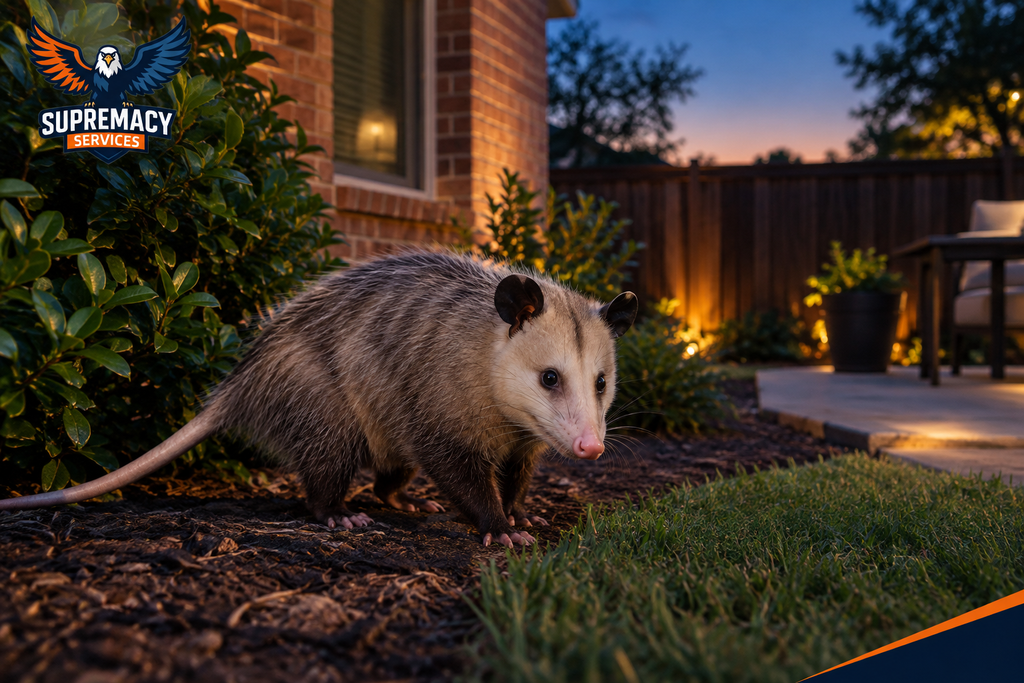
The Virginia opossum is usually recognizable by several distinctive characteristics:
- Grayish fur
- A pointed snout
- Small ears
- A long, scaly tail
- Opposable digits on the feet
- A cat-sized body
Texas Parks & Wildlife notes that males are generally larger than females and that opossums are primarily active at night.
Because they are nocturnal, homeowners may never see the animal directly. Instead, the first indication may be scratching, movement around the exterior of the house, disturbed materials, droppings, or an animal repeatedly appearing near a particular access point.
This is one reason proper identification matters before deciding how to address the problem.
3.Where Opossums Hide Around Dallas Homes
Opossums are opportunistic animals. They do not need a sophisticated den to take shelter.
Common locations around residential properties include:
Under Decks and Porches
The space underneath decks, porches and raised structures can provide darkness, shelter and protection from weather.
Crawlspaces
An opening around a foundation, vent or access door can give an opossum an easy route into a crawlspace.
Garages
An open garage door or damaged exterior opening can provide temporary access to food and shelter.
Beneath Sheds and Outbuildings
Gaps beneath sheds and similar structures can become attractive hiding areas.
Attics
Although opossums are more commonly associated with ground-level shelter, they can enter attics through vulnerable exterior openings. Wildlife damage research identifies attics and crawlspaces as potential areas used by opossums and other nuisance wildlife.
Around Roofline Entry Points
Damaged soffits, vents, roofline gaps and other openings can provide access to protected parts of a home.
The important point is that the animal’s location is often only part of the problem.
The entry point is what needs to be found and corrected.
4.Signs You May Have an Opossum Problem
Not every nighttime noise is an opossum. Mice, rats, raccoons, squirrels and other wildlife can create similar symptoms.
Look for a combination of signs rather than relying on one clue.
Common signs include:
- Scratching or movement after dark
- Animal activity around decks or crawlspaces
- Disturbed insulation or nesting material
- Droppings or strong animal odors
- Damaged screening or vents
- Openings beneath decks or structures
- Repeated nighttime activity around garbage or pet food
- Tracks around suspected entry points
- An opossum repeatedly returning to the same location
Time of day can also provide a useful clue. Extension wildlife guidance notes that nocturnal wildlife such as opossums commonly creates signs of activity during the night.
When the animal itself is not visible, professional wildlife inspection or monitoring can help distinguish an opossum problem from another type of wildlife intrusion.
5.Why Opossums Enter Homes
Opossums generally are not trying to invade a house for the sake of damaging it.
They are looking for basic survival resources:
Food + shelter + protection = opportunity.
Food sources around residential properties can include accessible garbage, fallen fruit, pet food, bird-feeder debris and other edible material.
Texas A&M AgriLife Extension specifically identifies pet food, tree fruit, pecans, bird-feeder seed and garbage among food sources that can attract opossums.
Shelter can be equally important.
A dark crawlspace beneath a house or a protected area beneath a deck can offer a safer resting location than an exposed yard.
This is why successful opossum control should examine both the animal and the property conditions attracting it.
6.Can Opossums Damage a Dallas Home?
Opossums are not normally considered major structural destroyers like some larger wildlife species.
However, that does not mean an animal living around or inside a home should simply be ignored.
Potential problems can include:
- Disturbed insulation
- Damaged screening
- Nesting materials
- Contamination from feces and urine
- Persistent odors
- Damage to vulnerable entry points
- Secondary pest activity associated with animal waste
- Repeated wildlife intrusion if access remains open
The larger concern is often what happens after the first animal leaves.
If a home has a hole large enough for one opossum to enter, another animal may eventually discover the same opening.
That is why exclusion is an important part of professional wildlife management.
7.Are Opossums Dangerous?
Opossums are generally not aggressive animals, but homeowners should not attempt to handle or corner wild animals.
Like other wildlife, an opossum can bite or scratch when threatened or restrained.
Texas A&M AgriLife also notes that opossums can carry and transmit certain diseases, including murine typhus, to people and pets.
The practical rule is simple:
Do not attempt to pick up, corner, or physically handle a wild opossum.
Keep children and pets away from the animal and allow trained wildlife professionals to determine the appropriate response.
An animal that appears slow or harmless can still react unpredictably when frightened.
8.Opossum Removal vs. Opossum Exclusion
These two terms are often treated as if they mean the same thing.
THEY DO NOT.
Opossum Removal
Removal addresses the immediate wildlife problem.
The animal is located, the situation is assessed, and appropriate capture or removal procedures are used.
Opossum Exclusion
Exclusion addresses the reason the animal was able to enter.
This can involve securing openings, reinforcing vulnerable areas and correcting access points around the structure.
Research-based wildlife management guidance identifies exclusion as one of the primary methods for preventing recurring opossum conflicts. Recommended measures include securing crawlspaces and other openings with appropriate hardware cloth or similar barriers.
Removal solves the immediate problem. Exclusion helps prevent the next one.
9.Our Opossum Removal Process in Dallas
At Supremacy Services, our approach is built around inspection, identification, removal and prevention.
01. Property & Entry-Point Inspection
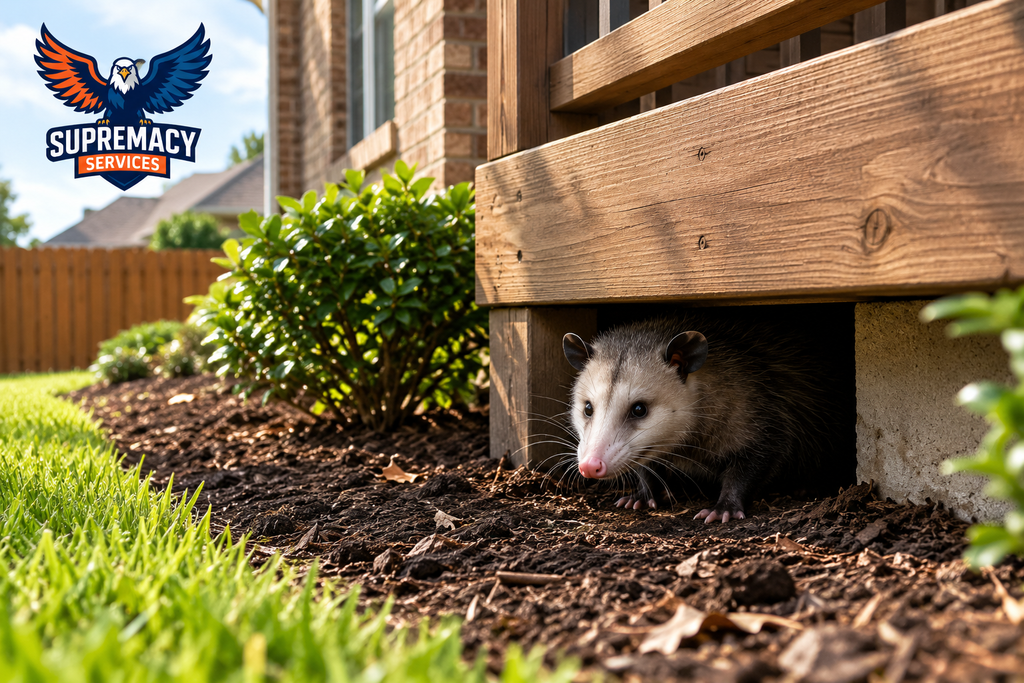
We begin by examining the areas where wildlife activity is occurring.
Depending on the situation, this may include:
- Roofline
- Soffits
- Vents
- Foundation areas
- Crawlspaces
- Decks
- Porches
- Garages
- Outbuildings
- Other potential access points
The objective is not simply to find the animal.
It is to understand how the animal is using the property.
02. Wildlife Identification
Different wildlife species behave differently.
An opossum, raccoon, squirrel or other animal may leave similar-looking evidence, but the appropriate management strategy can differ.
Correct identification helps prevent homeowners from spending money on the wrong solution.
03. Safe Wildlife Removal
Once the situation is understood, appropriate wildlife-management techniques are used to address the active animal.
Supremacy’s Dallas wildlife service covers opossums alongside other common nuisance wildlife. See our complete wildlife trapping and removal service.
The objective is to resolve the wildlife conflict while following applicable Texas requirements.
04. Entry-Point Exclusion
Removing an animal without addressing the opening creates an incomplete solution.
Our technicians identify vulnerable access points and recommend or perform appropriate exclusion work to reduce the likelihood of another animal entering through the same location.
Research from the University of California’s Integrated Pest Management program similarly recommends securing access beneath structures and confirming that an animal has left before permanently closing an opening.
05. Cleanup & Odor Control
Wildlife activity can leave behind nesting material, waste and odors.
Where required, the affected area should be cleaned and sanitized after removal.
This is particularly important in enclosed areas where contamination may remain after the animal is gone.
For homeowners dealing with broader animal intrusion, our Dallas wildlife removal service also includes attic sanitation and odor-removal services.
10.What Happens If There Are Baby Opossums?
This is one of the most important reasons homeowners should avoid sealing an active entry point immediately.
Female opossums can produce multiple litters, and newborn young are extremely undeveloped at birth. Texas Parks & Wildlife notes that young are born after a very short gestation period and enter the mother’s pouch immediately after birth.
If a mother and young are using a structure, simply blocking the opening can create a much bigger problem.
The correct response is to determine whether the structure is actively occupied before exclusion work is completed.
A professional inspection can help establish whether young are present and whether additional wildlife-management steps are necessary.
11.How to Prevent Opossums From Returning
Long-term prevention begins with making the property less attractive and less accessible.
Secure Garbage
Use tightly closed trash containers.
Accessible garbage can become an easy food source for opportunistic wildlife.
Remove Outdoor Pet Food
Do not leave pet food outside overnight where wildlife can access it.
Texas A&M AgriLife specifically identifies pet food as a potential attractant for opossums.
Manage Fallen Fruit
Pick up fallen fruit and nuts around the property.
Fruit and pecans can provide an accessible food source.
Maintain Bird Feeders
Birdseed that falls onto the ground can attract wildlife.
Keep feeding areas clean and consider how feeder placement affects access from trees and structures.
Inspect Crawlspaces and Decks
Look for:
- Torn screening
- Foundation gaps
- Damaged vents
- Openings beneath decks
- Gaps around pipes
- Damaged access doors
Secure Structural Openings
Wildlife exclusion materials should be durable enough to resist repeated animal access.
Research-based wildlife management guidance recommends appropriately sized hardware cloth and other physical exclusion measures for vulnerable areas.
12.Texas Opossum Removal Regulations
Texas wildlife regulations matter when dealing with nuisance wildlife.
Texas Parks & Wildlife classifies opossums as fur-bearing animals.
Texas regulations also contain specific provisions concerning nuisance fur-bearing animals. Landowners or their agents may take nuisance fur-bearing animals on their property under the conditions established by state law. However, live relocation is subject to specific authorization requirements, including authorization from the department and the property owner where the animal would be released.
That distinction is important.
A professional wildlife company should not treat wildlife relocation as a simple matter of catching an animal and releasing it wherever convenient.
For current requirements, homeowners can consult Texas Parks & Wildlife Department’s nuisance fur-bearing animal regulations.
13.Why Dallas Homeowners Choose Professional Wildlife Removal
DIY wildlife removal can appear straightforward until the animal is inside a crawlspace, attic, wall void or another difficult location.
Professional wildlife management provides several advantages.
Correct Identification
The first step is determining what animal is actually causing the problem.
Property-Focused Inspection
The goal is not simply to remove the animal but to identify the conditions that allowed it to enter.
Safer Wildlife Handling
Wild animals should not be handled casually, particularly when children, pets or enclosed living spaces are involved.
Exclusion
A properly secured entry point can be more valuable than repeatedly removing individual animals.
Cleanup
Wildlife activity can leave behind odors, nesting material and contamination that should be addressed after removal.
Supremacy Services’ broader Dallas wildlife program combines trapping, removal, exclusion and cleanup rather than treating wildlife intrusion as a one-step trapping job.
14.Opossum Removal Dallas: Frequently Asked Questions
How do I know if the animal under my deck is an opossum?
Opossums are nocturnal, generally solitary animals with grayish fur, pointed snouts and long scaly tails. Tracks, nighttime activity and direct observation can help, but professional identification is useful when several wildlife species could be responsible.
Are opossums common in Dallas?
Yes. Virginia opossums are well established in the Dallas-Fort Worth area and are frequently encountered in urban and suburban environments.
Can an opossum get into my attic?
Yes. Opossums can use vulnerable openings to access protected portions of residential structures, although ground-level locations such as crawlspaces, decks and areas beneath structures are also common shelter sites.
Should I seal the hole where the opossum entered?
Not until you are confident the animal and any young have left.
Premature exclusion can trap an animal inside the structure. Wildlife management guidance recommends confirming that the animal has exited before permanently closing an opening.
Will removing one opossum solve the problem?
Not necessarily.
If the property continues to provide accessible food, shelter or an open entry point, another animal may eventually use the same area.
That is why professional wildlife management should include inspection and exclusion where appropriate.
Do opossums damage houses?
They generally cause less structural damage than some larger nuisance wildlife species, but they can disturb insulation, damage vulnerable screening, leave waste and create odors.
Are opossums dangerous to pets?
A wild opossum should never be allowed to interact closely with pets. Keep dogs and cats away from wildlife and contact a qualified wildlife professional if an animal is trapped, cornered or behaving abnormally.
Does Supremacy Services remove opossums in Dallas?
Yes. Opossums are among the wildlife species addressed through Supremacy Services’ Dallas wildlife trapping and removal service.
Learn more about Dallas wildlife trapping and removal.
Do you only remove the animal?
No. A complete wildlife solution should look beyond the animal itself.
Where appropriate, the process can include inspection, removal, exclusion and cleanup to address both the immediate wildlife problem and the conditions that allowed the animal to enter.
15.Final Thoughts: Solve the Entry Point, Not Just the Opossum
An opossum wandering through your Dallas yard is usually part of normal urban wildlife activity.
An opossum living beneath your house, inside a crawlspace or within another protected part of the structure is a different situation.
The strongest solution is not simply to remove the animal and leave.
It is to identify the wildlife correctly, address the immediate problem, locate the access point, secure the structure and clean the affected area when necessary.
That is the difference between temporary wildlife removal and long-term wildlife control.
If you are seeing an opossum repeatedly around your Dallas home or suspect one has entered the structure, contact Supremacy Services for professional wildlife trapping and removal in Dallas.
