10400 Clarence Drive, Frisco, TX 75033
Support 24/7: 945-777-3345
Electrician inspecting an electrical panel for warning signs a Dallas home may need rewiring

Does Your Dallas Home Need Rewiring? 10 Warning Signs

Your Dallas home may need electrical rewiring if you are seeing repeated breaker trips, unexplained flickering lights, warm or discolored outlets, burning odors, sparking, ungrounded outlets or recurring electrical failures. One symptom does not automatically mean the entire house needs new wiring, but several recurring problems—especially in an older electrical system—are good reasons to have the wiring professionally evaluated.

Some problems can be corrected with a damaged connection, receptacle, breaker or individual circuit repair. Others point to a broader problem that may justify partial or whole-home rewiring.

Here are 10 warning signs Dallas homeowners should take seriously.

1. Your Circuit Breakers Keep Tripping

A circuit breaker is designed to interrupt a circuit when electrical conditions become unsafe. An occasional trip caused by plugging too many devices into one circuit does not mean your home needs rewiring.

Repeated trips are different.

If the same breaker continually trips even after you reduce the connected load, there may be a problem somewhere in that circuit. Potential causes include an overloaded circuit, short circuit, ground fault, damaged wiring, a faulty breaker or another electrical defect.

The important question is not simply, “How do I stop the breaker from tripping?”

It is why the breaker keeps tripping.

Replacing or repeatedly resetting a breaker without identifying the cause can leave the underlying problem unresolved.

Does a tripping breaker mean the whole house needs rewiring?

Not necessarily. A licensed electrician may find that the problem is isolated to one circuit or component. But recurring problems across several circuits can indicate that a broader electrical assessment is appropriate.
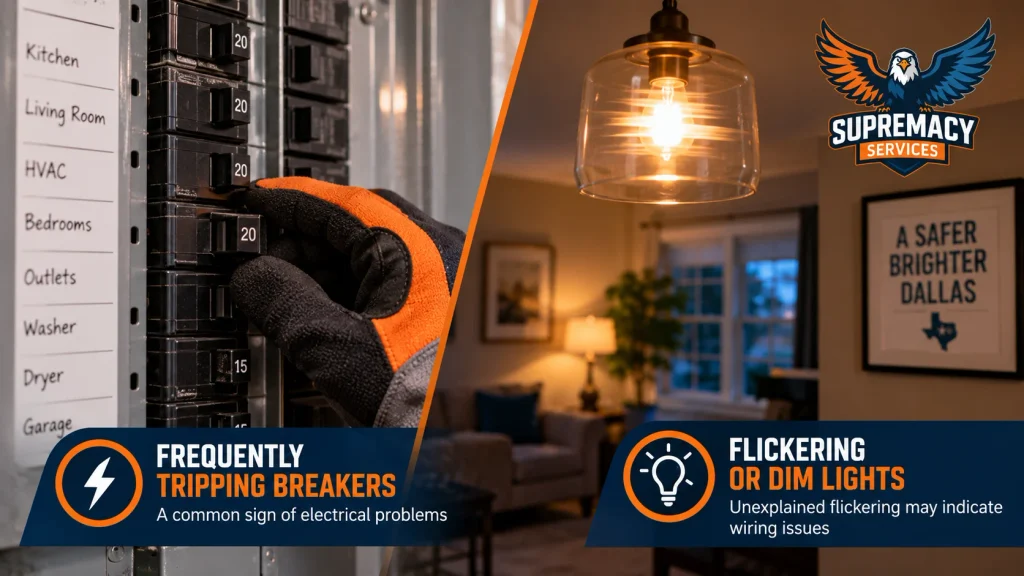
Circuit breaker panel and flickering home light showing common electrical wiring warning signs
Frequently tripping breakers and unexplained flickering lights can indicate an electrical problem that needs diagnosis.
2. Lights Flicker or Dim for No Obvious Reason

A light that flickers because of a loose bulb is usually a fixture-level problem. Flickering throughout multiple rooms deserves more attention.

Unexplained flickering or dimming can be associated with loose electrical connections, problems within a branch circuit, service issues or other faults that require diagnosis.

The U.S. Consumer Product Safety Commission also identifies flickering lights as one of the potential warning signals associated with problematic aluminum-wiring connections.

Pay particular attention when:

  • several fixtures flicker simultaneously;
  • the problem happens frequently;
  • lights dim dramatically when appliances operate;
  • flickering occurs on multiple circuits; or
  • the problem is accompanied by heat, odor or unusual sounds.

An electrical inspection can determine whether the problem originates with a fixture, circuit, panel, service connection or the home’s wiring.

3. You Smell Burning Plastic or an Electrical Odor

Scorched electrical outlet showing heat damage and discoloration from a possible electrical fault
Burning odors, unusual heat and discoloration around an outlet should not be ignored.

A persistent burning smell near an outlet, switch, electrical panel or wall should never be treated as normal.

Heat generated by a deteriorated or loose electrical connection can damage insulation and electrical components. The CPSC specifically lists the smell of burning plastic near outlets or switches as a warning sign associated with problematic aluminum-wired connections.

If you see smoke, active sparking or signs of fire, treat the situation as an emergency rather than attempting a DIY investigation.

Do not remove outlets or open electrical equipment simply to look for the source.

4. Outlets or Switch Plates Feel Unusually Warm

Electrical switches and receptacles should not become noticeably hot because of the wiring connection behind them.

A warm or hot faceplate can indicate excessive resistance or another electrical fault. The CPSC identifies hot-to-the-touch switch and receptacle faceplates among signs homeowners with aluminum branch-circuit wiring should have investigated.

Heat is particularly concerning when it occurs alongside:

  • discoloration;
  • a burning smell;
  • crackling;
  • intermittent power;
  • melted plastic; or
  • flickering lights.

The correct response is diagnosis—not simply replacing the cover plate.

5. You See Scorch Marks or Discoloration Around Outlets

Brown or black marks, melting, heat damage or unusual discoloration around a receptacle or switch indicate that something has become hotter than it should.

Possible causes can include a damaged receptacle, loose connection, arcing or another electrical fault.

This does not prove that the entire home needs rewiring. It does mean that the affected circuit should be assessed before normal use continues.

Where damage is isolated, a localized electrical repair may solve the problem. When similar deterioration appears throughout an older house, a broader wiring evaluation becomes more important.

6. Outlets Spark, Buzz or Crackle

A tiny, brief spark can sometimes occur as a plug makes contact with an energized receptacle. Repeated, large or unusual sparking is different.

Buzzing, sizzling or crackling sounds can also indicate an abnormal electrical condition.

The CPSC has historically identified sparking or arcing at switches and outlets among warning signs associated with deteriorating aluminum-wiring connections.

If an outlet repeatedly sparks, becomes hot or produces an unusual smell, stop treating it as a nuisance. Have the cause professionally diagnosed.

7. Your Home Still Has Many Two-Prong Outlets

Two-slot receptacles can be a visible clue that at least portions of a home’s electrical system are older or lack an equipment-grounding conductor.

However, the presence of a two-prong outlet alone does not prove that the entire house needs rewiring.

A professional evaluation can determine:

  • whether an equipment grounding path exists;
  • what wiring method is installed;
  • whether receptacles have been modified improperly;
  • what protection is present; and
  • whether upgrading individual circuits or more extensive rewiring makes sense.

Simply replacing a two-prong receptacle with a three-prong device does not create a grounding path.

For Dallas homeowners renovating an older property, this is an excellent time to have the electrical system evaluated before walls are closed again.

8. Your Home Has Older Aluminum Branch-Circuit Wiring

Electrician evaluating older aluminum branch-circuit wiring in a Dallas home
Older aluminum branch-circuit wiring should be properly identified and evaluated, especially when electrical warning signs are present.

Aluminum wiring requires a more specific discussion than simply saying “old wiring is dangerous.”

The CPSC’s guidance focuses particularly on aluminum branch-circuit wiring installed in many homes during the mid-1960s through early 1970s. Problems can develop at connections, potentially leading to overheating.

Potential warning signs include:

  • warm outlet or switch plates;
  • flickering lights;
  • circuits that stop working; and
  • burning-plastic odors around receptacles or switches.

Importantly, a homeowner cannot reliably determine the condition of concealed wiring simply by looking at the front of an outlet.

If you suspect aluminum branch-circuit wiring, have a qualified professional identify the wiring and evaluate its connections and condition.

9. Your Electrical System Struggles With Modern Loads

Older electrical systems were designed around the electrical demands of their era.

Today’s homes may include large HVAC equipment, kitchen appliances, home offices, entertainment systems, EV charging equipment and numerous electronic devices.

Symptoms such as persistent circuit overloads, insufficient receptacles, heavy dependence on extension cords or recurring electrical problems after adding equipment can indicate that the existing electrical infrastructure needs evaluation.

But this is where an important distinction is necessary:

Wiring problem vs. panel-capacity problem

They are not the same thing.

A house can have serviceable branch wiring but insufficient panel capacity. Conversely, installing a larger electrical panel does not automatically correct deteriorated or unsuitable branch wiring.

An electrician should evaluate the system as a whole before recommending either solution.

10. Electrical Problems Keep Returning in Different Parts of the House

One failed outlet can be an isolated repair.

Recurring failures across multiple rooms are different.

If you have already repaired outlets, breakers, switches or circuits but continue experiencing electrical problems elsewhere, it may be time to stop treating each symptom separately.

A whole-home electrical evaluation can look for patterns involving:

  • wiring condition;
  • grounding;
  • circuit loading;
  • panel condition;
  • previous modifications;
  • damaged connections; and
  • inadequate circuits.

The objective should be to identify the root cause before deciding whether you need another repair, partial rewiring or a complete rewire.

Quick Checklist: Does Your House Need Rewiring?

Warning signWhat it may indicateRecommended response
Frequent breaker tripsOverload, circuit fault or breaker issueHave recurring trips diagnosed
Multiple flickering lightsLoose connection, circuit or service issueElectrical inspection
Burning electrical odorOverheating component or connectionPrompt professional attention
Hot outlet/switchAbnormal resistance or connection problemStop using and have it inspected
Scorching/discolorationExcessive heat or arcingProfessional diagnosis
Repeated sparkingReceptacle or connection faultElectrical inspection
Many two-prong outletsOlder/possibly ungrounded systemGrounding/wiring evaluation
Aluminum branch wiringConnection-related overheating concernQualified wiring assessment
Insufficient circuitsSystem may not match modern loadsLoad and circuit assessment
Problems throughout homeBroader system deteriorationWhole-home electrical evaluation

Important: These signs indicate that an electrical evaluation may be warranted. They do not, by themselves, prove that whole-home rewiring is necessary.

Repair, Partial Rewiring or Whole-Home Rewiring?

Comparison of electrical repair, dedicated circuits, partial rewiring and whole-home rewiring options
Not every wiring problem requires a complete rewire—the appropriate solution depends on the condition and extent of the electrical problem.

Not every electrical problem requires tearing out all the wiring.

The appropriate scope depends on what an inspection finds.

OptionTypically considered when
Electrical repairProblem is isolated to a device, connection, breaker or small section
Dedicated/new circuitExisting system is generally sound but a specific load needs its own circuit
Partial rewiringWiring problems are confined to specific rooms, renovations or circuits
Whole-home rewiringDeficiencies or unsuitable wiring are widespread throughout the electrical system
Panel upgradeService/distribution capacity or panel condition is the primary issue
Panel upgrade + rewiringBoth distribution equipment and branch wiring require substantial modernization

The goal should be to use the least extensive solution that properly addresses the underlying condition and applicable requirements, rather than assuming every old house needs complete rewiring.


Does an Older Dallas House Automatically Need Rewiring?

No. The age of a Dallas house alone does not determine whether it needs rewiring.

What matters more is the wiring type, condition, previous modifications, grounding, circuit configuration, electrical load and whether there are signs of deterioration or unsafe connections.

Older properties can also contain electrical work completed during several different renovations. One section of a house may have newer wiring while another retains older components.

That is why an inspection is more useful than choosing an arbitrary age at which every house should be rewired.

Older and remodeled homes deserve particular attention

If you are planning to remodel a kitchen, bathroom or substantial part of an older Dallas home, consider evaluating the electrical system while the project is being planned.

Open walls can provide better access to wiring and make it easier to coordinate electrical improvements with the renovation.

Electrical Rewiring vs. Electrical Panel Upgrade

Homeowners often use these terms interchangeably, but they describe different projects.

Electrical rewiring deals primarily with the conductors and circuits that distribute electricity through the home.

A panel upgrade changes or expands the equipment that distributes those circuits and provides overcurrent protection.

You may need one without the other.

For example, a house experiencing inadequate electrical capacity may need panel work even if its branch wiring remains suitable. A house with deteriorated branch wiring can require rewiring even when the panel itself is not the principal problem.

A proper assessment should examine both before the scope of work is determined.

Can You Rewire Only Part of a House?

Yes, partial rewiring can be appropriate when the electrical deficiencies are limited to identifiable rooms, additions or circuits.

For example, partial rewiring may make sense during:

  • a kitchen renovation;
  • bathroom remodeling;
  • an addition;
  • repair of a damaged circuit;
  • modernization of an older section of the house; or
  • installation of circuits for new electrical loads.

Whole-home rewiring becomes more relevant when outdated or deteriorated wiring is widespread rather than localized.

The decision should follow an inspection rather than being based solely on the home’s age.

What Does a Professional Electrical Wiring Evaluation Include?

Supremacy Services electrician testing a Dallas home's electrical panel during a wiring inspection
A professional electrical evaluation can help identify whether a home needs a repair, partial rewire or more extensive electrical work.

The exact inspection depends on the property and symptoms, but an electrician may evaluate the home’s:

  1. electrical service and panel;
  2. breakers and circuit configuration;
  3. accessible branch-circuit wiring;
  4. outlets and switches;
  5. grounding and bonding;
  6. visible connections and junction boxes;
  7. evidence of overheating or deterioration;
  8. recurring faults or voltage-related symptoms;
  9. electrical demands and overloaded circuits; and
  10. previous additions or modifications.

Testing helps separate a simple component failure from a systemic wiring problem.

If you are experiencing several of the warning signs above, Supremacy Services’ Dallas residential electrical and wiring services can be used to identify whether the appropriate next step is repair, partial rewiring or a larger electrical upgrade.

Should You Rewire a House Yourself in Dallas?

Whole-home rewiring is not a good project to approach casually as a DIY upgrade.

Texas generally requires people performing non-exempt electrical work to be properly licensed and to perform that work through a licensed electrical contractor. State law contains a homeowner exemption for someone working on a dwelling they own and reside in, but TDLR specifically notes that municipal requirements can override or restrict that exemption.

Within Dallas, local permitting requirements also matter. The City maintains a specific residential electrical permit category, and its electrical-permit documentation states that an owner working on a residential homesteaded property must satisfy the City’s homeowner requirements before personally performing the electrical work.

For a substantial rewire, homeowners should confirm the project’s current permit and inspection requirements with the City of Dallas before work begins.

Even where a homeowner exemption exists, legal permission and electrical competence are two separate questions.

What Does House Rewiring Involve?

The exact process varies with the house and scope, but a substantial residential rewiring project generally starts with assessment and planning rather than immediately removing wires.

A project may involve:

1. Electrical assessment

Existing circuits, wiring, panel capacity and visible deficiencies are evaluated.

2. Scope and circuit planning

The electrician determines which circuits need replacement and whether new dedicated circuits, grounding improvements or panel work are required.

3. Permitting

Required electrical permits are obtained according to the applicable municipality’s process.

4. Access and installation

New wiring is routed through accessible wall, ceiling, attic or other approved pathways. The amount of wall access required depends heavily on the house.

5. Device and circuit work

Receptacles, switches, junction boxes and other affected equipment may be updated as required by the project.

6. Inspection and testing

Required municipal inspections and electrical testing are completed before the project is considered finished.

Homeowners should ask a contractor what is included in the electrical proposal and what restoration work—such as drywall patching or painting—is excluded.

What Affects the Cost of Rewiring a Dallas Home?

There is no responsible single price for every Dallas house because the scope can vary dramatically.

Important cost factors include:

  • home size;
  • number of circuits;
  • partial versus whole-home rewiring;
  • accessibility through attics, crawlspaces and walls;
  • number of stories;
  • wiring condition;
  • panel work required;
  • number and type of receptacles and switches;
  • dedicated circuits needed;
  • local permit requirements;
  • extent of wall or ceiling access;
  • renovation status; and
  • restoration work after electrical access.

A smaller targeted rewire is fundamentally different from replacing branch wiring throughout a large finished two-story house.

For homeowners specifically researching project pricing, see Electrical Rewiring Cost in Dallas: 2026 Homeowner Guide for a dedicated discussion of cost factors rather than turning this warning-sign guide into a pricing page.

When Is Rewiring an Urgent Electrical Issue?

Some symptoms deserve faster attention than others.

Seek professional assistance promptly when you notice:

  • smoke;
  • burning odors;
  • melted electrical components;
  • outlets or switches that become unusually hot;
  • repeated significant sparking;
  • visible electrical damage; or
  • recurring failures accompanied by heat or unusual sounds.

Do not open an electrical panel, remove wiring or dismantle energized devices to investigate a suspected fault yourself.

If there is an active fire, smoke condition or immediate danger, leave the affected area and contact emergency services as appropriate.


How Can Dallas Homeowners Reduce Future Wiring Problems?

You cannot prevent normal material aging, but you can avoid practices that unnecessarily stress or conceal electrical problems.

Do not ignore repeated symptoms

A breaker that repeatedly trips is providing information. Determine the cause instead of continually resetting it.

Avoid using extension cords as permanent wiring

If a room consistently lacks enough receptacles for normal use, consider whether additional permanent circuits or receptacles are appropriate.

Evaluate electrical capacity before major additions

EV charging, remodeling, major HVAC equipment and other high-demand additions should be considered in the context of the home’s existing electrical system.

Include electrical planning in renovations

A renovation that exposes walls can be an efficient opportunity to evaluate older wiring and plan necessary circuit improvements.

Have unexplained electrical problems diagnosed

Persistent heat, odors, flickering or recurring failures should be investigated rather than normalized as quirks of an older house.

When Should You Call a Dallas Electrician?

Call an electrician when an electrical problem is persistent, occurs across multiple circuits, involves heat or burning odors, or cannot be clearly traced to a simple appliance or fixture problem.

You should also consider an electrical evaluation before a major renovation or when buying, modernizing or adding significant electrical loads to an older property.

The purpose of the inspection is not automatically to sell a whole-home rewire. It is to answer a more important question:

What is actually causing the problem, and what scope of work will correct it?

Supremacy Services provides electrical diagnostics, wiring repair, partial rewiring and whole-home rewiring for Dallas-area properties. If your home is showing several of these warning signs, schedule an electrical evaluation to determine whether you need a localized repair, a circuit upgrade or a broader rewiring project.


Frequently Asked Questions

How do I know if my house needs rewiring?

Repeated breaker trips, unexplained flickering, burning odors, hot or discolored outlets, sparking, recurring circuit failures and widespread older wiring are reasons to have the system evaluated. An inspection is needed to determine whether repair, partial rewiring or complete rewiring is appropriate.

Does flickering lighting mean I need to rewire my house?

Not automatically. Flickering can have several causes, ranging from a loose bulb to electrical connection, circuit or service problems. Flickering across multiple fixtures or circuits deserves professional diagnosis.

Do two-prong outlets mean a house needs rewiring?

Not necessarily. They can indicate an older electrical system or lack of an equipment grounding conductor, but the wiring and grounding configuration should be inspected before deciding on the correct upgrade.

Can I replace only some of my home’s wiring?

Yes. Partial rewiring may be appropriate when problems are confined to particular circuits, rooms or renovation areas. Widespread deficiencies can make whole-home rewiring more appropriate.

Is an electrical panel upgrade the same as rewiring?

No. A panel upgrade changes electrical distribution and overcurrent-protection equipment. Rewiring replaces or modifies the circuits and conductors running through the home. Some projects require one; others require both.

Should I rewire my Dallas home before remodeling?

A remodel can be a useful time to evaluate older wiring because walls may already be open and new electrical loads can be planned before finishes are installed. Whether rewiring is necessary depends on the existing system’s condition and the renovation scope.

Is aluminum wiring always a reason to completely rewire a house?

No single visible feature should be used to prescribe a whole-home rewire without evaluation. CPSC guidance identifies particular concerns with older aluminum branch-circuit connections and recommends qualified assessment when aluminum wiring is present or warning signs occur.

Do I need a permit to rewire a house in Dallas?

Dallas maintains residential electrical permits and electrical inspections. The exact permits and inspections required depend on the project scope, so confirm current requirements with the City’s Planning and Development Department before work begins.

Can a repeatedly tripping breaker simply be replaced?

A breaker should not be replaced merely to stop repeated tripping without determining why it is operating. The underlying cause could involve the load, circuit, connected equipment, wiring or the breaker itself.

Who should inspect old electrical wiring in Dallas?

For professional electrical work, use an appropriately licensed electrical contractor or electrician. Texas electrical licensing is administered by the Texas Department of Licensing and Regulation, where homeowners can also verify licensing requirements.


Supremacy Services electrician inspecting a residential electrical panel during a Dallas home rewiring project

Electrical Rewiring Cost in Dallas: 2026 Homeowner Guide

If you are budgeting for electrical rewiring in Dallas, the price can vary considerably depending on the size and age of the house, how easily electricians can access the existing wiring, the number of circuits being replaced, and whether the electrical panel or service also needs upgrading.

Current Dallas market data published by Angi estimates rewiring labor and materials at roughly $2–$4 per square foot, but that figure should be treated as a planning benchmark rather than a quote. Whole-home projects can move well beyond simple square-foot estimates when finished walls must be opened, old wiring is difficult to reach, additional circuits are required, or panel and service work becomes part of the project.

For Dallas homeowners, there is another important consideration: rewiring is regulated electrical work. Texas generally requires people performing non-exempt electrical work to be properly licensed, while the City of Dallas requires permits for electrical work unless a specific exemption applies.

This guide explains what determines the cost, what a professional rewire includes, when rewiring may actually be necessary, and how to compare estimates without focusing only on the lowest number.

Table of Contents

  1. How Much Does Electrical Rewiring Cost in Dallas?
  2. What Affects the Cost of Rewiring a House?
  3. What Does Whole-House Rewiring Include?
  4. Signs Your Dallas Home May Need Rewiring
  5. Partial Rewiring vs. Whole-House Rewiring
  6. Rewiring vs. an Electrical Panel Upgrade
  7. Dallas Permits and Electrical Requirements
  8. Can You Rewire a House Yourself?
  9. What to Expect During a Professional Rewire
  10. How to Compare Rewiring Estimates
  11. FAQs

How Much Does Electrical Rewiring Cost in Dallas?

A Dallas house rewire does not have one reliable flat price. Current local market estimates put basic rewiring labor and materials around $2–$4 per square foot, but actual whole-home pricing depends heavily on access, circuit count, wall repair, panel work, permits and the condition of the existing electrical system.

That distinction matters.

A contractor who can route new cable through accessible attic spaces and wall cavities may face a very different job from one rewiring a multi-story house with finished walls, limited access and extensive existing electrical modifications.

For that reason, homeowners should treat online cost figures as budgeting ranges rather than estimates for their particular property.

Cost factorWhy it matters
Home sizeLarger houses generally require more cable, circuits, devices and labor
Number of circuitsMore circuits mean additional cable runs, breakers and terminations
Wall and ceiling accessFinished or difficult-to-access cavities can increase labor
Existing wiringOld, damaged or extensively modified wiring may complicate replacement
Panel conditionThe existing panel may or may not be suitable for the finished system
Service capacityMajor electrical changes can reveal the need for broader service work
Outlet/switch countMore devices increase materials and installation time
Permitting/inspectionDallas electrical work can require permits and inspections
Drywall/plaster restorationWall repair may be separate from the electrician’s proposal
Remodel coordinationRewiring during an open-wall renovation may simplify access

A Better Way to Budget

Instead of asking only, “What is the price per square foot?”, ask:

What exactly is being replaced, what is included in the proposal, and what work will be required to access the wiring?

Two estimates can differ substantially while both are reasonable if one includes panel work, new devices, permitting and wall restoration and the other does not.

If you suspect your home needs extensive wiring replacement, Supremacy Services’ whole-home rough wiring and rewiring service can be used to evaluate the existing system and determine the appropriate scope before you budget around a generic online number.


What Affects the Cost of Rewiring a House?

1. Size of the Home

Square footage matters because larger homes normally contain longer cable runs and more outlets, lighting circuits and dedicated appliance circuits.

However, square footage alone cannot tell you what a rewire should cost.

A compact home with difficult plaster walls and extensive electrical modifications can require more labor than a larger home undergoing an open-wall renovation.

2. Accessibility of Existing Wiring

Electricians comparing accessible attic wiring with wiring concealed behind finished walls during a home rewire
Easy attic access can simplify cable routing, while finished walls may require additional labor and carefully planned access openings.

Accessibility can be one of the largest cost variables.

Wiring that can be reached through an attic, unfinished space or open renovation area is generally easier to replace than wiring concealed behind finished surfaces.

The electrician may need to create strategic access openings when existing cable cannot be removed or new cable cannot be safely routed through the existing pathways.

Before signing a proposal, determine whether drywall, plaster, painting and finish repairs are included or excluded.

3. Partial vs. Whole-Home Rewiring

Not every electrical problem means the entire house needs new wiring.

A localized damaged circuit may require repair or replacement of only that circuit. A remodeling project might require new wiring only in the affected area.

A full rewire becomes a different scope because electricians must evaluate and replace electrical distribution throughout the property.

4. Number of Circuits and Electrical Loads

Modern homes can contain dedicated circuits for equipment such as:

  • air-conditioning systems;
  • electric ranges and ovens;
  • clothes dryers;
  • EV chargers;
  • workshops;
  • pool equipment;
  • home offices; and
  • other high-demand equipment.

The required circuit design therefore depends on how the house is actually used—not simply its age or square footage.

5. Electrical Panel and Service Condition

A house can have wiring problems without needing a panel replacement, and it can need a panel upgrade without needing a complete rewire.

During a rewiring assessment, an electrician should evaluate whether the existing panel and service are suitable for the proposed circuits and electrical load.

That prevents homeowners from unnecessarily treating two related but different projects as one.

6. Permits and Inspections

The City of Dallas identifies a specific Residential Electrical Permit category and electrical inspections including rough-wall, rough-ceiling, service and final inspections.

Permit requirements therefore need to be accounted for when defining the project schedule and price.

What Does Whole-House Rewiring Include?

Cutaway Dallas home showing electrical wiring routes from the panel to lighting, outlets, appliances and HVAC circuits
Whole-house rewiring connects the electrical panel to lighting, outlets, appliances and other circuits throughout the home.

Whole-house rewiring generally means replacing or substantially renewing the branch wiring that distributes electricity from the home’s electrical distribution system to outlets, switches, lights and equipment. The exact scope should always be written into the contractor’s proposal.

A professional project may include:

  1. evaluating the existing wiring and panel;
  2. identifying circuits and electrical loads;
  3. planning new cable routes;
  4. obtaining required electrical permits;
  5. installing new branch-circuit wiring;
  6. replacing applicable boxes, switches and receptacles;
  7. installing required grounding and protective devices;
  8. connecting circuits at the electrical panel;
  9. testing the completed circuits;
  10. coordinating required inspections; and
  11. identifying any wall or finish restoration required afterward.

The important word is may.

Do not assume that panel replacement, drywall repair, painting, fixtures or other remodeling work is automatically included in a “whole-house rewire.”

Ask for those items to be identified explicitly.

Signs Your Dallas Home May Need Rewiring

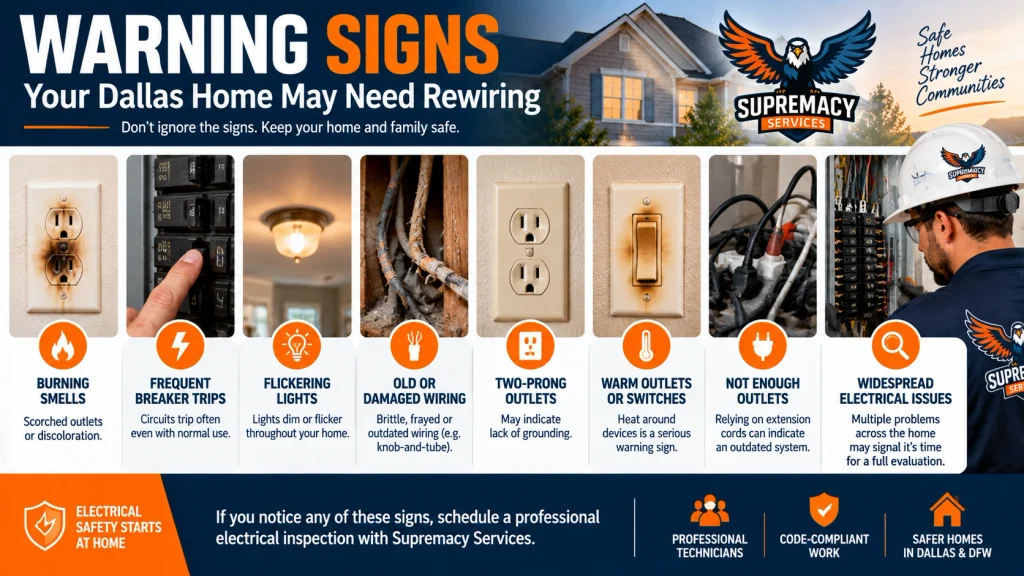
Electrical rewiring warning signs including scorched outlets, breaker trips, flickering lights, damaged wiring and warm switches
Recurring breaker trips, damaged wiring, overheating, flickering lights and other widespread electrical problems warrant professional evaluation.

Frequent electrical problems, damaged conductors, ungrounded systems or widespread obsolete wiring can justify a professional wiring evaluation, but individual symptoms do not automatically prove that a complete rewire is necessary.

Have the system evaluated if you notice:

  • repeated breaker trips without an obvious appliance overload;
  • persistent flickering or dimming;
  • damaged or deteriorated wiring;
  • burning odors, scorching or unusual heat around electrical devices;
  • loose or damaged receptacles;
  • widespread two-prong receptacles indicating that grounding deserves investigation;
  • circuits that cannot reliably support normal household loads;
  • extensive undocumented electrical alterations; or
  • electrical problems uncovered during a major renovation.

Burning Smells or Heat Require Faster Attention

A burning smell, visible scorching, sparking or unusual heat should not be treated as a routine remodeling decision.

Stop using the affected circuit or device and have the condition evaluated by a qualified electrician.

The goal is to diagnose the actual fault—not assume that rewiring the entire house is automatically the answer.

Partial Rewiring vs. Whole-House Rewiring

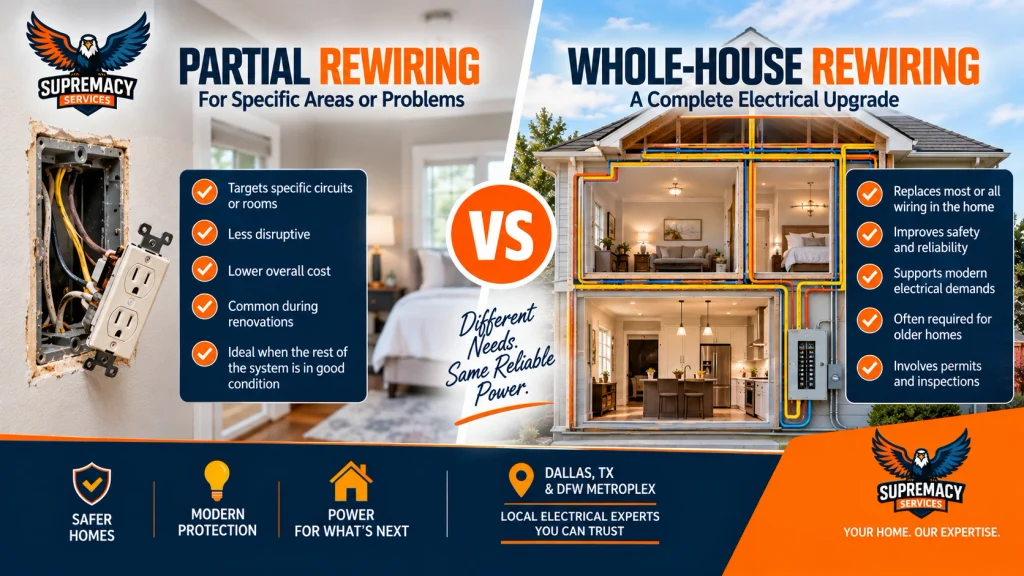
Comparison of partial electrical rewiring for individual circuits and whole-house rewiring throughout a Dallas home
Partial rewiring addresses specific circuits or areas, while whole-house rewiring involves a much broader replacement of the home’s electrical wiring.
Partial rewiringWhole-house rewiring
Targets specific damaged or outdated circuitsAddresses wiring throughout most or all of the house
Less disruptive when the problem is localizedMore extensive access and planning
Common during room renovationsMore relevant when problems are widespread
May retain serviceable existing circuitsReplaces much more of the branch-circuit system
Lower scope does not automatically mean simpleRequires broader permitting, testing and coordination

A professional electrical assessment should determine which approach is justified.

Replacing serviceable wiring simply because another circuit failed can waste money. Conversely, repeatedly patching a system with widespread deficiencies can postpone a larger underlying problem.

Rewiring vs. an Electrical Panel Upgrade

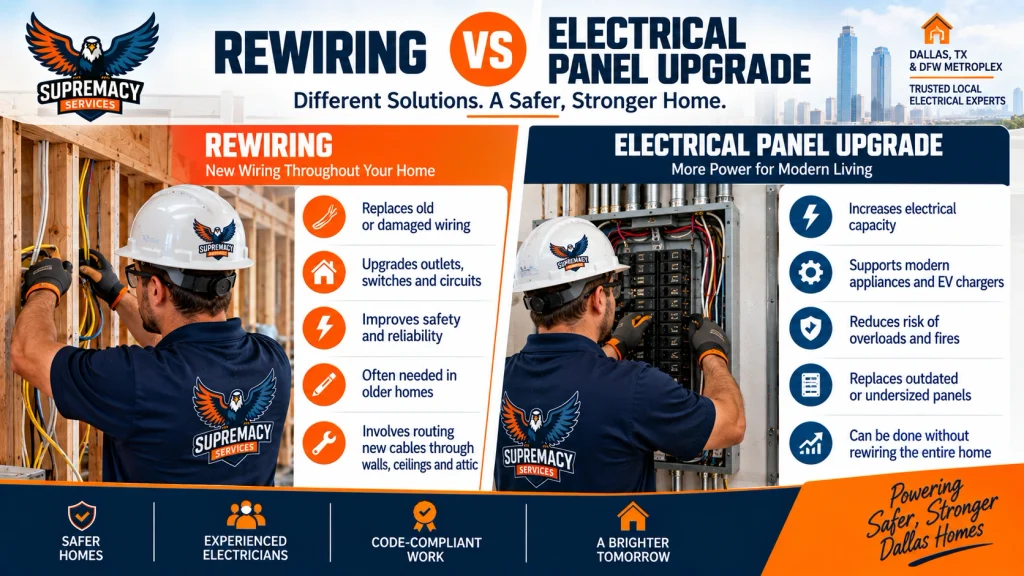
Supremacy Services electricians comparing whole-home electrical rewiring with a residential electrical panel upgrade
Rewiring and panel upgrades solve different electrical problems: rewiring addresses circuits and conductors, while a panel upgrade addresses electrical distribution equipment and capacity.

Rewiring replaces electrical conductors and circuits throughout the home. A panel upgrade replaces or expands the equipment that distributes power to those circuits. They are related projects, but they are not the same service.

This distinction is particularly important for searchers comparing electrical upgrade costs.

RewiringPanel upgrade
Focuses on wiring/circuitsFocuses on distribution equipment
May affect many roomsUsually concentrated around the panel/service
Often involves routing cable through wallsTypically involves replacing or modifying panel equipment
May be partial or whole-homeCan occur without replacing household wiring
Panel evaluation is part of planningWiring evaluation may reveal separate deficiencies

Supremacy Services maintains a dedicated electrical panel upgrade service for homeowners whose primary problem is panel capacity or condition rather than widespread branch wiring.


Dallas Permits and Electrical Requirements

Electrical rewiring should not be treated like an ordinary DIY cosmetic renovation.

The Texas Department of Licensing and Regulation states that people performing non-exempt electrical work in Texas must be licensed and that this work must be performed through a licensed electrical contractor. TDLR defines electrical work to include installing, maintaining or extending electrical wiring systems.

The City of Dallas also states that electrical work must be performed by a licensed electrician unless a homeowner demonstrates the required knowledge and expertise to the Chief Electrical Inspector. Dallas further states that permits are required for electrical work unless exempted under the applicable city code.

Dallas’ permitting directory includes a Residential Electrical Permit and inspections for rough wiring and final electrical work.

What About the Electrical Code?

Homeowners should verify the current adopted requirements for their project rather than relying on an old blog article or assuming a particular edition of the National Electrical Code applies.

The City of Dallas Electrical Section publishes its current code information and local amendments.

That is particularly important because municipal code adoption changes over time.

Can You Rewire a House Yourself?

Whole-house rewiring is generally not an appropriate DIY project for most homeowners.

The City of Dallas specifically states that electrical work must be performed by a licensed electrician unless a homeowner demonstrates sufficient knowledge and expertise to the Chief Electrical Inspector. Required permits still apply unless the work qualifies for an exemption.

A rewire involves much more than pulling cable.

It requires correct conductor sizing, circuit protection, grounding and bonding, box installation, routing, termination, load considerations, code compliance, testing and inspection.

Mistakes can remain concealed inside walls.

For homeowners, the safer role is usually to understand the scope, compare written proposals, ask questions and verify licensing rather than attempt the electrical installation themselves.


What to Expect During a Professional Rewire

Step 1: Electrical Assessment

The electrician evaluates the existing wiring, panel, circuits, grounding and areas where problems have been reported.

Step 2: Define the Scope

The contractor determines whether the property needs:

  • isolated circuit repair;
  • partial rewiring;
  • renovation wiring;
  • whole-house rewiring;
  • panel work; or
  • a combination of services.
Step 3: Create a Written Estimate

The proposal should identify what is being replaced and clearly state exclusions.

Step 4: Permitting

Required permits should be obtained before regulated work begins.

Step 5: Routing and Installation

New circuits are routed through accessible cavities, attic areas and other approved pathways.

Where access is limited, openings may be necessary.

Step 6: Device and Panel Connections

Circuits are terminated at the appropriate outlets, switches, fixtures, equipment and distribution equipment.

Step 7: Inspection and Testing

Required inspections are completed and circuits are tested before the project is considered finished.

Step 8: Restoration

Any drywall, plaster, texture or paint affected by access openings is restored according to the responsibilities established in the contract.

How to Compare Rewiring Estimates

Do not compare only the bottom-line price.

Use this checklist:

  • Is the scope partial or whole-home?
  • How many circuits are being replaced?
  • Are outlets and switches included?
  • Is panel work included?
  • Are permit and inspection costs included?
  • Who handles permit coordination?
  • Is drywall/plaster repair included?
  • Is painting included?
  • What happens to abandoned old wiring?
  • Is cleanup included?
  • What testing is performed?
  • What workmanship warranty is provided?
  • Is the contractor properly licensed for the work?

When two bids differ substantially, ask both contractors to explain the scope line by line.

The cheapest proposal can simply contain fewer services.

Dallas/DFW Considerations

Dallas contains housing from many construction eras, so electrical conditions can vary significantly from one neighborhood and property to another.

Rather than assuming that every “older Dallas house” requires rewiring, base the decision on the actual electrical system.

Remodeling also creates an opportunity to coordinate electrical work while walls are already accessible. If a kitchen, addition or major interior renovation is planned, having the wiring evaluated before finishes are installed can reduce unnecessary reopening of completed surfaces.

Likewise, homeowners adding substantial new electrical loads—such as an EV charger or major electric equipment—should have both the circuits and panel capacity evaluated.

How to Keep Rewiring Costs Under Control

You cannot safely reduce a rewiring budget by cutting required electrical work, but you can make the project easier to price and coordinate.

Get the Scope Diagnosed First

Do not request a “whole-house rewire” simply because one breaker trips.

Diagnosis comes before replacement.

Coordinate With Planned Renovations

If walls will already be open, discuss wiring before drywall and finishes are completed.

Compare Equal Scopes

Ask contractors to identify the same major inclusions so you are not comparing a bare electrical quote with a turnkey proposal.

Separate Optional Improvements

If you are also considering smart switches, lighting changes, EV charging or other upgrades, request them as identifiable line items.

That makes the essential rewiring cost easier to understand.

When Should You Call an Electrician?

Arrange professional evaluation when electrical symptoms are recurring, affect multiple areas of the house, involve visible damage, or suggest overheating.

You should also consider an assessment before a major renovation when existing wiring will become inaccessible again after walls are closed.

Supremacy Services provides residential electrical diagnostics and rough wiring, repair and rewiring services in Dallas and the DFW area for homeowners who need the underlying condition assessed before deciding between repair, partial rewiring and a larger electrical upgrade.


Frequently Asked Questions

How much does it cost to rewire a house in Dallas?

Current Dallas market estimates published by Angi put rewiring labor and materials around $2–$4 per square foot, but whole-home quotes can vary substantially according to access, circuit count, home condition, panel work, permits and restoration requirements.

How much does it cost to rewire a 2,000-square-foot house?

A simple multiplication of a published $2–$4-per-square-foot Dallas market benchmark would imply roughly $4,000–$8,000, but homeowners should not treat that calculation as a contractor quote. Finished-wall access, circuit complexity, panel/service work and repairs can materially change the total.

Does rewiring include a new electrical panel?

Not necessarily. Panel replacement and house rewiring are separate scopes. Ask whether panel or service work is specifically included in the written proposal.

Can I rewire only part of my house?

Yes, when the electrical problem or renovation is limited to particular circuits or areas and the remaining system is suitable to remain in service. An electrician should determine the appropriate scope.

Does Dallas require a permit for house rewiring?

Dallas states that permits are required for electrical work unless the work falls under an applicable exemption. The city has a Residential Electrical Permit category and electrical inspection requirements.

Do electricians have to be licensed in Texas?

Texas requires people performing non-exempt electrical work to be appropriately licensed, and TDLR states that such work must be performed through a licensed electrical contractor.

How long does whole-house rewiring take?

There is no reliable universal duration. Home size, access, number of circuits, inspections, wall openings and other project conditions affect the schedule. A contractor should provide a project-specific timeline after evaluating the house.

Do you have to remove drywall to rewire a house?

Not always. Electricians can sometimes route wiring through accessible attics and existing cavities, but strategic openings may be required when pathways are inaccessible. Ask how access openings and restoration will be handled before work begins.

Is an electrical panel upgrade the same as rewiring?

No. A panel upgrade changes the equipment distributing electricity to the circuits; rewiring replaces or modifies the conductors supplying outlets, lights and equipment throughout the home.


Get a Rewiring Assessment Before You Budget Around a Generic Price

The most useful rewiring estimate is not the one with the neatest price-per-square-foot calculation. It is the one based on your home’s actual wiring, access, circuits, electrical loads and panel condition.

If you are seeing recurring electrical problems or planning a major Dallas-area renovation, schedule an electrical wiring assessment with Supremacy Services to determine whether you need a repair, partial rewire, whole-home rewire or related panel work.

That gives you a defined scope before you make a major investment in the electrical system.