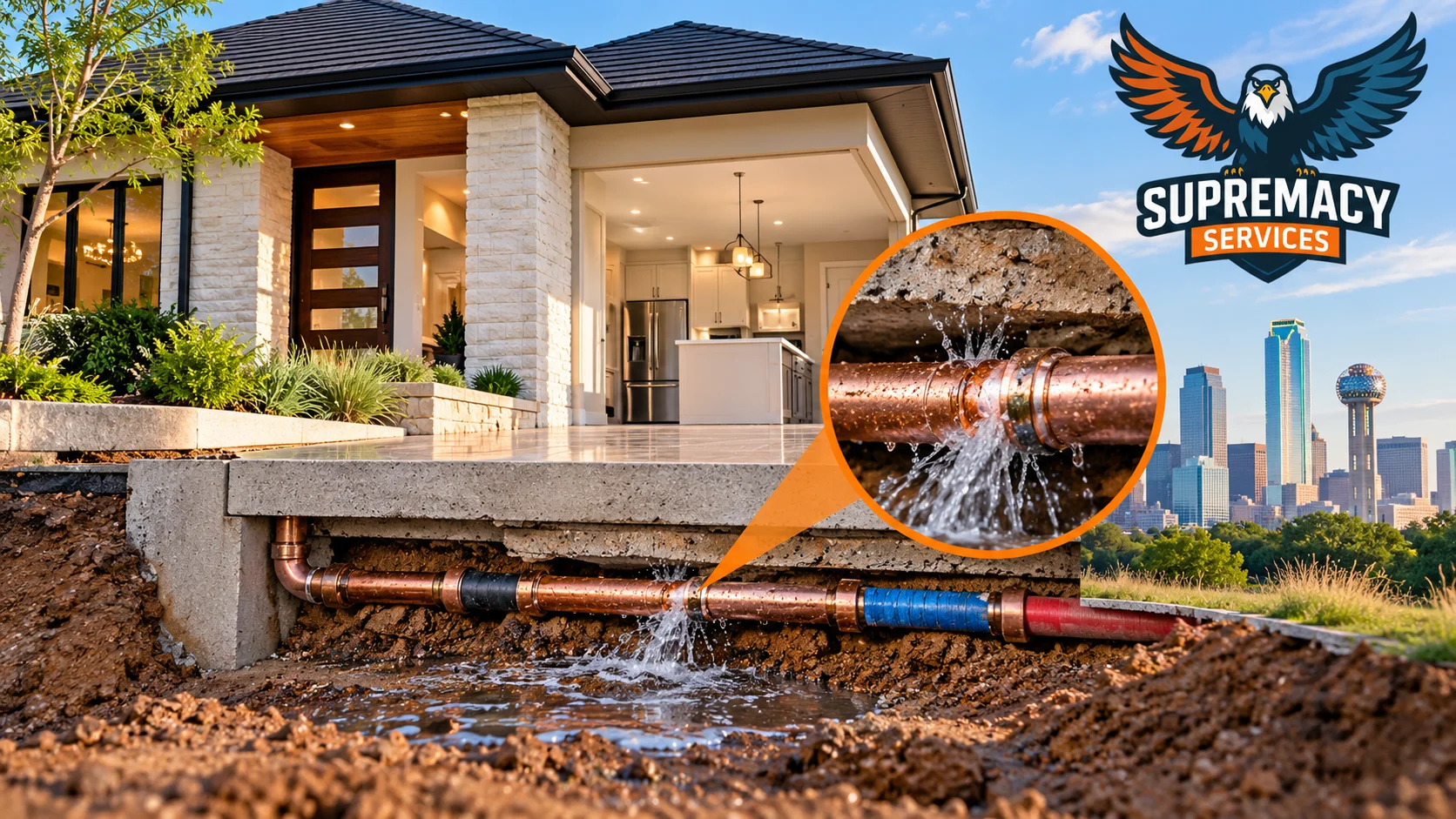
A slab leak can be one of the harder plumbing problems to diagnose because the leaking water line may be buried beneath the concrete foundation rather than exposed inside a wall or cabinet.
For Dallas homeowners, slab leak repair cost depends heavily on where the leak is located, how easily the pipe can be reached, whether the damaged section can be repaired directly, and whether rerouting part of the plumbing system makes more sense.
As a broad 2026 market reference, Angi reports national slab-leak projects commonly ranging from approximately $630 to $4,400, with an average around $2,280, including detection. Those figures are not a Dallas price quote. A complicated under-slab repair involving concrete removal, flooring restoration or extensive repiping can differ substantially.
The most useful first step is therefore not choosing a repair method—it is determining exactly where the leak is and which pipe has failed.
Table of Contents
- What Is a Slab Leak?
- How Much Does Slab Leak Repair Cost in Dallas?
- What Affects Slab Leak Repair Cost?
- How Are Slab Leaks Detected?
- Slab Leak Repair Methods
- Repair Through the Slab vs. Rerouting
- Warning Signs of a Slab Leak
- What Causes Slab Leaks?
- Slab Leak or Another Plumbing Problem?
- Can You Repair a Slab Leak Yourself?
- What to Expect During Professional Repair
- Dallas Permits and Water-Bill Considerations
- How to Reduce the Risk of Future Leaks
- FAQs
What Is a Slab Leak?
A slab leak is a plumbing leak in a water line located beneath or within a home’s concrete slab foundation.
Unlike a leaking faucet or exposed pipe, the source may not be visible. Water can escape below the flooring or foundation for some time before homeowners notice obvious symptoms.
Slab leaks should also be distinguished from several other problems:
- a leaking water service line outside the foundation;
- a drain or sewer-line failure;
- a leaking appliance connection;
- a toilet or fixture leak;
- moisture entering from outside the structure; or
- an above-slab pipe leaking inside a wall.
Determining which problem you actually have matters because the appropriate repair—and its cost—can be completely different.
How Much Does Slab Leak Repair Cost in Dallas?
There is no reliable single flat price for slab leak repair in Dallas because accessibility and repair method can change the scope dramatically.
Current national consumer-market data from Angi places many slab-leak projects between approximately $630 and $4,400, with a reported 2026 average of about $2,280 including detection. Treat that as a budgeting benchmark rather than a Dallas-specific quote.
Angi separately reports that ordinary pipe-leak repairs in Dallas average around $516, with many projects between approximately $258 and $876. That Dallas figure covers pipe-leak repair generally and should not be interpreted as the expected price of an under-slab project.
Why slab-leak pricing varies so much
Consider two homes with similar leaking pipes.
In the first, the plumber pinpoints a leak beneath an accessible utility area and can expose a small section of slab.
In the second, the failed line runs beneath finished flooring, cabinets or another difficult area. The plumber may recommend rerouting the line rather than opening the slab.
Both homes technically have a “slab leak,” but the labor, access and restoration requirements are very different.
Budget for the entire project—not just the pipe
A complete estimate may need to account for:
| Cost component | Why it matters |
|---|---|
| Leak detection | Determines where the leak is before demolition begins |
| Plumbing repair | Repairs, isolates or replaces the failed line |
| Access | May involve opening concrete, flooring, walls or ceilings |
| Pipe material and length | Influences materials and labor |
| Rerouting/repiping | May replace the need to access the pipe beneath the slab |
| Concrete restoration | Required when direct slab access is used |
| Flooring/finish restoration | Tile, hardwood, cabinets or drywall may require separate work |
| Permit/inspection | Depends on the scope and local requirements |
| Water damage remediation | Separate from the plumbing repair if significant damage occurred |
Homeowner tip: When comparing estimates, ask whether the quote includes leak detection, access, plumbing work, concrete repair and finish restoration—or only the plumbing portion.
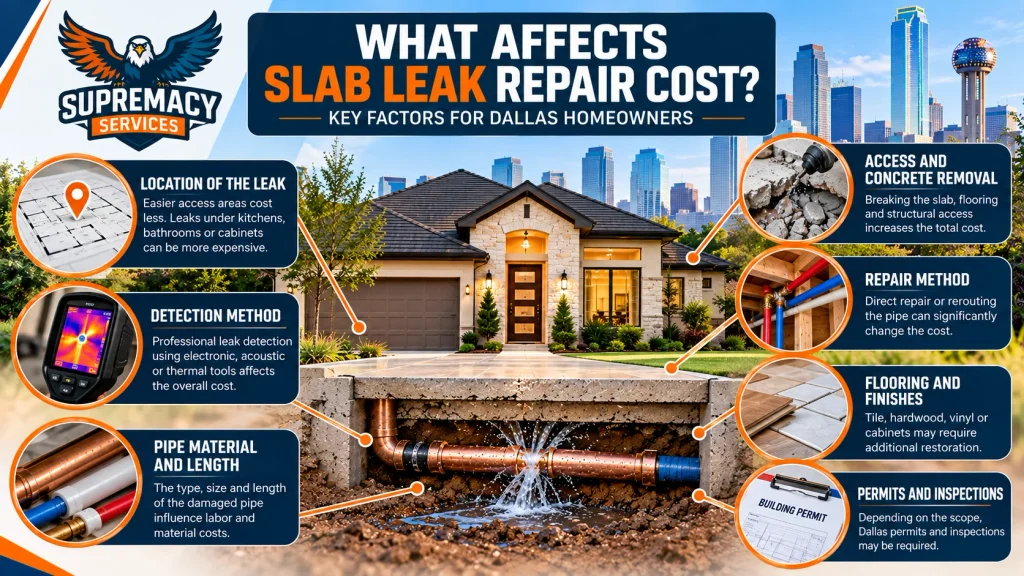
What Affects Slab Leak Repair Cost?
1. The exact location of the leak
Accessibility is one of the largest cost variables.
A leak underneath an open utility area can be much simpler to reach than one underneath a kitchen island, bathroom, built-in cabinetry or expensive finished flooring.
2. Whether the leak has already been located
Accurate diagnosis helps prevent unnecessary exploratory demolition.
A plumber may first confirm that the pressurized water system is losing water and then use specialized equipment to narrow down the leak location.
3. Direct repair versus rerouting
Sometimes accessing the damaged pipe through the concrete is practical.
In other situations, abandoning the failed underground section and installing a new route through accessible walls, ceilings or attic areas may reduce structural disruption.
The best choice depends on the plumbing layout, pipe condition and leak location—not simply which option sounds less invasive.
4. How much piping is affected
One isolated failure may justify a localized repair.
Repeated leaks or deterioration across a larger piping system may prompt a discussion about rerouting or repiping rather than continuing to repair individual failures.
5. Flooring and interior finishes
Breaking concrete is only part of the restoration equation.
Tile, hardwood, luxury vinyl, cabinets and other finishes can materially affect total project cost.
6. Emergency conditions
An actively leaking pipe that cannot be isolated may require faster intervention than a small, contained leak.
If water is escaping rapidly, shut off the appropriate water supply when it is safe to do so and arrange professional diagnosis.
How Are Slab Leaks Detected?
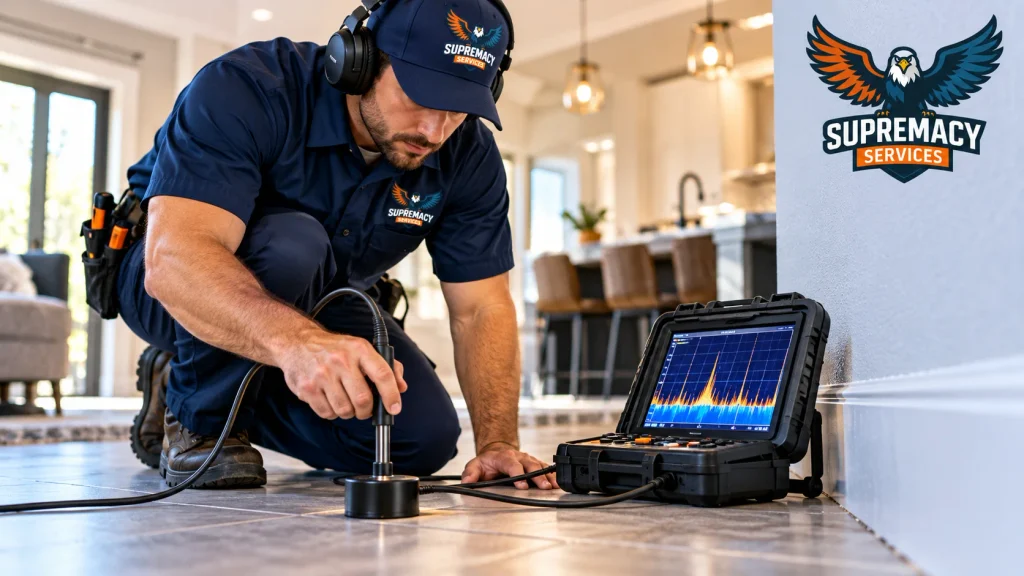
Professional slab leak detection usually begins by confirming that the plumbing system is actually losing water, then narrowing down the location before opening the slab.
The objective is to avoid unnecessary demolition.
Common diagnostic approaches include:
Water-meter testing
With all fixtures and water-using appliances turned off, unexpected meter activity can indicate water is still flowing somewhere in the system.
This test can suggest a leak, but it does not tell you where the leak is.
Pressure testing
A plumber can test sections of the water-supply system to determine whether pressure is being lost.
This can help distinguish a pressurized supply-line leak from other sources of moisture.
Acoustic leak detection
Escaping pressurized water creates sound and vibration.
Specialized listening equipment can help technicians narrow down the source beneath floors or concrete.
Thermal imaging
Temperature differences associated with leaking hot-water lines can sometimes produce patterns detectable with infrared equipment.
Thermal imaging is a diagnostic aid—not proof by itself of the precise location or cause of a leak.
Isolation testing
When necessary, sections of the plumbing system can be isolated to determine which branch contains the failure.
Supremacy’s existing Water Leak Detection service describes acoustic, infrared, electronic and pressure-testing approaches for locating hidden plumbing leaks before unnecessary cutting or demolition.
Suspect a hidden leak but do not know where it is? Schedule professional water leak detection before deciding how the slab should be repaired.
Slab Leak Repair Methods
Once the leak has been located, the plumber can recommend a repair based on the pipe condition, location and accessibility.
Direct access through the slab
This approach involves opening the flooring and concrete near the confirmed leak location, exposing the pipe and repairing the damaged section.
May make sense when:
- the failure is highly localized;
- the pipe is reasonably accessible;
- the surrounding piping appears serviceable; and
- opening the slab is less disruptive than rerouting the line.
Potential disadvantages:
- concrete must be opened;
- flooring may be damaged or removed;
- dust/noise must be managed;
- the slab and finishes require restoration afterward.
Rerouting the affected water line
Instead of reopening the original underground route, the plumber may disconnect or abandon the failed section and install a replacement line through an accessible route.
Depending on the home, that could involve walls, ceilings or other accessible spaces.
Rerouting may be considered when:
- the leak is beneath an especially difficult area;
- direct access would cause excessive damage;
- the affected run can be replaced through a practical alternative route; or
- the condition of the original line makes another localized underground repair unattractive.
Repiping a larger section
A single slab leak does not automatically mean a home needs to be repiped.
However, multiple failures or broader pipe deterioration can change the economics. Homeowners should ask whether the diagnosed problem appears isolated or whether there is evidence of a more widespread piping issue.
Repair Through the Slab vs. Rerouting
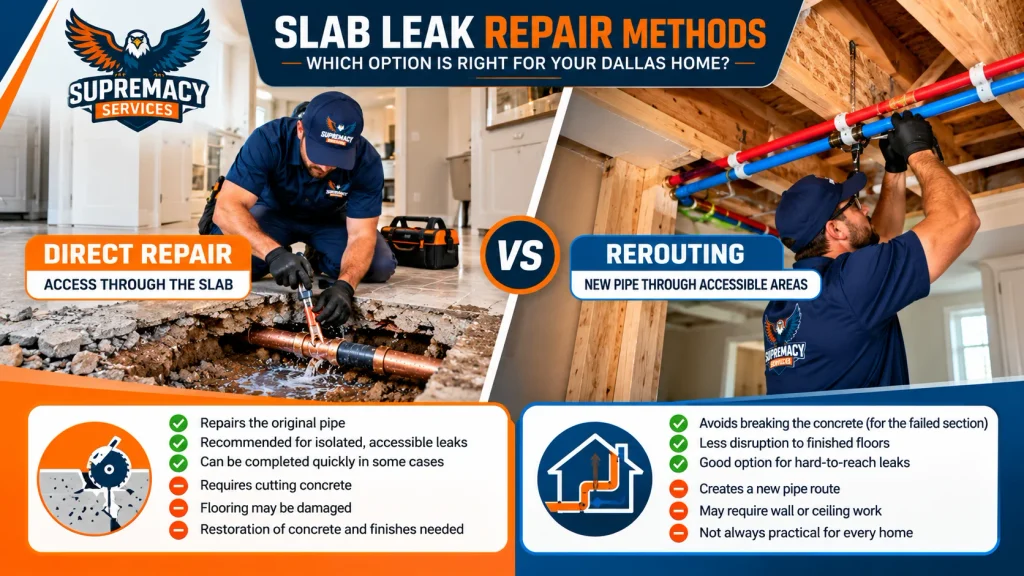
| Question | Direct slab access | Rerouting |
|---|---|---|
| Does the original pipe get exposed? | Yes | Usually no |
| Concrete opening required? | Usually | Often avoided for the failed section |
| Best for isolated accessible leak? | Often | Depends |
| Can it avoid finished-floor demolition? | Not always | Potentially |
| Changes pipe routing? | No | Yes |
| Restoration required? | Concrete/flooring | Walls/ceilings may require repair |
| Best option determined by | Leak location and pipe condition | Layout and practical alternative route |
There is no universally superior method.
A properly diagnosed leak beneath an accessible section of slab may be straightforward to repair directly. A leak under expensive flooring or difficult structural features may make rerouting more practical.
Have a confirmed under-slab leak? Ask Supremacy Services to compare direct repair and rerouting options based on the actual location and condition of your plumbing.
Warning Signs of a Slab Leak
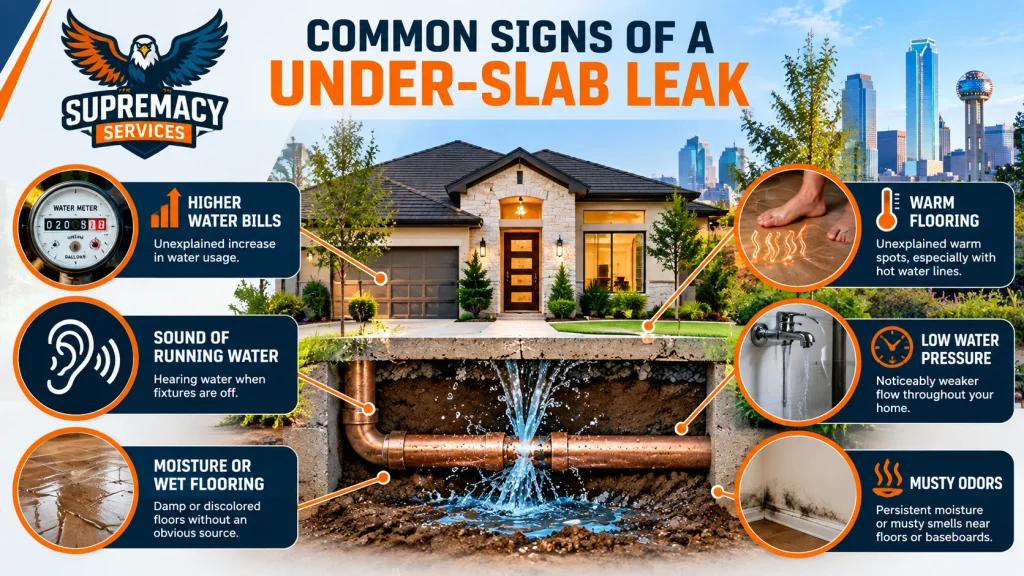
A slab leak can produce several symptoms, but none of these signs alone proves that the pipe beneath your foundation is leaking.
Unexplained increase in water usage
If household habits have not changed but water consumption rises, investigate for leaks.
Dallas Water Utilities notes that customers pay for water passing through the meter whether the water is intentionally used or lost through a leak.
Water meter movement when everything is off
Turn off faucets, fixtures and water-using appliances.
If the meter continues registering usage, water may be escaping somewhere downstream of the meter.
Sound of running water
Hearing water movement when fixtures are not operating can justify further investigation.
Warm flooring
An unexplained warm area can sometimes accompany a leaking hot-water line beneath the slab.
However, warm flooring alone is not sufficient to diagnose a slab leak.
Damp or discolored flooring
Moisture appearing without an obvious spill or fixture leak warrants investigation.
Reduced water pressure
A significant supply-line leak can affect available pressure, although low pressure has many other potential causes.
Musty odors or persistent moisture
Hidden moisture may affect flooring, baseboards and nearby building materials.
The source still needs to be identified before assuming it originates beneath the slab.
What Causes Slab Leaks?
Slab leaks can result from several different mechanisms rather than one single Dallas-specific cause.
Aging or deteriorated pipe
Plumbing materials can deteriorate over time depending on pipe type, installation, water conditions and service history.
Failed joints or fittings
The failure may occur at a fitting or connection rather than along a straight pipe section.
Installation-related problems
Improper installation, damaged pipe or excessive stress at a connection can contribute to premature failure.
Movement and mechanical stress
Pipes should be installed so that normal movement and expansion do not create damaging stress.
A professional diagnosis should focus on the actual failed component rather than assuming every under-slab leak has the same cause.
Slab Leak or Another Plumbing Problem?
Several common problems can imitate some of the symptoms of a slab leak.
| Symptom | Possible slab leak | Other possibilities |
|---|---|---|
| High water bill | Yes | Running toilet, irrigation leak, fixture leak |
| Wet floor | Yes | Appliance, toilet, shower or supply-line leak |
| Low water pressure | Possible | Valve issue, main-line problem, fixture restriction |
| Wet yard | Less typical for interior slab leak | Service-line or irrigation leak |
| Sewer odor | Not typical of clean-water slab leak | Drain/sewer problem |
| Warm floor | Possible hot-water leak | Radiant heat or environmental causes |
| Foundation moisture | Possible | Drainage or exterior water intrusion |
Slab leak vs. main water-line leak
A slab leak occurs beneath or within the foundation area.
A main/service water-line leak can occur between the municipal connection/meter and the house, often outside the slab.
Supremacy already has a dedicated Water Line Repair and Replacement service page for broader water-line failures, so homeowners with wet yards, service-line problems or whole-property pressure issues should be directed there rather than treating every underground leak as a slab leak.
Slab leak vs. sewer-line problem
A pressurized water-supply leak and a damaged sewer line require different diagnostic methods and repairs.
Recurring drain backups, widespread slow drains, sewage odors and wastewater appearing where it should not are stronger reasons to investigate the drainage/sewer system.
Can You Repair a Slab Leak Yourself?
Diagnosing and repairing a concealed under-slab plumbing leak is generally a poor DIY project because accurate location, pipe isolation, concrete access and code compliance may all be involved.
Texas does provide a homeowner exemption allowing qualifying property owners to perform plumbing work on their own homestead, but that does not eliminate applicable local permit, inspection or code requirements. The Texas State Board of Plumbing Examiners specifically advises homeowners to check municipal requirements.
The City of Dallas likewise states that qualifying homeowners performing their own plumbing work must obtain permits and inspections when required and comply with applicable plumbing codes.
A homeowner can still perform useful preliminary observations:
- check whether all fixtures are off;
- look at the water meter;
- document unexplained water usage;
- identify visible moisture;
- note whether the problem appears associated with hot or cold water;
- locate the main shutoff before an emergency occurs.
Avoid breaking flooring or concrete simply because a wet or warm area appears nearby. Water can travel away from the actual pipe failure.
What to Expect During Professional Slab Leak Repair

A well-planned slab leak project generally follows a diagnostic sequence rather than starting with demolition.
Step 1: Confirm the leak
The plumber determines whether the water-supply system is actually losing water.
Step 2: Narrow down the affected line
Testing helps determine which portion of the plumbing system is involved.
Step 3: Locate the leak
Diagnostic equipment and testing are used to narrow down the likely failure point.
Step 4: Evaluate the pipe and access
The plumber considers:
- leak location;
- pipe material;
- accessibility;
- surrounding finishes;
- plumbing layout;
- condition of the affected run; and
- whether other failures are evident.
Step 5: Compare repair methods
The homeowner should receive an explanation of why direct repair, rerouting or a broader piping solution is being recommended.
Step 6: Obtain required permits when applicable
The permitting requirement depends on the work being performed.
Dallas currently uses the 2021 International Plumbing Code with local amendments.
Step 7: Complete the plumbing work
The damaged section is repaired or bypassed according to the selected method.
Step 8: Verify the repair
The system should be checked after repair to confirm that the diagnosed leak has been addressed.
Step 9: Restore affected finishes
Depending on the repair method, this may include concrete, flooring, drywall, paint or other finish work.
Dallas Permits and Water-Bill Considerations
Does slab leak repair require a permit in Dallas?
It depends on the scope.
The City of Dallas lists stopping a leak without replacing or rearranging valves, pipes or fixtures among work that may not require a permit. More substantial plumbing alteration or replacement may require permitting and inspection.
Because slab-leak projects can involve pipe replacement or rerouting, homeowners should verify the requirements for their specific repair rather than assuming the project is exempt.
For permitted professional plumbing work, Dallas states that a licensed Master Plumber registered with the city may obtain a plumbing permit.
Can Dallas homeowners get a water-bill adjustment after a leak?
Potentially.
Dallas Water Utilities operates a Leak Adjustment Program for qualifying leaks that cause substantial increases in water consumption. The city states that an approved adjustment is limited to one adjustment per 12-month period and a maximum of three months of affected usage.
The program adjusts eligible excess water consumption; it does not reimburse the plumbing repair itself. Repairs must be completed and supporting information is required.
Keep:
- the repair date;
- detailed description of the work;
- plumber’s invoice;
- property/service address; and
- relevant account information.
These records can also help document when the problem was corrected.
How to Reduce the Risk of Future Leaks
Not every slab leak can be prevented, but early detection can reduce the amount of water lost before a hidden problem is found.
Watch your normal water usage
A sudden unexplained change deserves attention.
Investigate recurring leaks
If a property has experienced more than one piping failure, ask whether the leaks appear unrelated or indicate deterioration affecting a larger part of the system.
Do not ignore unexplained moisture
Water showing up around floors, baseboards or cabinets should have an identified source.
Know where your shutoff is
Being able to stop water quickly can be valuable during an active plumbing failure.
Keep plumbing records
Knowing the age, material and previous repair history of the plumbing system gives future plumbers useful context.
Questions to Ask Before Approving a Slab Leak Repair
Before signing a repair proposal, ask:
- How was the leak confirmed?
- How precisely has it been located?
- Which pipe or branch has failed?
- Is the failure isolated?
- Why are you recommending direct repair or rerouting?
- What areas of the home need to be opened?
- Who restores the concrete, flooring or drywall?
- Is restoration included in this estimate?
- Does the repair require a permit?
- What testing will be performed after repair?
- What parts and labor warranties apply?
- Could another section of the same piping system be at risk?
A clear diagnosis should come before a major repair recommendation.
Slab Leak FAQs
How much does it cost to repair a slab leak in Dallas?
There is no reliable flat Dallas price. As a national 2026 market benchmark, Angi reports many slab-leak projects between about $630 and $4,400, averaging roughly $2,280 including detection. Dallas pricing will depend on location, access, repair method and restoration requirements.
How do plumbers know where a slab leak is?
Plumbers can combine water-meter observations, pressure or isolation testing, acoustic equipment, electronic leak detection and other diagnostic methods. The goal is to narrow down the failed line before opening finished surfaces.
Do you have to break the concrete to fix a slab leak?
Not always. Some leaks are repaired by accessing the pipe through the slab. In other situations, the affected line can be rerouted through a more accessible location.
Is rerouting better than repairing a pipe under the slab?
Neither method is automatically better. The appropriate choice depends on the leak location, pipe condition, plumbing layout and amount of disruption each method would require.
Does homeowners insurance cover slab leaks?
Coverage depends on the policy, cause of loss and circumstances. Plumbing repair and resulting water damage may also be treated differently. Homeowners should review their policy and ask their insurer what documentation is required before assuming coverage.
Can a slab leak increase my Dallas water bill?
Yes. A leak in a metered water-supply line can increase recorded water consumption. Dallas Water Utilities notes that customers are responsible for water passing through their meter, although qualifying customers may request a leak adjustment after repairs.
How urgent is a slab leak?
An active leak should be investigated promptly. The urgency increases when water loss is significant, moisture is entering finished areas, pressure is dropping or the leak cannot be isolated.
Can I find a slab leak using my water meter?
The meter can help indicate whether water is flowing while fixtures are off, but it cannot identify the leak’s exact location. A running meter could indicate several types of plumbing leaks.
Should I repair one leak or repipe the house?
One isolated failure does not automatically justify repiping. If there have been repeated failures or widespread deterioration, however, comparing continued spot repairs with a broader piping solution may be worthwhile.
Need Help Locating an Under-Slab Leak in Dallas?
A slab leak repair should begin with evidence, not unnecessary demolition.
Supremacy Services provides leak detection and plumbing repair throughout Dallas and the DFW Metroplex. A professional assessment can determine whether the problem is actually beneath the slab, locate the affected line and compare repair approaches based on the home’s plumbing layout.
If the source has not yet been confirmed, start with professional water leak detection. If testing identifies a broader supply-line problem, review water line repair and replacement options before choosing the scope of work.