Rooftop HVAC replacement cost in Dallas depends on equipment capacity and the work needed to install it. As an early budgeting reference, published U.S. estimates place a standard 6–10 ton packaged rooftop replacement at $12,000–$30,000 installed. That is a national planning range, not a verified Dallas average or a Supremacy Services quote.
The useful number is the complete project price: suitable equipment, removal, lifting, roof connections, utilities and startup. A low equipment-only listing cannot tell you what your building will cost to finish.
This guide covers packaged rooftop units used on commercial properties and some homes. If your home has an outdoor condenser on the roof connected to an indoor furnace or air handler, confirm whether you have a split system before using commercial RTU estimates.
Table of contents
- What does a rooftop replacement cost?
- What should the installed price include?
- Why do rooftop replacement quotes differ?
- What matters specifically in Dallas and DFW?
- Should you repair the unit before replacing it?
- How should you compare replacement proposals?
- How can you control costs and prevent repeat problems?
- What can owners do themselves?
- Frequently asked questions
- Get a rooftop replacement plan for your property
What does a rooftop replacement cost?
Published estimates vary by capacity and installation scope. The following figures are useful starting points for a single packaged rooftop replacement.
| Packaged rooftop capacity | U.S. installed-cost planning range |
|---|---|
| 3–5 tons | $7,500–$16,000 |
| 6–10 tons | $12,000–$30,000 |
| 15–25 tons | $25,000–$60,000+ |
Source: PickHVAC’s commercial rooftop cost guide, published October 4, 2026. These estimates assume standard equipment, removal of one existing unit, ordinary crane access and basic connections, with no major structural work. Dallas proposals can fall outside them. Unlisted capacities require their own estimate; do not interpolate a price from the table.
Confirm which kind of system you have
A packaged rooftop unit, usually called an RTU, contains its principal cooling components and, where fitted, heating equipment in one outdoor cabinet. A split system has components in separate indoor and outdoor assemblies. ENERGY STAR’s system definitions explain that distinction.
For a homeowner, a photograph of a rooftop cabinet may not establish the configuration. Share the model information already in your records and ask the contractor what the replacement includes. Replacing a roof-mounted condenser alone is a different scope from replacing an entire packaged RTU.
What should the installed price include?
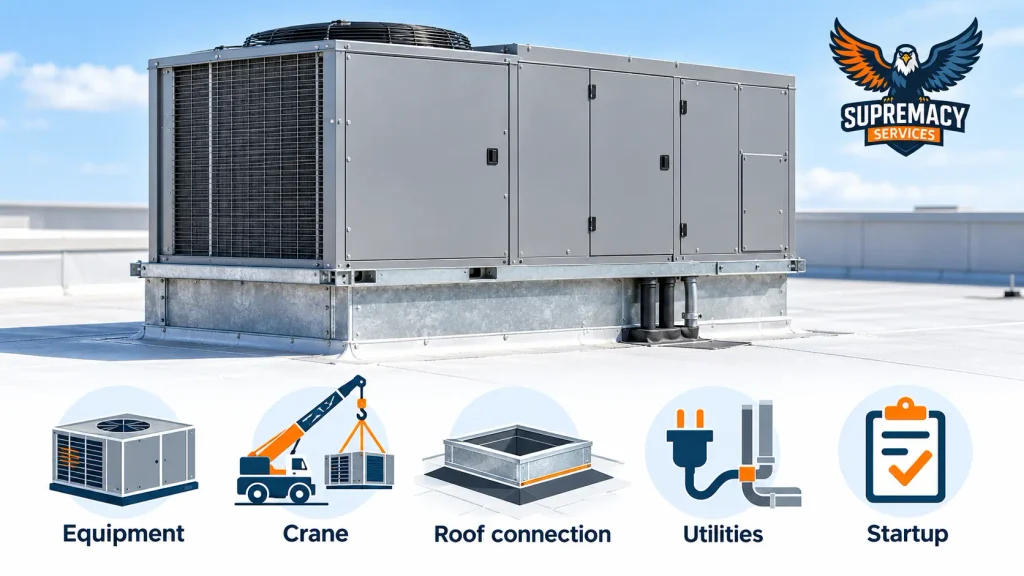
A complete proposal should identify the equipment and every installation task included in the total. Ask the contractor to mark each item as included, excluded or subject to an allowance.
| Project item | What to confirm in writing |
|---|---|
| New equipment | Exact model, capacity, heating type, efficiency rating and options |
| Removal and disposal | Existing equipment removal, applicable refrigerant handling and haul-away |
| Crane and rigging | Whether the lift is included and what access assumptions apply |
| Roof curb and roofing | Reuse, adapter or replacement; responsibility for flashing and roof repairs |
| Duct connections | Transitions, sealing and any separate airflow corrections |
| Utilities | Electrical compatibility and modifications, gas work where applicable, condensate drainage |
| Controls and ventilation | Thermostat or building-control integration, outdoor-air settings and included accessories |
| Permits and inspections | Who obtains approvals, pays fees and closes out required inspections |
| Startup and handover | Manufacturer-prescribed checks, operating settings, documentation and warranty terms |
A crane charge may already be included in an installed quote. Confirm that before adding another crane allowance to your budget.
Ask separately about tax treatment, major structural or electrical work, temporary cooling, premium scheduling and any roof repair excluded from the base price.
For help defining your project’s scope, explore Supremacy Services’ rooftop HVAC installation and replacement services.
Why do rooftop replacement quotes differ?
Two units with the same nominal capacity can require different equipment, connections and installation work. Compare the assumptions behind each total.
Capacity and current building needs
Tonnage describes cooling capacity, not the unit’s physical weight. The existing capacity is a starting point for assessment.
Tell the contractor about changes in occupancy, operating hours, insulation, windows, lighting, kitchens or equipment. Ask for a load assessment before approving a larger unit or automatically matching the old one. DOE’s guidance on proactive rooftop replacement includes appropriate sizing and replacement timing in the planning process.
A larger purchase will not necessarily solve a duct or control problem.
Roof curb and installation fit
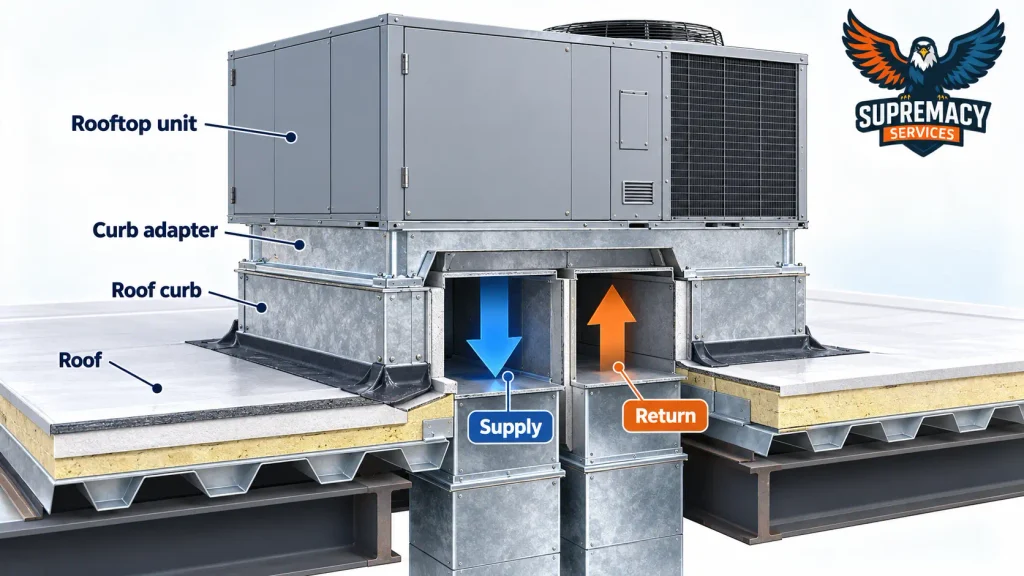
The curb is the raised base connecting the equipment to the roof and duct openings. Its dimensions, condition, support and airflow arrangement must suit the proposed unit.
Manufacturer roof-curb adapter instructions require checks of roof and curb support and account for the adapter’s effect on airflow. Depending on the actual installation, reinforcement or other modifications may be needed. shareddocs.com
Some replacement equipment is designed around compatible existing footprints. The proposal should explain whether your project needs a direct fit, an adapter or a new curb arrangement. Matching tonnage alone does not settle that question.
Crane access and project coordination
Ask where the crane will stand, what reach is required, how deliveries will enter the property and whether occupied areas need protection or temporary restrictions.
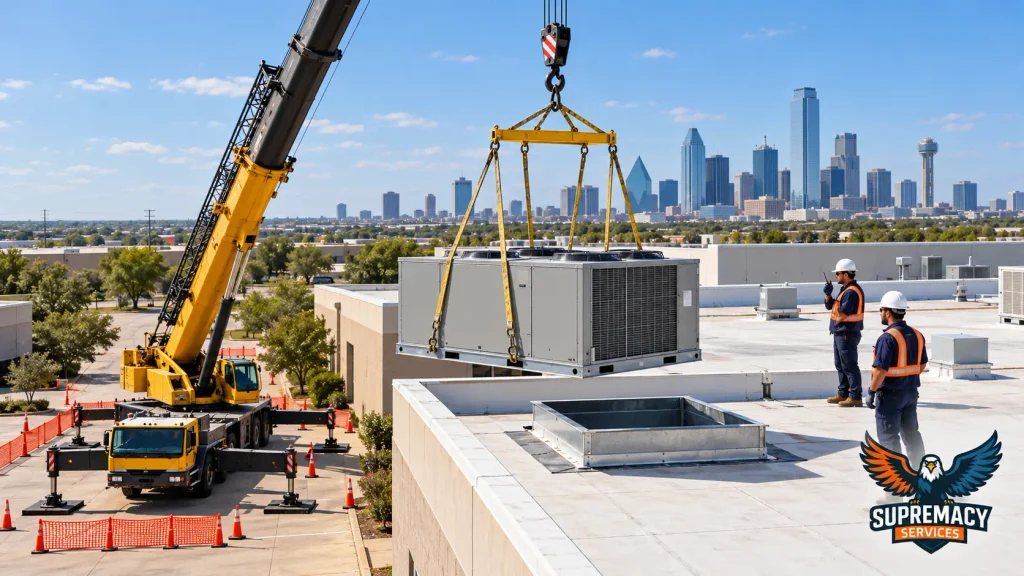
A clear lift plan helps explain the scope. Shared parking, adjacent buildings, overhead obstructions or limited access hours should be addressed before the price is treated as complete.
Confirm who handles any required access approvals. A lift over a private parking area and a project involving public access restrictions may involve different coordination.
Electrical, heating and controls
Ask whether the proposed equipment matches the available voltage and phase, and whether its electrical requirements call for modifications. For gas-heated equipment, have the quote identify the relevant gas connection work.
Controls also deserve a separate line of discussion. Establish whether the replacement will use a basic thermostat, connect to existing building automation or require additional controls. Have outdoor-air and ventilation needs checked against the space’s actual use.
The question is which of these tasks your proposal includes, rather than whether every project needs every possible upgrade.
Efficiency and ongoing costs
A higher purchase price can be worth evaluating when the equipment operates for many hours, but the savings calculation needs building-specific inputs.
Ask for the proposed model’s applicable efficiency rating and an explanation of the comparison. Use consistent assumptions for operating hours, weather, utility rates and building use. Pacific Northwest National Laboratory’s Rooftop Unit Comparison Calculator provides a screening approach that accounts for local climate and performance at different loads.
An estimate of cooling-energy savings is not a guarantee that the whole electricity bill will fall by the same percentage.
What matters specifically in Dallas and DFW?
Local climate, roof access and the property’s permitting jurisdiction should shape the proposal.
Summer conditions and exposed equipment
The National Weather Service describes Dallas–Fort Worth’s hot summers and seasonal severe weather. For replacement planning, that makes cooling performance, the condition of exposed equipment and weather-sensitive scheduling practical considerations.
Tell the contractor whether comfort problems occur only during the hottest afternoons, throughout the day or in one part of the building. Those patterns help focus the assessment; they do not establish the required capacity by themselves.
Have observed hail damage or deteriorated roof details assessed before assuming a new rooftop cabinet is the entire repair.
Dallas permits and nearby cities
The City of Dallas identifies HVAC replacement as mechanical-permit work. Have the contractor confirm the requirements for your exact scope and explain who obtains the permit and arranges inspections.
Electrical alterations, structural changes or roof work may need additional coordination. Do not assume every item is covered simply because a quote says “permit included.”
For properties in Plano, Frisco, Allen or another DFW municipality, confirm requirements with the jurisdiction where the building is located. If you lease the property, establish approval, payment and roof-access responsibilities before accepting the work.
Should you repair the unit before replacing it?
Get a diagnosis before using a replacement estimate as the answer to every cooling complaint. Replacement deserves evaluation when major deterioration, recurring failures or unsuitable performance make further repairs poor value.
A single repairable fault may justify keeping an otherwise serviceable unit. For the detailed decision, read our guide to rooftop HVAC repair versus replacement.
Several symptoms can have more than one explanation:
| What you notice | What to investigate before approving replacement |
|---|---|
| Weak cooling | Filters, coils, airflow, refrigerant condition, controls and actual building load |
| One persistently warm room or zone | Duct distribution, airflow balance, controls and localized heat gains |
| Frequent starting and stopping | Control settings, safety trips, operating conditions and equipment sizing |
| Water near a ceiling penetration | Condensate drainage, condensation and separate roof leakage |
| A higher electricity bill | Energy consumption, rates, weather, operating hours and equipment performance |
Manufacturer rooftop troubleshooting guidance illustrates why airflow, controls, refrigerant and electrical conditions must be distinguished.
Persistent hot spots may justify a duct inspection and airflow assessment before equipment selection. Our guide to commercial rooftop HVAC lifespan in North Texas provides additional context for aging equipment.
If inspection identifies an unsafe condition, follow the professional’s shutdown and repair guidance promptly. Do not keep resetting a unit that repeatedly trips.
How should you compare replacement proposals?
Compare complete projects with equivalent performance requirements, then examine the exclusions. The lowest total is difficult to judge when the bids describe different work.

Use this sequence:
- Identify each unit. Match the quote to the equipment and spaces it serves.
- Confirm the design. Compare capacity, heating configuration, electrical requirements, efficiency and included controls.
- Align installation scope. Check removal, lift, curb, roofing, ductwork, utilities and permits.
- Separate fixed prices from allowances. Ask what triggers an extra charge and how changes will be approved.
- Separate delivery from downtime. Request the equipment lead time, work schedule and expected period without heating or cooling.
- Check completion requirements. Ask for startup records, control settings, required inspections and operating instructions.
- Read warranty coverage. Establish the actual parts, labor, refrigerant and access-work terms. Check exclusions and registration requirements for the exact equipment.
For example, one proposal may reuse compatible utilities and include a curb adapter, while another includes new electrical work and roof repairs. The difference cannot be evaluated fairly until those scopes are reconciled.
A complete comparison also records temporary arrangements, financing costs where relevant, expected maintenance and projected energy use. Ask for the assumptions behind any claimed payback.
Ready to turn a planning range into a property-specific scope? Request a rooftop replacement assessment and discuss the equipment, access and installation work your proposal should address.
How can you control costs and prevent repeat problems?
Plan early, document the existing equipment and maintain the system you install. That gives you more information when comparing repairs, replacements and scheduling options.
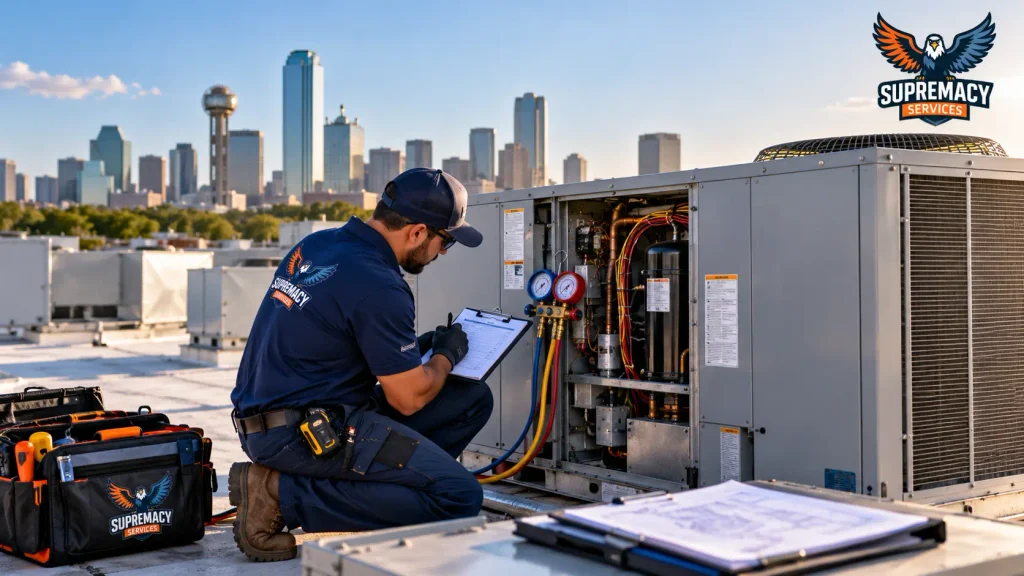
Useful steps include:
- Keep service invoices, model information and a separate history for each RTU.
- Ask whether compatible existing curbs, ducts, utilities and controls can be retained.
- Correct confirmed airflow or drainage problems that could persist after a changeout.
- For buildings with several units, request a condition-based replacement sequence and compare coordinated versus separate work.
- Agree on a maintenance plan based on the manufacturer’s instructions and actual operating conditions.
The national laboratory RTU maintenance guide emphasizes maintenance of items such as filters, coils, drains and controls, while preserving manufacturer-specific requirements.
Planning can improve your choice of equipment and scheduling. A particular offseason discount or guaranteed energy payback should only be included if supported by an actual offer or calculation.
What can owners do themselves?
Owners can prepare records and describe symptoms; rooftop replacement requires qualified professionals.
Collect utility bills, service history, operating schedules and equipment details already available to you. Note which areas are uncomfortable and when. Arrange building access through the owner or property manager.
Equipment lifting, electrical disconnection, refrigerant work, gas connections and commissioning involve hazards and specialized requirements. Manufacturer instructions call for trained, qualified personnel for rooftop installation and service.
Before hiring, verify the contractor’s active Texas license and confirm that its class and endorsement cover the proposed equipment. Ask for clear responsibility for any other trades involved.
Frequently asked questions
How much does a 5-ton rooftop HVAC replacement cost?
Use the 3–5 ton planning range above as an initial reference, then obtain a proposal for the exact model and property. A 5-ton label does not determine the heating configuration, roof fit, electrical work or installation scope.
Why can two 10-ton rooftop replacement quotes be different?
The units may differ in heating type, efficiency, controls or accessories. The bids may also include different amounts of crane, curb, duct, electrical and roof work. Compare model numbers and written inclusions before comparing totals.
Is crane service included in rooftop HVAC replacement?
It may be included in the installed price or listed separately. Ask the contractor to identify the lifting plan and any access assumptions. Avoid adding a second crane allowance when the quote already includes it.
Can the existing roof curb be reused?
Possibly, if its condition, dimensions, support and duct arrangement work with the new equipment. Some projects need an adapter or another modification. The contractor should verify compatibility before ordering the replacement.
Does using R-410A mean I must replace my unit now?
No. EPA explains that the HFC transition does not require retiring existing equipment simply because of its refrigerant. Condition and repair practicality still matter. Have the contractor confirm current requirements for any proposed new model; do not substitute a different refrigerant into equipment not designed for it.
Is rooftop replacement on a house priced like a commercial RTU?
Only comparable equipment and scope make a useful comparison. A house may have a packaged rooftop unit or a roof-mounted component of a split system. Identify the configuration first and request a complete residential proposal.
Can I replace one rooftop unit at a time?
A phased approach may be practical. Have the contractor check which spaces each unit serves and whether controls or ventilation affect sequencing. Prioritize condition and operational needs, then compare the logistics of separate versus coordinated replacements.
How long will the property be without cooling?
Ask for a shutdown plan separate from equipment delivery and permitting. Roof work, utility changes, weather, startup checks and the number of units affect the schedule. The proposal should identify affected spaces and any temporary arrangements.
Get a rooftop replacement plan for your property
A useful replacement proposal starts with your building, its equipment and the work needed to connect the two. Bring your service records, comfort concerns and any existing quotes so the assessment can address the same questions you are using to compare options.
Discuss your rooftop HVAC replacement with Supremacy Services to review suitable options and installation requirements for your Dallas or DFW property. Ask for a written scope that makes the equipment, installation work, exclusions and next steps clear.