
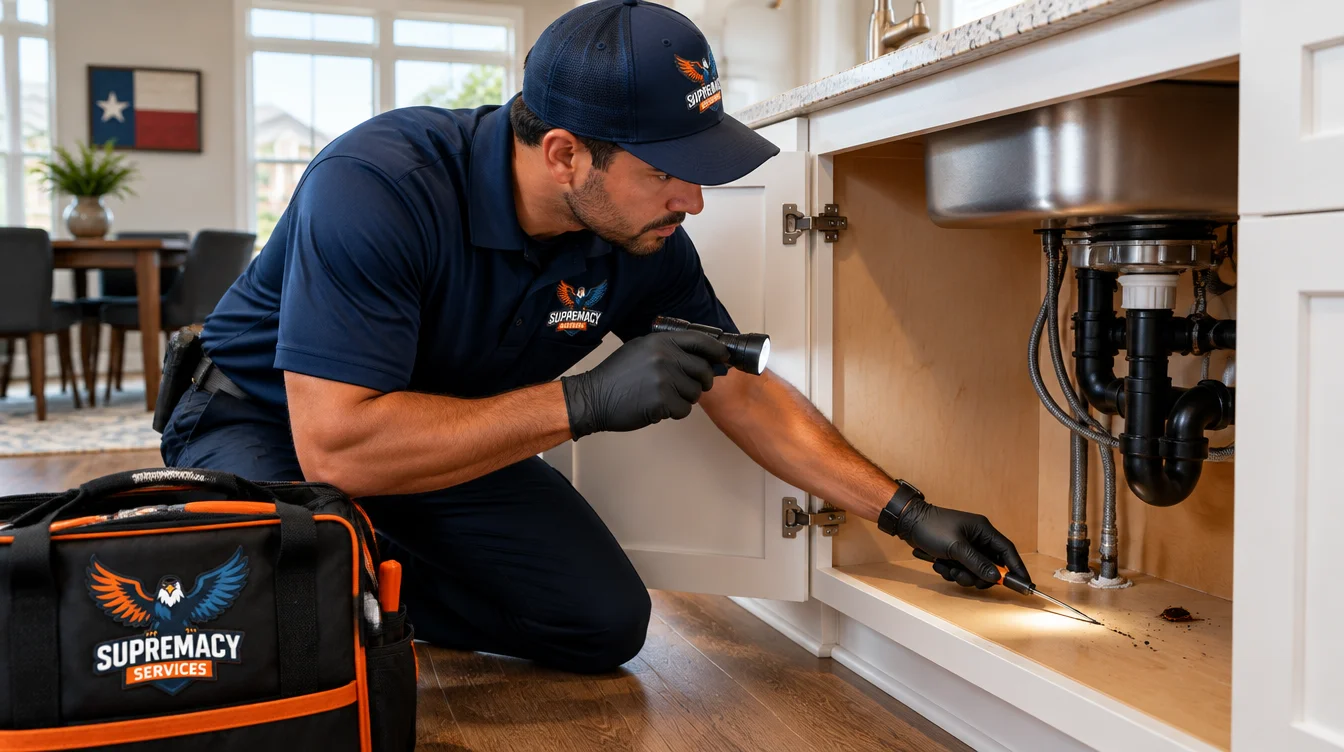
Professional cockroach treatment in North Texas does not have one standard price. Current Dallas/Texas consumer-market examples put many residential roach treatments broadly in the low hundreds of dollars, while established German cockroach infestations, larger properties and jobs requiring repeated visits can cost considerably more.
For budgeting context, current Dallas consumer-market data from Angi places many full-service roach-type pest-control jobs around $300–$550, while other Texas pest-control companies publish German cockroach treatment ranges extending roughly from $200 to $550 or more, depending on the scope. These are third-party market estimates—not Supremacy Services prices or guaranteed North Texas averages.
The biggest pricing variables are the cockroach species, severity of the infestation, number of affected rooms, property type, treatment strategy and number of follow-up visits required.
If you are seeing roaches in a Dallas-Fort Worth home, the most useful question is therefore not simply, “How much does an exterminator cost?” It is:
What type of cockroach problem do I have, and what will actually be required to control it?
Table of Contents
- How Much Does Cockroach Treatment Cost in North Texas?
- Why Cockroach Exterminator Prices Vary
- Does the Type of Cockroach Affect Treatment Cost?
- What Does Professional Cockroach Treatment Include?
- One-Time vs. Multiple-Visit Treatment
- DIY vs. Professional Cockroach Control
- When Should You Call a Cockroach Exterminator?
- How Can You Reduce Future Cockroach Problems?
- Choosing a Cockroach Exterminator in Texas
- Frequently Asked Questions
How Much Does Cockroach Treatment Cost in North Texas?
For planning purposes, many professional residential cockroach treatments in the Dallas/Texas market fall somewhere in the low-to-mid hundreds of dollars, but serious infestations and multi-visit programs can cost more.
There is not a reliable universal price that applies to every North Texas property.
Current published market examples illustrate the variation:
| Service situation | Useful market-planning range | Important qualification |
|---|---|---|
| General Dallas pest-control service | About $88–$216 typical consumer-market range | Not cockroach-specific |
| Full-service Dallas roach-type infestation | About $300–$550 | Consumer-market estimate |
| German cockroach treatment | About $200–$550+ | Texas/DFW commercial examples vary |
| Larger or persistent infestation | Property-specific | Multiple treatments may be needed |
| Apartment/multi-unit problem | Property-specific | Adjacent units can affect scope |
| Commercial cockroach control | Property-specific | Facility size, use and service frequency matter |
These figures are budgeting references compiled from third-party market sources, not a Supremacy Services price sheet.
A quote should ideally explain what is being treated, the treatment approach, whether follow-up visits are included and whether prevention or exclusion work is separate.
Why shouldn’t you choose an exterminator based only on the lowest price?
Two quotes may represent completely different scopes of work.
One company might quote for a basic treatment of visible activity. Another might include inspection, species identification, monitoring, targeted bait placement, treatment of harborages and scheduled follow-up.
The cheaper number is not necessarily cheaper if the underlying infestation remains active.
If you’re already seeing recurring cockroach activity, explore professional cockroach control in Dallas-Fort Worth to understand how Supremacy approaches species identification, treatment and prevention.
Why Cockroach Exterminator Prices Vary
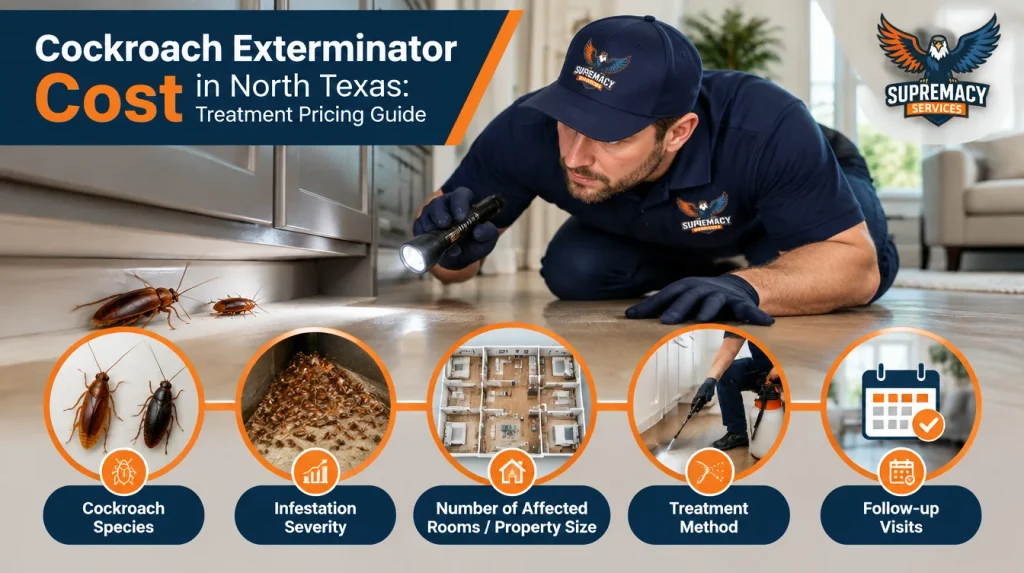
Cockroach extermination costs vary because technicians are treating an infestation, not simply charging for the number of roaches you happen to see.
Several factors determine the actual scope.
1. Cockroach species
Species identification matters.
German cockroaches and American cockroaches behave differently, occupy different environments and may require different control strategies.
Texas A&M identifies German cockroaches as common indoor pests associated particularly with kitchens, bathrooms and pantries. They favor warm, moist environments and hide in cracks and crevices.
That can make an established German cockroach problem substantially different from dealing with occasional large outdoor cockroaches entering a home.
2. Severity of the infestation
A few cockroaches confined to one area do not represent the same job as activity throughout:
- kitchen cabinets;
- behind refrigerators and dishwashers;
- bathrooms;
- laundry rooms;
- wall voids;
- utility areas; and
- several rooms.
More widespread activity means more inspection, monitoring, treatment points and potentially follow-up work.
3. Number of affected rooms
Cockroach treatment is often driven more by the distribution of activity than simply the total square footage of the house.
A large house with activity isolated around one plumbing area may present a different scope from a smaller apartment with German cockroaches throughout the kitchen and adjoining rooms.
4. Single-family vs. multifamily housing
Apartments, townhomes and other attached housing can be more complicated because cockroaches may move between units through openings around utilities, plumbing and other shared pathways.
Texas A&M’s housing IPM guidance specifically recommends sealing routes between apartments, including openings associated with vents and plumbing.
Treating one unit without understanding activity in adjoining spaces may therefore fail to address the entire problem.
5. Food, water and harborage conditions
Cockroaches need access to resources.
Food residue, garbage, pet food, moisture, plumbing leaks and clutter can all make control more difficult.
EPA recommends reducing pest-supporting conditions by sealing food, removing garbage regularly, avoiding leaving pet food and water out overnight and fixing plumbing leaks.
6. Follow-up requirements
Some cockroach problems require monitoring and repeated treatment rather than a single visit.
That can increase the total price but may also be necessary to determine whether the population is actually declining.
7. Exclusion or corrective work
Treatment and prevention are not always the same service.
Sealing gaps, addressing plumbing penetrations, repairing moisture problems or changing sanitation conditions may be recommended separately from pesticide treatment.
Does the Type of Cockroach Affect Treatment Cost?
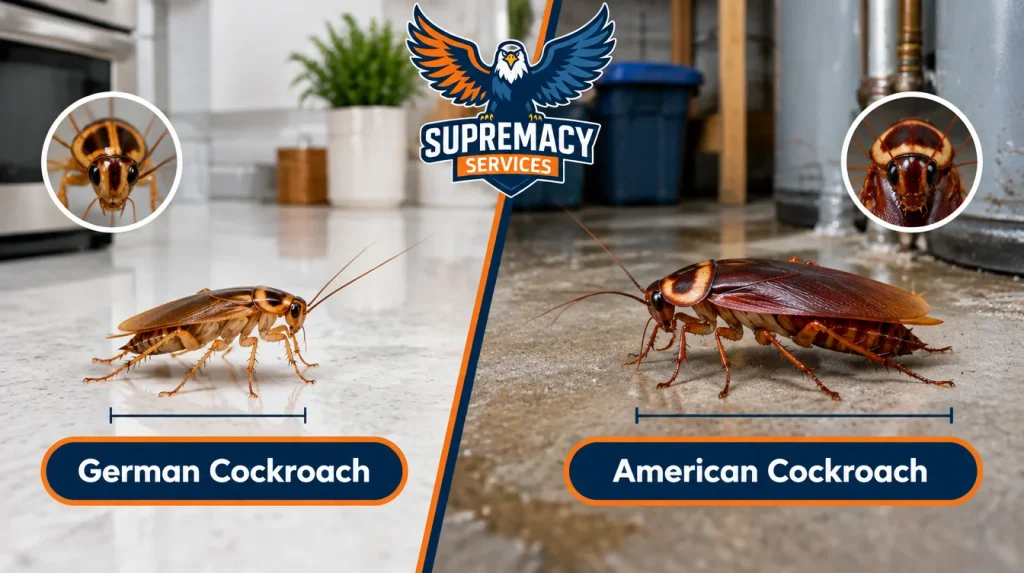
Yes. Species can significantly affect treatment scope because German and American cockroaches do not behave the same way.
| Factor | German cockroach | American cockroach |
|---|---|---|
| Typical adult size | Small | Much larger |
| Common concern | Indoor infestation | Indoor or outdoor-associated activity |
| Typical indoor locations | Kitchens, bathrooms, appliances, cabinets | Utility areas, drains, garages and other damp areas |
| Key challenge | Hidden breeding population | Finding entry/source conditions |
| Treatment emphasis | Monitoring, baiting, harborage treatment, sanitation | Source reduction, targeted treatment and exclusion where appropriate |
| Potential pricing effect | May require repeated service | Depends heavily on source and extent |
Texas A&M describes adult German cockroaches as approximately ½–⅝ inch long and notes their association with kitchens, bathrooms and pantries.
Correct identification matters because a homeowner who treats every roach as the same pest may spend money repeatedly without addressing the conditions sustaining the population.
German cockroach treatment
German cockroaches deserve particular attention because they can establish indoor populations around food, warmth and moisture.
Finding multiple small tan cockroaches, nymphs or egg cases around a kitchen is therefore different from occasionally finding a single large cockroach near a garage or exterior doorway.
If you’re unsure what you’re seeing, compare the identifying characteristics in Supremacy’s German vs. American Cockroach guide before assuming the treatment required.
What Does Professional Cockroach Treatment Include?
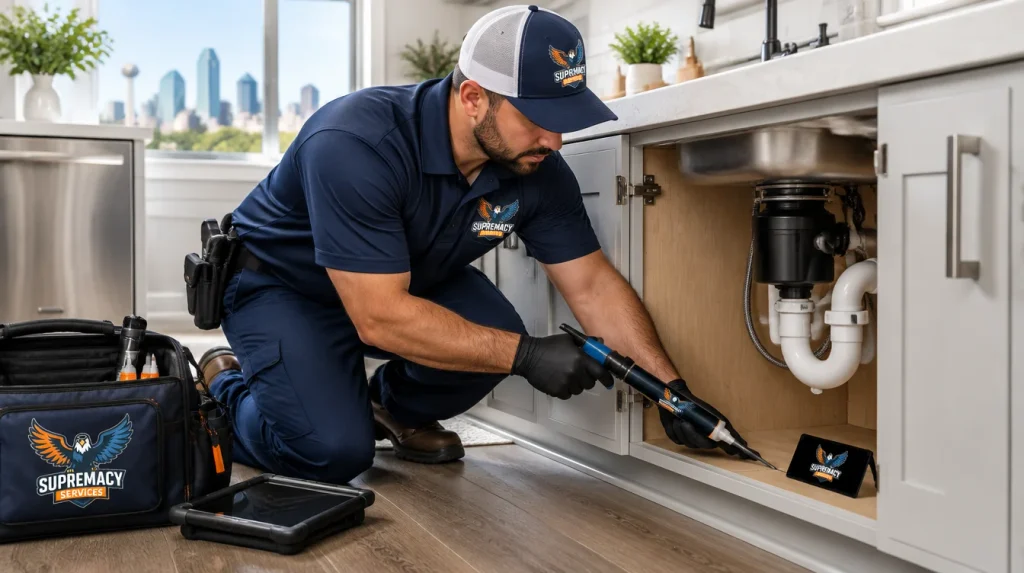
A professional cockroach-control program should begin by identifying the pest and determining where activity is concentrated before selecting treatment methods.
Depending on the property and infestation, professional service may involve:
- inspecting likely activity areas;
- identifying the cockroach species;
- looking for droppings, egg cases and harborages;
- checking moisture, food and sanitation conditions;
- placing monitoring devices where appropriate;
- applying labeled cockroach-control products to appropriate locations;
- using baits or other targeted treatments where appropriate;
- identifying potential entry or movement pathways;
- recommending sanitation or moisture corrections; and
- scheduling follow-up monitoring or treatment when necessary.
EPA describes Integrated Pest Management as an approach combining information about pests and their environment with appropriate control methods while seeking economical control with the least possible hazard to people, property and the environment.
That is why effective cockroach management is broader than spraying every baseboard.
Why are gel baits commonly associated with cockroach control?
Gel and paste baits allow treatment to be placed strategically near cockroach harborages.
EPA pesticide information confirms that registered cockroach bait products are labeled for locations such as kitchens, sinks, utility areas and domestic dwellings. Product labels also impose specific placement and safety requirements.
Any pesticide should be used strictly according to its label.
One-Time vs. Multiple-Visit Treatment
A one-time visit may be sufficient for some limited cockroach problems, while established infestations can require follow-up monitoring and additional treatment.
The difference is important when comparing quotes.
A one-time treatment may be appropriate when:
- activity is limited;
- the source is readily identifiable;
- there is little evidence of an established indoor population; or
- the treatment objective is primarily preventive or targeted.
Multiple visits may be more appropriate when:
- German cockroaches are established indoors;
- multiple life stages are present;
- activity occurs across several rooms;
- sticky monitors continue catching cockroaches;
- sanitation or moisture conditions are contributing to the infestation; or
- previous treatments have failed.
Do not compare a single-service quote directly with a multi-visit program without comparing what each includes.
DIY vs. Professional Cockroach Control
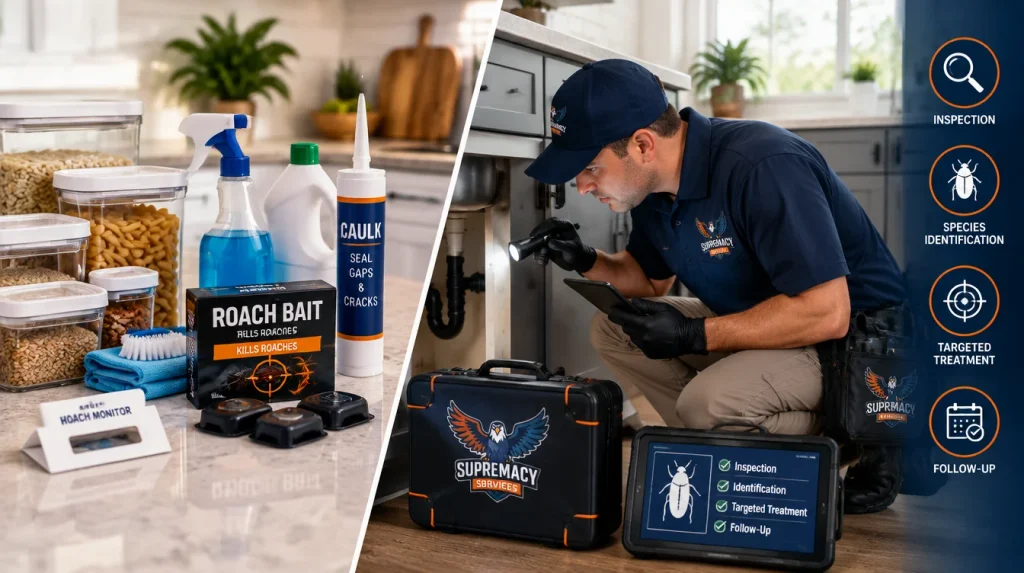
DIY cockroach control can be reasonable for limited activity, but widespread, persistent or German cockroach infestations often justify professional assessment.
DIY may be reasonable when:
- you have seen only occasional activity;
- you can identify and remove obvious food or water sources;
- you can seal obvious entry points;
- there is no evidence of widespread breeding; and
- you can safely use an appropriately labeled consumer product.
Useful nonchemical steps include keeping food sealed, removing garbage, cleaning food residue, fixing leaks, reducing clutter and sealing cracks.
EPA specifically recommends addressing food, water and shelter as part of smart pest control.
Be careful with indiscriminate spraying
More pesticide does not automatically mean better control.
A pesticide label is legally significant, and homeowners should follow the product’s instructions regarding application locations, quantities and safety precautions.
For example, an EPA-approved cockroach gel label warns against placing bait on food-preparation surfaces or in areas easily accessible to children and pets.
When professional treatment makes more sense
Consider professional service when:
- cockroaches keep returning after DIY treatment;
- you regularly see German cockroaches;
- nymphs or egg cases are present;
- several rooms are affected;
- you live in connected or multifamily housing;
- you cannot locate the source;
- the infestation affects a restaurant or commercial facility; or
- you need professional monitoring and follow-up.
Cockroaches still returning after treatment? Request a professional cockroach assessment from Supremacy Services to identify the species, activity areas and conditions contributing to the infestation.
When Should You Call a Cockroach Exterminator?
Call a professional when cockroach activity is persistent, spreading, difficult to identify or no longer responding to reasonable DIY measures.
Watch for:
- repeated nighttime sightings;
- cockroaches appearing in multiple rooms;
- small cockroach nymphs;
- egg cases;
- droppings around cabinets or appliances;
- activity behind refrigerators or dishwashers;
- recurring activity around sinks;
- cockroaches returning shortly after treatment; and
- activity in adjacent apartment units.
One visible cockroach cannot tell you precisely how many others are present, so avoid unsupported rules such as “one roach means X roaches.”
Instead, look for patterns of activity and evidence of reproduction.
Why Do Cockroaches Keep Coming Back?
Recurring cockroach activity usually means the source, harborage, resources or movement pathways have not been fully addressed.
Possible contributors include:
- accessible food;
- grease or crumbs beneath appliances;
- leaking plumbing;
- moisture around sinks;
- pet food left overnight;
- clutter;
- cardboard storage;
- gaps around pipes;
- openings between connected units;
- untreated harborages; and
- reintroduction through boxes, bags or other items.
Texas A&M notes that German cockroaches can hitchhike into homes in bags and boxes.
That is why simply killing visible cockroaches may provide temporary relief without resolving the underlying infestation.
How Can You Reduce Future Cockroach Problems?
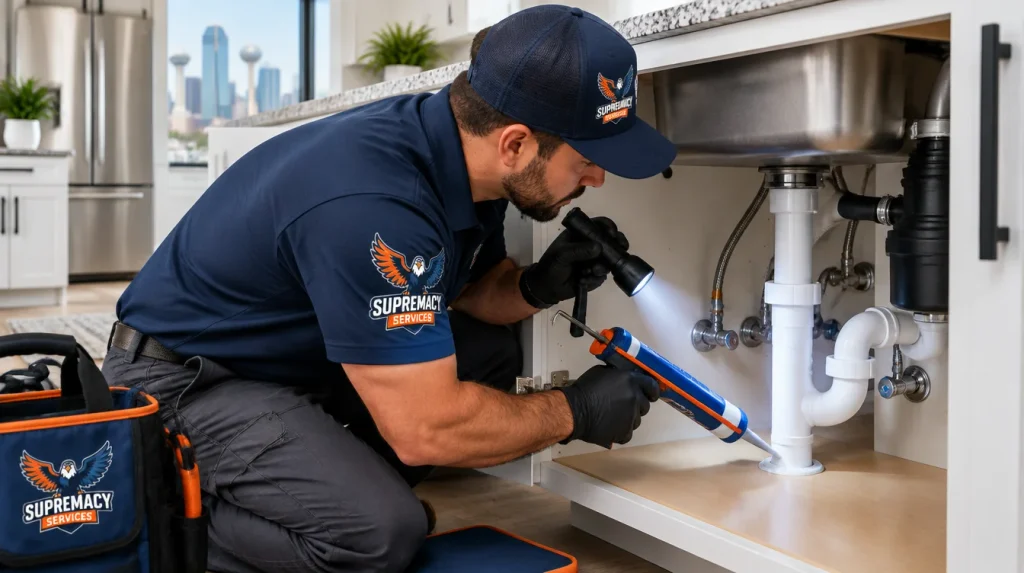
Cockroach prevention focuses on removing food, water and shelter while limiting entry and movement pathways.
Use this homeowner checklist:
- Store pantry foods in sealed containers.
- Clean crumbs and grease around cooking areas.
- Clean beneath refrigerators and other appliances.
- Empty household garbage regularly.
- Avoid leaving pet food out overnight.
- Repair leaking faucets and plumbing.
- Dry wet sink and counter areas.
- Reduce cardboard and unnecessary clutter.
- Inspect boxes before bringing them indoors.
- Seal cracks and gaps where practical.
- Seal openings around plumbing penetrations.
- Use monitoring traps to identify recurring activity.
These steps complement professional treatment rather than replacing it when an infestation is already established.
North Texas Considerations
Cockroach pressure in DFW should be approached according to the property rather than assumptions about the ZIP code.
Homes throughout Dallas, Plano, Frisco, McKinney, Allen, Richardson and surrounding communities vary substantially in age, construction, plumbing configuration, moisture conditions and proximity to neighboring units.
Apartments and attached housing
Shared walls and utility penetrations deserve particular attention because cockroaches can move between connected spaces.
A treatment strategy should therefore consider whether activity is isolated to your unit or potentially connected to a larger building problem.
Kitchens and plumbing areas
Kitchens and bathrooms combine several resources cockroaches need: moisture, warmth, food and protected cracks or voids.
Inspect:
- beneath sinks;
- around plumbing penetrations;
- behind refrigerators;
- around dishwashers;
- inside cabinet voids; and
- around food-storage areas.
Outdoor-origin cockroaches
Not every large cockroach found indoors indicates the same type of infestation as German cockroaches breeding around a kitchen.
Species identification should come before assuming you need an intensive indoor treatment program.
Choosing a Cockroach Exterminator in Texas
Texas regulates structural pest-control businesses and professionals, so licensing should be one of the first things a homeowner checks.
The Texas Department of Agriculture states that businesses and individuals performing structural pest control for hire are subject to licensing requirements. The state’s pest-control category specifically includes pests such as roaches, ants, flies, mosquitoes, rats and mice.
Before hiring a company, ask:
- Are you licensed for structural pest control in Texas?
- What cockroach species do you believe is present?
- What areas will you inspect and treat?
- Is this a one-time service or multi-visit program?
- Are follow-up visits included in the quote?
- What preparation is required before service?
- What should we change after treatment?
- How will treatment effectiveness be monitored?
- Are exclusion or corrective services separate?
- What exactly is included in the quoted price?
TDA also maintains information on current structural pest-control licenses, giving Texas consumers a way to verify licensing status.
Is Professional Cockroach Treatment Worth the Cost?
Professional treatment becomes particularly valuable when the problem requires species identification, targeted treatment, monitoring or multiple visits rather than another round of general-purpose spraying.
The objective should not simply be to stop seeing roaches for several days.
It should be to:
identify → locate → treat → monitor → correct contributing conditions → prevent recurrence.
That distinction matters most with established German cockroach populations and recurring infestations.
Frequently Asked Questions
How much does a cockroach exterminator cost in North Texas?
There is no universal North Texas rate. Current third-party Dallas/Texas market examples place many residential cockroach treatments in the low-to-mid hundreds of dollars, while larger, severe or multi-visit infestations can cost more. Request a property-specific quote rather than treating published averages as guaranteed pricing.
Why is German cockroach treatment more expensive?
It can be more involved because German cockroaches establish indoor populations in protected areas near food, warmth and moisture. Widespread infestations may require detailed inspection, strategically placed treatments, monitoring and follow-up.
Can an exterminator get rid of cockroaches in one visit?
Sometimes, but not every infestation is a one-visit problem. Species, infestation severity, harborages, property conditions and continued monitoring determine whether follow-up treatment is appropriate.
Does seeing one cockroach mean I have an infestation?
Not necessarily. One large outdoor-origin cockroach entering a home is different from repeatedly finding German cockroaches, nymphs and egg cases around a kitchen. Look at species and patterns rather than relying on a fixed “one roach equals many” rule.
Are German and American cockroaches treated the same way?
Not necessarily. Their biology, preferred environments and sources differ, so correct identification helps determine an appropriate treatment and prevention strategy.
Is DIY cockroach treatment cheaper?
Initially, yes. But repeatedly purchasing products without locating the source can become inefficient. DIY measures are most useful when combined with sanitation, moisture correction, exclusion and careful use of properly labeled products.
Why do cockroaches come back after extermination?
Recurring activity may result from remaining harborages, accessible food or moisture, movement from adjacent spaces, incomplete treatment, new introductions or environmental conditions that continue supporting cockroaches.
Should I get recurring pest control after cockroach treatment?
It depends on the property and pest pressure. Some homes need only corrective treatment, while others benefit from ongoing monitoring and preventive pest management. Ask whether recurring service solves a demonstrated risk rather than purchasing it automatically.
Are cockroach exterminators licensed in Texas?
Structural pest-control businesses and professionals performing pest control for hire are regulated by the Texas Department of Agriculture. Consumers can check licensing information through TDA.
Final Takeaway
Cockroach exterminator cost in North Texas depends far more on the species, infestation level, affected areas and treatment scope than on a simple flat-rate average.
Published Dallas and Texas prices can help establish a budget, but they should not replace a property-specific assessment.
If you are comparing quotes, find out:
- which species is being treated;
- which rooms or areas are included;
- which treatment methods are planned;
- whether monitoring is included;
- whether follow-up visits are included;
- what preparation is required; and
- whether exclusion or prevention work costs extra.
That gives you a much more useful comparison than choosing the lowest number alone.
Dealing with recurring cockroaches in Dallas-Fort Worth? Explore Supremacy Services’ professional cockroach-control service or request an inspection to identify the species, determine the scope of the problem and receive a property-specific treatment recommendation.

