
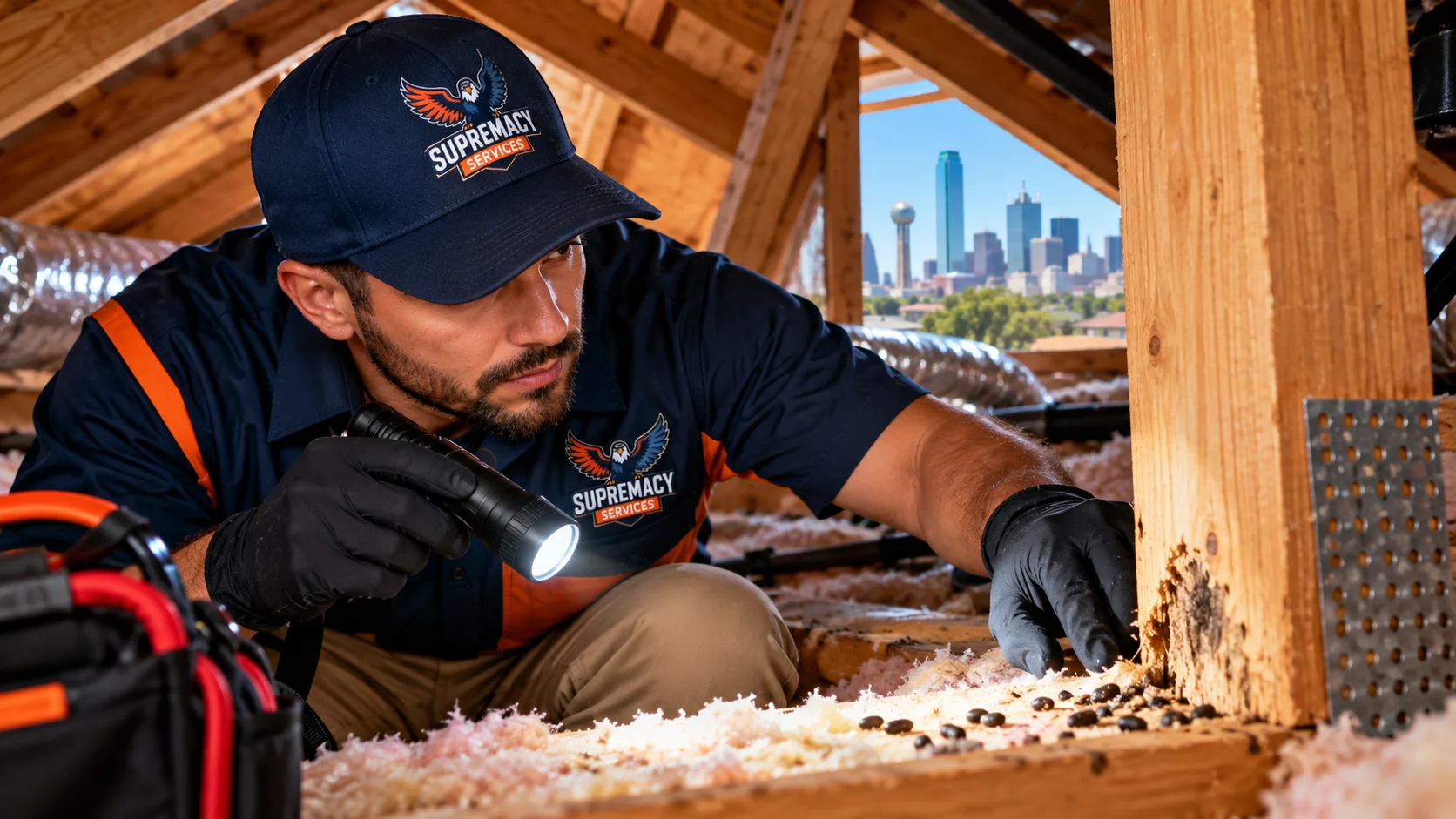
If you are hearing scratching above the ceiling, finding droppings in the garage or discovering gnawed food packaging, one of the first practical questions is usually: how much does rodent removal cost in North Texas?
There is no responsible single price for every Dallas–Fort Worth home because “rodent removal” can describe very different scopes of work.
Current third-party market data puts basic professional rodent removal broadly around $150–$600, while current Dallas-specific data for rat extermination shows a wider typical range of approximately $224–$1,192. Those figures should be treated as market-planning estimates—not Supremacy Services pricing or a quote for a particular home.
The important distinction is what the quoted price actually includes.
Catching several mice in an accessible garage is fundamentally different from controlling rats in an attic, finding several roofline openings, sealing those openings and cleaning contaminated insulation.
This guide explains how rat removal, mouse control, rodent exclusion, follow-up visits and cleanup affect the overall cost—and what North Texas homeowners should compare before choosing a service.
Table of Contents
- How much does rodent removal cost in North Texas?
- Rat removal vs. mouse removal costs
- Why rodent exclusion changes the price
- What determines your final cost?
- What does professional rodent removal include?
- DIY vs. professional rodent control
- Signs you may need professional service
- Rodent removal vs. wildlife removal
- What to ask before accepting an estimate
- How to prevent rodents from returning
- Frequently asked questions
How Much Does Rodent Removal Cost in North Texas?
Basic professional rodent removal commonly falls within published national ranges of roughly $150–$600, but a complete North Texas project involving exclusion, repeated monitoring, attic cleanup or repairs can cost considerably more.
For Dallas specifically, Angi’s 2026 data reports a normal rat-extermination range of approximately $224–$1,192, with an average around $693. HomeGuide reports broader national averages of approximately $150–$600 for rat extermination and $150–$550 for mouse extermination.
These are third-party market estimates rather than Supremacy Services prices.
| Service or situation | Published planning range | Important distinction |
|---|---|---|
| General rodent removal | $150–$600 | Basic removal; scope varies |
| Mouse extermination | $150–$550 | Depends on infestation, method and location |
| Rat extermination | $150–$600 nationally | Basic control rather than necessarily whole-home exclusion |
| Dallas rat extermination | $224–$1,192 typical range | Dallas-specific Angi estimate |
| Rodent inspection | $75–$150 | May be separate or incorporated into service |
| More extensive exclusion plan | $600–$1,400 | Published estimate involving exclusion/repairs/monitoring |
| Rodent cleanup | $600–$1,000 | Published estimate; severity can substantially change scope |
Published ranges: HomeGuide and Angi. Actual North Texas pricing depends on inspection findings, property construction, infestation severity and included services.
The best way to compare rodent estimates is therefore not simply to ask, “Which company has the lowest number?”
Ask:
What does that number include?A $300 trapping quote and a $1,200 removal-and-exclusion proposal may be pricing completely different jobs.
Hearing scratching or finding rodent evidence? Request a rodent inspection from Supremacy Services to determine whether the problem requires removal alone or removal plus structural exclusion.
How Much Does Rat Removal Cost?
Current published national estimates generally place ordinary professional rat extermination around $150–$600, while Dallas-specific pricing data shows that local projects can span a wider range depending on the property and infestation.
Rat jobs become more involved when activity is occurring in:
- attics;
- rooflines;
- inaccessible wall cavities;
- garages and storage areas;
- crawl spaces;
- multiple parts of the property; or
- areas requiring structural repairs.
Supremacy’s existing DFW rat-control page specifically identifies roof gaps, soffits, vents, garages and utility penetrations among potential structural access routes.
That matters because the price of catching active rats should not automatically be confused with the price of preventing new rats from using the same building.
Why attic rat removal can cost more
An attic problem can require considerably more investigation than seeing one rat around a garage.
A technician may need to determine:
- whether the animal actually is a rat;
- where activity is concentrated;
- how rats reached the attic;
- how many potential exterior openings exist;
- whether contamination or damage is present; and
- whether follow-up trapping or monitoring is required.
A complicated roofline can also turn what sounds like “seal the rat hole” into a much larger exclusion project.
How Much Does Mouse Removal Cost?
HomeGuide currently reports approximately $150–$550 as a broad professional mouse-extermination range. Again, this is a market estimate rather than a quote for a North Texas property.
A mouse problem is not necessarily cheaper simply because mice are smaller.
The CDC states that mice can enter an opening approximately 1/4 inch (6 mm) wide—about the width of a pencil. That means effective mouse exclusion may require finding numerous small vulnerabilities around pipes, vents, doors, cabinets, utility penetrations, foundations and roof components.
The cost therefore depends less on the size of the animal than on the extent of the infestation and the building vulnerabilities that need attention.
Rat vs. Mouse Removal: What Changes the Price?
| Factor | Rats | Mice |
|---|---|---|
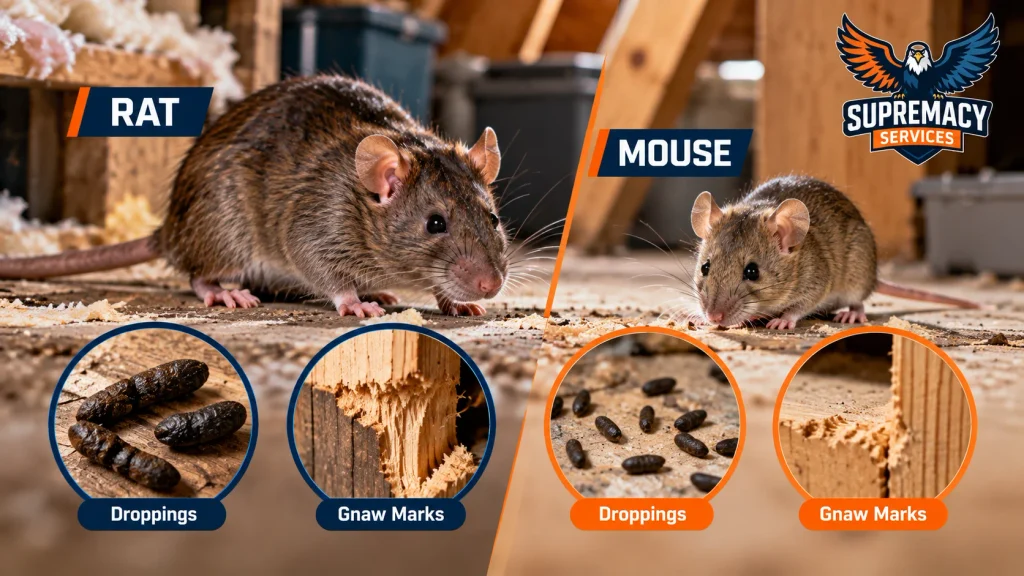
| Typical evidence | Larger droppings, stronger gnawing, heavier movement | Smaller droppings, light scratching, small gnaw marks |
| Potential access | Rooflines, vents, garages, utility routes and structural openings | Extremely small gaps and penetrations |
| Attic activity | Common concern, particularly with climbing rats | Possible in attics, walls and other voids |
| Exclusion challenge | Elevated roof access may increase work | Numerous tiny openings may need attention |
| Treatment | Depends on location and infestation | Depends on location and infestation |
| Final price | Driven by scope, access and exclusion | Driven by scope, access and exclusion |
Correct identification matters because rats and mice can use buildings differently and may require different placement, inspection and exclusion strategies.
What Is Rodent Exclusion—and Why Can It Cost More Than Trapping?
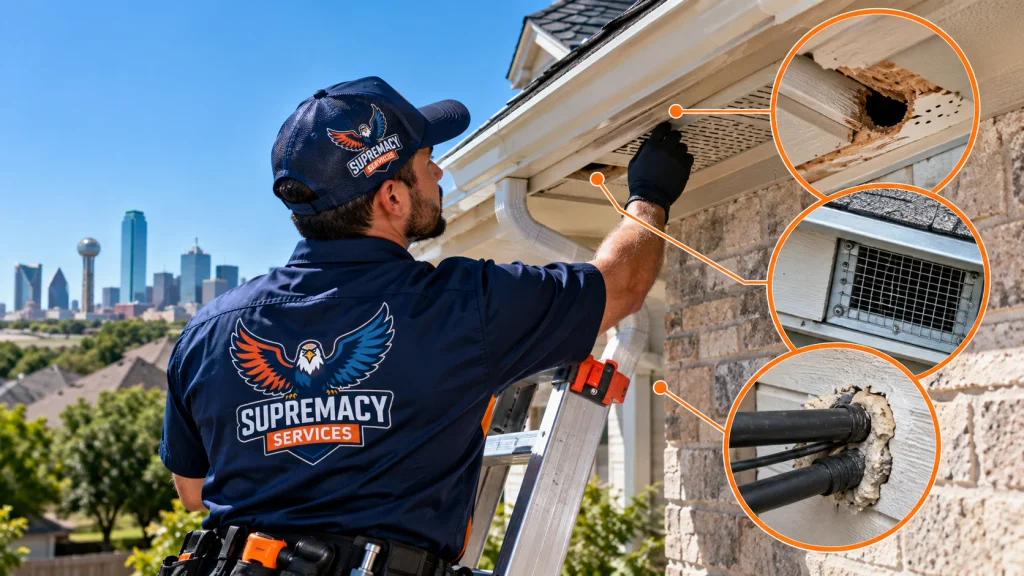
Rodent exclusion is the process of finding and securing openings that allow rats or mice to enter a building.
It addresses the structural side of the infestation rather than only the rodents already inside.
The CDC recommends inspecting homes for gaps and holes and sealing openings that rodents can use. Depending on the opening, its guidance includes materials such as steel wool combined with caulk for small gaps and metal, hardware cloth, cement or similar durable materials for larger openings.
Potential entry areas include:
- roof edges;
- eaves and soffits;
- attic vents;
- crawl-space vents;
- foundation gaps;
- garage-door gaps;
- utility penetrations;
- plumbing penetrations;
- damaged screening;
- gaps around doors and windows.
Removal and exclusion are not the same thing
Think about the problem as two separate questions:
Removal: How do we deal with the rats or mice currently inside?
Exclusion: How did they get inside, and how do we reduce the opportunity for more rodents to enter?
A quote covering both jobs should naturally be different from one covering trapping alone.
Why exclusion pricing varies so much
Sealing one accessible opening near a foundation is very different from addressing multiple vulnerabilities along a two-story roofline.
Cost can increase with:
- number of entry points;
- height and accessibility;
- amount of roofline involved;
- construction type;
- damaged vents or screens;
- soffit or fascia conditions;
- utility penetrations;
- required materials;
- amount of inspection work; and
- follow-up requirements.
This is one reason a reliable exclusion estimate normally requires seeing the structure.
What Factors Affect Rodent Removal Cost?
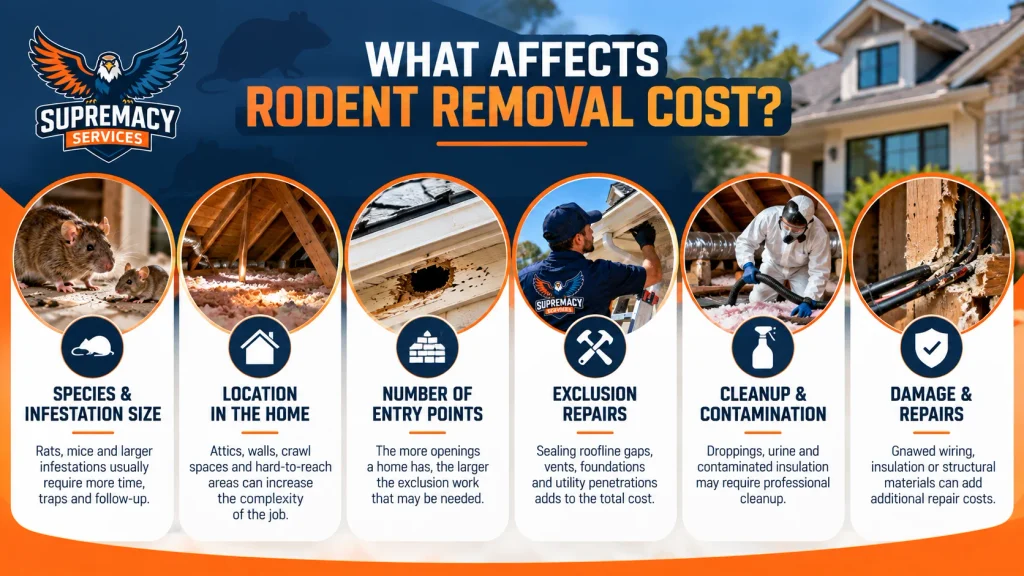
1. Infestation severity
A small, recently discovered mouse problem and established activity across an attic and walls do not require the same amount of labor.
More extensive activity can mean additional traps, monitoring and follow-up visits.
2. Location of the rodents
Accessibility matters.
Activity in an open garage may be relatively straightforward to investigate. Activity behind walls, above ceilings or around difficult roof areas can require more time.
3. Number of entry points
The more vulnerabilities a house has, the larger the potential exclusion scope.
4. Home size and construction
A larger property generally provides more exterior perimeter and more potential access areas to inspect.
Construction details matter as well. Roof intersections, attached garages, utility penetrations, vents, soffits and additions can all affect the inspection.
5. Rats vs. mice
Species identification affects trap selection, placement and exclusion planning.
6. Follow-up visits
Rodent control often involves monitoring rather than simply placing equipment and immediately declaring the problem solved.
The CDC advises continuing trapping until rodent activity has stopped.
7. Contamination and cleanup
Droppings, urine, nesting material or contaminated insulation can add an entirely separate cleanup component.
8. Damage and repairs
Rodents can gnaw or disturb building materials. If electrical wiring, insulation, ductwork or structural components appear damaged, the appropriate trade professional may also need to evaluate or repair those components.
Does Rodent Removal Include Attic Cleanup?
Not necessarily. Removal, exclusion and cleanup should be treated as separate scope items unless the estimate explicitly says otherwise.
This distinction can prevent a major misunderstanding when comparing quotes.
A company might quote:
- trapping only;
- trapping plus monitoring;
- trapping plus exclusion;
- removal plus sanitation;
- removal, exclusion and cleanup; or
- a broader restoration project.
Ask for the scope in writing.
Rodent droppings require careful cleanup
The CDC specifically advises homeowners not to vacuum or sweep dry rodent urine, droppings or nesting materials, because doing so can put contaminated particles into the air. Its cleanup guidance instead recommends wetting contaminated material with an appropriate disinfectant before removal and following suitable protective precautions.
Heavy infestations require additional precautions.
That is one reason substantial attic contamination should not be treated like ordinary household dust.
What Does Professional Rodent Control Usually Involve?
The exact process varies with the property, but a comprehensive rodent-control strategy generally addresses both activity and access.
Step 1: Inspection
Inspect areas where rodents have been seen or heard and look for:
- droppings;
- gnaw marks;
- nesting material;
- tracks;
- rub marks;
- disturbed insulation;
- food sources;
- exterior openings.
Step 2: Identification
Determine whether the evidence points toward rats, mice or another animal.
This matters because scratching in an attic does not automatically mean rodents. Squirrels and other wildlife can produce similar noises.
Step 3: Active control
The appropriate strategy is selected based on the species, activity level and property.
CDC guidance recommends traditional snap traps for household rat and mouse infestations and stresses keeping traps and baits inaccessible to children and pets.
Step 4: Find entry points
Inspect the building to understand how rodents are gaining access.
Step 5: Exclusion
Appropriate openings can then be secured to reduce recurring entry.
Step 6: Monitor
Continue monitoring for fresh droppings, sounds, trap activity and other evidence.
Step 7: Evaluate cleanup or damage
Once the infestation is controlled, assess whether contaminated material or damaged building components require additional work.
If trapping has not stopped recurring activity, schedule a Supremacy rodent-control and exclusion inspection to identify both the active infestation and the structural openings that may be allowing rodents back inside.
DIY Rodent Control vs. Professional Removal
A limited, clearly identified problem can sometimes be approached by a homeowner. A recurring attic or structural infestation is different.
| Situation | DIY may be reasonable | Professional inspection is preferable |
|---|---|---|
| One mouse in accessible room | ✓ | |
| Clearly visible small opening | ✓ | |
| Simple food-storage problem | ✓ | |
| Repeated nighttime attic activity | ✓ | |
| Multiple rooms show activity | ✓ | |
| Species is uncertain | ✓ | |
| Several roofline openings | ✓ | |
| Activity continues after trapping | ✓ | |
| Significant droppings/contamination | ✓ | |
| Rodents inside inaccessible walls | ✓ | |
| Electrical or structural damage suspected | ✓ |
If you try DIY trapping
The CDC recommends appropriately sized traditional snap traps and placing them in areas where rodent evidence has been observed.
Keep traps away from children and pets.
Be cautious with rodenticides
EPA advises consumers to follow pesticide labels carefully and keep rodent baits inaccessible to children and pets.
Consumer rodenticides are sold in ready-to-use bait stations, and EPA has specific restrictions intended to reduce accidental exposure and risks to non-target wildlife.
Buying poison should therefore not be treated as a substitute for identifying how rodents are entering the house.
When Should You Call a Rodent Professional?
Consider professional help when:
- scratching continues night after night;
- traps are not resolving the activity;
- you repeatedly find fresh droppings;
- rodents are inside an attic or inaccessible wall void;
- several possible entry points exist;
- the problem keeps returning;
- you cannot safely inspect the affected area;
- significant contamination is present;
- you suspect damaged wiring or building materials; or
- you cannot confidently determine whether you have rats, mice or wildlife.
Recurring activity is particularly important.
Catching one animal does not necessarily mean the structure is secure.
What Are the Signs of Rats or Mice?
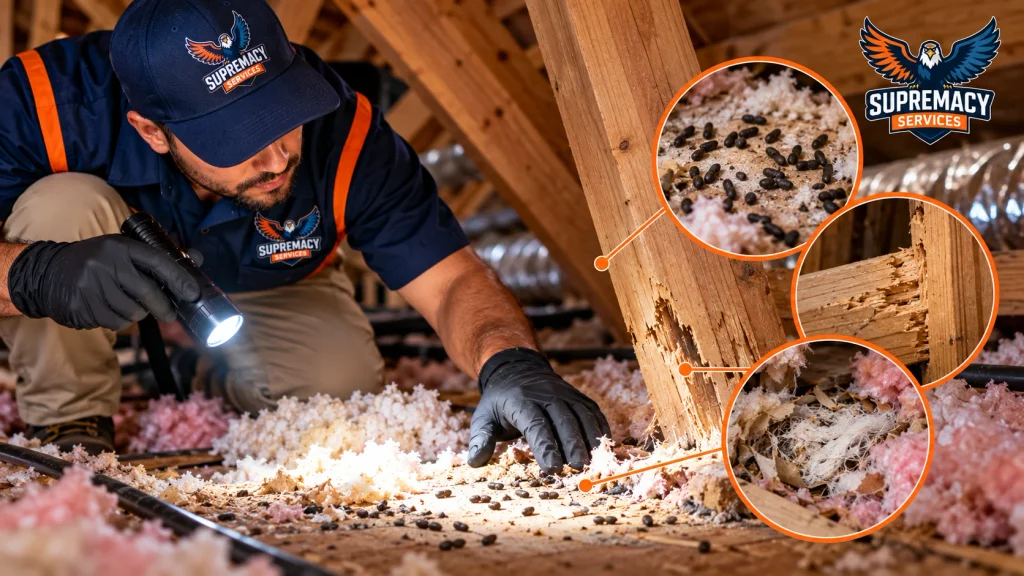
Common warning signs include:
- scratching or scurrying inside walls or ceilings;
- droppings;
- gnaw marks;
- damaged food packaging;
- disturbed attic insulation;
- nesting material;
- tracks;
- rub marks;
- unusual odors; and
- repeated nighttime activity.
The CDC notes that signs such as droppings and gnaw marks may appear before a homeowner actually sees the rodent.
Rats, Mice or Something Else in the Attic?
Do not assume every scratching noise is a rodent.
Supremacy’s existing attic-noise guide distinguishes rats and mice from squirrels using activity timing and physical evidence. Rats and mice are more commonly noticed after dark, while squirrel activity is more commonly associated with daytime hours. Evidence such as droppings, nesting material, gnawing and entry-point size is more useful than sound alone.
| Clue | Rats | Mice | Squirrels |
|---|---|---|---|
| Typical activity | Mostly nighttime | Mostly nighttime | Commonly daytime |
| Movement | Heavier scratching/running | Lighter scratching | Faster, noticeable running |
| Evidence | Droppings, gnawing, rub marks | Small droppings, nesting material | Nest material, gnawing |
| Service category | Rodent control | Rodent control | Wildlife removal |
Correct identification prevents homeowners from paying for the wrong solution.
Rodent Removal vs. Wildlife Removal
Rats and mice should remain under Supremacy’s rodent control and exclusion service.
Raccoons, squirrels, opossums and similar nuisance animals belong under the company’s wildlife-removal service.
That distinction matters for both treatment and cost.
A squirrel in an attic should not automatically be priced or handled as a mouse infestation. Supremacy’s wildlife guidance uses a broader inspection, species identification, removal, exclusion and cleanup framework.
Why Rodents Keep Coming Back
Repeated infestations often indicate that one part of the problem remains unresolved.
Rodents seek:
- food;
- water;
- shelter; and
- access.
Accessible garbage, pet food and stored food can support activity, while exterior openings provide access to protected spaces.
CDC prevention guidance recommends addressing both structural openings and food or shelter sources around a home.
The practical lesson is simple:
Control the animals already inside, then address the conditions that allow the next ones to enter.
North Texas Rodent Considerations
North Texas homeowners can encounter both rats and mice, but the building itself often determines how difficult the problem is to solve.
Supremacy’s rat-control material identifies roof rats as capable climbers that may use trees, fences, utility lines and structural features to reach upper portions of buildings. Norway rats are described as more commonly associated with lower structural and exterior environments.
For homeowners, this means an inspection should not focus exclusively on the floor or foundation.
Depending on the evidence, relevant areas may include:
- roof edges;
- soffits;
- fascia;
- attic vents;
- garages;
- utility penetrations;
- foundations;
- storage areas; and
- vegetation or features providing access toward the structure.
The goal is not to manufacture a Dallas-specific explanation for every infestation. It is to evaluate the particular North Texas property and determine where the rodents are actually traveling.
Is Rodent Exclusion Worth the Cost?
Exclusion is worth considering when rodents are entering through identifiable structural openings, particularly when infestations keep returning after trapping.
Trapping addresses animals already present.
Exclusion addresses access.
That distinction is central to long-term rodent management. CDC guidance likewise emphasizes finding and sealing gaps as part of preventing future infestations.
For a homeowner comparing estimates, a higher quote that includes meaningful exclusion cannot fairly be compared with a lower trapping-only quote without accounting for the difference in scope.
How to Compare Rodent Removal Quotes
Before choosing a provider, ask these questions:
- Does the price include an inspection?
- Does it cover rats, mice or both?
- Is trapping included?
- How many follow-up visits are included?
- Does the quote include exclusion?
- Which entry points will be repaired or sealed?
- What materials will be used?
- Is attic cleanup included or separate?
- Are structural repairs included or separate?
- What happens if rodent activity continues?
- Are there exclusions or limitations in any warranty?
- Is the company properly licensed for applicable Texas structural pest-control work?
Texas requires businesses and individuals performing covered structural pest-control services for compensation to be appropriately licensed. The Texas Department of Agriculture’s pest-control category specifically includes rats and mice.
Comparing scope is usually more useful than comparing headline price.
How to Reduce the Risk of Future Rodent Problems
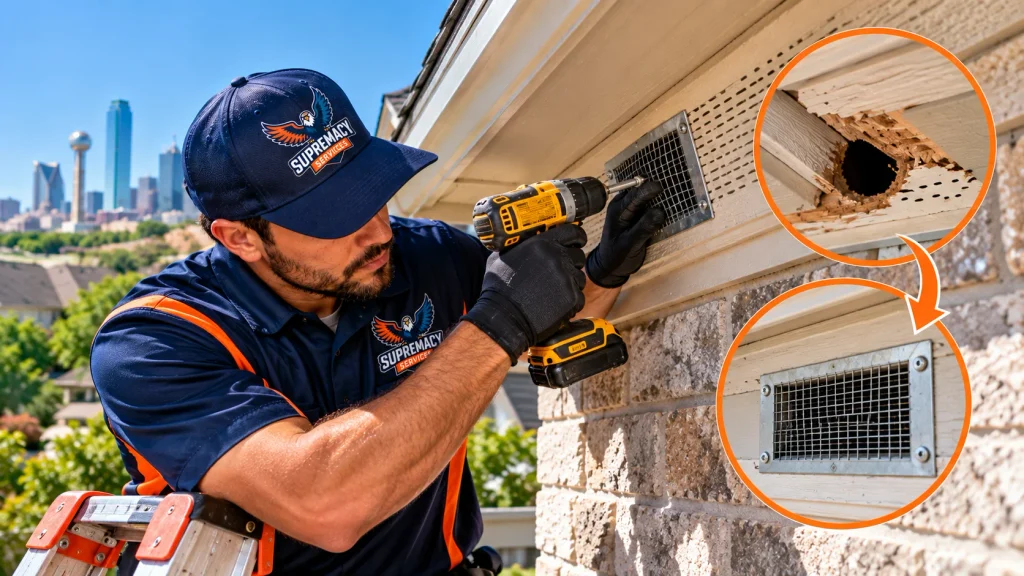
After active rodent activity has been addressed:
- seal appropriate exterior gaps;
- repair damaged screens and vents;
- check utility penetrations;
- keep food in secure containers;
- clean spilled food promptly;
- secure garbage;
- remove pet food after feeding;
- reduce clutter and nesting opportunities;
- inspect garages and outbuildings;
- monitor repaired entry points; and
- watch for fresh droppings or gnawing.
The CDC likewise recommends combining exclusion with reducing food, water and shelter opportunities.
Frequently Asked Questions
How much does rodent removal cost in North Texas?
Published 2026 market estimates commonly put basic professional rodent removal around $150–$600, while Dallas-specific rat-extermination data shows a wider typical range of approximately $224–$1,192. Full exclusion, cleanup, repairs and difficult access can increase the total substantially.
How much does it cost to remove rats from an attic?
There is no reliable flat attic-rat price without inspecting the property. Cost depends on infestation severity, attic access, entry points, trapping requirements, follow-up visits, contamination and whether roofline exclusion is required.
How much does a mouse exterminator cost?
HomeGuide currently reports a broad average range of approximately $150–$550 for professional mouse extermination. Actual North Texas pricing depends on the property and scope of service.
Does rodent removal include sealing holes?
Not always. Ask whether the estimate includes exclusion. Some quotes cover active control only, while others include identifying and securing entry points.
What is rodent exclusion?
Rodent exclusion is the process of identifying and securing openings that rats or mice can use to enter a building. It can include vulnerable areas around rooflines, vents, foundations, doors and utility penetrations.
Why does rodent exclusion cost more than trapping?
Exclusion can require detailed exterior inspection, roof access, multiple repairs and durable materials. The scope depends heavily on the number and location of structural vulnerabilities.
Can I remove rats or mice myself?
A small, accessible problem may sometimes be handled with appropriate trapping and exclusion. Professional help becomes more appropriate for recurring infestations, inaccessible areas, multiple entry points, heavy contamination or uncertain species identification.
Should I vacuum mouse or rat droppings?
No. CDC guidance specifically says not to vacuum or sweep dry rodent urine, droppings or nesting material because this can put contaminated particles into the air. Follow CDC wet-cleaning and disinfection guidance instead.
Is catching the rats enough?
Not necessarily. If structural entry points remain open, new rodents can potentially enter. Effective long-term control should consider both the active infestation and how rodents accessed the building.
Are rodent-control companies licensed in Texas?
Texas regulates structural pest-control services performed for compensation. The Texas Department of Agriculture’s structural pest-control licensing system includes pest control for rats and mice.
Need Help With Rats or Mice in Your North Texas Home?
The most useful rodent estimate is one based on the actual property—not a generic online price.
If you are hearing nighttime scratching, finding droppings or dealing with a recurring rat or mouse problem, Supremacy Services can inspect the affected areas, identify likely entry routes and determine whether the job requires active control, structural exclusion or additional cleanup.
Schedule a rodent control and exclusion inspection with Supremacy Services to identify the infestation, locate entry points and determine the appropriate scope for your Dallas–Fort Worth property.

