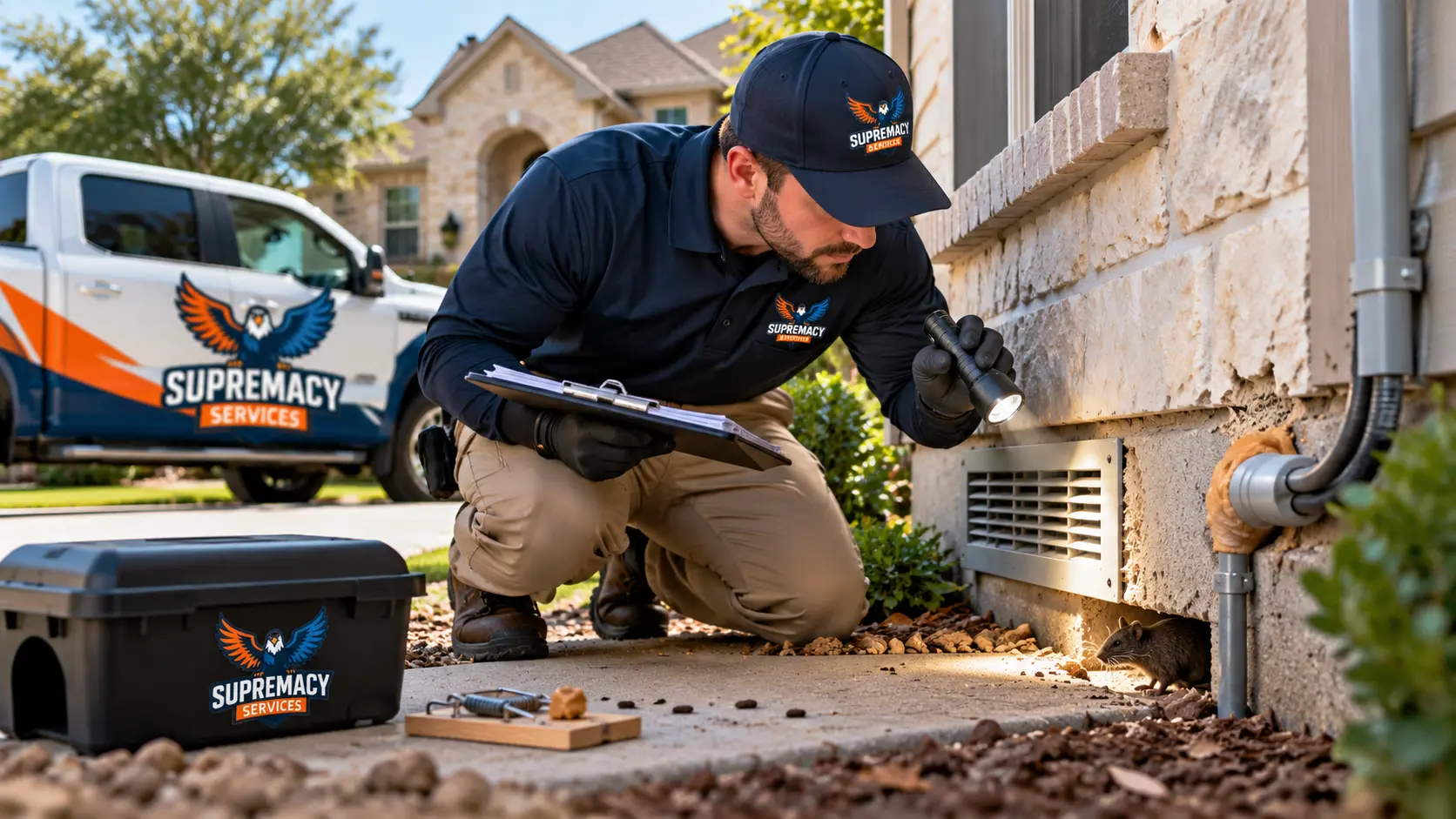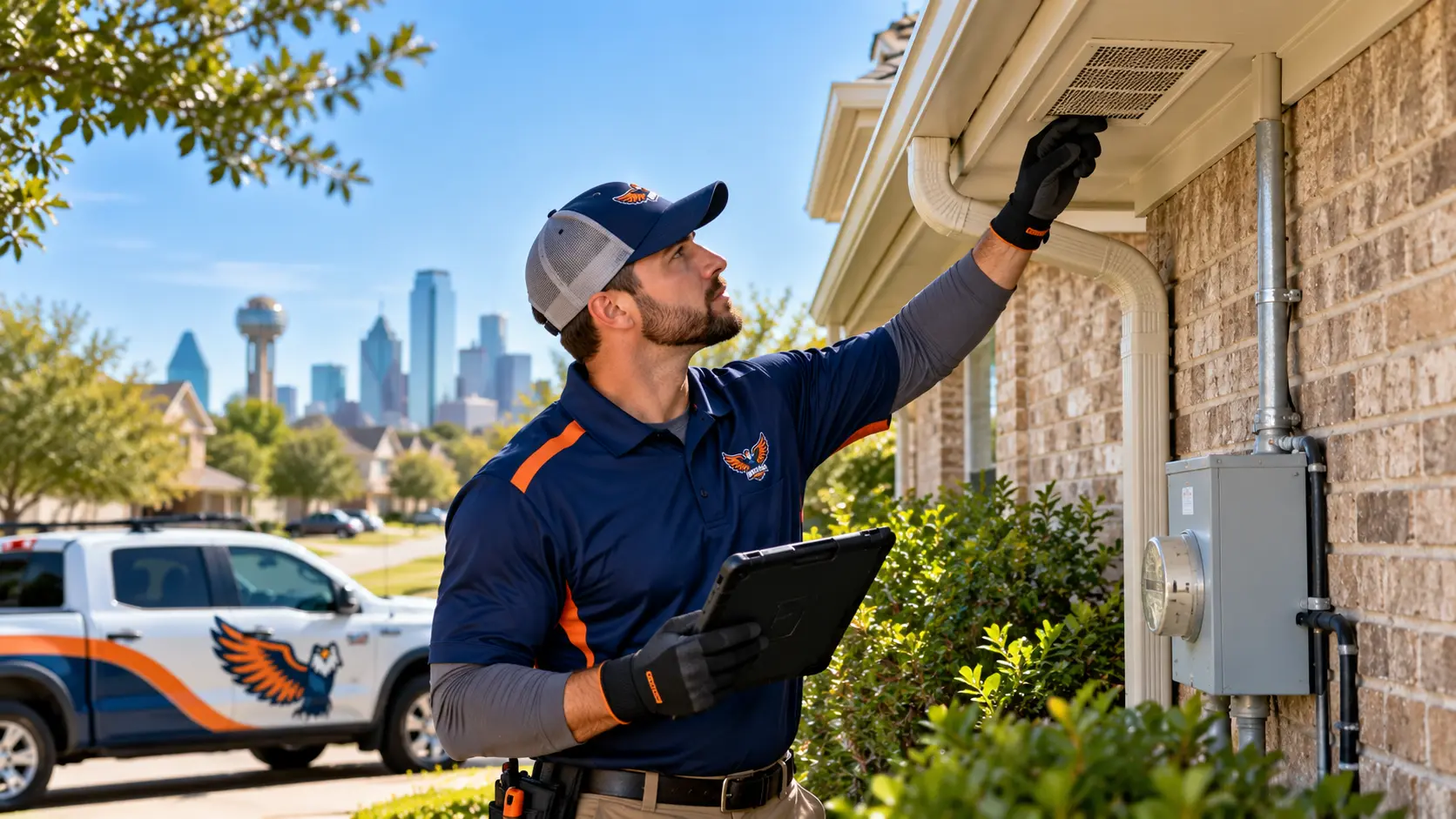
Commercial pest control in Dallas is rarely priced with one flat rate because two businesses of the same size can create very different pest-management demands. A small professional office may need basic inspection, monitoring and exterior prevention, while a restaurant, warehouse or apartment community may require more frequent visits, rodent stations, drain monitoring, documentation, exclusion work and corrective treatments.
For budgeting purposes, published Dallas-Fort Worth commercial pricing examples suggest that relatively straightforward recurring accounts can sometimes fall around $100–$300 per scheduled service, although actual quotes may be lower or substantially higher depending on the property.
Those figures are market-planning references—not Supremacy Services pricing.
The final price is usually determined by the type of business, property size and layout, pest species, level of infestation, number of monitoring points, service frequency, exclusion needs, reporting requirements and the amount of technician time required.
For most businesses, the best way to compare commercial pest-control prices is therefore to compare scope of service, not simply the monthly number.
Table of Contents
- How much does commercial pest control cost in Dallas?
- What determines the price?
- Commercial pest-control costs by property type
- One-time treatment vs. recurring service
- Is commercial pest control priced by square foot?
- What should be included in the price?
- Integrated Pest Management vs. routine spraying
- Restaurant and food-business requirements
- DIY vs. professional commercial pest control
- How to reduce long-term pest-management costs
- How to compare commercial pest-control quotes
- What to expect during a commercial inspection
- When to call a professional
- Frequently asked questions
How Much Does Commercial Pest Control Cost in Dallas?
There is no single standard commercial pest-control price in Dallas. Smaller, relatively low-risk properties may encounter recurring services in the low hundreds of dollars per visit, while large, highly regulated or heavily infested facilities can require substantially larger programs.
A published DFW commercial provider, for example, reports a typical range of approximately $115–$200 per monthly service for an average-size commercial building. Another North Texas provider publishes ongoing commercial plans beginning around $50–$200 per month for some properties.
These figures should be used only as budgeting references because commercial pest control is usually quoted after the facility’s pest risks and service requirements have been evaluated.
Commercial pest-control cost at a glance
| Commercial situation | Relative cost tendency | What typically drives the scope |
|---|---|---|
| Small professional office | Lower | Limited food activity and fewer pest-sensitive areas |
| Retail storefront | Low–moderate | Door traffic, stockrooms and customer-facing areas |
| Restaurant or café | Moderate–high | Kitchens, drains, grease, waste and food storage |
| Warehouse | Moderate–high | Large perimeter, docks, inventory and rodent monitoring |
| Apartment community | Highly variable | Unit count, common areas and recurring tenant requests |
| Hotel | Moderate–high | Guest areas, kitchens, laundry and multiple rooms |
| Healthcare property | Higher complexity | Sensitive treatment environment and documentation |
| Food storage facility | Higher complexity | Sanitation, monitoring and food-safety requirements |
| Property-management portfolio | Variable | Number of sites or units and service frequency |
| Active infestation | Higher initial cost | Corrective treatment before routine prevention |
A commercial quote should therefore tell you considerably more than the price.
It should tell you what will be inspected, which pests are covered, how often the property will be serviced, which monitoring devices are included, how follow-ups work and what conditions remain the responsibility of the property owner or facility manager.
Need an accurate number for your property? Explore Supremacy Services’ commercial pest-control programs in DFW and request a facility-specific assessment.
What Determines Commercial Pest Control Cost?
The biggest pricing factors are facility type, size and complexity, pest species, infestation severity, service frequency, monitoring requirements, structural exclusion needs and reporting requirements.
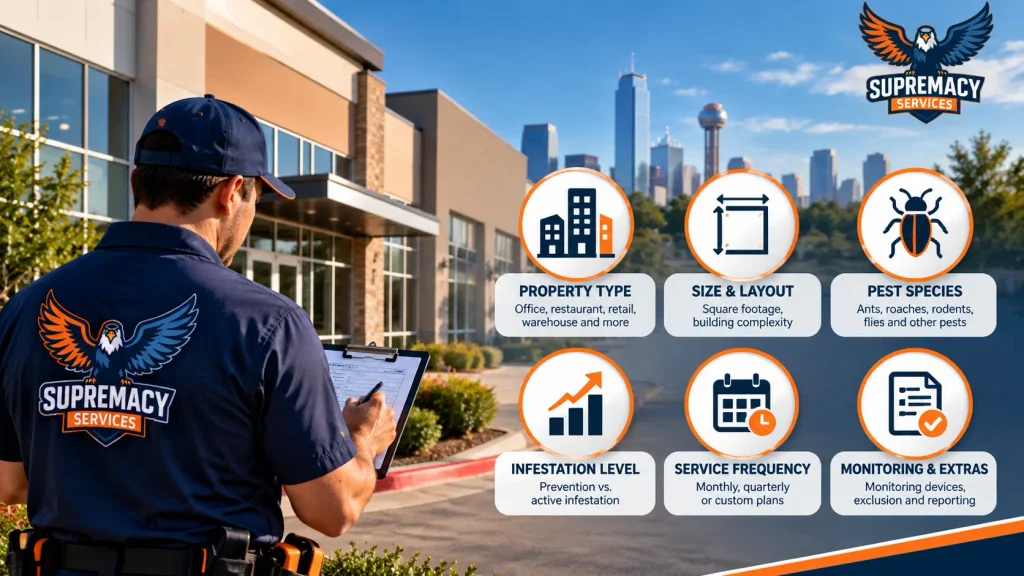
Square footage matters, but it is only one part of the calculation.
1. Property size and layout
Larger buildings usually require more inspection time, more monitoring points and longer service visits.
But layout can matter as much as total floor area.
A technician may need to inspect:
- exterior walls;
- employee entrances;
- loading docks;
- kitchens;
- floor drains;
- storage rooms;
- mechanical areas;
- utility penetrations;
- tenant suites;
- dumpster enclosures;
- roof or attic spaces;
- landscaping;
- receiving areas.
A compact but complicated commercial kitchen can therefore require more pest-management work than a much larger, low-risk office.
2. Type of business
How the business operates directly affects pest risk.
An accounting office does not normally have the same combination of food, grease, moisture, floor drains, incoming deliveries and waste found in a restaurant.
Likewise, a warehouse with constantly opening dock doors, palletized products and hundreds of feet of exterior perimeter presents a different management problem from a small retail storefront.
Common commercial environments include:
- offices;
- restaurants;
- grocery stores;
- retail stores;
- warehouses;
- manufacturing facilities;
- healthcare properties;
- hotels;
- schools;
- apartment communities;
- property-management portfolios.
A good commercial pest-control program should be designed around the way the property actually operates.
3. Pest species
Not every pest requires the same treatment.
Routine ant activity around an exterior wall is very different from:
- German cockroaches in a commercial kitchen;
- rodents inside a warehouse;
- flies breeding around drains;
- stored-product insects in food inventory;
- bed bugs in a hotel;
- termites affecting structural materials.
Different pests may require different monitoring equipment, products, treatment methods, technician time and follow-up schedules.
Specialized services such as termites, bed bugs, wildlife removal or major rodent exclusion may therefore be quoted separately from a general commercial pest-management contract.
4. Severity of the infestation
Preventing a pest problem generally requires a different scope from correcting an established infestation.
A property with widespread activity may initially require:
- detailed inspection;
- pest identification;
- identification of food, water and harborage sources;
- corrective treatment;
- trapping or monitoring devices;
- sanitation recommendations;
- structural exclusion;
- follow-up visits.
Once the infestation is under control, the account can often move toward routine monitoring and prevention.
5. Number of monitoring devices
Commercial programs sometimes involve numerous devices.
Depending on the pest and facility, these may include:
- rodent stations;
- interior rodent monitors;
- insect monitors;
- fly-monitoring equipment;
- other pest-specific devices.
A small office may need only limited monitoring.
A warehouse, food facility or multi-building property may require a much larger device network that must be inspected and documented during each service.
6. Service frequency
The frequency of service has a direct effect on pricing.
A low-risk office may not need the same monitoring schedule as a restaurant with food preparation, waste, drains and continual deliveries.
Commercial service may be scheduled:
- periodically;
- monthly;
- more frequently for higher-risk environments;
- through a customized schedule based on activity and facility risk.
The cheapest frequency is not necessarily the most economical if inadequate monitoring allows pest activity to become established between visits.
7. Structural exclusion
Pesticides cannot permanently compensate for a building that continually allows pests to enter.
Potential entry points include:
- worn door sweeps;
- gaps around loading doors;
- utility penetrations;
- pipe openings;
- roofline gaps;
- vents;
- wall penetrations;
- damaged weather stripping.
Rodent or insect exclusion may therefore be recommended separately from routine treatment.
That can increase the initial cost while addressing the source of recurring pest entry.
8. Sanitation and maintenance conditions
A pest-management company cannot completely overcome conditions that continually provide pests with food, water and shelter.
Examples include:
- leaking plumbing;
- standing water;
- uncovered food;
- accumulated grease;
- overflowing dumpsters;
- food debris;
- clutter;
- damaged doors;
- unsealed penetrations;
- excessive cardboard storage.
When these conditions remain unresolved, a facility may require additional corrective service.
9. Documentation and reporting
Commercial pest management can involve substantially more documentation than residential service.
Depending on the property, reporting may include:
- technician service reports;
- pest-activity observations;
- monitoring-device records;
- treatment information;
- corrective recommendations;
- site maps;
- trend records;
- management notes.
Businesses that need detailed documentation for internal quality programs or inspections should include those requirements when requesting quotes.
Commercial Pest-Control Costs by Property Type
Office buildings
Offices are usually among the lower-risk commercial environments.
Common pressure points include:
- employee break rooms;
- vending areas;
- plumbing penetrations;
- landscaping;
- trash areas;
- food stored at desks;
- shared walls.
Multi-tenant office properties can be more complicated because pests may move through wall voids and utility pathways between suites.
The emphasis is often prevention and early detection rather than aggressive corrective treatment.
Restaurants and cafés
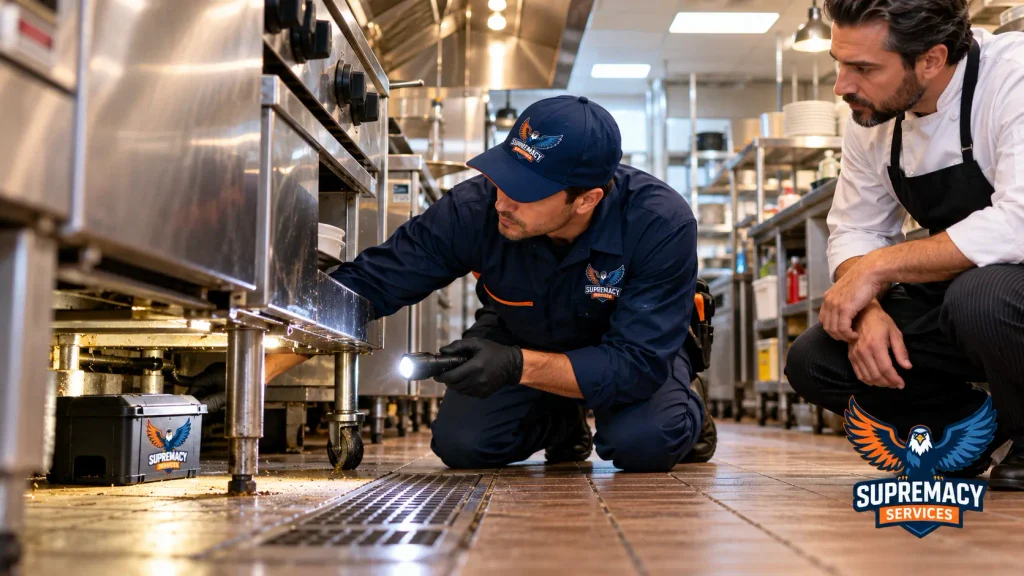
Restaurants generally require more intensive pest management because kitchens provide several resources pests need in one place: food, moisture, shelter and access.
Important inspection areas can include:
- food-preparation areas;
- floor drains;
- beverage stations;
- dry storage;
- equipment voids;
- receiving areas;
- dumpsters;
- grease areas;
- exterior doors.
Cockroaches, rodents and flies can also create food-safety concerns, making consistent monitoring especially important.
Texas food-establishment rules require pests to be controlled and emphasize routine inspection of the premises and incoming supplies for evidence of pest activity.
That does not mean every restaurant requires the same service schedule. It means the pest-management program should reflect the facility’s actual risk.
Grocery stores
Grocery stores combine customer traffic, food storage, produce, loading areas, waste and frequent deliveries.
Potential concerns can include:
- rodents;
- cockroaches;
- flies;
- stored-product pests;
- ants;
- occasional invaders.
Because grocery facilities may have many separate departments, the service scope should clearly define which areas and pests are covered.
Warehouses and distribution centers
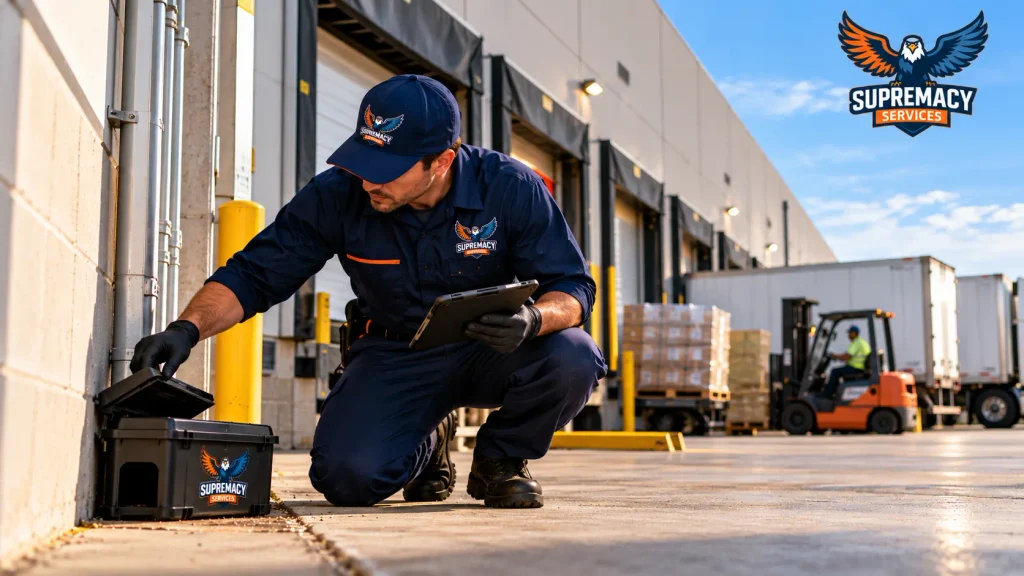
Warehouses are often priced according to both size and operational complexity.
Important pest-pressure areas include:
- dock doors;
- receiving bays;
- pallet storage;
- exterior walls;
- employee break areas;
- waste areas;
- utility penetrations;
- stored inventory.
Rodent monitoring can become particularly important where exterior doors remain open during shipping and receiving.
A large warehouse may also require a substantial number of monitoring locations, which increases inspection and documentation time.
Apartment and multifamily properties
Multifamily pest management can be priced in several ways depending on the provider and property.
Relevant factors may include:
- number of units;
- number of buildings;
- common areas;
- turnover units;
- dumpster locations;
- recurring tenant requests;
- exterior pest pressure;
- severity of existing activity.
Your Search Console data is already showing interest in per-door pest-control pricing for property-management portfolios, making this an especially valuable area for Supremacy to develop further.
Property managers should clarify whether a proposal includes:
- exterior prevention;
- common areas;
- individual-unit treatments;
- vacant-unit service;
- emergency callbacks;
- monitoring;
- reporting.
One-Time Commercial Treatment vs. Recurring Pest Control
| One-time treatment | Recurring commercial program |
|---|---|
| Addresses a specific immediate problem | Combines prevention with management of active problems |
| Usually a single corrective project | Ongoing inspections and monitoring |
| Lower immediate commitment | Predictable ongoing expense |
| Appropriate for some isolated problems | Better suited to recurring commercial risk |
| Limited long-term monitoring | Regular reassessment |
| Future introductions may not be covered | New activity can be detected earlier |
For many businesses, pests can continually be reintroduced by deliveries, employees, customers, neighboring properties, landscaping or open doors.
That makes recurring monitoring valuable even after the original pest problem is controlled.
Is Commercial Pest Control Priced by Square Foot?
Sometimes square footage contributes to the quote, but commercial pest control should not normally be evaluated by square footage alone.
Consider two 10,000-square-foot buildings.
One is a professional office.
The other is a restaurant and food-storage facility containing floor drains, commercial kitchens, multiple exterior doors, dumpsters and receiving areas.
Their pest-management requirements could be dramatically different even though the buildings occupy the same amount of floor space.
A more useful commercial quote evaluates:
property size + facility use + pest pressure + monitoring requirements + treatment scope + service frequency + documentation requirements.
What Should Commercial Pest Control Include?
A professional commercial pest-control program should generally begin with inspection and pest identification rather than simply applying pesticide throughout the property.
Depending on the account, the program may include:
Facility inspection
Identify pest activity, entry points, food sources, moisture, sanitation concerns and potential harborage.
Correct pest identification
Treatment should be based on the pest actually present.
Different cockroach, ant, rodent or fly problems can require different management strategies.
Monitoring
Monitoring helps determine where pest activity is occurring and whether conditions are improving.
Prevention recommendations
Technicians may identify structural or operational changes that could reduce pest pressure.
Targeted treatment
Control methods should be selected according to the pest, location and facility conditions.
Structural-exclusion recommendations
Entry points should be identified where pests continually enter through openings in the building.
Documentation
Commercial service records can help property managers understand what technicians found, what was done and what requires attention.
Follow-up
Pest activity should be reassessed so the strategy can be adjusted when necessary.
If your current commercial program consists mainly of routine spraying without inspection, monitoring or documented recommendations, request a commercial pest assessment from Supremacy Services to compare the actual scope of protection.
Integrated Pest Management vs. Routine Spraying
Integrated Pest Management, or IPM, combines pest identification, monitoring, prevention and appropriate control methods rather than relying only on routine pesticide applications.
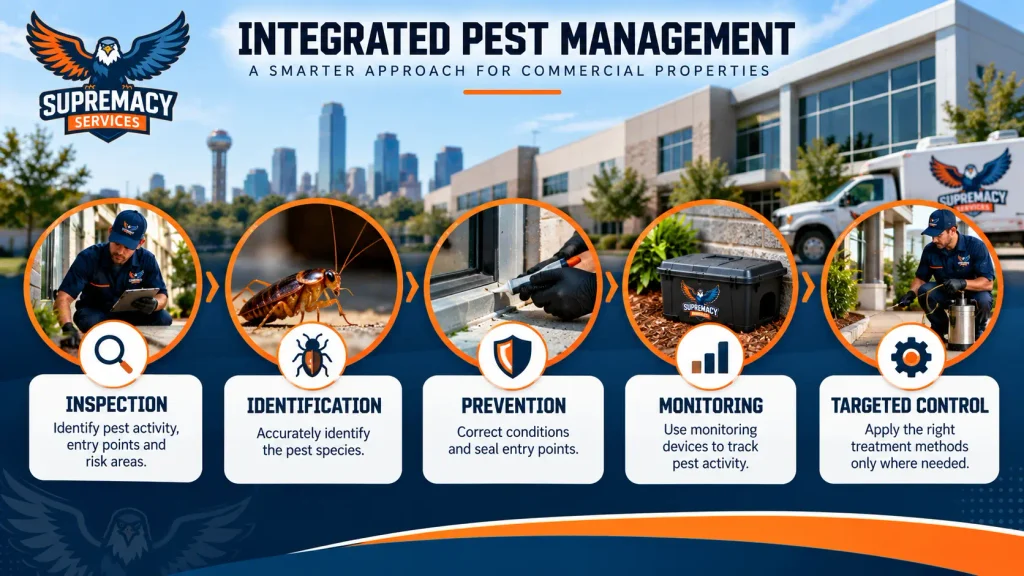
That distinction matters for commercial properties.
Repeatedly treating visible cockroaches, for example, may not solve:
- moisture around equipment;
- sanitation issues;
- drain activity;
- food debris;
- structural cracks;
- hidden harborages.
Rodent problems may require:
- monitoring;
- trapping;
- sanitation;
- exterior management;
- structural exclusion.
The U.S. Environmental Protection Agency describes IPM as a practical approach that combines multiple pest-management methods while emphasizing prevention and informed control decisions.
For commercial facilities, that means spending money on the cause of pest pressure, not simply treating the visible symptom repeatedly.
Dallas and DFW Conditions That Can Affect Pest Pressure
The most useful local factors are not generic claims about “Texas pests.” They are conditions around individual North Texas commercial properties.
Landscaping against buildings
Dense vegetation and organic debris near walls can create sheltered pest areas and complicate inspections.
Dumpsters and refuse areas
Food residue and spilled liquids can attract flies, rodents and cockroaches.
Loading docks
Frequently opened doors increase opportunities for pests to enter warehouses, restaurants and distribution facilities.
Moisture
Leaks, condensation and standing water can support pest activity.
Shared commercial walls
Restaurants, offices and retailers in multi-tenant developments may experience pest movement through common structural pathways.
Frequent deliveries
Pests can arrive with pallets, cartons, food products and other incoming supplies.
The Texas Food Establishment Rules specifically recognize the importance of inspecting incoming food and supplies for evidence of pests.
DIY vs. Professional Commercial Pest Control
Employees play an important role in pest prevention.
Your staff can:
- clean spills quickly;
- keep food properly stored;
- maintain dumpster areas;
- report pest sightings;
- reduce clutter;
- inspect incoming products;
- correct leaks;
- keep exterior doors closed when practical;
- alert maintenance staff to damaged doors or gaps.
However, significant pest activity should not be treated as a housekeeping problem alone.
Professional commercial pest management becomes especially appropriate when:
- rodents are active indoors;
- cockroaches appear in food areas;
- pest activity keeps returning;
- inventory is being damaged;
- multiple tenant spaces are affected;
- formal monitoring is required;
- pest activity could affect customers or guests;
- employees cannot identify the source;
- specialized treatment is required.
Texas regulates structural pest-control companies and professionals. Businesses offering structural pest-control services for compensation must meet applicable licensing requirements through the Texas Department of Agriculture.
How Can a Dallas Business Reduce Pest-Control Costs?
The most effective strategy is usually not simply reducing the number of service visits.
It is reducing the conditions that create repeat pest problems.
Commercial pest-prevention checklist
- Repair plumbing leaks.
- Eliminate standing water.
- Replace worn door sweeps.
- Keep exterior doors properly sealed.
- Seal appropriate utility penetrations.
- Keep dumpster lids closed.
- Keep refuse areas clean.
- Clean food spills quickly.
- Reduce unnecessary cardboard and clutter.
- Rotate stored inventory.
- Inspect incoming deliveries.
- Keep food in suitable containers.
- Maintain landscaping around the structure.
- Train staff to report pests early.
- Follow corrective recommendations from pest inspections.
When the building and operating environment are working with the pest-management program instead of against it, technicians can focus more effectively on prevention and monitoring.
How to Compare Commercial Pest-Control Quotes
Do not choose a commercial pest-control company based only on the monthly price. Compare what the quote actually covers.
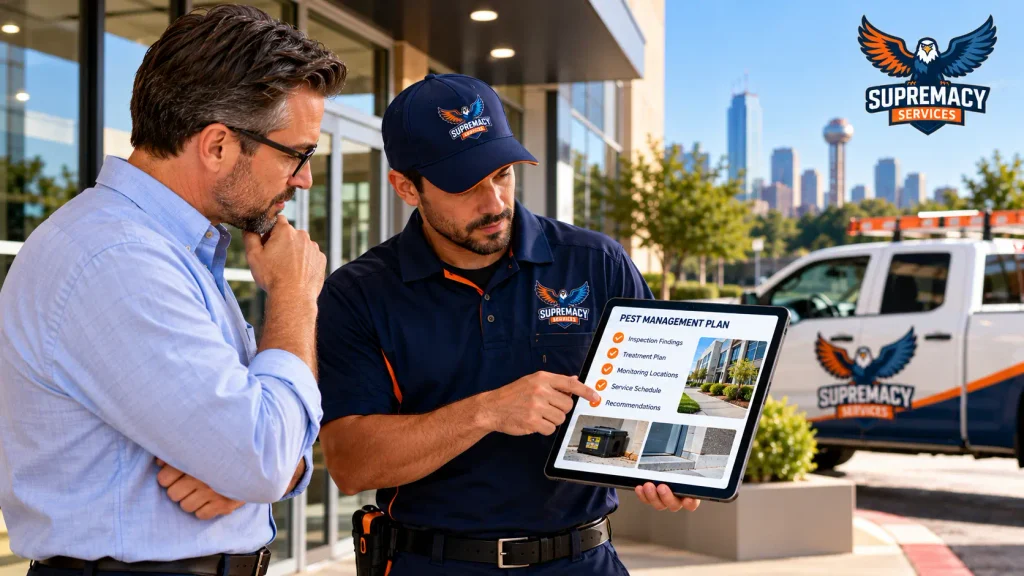
Ask every provider the following:
| Question | Why it matters |
|---|---|
| Which pests are included? | Specialized pests may cost extra |
| Which areas are inspected? | Limited inspections may miss exterior sources |
| How frequently will you visit? | Frequency affects monitoring and cost |
| Are rodent devices included? | Equipment and servicing can affect pricing |
| Are follow-up visits included? | Activity can occur between scheduled visits |
| Is exclusion included? | Treatment cannot permanently fix structural entry points |
| Are sanitation recommendations documented? | Management needs actionable corrective steps |
| Will we receive service records? | Important for facility management |
| Can service occur after hours? | Useful for customer-facing businesses |
| What happens if pest activity increases? | Shows whether the program adapts |
| What services cost extra? | Prevents surprise charges |
| Is the business properly licensed in Texas? | Commercial structural pest control is regulated |
A cheaper quote may actually cost more if important services are excluded.
What Should You Expect During a Commercial Pest Inspection?
A useful pest inspection should answer four questions:
- What pest is present?
- Where is it coming from?
- What conditions are allowing it to survive?
- What combination of monitoring, prevention and treatment is appropriate?
Depending on the property, the technician may examine:
- exterior walls;
- doors;
- utility penetrations;
- drains;
- kitchens;
- storage areas;
- mechanical rooms;
- landscaping;
- dumpster areas;
- receiving zones;
- loading docks;
- tenant areas.
The final proposal should then explain the service scope rather than presenting only a monthly price.
Warning Signs That a Commercial Property Needs Professional Pest Control
A business should investigate promptly when pest activity begins affecting customers, employees, food, inventory or multiple parts of the property.
Warning signs include:
- cockroaches seen during operating hours;
- rodent droppings;
- gnaw marks;
- damaged food packaging;
- recurring flies near drains;
- insects around stored goods;
- repeated employee pest sightings;
- pest activity near customer entrances;
- pests appearing in several tenant spaces;
- repeated problems despite cleaning;
- unexplained pest odors.
Early investigation is usually easier than attempting to correct a problem after pests have become established throughout the facility.
Commercial Pest Control in Dallas: When an Inspection Makes Sense
Because commercial properties differ so widely, an on-site assessment is usually the best way to establish a realistic pest-control budget.
Supremacy Services provides commercial pest-management programs for Dallas-Fort Worth properties including:
- restaurants;
- retail businesses;
- offices;
- warehouses;
- multifamily properties;
- hotels;
- healthcare facilities;
- schools;
- property-management portfolios.
A commercial assessment can help determine:
- what pests are present;
- where they are entering;
- which areas require monitoring;
- whether corrective treatment is needed;
- whether exclusion should be performed;
- what service frequency is appropriate.
That information produces a far more meaningful quote than relying on a generic square-foot calculation.
Frequently Asked Questions
How much does commercial pest control cost per month in Dallas?
There is no universal monthly rate. Published DFW examples place some smaller recurring commercial programs in roughly the low hundreds of dollars per service, while restaurants, warehouses, large properties and heavily infested facilities can cost considerably more. A facility inspection is the best basis for pricing.
Why does restaurant pest control usually cost more than office pest control?
Restaurants generally contain more food, moisture, drains, grease, waste and incoming deliveries. Those conditions can require closer monitoring and more frequent service than a typical professional office.
Is commercial pest control priced by square foot?
Square footage may influence pricing, but it is rarely the only factor. Facility type, pest species, infestation severity, monitoring requirements, building layout and service frequency can matter just as much.
How often should commercial pest control be performed?
There is no schedule appropriate for every property. Frequency should reflect the type of business, pest pressure, operating conditions and monitoring needs.
Does commercial pest control include rodents?
Many commercial programs can include rodent monitoring or control, but significant infestations, large monitoring networks and structural exclusion may be priced separately. Confirm exactly what the proposal covers.
What should a commercial pest-control contract include?
The proposal should clearly describe the areas inspected, pests covered, service frequency, monitoring equipment, treatment scope, documentation, follow-up policy, exclusions and services that require additional charges.
Can employees perform pest control themselves?
Employees can support prevention through sanitation, maintenance, waste management and pest reporting. Structural pest-control services performed commercially in Texas are regulated, so professional treatment should be handled in accordance with applicable licensing and pesticide requirements.
What is Integrated Pest Management?
Integrated Pest Management combines pest identification, monitoring, prevention and appropriate control methods. The goal is to address both the pests and the conditions allowing them to survive.
Do commercial pest-control companies provide inspection records?
Many programs provide service records and pest observations, but documentation varies by provider. Businesses requiring records for management or audits should make that requirement clear when requesting proposals.
What affects multifamily pest-control pricing?
Unit count, number of buildings, common areas, dumpsters, turnover units, infestation distribution, individual-unit requests and service frequency can all affect a property-management pest-control program.
Get a Commercial Pest-Control Assessment in Dallas
The most useful commercial pest-control quote is not simply the lowest monthly number. It is a clearly defined program that matches the building’s actual pest risks.
If you operate or manage a restaurant, office, retail property, warehouse, apartment community or other commercial property in Dallas-Fort Worth, request a commercial pest-control assessment from Supremacy Services.
An inspection can identify current activity, vulnerable areas, monitoring requirements and the appropriate service schedule so you can compare the cost against a clearly defined scope of work.