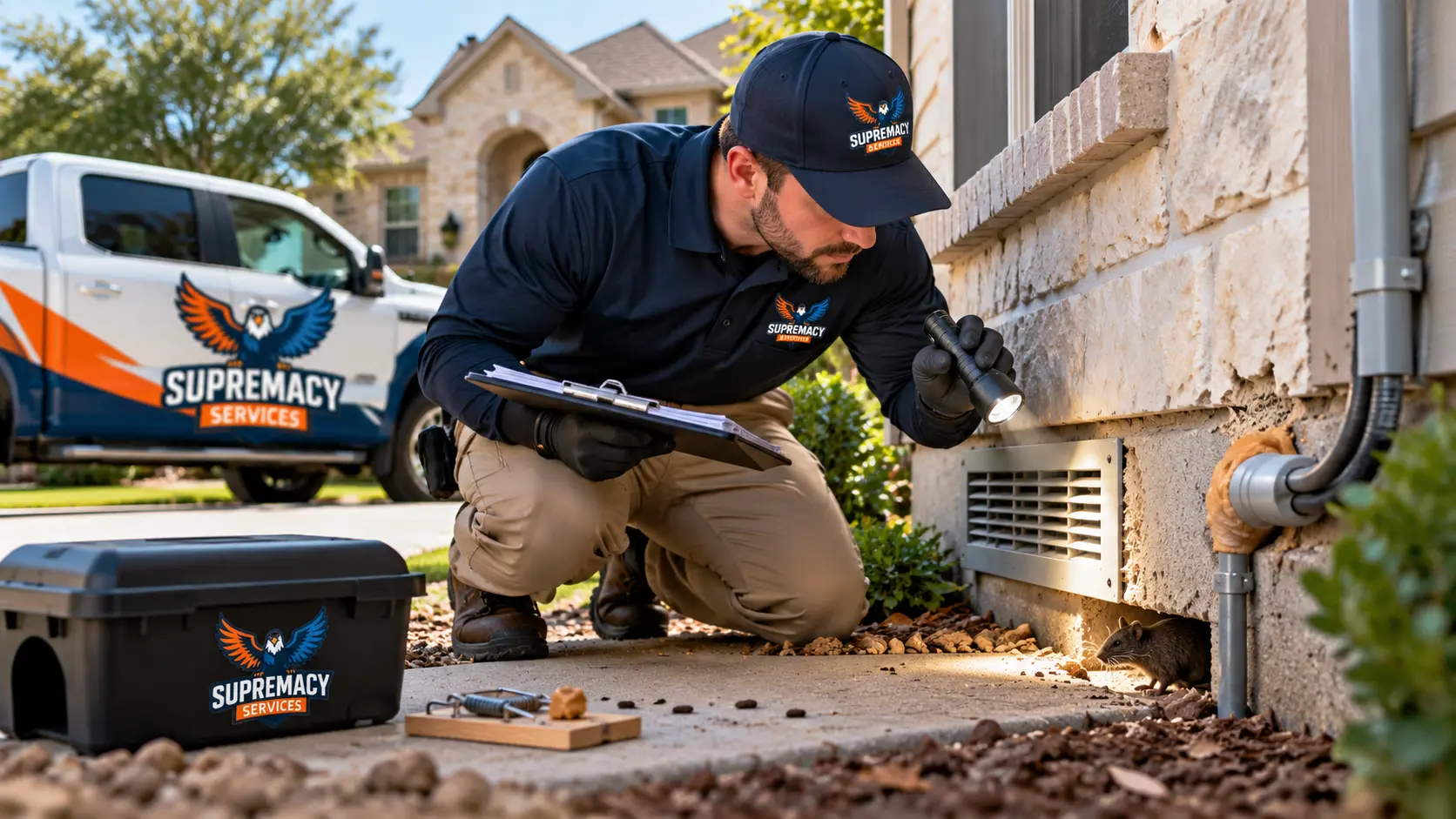
There is no single pest-control schedule that is right for every Dallas business.
For many commercial properties, regular inspections ranging from monthly to quarterly can be a practical starting point, while restaurants, food-handling facilities, healthcare environments, properties with recurring infestations, and other higher-risk operations may require more frequent monitoring or service.
The important distinction is that commercial pest control should not be scheduled solely by the calendar. A good program adjusts frequency according to the facility, pest pressure, previous activity, sanitation conditions, structural vulnerabilities, operational requirements, and monitoring results.
That risk-based approach is consistent with Integrated Pest Management, or IPM: inspect and identify pests, monitor activity, prevent conditions that support infestations, establish appropriate action thresholds, and use targeted control where necessary.
For Dallas-Fort Worth businesses, the real question therefore is not simply, “Should we have pest control every month?” It is:
How often does this particular property need to be inspected, monitored and serviced to keep pest activity under control?
Table of Contents
- How often should commercial pest control be scheduled?
- Commercial pest-control frequency by business type
- Why some Dallas businesses need more frequent service
- Does monthly service mean pesticide application every month?
- Signs your current schedule may not be frequent enough
- What should happen during a recurring pest-control visit?
- One-time treatment vs. recurring commercial pest management
- How pest-control frequency affects cost
- DIY prevention between professional visits
- Dallas and DFW considerations
- How to choose the right schedule
- Frequently asked questions
How Often Should Commercial Pest Control Be Scheduled?
Commercial pest control should be scheduled according to facility risk rather than using one universal interval. Lower-risk offices or retail properties may sometimes be managed with monthly or quarterly inspections, while restaurants and other high-risk facilities often benefit from monthly or more frequent monitoring.
Those are planning ranges—not Texas legal requirements and not a substitute for an inspection.
A professional should first evaluate:
- the type of business;
- pests historically found on the property;
- current pest activity;
- food and water sources;
- dumpsters and waste areas;
- loading and receiving activity;
- building construction;
- cracks, utility penetrations and other entry points;
- neighboring properties;
- landscaping;
- sanitation practices;
- previous infestations;
- monitoring results; and
- any operational or industry requirements affecting the facility.
EPA’s Integrated Pest Management framework emphasizes monitoring, correct pest identification, prevention and using control measures based on actual conditions rather than automatically treating every facility the same way.
A business with no visible activity can therefore still need regular inspections, while another property experiencing an active cockroach or rodent problem may temporarily require much closer follow-up.
Not sure what schedule your property needs? Request a commercial pest-control assessment from Supremacy Services so the program can be based on your facility, pest history and operating environment.
Commercial Pest-Control Frequency by Business Type

There is no official schedule that applies to every property category, but risk generally increases when a facility has abundant food, water, waste, storage areas, frequent deliveries, overnight occupancy or large numbers of exterior openings.
A practical framework looks like this:
| Facility | Practical starting point | Why frequency may increase |
|---|---|---|
| Professional office | Monthly to quarterly inspection | Break rooms, landscaping, shared walls or previous activity |
| Retail store | Monthly to quarterly | Customer traffic, stockrooms, receiving doors and adjoining tenants |
| Restaurant/café | Often monthly or more frequent | Food, grease, drains, waste, deliveries and continuous pest attractants |
| Grocery/food retail | Monthly or more frequent based on risk | Food inventory, receiving areas and storage |
| Warehouse/distribution | Monthly to quarterly depending on stored goods and risk | Loading docks, open doors, pallets and rodent entry |
| Hotel/hospitality | Often monthly; targeted areas may need closer monitoring | Guest turnover, food service, laundry and bed-bug risk |
| Multifamily property | Monthly or risk-based recurring program | Shared walls, utility routes and multiple occupants |
| Healthcare facility | Risk-based recurring monitoring | Sensitive occupied environment and strict sanitation expectations |
| Manufacturing | Monthly or customized | Production activity, materials, storage and loading operations |
| Food processing/storage | Frequently monitored, customized program | Elevated food-safety and pest-risk concerns |
These intervals should be treated as starting points for planning, not automatic treatment schedules.
The actual interval should change when monitoring shows that the risk has changed.
Why monthly pest control is common in higher-risk businesses
Monthly commercial pest-control service gives the pest-management provider frequent opportunities to:
- inspect monitoring devices;
- identify new pest activity;
- compare findings with previous visits;
- inspect high-risk locations;
- identify sanitation or maintenance issues;
- adjust the management plan;
- treat confirmed activity when appropriate; and
- document what was found and what was done.
Monthly service is especially useful when conditions can change quickly.
A restaurant can receive dozens of deliveries between visits. A warehouse can have doors opening throughout the day. A multifamily property can experience activity moving through shared utility penetrations. A retail facility can develop a problem in a stockroom even when the sales floor appears clean.
When quarterly commercial pest control may be enough
Quarterly professional visits can sometimes be appropriate for a lower-risk commercial property with:
- little or no history of infestation;
- limited food handling;
- good sanitation;
- effective waste management;
- few structural entry points;
- effective door sweeps and screens;
- minimal moisture problems; and
- reliable internal pest reporting.
However, quarterly service should not mean ignoring the property for three months.
Employees and facility staff should continue watching for pest evidence between professional inspections.
Why Some Dallas Businesses Need More Frequent Service
The appropriate frequency is determined by risk—not simply square footage.

1. Food availability
Restaurants, cafés, break rooms, grocery stores and food-processing environments give insects and rodents more opportunities to find food.
Even small amounts of residue can matter.
Areas such as:
- floor-wall junctions;
- underneath equipment;
- drains;
- storage racks;
- food-preparation areas;
- beverage stations;
- dumpsters; and
- receiving areas
deserve particular attention.
2. Water and moisture
Cockroaches, rodents and many other pests benefit from accessible water.
Pest pressure can increase around:
- leaking plumbing;
- floor drains;
- condensation;
- mop sinks;
- standing water;
- poorly drained exterior areas; and
- irrigation near the structure.
Correcting the moisture source can therefore be part of pest management—not just repeatedly treating the insects it attracts.
3. Deliveries and loading docks
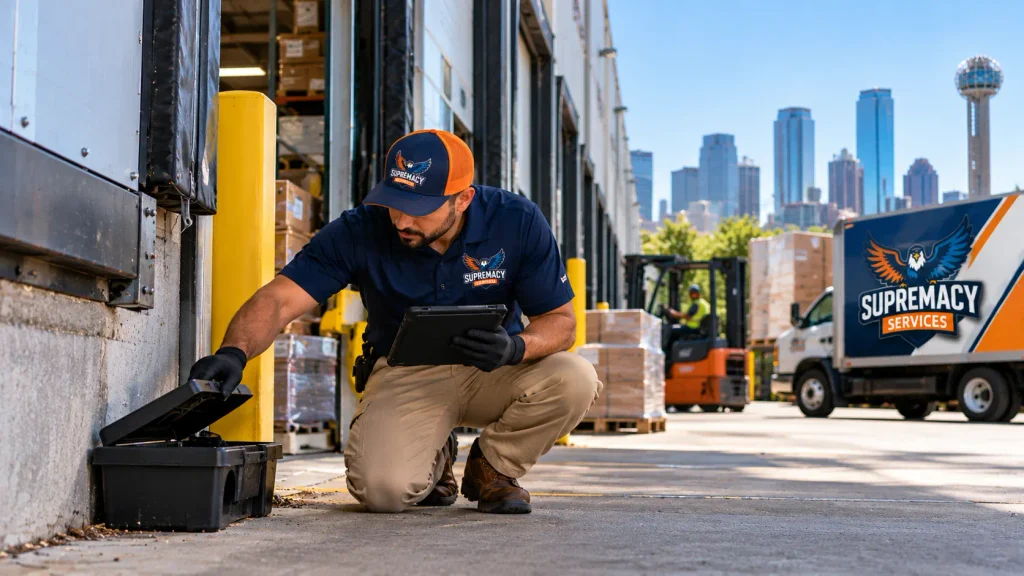
A pest-management program cannot completely control what arrives at a commercial building.
Cardboard, pallets, stored products and incoming deliveries can provide opportunities for pests to enter a facility.
Warehouses, retailers, restaurants and manufacturers with frequent receiving activity may consequently need more monitoring around docks, doors and storage areas.
4. Waste handling
Dumpsters, grease, food waste and poorly maintained trash areas can sustain pest populations near the building.
The closer that pressure becomes to doors, loading areas or utility penetrations, the greater the chance pests reach the structure.
5. Building construction and entry points
Pest pressure is partly a building-maintenance issue.
Potential access points include:
- gaps beneath doors;
- damaged door sweeps;
- wall penetrations;
- utility openings;
- roofline gaps;
- pipe penetrations;
- damaged screens;
- expansion joints;
- dock doors; and
- other structural openings.
Repeated activity at the same location can be a sign that exclusion or building repair deserves as much attention as treatment.
6. Previous infestation history
A building that previously experienced German cockroaches, rodents, stored-product pests or another persistent infestation may require closer monitoring even after visible activity disappears.
A period with no customer or employee sightings does not necessarily prove that the underlying problem is gone.
Monitoring data is more useful.
7. Neighboring properties
Commercial buildings do not operate in isolation.
Shared walls, connected retail suites, adjacent restaurants, dense urban blocks and neighboring waste areas can all influence pest pressure.
A clean tenant can still experience problems originating elsewhere in a building.
Does Monthly Service Mean Pesticide Application Every Month?
No. A monthly pest-management visit does not necessarily mean the same pesticide treatment should be applied everywhere every month.
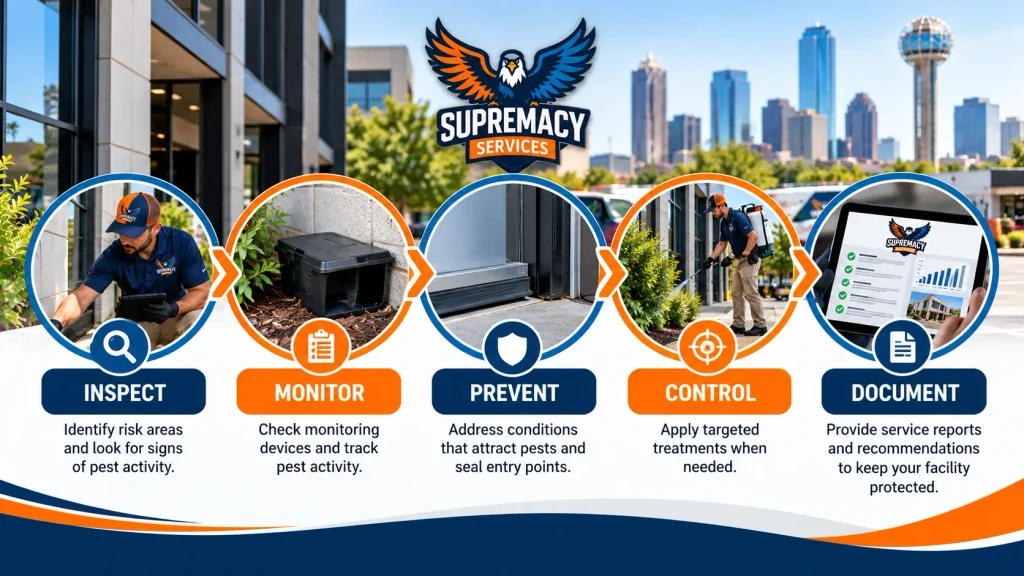
This distinction is central to Integrated Pest Management.
A recurring service visit can involve inspection, monitoring, identification, sanitation recommendations, exclusion checks, trap or monitoring-station review and targeted treatment when findings justify it.
EPA describes IPM as a decision-making process rather than a single pest-control technique.
That matters for commercial properties because the objective should be control and prevention, not simply maximizing how much product is applied.
A technician might spend one visit investigating rodent evidence around a loading dock and another reviewing cockroach monitors around a kitchen.
The work should respond to what the facility is showing.
Signs Your Current Schedule May Not Be Frequent Enough
Do not automatically wait until the next scheduled visit when pest activity is increasing.
Your current program may need review when:
- employees repeatedly report live pests;
- monitoring devices show increasing activity;
- rodent droppings repeatedly appear;
- gnawing or damaged packaging is found;
- cockroaches are appearing during operating hours;
- flies are increasing around drains or waste areas;
- the same pest returns shortly after service;
- pest activity is spreading to new parts of the building;
- customers or tenants are reporting sightings;
- structural openings have increased because of repairs or construction;
- sanitation or waste conditions have changed; or
- the facility has experienced a significant operational change.
A recurring spike in activity should trigger investigation.
Simply shortening the service interval without understanding the cause can still leave the real problem unresolved.
What Should Happen During a Recurring Pest-Control Visit?
A professional recurring program should involve more than walking through the property and automatically spraying.

Review previous findings
Historical records help identify trends.
A technician should know whether activity has:
- increased;
- decreased;
- moved;
- disappeared; or
- repeatedly returned in the same area.
Inspect high-risk areas
Depending on the property, this can include:
- kitchens;
- food storage;
- receiving areas;
- loading docks;
- trash areas;
- utility rooms;
- employee break rooms;
- restrooms;
- stockrooms;
- exterior perimeter areas;
- landscaping;
- roof or mechanical areas where safely accessible;
- utility penetrations; and
- previously identified hotspots.
Check monitoring devices
Monitoring helps turn pest control from guesswork into evidence-based management.
The important question is not simply whether a device was checked.
It is what the findings mean.
Identify conditions supporting pests
Professional pest management should also identify circumstances that are allowing activity to persist.
Examples include:
- food debris;
- moisture;
- standing water;
- broken door sweeps;
- gaps;
- clutter;
- damaged screens;
- poor storage practices;
- waste buildup; or
- vegetation contacting the structure.
Perform targeted treatment when needed
Treatment should match the identified pest, activity level, location and product label.
Not every pest sighting requires the same response.
Document findings and recommendations
Commercial facilities benefit from written records showing:
- inspection date;
- areas inspected;
- pest activity observed;
- monitoring results;
- treatments performed;
- recommendations;
- structural deficiencies; and
- follow-up needs.
This documentation also makes it easier for facility managers to see whether the program is improving over time.
If your current provider is treating the property without showing you what is being found, compare your program with Supremacy’s commercial pest-management approach for Dallas-Fort Worth facilities.
One-Time Treatment vs. Recurring Commercial Pest Management
A one-time treatment solves a different problem from an ongoing program.
| One-time service | Recurring commercial program |
|---|---|
| Addresses a defined current problem | Manages continuing pest risk |
| Limited monitoring period | Repeated inspections and monitoring |
| Often reactive | More preventive |
| Useful for some isolated problems | Better suited to continuing commercial exposure |
| Limited trend data | Builds pest-activity history |
| May not identify recurring seasonal patterns | Can adapt to changing conditions |
A one-time service can be appropriate when a specific, isolated problem has a clearly identified source.
Recurring service becomes more useful where pest pressure is continually being reintroduced by:
- deliveries;
- customers;
- neighboring tenants;
- waste;
- landscaping;
- food handling;
- building openings; or
- seasonal activity.
That is why many commercial facilities should think of pest control as a management program rather than an occasional extermination service.
How Pest-Control Frequency Affects Cost
Increasing service frequency generally increases annual service activity, but frequency is only one part of commercial pest-control pricing.
Other major variables can include:
- facility size;
- number of buildings;
- pest species;
- severity of activity;
- industry;
- treatment areas;
- number of monitoring devices;
- structural exclusion needs;
- service hours;
- documentation requirements; and
- whether specialized pests require a separate program.
That means the cheapest visit is not necessarily the least expensive program.
For example, four poorly targeted treatments may produce less value than a program that identifies a structural entry point and prevents repeated infestation.
When comparing proposals, ask for the annual scope—not simply the price of one visit.
Compare:
| Question | Why it matters |
|---|---|
| How often will routine inspections occur? | Establishes the baseline schedule |
| What pests are included? | Specialized pests may be separate |
| Are monitoring devices included? | Important for trend-based management |
| What happens between visits? | Determines response to new activity |
| Are follow-up visits included? | Important after corrective treatment |
| Is exclusion included? | Structural corrections may be separate |
| What documentation is provided? | Useful for facility management |
| Can frequency change if activity increases? | A rigid schedule may not match changing risk |
| What is the full annual cost? | Allows accurate comparison |
Supremacy also has a separate Dallas commercial pest-control cost guide for businesses that want a deeper pricing discussion.
DIY Prevention Between Professional Visits
Commercial pest management works best when employees and the pest-control provider are working from the same prevention strategy.
Facility staff can help by:
Managing food
- Clean spills promptly.
- Store food appropriately.
- Avoid leaving open employee food overnight.
- Clean underneath movable equipment where practical.
- Pay attention to vending and break-room areas.
Managing waste
- Keep trash containers appropriately closed.
- Clean spills around waste areas.
- Avoid unnecessary accumulation of cardboard and clutter.
- Monitor dumpsters and exterior waste areas.
Reducing moisture
- Repair plumbing leaks.
- Investigate recurring condensation.
- Keep floor drains and wet areas properly maintained.
- Address exterior drainage problems.
Reducing access
- Report damaged door sweeps.
- Repair screens.
- Seal appropriate structural gaps.
- Keep exterior doors closed when practical.
- Inspect utility penetrations.
Reporting activity
Employees do not need to identify every insect correctly.
They should be encouraged to report:
- what they saw;
- where it appeared;
- when it was observed; and
- preferably a photograph where practical.
That information can help the pest-management provider identify patterns.
Dallas and DFW Considerations
Commercial pest management in Dallas-Fort Worth should account for the actual property and operating environment rather than assuming every Metroplex business has identical pest pressure.
Long warm periods
North Texas businesses can experience insect activity across a substantial portion of the year.
This makes continuous monitoring useful even when a property is not currently experiencing a serious infestation.
Seasonal changes
Exterior pest activity changes through the year.
Service plans should therefore allow technicians to shift attention as conditions change rather than perform exactly the same procedure at every visit.
Dense commercial development
Restaurants, retail centers, offices and multifamily properties frequently operate beside other occupied properties.
Shared walls, connected rooflines, common utility routes and nearby waste areas can complicate pest management.
Warehousing and logistics
DFW contains extensive warehousing, distribution and logistics activity.
Facilities with numerous dock doors, pallets, incoming products and large exterior perimeters have a different risk profile from a small professional office.
Landscaping and irrigation
Landscaping, irrigation and protected exterior areas can create moisture or shelter close to commercial structures.
Exterior inspection should therefore be part of a comprehensive commercial program where relevant.
How to Choose the Right Commercial Pest-Control Schedule
Rather than asking a provider to sell you “monthly” or “quarterly” pest control before inspecting the property, ask the provider to explain why that interval makes sense.
A good recommendation should be based on:
- facility type;
- pest history;
- current inspection findings;
- known pest vulnerabilities;
- food and water availability;
- waste handling;
- building condition;
- surrounding property conditions;
- monitoring requirements; and
- how quickly new pest activity needs to be detected.
After service begins, the schedule should still be reviewed.
Increase frequency when:
- activity rises;
- a serious infestation develops;
- construction creates new vulnerabilities;
- sanitation conditions deteriorate;
- seasonal pest pressure increases;
- monitoring data shows repeated activity; or
- an operational change creates new risk.
Frequency may potentially be reduced when:
- activity remains consistently low;
- structural deficiencies are corrected;
- sanitation problems are resolved;
- monitoring data supports the change; and
- the property remains at an acceptable risk level.
The objective is not the greatest possible number of service visits.
It is the right level of monitoring and intervention for the facility.
Frequently Asked Questions
Is monthly pest control necessary for every Dallas business?
No. The correct interval depends on pest risk, facility type, history and monitoring results. Higher-risk operations such as food-service facilities often warrant more frequent service than a low-risk professional office.
Is quarterly pest control enough for a commercial building?
It can be for some lower-risk properties with good sanitation, little food handling and minimal history of pest activity. A property assessment should determine whether quarterly monitoring is appropriate.
How often should restaurants receive pest control?
Restaurants commonly require frequent monitoring because food, water, drains, waste and deliveries create continuing pest pressure. Monthly service is a common planning point, while higher-risk conditions may justify additional inspections or follow-up.
How often should a warehouse have pest control?
The appropriate frequency depends heavily on what is stored, loading activity, door usage, previous rodent or insect activity and surrounding conditions. Some lower-risk warehouses may operate with quarterly visits, while others benefit from monthly or more frequent monitoring.
Can a business need pest control more than once a month?
Yes. An active infestation, high-risk food environment, significant rodent problem or changing monitoring results can justify biweekly, weekly or other targeted follow-up until activity is controlled.
Does monthly commercial pest control mean monthly spraying?
No. A recurring visit can involve inspection, monitoring, exclusion recommendations, sanitation review, documentation and targeted treatment. IPM emphasizes deciding what control is necessary based on actual findings.
Should pest-control frequency increase during an infestation?
Often, yes. Corrective treatment may require closer follow-up than preventive maintenance. Once activity is controlled, the ongoing schedule can be reassessed.
What should a commercial pest-control plan include?
A strong plan typically addresses inspection, pest identification, monitoring, prevention, sanitation or exclusion recommendations, appropriate treatment, documentation and procedures for responding when activity is detected between visits.
Who regulates commercial structural pest-control providers in Texas?
The Texas Department of Agriculture’s Structural Pest Control Service regulates structural pest-control businesses and licensing in Texas. Businesses providing structural pest-control services for compensation must meet applicable state licensing requirements.
How do I know whether my business needs monthly or quarterly pest control?
Start with a property inspection. The provider should consider your facility type, pest history, food and waste exposure, building condition, monitoring needs and surrounding pest pressure before recommending a frequency.
Build the Schedule Around the Property—not the Calendar
For Dallas businesses, there is no credible answer that says every commercial property needs exactly the same pest-control interval.
A quiet professional office and a busy restaurant should not automatically receive the same program.
Neither should a small retail suite and a distribution warehouse with dozens of loading doors.
The better approach is to establish a baseline inspection schedule, monitor what is actually happening and adjust the program as risk changes.
That produces a commercial pest-management program built around evidence rather than habit.
Need a recurring pest-control program for a restaurant, office, retail property, warehouse, multifamily community or other Dallas-Fort Worth facility? Request a commercial pest-control assessment from Supremacy Services to determine an appropriate inspection, monitoring and service schedule for your property.