
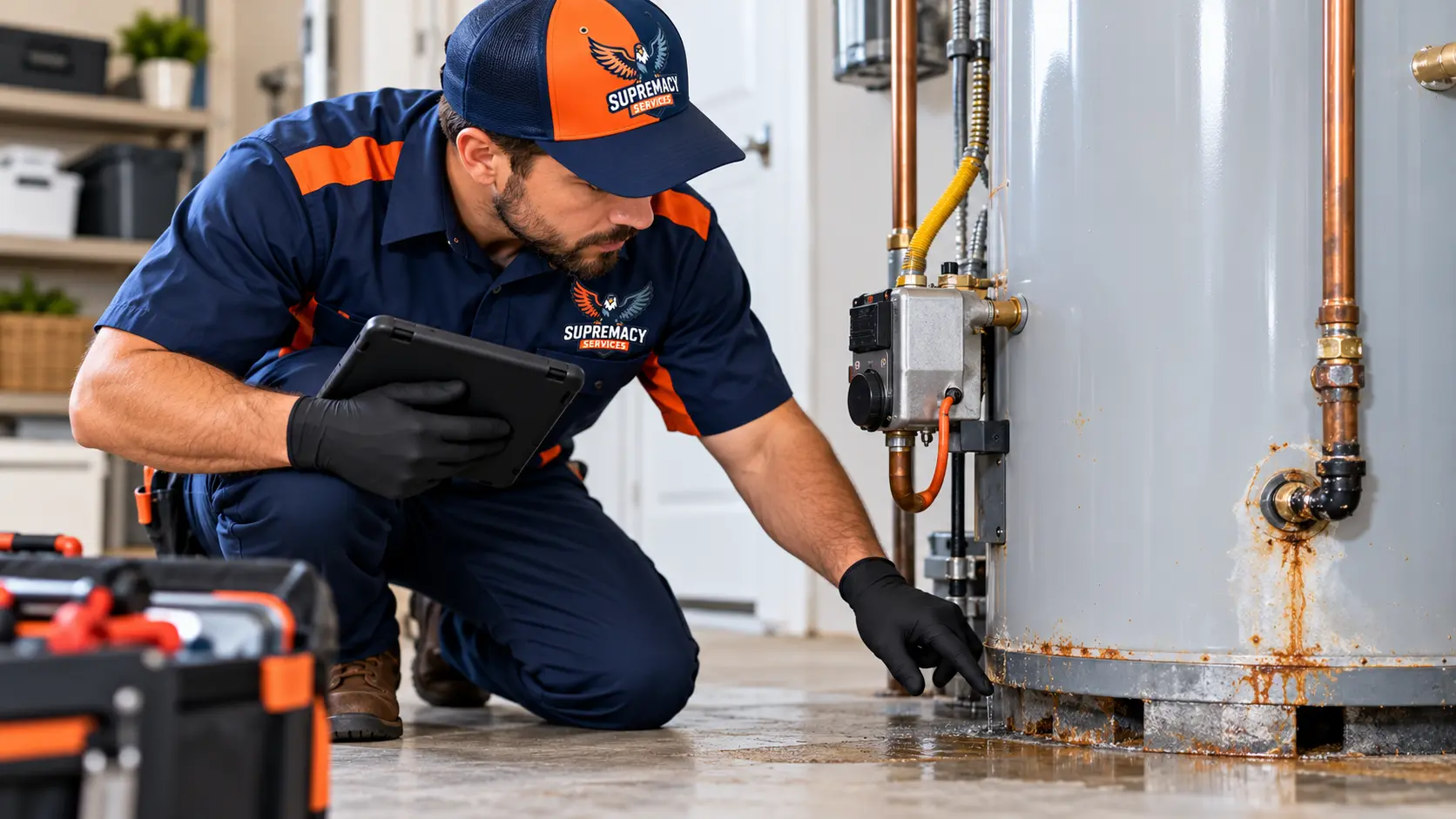
A failing water heater often gives homeowners warning before it stops producing hot water or begins leaking. Common signs your water heater is failing include corrosion, rusty hot water, water around the tank, unusual rumbling or popping noises, reduced hot-water capacity, inconsistent temperatures and repeated component problems.
Age matters too. ENERGY STAR advises homeowners to pay closer attention once a storage water heater reaches roughly the 10-year mark, particularly when age appears alongside corrosion, leaks, rusty water, reduced hot-water supply or unusual noises. ENERGY STAR
For Dallas–Fort Worth homeowners, recognizing these symptoms early gives you time to determine whether the problem is a repairable component or a deteriorating tank that should be replaced before it fails unexpectedly.
Table of Contents
- Quick Answer: What Are the Signs a Water Heater Is Failing?
- Water Is Leaking or Pooling Around the Heater
- Rust or Corrosion Is Appearing
- Hot Water Looks Rusty or Discolored
- Your Water Heater Is Rumbling or Popping
- Hot Water Runs Out Faster Than It Used To
- Water Temperature Has Become Unpredictable
- Your Water Heater Needs Repeated Repairs
- Energy Use Appears to Be Increasing
- Your Water Heater Is Around 10 Years Old or Older
- Repair or Replace?
- What Should You Do if Your Water Heater Is Leaking?
- What a Professional Water-Heater Inspection Includes
- Dallas Water-Heater Installation Considerations
- How to Reduce the Risk of Premature Failure
- Frequently Asked Questions
What Are the Signs a Water Heater Is About to Fail?
The most important warning signs are water leakage, visible corrosion, rusty hot water, unusual noises, reduced hot-water capacity, inconsistent heating, repeated repair problems and advanced equipment age.
ENERGY STAR specifically identifies visible corrosion, leaking, rust in the water, loss of available hot water and rumbling noises as potential indications of water-heater failure.
One symptom does not automatically mean the entire heater needs replacing. A failed thermostat or heating element, for example, may be repairable. A storage tank that has corroded through is a very different problem.
The key is identifying where the symptom originates and whether the tank itself is still structurally sound.
1. Water Is Leaking or Pooling Around the Heater
Water around your heater should never be ignored. The source may be a repairable fitting or valve, but leakage from the tank itself can indicate deterioration that requires replacement.
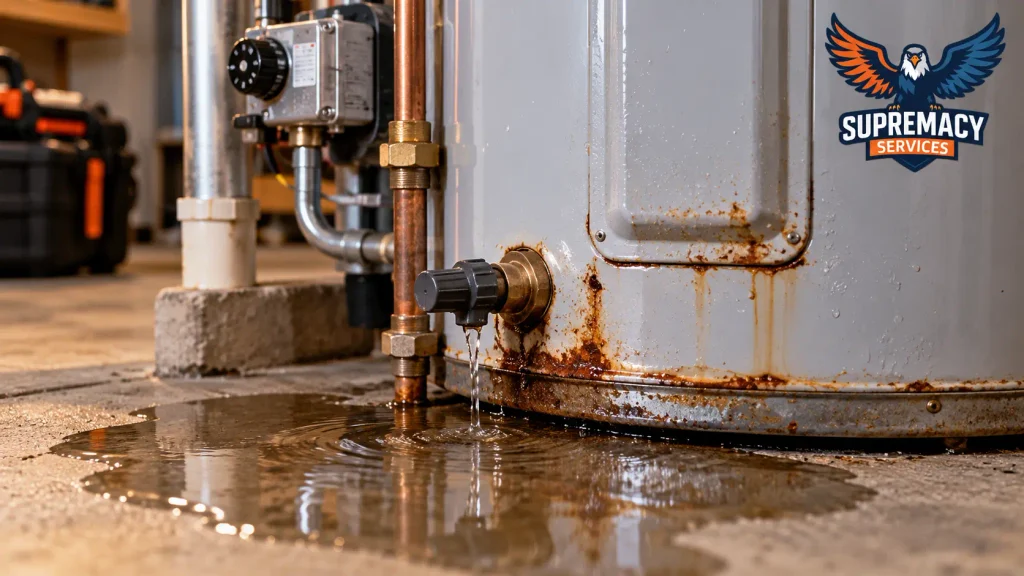
Start by determining where the moisture appears to originate.
Possible sources include:
- a water-supply connection;
- the drain valve;
- the temperature-and-pressure relief system;
- condensation;
- nearby plumbing;
- or the water-heater tank itself.
ENERGY STAR lists leaking from joints, seals or seams as a warning that the system has a problem.
A fitting leak is different from a tank leak
A plumber may sometimes repair a leaking connection, valve or other external component.
A corroded storage tank is different. Once the tank itself loses structural integrity, replacing an external component does not restore the tank.
Look carefully for:
- moisture repeatedly returning after the floor has been dried;
- rust trails down the tank;
- water appearing beneath the jacket;
- corrosion around the lower portion of the heater;
- or a growing puddle.
Not sure whether the water is coming from a valve, connection or the tank itself? Have the unit professionally diagnosed before a small leak becomes a larger water-damage problem.
Supremacy services
2. Rust or Corrosion Is Appearing on the Water Heater
Visible corrosion is one of the more important physical warning signs of an aging water heater.
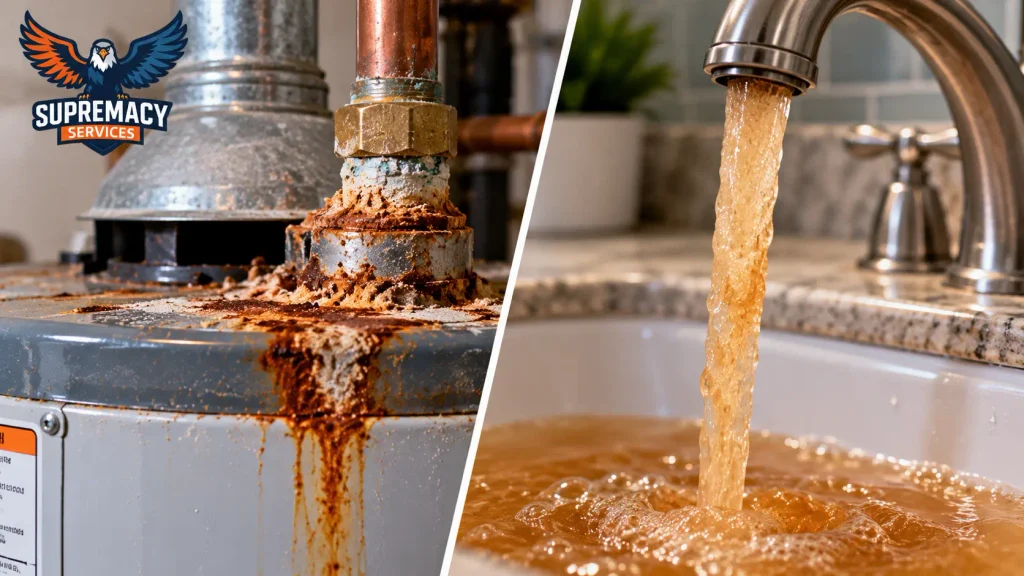
Inspect areas including:
- hot- and cold-water connections;
- fittings;
- valves;
- the top of the tank;
- the tank jacket;
- and the area around the base.
ENERGY STAR advises homeowners to look for corrosion on both the water lines entering and leaving the heater and on the unit itself.
Surface discoloration on one replaceable fitting does not necessarily mean the tank is finished. Widespread deterioration deserves more attention.
Why corrosion matters
Traditional storage heaters contain a steel tank protected against corrosion through tank construction, lining and sacrificial components.
As protective systems deteriorate, corrosion may eventually reach components that cannot economically or safely be restored.
This is why corrosion should be evaluated alongside:
- unit age;
- water quality;
- leakage;
- repair history;
- and condition of the tank.
3. Hot Water Looks Rusty, Brown or Discolored
Rust-colored water coming specifically from hot-water fixtures can indicate corrosion somewhere in the hot-water system.
ENERGY STAR identifies rust in hot water as a potential indication that the interior of the water-heating system is corroding.
Before assuming the tank has failed, compare the hot and cold water.
Simple diagnostic comparison
| What you observe | What it may suggest |
|---|---|
| Discoloration only from hot taps | Investigate water heater/hot-water piping |
| Discoloration from hot and cold taps | Problem may be elsewhere in the water supply |
| Short burst of discoloration only | Could involve localized piping or sediment |
| Persistent rusty hot water plus tank corrosion | Stronger reason for professional inspection |
Do not diagnose tank failure solely from water color.
A plumber should determine whether the discoloration originates in:
- the heater;
- hot-water piping;
- a corroded fitting;
- sediment;
- or another part of the plumbing system.
4. Your Water Heater Is Making Popping, Rumbling or Unusual Noises
Persistent popping or rumbling often indicates sediment or mineral deposits interfering with normal water-heater operation.
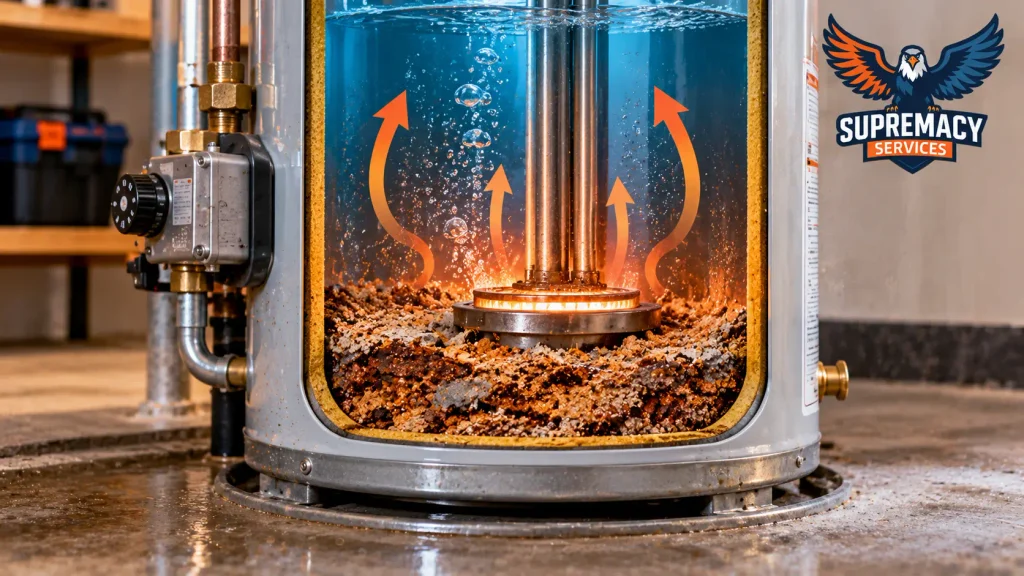
ENERGY STAR specifically lists rumbling, unusual noises and vibration among potential warning signs, noting that sediment buildup can be involved.
Sediment can settle at the bottom of a storage tank.
When the burner or heating element heats the water, trapped water moving through or beneath those deposits can contribute to unusual sounds.
Supremacy’s existing water-heater service page already states that its diagnostic process checks sediment buildup, anode condition, burner efficiency and tank integrity. Supremacy Services
Does rumbling mean the heater must be replaced?
Not automatically.
The correct response depends on factors such as:
- how much sediment is present;
- the condition of the tank;
- equipment age;
- previous maintenance;
- whether leakage or corrosion is also present;
- and whether flushing is appropriate for that specific unit.
A relatively young system with sediment is a different situation from an old heater that is simultaneously rumbling, rusting and leaking.
5. Hot Water Runs Out Faster Than It Used To
A noticeable reduction in usable hot-water capacity can indicate sediment accumulation, a heating problem or an aging system that is no longer performing as expected.
ENERGY STAR notes that sediment accumulation in aging hot-water tanks can reduce available capacity.
For example, a shower routine that previously used only part of the tank may suddenly exhaust the available hot water.
Possible explanations include:
- sediment occupying tank volume;
- a failed electric heating element;
- thermostat problems;
- burner problems;
- damaged internal components;
- unusually high household demand;
- or an undersized heater.
First rule out changed household demand
Before blaming the heater, ask:
- Have more people been staying in the home?
- Are showers longer?
- Is the dishwasher running at the same time?
- Has a new fixture been installed?
- Has the thermostat setting changed?
If demand has not changed and capacity continues declining, the heater deserves inspection.
6. Water Temperature Has Become Unpredictable
Water that alternates between properly hot, lukewarm and cold can point to a control, heating or capacity problem.
Depending on the type of heater, possibilities can include:
- thermostat trouble;
- electric element failure;
- burner or ignition trouble;
- sediment;
- flow or sizing issues;
- sensor problems on tankless units;
- or other internal faults.
An intermittent temperature problem does not automatically mean replacement is necessary.
Component-level faults can sometimes be repaired.
The decision becomes more complicated when inconsistent heating occurs on an older unit that also has corrosion, leakage, noise or a history of repeated repairs.
7. Your Water Heater Needs Repairs More and More Often
A single component failure can be reasonable to repair. Repeated failures on an aging water heater are a sign to compare future repair spending against replacement.
Think beyond the latest repair.
Ask:
- How old is the heater?
- What was repaired last time?
- Are new components failing?
- Is the tank itself still in good condition?
- Is corrosion developing?
- Does the heater still meet your household’s demand?
- Would replacement improve reliability or efficiency?
The decision should be based on the condition of the entire system, not simply whether the current component can technically be changed.
If your water heater is accumulating repair issues, Supremacy Services can evaluate the system and help you compare repair versus replacement based on the tank condition, age and your household’s hot-water needs.
8. Energy Consumption Seems to Be Increasing
A water heater that takes longer to recover or transfers heat less effectively may use more energy, but higher utility bills alone do not prove the heater is failing.
Water heating is a major household energy use. The U.S. Department of Energy recommends measures such as appropriate thermostat settings, pipe insulation and sediment management to improve water-heating efficiency. The Department of Energy’s Energy.gov
Higher bills may also result from:
- rate increases;
- seasonal changes;
- more occupants;
- longer showers;
- leaking hot-water fixtures;
- or other gas/electrical loads.
Treat higher consumption as a supporting symptom rather than a stand-alone diagnosis.
It becomes more meaningful when paired with:
- longer heating times;
- reduced hot-water output;
- sediment noise;
- equipment age;
- or visible deterioration.
9. Your Storage Water Heater Is Around 10 Years Old or Older
Age alone does not prove a water heater has failed, but an older heater deserves closer monitoring—especially when other warning signs appear.
ENERGY STAR advises homeowners with water heaters around 10 years old or older to consider planning ahead rather than waiting for an unexpected failure.
Supremacy’s existing Dallas tank-versus-tankless guide describes conventional storage-heater service life as commonly around 8–12 years, while also emphasizing that actual lifespan depends on water conditions, maintenance, installation quality, usage and equipment quality. Supremacy Services
The important distinction is:
Age is a risk factor, not an automatic replacement deadline.
A 10-year-old heater with no leakage, good tank condition and reliable operation is different from a similarly aged unit with rusty water, corrosion, noise and declining capacity.
Find the manufacturing information
The data plate normally contains:
- manufacturer;
- model number;
- serial number;
- fuel type;
- capacity;
- electrical or gas ratings.
If the installation date is unknown, the manufacturer may provide instructions for interpreting the serial number.
Should You Repair or Replace a Failing Water Heater?
Repair usually makes more sense when the problem involves a serviceable component and the tank itself remains sound. Replacement becomes more compelling when the tank is leaking, badly corroded or showing multiple age-related problems.
Use this framework:
| Situation | Repair may make sense | Replacement deserves stronger consideration |
|---|---|---|
| Failed thermostat | ✓ | |
| Failed electric element | ✓ | |
| Repairable valve/fitting | ✓ | |
| Isolated ignition/control problem | ✓ | |
| Heavy sediment on otherwise sound unit | Possibly | Possibly |
| Repeated repair history | ✓ | |
| Significant tank corrosion | ✓ | |
| Tank-body leak | ✓ | |
| Old unit plus multiple warning signs | ✓ | |
| No longer meets household demand | ✓ |
No table can replace a hands-on inspection because the actual condition of the tank, venting, connections and safety components matters.
Do not compare repair cost alone
A better decision compares:
current repair + likely remaining life + efficiency + reliability + future repair risk
against:
replacement + installation requirements + expected service life + improved reliability
Supremacy already has a dedicated commercial page for this next step, so this blog should educate homeowners and then hand them off rather than turning into another replacement sales page. Supremacy Services
What Should You Do if Your Water Heater Is Leaking?
If significant water is escaping from the heater, protect the property first and arrange professional evaluation promptly.
The exact shutdown procedure depends on whether the heater is gas or electric and on the equipment configuration.
Homeowners should avoid improvising around:
- gas controls;
- electrical panels;
- hot pressurized water;
- relief valves;
- venting;
- or damaged equipment.
For minor visible moisture, identify the source if it can be done safely.
For active or worsening leakage, professional diagnosis is appropriate.
If you smell gas
Do not continue diagnosing the water heater yourself. Leave the affected area and follow your gas utility’s emergency instructions.
What Does a Professional Water-Heater Inspection Look For?
A water-heater diagnosis should determine why the symptom is occurring instead of assuming that every old heater needs replacement.
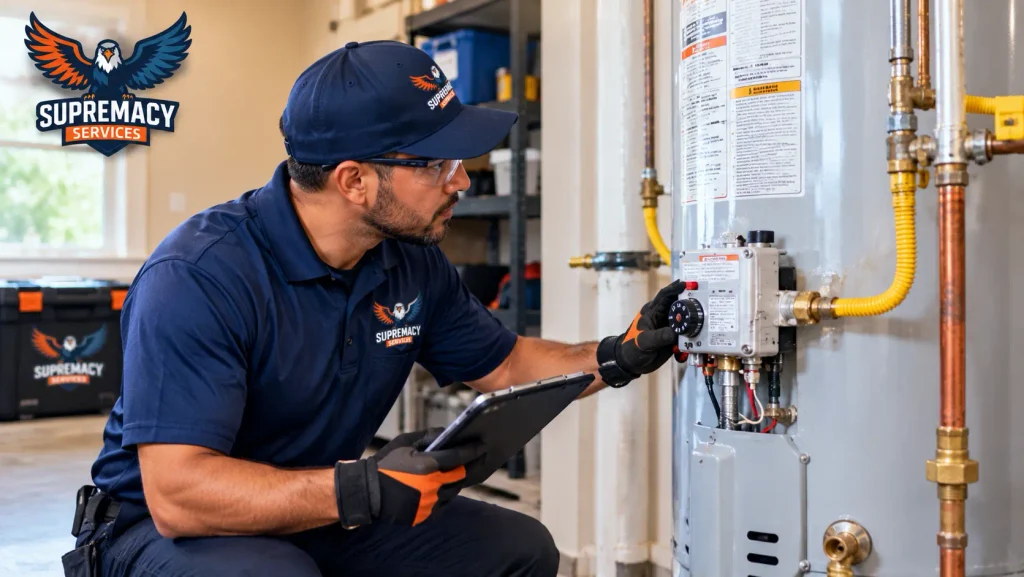
Depending on the equipment and complaint, an inspection may evaluate:
- tank integrity;
- corrosion;
- signs of leakage;
- water connections;
- sediment buildup;
- burner operation;
- electric heating components;
- thermostat/control operation;
- ignition system;
- venting for fuel-fired equipment;
- T&P relief components;
- water temperature;
- hot-water capacity;
- equipment sizing;
- and installation condition.
Supremacy’s published water-heater replacement process currently states that its full-system diagnostic checks sediment buildup, anode condition, burner efficiency and tank integrity before selection and installation of replacement equipment. Supremacy Services
That diagnostic approach is useful because the correct answer may be repair, maintenance or replacement, depending on what is actually wrong.
What Should Dallas Homeowners Know About Water-Heater Replacement?
Water-heater replacement is not simply a matter of buying a tank with the same gallon capacity.
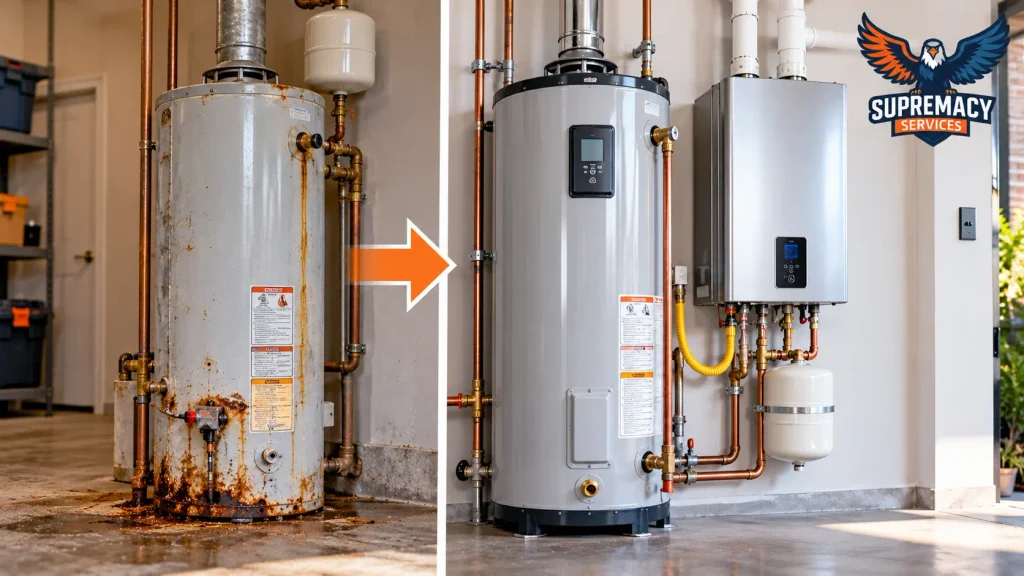
The installation may also involve:
- fuel supply;
- plumbing connections;
- venting;
- drainage;
- electrical requirements;
- available space;
- manufacturer clearances;
- equipment sizing;
- and applicable local construction requirements.
The City of Dallas currently identifies the 2021 International Plumbing Code with Dallas amendments, along with applicable mechanical, residential, energy and fuel-gas codes, as part of its adopted plumbing/mechanical framework.
Dallas also states that work involving the installation, alteration, repair or replacement of building service equipment generally requires the appropriate permit unless a specific exemption applies. Simple leak stopping that does not involve replacement or rearrangement of valves, pipes or fixtures is among the examples the city lists separately.
Permit requirements can depend on the exact scope and jurisdiction, so homeowners elsewhere in the DFW Metroplex should verify requirements with their own city.
Texas plumbing work is also regulated through the Texas State Board of Plumbing Examiners, which administers state plumbing licenses and registrations. tsbpe.texas.gov
Dallas/DFW takeaway
If replacement is required, evaluate the complete installation—not merely the appliance.
A contractor may need to assess:
- existing venting;
- fuel or electrical capacity;
- drainage;
- location;
- tank size or tankless flow requirements;
- and whether current installation details meet applicable requirements.
How Can You Reduce the Risk of Premature Water-Heater Failure?
Water heaters cannot last indefinitely, but maintenance may help preserve performance and identify problems earlier.
1. Inspect around the heater periodically
Look for:
- moisture;
- rust;
- corrosion;
- damaged connections;
- and changes in normal operation.
2. Pay attention to new sounds
A heater that was previously quiet and begins popping or rumbling deserves investigation.
3. Follow manufacturer maintenance instructions
Maintenance requirements vary among:
- conventional gas tanks;
- electric tanks;
- heat-pump water heaters;
- and tankless systems.
Follow the schedule in the specific manufacturer’s documentation rather than relying on a universal interval.
4. Address sediment appropriately
The Department of Energy recommends periodic sediment management for storage water heaters because accumulated material can interfere with efficient operation.
Older tanks or neglected systems should be evaluated before aggressive flushing because the appropriate maintenance procedure depends on equipment condition.
5. Do not ignore small leaks
A slow drip may originate from something repairable.
Waiting until it becomes a major leak can increase the risk of surrounding property damage.
Problems That Can Be Mistaken for Water-Heater Failure
Not every hot-water complaint means the water heater itself is dying.
| Symptom | Possible issue besides complete heater failure |
|---|---|
| No hot water | Breaker, heating element, gas/ignition issue, control fault |
| Hot water runs out quickly | High household demand, sizing issue, heating-element failure |
| Discolored water | Supply or piping issue |
| Water near heater | Nearby plumbing leak or condensation |
| High energy bill | Utility rate or usage changes |
| Temperature fluctuations | Thermostat/control issue |
| Poor hot-water pressure | Plumbing restriction or fixture problem |
This distinction matters because replacing a functioning water heater will not solve a problem originating elsewhere in the plumbing system.
When Should You Call a Professional?
Arrange a professional inspection when you notice:
- persistent water around the heater;
- tank or connection corrosion;
- rusty hot water;
- loud or worsening noises;
- rapidly declining hot-water capacity;
- repeated loss of heat;
- recurring component failures;
- an older heater displaying several symptoms at once;
- or uncertainty about whether the tank itself is leaking.
Homeowners can visually monitor equipment and note symptoms, but work involving gas, electrical connections, venting, pressurized hot water or safety devices is better handled by qualified professionals.
Final Takeaway: Water Heaters Usually Give You Clues
The most useful warning signs of water-heater failure are not mysterious.
Watch for:
- leaking water;
- visible corrosion;
- rusty or discolored hot water;
- rumbling or popping;
- declining hot-water capacity;
- inconsistent temperature;
- repeated repairs;
- abnormal operating performance;
- and advanced age combined with other symptoms.
The strongest case for replacement is generally not one isolated symptom. It is the combination of equipment age, tank condition and worsening performance.
If your Dallas–Fort Worth water heater is showing several warning signs, Supremacy Services can inspect the system and determine whether repair is practical or whether replacement is the better long-term option.
Concerned your water heater is approaching failure? Schedule a water-heater diagnostic with Supremacy Services and get a clear assessment of the tank, connections and system performance before a minor warning becomes an unexpected breakdown.
Frequently Asked Questions
How do you know when a water heater is about to fail?
Common signs include leaks, corrosion, rusty hot water, rumbling or popping noises, declining hot-water capacity, inconsistent temperatures and repeated repairs. Age becomes more important when several of these symptoms occur together.
Is a 10-year-old water heater too old?
Not necessarily, but it should be monitored more closely. ENERGY STAR specifically highlights water heaters around 10 years old or older as candidates for proactive replacement planning when signs of deterioration are present.
Does rusty hot water mean the water heater needs replacing?
Not always. Rusty water from hot taps can indicate corrosion within the water-heating system, but a plumber should first determine whether the discoloration comes from the heater, piping or another source.
Is a popping water heater dangerous?
Popping or rumbling commonly points to sediment-related problems and deserves investigation. The noise by itself does not prove the tank is unsafe or requires replacement, but it should not be ignored—especially on an older heater.
Can a leaking water heater be repaired?
Sometimes. A leaking fitting, connection or serviceable valve may be repairable. Leakage from a deteriorated tank itself generally creates a stronger case for replacement.
Why is my hot water suddenly running out faster?
Possible causes include sediment reducing usable tank capacity, a heating-element or burner problem, increased household demand or an undersized system.
Should I repair or replace an old water heater?
Consider the heater’s age, tank condition, repair history, reliability and cost of the current repair. Replacement becomes more reasonable when an aging unit develops tank leakage, serious corrosion or multiple recurring problems.
Can sediment damage a water heater?
Sediment can reduce usable capacity and interfere with heat transfer. ENERGY STAR identifies sediment as one possible cause of declining hot-water capacity and rumbling noises.
Who should replace a water heater in Texas?
Texas plumbing licensing is administered by the Texas State Board of Plumbing Examiners. Water-heater work should comply with applicable licensing, manufacturer and local jurisdiction requirements.

