
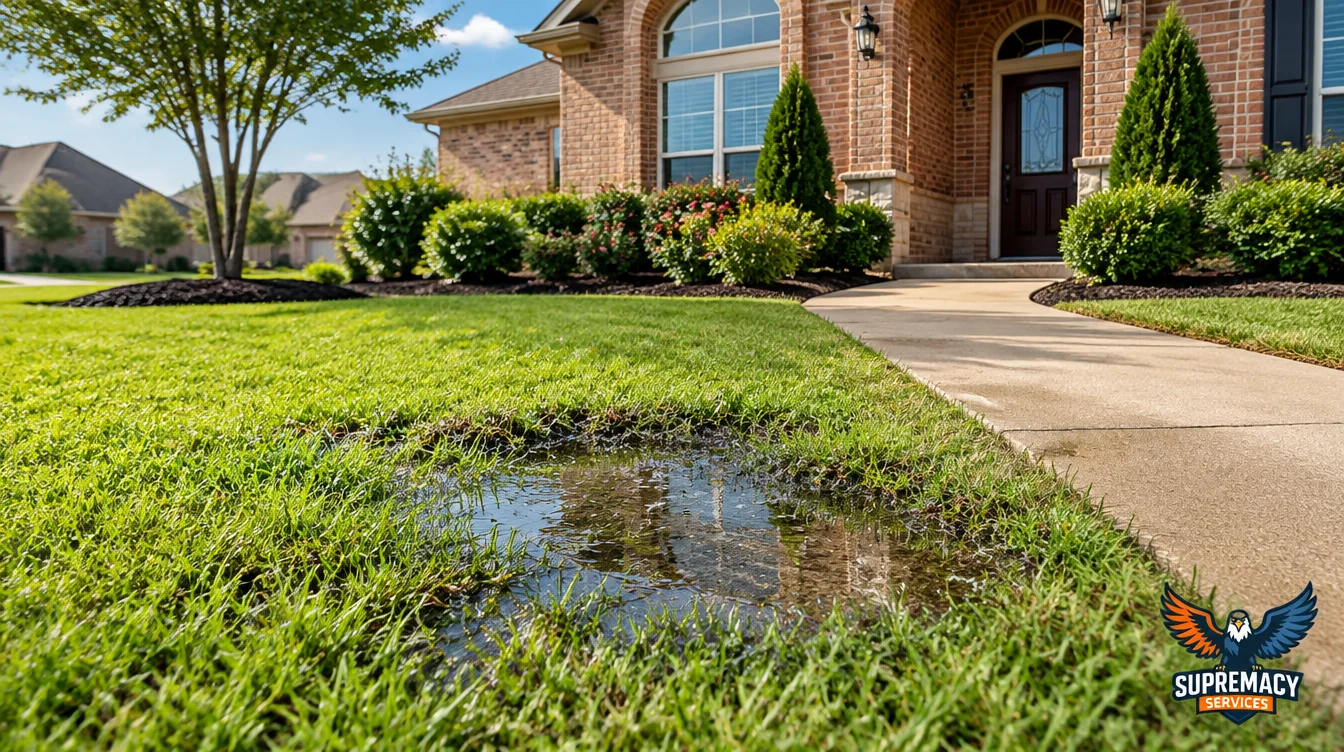
A main water line leaking in your Dallas home is often caused by aging pipes, corrosion, shifting soil, damaged fittings, excessive water pressure, or accidental damage to an underground supply pipe. Sometimes, several factors contribute to the same leak.
Because the main water line carries water from the municipal supply connection toward your house, damage can occur underground without an obvious broken pipe in sight.
You might first notice an unusually wet patch of grass, a higher water bill, reduced water pressure, or water collecting near your driveway.
In Dallas and the surrounding DFW Metroplex, changing soil moisture and underground pipe conditions are additional factors worth investigating. However, the only reliable way to identify the cause is to locate the leak and evaluate the damaged section.
This guide explains the most common causes of main water line leaks, how to recognize warning signs, what you can safely check yourself, and when professional repairs are necessary.
Table of Contents
- What Is a Main Water Line Leak?
- What Causes a Main Water Line to Leak?
- What Are the Warning Signs?
- How Can You Check for a Leak?
- Why Are Underground Leaks a Concern in Dallas?
- Main Water Line Leak vs. Other Plumbing Problems
- What Should You Do If Your Main Water Line Is Leaking?
- How Do Plumbers Find and Repair Underground Leaks?
- Should You Repair or Replace the Water Line?
- What Affects the Cost of Repair?
- How Can You Prevent Future Leaks?
- Frequently Asked Questions
- When to Contact Supremacy Services
What Is a Main Water Line Leak?
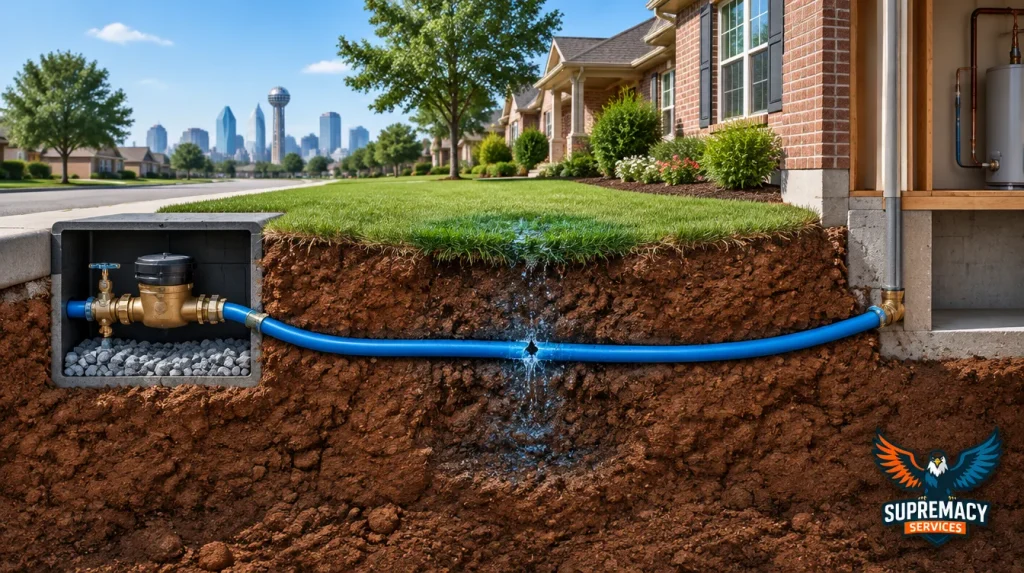
A main water line leak occurs when the pressurized pipe supplying water to a property develops a crack, hole, failed joint, or other opening that allows water to escape.
For most single-family homes, the private water service line runs underground between the municipal water connection or meter area and the home’s plumbing system.
Basic layout of a residential water service line, showing a possible underground leak between the meter and the house.
A leak may develop in the buried pipe, a fitting, a connection, or near the point where the service line enters the building.
Because the pipe is underground, water may travel through soil before appearing at the surface. The wettest area in your yard is not necessarily directly above the damaged pipe.
Why it matters: A persistent leak can waste treated water, increase utility bills, erode soil, and contribute to moisture problems near foundations or paved areas.
If you suspect damage to the underground supply pipe, Supremacy Services offers water line repair and replacement in Dallas for homeowners who need the problem professionally evaluated.
What Causes a Main Water Line to Leak?
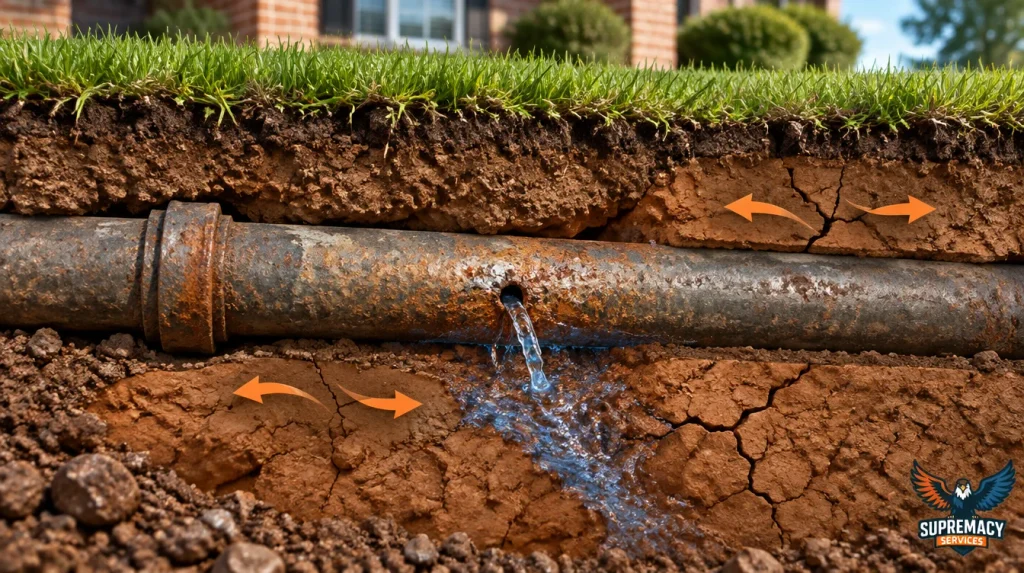
The most common causes of underground water line leaks are pipe deterioration, corrosion, ground movement, pressure-related stress, damaged joints, root-related movement, freezing conditions, and accidental excavation damage.
1. Aging or deteriorating water pipes
Water supply pipes do not last indefinitely.
Over time, some pipe materials become more vulnerable to deterioration, particularly when exposed to unfavorable soil conditions, repeated movement, or previous repairs.
Older properties may have galvanized steel or other materials that have been in service for decades. Newer homes may use copper or approved plastic piping.
Age alone does not prove that a pipe needs replacement. A plumber should consider its material, condition, leak history, and whether the failure is isolated.
2. Corrosion of underground pipes
Metal water lines can corrode under certain conditions.
Corrosion may weaken the pipe wall until a small opening develops. Depending on the material and surrounding environment, corrosion can occur externally or internally.
Possible indicators include:
- Repeated leaks along an older metal line.
- Visible rust or deterioration on exposed sections.
- Discolored water associated with deteriorating metallic plumbing.
- Pinhole leaks or weakened fittings.
Corrosion is one reason repeated patch repairs may become less economical than replacing a deteriorated section.
3. Soil movement and changing moisture levels
Soil movement is particularly relevant to underground plumbing in parts of North Texas.
Clay-rich soils can change volume as their moisture content changes. During dry conditions, some soils shrink; when moisture returns, they may swell.
These changes can place stress on buried pipes, joints, and connections, especially where the pipe passes between areas that move differently.
Soil movement does not automatically mean a water line will fail. Pipe flexibility, installation depth, bedding, joint design, and existing condition all influence how well it tolerates movement.
For a Dallas homeowner, the important question is whether ground movement contributed to the actual pipe damage—not simply whether the yard contains clay soil.
4. Excessive water pressure or pressure fluctuations
Water lines are designed to operate within suitable pressure conditions.
Excessive pressure can increase stress on plumbing components, while sudden changes in flow can create pressure surges.
Over time, vulnerable fittings, joints, and weakened pipe sections may fail.
A plumber can measure water pressure and evaluate whether a pressure-regulating valve or another system issue needs attention.
A leak should not automatically be attributed to high pressure without testing.
5. Damaged pipe joints and fittings
Not every underground water leak comes from a crack in the pipe itself.
Leaks can develop where two pipe sections connect.
Potential causes include improper assembly, movement at the joint, aging seals, unsuitable fittings, or mechanical stress.
A failed fitting may produce symptoms similar to a ruptured pipe, including wet soil and declining pressure.
6. Tree roots and nearby vegetation
Tree roots naturally grow toward areas where water and oxygen are available.
Roots may grow around underground plumbing, and expanding roots can sometimes contribute to pipe displacement or stress.
However, roots are not proof that a sound pressurized water line was punctured. Roots may also exploit soil moisture from a leak that already exists.
A professional inspection helps distinguish root-related displacement from corrosion, a defective joint, or another failure.
7. Freezing temperatures and sudden weather changes
Although Dallas generally experiences milder winters than northern states, freezing weather can still damage inadequately protected water piping.
Water that freezes inside a vulnerable pipe section expands and can create enough stress to split the pipe or damage a fitting.
Buried service lines are often better protected than exposed pipes, but shallow or exposed sections may be vulnerable during severe cold.
After a freeze, watch for unexplained wet areas or pressure changes once temperatures rise.
8. Accidental excavation or installation damage
Underground pipes may be damaged during landscaping, fence installation, driveway work, or other excavation.
Sometimes damage is immediate. In other cases, a pipe is weakened and develops a leak later.
Poor bedding, inadequate support, or unsuitable connections may also contribute to premature failures.
Before excavation, arrange utility locating through Texas 811 and confirm how privately owned lines will be identified.
What Are the Warning Signs of a Leaking Main Water Line?
Common warning signs include unexplained wet spots, unusual water consumption, lower water pressure, water pooling in the yard, and persistent moisture near the house.
| Warning sign | What it could indicate | What to check |
|---|---|---|
| Wet patch in the yard | Underground supply leak or irrigation issue | Whether the area remains wet without watering or rain |
| Unexpected water bill increase | Continuous water loss | Compare meter readings and recent usage |
| Low pressure throughout the house | Supply restriction, leak, or utility issue | Whether multiple fixtures are affected |
| Water pooling near driveway | Underground water escaping toward the surface | Location, timing, and nearby irrigation |
| Unusually green strip of grass | Localized excess moisture | Whether it follows a buried pipe route |
| Sound of running water | Water moving through a leaking or operating pipe | Whether all fixtures and equipment are off |
| Soil erosion or settling | Escaping water affecting surrounding soil | Whether the area is becoming unstable |
Can a main water line leak without visible water?
Yes. An underground leak can remain hidden when water disperses into surrounding soil or drains away before reaching the surface.
This is why water meter readings can be useful even when the yard appears dry.
The U.S. Environmental Protection Agency recommends checking the water meter during a period when no water is being used. A changing reading may indicate a leak somewhere in the property’s water system.
How Can You Check for a Main Water Line Leak?
You can perform a basic water meter check to determine whether water is being recorded while your home is not intentionally using it.
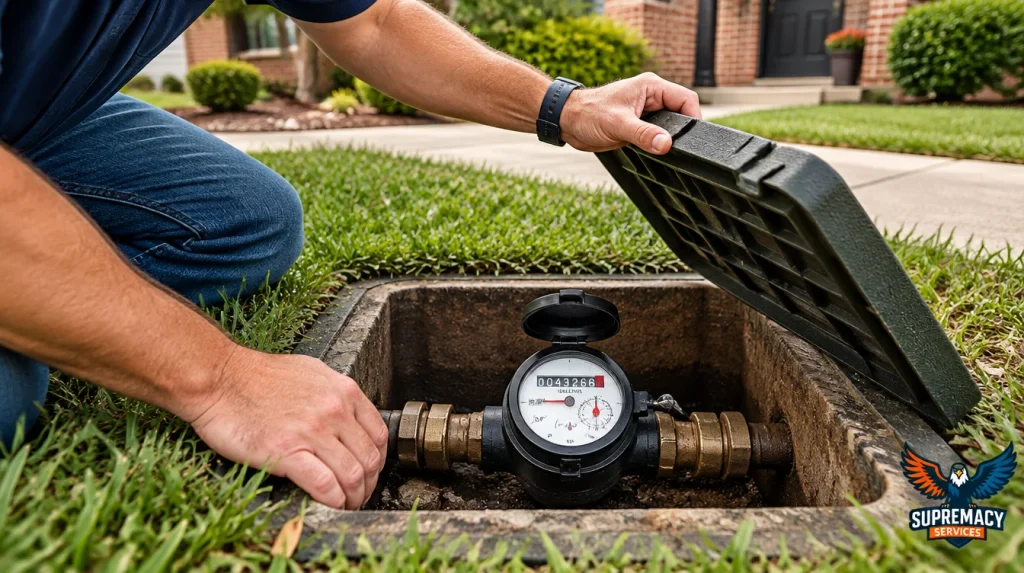
Homeowner leak-check checklist
EPA-style meter check
0 of 6 completedTurn off faucets, showers, appliances, and irrigation systems.Check that toilets are not continuously refilling.Record the water meter reading or photograph it.Avoid using water for approximately two hours.Read the meter again and compare the readings.If consumption is recorded, arrange further investigation.
Reset checklist
A changing meter reading suggests water is passing through the meter, but it does not identify the exact location.
To help narrow the problem, a plumber may compare readings with the home’s main shutoff valve closed, where the plumbing arrangement permits that test.
If the meter continues registering flow with the home’s plumbing isolated, the service line between the meter and the shutoff becomes a possible source. This is not conclusive because valve condition and plumbing layout vary.
Do not open or operate utility-controlled equipment, force a stuck valve, or dig around the meter.
Why Are Underground Water Line Leaks a Concern in Dallas?
Underground leaks in Dallas deserve attention because prolonged water escape can affect the soil around foundations, landscaping, driveways, and other structures.
Clay soils and foundation movement
Some Dallas-area properties have expansive clay soils that respond to changes in moisture.
An underground leak may create an unusually wet area next to drier surrounding soil. This moisture imbalance can contribute to movement under certain conditions.
However, a foundation crack does not automatically establish that a water line is leaking. Structural movement has multiple possible causes.
Hot summers and concealed water loss
During warm weather, a homeowner may initially mistake a damp lawn for an irrigation problem.
Conversely, dry surface soil does not rule out a buried leak.
The best approach is to compare water use, check the meter, and evaluate whether the wet area is associated with the service line, irrigation system, drainage, or another source.
Municipal water infrastructure and private service lines
A leak near the street may involve municipal infrastructure, the water meter assembly, or the property’s private water service line.
Responsibility depends on the actual location and applicable utility rules.
For suspected Dallas utility-side leaks or water main breaks, the City of Dallas directs residents to use 311 for reporting.
Homeowners elsewhere in DFW should contact their own municipal water utility.
Main Water Line Leak vs. Other Plumbing Problems
Several plumbing issues can produce similar symptoms, but the appropriate repair depends on which system is affected.
| Problem | Typical clues | Key distinction |
|---|---|---|
| Main water line leak | Wet yard, unexplained metered use, possible low pressure | Pressurized water supply between the utility connection and home |
| Irrigation leak | Wet lawn near sprinklers or irrigation piping | May occur during scheduled watering or from a leaking irrigation valve |
| Sewer line leak | Wastewater odors, drainage issues, soggy ground | Involves wastewater rather than the pressurized potable supply |
| Slab leak | Moisture under flooring, warm spots with hot-water leaks, unexplained water use | Usually involves plumbing beneath or within the foundation |
| Indoor fixture leak | Running toilet, dripping faucet, damp cabinet | Water loss occurs at or near a fixture |
A wet lawn alone cannot distinguish these problems.
For example, a leaking irrigation line and a damaged water service line can both create localized wet soil. The difference becomes clearer when a plumber isolates individual systems and tests them.
What Should You Do If Your Main Water Line Is Leaking?
If you suspect an active main water line leak, prioritize stopping unnecessary water loss and preventing property damage.
- Assess the severity. Rapidly accumulating water, ground erosion, or flooding near electrical equipment requires immediate attention.
- Shut off the property’s water supply if safe. Use the homeowner-accessible shutoff valve. Avoid forcing damaged valves or operating utility equipment without authorization.
- Keep people away from unstable ground. Saturated soil near excavations, retaining walls, or pavement may be unsafe.
- Document the problem. Photograph wet areas, visible damage, and unusual meter readings.
- Contact the water utility if the leak may be on its side. Report suspected municipal water main or meter problems through the appropriate utility.
- Arrange professional leak detection. A plumber can determine whether the service line is leaking and identify suitable repair options.
Avoid digging to expose a suspected leak without proper utility locating and excavation precautions.
If the source is not visible, Supremacy Services offers professional water leak detection to help locate concealed plumbing leaks before unnecessary excavation.
How Do Plumbers Find and Repair Underground Water Line Leaks?

Professional diagnosis typically combines an assessment of the property’s plumbing layout, water meter observations, pressure testing where appropriate, and leak-location equipment.
Step 1: Evaluate the symptoms
The plumber asks when the issue started, whether the water bill changed, whether pressure has dropped, and where moisture appears.
Step 2: Identify the affected pipe
The technician determines whether the problem involves the private service line, irrigation, interior plumbing, or utility infrastructure.
Step 3: Locate the leak
Depending on pipe material and site conditions, acoustic leak detection, electronic equipment, pressure testing, or other appropriate methods may help narrow the leak location.
No single detection method works equally well on every property.
Step 4: Expose the damaged area
If excavation is required, the work area is planned around buried utilities, access limitations, and property features.
Step 5: Repair or replace the pipe
The plumber selects an approved repair method and suitable materials based on the pipe’s condition and the location of the failure.
Step 6: Test and restore
After repairs, the system should be checked for leakage and proper operation. Excavated areas are then restored according to the agreed scope.
The goal is to identify the actual failure rather than repeatedly repairing symptoms without addressing the cause.
Should You Repair or Replace a Leaking Main Water Line?
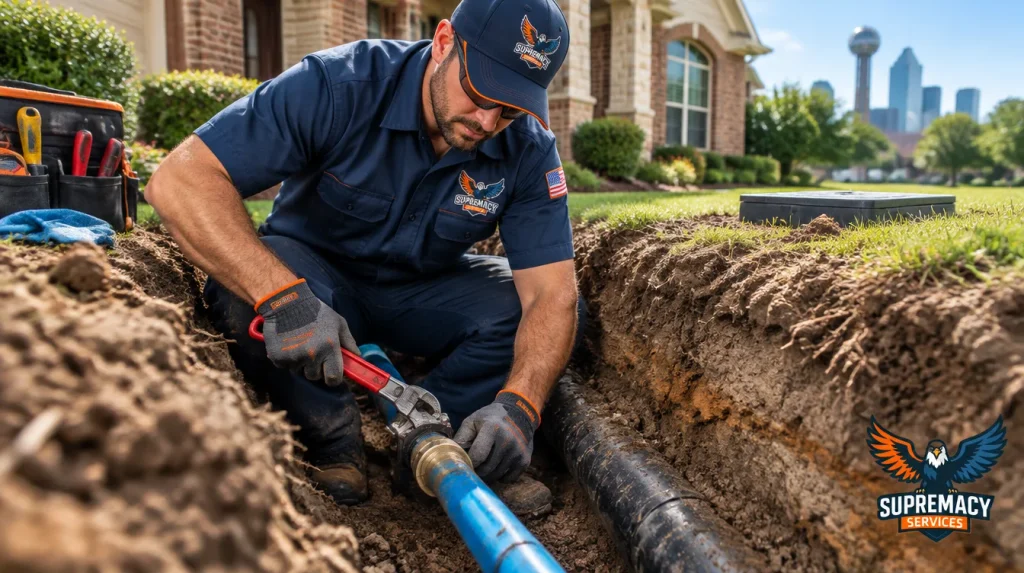
An isolated leak in an otherwise sound pipe may be suitable for repair. Replacement becomes more attractive when the pipe is extensively corroded, repeatedly leaking, or structurally deteriorated.
| Consideration | Repair may make sense | Replacement may make sense |
|---|---|---|
| Pipe condition | Generally sound | Widespread deterioration |
| Number of leaks | One localized failure | Multiple or recurring failures |
| Pipe material | Suitable for durable repair | Material or condition creates ongoing concerns |
| Accessibility | Damaged area can be reached | Repeated excavation would be disruptive |
| Long-term outlook | Remaining pipe is reliable | More failures are reasonably anticipated |
Some properties may qualify for trenchless replacement methods, but feasibility depends on pipe routing, material, condition, and site access.
A plumber should explain why a localized repair or broader replacement is recommended.
What Affects the Cost of Main Water Line Leak Repair in Dallas?
The cost depends on the leak’s location, the amount of excavation required, pipe material, length of damaged piping, and whether repair or replacement is necessary.
Other important factors include:
- Whether the pipe runs beneath a driveway, sidewalk, or landscaping.
- The depth of the water service line.
- Underground utility conflicts.
- Whether a small section can be repaired.
- Required permits, inspections, and restoration.
- Emergency work or difficult site access.
A small accessible repair and a complete service-line replacement are different projects and should not be compared using a single advertised price.
Ask for a written estimate identifying the proposed repair, materials, excavation, restoration, and any exclusions.
The Texas State Board of Plumbing Examiners recommends obtaining written estimates and verifying plumbing credentials.
For an assessment of a suspected underground leak, contact Supremacy Services through its Dallas water line repair and replacement page.
Can a Dallas water bill be adjusted after a leak?
Possibly.
Dallas Water Utilities has a leak-adjustment request process for qualifying situations. Its published form says requests should be submitted within 90 days of the repair, with a repair receipt or paid invoice. Approval is not guaranteed, and other eligibility limits apply.
dallas.gov
Keep your repair documentation and contact the utility for current requirements.
How Can You Prevent Future Main Water Line Leaks?
Not every underground pipe failure is preventable, but homeowners can reduce avoidable risks and detect problems earlier.
- Monitor water consumption. Unexpected changes may reveal a hidden leak.
- Investigate persistent wet spots. Do not assume unexplained moisture is harmless.
- Address pressure problems. Have unusual water pressure or recurring pressure surges evaluated.
- Protect buried utilities during landscaping. Arrange utility locating before digging.
- Maintain irrigation systems. Broken sprinkler lines can waste water and complicate leak diagnosis.
- Keep records of previous repairs. Recurring failures can help identify a deteriorating pipe.
- Consider water-use monitoring. Leak detection and flow monitoring devices may provide early warnings of unusual consumption.
EPA WaterSense explains that monitoring devices can help homeowners identify abnormal water use and reduce damage from undetected leaks.
Frequently Asked Questions
1. Why is my main water line leaking underground?
Common causes include corrosion, deteriorated pipes, soil movement, damaged fittings, pressure-related stress, freezing, and excavation damage. A plumber must inspect or test the system to identify the actual cause.
2. Can a main water line leak without affecting water pressure?
Yes. A small underground leak may not noticeably reduce pressure at your faucets. An unexpected water bill increase or changing meter reading may be the first warning.
3. Why is my yard wet when it hasn’t rained?
A wet yard may result from a leaking water supply line, damaged irrigation piping, drainage problems, or another underground water source. A meter check and system isolation can help narrow the cause.
4. Can tree roots cause a main water line leak?
Roots can contribute to movement or stress around underground piping, but they may also grow toward moisture from an existing leak. Finding roots near a pipe does not establish the original cause.
5. Can a leaking water line damage my foundation?
A persistent underground leak may alter soil moisture near the foundation and contribute to erosion or movement under certain conditions. However, foundation damage has many possible causes and requires proper evaluation.
6. Who is responsible for a leaking water line near the street in Dallas?
Responsibility depends on whether the leak affects utility-owned infrastructure, the meter assembly, or the private service line. Contact Dallas Water Utilities for suspected public-side leaks and verify the applicable service boundary.
7. How long can an underground water line leak go unnoticed?
A small leak may remain hidden for an extended period, particularly when water drains into the surrounding soil. Regular water meter and billing checks improve the chances of early detection.
8. Can I repair an underground main water line myself?
Checking the meter and identifying visible symptoms are reasonable homeowner steps. Excavation and pressurized potable-water pipe repairs should be handled by appropriately licensed plumbing professionals, with required permits and inspections.
9. Does a leaking main water line always need replacement?
No. A localized failure in an otherwise serviceable pipe may be repairable. Replacement may be more appropriate for extensive deterioration, repeated leaks, or unsuitable existing materials.
10. Is a main water line leak an emergency?
It can be. Rapid water loss, flooding, soil erosion, loss of water service, or water near electrical equipment warrants urgent attention. Small concealed leaks also need prompt investigation to limit damage and waste.
When to Contact Supremacy Services
If your Dallas-area home has unexplained wet ground, a sudden increase in water consumption, or signs of an underground supply pipe failure, the next step is to identify the source before choosing a repair.
Supremacy Services provides water leak detection and water line repair and replacement services for Dallas and surrounding DFW communities.
A professional assessment can help determine whether the problem is an isolated pipe failure, a damaged fitting, or deterioration that calls for a broader solution.
Concerned about a leaking underground water line? Visit Supremacy Services’ water line repair and replacement service to request an assessment and discuss the appropriate next steps for your home.

