
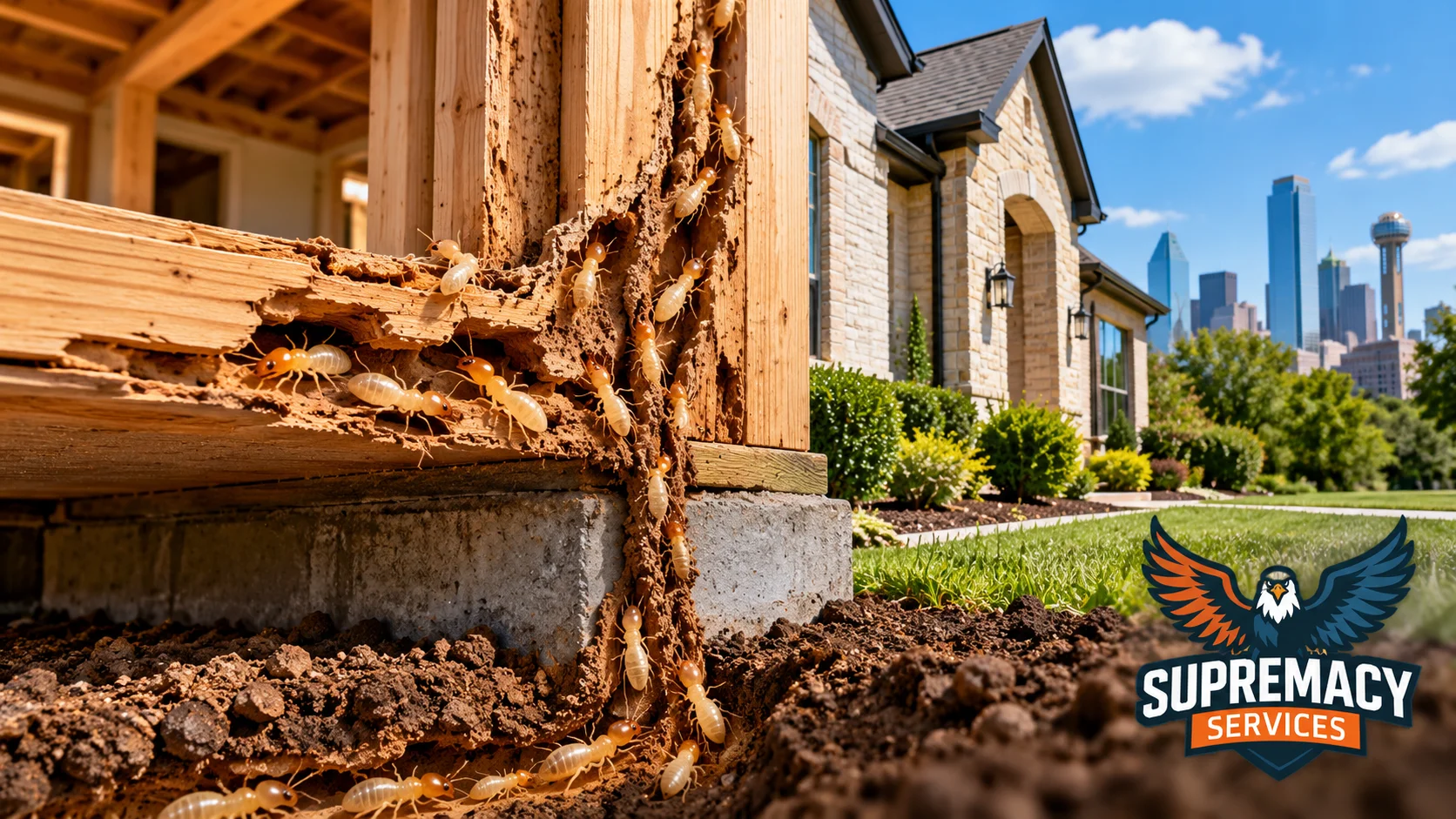
How Fast Can Termites Damage a House; Termites can begin feeding on accessible wood as soon as workers reach it, but significant structural damage generally develops over months or years—not overnight. How quickly the damage becomes serious depends on the termite species, colony size, number of workers reaching the structure, moisture and temperature conditions, available wood and how long the infestation remains undetected.
For Dallas-Fort Worth homeowners, the more useful question is therefore not, “How many days do I have?” It is, “How much activity and damage already exist?”
Termites often work inside wood, soil and concealed structural spaces. By the time mud tubes, swarmers or damaged wood become noticeable, the infestation may have been present longer than the visible evidence suggests.
Table of Contents
- How Long Does It Take Termites to Damage a House?
- Why There Is No Universal Termite Damage Timeline
- How Much Wood Can Termites Eat?
- What Makes Termite Damage Progress Faster?
- What Termite Damage Looks Like
- How Can You Tell Whether the Damage Is Serious?
- What Should You Do If You Find Termites?
- DIY vs. Professional Termite Evaluation
- How Professional Termite Service Works
- How to Reduce Future Termite Risk
- Frequently Asked Questions
How Long Does It Take Termites to Damage a House?
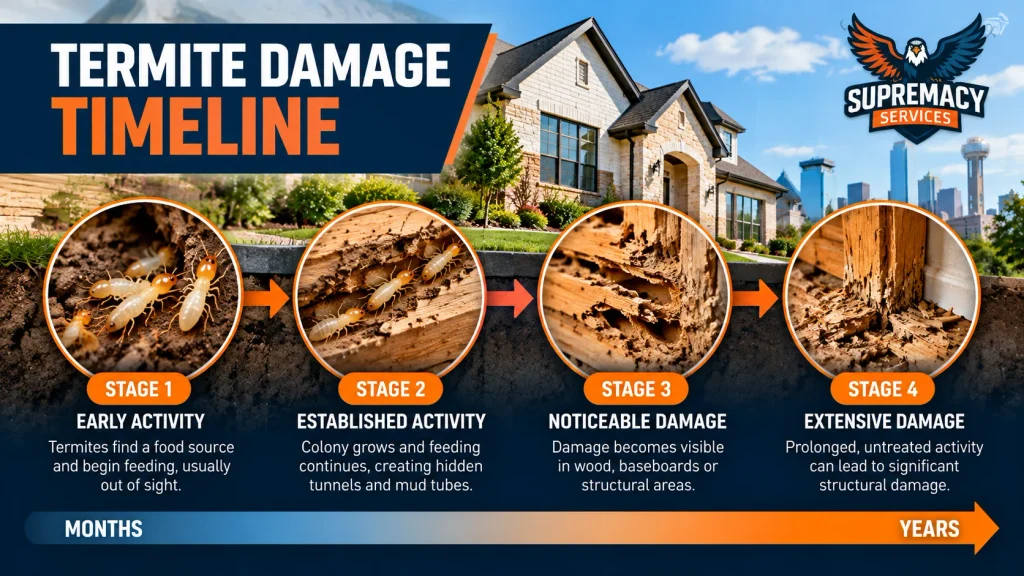
Significant termite damage usually takes months or years of sustained feeding rather than days or weeks. However, no reliable inspection method can determine the exact age of termite damage simply by looking at damaged wood.
University of Missouri Extension notes that subterranean termites do not normally cause significant damage in days or weeks; substantial damage typically results from several months or years of feeding.
North Carolina State Extension similarly notes that serious structural damage from eastern subterranean termites typically develops over years of continuing infestation.
That does not mean a homeowner who discovers termites should intentionally wait.
The important distinction is between urgency and panic.
Finding active termites warrants investigation and an appropriate response. But the evidence does not support claims that an otherwise sound house will suddenly be destroyed within a few days.
A practical termite damage timeline
| Time/activity scenario | What it means |
|---|---|
| Days to weeks | Workers can continue feeding, but major new structural destruction would not normally develop from scratch this quickly. |
| Several months | Continued feeding can accumulate meaningful localized damage, especially where activity is concentrated. |
| Years | A concealed, untreated infestation has much more opportunity to cause extensive damage. |
| Unknown infestation age | This is the most realistic situation for many homeowners because termites may have been present before signs became visible. |
These are not deadlines or guarantees. Termite activity varies too much for a calendar alone to determine structural condition.
Why There Is No Universal Termite Damage Timeline
You may see claims online that termites can “destroy a house in X months” or consume a precise amount of lumber every day.
Those numbers can be misleading when applied to an individual home.
The rate of damage depends on several interacting variables.
Colony size
A developing colony with relatively few workers does not have the same feeding capacity as a large, established colony.
Worker termites are the members responsible for gathering food and damaging wood.
Termite species
Not every termite behaves identically.
Texas A&M AgriLife identifies the eastern subterranean termite and Formosan subterranean termite among economically important subterranean termites in Texas.
Formosan subterranean termites deserve particular attention because Texas A&M describes them as aggressive termites capable of attacking materials at a faster rate than many other termites.
That still does not provide a reliable countdown for an individual house.
Number of feeding locations
A colony may have access to more than one food source.
Visible damage in one baseboard or framing member does not necessarily reveal every area where termites are foraging.
Moisture
Subterranean termites depend heavily on moisture.
Plumbing leaks, drainage problems, persistent moisture near foundations and wood-to-soil contact can create conditions favorable to termite activity.
Temperature and environmental conditions
Termite activity and foraging can be affected by environmental conditions.
This is another reason laboratory consumption rates should not be converted into precise predictions for a Dallas home.
Access to the structure
Foundation cracks, construction joints, plumbing penetrations, hidden wood-to-soil contact and other accessible routes can allow subterranean termites to reach cellulose-containing building materials while remaining difficult to see.
How Much Wood Can Termites Eat?
The amount of wood consumed depends heavily on the number of workers feeding and the conditions surrounding the colony, so a single consumption rate should not be used to predict damage to a particular house.
For perspective, North Carolina State Extension provides an educational example in which a colony of approximately 60,000 eastern subterranean termites could consume about one foot of 2×4 lumber in roughly five months.
The important part of that example is not to start calculating how many boards remain in your house.
Real infestations are more complicated.
A colony can forage through multiple locations, worker populations vary, several colonies may occur around a property, and structural materials differ.
A better rule for homeowners: the longer active termites have uninterrupted access to structural wood, the greater the opportunity for cumulative damage.
What Makes Termite Damage Progress Faster?
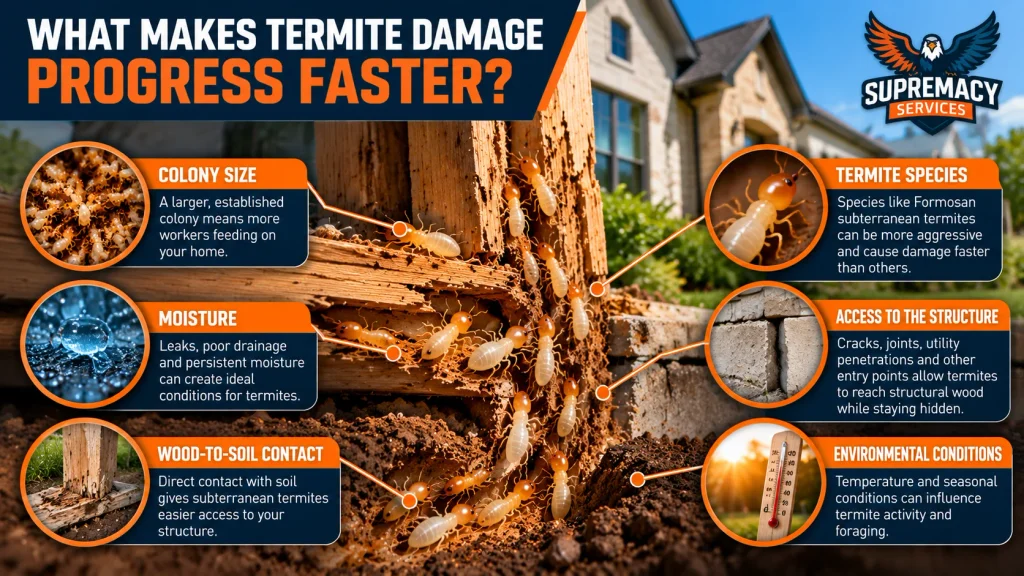
Several conditions can influence how much damage develops.
1. A large, established colony
More foraging workers can mean more feeding activity.
2. Long-term undetected access
Termites cause much of their damage out of sight.
The EPA notes that people often do not realize termites are present until they encounter a swarm or discover damage.
3. Favorable moisture conditions
Persistent moisture can support subterranean termite activity and can also contribute to wood decay.
That combination is important because rot and termite damage can occur in the same general area.
4. Wood touching soil
Wood-to-soil contact creates a particularly favorable access route for subterranean termites.
Examples may include buried wood, structural components contacting grade, stored lumber or other cellulose materials positioned against the structure.
5. Concealed entry routes
Termites may travel through cracks, joints and protected structural areas without creating an obvious exterior warning sign.
6. Termite species
Species and colony biology matter.
Texas A&M describes Formosan subterranean termites as particularly aggressive, although the species involved must be correctly identified before conclusions about an individual infestation can be made.
What Termite Damage Looks Like
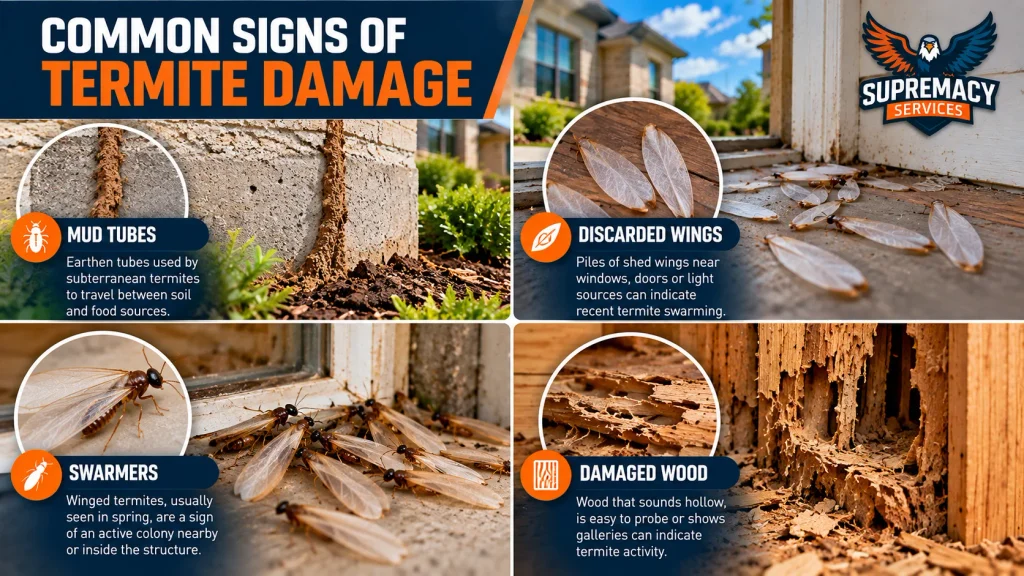
Termite damage is frequently concealed beneath an apparently intact surface.
Warning signs worth investigating include:
- mud or shelter tubes on foundations, walls or piers;
- wood that sounds hollow when tapped;
- wood that is unusually easy to probe;
- galleries inside damaged wood;
- swarmers emerging indoors;
- piles of discarded wings;
- soil or mud inside cracks and wood galleries;
- visibly weakened structural wood;
- recurring termite evidence after previous treatment.
Mud tubes
Subterranean termites construct protected earthen passageways between soil and food sources.
Finding a genuine mud tube does not tell you how long the infestation has existed or how much damage has occurred, but it is evidence worth investigating.
Swarmers
Indoor termite swarmers can be especially important.
Texas A&M notes that swarming termites inside a house usually indicate an active infestation in the structure.
Winged ants can look similar, however, so identification matters.
Damaged wood
Subterranean termite galleries generally follow the grain of the wood and can contain soil or mud-like material.
One particularly important limitation is that the age of termite-damaged wood cannot reliably be determined from appearance alone.
A professional therefore needs to assess the extent and location of evidence rather than trying to date a damaged board.
How Can You Tell Whether the Damage Is Serious?
You cannot reliably determine structural severity from the number of termites you see.
A homeowner might see only a few termites even though much more activity is concealed.
Conversely, seeing a large swarm does not automatically prove that major structural repairs are required.
The evaluation should answer separate questions:
| Question | Why it matters |
|---|---|
| Are termites currently active? | Establishes whether an active infestation is present |
| Where are they entering? | Helps determine treatment strategy |
| How many areas show evidence? | Helps establish infestation extent |
| Which materials are damaged? | Separates cosmetic from potentially structural concerns |
| Is the wood still structurally adequate? | Determines whether repair evaluation is necessary |
| Are moisture or construction conditions contributing? | Helps reduce future risk |
If load-bearing framing or other important structural components appear significantly compromised, termite treatment and structural repair should be treated as separate issues. The damaged components may require evaluation by an appropriately qualified construction or structural professional.
Termite Damage vs. Wood Rot
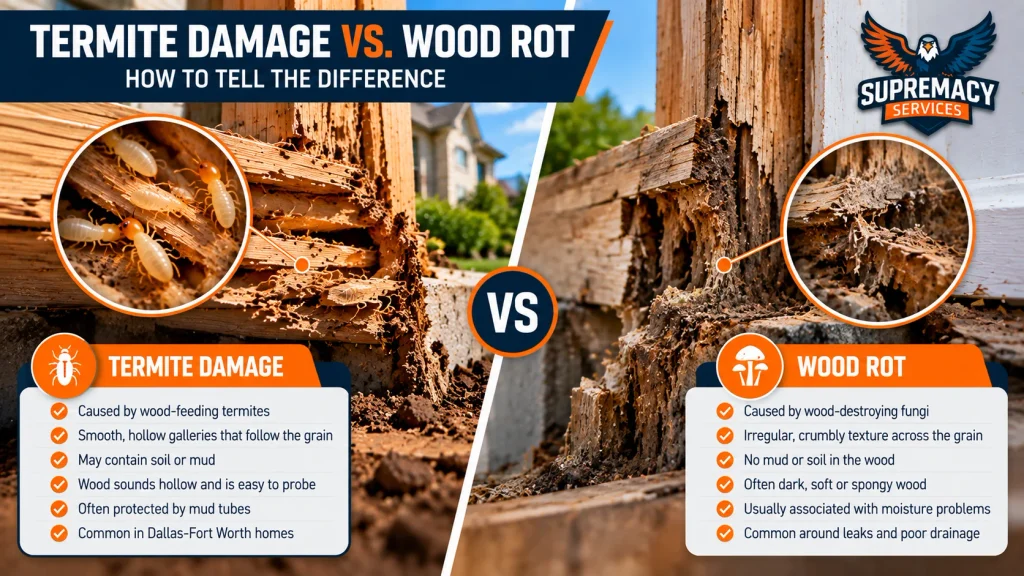
These two problems can look similar but have different causes.
| Feature | Termite damage | Wood decay/rot |
|---|---|---|
| Cause | Wood-feeding insects | Wood-destroying fungi |
| Mud/soil in galleries | Common with subterranean termite activity | Not characteristic |
| Wood consumption | Termites consume cellulose | Fungal deterioration breaks down wood |
| Moisture association | Moisture can favor termite activity | Moisture is fundamental to decay |
| Treatment | Termite-management strategy | Moisture correction plus appropriate repair |
| Can both occur together? | Yes | Yes |
Do not assume soft or deteriorated wood automatically proves termites.
Should You Panic If You Find Termites?
No—but you should investigate promptly.
University extension guidance consistently distinguishes termite problems from emergencies that change dramatically overnight.
That gives homeowners time to:
- document what they found;
- avoid destroying useful evidence;
- obtain a proper inspection;
- understand where activity exists;
- compare appropriate treatment options; and
- review the written treatment scope.
It does not justify ignoring confirmed activity for months while termites continue feeding.
Found mud tubes, swarmers or suspicious wood? Have Supremacy Services evaluate the termite evidence before assuming how old or extensive the infestation is.
What Should You Do If You Find Termites?
Step 1: Document the evidence
Photograph suspected termites, wings, mud tubes and damaged areas.
Take close-up and wider photographs showing where the evidence occurs in relation to the foundation or structure.
Step 2: Don’t immediately remove everything
Scraping away tubes or discarding damaged wood can eliminate useful evidence before an inspection.
Step 3: Check nearby accessible areas
Look around:
- slab and foundation edges;
- plumbing penetrations;
- garage walls;
- crawlspace piers where safely accessible;
- siding transitions;
- wood stored against the building;
- damp areas;
- nearby structural wood.
Do not dismantle walls simply to look for termites.
Step 4: Look for moisture problems
Check for leaking plumbing, poor drainage, irrigation repeatedly wetting the foundation and other persistent moisture sources.
Correcting moisture is good property maintenance, but it does not eliminate an established termite colony.
Step 5: Arrange an inspection when evidence is credible
An inspection becomes especially appropriate when you find:
- live termites;
- indoor swarmers;
- multiple shelter tubes;
- damaged structural wood;
- repeated termite evidence;
- activity following previous treatment; or
- evidence you cannot confidently identify.
DIY vs. Professional Termite Evaluation
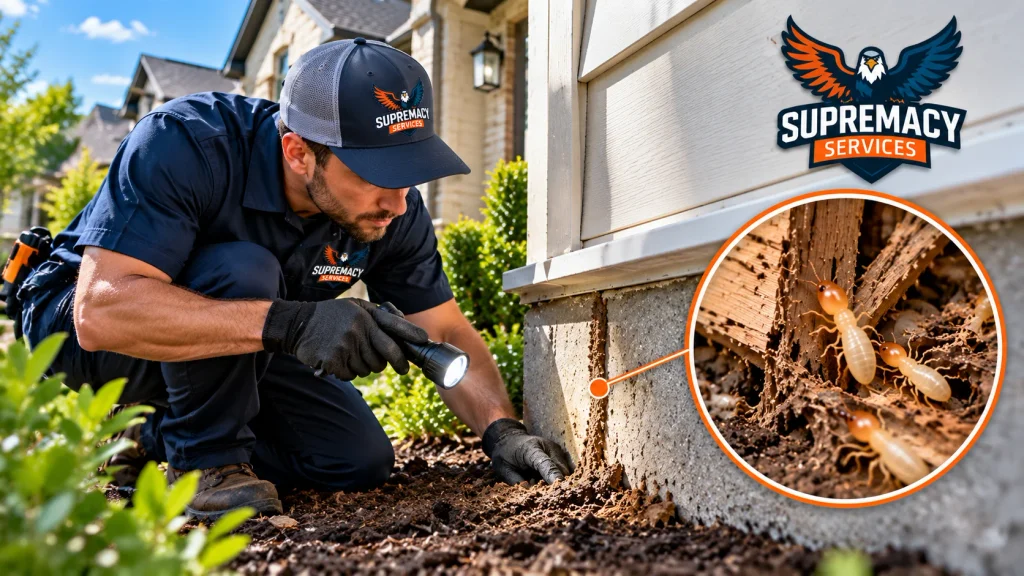
Homeowners can perform useful visual monitoring, but DIY investigation has important limitations.
What you can do yourself
You can:
- inspect exposed foundation areas;
- watch for swarmers;
- document mud tubes;
- look for discarded wings;
- move firewood away from the structure;
- correct plumbing leaks;
- improve obvious drainage problems;
- eliminate unnecessary wood-to-soil contact.
What DIY inspection cannot reliably establish
A visual homeowner inspection usually cannot establish:
- the full extent of concealed activity;
- every termite entry route;
- colony size;
- exactly how long the infestation has existed;
- whether concealed structural members are damaged;
- which professional treatment method is appropriate.
Surface insecticide applied to the termites you can see also does not establish that the colony or concealed infestation has been controlled.
The EPA notes that many termite treatments are appropriately performed by trained pest-management professionals.
What Does Professional Termite Service Include?
A termite evaluation should begin with identifying evidence and understanding the structure rather than automatically prescribing one treatment.
A professional process may include:
- inspecting accessible foundation areas;
- identifying termite evidence;
- examining accessible damaged wood;
- checking potential entry routes;
- evaluating moisture and wood-to-soil conditions;
- determining the likely termite type;
- identifying active and previous evidence;
- developing a treatment scope; and
- explaining monitoring or follow-up requirements.
Texas termite-treatment proposals
Texas regulates structural pest-control services.
When a termite-treatment estimate or proposal is provided, the Texas Department of Agriculture requires specific written disclosure information, including a detailed diagram identifying areas to be treated and active or previous termite activity, warranty or guarantee information, the chemical label, and applicable information about liquid termiticide concentration or baiting systems.
That documentation gives homeowners a better way to compare termite proposals than price alone.
If an inspection confirms subterranean termite activity, explore Termite Vault Security in Dallas to understand Supremacy Services’ termite protection and monitoring approach.
How Are Subterranean Termites Treated?
Treatment depends on the infestation, structure, termite involved and site conditions.
The EPA identifies recognized approaches that include:
- liquid soil-applied termiticides;
- termite bait systems;
- certain wood treatments; and
- termite-resistant or treated building materials in applicable situations.
Liquid soil treatments
These use appropriately labeled termiticides to establish treated areas between subterranean termites and the structure.
Installation requirements vary according to construction.
Termite bait systems
Bait systems use cellulose material containing a slow-acting active ingredient.
The delayed action is intentional: foraging termites must have an opportunity to interact with and distribute the bait through the colony.
Consequently, bait programs should not be judged by whether every termite disappears immediately after installation.
Wood treatments
Certain appropriately labeled products can be applied to wood in applicable situations.
Treatment selection should follow the actual inspection findings and product label rather than a homeowner choosing a method solely because it appears fastest.
Why Dallas-Fort Worth Homeowners Should Pay Attention
Texas A&M AgriLife identifies subterranean termites as significant structural pests throughout Texas.
Dallas-Fort Worth homes can also contain many of the construction conditions relevant to subterranean termite inspections: slab edges, utility penetrations, landscaping adjacent to foundations, attached garages and other transitions between soil and building materials.
The useful local takeaway is not that every DFW property will develop termites.
It is that North Texas homeowners should recognize the signs and avoid assuming that the absence of visible insects means the structure has no activity.
Subterranean termites are specifically adapted to remain concealed.
How to Reduce Future Termite Risk
You cannot make a property biologically impossible for termites to approach, but you can reduce favorable conditions and improve inspection visibility.
Keep soil and drainage conditions under control
Direct drainage away from the structure where appropriate and repair leaks promptly.
Reduce wood-to-soil contact
Avoid leaving untreated lumber, firewood, stumps, cardboard or similar cellulose materials against the house.
Keep foundation areas visible
Dense vegetation and stored materials can hide mud tubes and other evidence.
Maintain plumbing
Persistent leaks can create moisture conditions favorable to termites and wood decay.
Seal appropriate cracks and penetrations
The EPA recommends reducing openings around foundations and utility penetrations that can provide termite access.
Sealing a crack, however, is preventive maintenance—not treatment for an established infestation.
Inspect periodically
Because termites remain concealed, periodic inspection can identify warning signs before damage becomes more extensive.
How Much Does Termite Damage Cost to Repair?
There is no responsible universal repair price.
Repair cost depends on what was damaged, not simply whether termites were found.
Replacing cosmetic trim is fundamentally different from repairing structural framing, flooring systems or multiple concealed areas.
Termite treatment and building repair should also be treated as separate scopes unless a written contract specifically combines them.
For treatment budgeting, see Supremacy Services’ separate Termite Treatment Cost in North Texas: 2026 Guide rather than turning this timeline article into another pricing page.
Frequently Asked Questions
Can termites destroy a house in a few weeks?
Significant new structural damage generally does not develop from scratch in only a few weeks. Extension guidance indicates that meaningful subterranean-termite damage usually accumulates over months or years. Existing damage, however, may already be present when termites are discovered.
Can termites damage a house in six months?
Termites can continue feeding and produce additional damage over six months, but the amount cannot be predicted without knowing the species, colony size, feeding locations and conditions. A calendar alone cannot determine severity.
Can termites cause major damage in one year?
It is possible for meaningful damage to accumulate during a year of active feeding, particularly when an established colony already has access to a structure. However, there is no universal one-year damage level.
How long can termites be in a house before you notice?
Potentially a long time. Subterranean termites commonly remain concealed in soil, shelter tubes and wood, and homeowners may not discover an infestation until swarmers or damage appear.
Does seeing termites mean my house already has structural damage?
No. Finding termites confirms or strongly suggests activity depending on where they were found, but it does not establish the severity of structural damage. Inspection is needed to determine what materials are affected.
How do I know whether termite damage is old or new?
Appearance alone cannot reliably date termite-damaged wood. Live termites and active shelter tubes can demonstrate current activity, but determining the age of existing wood damage is much more difficult.
Are termite mud tubes a sign of damage?
Mud tubes indicate subterranean termite activity or previous activity, but the tube itself does not reveal how much wood has been damaged. Additional inspection is necessary.
Should I treat termites immediately?
Confirmed termite activity should be addressed rather than ignored, but homeowners generally have time to obtain an inspection, understand the findings and compare appropriate treatment proposals instead of making a panic decision.
Can I kill termites myself?
Killing exposed termites does not necessarily control the colony or termites hidden elsewhere in the structure. Structural termite control often requires specialized inspection and treatment techniques.
How often should a Dallas home be checked for termites?
Inspection frequency should reflect the property’s history, construction, termite protection system and risk conditions rather than a universal schedule. Homes with previous activity or an active monitoring/treatment agreement should follow the inspection requirements associated with that program.
Don’t Let an Unknown Timeline Become a Larger Problem
The biggest problem with asking how fast termites damage a house is that homeowners rarely know when the clock started.
A visible mud tube might be new. The concealed activity behind it may not be.
A swarm might be the first thing you noticed. It may not represent the beginning of the infestation.
And damaged wood can reveal that termites were present without telling you precisely when the feeding began.
If you discover termites, mud tubes, indoor swarmers or suspicious wood around a Dallas-Fort Worth home, document the evidence and have the property evaluated.
Schedule a termite assessment with Supremacy Services to determine whether activity is present, where termites may be entering and what treatment or monitoring strategy is appropriate for your property.

