
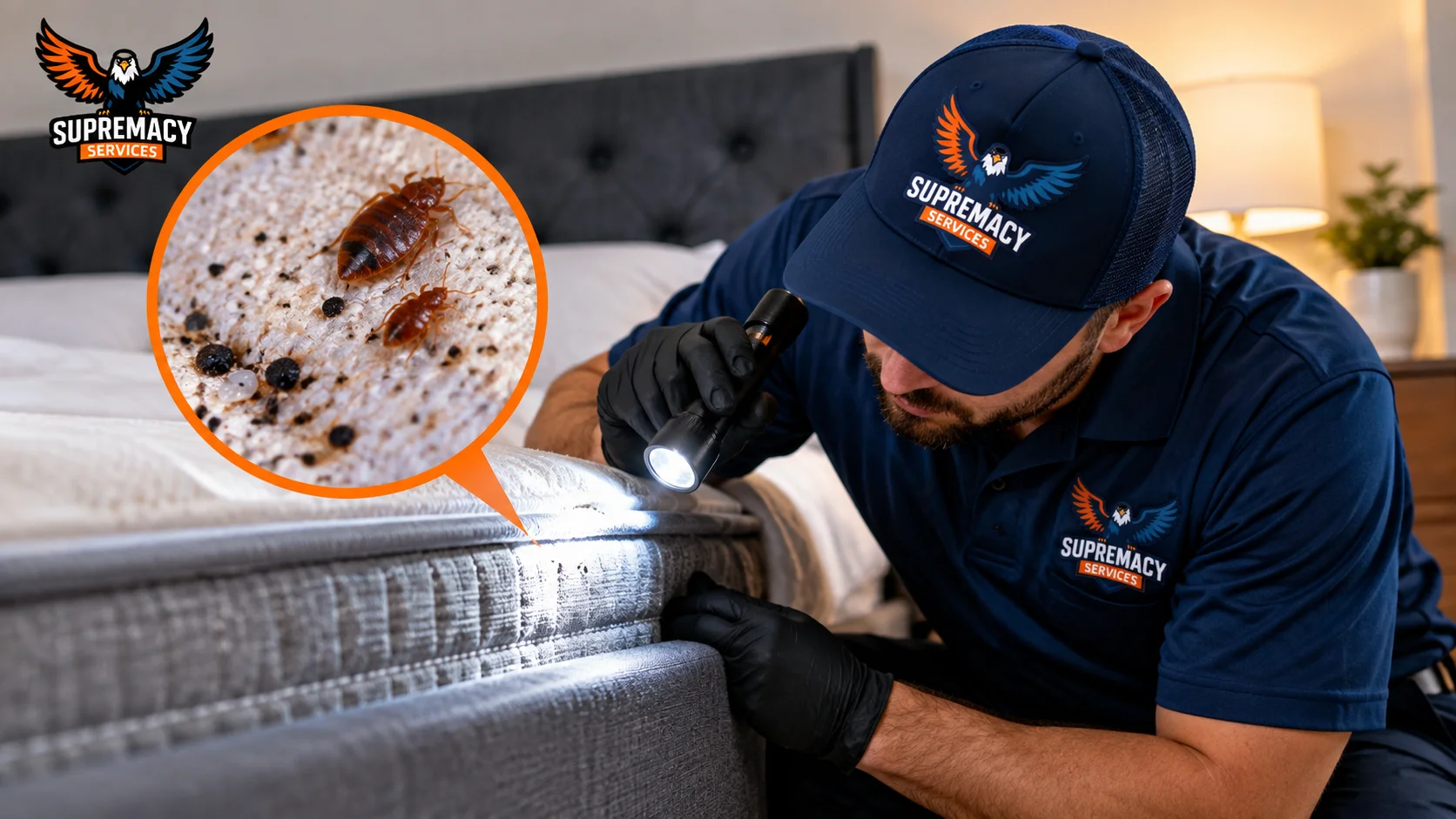
Bed bug bites are not the most reliable way to determine whether bed bugs are in your home. Signs of bed bugs besides bites include dark fecal spots, rusty or reddish stains on bedding, shed skins, tiny eggs or eggshells, live bugs and, in heavier infestations, a noticeable musty odor.
That distinction matters for Dallas and DFW homeowners because bite reactions vary significantly. Some people develop itchy marks while others may show no visible reaction. The EPA specifically describes bites as a poor indicator of a bed bug infestation and recommends looking for physical evidence instead.
If you suspect bed bugs, concentrate your inspection around the mattress, box spring, bed frame and headboard before expanding outward to nearby furniture and cracks.
Table of Contents
- What Are the Most Reliable Signs of Bed Bugs Besides Bites?
- Dark or Black Fecal Spots
- Rusty or Reddish Stains on Bedding
- Shed Bed Bug Skins
- Tiny Bed Bug Eggs and Eggshells
- Live Bed Bugs
- A Sweet or Musty Odor
- Evidence in Mattress and Furniture Crevices
- Where Should You Look for Bed Bugs?
- Can You Have Bed Bugs Without Seeing Bites?
- What Can Be Mistaken for Bed Bugs?
- What Should You Do If You Find Signs?
- DIY Inspection vs. Professional Inspection
- How Professional Bed Bug Treatment Works
- How to Reduce the Risk of Bringing Bed Bugs Home
- Frequently Asked Questions
What Are the Most Reliable Signs of Bed Bugs Besides Bites?
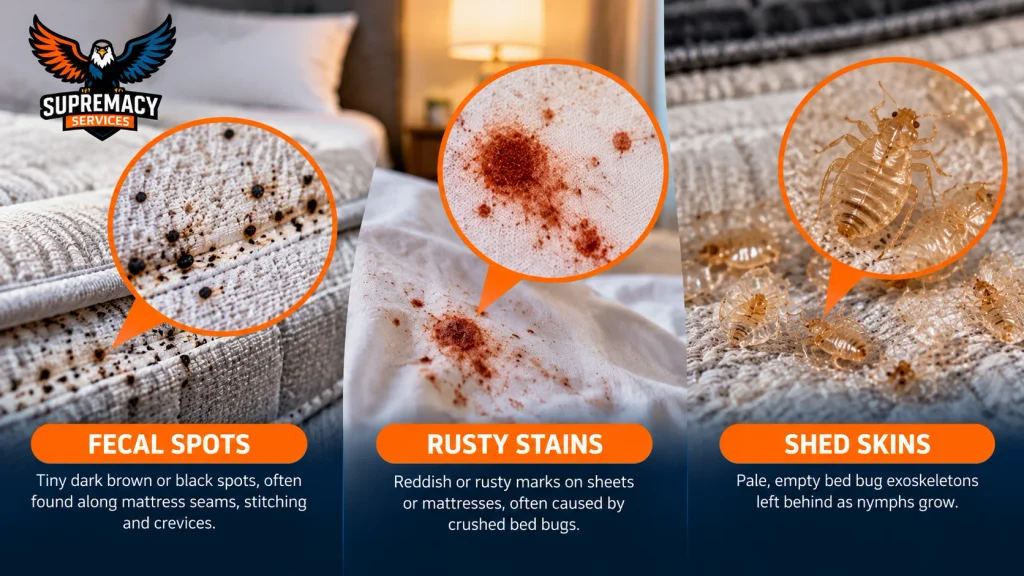
The strongest evidence of bed bugs is physical evidence of the insects themselves or the traces they leave where they hide.
Look for:
| Sign | What to look for | Common locations |
|---|---|---|
| Fecal spots | Tiny dark brown or black marks | Mattress seams, bed frames, headboards |
| Rust-colored stains | Small reddish or rusty marks | Sheets, pillowcases, mattress surfaces |
| Shed skins | Pale, empty bug-shaped shells | Mattress seams, cracks, furniture |
| Eggs or eggshells | Tiny pale or whitish objects | Protected seams and crevices |
| Live bugs | Flat, oval insects; adults are reddish-brown | Mattress piping, box springs, frames |
| Musty odor | Unusual sweet/musty smell, generally associated with heavier activity | Sleeping areas and infested furniture |
| Clusters of evidence | Several of the above signs together | Established hiding areas |
Finding one suspicious mark does not automatically prove that you have bed bugs. Finding a live specimen or several characteristic signs in the same hiding area is much stronger evidence.
The EPA recommends physical inspection because skin reactions alone can resemble mosquito bites, flea bites, rashes, eczema and other conditions.
1. Dark or Black Fecal Spots
Tiny dark spots around mattress seams and other hiding places can be bed bug excrement.
The EPA describes these spots as dark marks that may bleed into fabric in a manner similar to ink from a marker.
Pay particular attention to concentrated spotting around:
- mattress seams and piping;
- mattress labels and stitching;
- box-spring edges;
- joints in the bed frame;
- cracks around the headboard;
- upholstered furniture seams.
A random dark speck is not enough to diagnose an infestation. Look for repeated spotting or additional evidence such as cast skins, eggs or live insects.
Do bed bug fecal spots wipe away?
Appearance varies according to the surface. On absorbent materials, fecal material may soak into the fibers rather than behaving like ordinary loose dirt. Avoid relying on a single “wipe test” to identify an infestation.
Instead, inspect the surrounding crevices carefully.
2. Rusty or Reddish Stains on Bedding
Small rusty or reddish stains on sheets or mattresses are another recognized sign of possible bed bug activity.
According to the EPA, these marks can occur when bed bugs are crushed.
Check light-colored bedding especially carefully when changing your sheets. Examine:
- fitted sheets;
- mattress protectors;
- pillowcases;
- mattress seams;
- areas where bedding contacts the bed frame.
Blood-colored stains can have many causes, so they should be treated as a reason to inspect—not proof by themselves.
If unexplained stains repeatedly appear together with dark spotting or insect evidence, a more thorough bed bug inspection is appropriate.
3. Shed Bed Bug Skins
Bed bugs shed their outer skins as immature bugs develop, so empty exoskeletons can indicate that bed bugs have been living and developing nearby.
Young bed bugs, called nymphs, pass through multiple developmental stages before becoming adults.
Their cast skins can look like pale, translucent or yellowish versions of a bed bug.
Because these skins do not move, homeowners sometimes mistake them for dried insects, crumbs or debris.
Look for them inside protected areas such as mattress folds, box-spring crevices, bed-frame joints and behind headboards.
Finding several cast skins concentrated in one area is more concerning than finding a single unidentified fragment.
4. Tiny Bed Bug Eggs and Eggshells
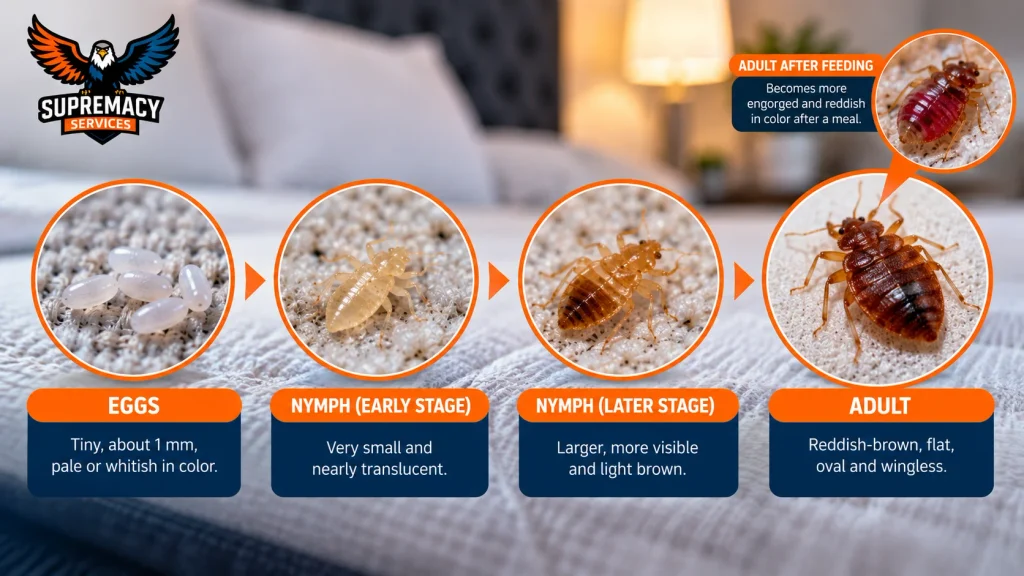
Bed bug eggs are extremely small and can be difficult to spot without careful inspection.
The EPA describes bed bug eggs as approximately 1 millimeter in size. They are pale and are typically found in protected hiding places.
Potential locations include:
- mattress and box-spring seams;
- cracks in bed frames;
- furniture joints;
- narrow crevices close to sleeping areas.
Their small size makes visual identification difficult.
Do not assume every white speck on your mattress is a bed bug egg. Fabric fibers, dust and other household debris can look similar to an untrained eye.
When eggs occur alongside fecal spotting, cast skins or live insects, however, the evidence becomes much stronger.
5. Live Bed Bugs
Finding and correctly identifying a live bed bug is one of the clearest ways to confirm an infestation.
Adult bed bugs are small, flat, wingless and reddish-brown. Younger nymphs are smaller and can be much paler.
Bed bugs’ flattened bodies allow them to hide in remarkably narrow spaces.
Start by examining the areas closest to where people sleep rather than searching randomly throughout the entire house.
What do bed bugs look like?
Adult bed bugs have:
- a flattened, oval body;
- six legs;
- no functional wings;
- a reddish-brown appearance;
- a body shape that becomes more swollen after feeding.
If you capture a suspicious insect, keep it in a sealed container or clear bag if this can be done safely. A pest professional can often identify a specimen more reliably than identification based on a skin reaction or internet photo alone.
6. A Sweet or Musty Odor
A noticeable sweet or musty odor can occur with bed bug infestations, particularly when activity is substantial.
The CDC includes a sweet, musty odor among signs that may accompany an infestation.
Odor alone, however, is not a reliable diagnostic test.
Bedrooms can develop unusual smells from humidity, laundry, mattresses, pets, mold and many other sources.
Treat odor as supporting evidence rather than confirmation. If it occurs together with spotting, cast skins or live insects, inspect the area more closely.
7. Evidence in Mattress and Furniture Crevices
Sometimes the most important sign is not a single object but a concentration of bed bug evidence in a protected hiding place.
Bed bugs generally remain close to areas where people rest and sleep.
That makes mattress seams, box springs, bed frames and headboards logical places to begin an inspection.
As infestations become more established, evidence may also occur in nearby upholstered furniture, drawers, curtains, cracks and other sheltered spaces.
Where Should You Look for Bed Bugs?

Start with the bed and gradually work outward.
The EPA identifies mattress seams and tags, box springs, bed frames and headboards as important inspection areas. With heavier infestations, bed bugs may also be found in chairs, couches, drawer joints, curtains and other cracks and crevices.
A practical bed bug inspection checklist
Use a bright flashlight and inspect systematically.
1. Remove the bedding
Check sheets and pillowcases for unexplained reddish stains or dark spotting.
2. Inspect the mattress
Pay close attention to seams, piping, labels, stitching, handles and folds.
3. Examine the box spring
Look along edges, seams, corners and protected structural areas.
4. Check the bed frame
Inspect screw holes, joints, cracks and areas where different materials meet.
5. Inspect the headboard
Look behind it as well as around brackets and mounting points.
6. Move to nearby furniture
Check nightstands, upholstered chairs and couches—especially seams and joints.
7. Document suspicious evidence
Take clear photographs or preserve a suspected insect for professional identification when practical.
Avoid immediately carrying suspected infested furniture through the house. Moving belongings without a plan can potentially relocate hidden insects.
Can You Have Bed Bugs Without Seeing Bites?
Yes. The absence of visible bites does not rule out bed bugs.
People respond differently to bed bug bites, and the CDC notes that reactions can range from no physical signs to noticeable marks. Bite marks may also take time to become visible.
That is why checking the home for physical evidence is more useful than asking whether everyone in the household has been bitten.
One person in a household may develop obvious marks while another person may show little or no visible reaction.
Conversely, unexplained itchy marks do not automatically prove bed bugs are responsible.
What Can Be Mistaken for Bed Bugs?
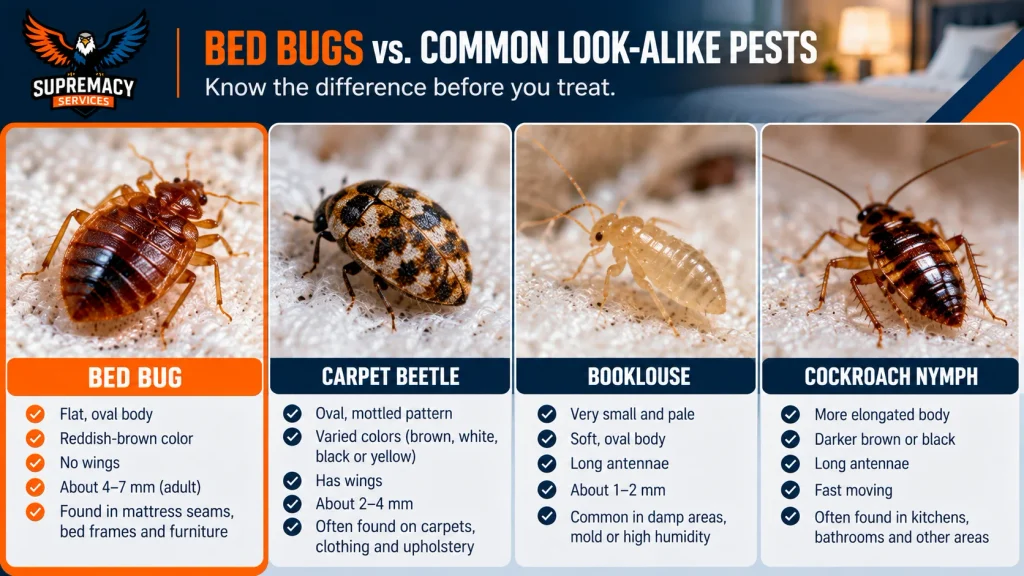
Carpet beetles and other small household insects can be mistaken for bed bugs, while skin reactions from other insects or dermatological conditions can be mistaken for bed bug bites.
The EPA specifically warns that incorrect identification can delay effective treatment.
Bed bugs vs. other possible problems
| What you notice | Bed bugs may be possible | Other explanations can include |
|---|---|---|
| Itchy skin marks | Yes | Mosquitoes, fleas, other arthropods or skin conditions |
| Tiny insect near bed | Yes | Carpet beetles or other household insects |
| Dark mattress spots | Yes | Dirt, mold or unrelated stains |
| Red marks on sheets | Yes | Other sources of blood or fabric staining |
| Small pale debris | Eggs or shed skins are possible | Dust, lint or fabric particles |
| Musty bedroom smell | Possible with infestation | Humidity, mold, laundry or other household sources |
Texas A&M AgriLife emphasizes that many arthropod bites can look similar and that confirmation of bed bugs should be based on finding and identifying the insect rather than diagnosing the pest from a bite alone.
What Should You Do If You Find Signs?
If you discover convincing bed bug evidence, the next priority is confirmation and containment—not panic-driven disposal of your belongings.
1. Preserve evidence
If possible, photograph the evidence or safely capture a specimen for identification.
2. Avoid moving items between rooms
Moving bedding, furniture, clothing or other belongings from a suspected room to an unaffected area can make inspection and treatment more complicated.
3. Reduce unnecessary clutter
Clutter provides additional hiding places and makes inspection harder. Do not randomly distribute items elsewhere in the home while decluttering.
4. Arrange a professional inspection when evidence is convincing
Bed bugs can occupy extremely small spaces and low-level infestations can be difficult to locate.
If you have found dark spotting, cast skins, eggs or a suspicious insect around your bed, schedule a professional bed bug inspection in Dallas/DFW before the problem has more time to spread.
DIY Inspection vs. Professional Inspection

A careful homeowner can identify obvious bed bug evidence, but finding every hiding area is considerably more difficult.
| DIY inspection | Professional inspection |
|---|---|
| Useful for initial screening | Useful when evidence is uncertain or activity persists |
| Low cost | Involves professional service |
| Can identify obvious bugs or stains | Technician can examine likely harborages systematically |
| Easy to miss small or hidden populations | Experience helps distinguish bed bugs from look-alike pests |
| Does not itself eliminate an infestation | Can lead directly to an appropriate treatment plan |
DIY inspection is most useful for answering, “Do I see anything suspicious?”
Professional inspection becomes more valuable when the question is, “Is this actually a bed bug infestation, where is the activity located, and what treatment is appropriate?”
When Is Professional Bed Bug Service Appropriate?
Consider professional help when:
- you find a live suspected bed bug;
- you repeatedly find fecal spotting or cast skins;
- evidence appears in more than one sleeping area;
- activity continues despite DIY measures;
- you cannot confidently identify the insect;
- bed bugs may have spread into upholstered furniture;
- the infestation involves an apartment, rental or other multi-unit environment;
- you need an appropriate treatment plan rather than continued inspection.
In Texas, structural pest-control businesses and professionals performing regulated pest-control work are subject to licensing requirements administered by the Texas Department of Agriculture.
Found convincing evidence? Learn how bed bug thermal treatment in DFW works and what homeowners should expect before treatment.
How Professional Bed Bug Treatment Works
Treatment should follow a proper inspection rather than being selected solely because someone has unexplained skin marks.
The exact approach depends on the property, extent and location of activity and treatment method being used.
Supremacy Services’ dedicated bed bug service focuses on professional thermal treatment. The service page describes a process that includes inspection, treatment setup, temperature monitoring and controlled heat circulation throughout targeted spaces.
That commercial page—not this identification guide—should remain the primary page for homeowners ready to investigate or schedule treatment.
What should homeowners expect before service?
Preparation requirements vary by treatment method and property.
A professional may need to know:
- where evidence has been found;
- which rooms are affected;
- whether furniture has recently been moved;
- whether occupants have recently traveled;
- whether used furniture has entered the property;
- whether previous treatments have been attempted.
Follow the pest professional’s preparation instructions rather than improvising a treatment plan.
How Do Bed Bugs Get Into Dallas Homes?
Bed bugs are primarily a transportation and hitchhiking problem, not evidence that a house is dirty.
The CDC notes that they can travel in luggage, overnight bags, folded clothing, bedding, furniture and other belongings.
That means exposure can occur in many environments where people and belongings move between locations.
For Dallas-Fort Worth households, practical risk situations can include travel, overnight guests, moving between residences and bringing secondhand furniture into a home.
Cleanliness alone does not determine whether bed bugs appear in a property.
Are Bed Bugs a Health Risk?
The CDC states that bed bugs are not known to spread disease to people.
They can still create health and quality-of-life problems. Bites may cause itching, and scratching can contribute to secondary skin infections. Some people can experience allergic reactions.
If you have severe swelling, signs of infection or another significant medical reaction, seek appropriate medical advice rather than relying on pest-control guidance for diagnosis.
Pest professionals address the infestation; healthcare professionals address medical symptoms.
How to Reduce the Risk of Bringing Bed Bugs Home
Prevention centers largely on recognizing how bed bugs hitchhike and inspecting belongings after potential exposure.
Practical precautions include:
- inspect secondhand beds and upholstered furniture carefully before bringing them inside;
- check luggage after travel;
- inspect mattress seams when staying away from home;
- avoid placing luggage directly on beds when traveling;
- remain alert for unexplained spotting, cast skins or insects after travel;
- investigate suspicious signs early rather than waiting for bite reactions.
Early identification is particularly valuable because smaller infestations are generally easier to locate and address than established ones.
Bed Bugs in Dallas Apartments and Multi-Unit Buildings
Bed bugs can occur in houses, apartments, hotels, dormitories and other places where people sleep.
Multi-unit properties can make investigation more complicated because determining where activity is occurring may require inspection beyond a single piece of furniture.
Renters who find convincing evidence should document what they see and follow the appropriate property-management reporting process while avoiding actions that could unnecessarily move potentially infested belongings into shared areas.
For treatment involving regulated structural pest-control services in Texas, homeowners and property managers can verify licensing information through the Texas Department of Agriculture.
What Does Bed Bug Treatment Cost?
There is no responsible single price that applies to every Dallas property.
Cost can vary according to factors such as:
- size of the treatment area;
- number of affected rooms;
- extent of the infestation;
- treatment method;
- amount and type of furniture;
- preparation requirements;
- whether follow-up service is needed.
A property-specific inspection or assessment is therefore more useful than relying on an unsupported online price range.
If pricing is your primary concern, see Supremacy Services’ related guide to bed bug heat treatment cost in Dallas for the cost-focused search intent.
Frequently Asked Questions
What is usually the first physical sign of bed bugs?
Dark fecal spotting, small rusty stains, cast skins or an actual insect around mattress seams can provide early clues. There is no single sign that will always appear first.
What do bed bug droppings look like?
Bed bug fecal evidence can appear as tiny dark spots. The EPA notes that these marks may bleed into fabric similarly to marker ink.
Do bed bugs leave blood stains on sheets?
Rusty or reddish stains on sheets and mattresses are recognized signs of possible bed bug activity. They can occur when bugs are crushed, but stains alone do not confirm an infestation.
What do bed bug eggs look like?
Bed bug eggs are tiny and pale, making them difficult to see. The EPA describes them as approximately 1 millimeter in size.
Can you have bed bugs without bites?
Yes. Some people show no physical reaction to bed bug bites, so the absence of visible bite marks cannot rule out an infestation.
Where do bed bugs hide during the day?
Common hiding places include mattress seams, box springs, bed frames, headboards and nearby cracks. More established infestations can also involve upholstered furniture and other protected crevices.
Does seeing one bed bug mean you have an infestation?
One correctly identified bed bug warrants a thorough inspection. It does not tell you how extensive the problem is, but it should not be ignored.
Do bed bugs only live in dirty houses?
No. The CDC states that cleanliness does not determine whether bed bugs are present. They commonly spread by hitchhiking on luggage, clothing, bedding, furniture and other belongings.
What bugs are commonly mistaken for bed bugs?
Carpet beetles and other small household insects can sometimes be mistaken for bed bugs. Identification of the actual insect is more reliable than diagnosing an infestation from bites.
When should I call a bed bug professional?
Professional inspection is appropriate when you find a suspected live bug, repeated fecal spotting, shed skins or eggs; when activity appears in multiple locations; or when you cannot confidently determine what you are seeing.
Think You Found Bed Bugs in Your Dallas Home?
Bites alone cannot reliably tell you whether bed bugs are present.
Instead, look for the evidence they leave behind: dark fecal spotting, rusty stains, shed skins, tiny eggs and live insects concentrated around sleeping areas.
If you find multiple signs—or simply cannot determine whether the insect or evidence you found is actually from bed bugs—professional identification can prevent you from treating the wrong pest.
Found signs of bed bugs? Schedule a Dallas/DFW bed bug inspection with Supremacy Services and get a treatment recommendation based on what is actually happening in your home.

