
Opossum removal cost in Dallas can range from a relatively small trapping job to a much larger wildlife-exclusion and restoration project. Current third-party 2026 pricing data puts straightforward professional opossum removal around $150–$350 nationally, while broader Dallas wildlife-removal projects average about $606, with reported Dallas projects spanning roughly $225–$1,003 depending on the animal, location, severity and number of visits. Local DFW market pricing published by one wildlife-control provider lists basic opossum removal around $200–$500, with removal plus exclusion, repairs or cleanup potentially costing substantially more.
Those figures are market estimates, not Supremacy Services pricing. The actual cost depends on where the opossum is living, whether there are young present, how many visits are necessary, how the animal entered the home, and whether the attic, crawl space, soffit, vent or foundation needs cleaning or repair.
For Dallas homeowners, the most useful question is therefore not simply “How much does it cost to trap an opossum?” It is:
What will it cost to remove the animal, correct the entry point and restore any affected part of the house?
Table of Contents
- How Much Does Opossum Removal Cost in Dallas?
- What Is Included in Opossum Removal?
- What Affects Opossum Removal Cost?
- Trapping vs. Exclusion vs. Repairs
- Why Is an Opossum Living Around Your House?
- Signs You May Have an Opossum
- Can You Remove an Opossum Yourself?
- Texas Rules for Trapping and Relocating Opossums
- Opossum vs. Raccoon vs. Rat
- How Professional Opossum Removal Works
- How to Help Prevent Opossums From Returning
- Frequently Asked Questions
How Much Does Opossum Removal Cost in Dallas?
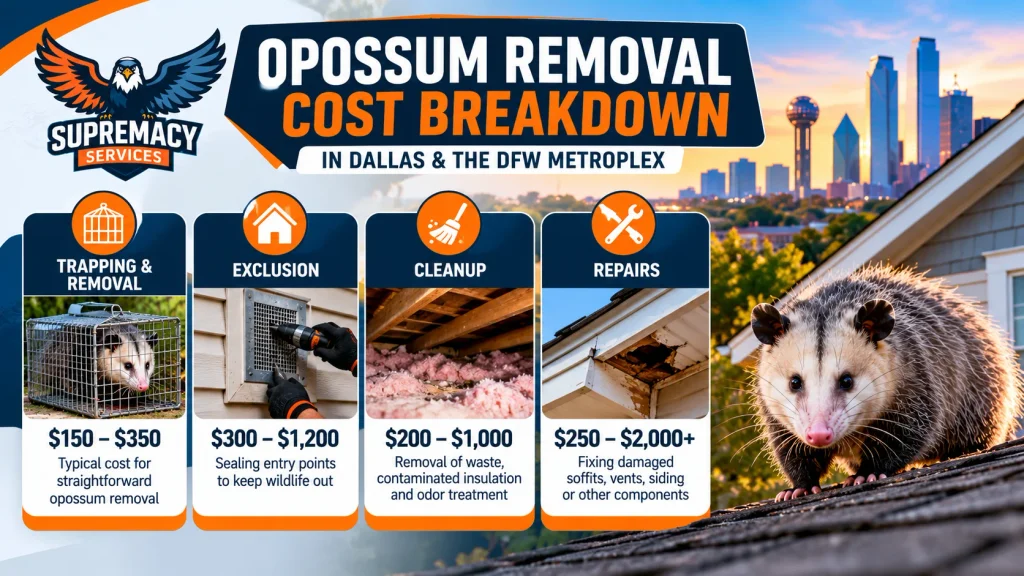
For a straightforward situation involving one accessible animal, a few hundred dollars is a reasonable market-planning range, but the cost can rise when removal involves an attic or crawl space, repeated trap checks, exclusion work, contaminated materials or building repairs.
The following table combines currently published third-party market information. It should be treated as a budgeting reference rather than a Supremacy quote.
| Situation | Published Market Reference | What Can Affect the Final Cost |
|---|---|---|
| Straightforward opossum removal | About $150–$350 nationally | Method, animal count, visits |
| Local DFW basic opossum removal | About $200–$500 | Accessibility and removal complexity |
| Dallas wildlife removal generally | About $225–$1,003 | Species, nesting location and follow-up visits |
| Attic/crawl-space opossum removal | Local provider reports $400–$1,000 | Confined access, labor and location |
| Removal + exclusion | Local provider reports roughly $600–$2,500+ | Number of openings, repairs and property conditions |
| Cleanup/restoration | Site-specific | Contamination, insulation, odor and damaged materials |
The most important distinction is between removing the animal and solving the property problem that allowed it inside.
A low trapping price can become poor value if an entry opening remains accessible and wildlife simply enters again.
What Is Included in Opossum Removal?
Professional wildlife removal can involve considerably more than putting a cage in the yard.
Depending on the property and scope, service may include:
- inspection of the attic, crawl space, garage, roofline and foundation;
- identification of the animal and activity areas;
- locating possible entry and exit points;
- selecting an appropriate removal strategy;
- trap placement and required monitoring;
- checking for dependent young;
- removal of the animal;
- evaluation of contaminated or disturbed materials;
- sealing accessible wildlife entry points;
- repairing damaged vents, soffits or other components when included in the proposal; and
- recommendations for reducing future wildlife attraction.
Supremacy’s dedicated wildlife service page describes its service around inspection, wildlife removal, entry sealing and cleanup rather than trapping alone.
Have an opossum in an attic, crawl space or garage? Schedule a wildlife inspection with Supremacy Services to identify the animal, locate entry points and determine the appropriate removal and exclusion scope.
What Affects Opossum Removal Cost?
1. Where the opossum is located
An opossum walking across the backyard is very different from one denning:
- beneath a deck;
- underneath a shed;
- inside a crawl space;
- behind stored items in a garage;
- inside an attic; or
- in a difficult structural void.
Hard-to-access locations generally require more inspection and labor.
2. How many animals are present
What appears to be one animal may involve a female with young.
That matters because closing an opening without determining whether animals remain inside can turn an exclusion project into a much more difficult problem.
3. Number of service visits
Trap-based removal may require return visits.
Texas regulations specify inspection requirements for traps used to take fur-bearing animals. TPWD states that snares, foothold traps, body-grip traps and live or box traps used for fur-bearing animals must be examined at least once every 36 hours and animals removed.
More visits can therefore increase labor and project cost.
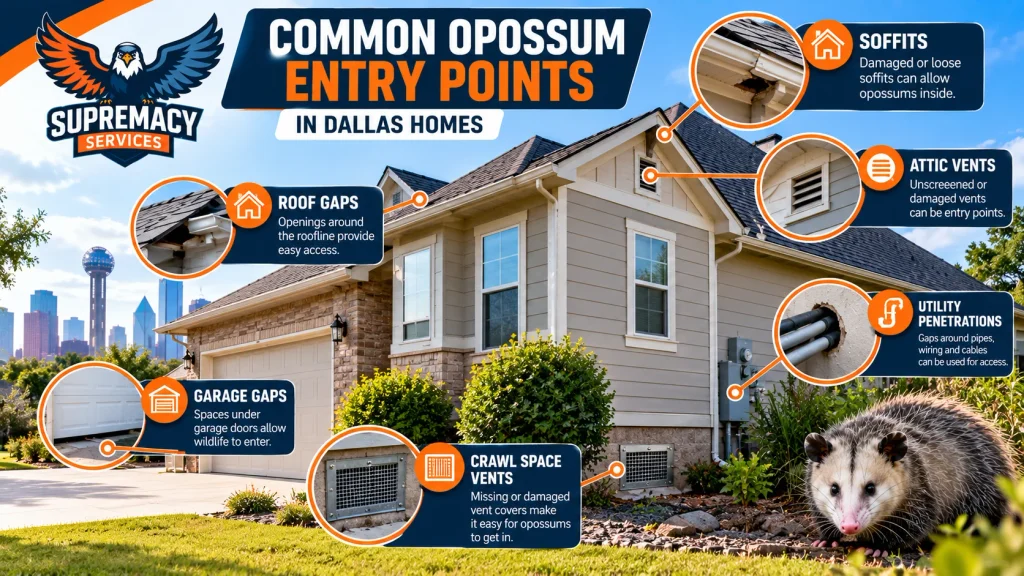
4. Number and size of entry points
Finding the opossum does not necessarily reveal how it entered.
A technician may need to inspect:
- crawl-space vents;
- damaged vent covers;
- openings around foundations;
- garage-door gaps;
- soffit damage;
- roof transitions;
- utility penetrations; and
- damaged exterior components.
The larger the exclusion scope, the more material and labor the project can require.
5. Cleanup requirements
Opossums can occupy areas where droppings, urine, nesting debris or odors accumulate.
Cleanup pricing depends on the affected area and materials involved rather than simply the presence of the animal.
6. Property repairs
An exclusion estimate and a repair estimate are not always the same thing.
For example, sealing an accessible wildlife opening may be relatively straightforward, while repairing damaged siding, soffits, crawl-space vents, insulation or another building component can require additional materials or another trade.
Ask for a written estimate identifying exactly what is—and is not—included.
Trapping vs. Exclusion vs. Repairs
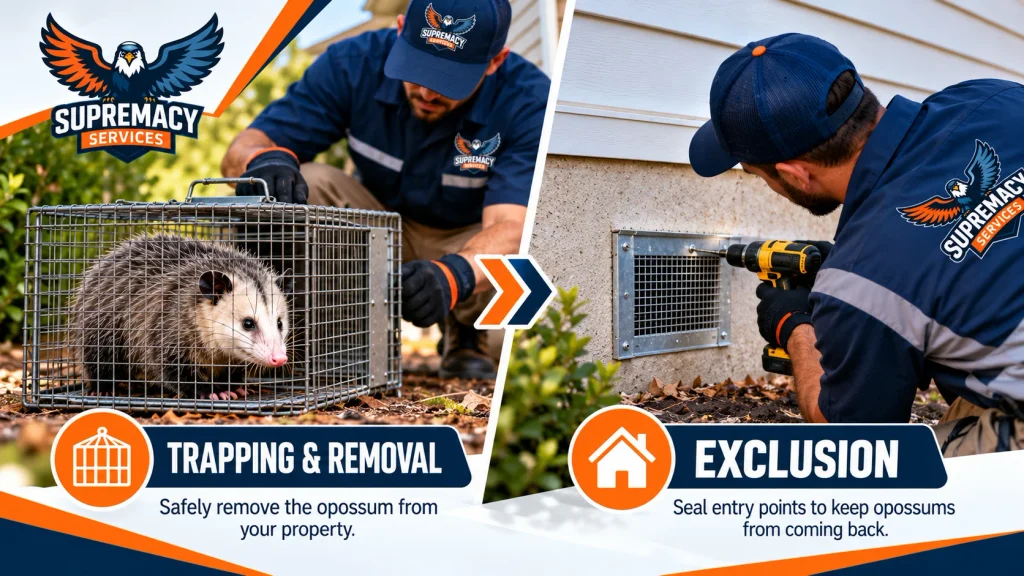
These three services solve different parts of the problem.
| Service | Main Purpose | Does It Solve the Current Animal Problem? | Does It Help Prevent Re-entry? |
|---|---|---|---|
| Trapping/removal | Remove active wildlife | Yes | Not by itself |
| Exclusion | Close wildlife access points | Helps complete the solution | Yes |
| Cleanup | Remove affected debris/material | No | Indirectly |
| Repair/restoration | Restore damaged building components | No | Sometimes |
| Prevention | Reduce food, shelter and access | No | Yes |
Why trapping alone may not be enough
If an opossum entered through a damaged crawl-space vent, removing that animal leaves the underlying access point unchanged.
That is why a complete wildlife-control plan should answer two separate questions:
- How will the animal be removed safely?
- How will the access point be corrected afterward?
Why Is an Opossum Living Around Your House?
Opossums are opportunistic omnivores and can be attracted to food and shelter around residential properties.
Texas A&M AgriLife specifically notes attractants including pet food, fruit, pecans, bird seed and garbage.
Around a DFW home, potential attractants can therefore include:
- pet food left outside overnight;
- accessible trash;
- fallen fruit;
- bird-feeding areas;
- sheltered spaces beneath decks or sheds;
- accessible crawl spaces;
- open garages; and
- existing structural openings.
An opossum passing through the yard does not automatically mean the home has an infestation. The concern increases when there is repeated activity around the same structural opening or evidence that an animal is denning inside or beneath the building.
Signs You May Have an Opossum
Possible signs include:
- heavier movement or thumping at night;
- repeated activity beneath a deck or porch;
- an animal entering a crawl-space opening;
- disturbed insulation or stored materials;
- droppings in a sheltered area;
- persistent animal odors;
- damaged vent screens;
- repeated sightings around the garage; or
- pet reactions around one particular wall, crawl space or exterior opening.
Do not identify the animal from sound alone
Nighttime noises can also come from rats, mice, raccoons, squirrels or other wildlife.
The size, timing, location of the noise, droppings, tracks and entry-point evidence can help with identification, but visual confirmation or a professional inspection is more reliable than guessing from scratching sounds.
Can You Remove an Opossum Yourself?
A homeowner may be able to address simple outdoor attractants without trapping—for example, securing garbage or removing overnight pet food.
An opossum inside an attic, crawl space or structural void is a different situation.
DIY trapping can create several problems:
- capturing the wrong animal;
- separating a mother from dependent young;
- handling a frightened wild animal;
- failing to monitor a trap appropriately;
- not knowing where a captured animal may legally be released;
- sealing an opening while another animal remains inside; or
- removing one animal while leaving the entry point available.
Wild animals can bite or scratch when frightened. CDC advises avoiding contact with wildlife and obtaining medical/public-health guidance after potential bites or scratches. Although opossums are not among the wildlife species CDC identifies as the principal U.S. rabies reservoirs, any mammal can potentially acquire rabies.
If someone has been bitten or scratched, treat that as a health issue rather than a pest-control question and seek appropriate medical/public-health guidance.
Texas Rules for Trapping and Relocating Opossums
Opossums are classified by the Texas Parks and Wildlife Department as fur-bearing animals.
For nuisance situations, Texas rules deserve particular attention.
TPWD states that landowners or their agents may take nuisance fur-bearing animals causing damage on their land without a hunting or trapping license. However, Texas also places specific restrictions on possession and relocation.
Can you simply trap an opossum and release it somewhere else?
Not automatically.
TPWD states that nuisance fur-bearing animals may be captured and relocated when the person has:
- authorization from the department; and
- permission from the owner of the property where the animal will be released.
TPWD also requires reporting for authorized nuisance relocation.
That is an important reason homeowners should not assume that driving a trapped opossum to a park, creek or vacant property is automatically lawful.
Regulations can change, so verify current TPWD requirements before trapping or relocating wildlife.
Opossum vs. Raccoon vs. Rat: What Might Be in Your Attic?
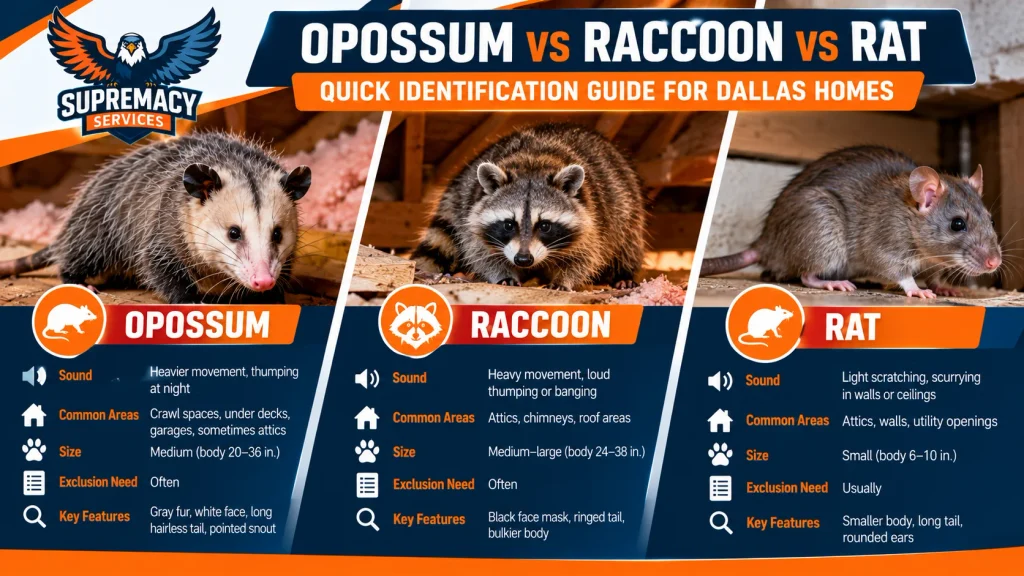
Correct identification affects both the removal method and the cost.
| Clue | Opossum | Raccoon | Rats/Mice |
|---|---|---|---|
| Typical sound | Heavier movement | Heavy movement/thumping | Light scratching/scurrying |
| Common residential shelter | Crawl spaces, decks, garages, sometimes attics | Attics, chimneys, roof areas | Attics, walls and utility openings |
| Animal size | Medium | Medium-large | Small |
| Exclusion need | Often | Often | Usually |
| Identification from sound alone reliable? | No | No | No |
Supremacy has a separate Rodent Control & Exclusion service for rats and mice, while opossums and raccoons belong under the broader wildlife-removal service. Keeping those service intents separate helps both users and search engines understand the site architecture.
How Professional Opossum Removal Works
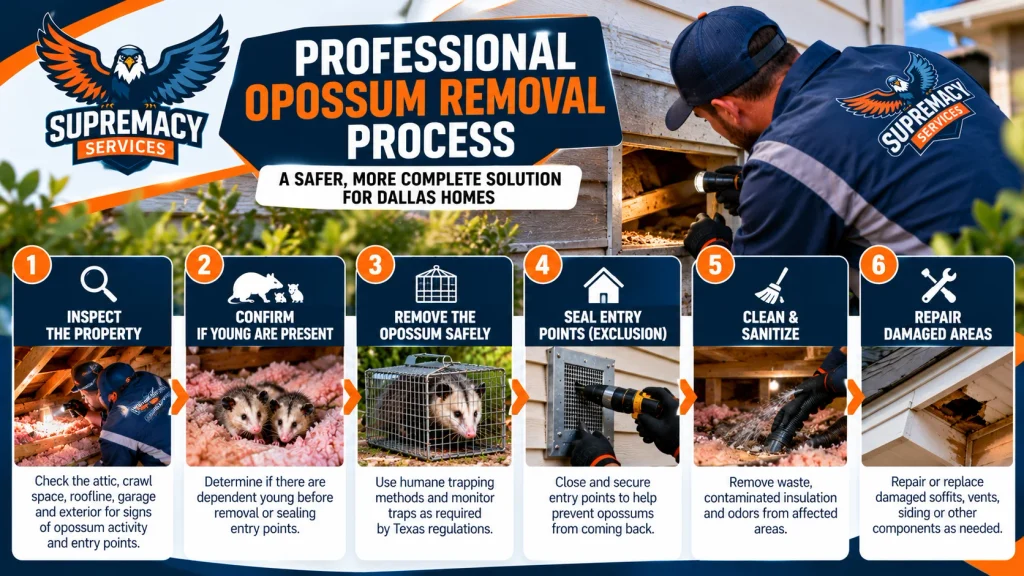
Step 1: Inspect the property
The first objective is to confirm the species and determine where the animal is entering or sheltering.
Inspection may include the roofline, attic, garage, crawl space, vents and foundation.
Step 2: Determine whether young are present
Wildlife removal should account for dependent young before openings are permanently closed.
Step 3: Choose the appropriate removal method
The correct method depends on the animal’s location, building configuration and applicable wildlife rules.
Step 4: Monitor the removal
If traps are used, they need appropriate placement and inspection.
Step 5: Confirm the structure is clear
Closing an entry point before confirming animals are out can trap wildlife inside.
Step 6: Complete exclusion work
Once appropriate, accessible openings can be secured using materials suitable for the particular building component.
Step 7: Evaluate cleanup and repairs
The final inspection should determine whether there are:
- contaminated materials;
- damaged insulation;
- odor issues;
- damaged vents;
- soffit or fascia problems; or
- other components requiring repair.
If the opossum is already inside your attic or crawl space, request a Dallas wildlife inspection before sealing the opening. Supremacy Services can evaluate removal, entry-point exclusion and any visible cleanup or repair needs as one coordinated scope.
How to Help Prevent Opossums From Returning
The best prevention strategy combines food-source control with structural exclusion.
Around the yard
- Keep garbage containers secured.
- Avoid leaving pet food outside overnight.
- Clean up fallen fruit when practical.
- Manage accessible food around bird-feeding areas.
- Avoid intentionally feeding wildlife.
Texas A&M AgriLife advises against feeding wildlife such as opossums and identifies human food sources as a factor bringing these animals into human environments.
Around the house
Check accessible areas for:
- damaged crawl-space vents;
- loose vent covers;
- gaps around utility penetrations;
- damaged soffits;
- garage-door gaps;
- openings beneath decks or additions; and
- deteriorated exterior materials.
Do not permanently seal an active opening until you are confident no wildlife or dependent young remain inside.
Is an Opossum Around the Yard Always a Problem?
No.
Seeing an opossum outdoors does not automatically justify removal. Opossums are native wildlife and can simply be moving through a property.
Professional intervention becomes more relevant when the animal:
- is living inside the structure;
- repeatedly enters a crawl space or garage;
- is causing property damage;
- cannot safely exit;
- has young in a structure;
- is creating contamination or persistent odor; or
- creates a situation where people or pets may come into close contact with it.
The objective should be to solve an actual wildlife conflict rather than remove every opossum that passes through a Dallas yard.
What Should a Dallas Opossum Removal Estimate Include?
Before comparing quotes, ask whether the estimate includes:
- species/activity inspection;
- removal or trapping;
- trap monitoring and return visits;
- checking for young;
- entry-point identification;
- exclusion materials;
- roofline or crawl-space work;
- cleanup;
- odor treatment if needed;
- insulation removal or replacement if needed;
- structural repairs;
- final inspection; and
- any applicable service warranty or follow-up terms.
A $250 trapping quote and a $900 removal-and-exclusion proposal may not represent competing prices for the same scope.
Compare the work included, not just the headline price.
Frequently Asked Questions
How much does it cost to remove an opossum in Dallas?
Published 2026 market data suggests straightforward opossum removal often costs a few hundred dollars, while projects involving attics, crawl spaces, multiple visits, exclusion, cleanup or repairs can cost considerably more. The property should be inspected before relying on a fixed estimate.
How much does it cost to remove an opossum from an attic?
Attic removal generally costs more than removing an easily accessible animal because access, inspection, trapping, exclusion and cleanup may all be involved. One DFW market source publishes approximately $400–$1,000 for more involved attic/crawl-space opossum removal, but that is a third-party market estimate rather than Supremacy pricing.
Is trapping enough to stop opossums from coming back?
Not necessarily. If the animal entered through a structural opening, removal solves the immediate animal problem while exclusion addresses the access point.
Can I relocate a trapped opossum in Texas?
Relocation is regulated. TPWD says nuisance fur-bearing animals may be relocated with department authorization and permission from the owner of the release property, along with applicable reporting requirements.
Do opossums carry rabies?
Any mammal can potentially acquire rabies, but CDC does not list opossums among the primary wildlife rabies reservoirs in the United States; bats, raccoons, skunks and foxes are the major wildlife groups identified. Avoid handling wildlife regardless.
What attracts opossums to Dallas homes?
Accessible food and shelter can attract them. Texas A&M AgriLife specifically identifies pet food, fruit, pecans, bird seed and garbage as food sources associated with nuisance opossum activity.
Should I seal an opening if I see an opossum using it?
Not until you know the structure is clear. Closing an active opening can trap an animal—or dependent young—inside.
Is an opossum in my yard an emergency?
Usually, simply seeing an opossum outdoors is not an emergency. The situation deserves more attention when wildlife is inside the home, trapped, injured, behaving unusually, causing damage or creating close-contact risks.
What is the difference between opossum removal and exclusion?
Removal gets the active animal out. Exclusion closes the access points that allowed wildlife into the structure. For a long-term solution, a property may require both.
Get an Opossum Problem Properly Assessed
The cheapest opossum removal is not necessarily the lowest-priced trap.
For a homeowner with wildlife inside a Dallas-area house, the real objective is to determine:
What animal is present? How did it get in? Are there young? What needs to be removed? What needs to be sealed? And what, if anything, needs to be cleaned or repaired?
Supremacy Services’ wildlife service is designed around that broader removal-and-exclusion approach for opossums, raccoons, squirrels, skunks and other nuisance wildlife in the Dallas–Fort Worth area.
Need an opossum removed from your Dallas-area home? Schedule Wildlife Trapping & Removal with Supremacy Services for an inspection of the animal activity, entry points and appropriate exclusion scope.

