
Installing a Tesla Wall Connector in Dallas generally requires more than mounting a charger on the garage wall. The electrician must determine whether your electrical system can support the charging load, select the appropriate dedicated circuit and breaker, route and terminate the wiring correctly, address applicable Dallas permitting and inspection requirements, and commission the Wall Connector for the selected circuit.
For maximum Wall Connector output, Tesla specifies a 60-amp double-pole circuit breaker providing up to 48 amps at 240 volts, or 11.5 kW. A 60-amp installation is not mandatory, however. Tesla allows the Wall Connector to operate at lower amperages when the property’s available electrical capacity or the vehicle’s charging capability makes that more appropriate.
Cost therefore depends less on the charger itself than many homeowners expect. The distance from the electrical panel to the parking location, available panel capacity, wiring route, breaker size, permit requirements and whether additional electrical work is needed can substantially change the installation.
Table of Contents
- How Much Does Tesla Wall Connector Installation Cost in Dallas?
- What Electrical Requirements Does a Tesla Wall Connector Have?
- Does Your Electrical Panel Have Enough Capacity?
- Do You Need a 60-Amp Breaker?
- Does a Tesla Wall Connector Need a Dedicated Circuit?
- Do You Need a Permit in Dallas?
- What Happens During Professional Installation?
- Can You Install a Tesla Wall Connector Yourself?
- Wall Connector vs. Mobile Connector
- When Might You Need a Panel Upgrade?
- How to Prepare for Installation
- Frequently Asked Questions
How Much Does Tesla Wall Connector Installation Cost in Dallas?
There is no responsible flat price for every Tesla Wall Connector installation because the electrical work can range from a short circuit run beside an adequately sized panel to a considerably more involved project requiring long wiring runs, new equipment or a panel/service modification.
As a national planning benchmark rather than a Dallas quote, HomeAdvisor’s June 2026 data puts professional EV charging-station installation at approximately $554–$1,381, with an average around $967. It also notes that panel upgrades and other additional electrical work can push costs higher.
Tesla similarly states that installation costs depend on the home’s electrical system and installation configuration. Tesla identifies long wire runs, additional panels, trenching, main-panel upgrades, pedestal installations and concealed wiring as examples of work that can increase installation complexity.
What affects your actual Dallas installation price?
| Cost factor | Why it matters |
|---|---|
| Panel-to-charger distance | Longer circuits require more conductor, conduit and labor |
| Panel capacity | An already heavily loaded service may require another solution before adding the charger |
| Breaker/output selected | Circuit design must correspond with the Wall Connector’s commissioned output |
| Wiring route | Open garage walls are generally simpler than finished interiors or difficult exterior routes |
| Indoor vs. outdoor location | Exterior installations require appropriately designed weather-resistant wiring methods and fittings |
| Panel space | Lack of suitable breaker positions can complicate the installation |
| Trenching | Detached garages and remote parking locations can require underground electrical work |
| Permit/inspection | Applicable municipal requirements become part of the project |
| Panel/service work | A charger may expose capacity limitations that need separate electrical work |
The useful question is therefore not simply, “What does Tesla charger installation cost?” It is:
What electrical work does this particular Dallas property need to safely supply the desired charging rate?
The Wall Connector itself is separate from installation
Tesla’s current U.S. shop pricing should be checked at the time of purchase because hardware pricing can change. The equipment price should be separated from electrician labor, materials, permits and any panel or service work.
Already have your Wall Connector? Have Supremacy Services evaluate your panel capacity and proposed charger location before installation.
What Electrical Requirements Does a Tesla Wall Connector Have?
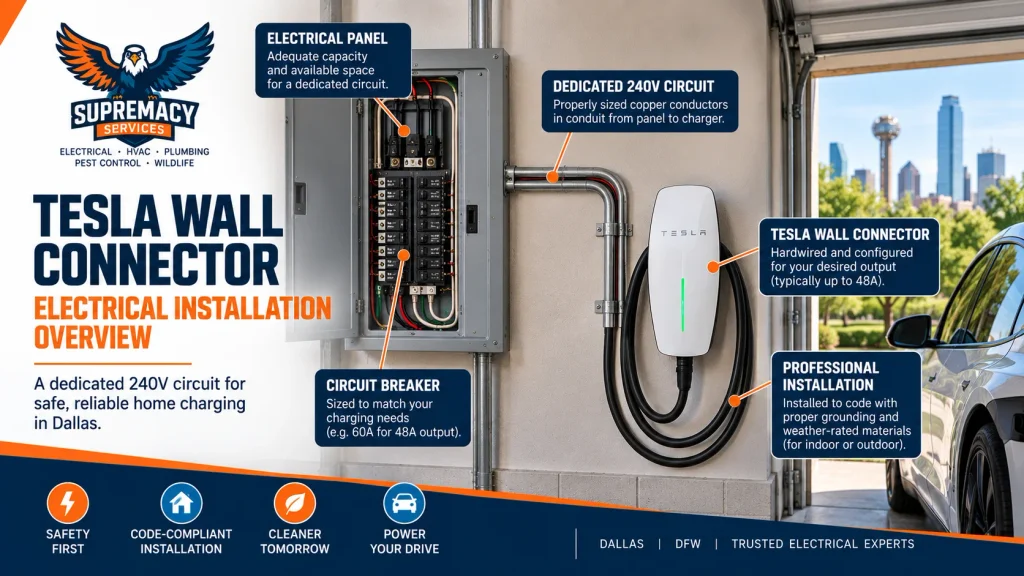
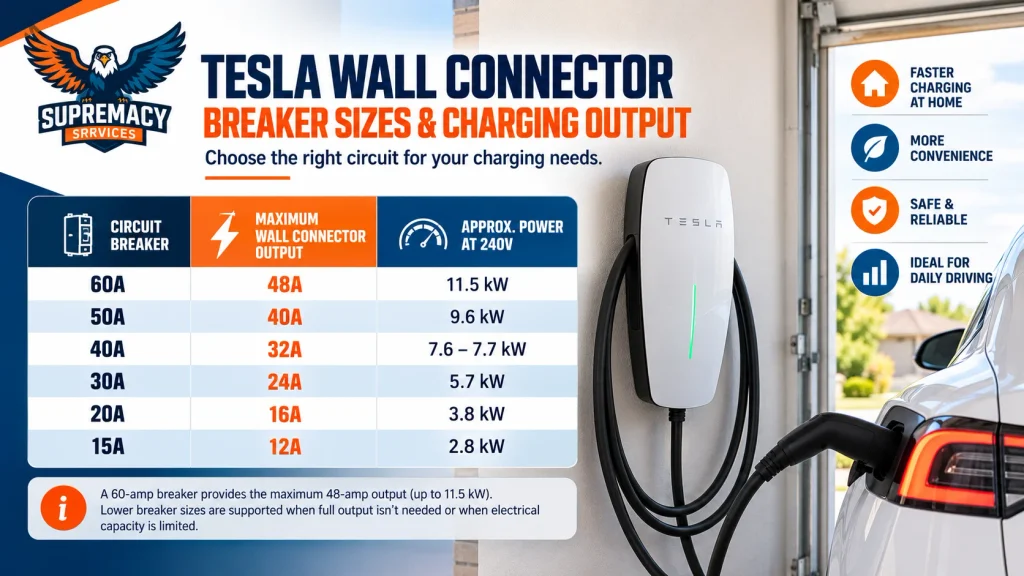
A Tesla Wall Connector is a hardwired Level 2 charging device. For maximum output, Tesla specifies a 60-amp double-pole breaker, allowing the Wall Connector to deliver up to 48 amps at 240 volts, or 11.5 kW. Tesla also supports lower breaker and charging configurations when full output is unnecessary or the available electrical capacity does not support it.
Tesla’s current output table is:
| Circuit breaker | Maximum Wall Connector output | Approx. power at 240V |
|---|---|---|
| 60A | 48A | 11.5 kW |
| 50A | 40A | 9.6 kW |
| 40A | 32A | 7.6–7.7 kW |
| 30A | 24A | 5.7 kW |
| 20A | 16A | 3.8 kW |
| 15A | 12A | 2.8 kW |
Actual vehicle charging can be lower because the vehicle’s onboard charger also limits how much AC power it can accept.
Why 48 amps uses a 60-amp circuit
EV charging represents a substantial sustained electrical load. That means homeowners should not assume that a charger’s advertised 48-amp output translates into using a 50-amp breaker.
Tesla’s specified maximum-output configuration pairs the 48-amp Wall Connector setting with a 60-amp breaker.
Wiring requirements matter too
Tesla’s installation documentation requires copper conductors at the Wall Connector terminals and specifies conductor requirements based on breaker configuration and termination temperature ratings.
For maximum output, Tesla’s current documentation identifies minimum conductor requirements that vary according to the temperature rating of the breaker. Conductor selection must also account for the installation method, applicable electrical code and circumstances such as voltage drop.
This is one reason selecting wire size from an online chart without evaluating the complete circuit is not a sound installation method.
Does Your Electrical Panel Have Enough Capacity?
Not necessarily. Having an empty breaker position does not by itself prove that your electrical service can support a 48-amp EV charging load.
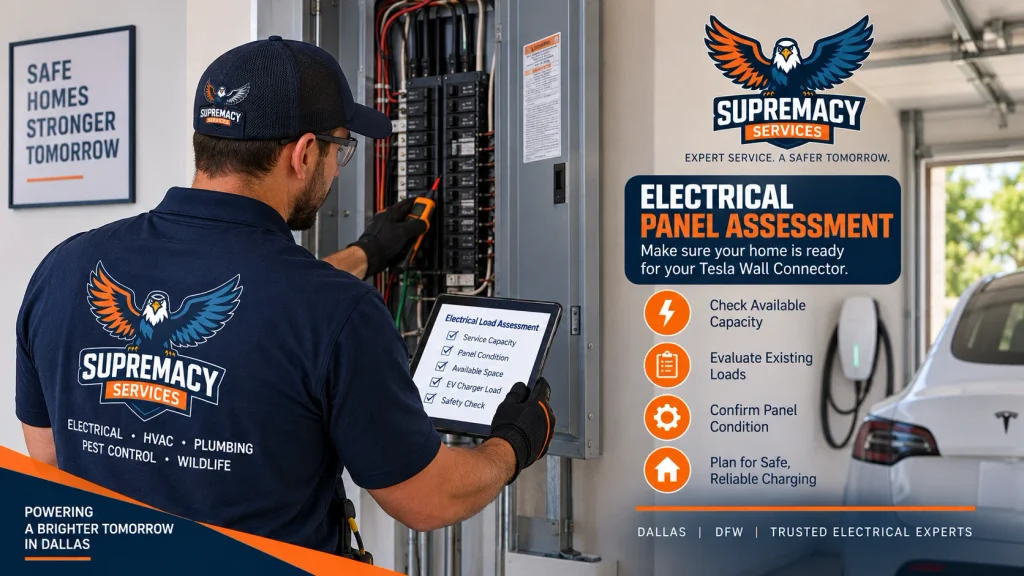
An electrician should evaluate the existing electrical system and anticipated loads before deciding how the Wall Connector should be configured.
That assessment may include:
- electrical service capacity;
- existing major loads;
- panel and breaker condition;
- available breaker positions;
- proposed charging amperage;
- conductor route and distance;
- grounding;
- other planned electrical additions; and
- whether an approved load-management approach is appropriate.
An empty breaker slot is not the same as available electrical capacity
This distinction is important.
Panel space describes whether there is a physical location for the required breaker.
Electrical capacity addresses whether the service and electrical system can safely accommodate the additional load.
A panel can have unused breaker spaces while the broader electrical system still requires careful load evaluation.
Do You Need a 60-Amp Breaker?
No. A Tesla Wall Connector does not always require a 60-amp breaker. The 60-amp configuration is used for its maximum 48-amp/11.5-kW output, but Tesla permits lower configurations when the home’s electrical supply or vehicle does not require maximum power.
This can be especially useful when a Dallas homeowner wants Level 2 charging but the existing electrical infrastructure cannot economically accommodate the highest Wall Connector setting.
For example, Tesla lists:
- 40A breaker → up to 32A charging;
- 50A breaker → up to 40A charging;
- 60A breaker → up to 48A charging.
The appropriate configuration should be determined from the home’s electrical capacity and the vehicle’s charging capability—not simply by choosing the largest breaker.
Your Tesla model also matters
Tesla states that different vehicles have different onboard charging capabilities.
For example, Tesla currently identifies some Model 3 and Model Y variants as having a maximum AC charging rate of 32 amps, while several other Tesla configurations can accept up to 48 amps.
Installing a larger circuit does not make a vehicle exceed its onboard charging limit.
Does a Tesla Wall Connector Need a Dedicated Circuit?
Tesla’s current Gen 3 installation instructions describe the Wall Connector as a hardwired installation connected to the appropriate branch circuit. Tesla specifically states not to convert the Wall Connector into a cord-and-plug installation.
That makes it different from using Tesla’s Mobile Connector with a compatible receptacle.
For homeowners comparing the two approaches, think of the Wall Connector as permanent charging infrastructure rather than another appliance that is casually plugged into a garage outlet.
Do You Need a Permit in Dallas?
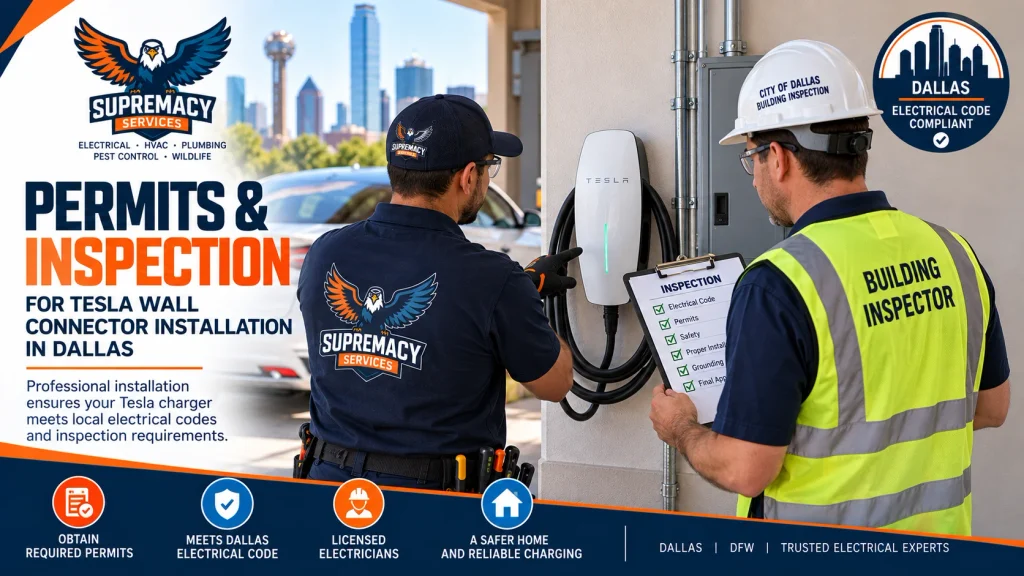
Electrical work in Dallas is governed by the City’s electrical code and permitting/inspection framework. Dallas has adopted the 2023 National Electrical Code with local amendments, and the City maintains an Electrical Inspections section for electrical permitting and code administration.
Texas licensing requirements also apply. The Texas Department of Licensing and Regulation states that people performing non-exempt electrical work in Texas must be licensed and that the work must be performed through a licensed electrical contractor.
Because permit requirements can depend on jurisdiction and scope, homeowners outside Dallas proper should not assume that City of Dallas procedures apply throughout the entire Metroplex. Plano, Richardson, Garland, Irving, Frisco, Carrollton and other DFW jurisdictions administer their own local permitting processes.
For a Dallas installation, confirm the current permit and inspection requirements for the exact property and project before beginning work.
Why permits matter for EV charging
A Wall Connector places a substantial sustained load on the electrical system. Permitting and inspection provide an independent code-compliance checkpoint for work involving elements such as:
- circuit protection;
- conductor installation;
- grounding;
- panel connections;
- equipment installation; and
- applicable electrical-code requirements.
Tesla itself lists an electrical permit and inspection among the standard items homeowners can expect professional installers to account for where applicable.
What Happens During Professional Installation?
A professional Tesla Wall Connector installation should begin with the electrical system—not with drilling holes for the charger.
1. Evaluate the electrical panel
The electrician determines the existing service and panel configuration, checks available capacity and identifies the appropriate approach for the additional charging load.
2. Confirm the vehicle and desired charging rate
Maximum charging speed depends on both the Wall Connector configuration and the vehicle’s onboard charger.
There is little benefit in designing around a charging rate the vehicle cannot accept.
3. Select the Wall Connector location
The charger should be positioned where the cable can comfortably reach the vehicle’s charge port without creating unnecessary routing problems.
The panel-to-charger distance also matters because longer wiring routes generally increase materials and labor.
4. Determine the circuit configuration
The electrician selects the breaker, conductors, wiring method and associated equipment based on the required charging output and installation conditions.
5. Complete permitting requirements
Where a permit is required, it should be obtained through the applicable authority before or as required for the electrical work.
6. Install the branch circuit and Wall Connector
The circuit is routed from the electrical panel to the charger location and the Wall Connector is permanently connected according to manufacturer instructions and applicable code.
7. Commission the charger
Commissioning is a critical step.
Tesla’s setup process allows the installer to configure parameters including the breaker rating and Wall Connector output. Wi-Fi connectivity also enables firmware updates and remote functionality.
8. Test charging
The completed system should be tested with the vehicle to verify normal operation.
Planning a Tesla charger installation? Schedule an electrical assessment with Supremacy Services to determine panel capacity, circuit requirements and the appropriate Wall Connector configuration for your Dallas-area property.
Can You Install a Tesla Wall Connector Yourself?
For a new installation, this is not a project homeowners should treat like mounting an ordinary smart-home device.
The job can involve high-current 240-volt electrical work, branch-circuit design, conductor sizing, grounding, panel work, permitting and commissioning.
Texas regulates non-exempt electrical work through TDLR, while Dallas also has its own electrical permitting and inspection requirements.
Tesla’s Universal Wall Connector product guidance expressly says the unit must be installed by a qualified electrician. Tesla also directs homeowners toward professional installation for its home-charging equipment.
Even where a homeowner exemption might potentially apply under state or local rules, legal eligibility to perform certain work should not be confused with having the technical ability to design and install a high-current charging circuit correctly.
Wall Connector vs. Mobile Connector
The best option depends on how quickly you need to charge, the available electrical infrastructure and whether you want permanent charging equipment.
| Feature | Tesla Wall Connector | Tesla Mobile Connector |
|---|---|---|
| Installation | Hardwired | Plug-in |
| Typical role | Permanent home charging | Portable/flexible charging |
| Maximum charging capability | Up to 48A / 11.5 kW depending on vehicle and circuit | Lower than Wall Connector maximum |
| Wi-Fi | Yes | No comparable Wall Connector functionality |
| Charging statistics | Available through Tesla ecosystem | More limited |
| Access control | Available | No equivalent Wall Connector access control |
| Best suited for | Frequent home charging | Travel, backup or lower-power home charging |
Tesla recommends Wall Connector for home charging while describing the Mobile Connector as an alternative that can use ordinary or compatible higher-voltage receptacles.
Do you need maximum charging speed?
Not every homeowner does.
If the vehicle sits in the garage for eight or ten hours most nights, a lower Wall Connector output may still replenish substantially more energy than the household typically consumes in daily driving.
The installation should therefore balance charging needs against available electrical capacity rather than automatically maximizing amperage.
When Might You Need a Panel Upgrade?
A Tesla Wall Connector does not automatically mean you need a new electrical panel.
A panel or service upgrade becomes a separate consideration when evaluation shows the existing system cannot appropriately support the proposed charging load or has other limitations that should be corrected.
Potential reasons for additional panel work include:
- insufficient electrical capacity;
- unsuitable or obsolete equipment;
- physical deterioration;
- lack of an appropriate expansion path;
- existing electrical defects; or
- broader modernization plans involving other significant loads.
The important point is that adding an EV charger and upgrading a panel are two separate decisions.
A load assessment should determine whether the second is actually necessary.
What if the panel is capacity-constrained?
Tesla’s current Wall Connector platform includes power-management capabilities designed to provide more flexibility where electrical capacity is limited. Tesla also supports lower charging-current configurations.
That means the correct solution is not automatically “replace the panel.”
Depending on the property, the answer could be:
- install the Wall Connector at lower output;
- use an appropriate approved power-management strategy;
- make targeted electrical modifications; or
- upgrade the panel/service when the electrical assessment shows that it is warranted.
This is where a proper assessment can prevent homeowners from paying for unnecessary work.
Installing Two Tesla Wall Connectors
Homes with two EVs require additional planning because simultaneous charging can create a much larger potential load.
Tesla provides Group Power Management, which allows compatible Wall Connectors to manage available power rather than simply treating every charger as an independent maximum load.
For households expecting a second EV, mentioning that plan before the first installation can help the electrician design the infrastructure more intelligently.
The same principle applies to commercial properties, apartment buildings and workplaces where several charging stations may eventually be installed.
Indoor vs. Outdoor Wall Connector Installation
Tesla Wall Connector is designed for indoor or outdoor mounting.
Outdoor installations still require the electrical wiring method and fittings to be appropriate for the environment. Tesla’s installation instructions specifically call for watertight fittings when feeder wiring enters the Wall Connector in outdoor installations.
For Dallas-area homeowners, practical placement considerations include:
- where the vehicle normally parks;
- cable reach;
- protection from physical damage;
- proximity to the electrical panel;
- garage versus driveway charging;
- wall versus pedestal mounting; and
- potential future EV parking arrangements.
The shortest electrical route is not automatically the best charger location, but unnecessary distance can increase project complexity.
How to Prepare for Tesla Wall Connector Installation
Before requesting an installation quote, gather a few details.
Homeowner pre-installation checklist
- Know your Tesla model and trim.
- Decide where the vehicle will normally park.
- Identify your preferred Wall Connector location.
- Locate your main electrical panel.
- Note whether the panel is in the garage, outdoors or elsewhere.
- Consider whether you expect to purchase another EV.
- Decide whether you want maximum available charging speed or simply reliable overnight charging.
- Tell the electrician about major existing or planned loads.
- Ask whether permitting and inspection are included in the quote.
- Ask whether panel work is actually necessary or simply optional.
Photos can help with preliminary estimating
Installers may ask for photographs of:
- the electrical panel;
- panel labels and main breaker;
- proposed charger wall;
- route between the panel and charger; and
- surrounding garage or parking area.
A site visit may still be needed before the final scope can be confirmed.
Questions to Ask a Tesla Wall Connector Installer
Before approving a quote, ask:
- What charging amperage are you proposing?
- Why was that amperage selected?
- Does my vehicle support that charging rate?
- Does the existing electrical system have sufficient capacity?
- What breaker size will be installed?
- What wiring route will be used?
- Is permitting included?
- Is inspection included?
- Is any panel work required?
- If so, why?
- Will the Wall Connector be commissioned and tested?
- Is Wi-Fi setup included?
- What changes would be needed if I add a second EV later?
A detailed quote should make the electrical scope understandable rather than hiding everything behind a single installation price.
Tesla Wall Connector Problems That Can Be Confused With Installation Issues
Not every charging problem means the Wall Connector was installed incorrectly.
Charging speed or reliability can also be affected by:
Vehicle charging limits
The onboard charger can limit AC charging speed even when the Wall Connector can provide more power.
Wall Connector configuration
The unit’s commissioned breaker/output setting determines the current it is allowed to supply.
Connectivity
Wi-Fi is used for firmware updates, remote diagnostics and connected functionality.
Power availability
Power-management settings or site conditions can affect available charging power.
Vehicle settings
Charging schedules and limits configured in the Tesla ecosystem can change when and how the vehicle charges.
Tesla recommends confirming commissioning and firmware connectivity when troubleshooting Wall Connector operation.
Frequently Asked Questions
How much does it cost to install a Tesla Wall Connector in Dallas?
The cost depends on panel capacity, circuit length, wiring route, breaker configuration, permits and whether additional electrical work is necessary. National 2026 market data from HomeAdvisor places professional EV charging-station installation around $554–$1,381, but that is a planning benchmark rather than a Dallas-specific contractor quote. Complex installations can cost more.
Does a Tesla Wall Connector need a 60-amp breaker?
Not always. Tesla specifies a 60-amp breaker for maximum 48-amp/11.5-kW Wall Connector output. Lower breaker/output configurations are supported when maximum charging power is unnecessary or unavailable.
Can a Tesla Wall Connector run on a 40-amp breaker?
Yes. Tesla lists a 40-amp breaker configuration with a maximum Wall Connector output of 32 amps, approximately 7.7 kW at 240 volts.
Do I need a 200-amp electrical panel for a Tesla charger?
Not automatically. The appropriate decision depends on the home’s overall electrical loads, existing service capacity and proposed charger configuration. A load assessment should be performed rather than assuming every EV charger requires a 200-amp service.
Can I install a Tesla Wall Connector outside?
Yes. Tesla identifies Wall Connector as suitable for indoor and outdoor mounting. Outdoor electrical connections and wiring methods must be appropriate for the environment.
Does Dallas require a permit for Tesla charger installation?
Dallas regulates electrical work through its electrical-code, permitting and inspection framework. Because requirements depend on the project’s scope and jurisdiction, confirm the current permit requirements for the property before installation. Dallas currently uses the 2023 NEC with local amendments.
Does the Tesla Wall Connector have to be hardwired?
Yes. Tesla’s current installation documentation instructs installers to hardwire the Wall Connector branch circuit rather than configuring it as a cord-and-plug installation.
Will I need an electrical-panel upgrade?
Only if an electrical assessment determines the existing system cannot appropriately accommodate the proposed charger or has another condition requiring correction. Tesla also supports lower-amperage configurations and power-management options, so a panel replacement should not be assumed before the system is evaluated.
How fast can a Tesla Wall Connector charge?
The Wall Connector can provide up to 48 amps at 240 volts, approximately 11.5 kW. Tesla currently lists up to roughly 44 miles of range added per hour for certain vehicles, but actual charging speed varies by vehicle and configuration.
Can two Tesla Wall Connectors share available power?
Compatible Wall Connectors can use Tesla’s Group Power Management functionality to manage charging power across multiple units. This can be useful for two-EV households and larger charging installations.
Get Your Dallas Home Ready for Tesla Charging
A Tesla Wall Connector can make overnight home charging straightforward, but the quality of the installation depends on the electrical infrastructure behind it.
Before deciding that you need a 60-amp circuit—or assuming that you need an expensive panel upgrade—have the property’s available capacity, charging requirements and wiring route evaluated.
Supremacy Services provides EV charger installation and electrical services throughout Dallas and the DFW Metroplex. The installation can begin with an assessment of your existing panel and charging goals, followed by the appropriate circuit design, Wall Connector installation, commissioning and applicable permit/inspection coordination.
Schedule a Tesla Wall Connector installation assessment with Supremacy Services to determine the appropriate circuit, panel requirements and installation scope for your Dallas-area property.

