
Installing a home EV charger in Dallas commonly costs about $800 to $2,500 for a straightforward Level 2 project, based on published DFW contractor pricing—not an official Supremacy Services price. More complicated installations can cost considerably more when the electrical panel lacks capacity, the charger is far from the panel, trenching is required, or other electrical upgrades are necessary.
Commercial EV charging has a much wider budget. Current 2026 market guides put many commercial Level 2 projects around $4,000–$15,000 per port installed, while high-powered DC fast-charging projects can cost tens or hundreds of thousands of dollars per port because of transformers, switchgear, utility upgrades and extensive site work. These are planning ranges rather than Dallas-specific quotes.
For both homes and businesses, the most important pricing question isn’t simply, “How much does the charger cost?” It is:
What electrical and site work is required to safely supply the charger?
Table of Contents
- EV Charger Installation Cost in Dallas
- Home EV Charger Pricing
- Commercial EV Charger Pricing
- Level 1 vs. Level 2 vs. DC Fast Charging
- What Affects EV Charger Installation Cost?
- Does Your Electrical Panel Need an Upgrade?
- Hardwired vs. Plug-In Chargers
- Commercial Installation Considerations
- Permits and Texas Electrical Requirements
- DIY vs. Professional Installation
- What Professional Installation Includes
- FAQs
EV Charger Installation Cost in Dallas
For budgeting purposes, a straightforward residential Level 2 EV charger installation in DFW is commonly advertised in roughly the $800–$2,500 range. That figure can increase when the installation requires extensive wiring, trenching, electrical-panel work or other infrastructure changes.
Commercial pricing is substantially more variable because the scope can range from one wall-mounted workplace charger to dozens of networked charging ports or high-powered DC fast chargers.
| Project | 2026 planning range | Main cost variables |
|---|---|---|
| Basic residential Level 2 | ~$800–$2,500 | Wiring distance, charger, circuit, panel capacity |
| Complex home installation | $2,500+ possible | Panel/service work, long runs, trenching |
| Commercial Level 2 | ~$4,000–$15,000 per port | Site work, networking, electrical capacity, quantity |
| DC fast charging | Tens of thousands to $200,000+ per port | Power level, transformer, switchgear, utility/site work |
Important: These are third-party market estimates for planning, not a Supremacy Services price list or guaranteed quote. Residential DFW figures are supported by published local contractor pricing, while commercial figures reflect current industry benchmarks.
The only reliable way to determine the price for a particular Dallas property is to evaluate the existing electrical service, charger requirements, installation route and site conditions.
How Much Does a Home EV Charger Cost to Install?
A Level 2 charger usually represents the practical upgrade for homeowners who want faster home charging.
The U.S. Department of Energy’s Alternative Fuels Data Center explains that residential Level 2 equipment uses 240-volt service, while Level 1 charging uses a conventional 120-volt source. DOE also recommends having the home’s electrical capacity evaluated before installing Level 2 equipment.
A home installation budget can contain several separate expenses:
- EV charging equipment
- dedicated branch circuit
- breaker
- electrical wiring
- conduit where required
- charger mounting
- electrical-panel modifications when necessary
- permit and inspection requirements where applicable
- trenching or exterior routing for remote parking areas
A charger located a few feet from an electrical panel with sufficient capacity will generally be less expensive to install than one located across the house or in a detached garage.
Example: Simple vs. Complex Installation
Simpler project
A homeowner has adequate electrical capacity and wants a wall-mounted Level 2 charger installed in the garage a short distance from the panel.
The project primarily involves the new circuit, conductors, mounting and final connection.
More complex project
The charger will be mounted at a detached garage or distant parking space. The electrician discovers that additional electrical infrastructure is required.
The project may now involve a longer conductor run, conduit, trenching, panel modifications or another capacity solution.
The charger may be identical in both examples. The infrastructure is what changes the price.
Planning a Level 2 charger at home? Have Supremacy Services evaluate your panel capacity and proposed charging location before deciding which installation approach makes sense.
How Much Does Commercial EV Charger Installation Cost?
Commercial Level 2 charging commonly falls in roughly the $4,000–$15,000-per-port installed range in current 2026 industry pricing guides, although individual projects can fall outside that range.
Commercial pricing becomes more complicated because the business is purchasing an entire charging system—not merely a charger.
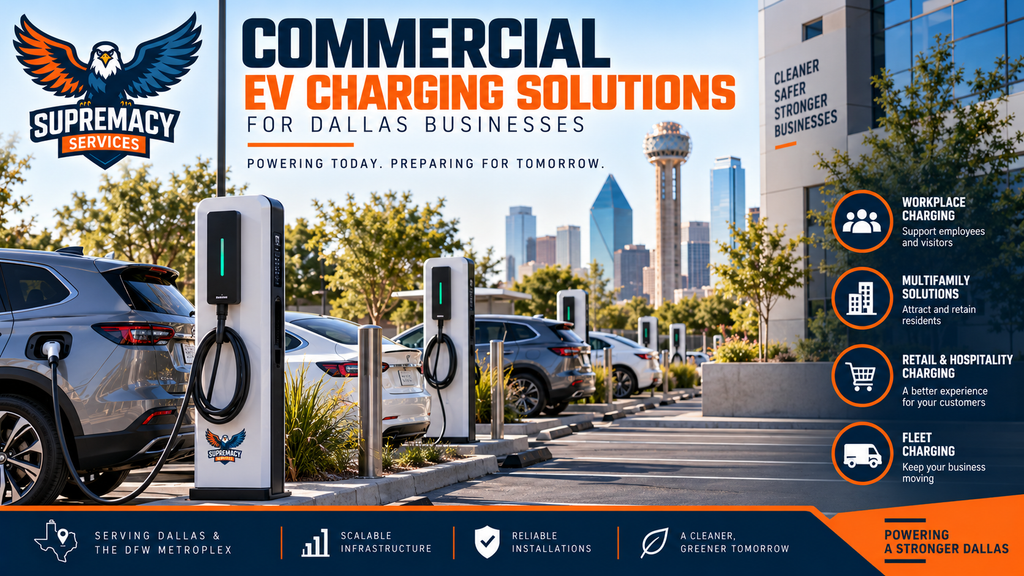
Potential expenses include:
- EVSE hardware
- electrical engineering/design
- dedicated electrical distribution
- switchgear
- panels or subpanels
- conduit and feeders
- trenching
- concrete work
- bollards
- pedestals
- networking
- payment systems
- signage and striping
- permitting and inspections
- utility coordination
- transformer or service upgrades
- commissioning
This is why quoting a commercial project solely from the charger model can be misleading.
Commercial Level 2 vs. DC Fast Charging
Commercial Level 2 charging makes sense where vehicles remain parked for meaningful periods—such as workplaces, hotels, multifamily properties and some retail locations.
DC fast charging serves a different use case. It provides substantially higher charging power but can require much more expensive electrical infrastructure.
| Consideration | Commercial Level 2 | DC Fast Charging |
|---|---|---|
| Typical use | Workplace, apartments, hotels, long-dwell parking | High-turnover/public/fleet charging |
| Electrical demand | Moderate | High to extremely high |
| Infrastructure complexity | Moderate | High |
| Utility involvement | Sometimes limited | Often significant |
| Installation cost | Lower | Substantially higher |
| Network/payment capability | Optional to common | Common |
DOE notes that Level 2 equipment typically operates on 208 V in commercial applications or 240 V in residential applications, while public charging deployments must be planned around the site’s actual use and electrical requirements.
Level 1 vs. Level 2 vs. DC Fast Charging
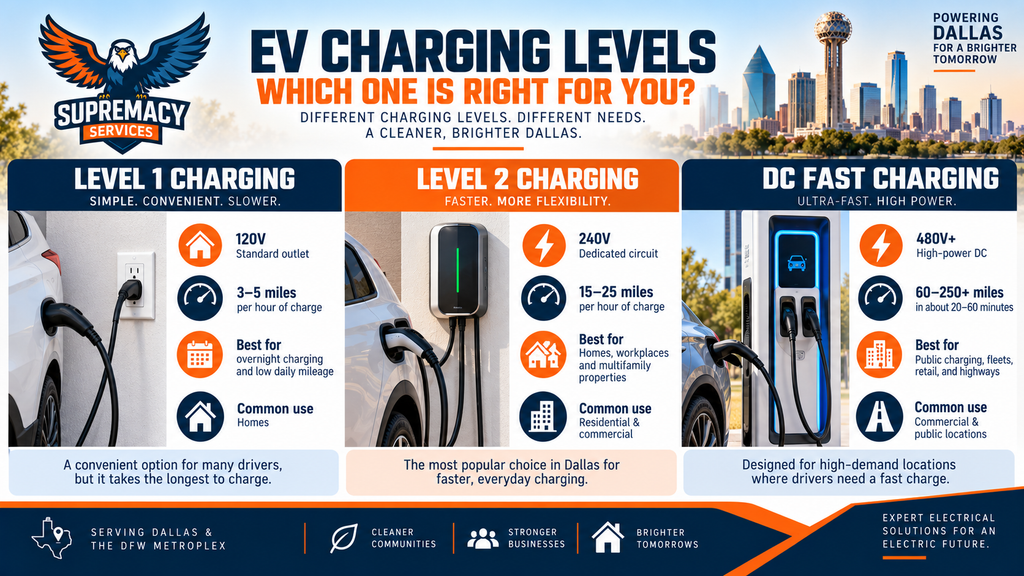
Understanding charger levels prevents homeowners and businesses from paying for more charging infrastructure than they actually need.
Level 1
Level 1 uses 120-volt AC power. It is the slowest charging option and can work for drivers with modest daily mileage and long overnight charging periods.
Level 2
Level 2 typically uses 240 V in homes and 208 V or 240 V in other applications.
DOE describes Level 2 as a common home, workplace and public charging solution. It offers substantially faster charging than Level 1 and is the category most Dallas homeowners will consider when planning a dedicated home charging setup.
DC Fast Charging
DC fast charging is primarily a commercial/public-infrastructure solution rather than a normal residential installation.
It makes the most sense where drivers need to add substantial energy quickly instead of leaving their vehicles parked for hours.
What Affects EV Charger Installation Cost in Dallas?
Seven factors usually have more influence on installation cost than the charger logo on the wall.
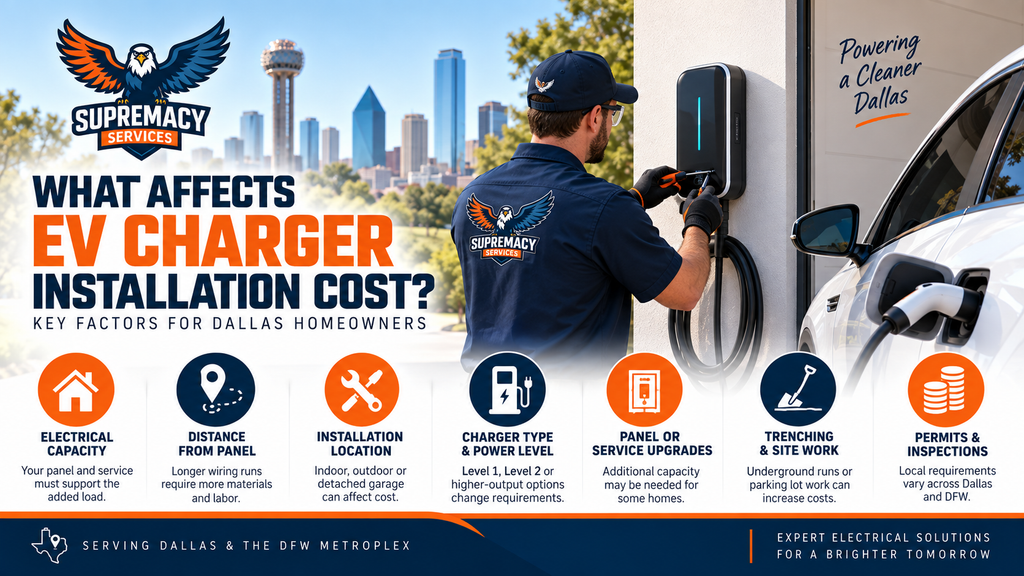
1. Electrical Capacity
Before adding a significant new electrical load, the electrician needs to determine whether the existing electrical system can support it.
DOE specifically recommends having an electrician determine whether the home has adequate capacity for Level 2 charging.
Available breaker space alone does not answer that question. A proper evaluation considers the electrical loads the service is already expected to support.
2. Distance From the Panel
Longer wiring routes require more conductor, conduit and labor.
A charger installed next to the electrical panel can therefore cost substantially less than the same charger installed on the opposite side of a property.
3. Indoor vs. Outdoor Location
Outdoor installations require equipment suitable for the environment.
DOE notes that outdoor residential charging can be safely installed, but outdoor-rated equipment is required.
4. Hardwired vs. Plug-In Installation
Some chargers connect directly to the electrical circuit. Others use an appropriate receptacle.
The correct approach depends on the equipment, charging requirements, location and electrical design.
5. Panel or Service Modifications
If the electrical system cannot support the planned charging load in its existing configuration, additional work may be necessary.
That can turn an otherwise straightforward charger project into a much larger electrical upgrade.
6. Trenching and Site Work
Detached garages, parking lots and chargers far from the building can require underground electrical runs.
For commercial sites, trenching through asphalt or concrete can become a major project expense.
7. Number of Commercial Ports
Commercial projects should be planned as systems.
Installing several chargers at once may allow common infrastructure—such as conduit pathways and electrical distribution—to support multiple ports instead of repeating that work later.
Will You Need an Electrical Panel Upgrade?
Not every EV charger installation requires a panel upgrade.
The correct question is whether the existing electrical service has sufficient capacity for the proposed charger and the property’s other electrical loads.
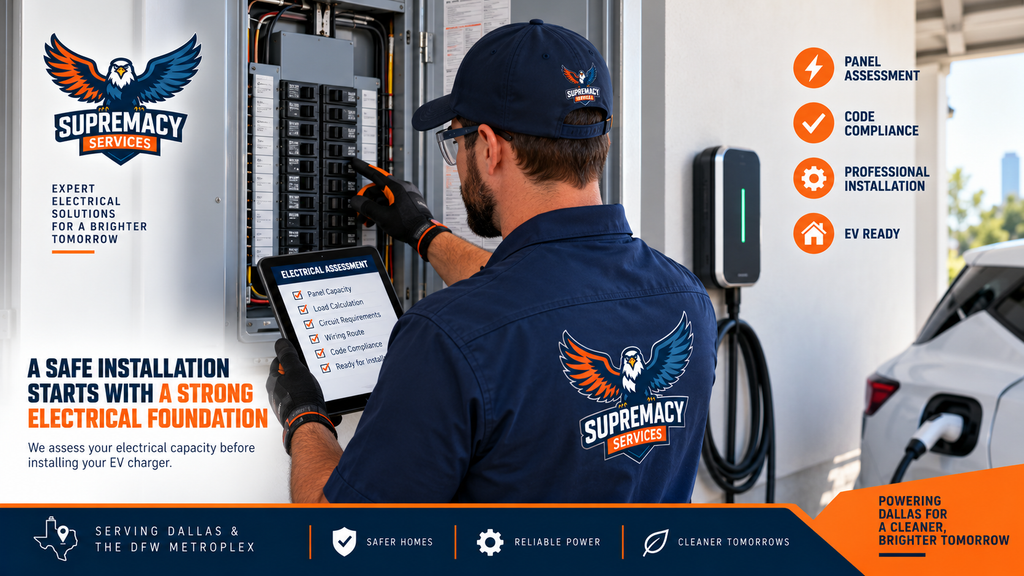
DOE specifically notes that some homes may lack adequate capacity for Level 2 equipment and that qualified electricians can determine the appropriate circuit and capacity requirements.
Potential signs that additional evaluation is particularly important include:
- little or no available panel space;
- plans for a relatively high-powered charger;
- an older electrical system;
- existing high electrical demand;
- other major electric loads being added;
- plans for two or more EVs.
Do not assume that buying an EV automatically means replacing the panel.
A load evaluation should come first.
Hardwired vs. Plug-In EV Chargers
Both approaches can be appropriate depending on the charger and installation.
Plug-In Charger
A plug-in system can provide flexibility because the EVSE can be disconnected from the receptacle.
However, the receptacle and electrical circuit still need to be properly designed for the equipment and applicable requirements.
Hardwired Charger
A hardwired EVSE connects directly to its dedicated electrical supply rather than relying on a plug-and-receptacle connection.
It can provide a clean permanent installation and may be particularly useful for outdoor or higher-output installations, depending on the equipment and design.
The better choice should be based on:
- charger manufacturer’s instructions;
- required charging power;
- installation location;
- circuit design;
- applicable electrical requirements;
- future charging plans.
What Makes Commercial EV Charging More Expensive?
Commercial EV charging introduces costs that homeowners rarely encounter.
Electrical Distribution
A building may need new panels, feeders, switchgear or other infrastructure to serve multiple charging ports.
Civil Work
Parking-lot installations can require trenching, concrete work, pedestals and protective equipment.
Networking
Commercial owners may want:
- user authentication;
- energy monitoring;
- usage reports;
- payment processing;
- remote diagnostics;
- load management.
These features can add equipment and recurring network costs.
Utility Capacity
A larger project can exceed the capacity readily available to the property.
That can introduce utility coordination, service changes or transformer-related work.
Scalability
Businesses should think beyond today’s number of EVs.
Installing pathways and electrical infrastructure with future expansion in mind may avoid reopening finished parking surfaces later.
Accessibility and Site Layout
Public or shared charging requires more than electrical design. Parking layout, equipment protection, pedestrian access and other applicable site requirements can influence the final design.
Permits, Licensing and Electrical Requirements
EV charger installation involves electrical work, so Texas licensing requirements matter.
The Texas Department of Licensing and Regulation states that, with limited exemptions, anyone performing or offering to perform non-exempt electrical work in Texas must be licensed and perform that work through a licensed electrical contractor.
DOE also advises that EV charging installations must comply with applicable state and local codes and that permits may be required by the relevant building authority.
Dallas itself has issued permits for projects specifically described as electric-vehicle charging-station installations, demonstrating that commercial EV charging projects enter the city’s permitting system.
Permit requirements can depend on the project’s exact scope and jurisdiction, so homeowners and businesses elsewhere in DFW should verify requirements with their applicable municipality rather than assuming every city follows an identical process.
Is There Still a Federal EV Charger Tax Credit in 2026?
For a new installation completed now, this is an especially important point.
The federal Alternative Fuel Vehicle Refueling Property Credit under Section 30C terminated for property placed in service after June 30, 2026.
The IRS instructions for Form 8911 explicitly state that the termination date changed and that the credit cannot be claimed for qualifying refueling property placed in service after June 30, 2026.
Because this guide is being prepared after that deadline, Dallas homeowners and businesses should not budget for a new September 2026 project on the assumption that the federal 30C credit will reduce its cost.
Other state, local, utility or manufacturer programs may change over time. Verify any incentive directly with the organization offering it before using it in a project budget.
Can You Install an EV Charger Yourself?
Using a portable charging cord with an existing suitable outlet is different from installing a new dedicated electrical circuit.
Adding new wiring, breakers, receptacles or hardwired EVSE involves electrical work.
Texas requires non-exempt electrical work to be performed under the state’s electrical licensing framework.
A professional installation also allows the electrical system to be evaluated before the charger is connected.
That evaluation matters because the question is not simply whether the charger turns on. The installation needs to be properly matched to the circuit, service capacity, equipment specifications and applicable requirements.
What Should Professional EV Charger Installation Include?
A well-planned residential project generally begins before any charger is mounted.
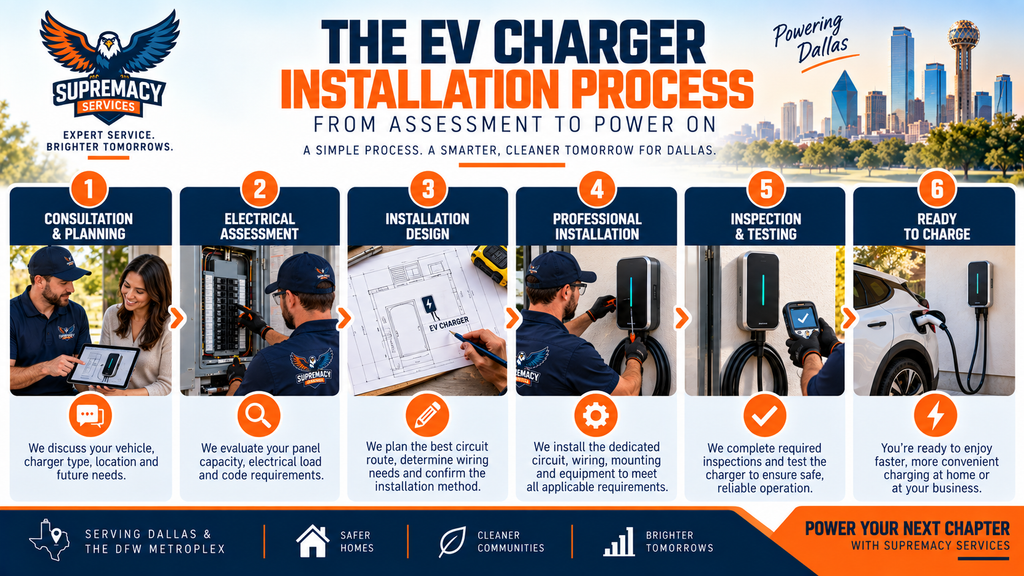
Step 1: Confirm the Vehicle and Charger
Identify:
- vehicle model;
- charging connector;
- EVSE model;
- maximum charging requirements;
- preferred parking location;
- future EV plans.
Step 2: Evaluate Electrical Capacity
The electrician evaluates the service and panel to determine whether the proposed charging load can be accommodated.
Step 3: Plan the Circuit Route
The proposed path from the electrical source to the charger is evaluated.
This is one of the biggest determinants of labor and material cost.
Step 4: Determine Connection Method
The installation is designed around the equipment requirements and whether the EVSE will be hardwired or use an appropriate receptacle.
Step 5: Complete Required Electrical Work
Depending on the project, this can include:
- dedicated circuit;
- breaker;
- conductors;
- conduit;
- mounting;
- equipment connection;
- panel modifications where necessary.
Step 6: Complete Applicable Permitting and Inspection
Requirements vary by jurisdiction and project scope.
Step 7: Test the Charger
The installer should verify operation and confirm that the EVSE communicates and charges as intended.
For smart chargers, this can also include initial app or network configuration.
Dallas/DFW Considerations Before Choosing a Charger
Don’t Buy the Highest-Amperage Charger Automatically
A larger number on the specification sheet does not necessarily make a charger the best choice for your home.
The vehicle’s charging capability, overnight charging window, electrical capacity and future needs all matter.
Think About Garage and Driveway Layout
The charger’s position should allow the cable to reach the vehicle conveniently without creating unnecessary trip hazards or forcing an unnecessarily long electrical run.
Plan for a Second EV
Households expecting another EV should tell the electrician before installation.
Designing around future demand may change charger placement, electrical planning or load-management options.
Commercial Properties Should Plan Around Dwell Time
A Dallas office where cars remain parked for eight hours has different charging requirements from a highway-adjacent retail site where drivers expect short stops.
Selecting the charger level before understanding how long vehicles will normally remain parked can lead to unnecessary infrastructure spending.
How to Get a More Accurate EV Charger Installation Estimate
Before requesting quotes, gather the following information:
- EV make and model;
- charger make and model, if already purchased;
- desired charging location;
- approximate distance from charger to electrical panel;
- photo of the panel and breaker area;
- whether parking is attached or detached from the building;
- whether the charger will be indoors or outdoors;
- whether another EV is expected;
- for businesses, expected number of charging ports;
- for businesses, whether charging will be free, employee-only, fleet-only or paid/public.
A contractor can still require an on-site assessment, but good project information makes it easier to define the correct scope.
Frequently Asked Questions
How much does it cost to install an EV charger at home in Dallas?
Published DFW contractor pricing places many straightforward Level 2 home installations around $800–$2,500, although complex electrical work can push the total higher. Your panel capacity, circuit length, charger and installation location are major variables.
Does an EV charger require 240 volts?
Level 2 residential EV charging normally uses 240-volt service. Level 1 charging uses 120 volts. DOE identifies Level 2 as the common faster home-charging option.
Do I need a new electrical panel for an EV charger?
Not automatically. An electrician should evaluate the existing service capacity and planned charging load first. DOE notes that some homes have adequate capacity while others may require electrical changes.
Is hardwiring an EV charger better than using an outlet?
Neither option is universally better. The correct approach depends on the EVSE, charging power, installation location, manufacturer’s requirements and electrical design.
Can I install an EV charger myself in Texas?
Installing a new EV circuit or hardwired charging equipment constitutes electrical work. Texas generally requires non-exempt electrical work to be performed under its electrical licensing requirements.
How much does a commercial EV charger cost?
Current 2026 market estimates commonly place commercial Level 2 installations at roughly $4,000–$15,000 per port, but infrastructure-heavy projects can exceed that range. DC fast charging is substantially more expensive.
What is the biggest EV charger installation cost factor?
Electrical infrastructure is often the biggest variable. Available capacity, distance from the electrical source, trenching, service upgrades and the number of chargers can change the project substantially.
Is the federal EV charger tax credit still available?
Not for charging property newly placed in service after June 30, 2026. The IRS states that Section 30C terminated after that date.
Can a business install several EV chargers at once?
Yes. Multi-port projects are common for workplaces, multifamily properties, retail sites and fleets. The electrical distribution, parking layout, networking requirements and future expansion plan should be evaluated as one system rather than as unrelated charger installations.
Get an EV Charger Installation Estimate in Dallas
The best EV charger installation is not necessarily the one with the highest charging rate or lowest initial price. It is the system that matches your vehicle, electrical capacity, parking location and future charging needs.
For homeowners, that may mean a straightforward Level 2 circuit and wall-mounted charger.
For a commercial property, it may mean several networked Level 2 stations, load management and infrastructure designed for future expansion.

