
Electrical preventive maintenance is the planned inspection, testing, cleaning and servicing of electrical equipment before deterioration develops into an unexpected failure. For a Dallas commercial building, a good program should cover the electrical service, switchgear, panelboards, breakers, connections, grounding, emergency power equipment and other critical components—not simply check whether the lights turn on.
The goal is straightforward: identify deterioration early, maintain electrical equipment according to its condition and manufacturer requirements, and document problems before they disrupt building operations or create a safety concern.
NFPA 70B specifically addresses electrical equipment maintenance and the development of an electrical maintenance program. Texas also requires people performing non-exempt electrical work to be appropriately licensed, while commercial electrical work in Dallas can trigger local permitting and inspection requirements.
For facility and property managers, the checklist below provides a practical framework for deciding what to monitor internally and what should be assigned to a qualified electrical professional.
Table of Contents
- What Is Electrical Preventive Maintenance?
- Commercial Electrical Preventive Maintenance Checklist
- How Often Should Commercial Electrical Equipment Be Maintained?
- Warning Signs That Need Faster Attention
- Thermal Imaging and Electrical Maintenance
- DIY Checks vs. Professional Electrical Maintenance
- What Professional Preventive Maintenance Includes
- Dallas and DFW Considerations
- Building an Electrical Maintenance Record
- Frequently Asked Questions
What Is Electrical Preventive Maintenance?
Electrical preventive maintenance is a structured program for inspecting, testing and maintaining electrical equipment before faults or deterioration cause an unexpected problem.
It is different from waiting for a breaker to trip repeatedly, equipment to stop operating or a panel to show obvious damage.
NFPA identifies NFPA 70B as its standard covering electrical equipment maintenance and explains that preventive maintenance can help prevent equipment failures while establishing an appropriate condition of maintenance.
A commercial electrical maintenance program can involve:
- visual inspections;
- equipment condition assessments;
- cleaning where appropriate;
- electrical testing;
- checking equipment against manufacturer instructions;
- identifying loose, damaged or deteriorated components;
- thermographic inspections where appropriate;
- verifying protective equipment and breakers;
- documenting deficiencies and corrective work;
- establishing future maintenance intervals.
The exact work and frequency should be based on the equipment, its condition, operating environment, criticality, manufacturer instructions and applicable standards rather than applying one arbitrary schedule to every component.
Preventive Maintenance vs. Electrical Repair
| Preventive maintenance | Reactive electrical repair |
|---|---|
| Performed before a known failure | Performed after a problem develops |
| Planned around building operations | Often unplanned |
| Evaluates equipment condition | Addresses an existing fault |
| Helps identify developing problems | Restores or repairs affected equipment |
| Creates maintenance history | Often addresses one immediate incident |
Both are necessary. Preventive maintenance does not guarantee that equipment will never fail, but it gives building managers a systematic way to identify and correct deterioration.
Commercial Electrical Preventive Maintenance Checklist
A comprehensive commercial electrical preventive maintenance checklist should cover the complete electrical distribution system rather than concentrating only on the main panel.

1. Review Previous Electrical Records
Start with documentation.
Review:
- previous inspection reports;
- electrical drawings and one-line diagrams;
- equipment inventories;
- maintenance records;
- previous thermal imaging reports;
- recurring breaker trips;
- outage history;
- previous repairs;
- equipment replacements or additions;
- known electrical deficiencies.
Maintenance records help an electrician understand whether a condition is new, recurring or progressively worsening.
They are particularly valuable in facilities where equipment or tenant loads have changed over time.
2. Inspect the Electrical Service and Main Distribution Equipment
The main electrical service is one of the most important points in the building’s distribution system.
A professional assessment may examine the condition of:
- service equipment;
- main disconnects;
- switchboards;
- switchgear;
- panelboards;
- enclosures;
- accessible connections;
- breakers and protective devices;
- grounding and bonding components.
Look for evidence of deterioration such as physical damage, contamination, corrosion, unusual heat or other abnormal conditions.
Electrical cabinets should remain properly secured and unobstructed.
3. Check Electrical Panels and Panelboards
Panelboards distribute power throughout the property and deserve regular attention.
A maintenance assessment can look for:
- damaged panel covers;
- missing enclosure components;
- signs of excessive heat;
- damaged breakers;
- contamination or moisture;
- corrosion;
- improper or unclear circuit identification;
- evidence of previous modifications;
- recurring breaker problems;
- conditions requiring further testing.
The City of Dallas’ electrical guidance specifically identifies damaged service panels, subpanels, breakers, panelboard covers and exposed wiring among conditions that can require repair.
Do not remove panel covers or attempt energized troubleshooting unless you are qualified and authorized to perform that work.
4. Investigate Repeatedly Tripping Circuit Breakers
A circuit breaker that trips once because of an identifiable temporary condition is different from a breaker that repeatedly opens during normal operations.
Repeated tripping can indicate that the circuit needs professional evaluation.
Possible causes include:
- excessive load;
- a downstream electrical fault;
- damaged wiring;
- equipment problems;
- incorrect modifications;
- problems involving the breaker itself.
Do not repeatedly reset a breaker without understanding why it is operating.
If a breaker continues to trip, document which equipment was operating at the time and arrange for troubleshooting.
5. Examine Wiring, Raceways and Electrical Enclosures
Accessible electrical infrastructure should be visually reviewed for deterioration.
Items can include:
- conduits and raceways;
- junction boxes;
- wiring enclosures;
- flexible connections;
- equipment feeds;
- exposed cable systems;
- fittings;
- covers and supports.
Report damaged conduit, open enclosures, exposed wiring, impact damage, corrosion or other unusual conditions.
Changes made during renovations and tenant improvements should also be reviewed when they affect the existing electrical distribution system.
6. Inspect Receptacles, Switches and Other Wiring Devices
Commercial receptacles and switches can receive considerably different use depending on the facility.
Visually check accessible devices for:
- cracked or broken covers;
- loose devices;
- discoloration;
- physical damage;
- unusual warmth;
- damaged cords or plugs;
- signs of arcing or overheating.
A damaged receptacle should not simply remain in service until the next scheduled maintenance visit.
7. Check for Abnormal Heat
Excessive temperature can be an important indication that electrical equipment requires further investigation.
Abnormal heating can be associated with several conditions, so temperature alone does not diagnose the cause.
A qualified electrician may use inspection, measurements and—in appropriate circumstances—infrared thermography to identify components that warrant further investigation.
8. Inspect Grounding and Bonding Components
Grounding and bonding form an important part of an electrical installation’s safety infrastructure.
Professional maintenance should evaluate applicable grounding and bonding components for damage, deterioration or other conditions requiring correction.
Because determining compliance and performing electrical tests requires technical knowledge, this is not a visual DIY inspection substitute.
9. Review Surge Protection and Sensitive Equipment
Commercial properties increasingly depend on controls, communications systems, computers, security equipment and electronic building systems.
Where surge protective devices are installed, include their condition or status indicators in the maintenance program according to manufacturer instructions.
Facility managers should also identify which business systems would be most affected by a power-quality event or outage.
10. Inspect Transformers and Distribution Equipment
Facilities with transformers or larger distribution equipment require equipment-specific maintenance.
Depending on the installation, professionals may inspect for:
- physical deterioration;
- contamination;
- abnormal operating conditions;
- evidence of overheating;
- ventilation problems;
- unusual noise;
- signs of moisture or corrosion;
- equipment-specific conditions identified by the manufacturer.
Maintenance procedures should follow the equipment manufacturer’s instructions and applicable standards.
11. Review Emergency and Backup Power Systems
If your property depends on a standby generator, UPS or other emergency/backup electrical equipment, include it in the maintenance plan.
A facility should understand:
- what equipment receives backup power;
- whether system testing is documented;
- the condition of associated electrical equipment;
- whether maintenance requirements are current;
- whether changes to the building have altered critical loads.
A backup system that has been installed but not maintained should not automatically be assumed to perform as expected during an outage.
12. Check Electrical Rooms and Equipment Access
Electrical equipment must remain accessible for inspection and service.
During routine facility walkthroughs, check that electrical areas have not gradually become storage spaces and that panels, disconnects and other equipment are not obstructed.
Also watch for water intrusion, excessive dust, physical damage or other environmental conditions around electrical equipment.
13. Review New Loads and Building Changes
One of the easiest maintenance issues to overlook is load growth.
Commercial buildings change.
A facility may add:
- HVAC equipment;
- commercial kitchen equipment;
- EV charging;
- servers;
- manufacturing equipment;
- tenant equipment;
- additional refrigeration;
- pumps;
- lighting;
- office equipment.
If electrical demand or the way the building is used has changed substantially, the existing distribution system may deserve reevaluation.
An electrical professional can determine whether further load calculations, circuit modifications, panel work or service changes are appropriate.
How Often Should Commercial Electrical Equipment Be Maintained?
There is no single maintenance interval that is appropriate for every piece of electrical equipment in every commercial building.
NFPA 70B uses equipment condition, equipment type and maintenance requirements to establish appropriate activities and intervals. Manufacturer instructions can also be important.
A practical maintenance plan should therefore consider:
| Factor | Why it matters |
|---|---|
| Equipment type | Different components require different maintenance procedures |
| Equipment condition | Deteriorated equipment may need more attention |
| Manufacturer requirements | Equipment-specific procedures and intervals may apply |
| Operating environment | Moisture, contamination, heat and other conditions can affect equipment |
| Equipment criticality | Failure of some equipment can have much greater operational consequences |
| Previous problems | Recurring faults can justify additional investigation |
| Facility changes | Added electrical loads can change system demands |
Rather than telling staff to “inspect everything annually,” create an equipment-specific electrical maintenance program.
The program can establish routine facility observations while assigning technical inspections and testing to qualified professionals at appropriate intervals.
Warning Signs That Need Faster Attention
Preventive maintenance should not become an excuse to wait for the next scheduled visit when a problem is already developing.
Request professional electrical troubleshooting when you observe conditions such as:
- repeated breaker trips;
- burning or unusual electrical odors;
- visible scorching or discoloration;
- damaged electrical equipment;
- crackling, buzzing or other unusual sounds;
- unusual heat at electrical equipment;
- loose or damaged receptacles;
- exposed wiring;
- signs of moisture inside or around electrical equipment;
- intermittent loss of power;
- recurring equipment shutdowns;
- unexplained electrical problems affecting the same area.
Some of these symptoms can have causes outside the electrical distribution system, which is why diagnosis matters.
For example, equipment that repeatedly shuts down could have an internal equipment fault rather than a building-wiring problem. A professional diagnosis should determine the source before repairs are recommended.
Thermal Imaging and Electrical Maintenance
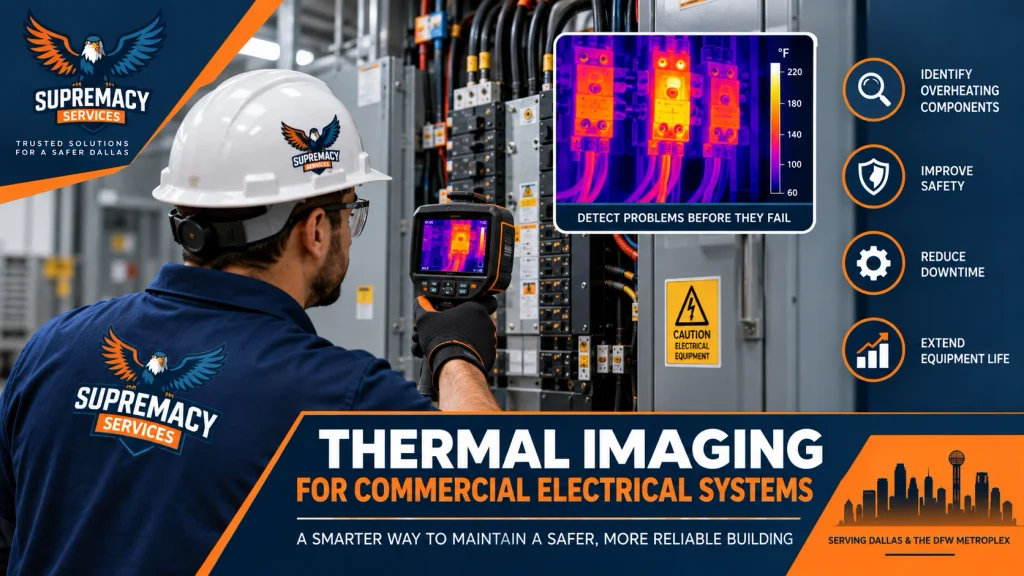
Infrared thermography can help identify temperature differences in electrical equipment that warrant further investigation, but it is not a stand-alone diagnosis.
A thermographic inspection can be useful because some developing electrical conditions produce abnormal heating before obvious physical damage becomes visible.
However, a thermal image needs context.
The electrician must consider factors such as:
- equipment load;
- comparison between similar components;
- operating conditions;
- equipment design;
- ambient conditions;
- other inspection or testing results.
A “hot spot” is therefore a reason for qualified evaluation—not automatically proof that a particular component must be replaced.
For Dallas commercial properties with important distribution equipment, incorporating appropriate thermal inspections into a broader maintenance program can provide another layer of condition monitoring.
DIY Checks vs. Professional Electrical Maintenance
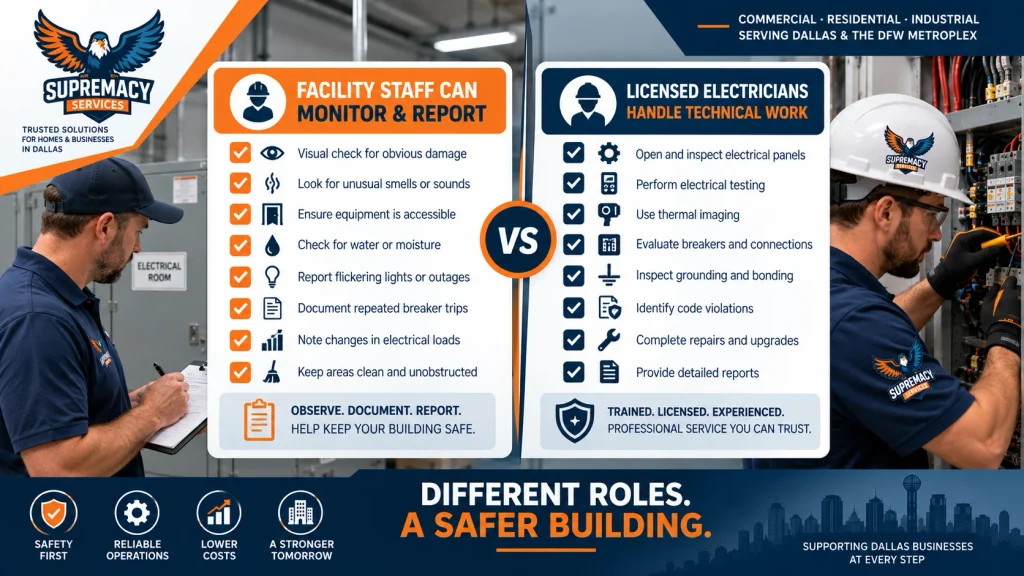
Facility staff can play an important role in preventive maintenance, but there is a clear difference between observing equipment and performing electrical work.
Building Staff Can Typically Monitor
Without opening electrical equipment or exposing themselves to electrical hazards, trained facility personnel can document:
- unusual smells or sounds;
- visible external damage;
- blocked electrical equipment;
- water near electrical equipment;
- recurring breaker incidents;
- lighting or equipment abnormalities;
- changes in building loads;
- dates and locations of electrical problems.
Leave Electrical Work to Qualified Professionals
Tasks involving opening equipment, electrical testing, internal component inspection, repairs, alterations or other electrical work should be handled by appropriately qualified and licensed personnel.
Texas Department of Licensing and Regulation states that people performing non-exempt electrical work in Texas must be licensed and perform that work through a licensed electrical contractor.
Commercial building managers should treat the checklist as a management and maintenance-planning tool, not as instructions for unqualified staff to work inside energized equipment.
What Does Professional Electrical Preventive Maintenance Include?
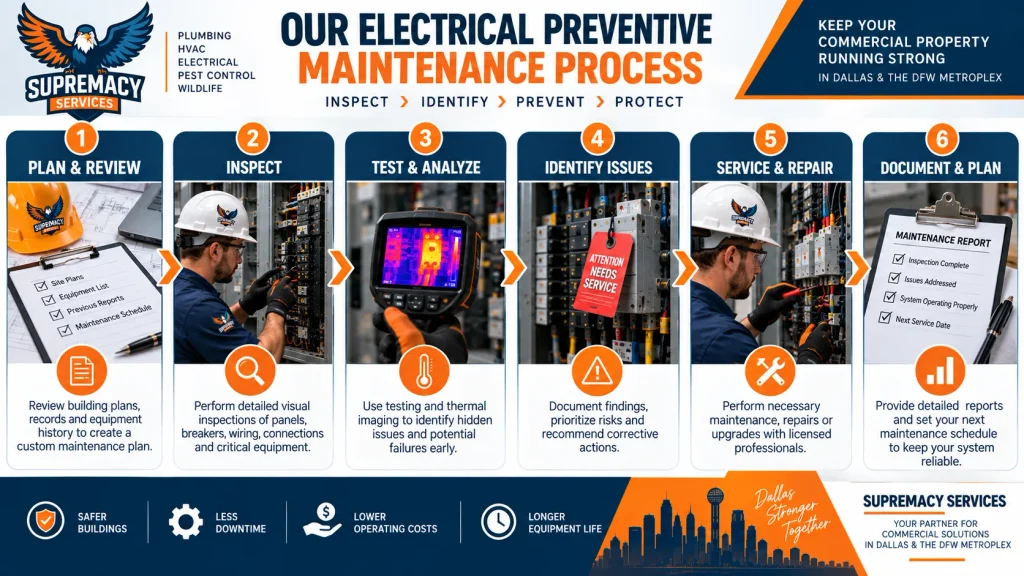
The exact scope depends on the facility, but a professional maintenance visit generally begins by understanding the building’s equipment, condition, history and operational priorities.
A commercial electrical contractor may:
- review available electrical documentation;
- identify equipment included in the maintenance scope;
- perform visual condition assessments;
- evaluate reported electrical problems;
- perform appropriate testing or measurements;
- use thermal imaging where appropriate;
- identify damaged or deteriorated equipment;
- document deficiencies;
- prioritize recommended corrective work;
- update maintenance records and future service recommendations.
A large industrial facility will not require the same program as a small Dallas office building. The maintenance scope should reflect the actual electrical infrastructure.
If your property has recurring electrical problems, aging distribution equipment or no documented maintenance program, Supremacy Services’ commercial electrical team can evaluate the system and help determine which components require immediate attention and which should be incorporated into an ongoing maintenance plan.
Dallas and DFW Considerations
Dallas commercial buildings should be maintained according to both applicable Texas requirements and the requirements of the local jurisdiction where the property is located.
Texas Electrical Licensing
Texas Department of Licensing and Regulation states that people performing non-exempt electrical work must be licensed. Electrical contractors are separately regulated, and an electrical contractor must employ a licensed Master Electrician of Record.
That matters when a maintenance inspection identifies something that moves from observation into repair, alteration or installation.
Dallas Electrical Permits and Inspections
Routine observation and maintenance planning should not be confused with construction or alteration work.
The City of Dallas maintains a commercial electrical permitting and inspection process. Its commercial electrical permit materials state that electrical work on commercial property requires a registered electrical contractor and a permit.
The scope of corrective work therefore matters.
A maintenance visit may identify a problem, but repairing or modifying the system can create separate permitting, inspection and documentation requirements.
Properties outside Dallas proper should verify requirements with their own authority having jurisdiction because DFW municipalities can have different administrative procedures.
Heat, Mechanical Loads and Building Operations
Dallas facilities often rely heavily on air-conditioning and mechanical equipment during hot weather.
For electrical maintenance purposes, the important point is not to assume that every HVAC shutdown is an HVAC-only problem.
Repeated breaker operation, damaged disconnects, supply problems or distribution-system issues can sometimes produce symptoms that appear to be mechanical failures.
Coordinated troubleshooting can prevent unnecessary component replacement and help identify where the fault actually originates.
Building and Electrical Maintenance Record
A preventive maintenance program becomes much more useful when inspections are documented consistently.
Consider maintaining a record containing:
| Record | What to document |
|---|---|
| Equipment inventory | Equipment ID, type and location |
| Inspection date | When the equipment was evaluated |
| Condition | Normal, monitor, investigate or corrective action required |
| Observations | Damage, heat, contamination, recurring problems, etc. |
| Testing | Tests performed and results where applicable |
| Corrective action | Repair or replacement completed |
| Technician | Person/company performing technical work |
| Next action | Follow-up requirement or future maintenance date |
Photos, thermal images, test reports and repair documentation can be retained with the corresponding equipment record.
Over time, this creates a maintenance history rather than a collection of unrelated service calls.
A Simple Facility-Manager Checklist
During routine building walkthroughs, facility managers can use this simplified list:
- Electrical rooms and panels remain accessible.
- No visible water intrusion is present around electrical equipment.
- No obvious physical damage is visible.
- No unusual electrical odors have been reported.
- No unexplained buzzing, crackling or abnormal sounds are present.
- Repeated breaker trips are documented and investigated.
- Damaged receptacles and switches are reported.
- Recent equipment additions have been documented.
- Backup-power maintenance records are current.
- Previous electrical deficiencies have been corrected or scheduled.
- Professional inspection/testing dates are documented.
- Electrical drawings and equipment records are kept current where practical.
This is an observation checklist, not authorization to open, test or repair electrical equipment.
When Should You Schedule Professional Electrical Maintenance?
Consider arranging a professional assessment when:
- the property has no established electrical maintenance program;
- electrical documentation is incomplete or outdated;
- breakers trip repeatedly;
- equipment shows physical deterioration;
- abnormal heat or odors are observed;
- tenants report recurring electrical problems;
- major electrical loads have recently been added;
- the building is preparing for renovations or tenant improvements;
- previous inspections identified unresolved deficiencies;
- critical operations depend on aging electrical distribution equipment.
The best time to discover a developing electrical problem is generally before it becomes an unplanned interruption.
For facilities where shutdowns would significantly affect customers, tenants or operations, planned maintenance also allows electrical work to be coordinated around operational requirements.
Create a Preventive Maintenance Plan for Your Dallas Commercial Property
An effective commercial electrical maintenance program is not simply an annual look at the breaker panel.
It should identify the building’s important electrical assets, establish equipment-appropriate maintenance requirements, document developing problems and create a clear process for corrective work.
Start with the building’s electrical records and equipment inventory. Document obvious concerns. Then have qualified professionals evaluate the portions of the system that require technical inspection, testing or repair.
For Dallas and DFW property managers who need commercial electrical diagnostics, preventive assessments, panel evaluations or corrective electrical work, Supremacy Services can evaluate the facility’s electrical infrastructure and help establish practical next steps based on the building’s actual condition and operating requirements.
Frequently Asked Questions
What is included in commercial electrical preventive maintenance?
Commercial electrical preventive maintenance can include condition inspections, electrical testing, equipment cleaning where appropriate, breaker and panel assessments, thermographic inspection, grounding and bonding evaluation, documentation and corrective-maintenance recommendations. The exact work depends on the equipment and facility.
How often should a commercial building have electrical maintenance?
There is no universal interval for every electrical component. Maintenance frequency should consider equipment type, condition, manufacturer instructions, operating environment, previous maintenance and applicable standards such as NFPA 70B.
What is NFPA 70B?
NFPA 70B is the Standard for Electrical Equipment Maintenance. It addresses preventive maintenance for electrical, electronic and communications equipment and systems and provides a framework for electrical maintenance programs.
Can building maintenance staff inspect electrical panels?
Staff can report externally visible problems without opening equipment or exposing themselves to electrical hazards. Internal inspections, testing and electrical work should be assigned to appropriately qualified personnel.
Is thermal imaging useful for commercial electrical panels?
It can be. Infrared thermography can identify temperature differences that warrant further investigation. It should be interpreted by qualified personnel and used as part of a broader condition assessment rather than as a stand-alone diagnosis.
Why does a commercial circuit breaker keep tripping?
Possible causes include excessive load, downstream faults, damaged equipment, wiring problems or problems involving the protective device itself. Repeated tripping should be professionally diagnosed rather than repeatedly resetting the breaker.
Does electrical maintenance require a permit in Dallas?
An inspection or maintenance review does not automatically mean a permit is required. However, the City of Dallas states that electrical work on commercial property requires a registered electrical contractor and a permit. The contractor should determine permit requirements based on the corrective work being performed.
Should electrical maintenance include backup generators and UPS equipment?
If these systems support building operations, they should be incorporated into the overall maintenance program according to their equipment-specific requirements and manufacturer instructions.
What should a commercial property manager do before an electrical inspection?
Gather available one-line diagrams, equipment records, previous inspection reports, outage history, thermal reports, repair records and a list of recurring problems. Also identify recent renovations and newly added electrical loads.
When should a Dallas commercial property call an electrician instead of waiting for scheduled maintenance?
Do not wait for a routine maintenance date when there is repeated breaker tripping, damaged equipment, unusual heat, electrical odors, visible scorching, exposed wiring, moisture intrusion or recurring power problems. Those conditions warrant timely professional evaluation.

