

Commercial electrical maintenance in Dallas can range from a relatively small service call or focused inspection to several thousand dollars for a comprehensive facility assessment and preventive-maintenance program. The actual price depends much more on the building, equipment, testing requirements and scope of work than on a single standard “maintenance fee.”
For context, one current DFW commercial electrical contractor publishes time-and-material labor rates of approximately $125–$165 per hour for journeyman electrical work and $165–$215 per hour for master-electrician work, with higher charges for after-hours or emergency service. Another Texas commercial contractor publishes inspection planning ranges of roughly $300–$600 for small commercial spaces, $600–$1,200 for medium facilities and $1,200–$3,000+ for larger comprehensive assessments. These are third-party market examples—not Supremacy Services prices or guaranteed Dallas rates—and should only be used as preliminary budgeting references.
The most reliable way to budget is therefore to define the scope first: building size, number and type of panels, switchgear, transformers, critical loads, testing requirements, access conditions and whether repairs are included.
Need a facility-specific estimate? Request a commercial electrical assessment from Supremacy Services to determine the maintenance scope for your Dallas/DFW property
Commercial Electrical Maintenance Cost Breakdown
There is no universal Dallas price schedule for preventive electrical maintenance. A small office with a few panels presents a very different maintenance workload from a warehouse, restaurant, medical facility or multi-building commercial property.
A useful way to think about cost is by scope, rather than trying to price maintenance by square footage alone.
| Maintenance scope | Typical work involved | Main cost drivers |
|---|---|---|
| Focused service visit | Troubleshooting, visual checks, limited testing | Labor time, problem complexity |
| Basic electrical inspection | Panels, breakers, visible wiring, service equipment | Number of panels and circuits |
| Thermal inspection | Infrared evaluation of energized equipment where appropriate | Number of assets, access, reporting |
| Preventive maintenance visit | Inspection, testing, cleaning/service where applicable, documentation | Equipment quantity and maintenance requirements |
| Large facility assessment | Multiple panels, switchgear, transformers, distribution equipment | Facility size and system complexity |
| Ongoing maintenance program | Scheduled inspections, testing, records and follow-up | Frequency, equipment inventory and scope |
| Corrective electrical work | Repairs or replacement discovered during maintenance | Parts, labor, permits and shutdown requirements |
The distinction matters because an inexpensive inspection is not automatically equivalent to a complete electrical preventive-maintenance program.
A practical 2026 budgeting approach
Instead of asking only, “What does electrical maintenance cost per year?” commercial property managers should ask contractors to identify:
- equipment covered;
- inspection and testing procedures;
- required shutdowns;
- thermal-imaging scope;
- documentation included;
- excluded repairs;
- service frequency;
- after-hours requirements;
- permit requirements for corrective work; and
- how deficiencies will be prioritized.
That produces quotes that are much easier to compare.
What Affects Commercial Electrical Maintenance Cost?
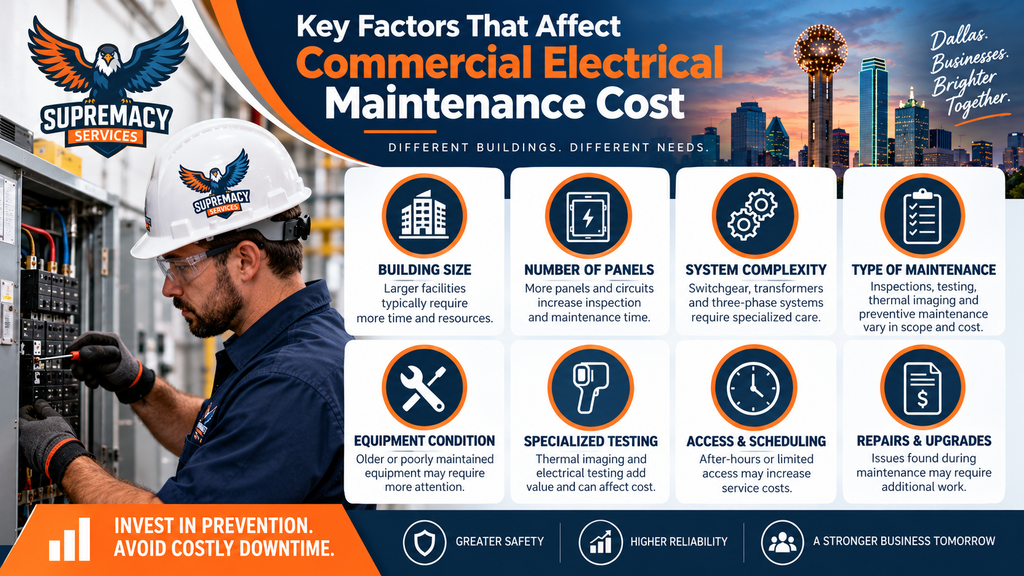
1. Building size
Larger facilities generally contain more electrical assets and require more technician time. Square footage is useful for initial planning, but equipment count is often more informative.
A compact restaurant, for example, may contain substantial electrical loads despite occupying less space than a lightly equipped office.
2. Number of electrical panels
Every panel adds breakers, connections, labeling and components that may require inspection.
A property with one main panel and two subpanels will usually require less field time than a complex facility with multiple distribution panels throughout several floors or buildings.
3. Switchgear and distribution complexity
Facilities containing switchboards, transformers, motor-control equipment, disconnects, three-phase systems and other distribution equipment require a broader maintenance scope.
4. Equipment condition and maintenance history
A well-documented electrical system that has been consistently maintained is different from one with missing records, damaged equipment, unexplained modifications or overdue maintenance.
NFPA 70B’s equipment-maintenance framework specifically considers equipment condition and maintenance history when evaluating maintenance needs.
5. Infrared thermography and specialized testing

Thermal imaging can help identify abnormal heating patterns that deserve further investigation.
However, thermography should not be treated as a substitute for the rest of an electrical maintenance program. Depending on the facility, contractors may also recommend electrical measurements or equipment-specific testing.
6. Access and shutdown requirements
Some work can be performed during normal operating hours. Other procedures may require de-energization, coordination with tenants or equipment operators, or work outside normal business hours.
A facility that can only be serviced overnight or during a narrow shutdown window may therefore cost more to maintain.
7. Repairs discovered during maintenance
Preventive maintenance and corrective repairs should be separated clearly in proposals.
A maintenance visit may identify damaged breakers, deteriorated components, overheating, loose or compromised connections, damaged enclosures or other deficiencies. Correcting those conditions adds parts and labor beyond the original inspection scope.
8. Documentation requirements
Multi-site businesses, property-management companies and facilities with formal maintenance programs may require equipment inventories, photographs, deficiency reports, test results and repair histories.
The additional documentation takes time but can make future maintenance considerably more organized.
What Does Commercial Electrical Maintenance Include?
A commercial electrical maintenance program evaluates the condition of the electrical distribution system and establishes appropriate inspection, testing, servicing and documentation procedures for the equipment involved.
NFPA describes NFPA 70B as a standard covering preventive maintenance for electrical, electronic and communications systems and equipment and as a framework for developing an effective Electrical Maintenance Program.
Depending on the property and scope, professional maintenance may address:
Service and distribution equipment
Electricians may evaluate service equipment, switchboards, disconnects, distribution panels and associated components for visible damage, deterioration, contamination, abnormal conditions and other deficiencies.
Panels and circuit breakers
Maintenance may include examination of panel condition, breaker condition, labeling, evidence of excessive heat and signs of previous modifications.
Wiring and raceways
Accessible wiring methods, conduits, raceways and connections can be checked for physical damage or other observable concerns.
Grounding and bonding
Grounding and bonding are fundamental parts of the electrical system and should be included where appropriate in the maintenance scope.
Thermal imaging
Infrared inspections can be useful for identifying abnormal heat patterns while appropriate equipment is operating.
Any thermal anomaly should then be evaluated rather than assuming that the image alone identifies the exact failure.
Emergency and backup power
Facilities relying on generators, automatic transfer equipment, UPS systems or other emergency-power infrastructure should coordinate maintenance of those systems with the broader electrical maintenance program.
Documentation
Professional maintenance should leave the facility manager with actionable information—not simply a statement that the inspection was completed.
Useful documentation may identify:
- equipment inspected;
- observed deficiencies;
- test findings;
- photographs where useful;
- repair priorities;
- recommended follow-up work; and
- maintenance history.
Why Preventive Electrical Maintenance Matters
Preventive maintenance is intended to identify developing problems before they become larger operational or safety issues.
NFPA’s “Electrical Cycle of Safety” distinguishes proper installation under NFPA 70 from maintenance under NFPA 70B and workplace electrical safety under NFPA 70E. NFPA states that appropriate electrical equipment maintenance can help prevent equipment failures and contribute to worker safety and system reliability.
For a Dallas business, that matters for several practical reasons.
Reduce unexpected electrical failures
Loose, deteriorating, overheated or damaged electrical components do not always produce obvious symptoms before failure.
Routine inspection and condition-based maintenance give facility teams an opportunity to identify deficiencies earlier.
Protect business operations
An electrical failure can affect lighting, computers, refrigeration, commercial HVAC, production equipment, security systems and other critical loads.
For businesses where downtime has a significant operational impact, electrical maintenance becomes part of continuity planning rather than simply a repair expense.
Build a maintenance history
Documented maintenance helps property managers understand recurring problems and track whether equipment condition is changing over time.
Plan capital improvements
Maintenance findings can help distinguish equipment that needs immediate attention from equipment that can be monitored or incorporated into a longer-term capital plan.
If your Dallas commercial property does not have a documented electrical maintenance plan, Supremacy Services can evaluate the system and identify an appropriate inspection and maintenance scope.
Warning Signs Your Building Needs Electrical Service
Certain symptoms justify professional evaluation rather than waiting for the next routine maintenance visit.
Repeated breaker trips
One isolated breaker trip may have an identifiable cause. Repeated trips can indicate an overloaded circuit, equipment problem, wiring issue or another condition requiring diagnosis.
Burning odor or visible heat damage
Burning smells, melted components, scorching or smoke around electrical equipment require prompt attention.
Buzzing, crackling or unusual electrical sounds
Unexpected noise from panels, switchgear or other electrical equipment should not be ignored.
Flickering or unstable lighting
Flickering can originate from a fixture or lamp, but widespread or recurring voltage-related symptoms deserve professional diagnosis.
Hot electrical equipment
Unexpected heat at panels, breakers, disconnects or other equipment can indicate a problem that needs investigation.
Corrosion, moisture or contamination
Electrical enclosures and equipment affected by moisture, corrosion, dust or other contaminants may require inspection and corrective action.
Frequent electrical repairs
Repeated failures can indicate that the underlying distribution system, load profile or equipment condition needs a broader assessment.
Recent building changes
Tenant improvements, new HVAC systems, commercial kitchen equipment, manufacturing machinery, EV charging, server infrastructure or other significant load changes are good reasons to review electrical capacity and distribution.
Maintenance vs. Inspection vs. Repair
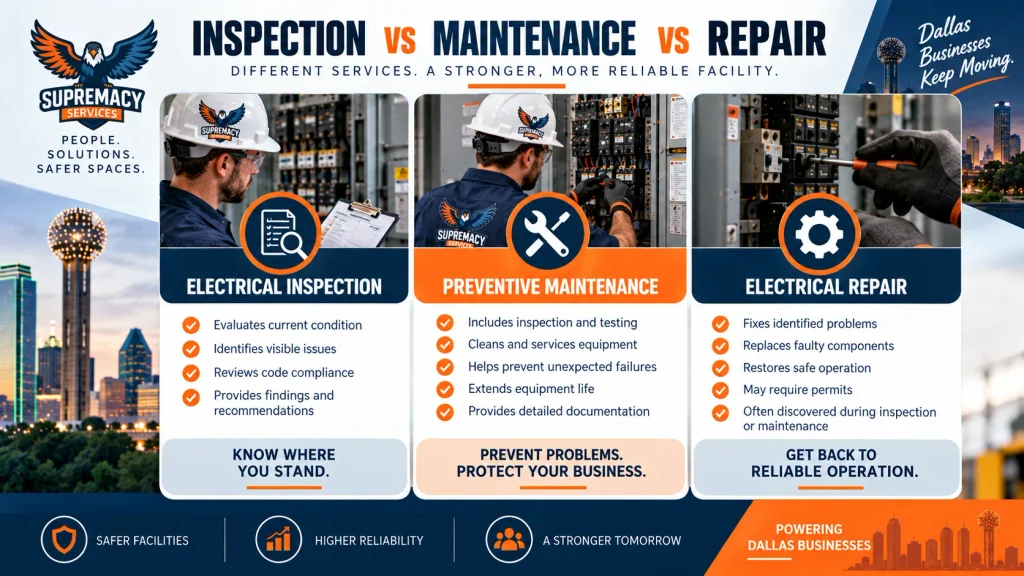
These terms should not be treated as interchangeable.
| Service | Primary purpose | Typical outcome |
|---|---|---|
| Electrical inspection | Evaluate condition | Findings and recommendations |
| Preventive maintenance | Preserve equipment condition and reliability | Inspection, servicing/testing and records |
| Electrical diagnostics | Find the cause of a specific problem | Identified fault or likely cause |
| Electrical repair | Correct a known deficiency | Repaired/replaced component |
| Electrical upgrade | Increase capacity or modernize equipment | Modified electrical system |
A facility can therefore pass through several stages: an inspection identifies a deficiency, diagnostics determine the underlying problem, and corrective work resolves it.
Preventive maintenance attempts to reduce the likelihood that the first sign of trouble is an unexpected failure.
How Often Should Commercial Electrical Systems Be Maintained?
There is no responsible one-size-fits-all interval for every component in every commercial building.
Maintenance frequency should reflect the equipment involved, manufacturer information, operating environment, equipment condition, duty cycle, previous maintenance results and the facility’s electrical maintenance program.
NFPA 70B uses equipment condition and maintenance history as part of its maintenance framework rather than assuming every asset belongs on one universal schedule.
A Dallas office, industrial facility, restaurant and data-intensive operation can therefore require very different schedules.
Maintenance may need to be reviewed sooner when:
- the building has experienced electrical failures;
- maintenance cycles have been missed;
- equipment operates in harsh conditions;
- previous testing identified developing problems;
- loads have changed substantially;
- renovations or tenant improvements have occurred;
- equipment has been added;
- there are signs of heat or deterioration; or
- critical operations depend on the equipment.
The better approach is to create an equipment inventory and determine maintenance requirements asset by asset.
Dallas and Texas Requirements
Commercial property owners should distinguish maintenance from electrical work that alters or repairs the installation.
Texas requires people performing non-exempt electrical work to be appropriately licensed and to perform that work through a licensed electrical contractor. TDLR defines electrical work broadly enough to include installing, maintaining or extending electrical wiring systems and associated equipment.
Electrical contractors in Texas must also meet state licensing requirements, including having a Master Electrician of Record and required liability insurance.
Dallas electrical code
The City of Dallas maintains its own electrical inspection and permitting process. Its electrical section identifies the 2023 National Electrical Code as the adopted NEC edition and provides resources for contractor registration, inspections and Dallas electrical requirements.
Because maintenance findings sometimes lead to repairs or alterations, a commercial contractor should determine whether the corrective work requires permits or municipal inspection.
The City maintains a specific Commercial Electrical Permit category with inspections including electrical final, service and several rough electrical inspections depending on the work performed.
Permit fees should not be guessed into a maintenance estimate. Dallas maintains a current fee guide and fee-estimation resources, and the applicable cost depends on the project.
Dallas/DFW Factors That Can Affect Electrical Maintenance
The most useful local considerations are related to building operations and electrical loads rather than inserting “Dallas” repeatedly into otherwise generic advice.
Heavy cooling demand
Commercial HVAC can represent a major electrical load during North Texas cooling season. Facilities should pay attention to electrical distribution serving rooftop units, chillers, VRF/VRV equipment and other cooling systems.
Severe weather and power interruptions
Businesses relying on emergency power should include generators, transfer equipment and related electrical infrastructure in their maintenance planning.
Rapid tenant and equipment changes
Commercial properties frequently undergo tenant improvements and equipment changes. New restaurant equipment, server loads, HVAC equipment, manufacturing machinery or EV charging can change the electrical demands placed on a facility.
A maintenance review is a useful opportunity to compare the building’s present operation with the electrical system originally installed.
DIY vs. Professional Electrical Maintenance
Facility staff can support an electrical maintenance program, but that does not mean they should open energized equipment or perform electrical work for which they are not qualified or licensed.
Building staff can help by:
- documenting breaker trips;
- recording equipment failures;
- keeping electrical rooms accessible;
- reporting unusual odors or sounds;
- maintaining previous service records;
- noting renovations and new equipment;
- keeping panel directories and equipment records organized; and
- reporting visible exterior damage without opening equipment.
Leave professional electrical work to qualified personnel
Testing energized equipment, opening electrical enclosures, performing repairs and altering electrical installations introduce hazards that are fundamentally different from routine building checks.
Texas also regulates who may perform electrical work.
The goal of DIY involvement should therefore be observation and documentation, not unauthorized electrical repair.
How to Budget for Commercial Electrical Maintenance
The most effective maintenance budget separates three categories.
1. Planned preventive maintenance
This is the predictable portion: scheduled inspections, testing, documentation and servicing included in the maintenance plan.
2. Corrective maintenance
This covers problems discovered during scheduled maintenance, such as deteriorated equipment or components requiring repair.
3. Capital improvements
Older switchgear, undersized distribution equipment, obsolete components or major capacity limitations may eventually require replacement or modernization rather than continued repair.
Keeping these categories separate helps facility managers avoid treating every electrical expense as an unexpected emergency.
Questions to ask when comparing Dallas electrical maintenance quotes
Ask each contractor:
- What equipment is included?
- Is thermal imaging included or optional?
- What electrical testing is included?
- Are repairs included or quoted separately?
- Will we receive a written report?
- How are deficiencies prioritized?
- Are after-hours costs different?
- Does the work require a shutdown?
- Who coordinates permits when corrective work requires them?
- How should future maintenance intervals be determined?
A cheaper quote may represent a much narrower scope, so compare deliverables before comparing totals.
What to Expect From Professional Commercial Electrical Maintenance

A well-organized maintenance visit should begin before the electrician opens the first panel.
Step 1: Review facility information
Available drawings, previous reports, maintenance history and equipment information help establish the scope.
Step 2: Identify critical electrical assets
The contractor determines which panels, switchboards, disconnects, transformers, emergency-power systems and other equipment fall within the maintenance plan.
Step 3: Inspect equipment condition
The technician looks for applicable signs of damage, deterioration, contamination, overheating and other deficiencies.
Step 4: Perform appropriate testing
Testing depends on the equipment and maintenance scope. Thermal imaging and electrical measurements may be incorporated where appropriate.
Step 5: Document findings
The facility should receive clear findings rather than a vague “checked everything” report.
Step 6: Prioritize corrective work
Deficiencies should be organized according to their significance and urgency so facility managers can make informed repair decisions.
Step 7: Establish the next maintenance cycle
Future maintenance should reflect equipment condition, previous findings, manufacturer information and the facility’s maintenance program rather than an arbitrary schedule.

Commercial Electrical Maintenance Checklist
Use this checklist when planning a facility assessment:
- Review previous electrical maintenance reports
- Update equipment inventory
- Document recent tenant improvements
- Identify newly installed electrical loads
- Review service and main distribution equipment
- Review panels and circuit breakers
- Check accessible raceways and wiring conditions
- Review grounding and bonding where applicable
- Evaluate thermal-imaging requirements
- Include generators/UPS/critical-power systems where applicable
- Record observed deficiencies
- Prioritize corrective repairs
- Update maintenance records
- Establish appropriate future maintenance intervals
Frequently Asked Questions
How much does commercial electrical maintenance cost in Dallas?
There is no fixed Dallas-wide maintenance price. Cost depends on building size, equipment count, system complexity, testing, documentation, access and whether repairs are included. Published DFW market rates show commercial electrician labor commonly exceeding $100 per hour, while comprehensive facility assessments can range from hundreds to several thousand dollars depending on scope.
Is commercial electrical maintenance the same as an electrical inspection?
No. An inspection primarily evaluates existing conditions. Preventive maintenance can include inspection plus appropriate testing, servicing, documentation and scheduled follow-up based on the equipment and maintenance program.
What is NFPA 70B?
NFPA 70B is the Standard for Electrical Equipment Maintenance. It provides a framework for preventive maintenance and electrical maintenance programs intended to support equipment safety and reliability.
How often should a commercial building have electrical maintenance?
The appropriate frequency depends on equipment type, condition, operating environment, maintenance history, manufacturer information and previous findings. A single interval should not automatically be applied to every electrical asset.
Does commercial electrical maintenance require shutting off power?
Some inspection activities may occur without a full-building shutdown, while other maintenance or testing procedures may require equipment to be de-energized. The contractor should determine shutdown requirements during planning.
Is thermal imaging worth including?
Thermal imaging can help identify abnormal heat patterns that warrant further investigation. Its value depends on the facility and equipment involved, and it should form part of a broader maintenance strategy rather than replacing other inspections or tests.
Can my building maintenance team perform electrical maintenance?
Staff can document symptoms, maintain records and visually report obvious problems from a safe location. Electrical work and hazardous testing should be left to appropriately qualified and licensed personnel.
Does Dallas require permits for electrical maintenance?
Routine observation or certain maintenance activities may differ from electrical alterations or repairs. When maintenance leads to regulated electrical work, permitting and inspection requirements may apply. The City of Dallas maintains commercial electrical permit and inspection procedures.
How can a business reduce electrical maintenance costs?
Maintain accurate equipment records, address deficiencies before they escalate, coordinate shutdowns efficiently, document building changes and establish a preventive maintenance program instead of relying exclusively on emergency service.
What should a commercial electrical maintenance report contain?
Depending on scope, useful reports identify inspected equipment, observed deficiencies, test findings, supporting photographs, recommended repairs and priorities for follow-up.
Planning Commercial Electrical Maintenance in Dallas
Commercial electrical maintenance should be treated as an operating and asset-management process—not simply a service call after something stops working.
The right maintenance scope depends on the property. A neighborhood retail space, multi-tenant office, restaurant, warehouse and industrial operation should not receive identical maintenance plans.
For Dallas and DFW property managers, the practical starting point is an assessment of the building’s existing equipment, condition, load profile, maintenance history and operational requirements. From there, a licensed commercial electrical contractor can identify appropriate maintenance procedures, testing and corrective priorities.

