
A straightforward circuit breaker replacement commonly costs about $100–$300 nationally, including labor, although Dallas homeowners can pay more when the problem involves a main breaker, AFCI/GFCI protection, damaged wiring, an obsolete panel, difficult-to-source components, or additional electrical repairs. Current national cost data from HomeGuide places a typical breaker-switch replacement at approximately $100–$260 and installation of a new breaker at $150–$300. These are planning ranges—not a Supremacy Services quote or a Dallas-specific fixed price.
More importantly, a breaker that repeatedly trips does not automatically need replacement. Circuit breakers are designed to interrupt electrical current when conditions exceed safe limits. The underlying problem could instead be an overloaded circuit, short circuit, ground fault, damaged wiring, loose connection, appliance problem, or another panel issue. The U.S. Consumer Product Safety Commission describes breakers as protective devices intended to interrupt current when a home’s electrical system is overloaded.
That is why the first step should usually be diagnosis rather than automatically installing a new breaker.
How Much Does Circuit Breaker Replacement Cost?
For budgeting purposes, current national pricing data provides the following ranges:
| Type of work | Typical national planning range |
|---|---|
| Standard single-pole breaker replacement | $100–$180 |
| Double-pole breaker replacement | $180–$260 |
| New breaker installation | $150–$300 |
| Main breaker replacement | $200–$600 |
| Subpanel installation | $500–$1,700 |
| Full breaker-panel replacement | $850–$4,000 |
Source: HomeGuide’s current national cost guide. These figures are not Dallas quotes and should be presented as market-planning estimates only.
Angi’s 2026 cost data similarly places circuit-breaker switch replacement around $100–$200, while costs rise substantially when the project becomes a main-breaker or complete-panel job.
Why can replacing a small breaker cost $100 or more?
The breaker itself is only part of the bill.
A professional price can include:
- electrician service-call or minimum labor charges;
- troubleshooting the circuit;
- verifying the breaker is actually defective;
- the correct replacement breaker;
- removing and installing the component;
- inspecting the panel and connection point;
- testing the circuit after installation; and
- additional repair work when another fault caused the breaker to trip.
Consequently, comparing estimates based only on the retail price of the breaker can be misleading.
Not sure whether the breaker or circuit is causing the problem? [Schedule circuit breaker inspection and replacement in Dallas] rather than replacing components before the cause has been identified.
What Determines Circuit Breaker Replacement Cost in Dallas?
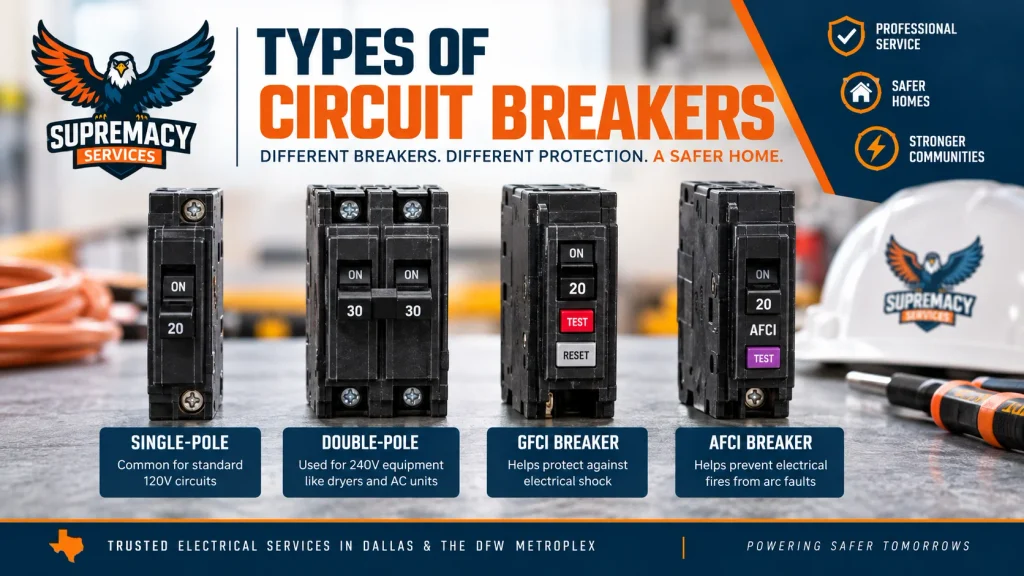
The final cost depends less on the physical size of the breaker than on what type of breaker is required and why it failed.
1. Breaker type
A conventional single-pole breaker generally costs less than specialized AFCI or GFCI equipment. Current market-price guides show that specialty breakers can cost considerably more than conventional breakers.
The electrician must also use equipment appropriate for the particular panel rather than treating breakers as universally interchangeable.
2. Single-pole vs. double-pole breaker
Many ordinary 120-volt household branch circuits use single-pole breakers, while higher-load 240-volt equipment commonly involves double-pole breakers.
Double-pole equipment can therefore cost more to replace
3. Branch breaker vs. main breaker
Replacing one branch-circuit breaker is very different from working on the home’s main breaker.
A branch breaker controls an individual circuit. The main breaker controls power supplied through the panel as a whole. Main-breaker work can involve greater complexity and therefore should not be compared directly with the price of replacing an ordinary branch breaker.
4. Whether the breaker is actually defective
This is one of the most important cost variables.
Suppose a breaker trips every time a particular appliance starts. Installing another breaker without diagnosing the circuit may leave the homeowner with exactly the same problem.
An electrician may need to investigate the connected load, wiring and equipment before determining whether replacement is appropriate.
5. Condition of the electrical panel
A simple breaker replacement can turn into a larger repair when inspection reveals deterioration around the breaker connection, overheating, corrosion, damaged components or other panel problems.
This is also where the distinction between breaker replacement and panel replacement becomes important.
6. Breaker availability
Older equipment can complicate what would otherwise be a straightforward repair.
If an appropriate replacement component is obsolete or difficult to obtain, an electrician may need to evaluate whether another compliant solution—or a larger panel project—is necessary.
7. Wiring repairs
A breaker cannot correct damaged wiring.
If troubleshooting identifies a wiring defect, loose connection or damaged conductor, the quote may include electrical repairs beyond replacing the breaker itself
8. Permit and inspection requirements
Dallas regulates electrical work locally, while Texas also regulates electrical licensing. Dallas maintains an electrical inspection program and residential electrical permit process. The city’s Building Inspection FAQ states that electrical work generally requires a licensed electrician unless a homeowner demonstrates the required knowledge and expertise to the Chief Electrical Inspector; permits are required unless the work qualifies for an exemption.
Because requirements depend on the actual scope of work, homeowners should confirm whether the quoted job includes any required permit or inspection rather than assuming every breaker swap is treated identically.
Does a Tripping Breaker Need to Be Replaced?
Not necessarily. A circuit breaker that trips may be doing exactly what it was designed to do.
The CPSC explains that breakers interrupt current when electrical demand exceeds safe levels. Resetting a breaker without determining why it tripped can therefore miss the actual problem.
Common possibilities include:
| Symptom | Possible explanation |
|---|---|
| Breaker trips when several devices operate | Circuit overload |
| Trips immediately when equipment starts | Appliance, wiring or circuit fault |
| Trips intermittently | Requires electrical diagnosis |
| Breaker will not remain reset | Persistent fault or breaker problem |
| Burning odor or discoloration | Possible overheating/electrical damage |
| One breaker feels abnormal compared with others | Requires professional inspection |
| Multiple electrical problems occur together | Possible broader panel/wiring issue |
This table is intentionally diagnostic rather than definitive. The symptoms alone cannot establish which component has failed.
7 Signs Your Circuit Breaker May Need Professional Inspection
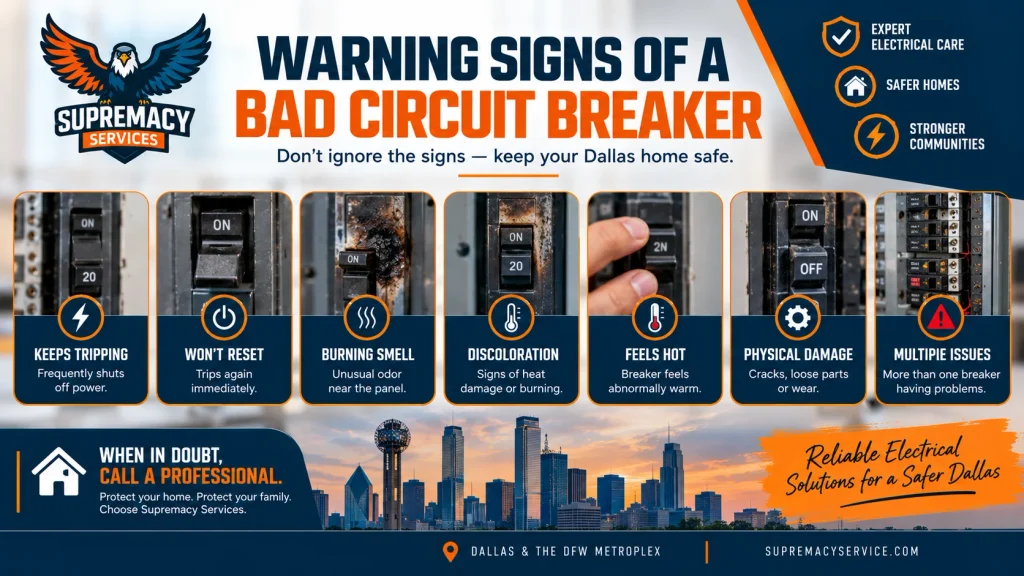
1. The breaker keeps tripping
One isolated trip can occur because the circuit became overloaded.
Repeated tripping deserves investigation, particularly when the homeowner cannot identify an obvious temporary overload.
2. The breaker will not reset
If the breaker immediately trips again, do not keep cycling it in an attempt to force the circuit back into service.
The underlying fault needs to be identified.
3. You notice a burning smell
A burning or unusual electrical odor around the panel warrants prompt attention.
Do not remove the panel cover to investigate.
4. There is visible discoloration or heat damage
Scorching, melting or discoloration around electrical equipment can indicate overheating or arcing.
Treat visible damage as a reason for professional evaluation rather than a cosmetic problem.
5. The breaker feels unusually hot
Electrical equipment can generate some heat under load, so touch alone is not a reliable diagnostic test. However, obvious or unusual heating—particularly with odor, discoloration or recurring trips—deserves professional inspection.
6. The breaker feels mechanically abnormal
A breaker that will not operate normally, will not remain in position or otherwise behaves differently from surrounding breakers should be inspected.
7. The problem keeps returning after resets
Repeated resetting addresses the symptom, not the cause.
If the breaker continues opening the circuit, determine why before continuing to use the affected circuit.
What Causes Circuit Breakers to Keep Tripping?
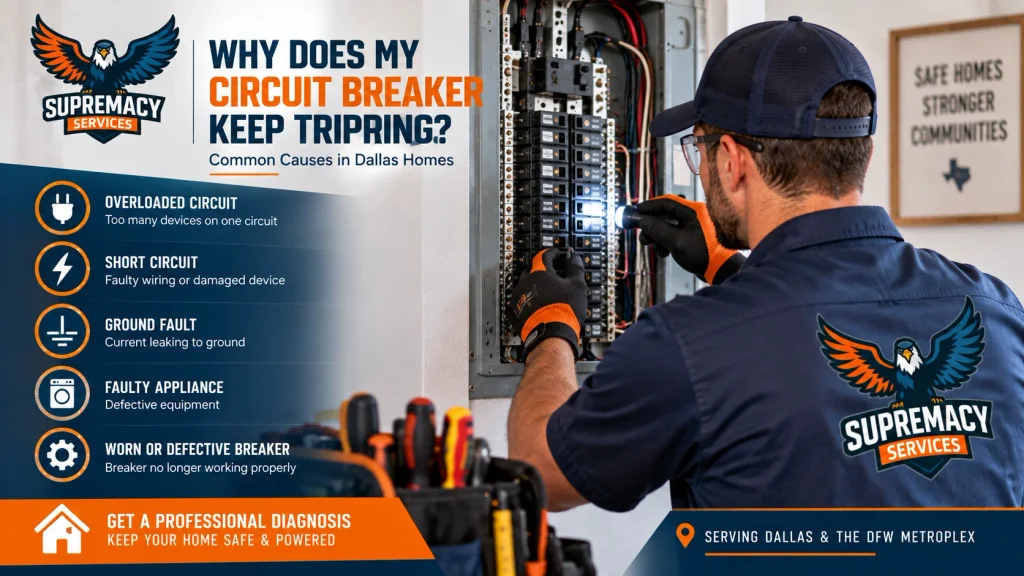
Three broad categories deserve particular attention.
Circuit overload
An overload occurs when connected electrical loads demand more current than the circuit is intended to carry.
CPSC guidance explains that circuit breakers protect against unsafe overcurrent conditions by interrupting current rather than allowing the circuit to continue operating under excessive load.
The solution may therefore involve reducing the load or modifying the electrical system—not installing a larger breaker.
Never assume that installing a higher-amperage breaker is an acceptable solution to recurring trips. The overcurrent protection must be appropriate for the circuit and conductors.
Short circuit or wiring problem
Damaged insulation, faulty equipment or other wiring problems can cause abnormal current conditions.
These problems require diagnosis because simply replacing the breaker does not repair defective wiring.
Ground fault
Current flowing along an unintended path can activate protective equipment designed to detect hazardous conditions.
Again, identifying the source matters more than repeatedly resetting the device.
Circuit Breaker Replacement vs. Electrical Panel Replacement
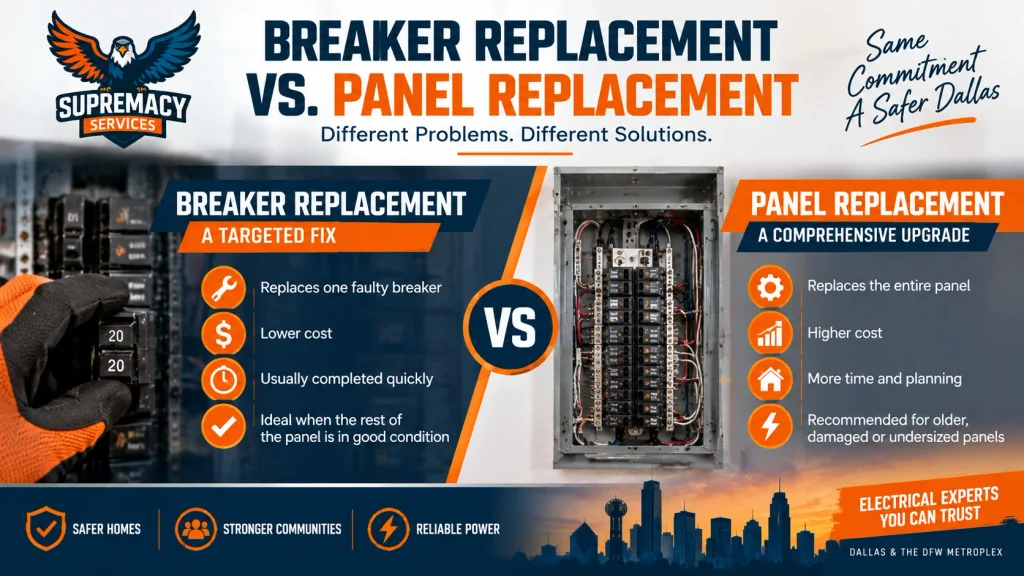
This distinction can save Dallas homeowners from misunderstanding a quote.
| Breaker replacement | Panel replacement |
|---|---|
| Addresses an individual breaker | Replaces the distribution panel |
| Usually limited scope | Major electrical project |
| Existing panel remains in service | Existing panel is removed/replaced |
| Often lower cost | Considerably higher cost |
| Appropriate when the rest of the system is serviceable | May be considered when problems involve the broader panel |
| Does not increase service capacity by itself | Upgrade may involve capacity changes |
Supremacy’s existing panel-upgrade service is therefore a different search intent from this article and from its breaker-replacement service.
When might the panel need attention instead?
An electrician may broaden the evaluation when there is damage affecting more than one breaker position, deterioration inside the panel, inadequate capacity for planned electrical loads, or other conditions that cannot be solved by replacing one breaker.
That does not mean every older panel needs replacement.
The condition and requirements of the actual electrical system should drive the recommendation.
If several breakers are giving you trouble, ask Supremacy Services to determine whether you need [a breaker repair or an electrical panel upgrade] before committing to a larger project.
Can You Replace a Circuit Breaker Yourself in Dallas?
For most homeowners, working inside an electrical panel is not a sensible DIY troubleshooting project.
Texas generally requires people performing non-exempt electrical work to be licensed and to perform that work through a licensed electrical contractor. Texas does provide a state licensing exemption for a person performing electrical work on a dwelling they own and occupy, but TDLR specifically notes that municipal or regional requirements can override aspects of those exemptions.
Dallas adds an important local consideration: the city’s Building Inspection FAQ says electrical work must be performed by a licensed electrician unless the homeowner demonstrates sufficient knowledge and expertise to the Chief Electrical Inspector. It also says electrical permits are required unless exempted by Dallas code.
That makes generic internet advice saying “Texas homeowners can simply replace their own breaker” incomplete for a Dallas homeowner.
For a breaker problem, homeowners can safely document:
- which breaker is tripping;
- when it trips;
- what equipment was operating;
- whether the problem is recurring;
- whether lights or outlets on the circuit behave abnormally; and
- whether there are visible warning signs without opening the panel.
Leave internal panel inspection and repair to someone qualified to perform the work.
What Happens During Professional Breaker Replacement?
A proper service visit should answer one question before anything is replaced:
Why is this breaker causing—or responding to—the problem?
A typical process may include:
1. Discussing the symptoms
The electrician determines when the problem started and under what conditions the breaker trips.
2. Inspecting the electrical panel
The panel, breaker and relevant electrical connections are evaluated for signs that could explain the problem.
3. Diagnosing the circuit
Testing helps distinguish an actual breaker failure from an overload, wiring problem or equipment-related fault.
4. Confirming the appropriate replacement
If the breaker is defective, the replacement must be suitable for the panel and circuit.
5. Replacing the failed component
The defective breaker is removed and the correct replacement installed using appropriate electrical safety procedures.
6. Testing the circuit
The electrician verifies operation after the work is complete.
Supremacy’s current breaker-service page describes its process as initial inspection, professional replacement and safety testing, making this article a natural informational entry point into that service.
How to Avoid Unnecessary Circuit Breaker Replacement Costs
You cannot prevent every electrical component from eventually failing, but you can avoid several expensive mistakes.
Don’t continually reset a breaker that repeatedly trips. Determine why it is opening the circuit.
Don’t solve an overloaded circuit by installing a larger breaker yourself. Breaker sizing is part of the circuit’s electrical protection.
Don’t assume every tripping problem means a bad breaker. Appliance and wiring faults can produce similar symptoms.
Don’t ignore heat, burning odors or visible damage. Those symptoms deserve prompt evaluation.
Don’t compare breaker-replacement and panel-replacement quotes as if they were the same project. Ask the electrician to explain exactly what needs replacing and why.
Get the scope in writing. For cost comparisons, determine whether the estimate includes diagnosis, materials, labor, repairs and any applicable permitting or inspection.
Dallas Electrical Code and Licensing Considerations
Texas has adopted the 2023 National Electrical Code at the state level, effective September 1, 2023. TDLR directs property owners and contractors to the applicable NEC and local inspecting authority for installation requirements.
The City of Dallas separately administers its electrical code and inspection requirements. Its Electrical Section currently identifies the 2023 NEC with Dallas amendments among its adopted electrical requirements.
For homeowners, the practical takeaway is simple:
Electrical requirements can depend on both Texas rules and the local jurisdiction where the property is located.
That distinction also matters across the DFW Metroplex. A homeowner in Dallas should not automatically assume that the permitting procedure is identical in Frisco, Fort Worth, Denton, Flower Mound or another municipality.
What Should You Ask Before Hiring an Electrician?
Before approving breaker work, ask:
- Have you confirmed the breaker itself is defective?
- Could an overload, appliance or wiring fault be causing the trips?
- What type of replacement breaker is required?
- Is anything else inside the panel damaged?
- Does this scope require a permit or inspection?
- Is diagnosis included in the quote?
- Are there additional wiring repairs?
- Is this truly a breaker replacement, or are you recommending panel work?
Those questions make estimates much easier to compare.
FAQs
How much does it cost to replace one circuit breaker in Dallas?
Current national cost guides generally put a straightforward breaker replacement around $100–$300, depending on breaker type and job complexity. Dallas pricing can differ, so use that range for planning rather than as a guaranteed local quote.
Does a circuit breaker that keeps tripping need replacement?
Not automatically. Repeated tripping can result from an overload or another electrical fault. The cause should be diagnosed before the breaker is replaced.
How much does it cost to replace a main breaker?
HomeGuide currently estimates approximately $200–$600 nationally for main-breaker replacement. Other current cost guides show broader ranges, so a property-specific diagnosis and quote is more useful than assuming a fixed price.
Is replacing a breaker cheaper than replacing an electrical panel?
Usually, substantially. Replacing an individual breaker leaves the existing panel in place. A panel replacement is a much larger electrical project involving the home’s distribution equipment.
Why does my new breaker keep tripping?
If a correctly installed breaker continues tripping, the breaker may simply be responding to an electrical condition elsewhere in the circuit. Overloads, wiring faults or connected equipment should be investigated.
Can I replace a breaker with a higher-amperage breaker?
Do not increase breaker amperage simply to prevent trips. Overcurrent protection has to correspond appropriately to the electrical circuit and conductors. Have the reason for the overload determined instead.
Do I need an electrician to replace a circuit breaker in Dallas?
Dallas states that electrical work must generally be performed by a licensed electrician unless the homeowner demonstrates the required knowledge and expertise to the Chief Electrical Inspector. Permit requirements can also apply depending on the scope.
Should I replace the breaker or the whole panel?
An isolated defective breaker may only require breaker replacement. Broader panel damage, capacity requirements or other system problems can lead an electrician to recommend panel work. The decision should follow inspection and diagnosis.
Breaker keeps tripping or won’t reset? Supremacy Services can inspect the circuit, identify whether the problem is the breaker, wiring or electrical panel, and explain the appropriate repair before work begins. Schedule circuit breaker service in Dallas and the DFW area.

