
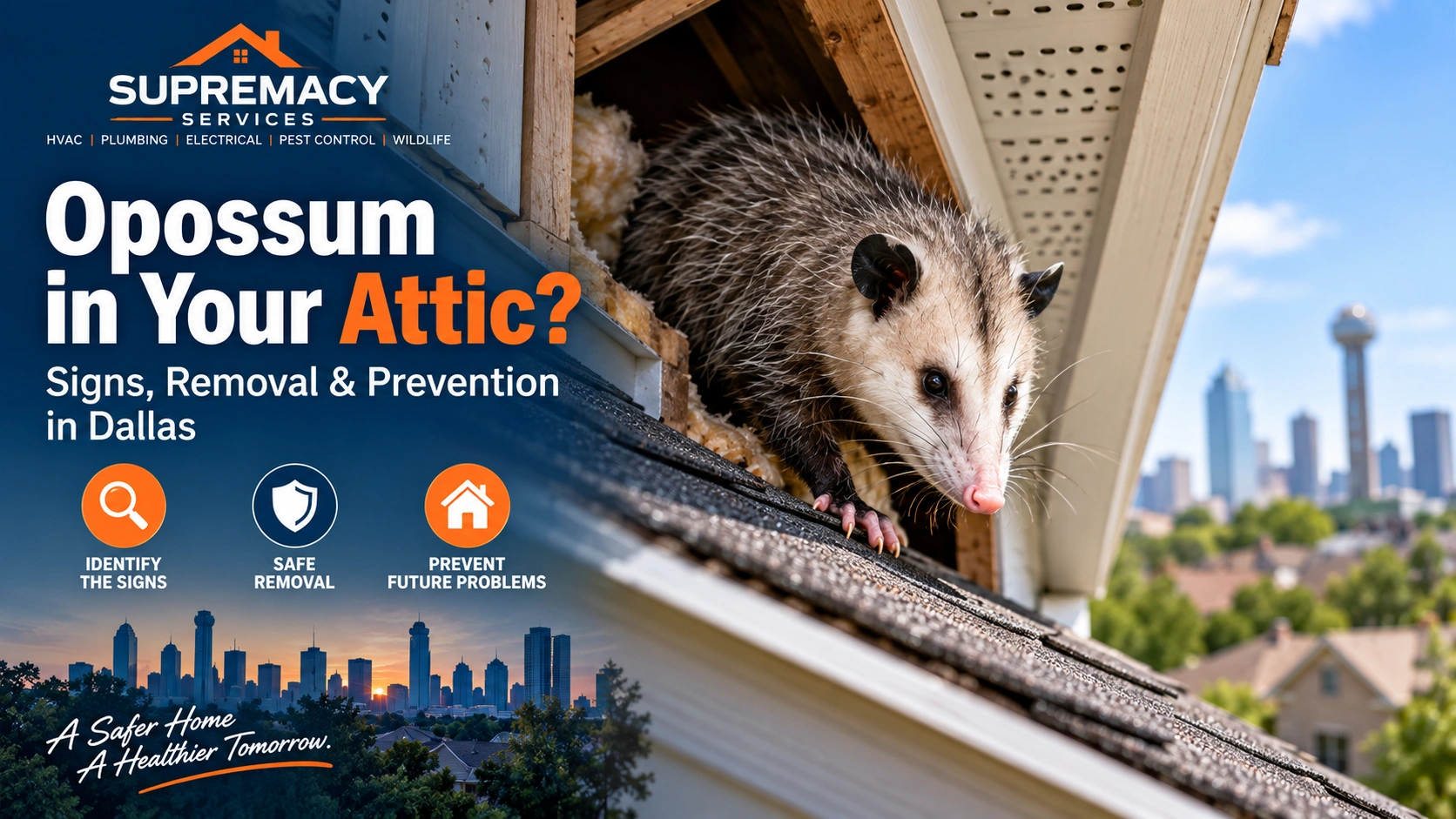
If you suspect an opossum in your attic, don’t seal the opening immediately or try to corner the animal. First confirm what is inside, determine how it entered, and make sure there are no dependent young before the entry point is permanently closed.
Opossums occur across much of Texas and may shelter in attics, underneath buildings and in other protected spaces. For Dallas–Fort Worth homeowners, the solution is usually more than simply getting the animal outside: the entry route and whatever attracted the animal also need to be addressed.
This guide explains how to recognize an opossum, what to do if one gets into your attic, how professional removal works, and how to make your home less inviting to wildlife afterward.
How Do You Know If an Opossum Is in Your Attic?
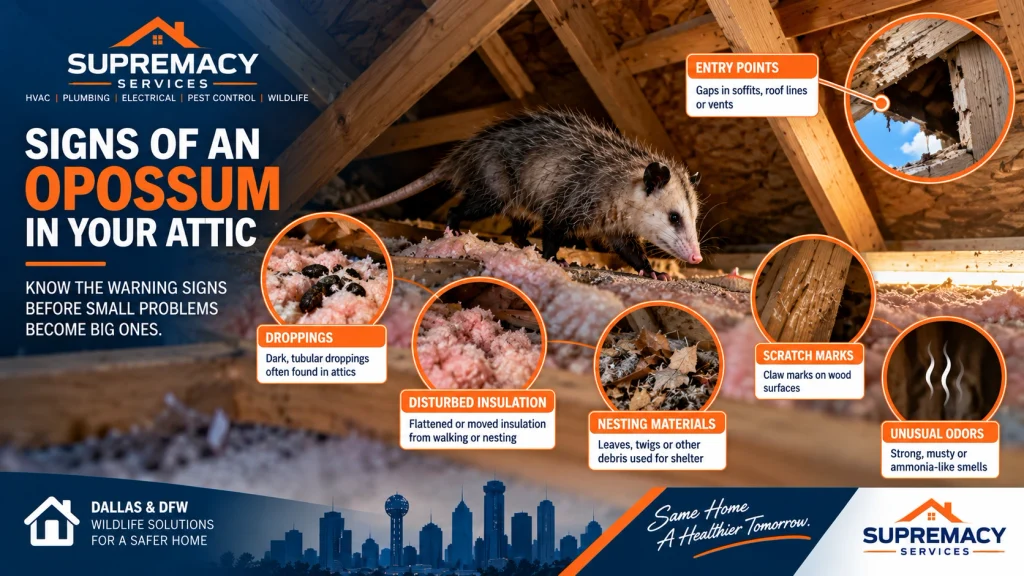
Common clues include heavy nighttime movement, disturbed insulation, droppings, odors, nesting material and an exterior opening large enough for a medium-sized animal.
No single sign proves you have an opossum. Raccoons, rats, squirrels and other animals can produce similar symptoms, which makes identification an important first step.
1. Heavy Noises Mostly at Night
Opossums are primarily nocturnal. If the activity happens mainly after dark, you might hear:
- slow walking or shuffling;
- scratching;
- occasional heavier thumps;
- movement above ceilings;
- noises near soffits, roof edges or attic access areas.
Nighttime activity narrows the possibilities, but it does not identify the animal by itself.
2. A Noticeable Wildlife Odor
A persistent animal or waste odor can indicate that wildlife has spent time in the attic.
Odor may come from urine, feces, nesting materials or, in some situations, a dead animal. The location and intensity of the odor can help an inspector determine where activity is concentrated.
3. Droppings or Contaminated Attic Areas
Wildlife feces in an attic deserve caution.
Avoid handling unidentified droppings with bare hands or disturbing heavily contaminated insulation unnecessarily. Different animals can produce similar-looking waste, so photographs, tracks and other evidence should be considered before identifying the species.
4. Disturbed Insulation or Nesting Material
Compressed, displaced or dirty insulation can show where an animal has been traveling or resting.
An inspector may also find leaves or other materials associated with a sheltered resting area.
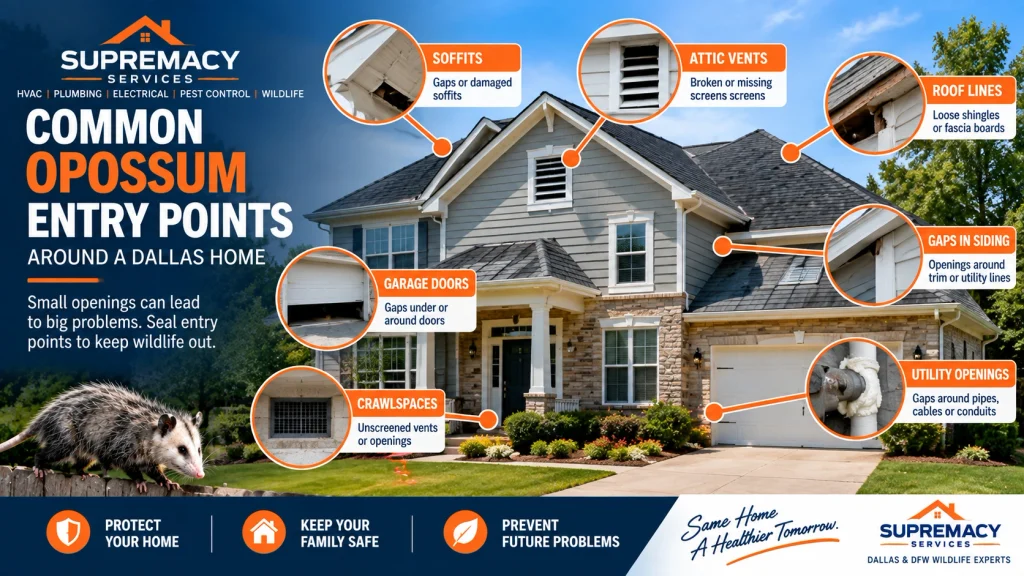
5. A Damaged or Open Entry Point
Look from ground level for problems around:
- soffits;
- fascia and roof edges;
- attic and gable vents;
- gaps around additions;
- damaged screens;
- openings around decks or crawlspaces;
- garage doors;
- other exterior gaps.
Do not climb onto a roof merely to investigate an animal. A professional inspection is safer when the suspected entry point is elevated or difficult to reach.
Contextual CTA: If you are hearing heavy nighttime movement and cannot identify the animal, schedule a [professional wildlife inspection and removal service] before closing any suspected opening.
Opossum vs. Raccoon vs. Rat vs. Squirrel: What Is in Your Attic?
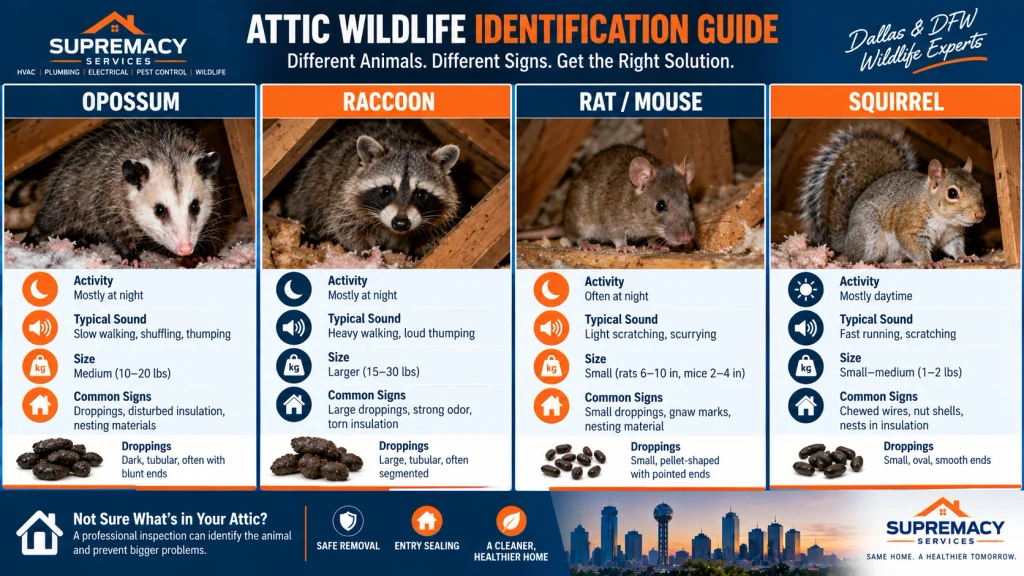
The time, weight and pattern of the noise can provide clues, but a physical inspection is the most reliable way to distinguish attic wildlife.
| Clue | Opossum | Raccoon | Rat/Mouse | Squirrel |
|---|---|---|---|---|
| Typical activity | Mostly nighttime | Mostly nighttime | Often nighttime | Mostly daytime |
| Sound | Slow/heavier movement | Heavy walking/thumping | Light scratching/scurrying | Fast running/scratching |
| Relative size | Medium | Larger/heavier | Small | Small-medium |
| Attic possible? | Yes | Yes | Yes | Yes |
| Identification from noise alone? | No | No | No | No |
This distinction matters because the correct removal and exclusion strategy depends on the species present.
For example, persistent light scratching may point toward a rodent problem rather than an opossum. Supremacy’s rodent control and exclusion service addresses mice and rats specifically, while larger wildlife belongs under wildlife removal.
Why Would an Opossum Get Into a Dallas Home?
An attic offers something wildlife constantly seeks: shelter.
Texas Parks & Wildlife notes that Virginia opossums can shelter in hollow trees, logs, under buildings, abandoned burrows and attics. Around homes, accessible food and an unprotected shelter can make the property even more attractive.
Accessible Food
Common attractants include:
- pet food left outdoors overnight;
- unsecured garbage;
- fallen fruit;
- accessible compost;
- food spilled beneath bird feeders.
Removing these resources is an important part of long-term prevention.
An Existing Opening
An opossum does not need to create every opening it uses. A damaged soffit, poorly screened opening, accessible garage or other existing gap may provide shelter.
That is why successful wildlife control should ask two separate questions:
How does the animal leave?
and
Why was the structure accessible in the first place?
Solving only the first question leaves the house vulnerable to another animal.
Is an Opossum in the Attic Dangerous?
An opossum should be treated as wildlife rather than a pet, even if it appears calm.
The main concerns inside a house are direct animal contact, bites or scratches if the animal is cornered, waste contamination, odor and damage associated with repeated occupation or entry.
It is worth correcting one common misconception: homeowners should not automatically assume an opossum has rabies. Opossums are not among the wildlife species most frequently reported with rabies in the United States.
That does not mean handling one is appropriate.
If a person is bitten or scratched by wildlife, wash the wound promptly and seek medical/public-health advice about the exposure.
Keep children and pets away from the animal while arranging an appropriate response.
What Should You Do If You Find an Opossum in Your Attic?
The safest approach is to isolate the area, avoid direct contact, identify the animal and its entry point, check for young, then use an appropriate removal and exclusion strategy.
Step 1: Keep People and Pets Away
Do not chase the opossum through the attic or attempt to grab it.
Cornering wildlife increases the likelihood of defensive behavior and can push the animal deeper into inaccessible parts of the structure.
Step 2: Confirm What Animal You Have
Try to document:
- when noises occur;
- where they are loudest;
- photographs from a safe distance;
- visible exterior damage;
- tracks or droppings without handling them.
A wildlife camera can sometimes help distinguish nocturnal visitors around an exterior entry route.
Step 3: Find the Entry Point
Inspect accessible areas from the ground for damaged soffits, vents, screens, roof-edge gaps, crawlspace openings and other vulnerabilities.
The objective is not merely to find an opening but to determine which opening is actively being used.
Step 4: Check for Dependent Young
This step is critical.
Do not permanently seal an entry simply because an adult animal appears to have left. If young remain inside, sealing the opening can separate them from the mother and turn a wildlife problem into an animal-welfare and odor problem.
Step 5: Choose the Correct Removal Method
Depending on the situation and applicable rules, professional management may involve direct removal, an appropriate exclusion method, or trapping.
Texas rules are especially important if relocation is contemplated.
Step 6: Seal the Structure After Removal Is Confirmed
Once the structure is confirmed clear, repair the access point with durable materials appropriate for that part of the building.
The goal is exclusion, not simply trapping.
Step 7: Address Contamination and Attractants
Remove nesting debris where appropriate, evaluate contaminated material and eliminate accessible food sources around the property.
That completes the cycle:
identify → remove → exclude → clean → prevent.
Can You Remove an Opossum Yourself in Texas?
Some nuisance-wildlife situations can be addressed by property owners, but DIY relocation is not as simple as catching an opossum and releasing it somewhere else.
Texas classifies opossums as fur-bearing animals. Texas Parks & Wildlife states that nuisance fur-bearing animals may be taken by landowners or their agents under specific conditions, while relocation requires authorization from TPWD and permission from the owner of the release property.
That makes random off-site relocation a poor DIY strategy.
Homeowners should verify the current TPWD requirements before trapping or transporting wildlife because wildlife regulations can change.
DIY vs. Professional Opossum Removal
| Situation | DIY may be reasonable | Professional help is preferable |
|---|---|---|
| Opossum passing through yard | ✓ | |
| Outdoor food attracting wildlife | ✓ | |
| Garbage can needs securing | ✓ | |
| Animal inside attic | ✓ | |
| Species uncertain | ✓ | |
| Possible babies | ✓ | |
| High roof entry | ✓ | |
| Significant contamination | ✓ | |
| Repeated wildlife entry | ✓ | |
| Trapping/relocation contemplated | ✓ |
A homeowner can often make meaningful progress simply by eliminating food sources and correcting easy exterior maintenance issues. An occupied attic is different because removal, animal welfare, access, safety and legal considerations overlap.
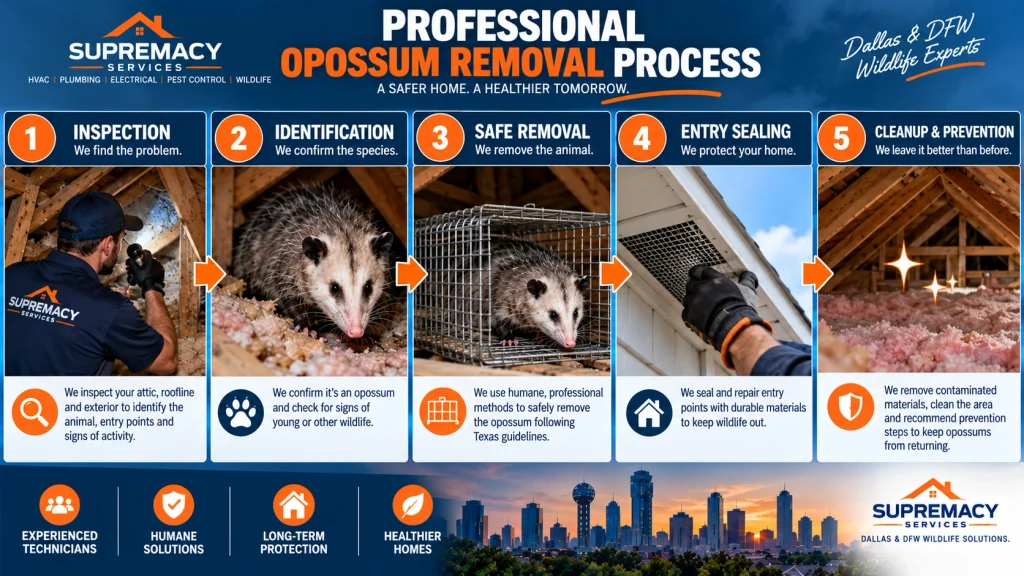
How Does Professional Opossum Removal Work?
A thorough wildlife service should focus on both the animal and the building.
1. Property and Attic Inspection
The technician looks for evidence that identifies the animal, its travel route and potential entry points.
Inspection may include the attic, soffits, vents, roofline, garage, foundation or crawlspace depending on where activity is occurring.
2. Species Identification
Before a removal strategy is selected, the evidence should support the identification.
This prevents a homeowner from paying for an opossum solution when rats, raccoons, squirrels or another species are actually responsible.
3. Check for Young
The occupied area should be evaluated for dependent young before exclusion work is completed.
4. Appropriate Wildlife Removal
The technique should match the animal, location and applicable Texas wildlife rules.
5. Entry-Point Exclusion
Once animals are clear, vulnerable openings can be repaired or screened using materials suitable for the location.
This is one of the most important differences between temporary animal removal and long-term wildlife control.
6. Attic Evaluation and Cleanup
The attic should be checked for nesting material, waste, odor and affected insulation.
The appropriate amount of cleanup depends on the extent and location of contamination.
Mid-article CTA: If an opossum is already inside your Dallas-area home, learn how Supremacy’s wildlife trapping and removal service combines animal removal with inspection, entry sealing and attic cleanup.
How Much Does Opossum Removal Cost in Dallas?
There is no responsible single price for every opossum-in-attic situation without inspecting the property.
The total scope can change significantly depending on whether the job involves straightforward removal or removal plus extensive exclusion and attic remediation.
Important cost factors include:
| Cost factor | Why it matters |
|---|---|
| Animal location | Accessible spaces are different from difficult attic or wall locations |
| Number of animals | A single visitor differs from a mother with young |
| Entry location | Ground-level access differs from high roofline work |
| Number of openings | Multiple vulnerabilities require more exclusion work |
| Building construction | Soffits, vents and roof configurations affect access |
| Attic contamination | Cleanup requirements vary |
| Damage | Repairs may extend beyond basic exclusion |
| Follow-up | Some situations require monitoring or return visits |
For that reason, the most useful estimate should distinguish animal removal, exclusion repairs and cleanup rather than presenting one unexplained number.
Why Trapping Alone May Not Solve the Problem
Removing one opossum does not remove the reason your house was accessible.
Wildlife-management guidance emphasizes reducing food, water and shelter opportunities. If an accessible opening remains after an animal is removed, another opossum—or an entirely different species—can potentially use it later.
This is why exclusion is so important.
Think of wildlife control as two problems:
Occupancy problem: something is currently inside.
Building problem: something allowed wildlife to get inside.
A durable solution addresses both.
How to Prevent Opossums From Returning
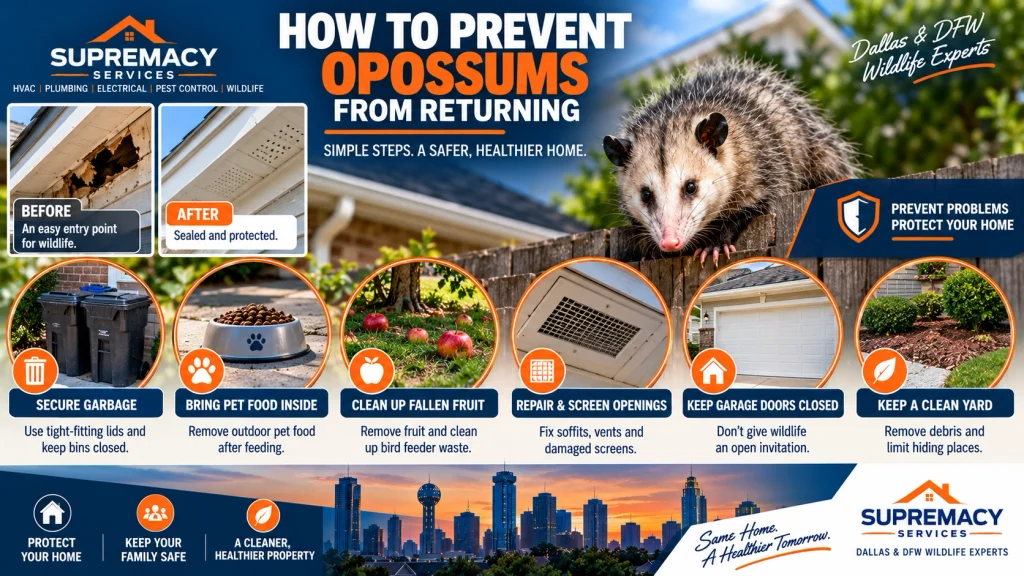
Prevention should combine structural exclusion with attractant reduction.
Secure Garbage
Use containers with properly fitting lids and avoid leaving loose food waste accessible overnight.
Bring Pet Food Inside
Outdoor pet food is an unnecessary wildlife attractant. Feed pets indoors where practical or remove leftover food promptly.
Manage Fallen Fruit and Bird-Feeder Waste
Collect fallen fruit and clean spilled seed beneath feeders.
Protect Crawlspaces and Openings
Repair damaged screens and protect appropriate structural openings while maintaining required ventilation.
Repair Soffit and Roofline Damage
Loose soffits, damaged vents and deteriorated exterior components should be repaired before they become convenient wildlife access points.
Keep Garage Doors Closed
An open garage can provide access to shelter, pet food, garbage or additional routes into the building.
Inspect After Exterior Damage
Storms, roofing work and deterioration can create new openings. Periodically inspect accessible exterior areas, especially after repairs or weather damage.
Dallas/DFW Considerations for Opossum Problems
Opossums are established Texas wildlife, and TPWD documents the species across most of the state.
For Dallas homeowners, the useful local issue is therefore not whether opossums can occur here, but how the home and property provide access, shelter or food.
DFW includes a wide variety of housing—from older properties with aging exterior components to newer homes with complex rooflines, attached garages and numerous vents. Wildlife prevention should therefore be based on the actual building rather than a generic treatment.
The same principle applies across Dallas, Plano, Frisco, McKinney, Richardson, Carrollton, Allen, Southlake and surrounding Metroplex communities: identify the species, locate the access route and fix the structural vulnerability.
Could It Be Something Other Than an Opossum?
Yes. Attic noise alone cannot reliably identify an opossum.
Rats or Mice
Smaller, quicker scratching and scurrying—particularly inside walls—may indicate rodents.
If inspection confirms rats or mice rather than wildlife, a dedicated rodent control and exclusion approach is more appropriate.
Raccoons
Raccoons can produce much heavier movement and may occupy attic spaces.
Squirrels
Daytime running or scratching is more consistent with squirrels than with a primarily nocturnal opossum.
Birds or Bats
Fluttering or activity associated with vents and roof openings may indicate another type of wildlife entirely and requires a species-appropriate response.
Correct identification comes before treatment.
When Should You Call a Wildlife Professional?
Professional inspection is particularly appropriate when:
- the animal is inside an attic or wall;
- you cannot confidently identify the species;
- there may be young present;
- the entry point is on a high roof;
- an animal has become trapped;
- contamination is substantial;
- wildlife keeps returning;
- multiple openings need to be repaired;
- trapping or relocation is being considered.
The objective should not simply be to make tonight’s scratching stop. It should be to determine what entered, how it entered and what needs to change so the structure is less likely to be occupied again.
Frequently Asked Questions About Opossums in Dallas Attics
Will an opossum leave an attic on its own?
It may leave to forage, but that does not mean it has permanently abandoned the shelter. Do not seal an opening until you have confirmed the space is clear and checked for dependent young.
What does an opossum sound like in an attic?
Homeowners may hear slow walking, scratching, shuffling or heavier movement, often at night. Noise alone cannot reliably distinguish an opossum from other attic wildlife.
Are opossums dangerous to people?
Opossums generally should be left alone rather than handled. Any wild mammal may defend itself if cornered. Keep children and pets away and seek medical advice after a bite or scratch.
Do opossums commonly have rabies?
CDC guidance notes that opossums are among animals that rarely have rabies, while bats, raccoons, skunks and foxes are more frequently associated with rabies in the United States. Any potential wildlife exposure should still be assessed appropriately.
Can I trap an opossum and release it somewhere else in Texas?
Do not assume you can. Texas Parks & Wildlife has specific rules for nuisance fur-bearing animals, and relocation requires authorization and permission from the owner of the release property. Check current TPWD requirements before acting.
Should I seal the hole while the opossum is outside?
Not until you know the structure is clear. Young or another animal could remain inside. Premature sealing can create a much more serious problem.
What attracts opossums to homes?
Accessible food and shelter are major factors. Pet food, garbage, fallen fruit, compost and bird-feed waste can encourage wildlife activity, while accessible structural openings provide shelter.
Does removing an opossum prevent another one from entering?
Not by itself. The entry point and attractants also need to be corrected. Exclusion is what turns removal into a longer-term solution.
Who removes opossums from attics in Dallas?
Wildlife-control professionals handle animals occupying attics and other structures. Look for a provider that identifies the animal, checks for young, addresses applicable Texas wildlife rules and provides exclusion recommendations instead of focusing only on trapping.
Need Help With an Opossum in Your Dallas-Area Home?
If you’re hearing unexplained nighttime movement, finding wildlife waste or have discovered an animal entering your roofline, the next step is to identify what is inside and how it is getting in.
Supremacy Services provides wildlife inspection, removal, exclusion and related attic services throughout Dallas and surrounding DFW communities.
Final CTA: Schedule a Dallas wildlife inspection with Supremacy Services to identify the animal, locate entry points and determine the appropriate removal and exclusion plan.

