Rooftop AC replacement cost in Dallas can vary from the low five figures for a relatively straightforward small commercial RTU replacement to $50,000 or considerably more for larger, higher-efficiency or complex rooftop systems. The final cost depends on much more than the price of the air conditioner itself. Tonnage, heating type, efficiency, crane access, roof-curb compatibility, electrical work, controls, duct transitions and installation conditions can all change the project price.
For Dallas–Fort Worth business owners and property managers, that makes a site-specific assessment much more useful than a simple “price per ton.”
This guide explains what goes into the cost of replacing a rooftop AC unit, how to compare commercial HVAC proposals, when replacement may make more sense than another repair, and what to expect during an RTU replacement project.
Important pricing note: The figures below are budgeting ranges drawn from published 2026 U.S. commercial-HVAC market estimates, not fixed Supremacy Services prices or Dallas quotes. Commercial projects should be priced after the equipment and site have been inspected.
How Much Does a Rooftop AC Replacement Cost in Dallas?
For preliminary budgeting, current 2026 commercial-market references put small packaged rooftop replacements at roughly $15,000 and upward, while larger or more sophisticated RTUs can exceed $50,000 per unit.
One 2026 commercial cost reference estimates approximately $2,800–$3,500 per ton for smaller RTUs and approximately $1,800–$2,500 per ton for larger commercial units as planning benchmarks. These numbers should not be treated as a Dallas contractor quote because every roof, building and mechanical system presents a different installation scope.
A useful preliminary framework is:
| RTU project | Published 2026 planning range* |
|---|---|
| Small packaged RTU | Around $15,000+ |
| 5-ton capacity model | Roughly $14,000–$17,500 |
| 10-ton capacity model | Roughly $28,000–$35,000 |
| 20-ton capacity model | Roughly $36,000–$50,000 |
| Large/advanced projects | $50,000+ is possible |
*These are third-party U.S. market-planning estimates rather than Supremacy Services pricing. Actual Dallas/DFW proposals can be below or above these ranges depending on equipment and installation requirements.
More importantly, tonnage should never be selected from a price table or building square footage alone. The appropriate replacement should account for the building’s cooling load, occupancy, ventilation requirements, envelope, operating schedule and internal heat loads.
What should a rooftop replacement estimate include?
Depending on the project, the proposal may need to account for:
- rooftop equipment;
- removal and disposal of the existing RTU;
- crane and rigging;
- roof curb or curb adapter;
- duct transitions;
- electrical connections or modifications;
- gas connections for gas/electric packaged units;
- condensate drainage;
- thermostat or building controls;
- economizer or outside-air components;
- permits and inspections where applicable;
- startup, testing and commissioning.
That is why comparing two bids by equipment price alone can be misleading.
Contextual CTA — insert here:
Planning an RTU replacement? Explore Supremacy Services’ [rooftop AC unit installation in Dallas] to see what a professionally planned rooftop HVAC project involves.
What Is a Rooftop AC Unit?
A rooftop unit, commonly abbreviated RTU, is a packaged HVAC system that places most or all of the primary heating and cooling components inside one outdoor cabinet, typically installed on the roof of a commercial building.
Unlike a traditional split system with equipment located in multiple places, a packaged rooftop system can contain the compressor, condenser, evaporator, blower, controls and—in many configurations—the heating equipment within the same cabinet.
RTUs are commonly associated with:
- retail stores;
- restaurants;
- offices;
- clinics;
- warehouses;
- schools;
- strip centers;
- light-industrial facilities;
- other low-rise commercial properties.
ENERGY STAR describes gas/electric package equipment as single-package commercial heating and air-conditioning equipment that is often installed on a slab or roof.
What Determines Rooftop AC Replacement Cost?
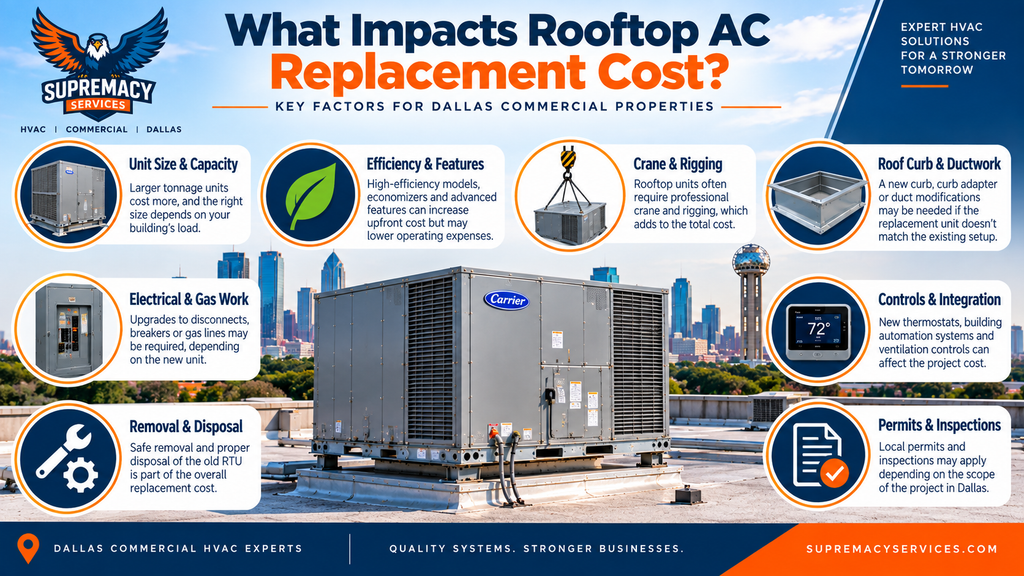
1. RTU capacity and tonnage
Equipment capacity is one of the largest pricing variables.
A larger RTU generally requires more expensive equipment and may also require heavier rigging, different electrical service, larger duct transitions and more complicated installation work.
But replacing a 10-ton unit does not automatically mean installing another 10-ton unit.
An older building may have changed since the original system was installed. Lighting, insulation, windows, occupancy, equipment loads and operating schedules may all be different.
A replacement project is therefore an opportunity to verify the building’s actual requirements rather than blindly reproducing the existing installation.
2. Standard vs. high-efficiency equipment
Higher-efficiency equipment normally carries a higher initial equipment cost.
That upfront premium should be evaluated against operating costs and the expected ownership period.
ENERGY STAR reports that qualifying light-commercial HVAC equipment is designed to use less energy than standard equipment. For larger commercial units, metrics such as IEER — Integrated Energy Efficiency Ratio — become particularly useful because commercial equipment frequently operates at part load rather than full capacity all day.
The best decision therefore isn’t automatically the cheapest unit or the unit with the highest efficiency rating. It is the equipment that fits the building’s load, operating pattern, budget and long-term ownership goals.
3. Crane and rigging requirements
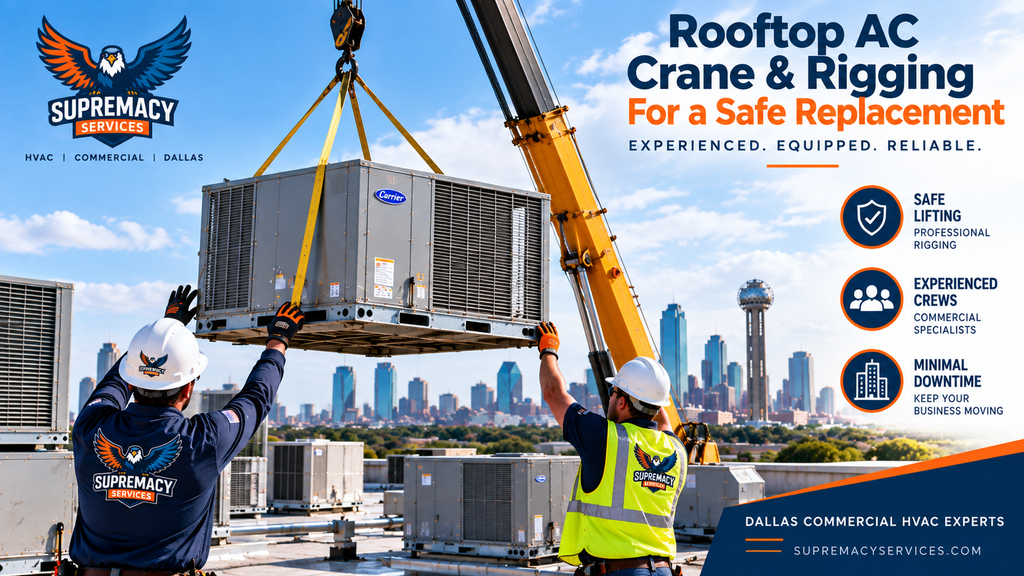
A ground-level condenser can often be moved relatively easily.
A rooftop package unit is different.
Removing the old RTU and positioning the new one may require a crane, rigging crew and carefully planned lift.
Cost can change according to:
- building height;
- RTU weight;
- distance from crane setup to the unit;
- parking-lot access;
- nearby structures;
- overhead obstructions;
- required traffic control;
- lift scheduling;
- number of units being replaced.
For multi-unit properties, coordinated replacement can sometimes improve project efficiency because multiple units may be handled during the same planned mobilization.
4. Roof curb compatibility
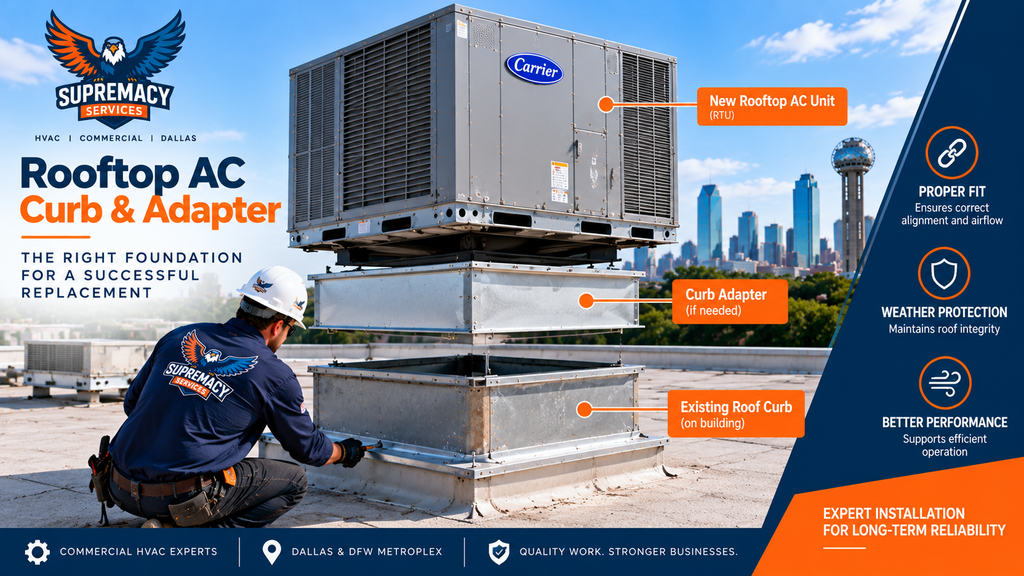
The roof curb is the structural interface between the rooftop equipment and the building.
When the new RTU’s dimensions and supply/return openings do not align with the existing curb, a curb adapter or other modification may be necessary.
This is an important line item because the connection must address more than equipment support. Airflow alignment, weather protection and roof integrity all matter.
A seemingly inexpensive replacement can become substantially more involved if the new equipment cannot use the existing rooftop configuration.
5. Ductwork modifications
Even when the new unit has similar capacity, its supply and return openings may not perfectly match the old RTU.
The contractor may therefore need to fabricate transition pieces or modify existing ductwork.
Existing duct problems should also be investigated before a new system is installed. A high-performance RTU connected to leaking, poorly configured or restrictive ductwork may still produce poor comfort and inefficient operation.
6. Electrical requirements
The replacement unit’s electrical characteristics must be checked against the building’s existing electrical infrastructure.
A project may involve evaluating or modifying:
- disconnects;
- breakers;
- conductors;
- controls;
- voltage and phase requirements;
- equipment grounding;
- service capacity.
These conditions are particularly important when changing equipment type, capacity or technology.
7. Heating configuration
A rooftop system may be:
- cooling only;
- gas/electric;
- electric heat;
- heat pump;
- another packaged configuration.
Changing the heating configuration can alter equipment price and installation requirements.
Gas/electric equipment, for example, introduces combustion and gas-supply considerations that a cooling-only unit does not.
8. Controls and building automation
A basic thermostat-controlled RTU and a unit integrated into a building automation system are different projects.
Controls can include:
- programmable thermostats;
- multi-stage controls;
- variable-speed operation;
- economizer controls;
- occupancy scheduling;
- demand-controlled ventilation;
- remote monitoring;
- fault detection;
- BAS integration.
These options increase project scope but can also improve how efficiently the equipment responds to changing building loads.
9. Economizers and ventilation
Commercial HVAC is responsible for more than temperature.
Many systems also have outside-air requirements, and some RTUs use economizers to take advantage of suitable outdoor conditions.
When an RTU is replaced, the contractor should evaluate the existing ventilation strategy rather than assuming the old configuration should simply be duplicated.
10. Site and roof conditions
Two identical RTUs can have very different installed costs.
One may sit on a single-story retail building with excellent crane access and a compatible curb.
Another may sit several stories above a busy area with restricted crane positioning, complicated electrical work, deteriorated duct connections and roof repairs around the curb.
The equipment may be identical.
The projects are not.
Rooftop AC Repair vs. Replacement: Which Makes More Sense?
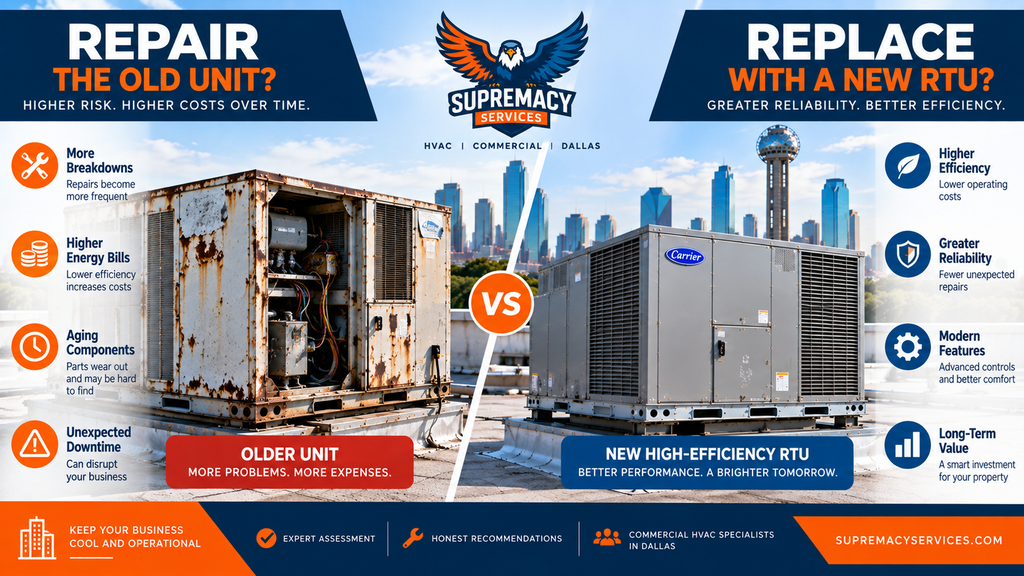
Replacement becomes more worth investigating when an older RTU is experiencing recurring failures, declining performance or rising repair requirements, particularly when the equipment is already well into its service life.
The U.S. Department of Energy has specifically highlighted older commercial RTUs as candidates for proactive evaluation rather than waiting for catastrophic failure.
That does not mean every older unit should automatically be replaced.
Repair may make sense when:
- the RTU is relatively young;
- the failure is isolated;
- major components remain in good condition;
- repair history is limited;
- the unit still matches the building load;
- replacement would provide little operational benefit.
Replacement deserves closer consideration when:
- major repairs are becoming frequent;
- compressor or heat-exchanger problems are developing;
- the building experiences persistent comfort problems;
- energy use has become difficult to control;
- parts availability is becoming problematic;
- the unit no longer matches the building’s requirements;
- multiple same-age RTUs are approaching major repair cycles.
The decision should consider total ownership cost, not simply today’s repair bill.
That means comparing repair expense with future maintenance exposure, energy consumption, reliability, remaining service life and the consequences of an unexpected failure.
Warning Signs Your Commercial RTU May Need Replacement
One symptom does not automatically justify replacement, but a combination of the following should prompt a detailed HVAC evaluation.
Increasing repair frequency
Occasional repairs are normal. Repeated compressor, motor, electrical, control or refrigerant-related problems can indicate that the system is entering a more expensive stage of its life.
Uneven building temperatures
Hot and cold areas may indicate an RTU problem, but they can also result from duct leakage, balancing problems, zoning controls, building-envelope issues or changed occupancy.
A technician should identify the cause before recommending new equipment.
Longer operating cycles
An RTU that runs for long periods without satisfying the thermostat may have dirty coils, restricted airflow, control problems, refrigerant issues, inadequate capacity or deteriorating components.
Unusual noise or vibration
Compressor noise, failing bearings, fan imbalance and loose mechanical components deserve investigation before they cause secondary damage.
Rising energy consumption
Higher utility bills are not proof that the RTU itself is failing. Weather, operating hours, occupancy and utility rates can all change.
But rising consumption combined with deteriorating performance can justify an efficiency and condition assessment.
Repeated business disruptions
For a commercial property, HVAC reliability has an operational value.
Unexpected cooling failures can affect tenants, customers, employees, inventory and business hours.
This is one reason planned replacement can be preferable to waiting for an aging RTU to fail during peak cooling demand.
Mid-article CTA — insert here:
If your rooftop unit is showing several of these symptoms, schedule a commercial HVAC evaluation before assuming another repair—or immediate replacement—is the right answer.
Why Proper RTU Sizing Matters
A replacement rooftop AC should be sized for the building’s actual cooling and ventilation requirements rather than selected only because it matches the nameplate tonnage of the old equipment.
Oversizing can create unnecessary cycling and reduce efficient part-load operation.
ENERGY STAR notes that oversized rooftop HVAC equipment can increase energy costs and equipment wear.
The evaluation should consider factors such as:
- conditioned floor area;
- roof and wall construction;
- glazing;
- solar exposure;
- occupancy;
- lighting;
- computers and equipment;
- ventilation;
- business hours;
- internal heat-producing processes;
- zoning;
- Dallas design conditions.
This is especially important when a building has undergone renovations since the original RTU was installed.
Dallas/DFW Considerations for Rooftop HVAC Replacement
Long cooling seasons
North Texas commercial buildings can experience substantial cooling demand, making part-load efficiency and proper system selection important considerations when comparing equipment.
Rather than evaluating only purchase price, owners should consider how the system will operate throughout its expected service life.
Direct rooftop exposure
RTUs operate outside, where components are exposed to sunlight, rain, wind, debris and changing weather.
Regular inspection of coils, cabinet condition, electrical components, drains, filters, belts and other service items therefore remains important after replacement.
Commercial operating schedules
A Dallas office building operating primarily during weekdays has a very different load profile from a restaurant, medical facility or retail location with extended operating hours.
Equipment selection and control strategy should reflect the actual building schedule.
Texas HVAC licensing
Air-conditioning and refrigeration contracting in Texas is regulated by the Texas Department of Licensing and Regulation (TDLR).
TDLR states that contractors who install, repair or maintain air-conditioning, refrigeration or heating systems must hold the applicable state license, and ACR contracting companies must employ a licensed ACR contractor at each permanent location.
Commercial owners should verify contractor licensing when evaluating an RTU replacement.
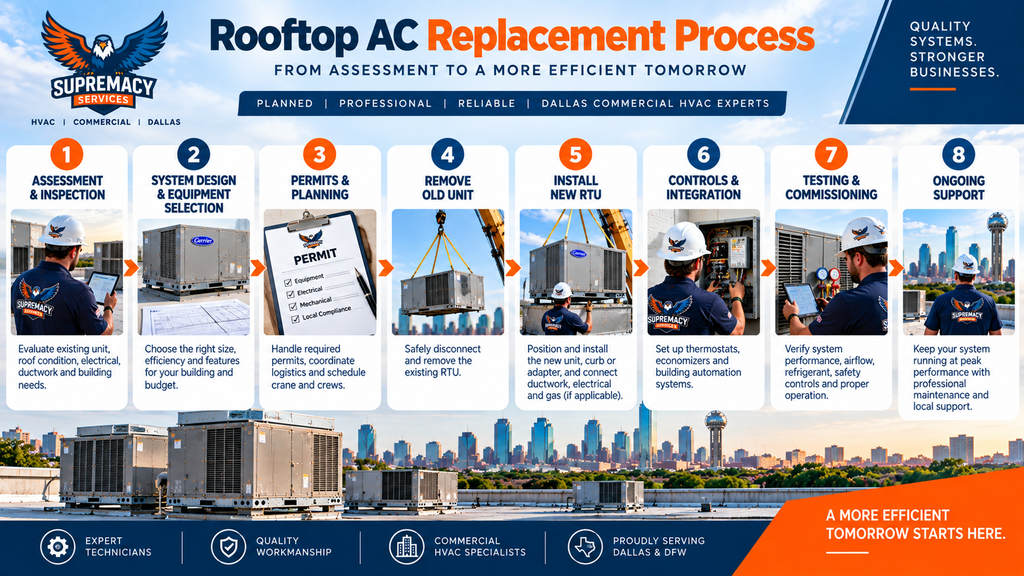
What Happens During a Rooftop AC Replacement?
A properly planned replacement involves much more than lifting one box off the roof and replacing it with another.
Step 1: Existing-system assessment
The contractor identifies:
- manufacturer and model;
- tonnage/capacity;
- electrical characteristics;
- heating configuration;
- curb dimensions;
- duct arrangement;
- controls;
- ventilation setup;
- equipment condition.
Step 2: Building and load evaluation
The contractor determines whether replacing the existing unit like-for-like is appropriate or whether building changes justify a different solution.
Step 3: Equipment selection
Potential replacements are compared according to capacity, efficiency, heating configuration, physical dimensions, controls and other project requirements.
Step 4: Roof and curb planning
The existing curb and roof conditions are examined.
If equipment footprints differ, a compatible curb adapter or other transition may be specified.
Step 5: Crane and logistics planning
The contractor coordinates equipment delivery, crane positioning, rigging, site access and the removal of the old RTU.
Commercial occupants may also need advance notice of temporary HVAC downtime.
Step 6: Old RTU removal
Power and other utilities are safely disconnected before the existing equipment is removed.
Step 7: New RTU installation
The replacement is positioned and connected to the appropriate ductwork, electrical, controls, drainage and heating utilities.
Step 8: Startup and commissioning
The installation should not end when the crane leaves.
The system must be started, tested and checked to verify correct operation.
That may include airflow, temperature, electrical operation, controls, safety devices, heating/cooling operation and ventilation functions as applicable.
Can You Replace a Commercial Rooftop AC Yourself?
For a commercial RTU, this is not an appropriate DIY project.
Rooftop HVAC replacement can involve high-voltage electrical work, refrigerant circuits, heavy equipment rigging, gas connections, structural/roof interfaces, ductwork and regulated HVAC work.
Texas regulates air-conditioning and refrigeration contracting through TDLR.
A facility manager can, however, make the professional process easier by gathering:
- RTU model and serial numbers;
- maintenance records;
- repair history;
- recent utility information;
- known comfort complaints;
- building operating schedules;
- roof-access information;
- existing mechanical drawings when available.
That information can make the assessment considerably more productive.
What Should You Ask Before Approving an RTU Replacement Quote?
Use this checklist when comparing proposals:
| Question | Why it matters |
|---|---|
| Is the replacement capacity verified? | Avoids automatically repeating an incorrectly sized system |
| Is crane/rigging included? | Prevents a major project expense from appearing later |
| Is the existing curb reusable? | Determines whether an adapter or roof work may be needed |
| Are duct transitions included? | Equipment openings can differ between models |
| Are electrical modifications included? | New equipment may have different requirements |
| What efficiency ratings apply? | Helps compare long-term operating performance |
| Is an economizer included or required? | Affects ventilation, controls and equipment scope |
| How will controls be handled? | Important for thermostats and BAS integration |
| What commissioning is included? | Confirms that the installed system is operating correctly |
| What warranties apply? | Clarifies equipment and workmanship coverage |
| What is excluded from the proposal? | Makes competing bids easier to compare |
The lowest proposal is not necessarily the least expensive solution over the life of the system.
Compare scope against scope, not simply total against total.
Can a High-Efficiency Rooftop Unit Reduce Operating Costs?
Potentially, yes—but the actual savings depend on the building, equipment being replaced, controls and operating conditions.
ENERGY STAR reports that certified light-commercial HVAC equipment uses approximately 17% less energy than standard equipment.
DOE’s Advanced Rooftop Unit work has also documented substantial energy-saving opportunities from high-efficiency RTU replacements and advanced controls across commercial-building portfolios.
Those figures should not be interpreted as a promise that an individual Dallas building will achieve the same result.
The most useful approach is to evaluate:
existing consumption → existing RTU performance → proposed equipment → expected operating schedule → incremental equipment cost → estimated savings
That produces a building-specific financial decision rather than relying on a generic efficiency percentage.
How Can Dallas Businesses Control RTU Replacement Costs?
Plan before the system fails
Emergency failure reduces your options.
Planned replacement provides more time to evaluate equipment, efficiency, crane logistics and business scheduling.
Evaluate multiple RTUs together
If a building has several RTUs of similar age, consider assessing the entire equipment inventory.
That does not necessarily mean replacing everything simultaneously.
It does allow ownership to identify which systems present the greatest reliability or operating-cost risk and create a capital replacement plan.
Don’t automatically replace like-for-like
The existing system is a starting point—not necessarily the correct specification for the next 15 years.
Changes to occupancy, lighting, insulation, windows or business operations can affect HVAC demand.
Address ductwork problems at the same time
Installing new equipment without correcting major distribution problems can leave the building with many of the same comfort complaints.
Compare lifecycle value
Consider:
initial cost + expected energy use + maintenance + repair exposure + operational reliability
rather than initial equipment cost alone.
Rooftop Unit vs. VRF: Should You Replace the RTU With Another System?
Not necessarily.
A packaged rooftop unit can remain an effective solution for many retail, restaurant, warehouse, office and other commercial applications.
But some properties may benefit from evaluating alternatives such as VRF/VRV systems, particularly when independent zoning and different space-use patterns are important.
The two technologies are fundamentally different.
An RTU packages major HVAC components together and generally distributes conditioned air through ducts.
VRF uses refrigerant piping and multiple indoor units to provide more granular zone control.
The right choice depends on building layout, zoning requirements, existing infrastructure, project budget and long-term operating priorities—not simply which technology is newer.
Rooftop AC Replacement Cost FAQs
How much does a commercial rooftop AC cost in Dallas?
There is no reliable single Dallas price because tonnage, equipment configuration, efficiency, crane access, curb compatibility, electrical work and controls vary significantly. Current U.S. commercial-market references place smaller replacements in the low five figures while larger and more complex RTUs can exceed $50,000.
How much does a 5-ton rooftop AC replacement cost?
One published 2026 commercial planning model estimates roughly $14,000–$17,500 for a 5-ton small-RTU capacity model before certain project-specific extras. Treat this as budgeting information rather than a Dallas quote.
How much does a 10-ton rooftop HVAC unit cost?
A current 2026 planning source estimates roughly $28,000–$35,000 for a 10-ton small-commercial RTU capacity model before project-specific extras. Site conditions can materially change the installed price.
Does replacing a rooftop AC require a crane?
Many commercial RTU replacements do require crane or specialized lifting equipment because the old equipment must be removed from the roof and the replacement positioned safely. The exact lifting plan depends on building height, access, unit weight and site conditions.
Can I put the new RTU on the old roof curb?
Sometimes. If dimensions, duct openings and structural requirements are compatible, the existing curb may be usable. Otherwise a curb adapter or new curb arrangement may be required.
Should I repair or replace an older rooftop unit?
Consider age together with repair history, system condition, efficiency, comfort, reliability and the cost of the proposed repair. A professional condition assessment is more useful than deciding from age alone.
How long does rooftop AC replacement take?
Project duration varies. Equipment availability, crane scheduling, curb work, electrical changes, roof work and controls can all affect the schedule. A straightforward replacement can be much faster than a project requiring significant infrastructure changes.
Should I replace every RTU on my building at once?
Not automatically. For buildings with multiple units, a condition assessment can identify which systems should be replaced first and whether coordinating several replacements offers logistical advantages.
Is a higher-efficiency rooftop unit worth the extra cost?
It can be, particularly for equipment with long operating hours, but the answer depends on the incremental purchase cost, expected energy savings, maintenance requirements and ownership horizon. Compare lifecycle cost rather than efficiency ratings alone.
Get a Rooftop AC Replacement Assessment in Dallas
The most useful answer to “How much will my rooftop AC replacement cost?” comes from inspecting the actual building.
Tonnage is only one piece of the project. A dependable proposal should account for the existing equipment, cooling requirements, roof curb, ductwork, electrical service, heating configuration, controls, ventilation, crane access and commissioning.
Supremacy Services provides rooftop HVAC installation and commercial HVAC solutions for businesses throughout Dallas and the DFW Metroplex.
Final CTA:
Request a rooftop HVAC assessment from Supremacy Services to compare replacement options, project scope and equipment choices for your Dallas/DFW property.