
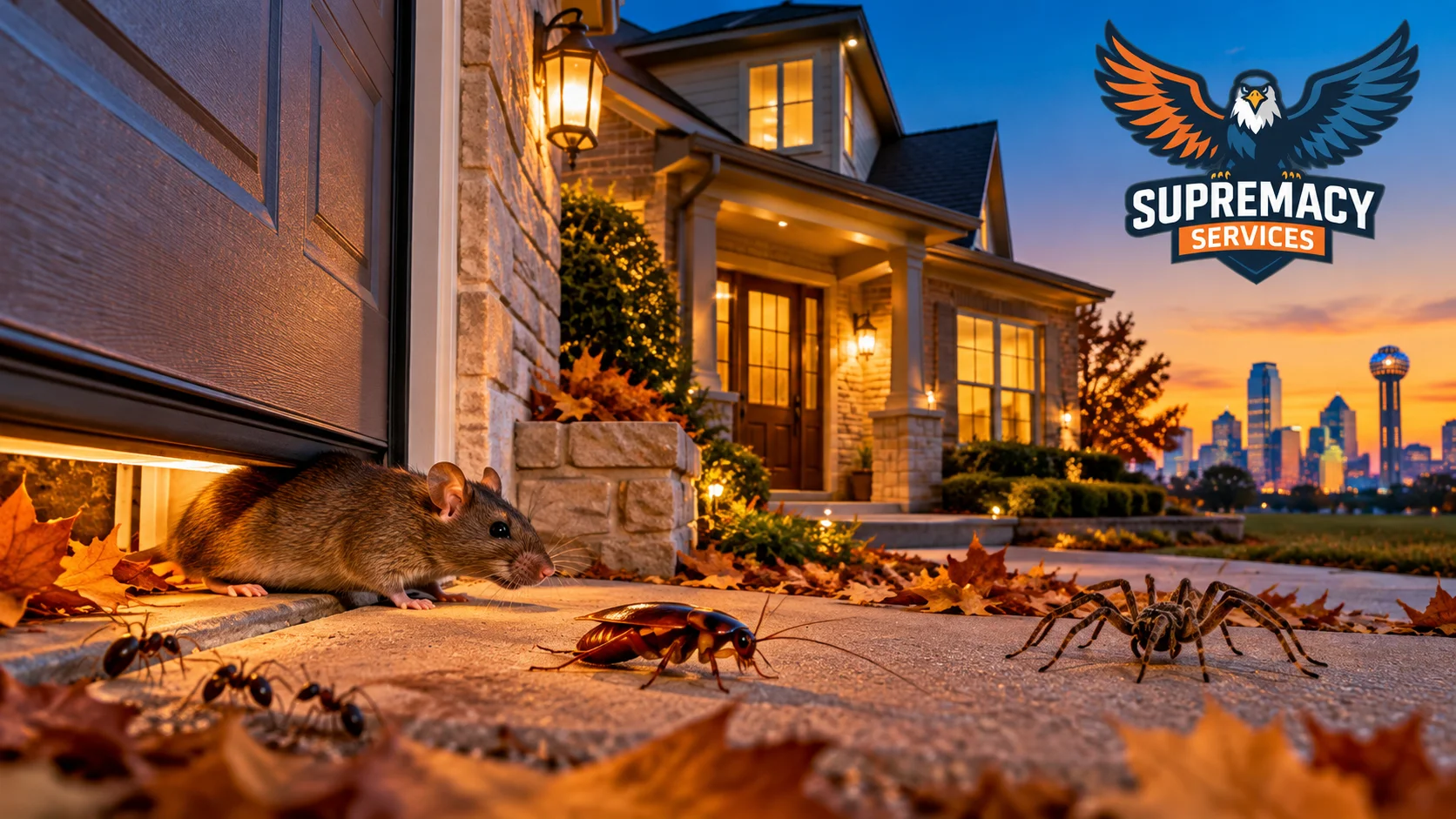
When temperatures drop, some pests move toward buildings because homes provide something outdoor conditions may no longer offer as reliably: protected shelter, stable temperatures, food, water and places to hide. Other insects naturally seek protected locations in which to overwinter.
For Dallas and North Texas homeowners, this does not mean every bug outside suddenly tries to move into the house at the first cold front. Different pests respond differently to seasonal changes. Rodents may remain active and exploit structural openings, while some insects enter protected cracks and wall voids and become relatively inactive until warmer conditions return.
The practical lesson is simple: cold weather can change where pest activity occurs rather than eliminating pest problems altogether.
That makes fall an important time to inspect doors, windows, rooflines, utility penetrations, garages and other potential entry areas.
Table of Contents
- Why Do Pests Come Inside When It Gets Cold?
- Does Cold Weather Kill Pests?
- Which Pests May Become More Noticeable Indoors?
- How Are Pests Getting Into Your House?
- Signs Pests Have Moved Indoors
- Why North Texas Weather Matters
- How to Keep Pests Out When Temperatures Drop
- DIY vs. Professional Pest Control
- What Does Professional Cold-Weather Pest Control Include?
- Frequently Asked Questions
Why Do Pests Come Inside When It Gets Cold?
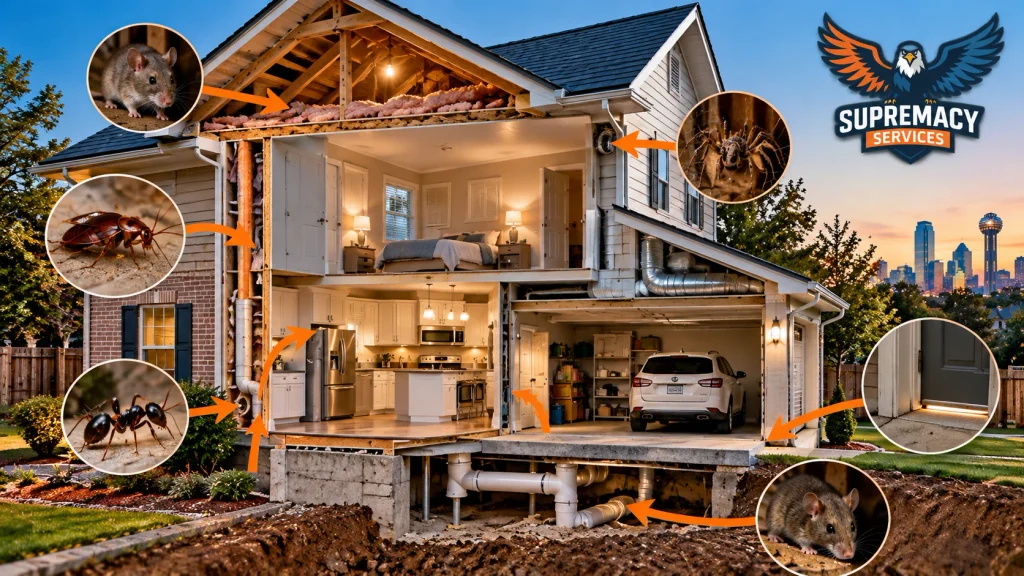
Pests may enter buildings as temperatures fall because structures provide protected shelter and access to resources such as food and water. Some insects also naturally seek sheltered overwintering locations as part of their seasonal life cycle.
The important distinction is that pests are not all behaving the same way.
1. Protected shelter becomes valuable
A wall void, attic, garage, crawl space or gap behind siding is more protected from wind, rain and temperature extremes than an exposed outdoor location.
Some insects specifically seek these types of protected areas for overwintering.
Extension research documents this behavior in several insects. For example, brown marmorated stink bugs seek protected overwintering sites around buildings in fall, while several other nuisance insects similarly use structures as temporary winter shelter. Penn State Extension
2. Your home may continue providing food
Winter does not empty the pantry.
Crumbs, improperly stored dry food, garbage, pet food and other organic material can remain available regardless of outdoor conditions.
EPA pest-prevention guidance emphasizes controlling food, water and shelter because these resources help support pests such as rodents and cockroaches. US EPA
3. Water is available indoors
A leaking pipe under a sink, condensation, pet water, appliance moisture or another damp area can support pests even when exterior conditions become less favorable.
This is particularly important with pests that already live indoors or around plumbing and utility spaces.
4. Buildings contain protected hiding spaces
Homes contain countless areas homeowners rarely disturb:
- wall voids;
- attics;
- garages;
- storage rooms;
- cabinets;
- spaces behind appliances;
- pipe penetrations;
- soffits;
- roof intersections.
Finding pests in one of these locations does not necessarily mean cold weather created the infestation. Seasonal conditions may simply have changed pest movement or made an existing problem more noticeable.
Does Cold Weather Kill Pests?
Sometimes—but not all pests die when winter arrives. Different species survive cold weather using different strategies.
Some insects die after completing their seasonal life cycle. Others survive as eggs, larvae, pupae or adults. Some enter diapause or another low-activity state, while others seek protected locations.
Insects are ectothermic, meaning their body temperature is strongly influenced by their surroundings. Extension entomology research shows that many insects also possess physiological adaptations that allow them to survive surprisingly cold conditions. Crop News
That means:
Cold weather does not equal a pest-free property.
A pest may:
| Cold-weather response | What happens |
|---|---|
| Die seasonally | Adults may die while another life stage survives |
| Become dormant/inactive | Activity becomes difficult to notice |
| Shelter outdoors | Soil, bark, debris and protected vegetation may provide shelter |
| Overwinter in structures | Cracks, attics or wall spaces provide protection |
| Remain active indoors | Indoor conditions continue supporting activity |
| Remain active year-round | Rodents and certain established indoor pests do not simply disappear |
This is why homeowners should avoid assuming that one hard freeze will eliminate an existing infestation.
Which Pests May Become More Noticeable Indoors?

Several very different pest situations can occur as North Texas moves from warm weather into fall and winter.
Rats and mice
Rodents deserve particular attention because they remain active rather than simply becoming dormant inside a wall.
They can use structural openings to reach:
- attics;
- garages;
- kitchens;
- wall cavities;
- storage spaces;
- utility areas.
Warning signs include droppings, gnawing, nighttime scratching, disturbed insulation and damaged food packaging.
Supremacy’s existing rat-control page specifically identifies roof gaps, vents, soffits, garages and utility penetrations as possible access routes around North Texas properties. Supremacy Services
Hearing scratching after dark or finding droppings in the attic? Learn about rodent control and exclusion in DFW to identify the animal and the openings it may be using.
This sends high-intent rodent traffic to the specialist money page instead of trying to make this article rank for “rodent control Dallas.”
Cockroaches
Cockroach sightings require more careful interpretation.
A large cockroach wandering indoors from an exterior environment is different from an established population of German cockroaches living and reproducing around a kitchen.
Supremacy’s cockroach service content already distinguishes recurring indoor infestations from general sightings and identifies food, moisture, shelter and access as important contributing conditions. Supremacy Services
If small cockroaches or multiple life stages repeatedly appear around kitchens or bathrooms, do not assume they are simply temporary “winter visitors.”
That pattern deserves investigation.
Spiders
Spiders can appear in garages, storage areas, eaves and indoor spaces.
But seeing spiders does not necessarily mean they entered solely because the house is warmer.
Their presence can also reflect available insect prey and suitable shelter. Supremacy’s spider-control page appropriately focuses on both spiders and the surrounding insect activity supporting them. Supremacy Services
Overwintering insects
Some insects use buildings as protected winter shelter rather than establishing a normal indoor infestation.
Depending on the species, they may enter:
- siding gaps;
- window-frame gaps;
- attic spaces;
- wall voids;
- soffits;
- cracks around exterior materials.
Some may remain largely inactive before becoming noticeable again on warmer, sunny days.
This distinction matters.
An insect appearing around a sunny window during winter may have been inside a wall void for weeks or months rather than having just entered the home.
Ants
Ant behavior varies greatly by species.
Indoor ant activity should therefore be diagnosed based on species, trail location, food and moisture sources, and possible nesting areas rather than automatically blamed on cold weather.
How Are Pests Getting Into Your House?

Pests usually enter through existing structural openings rather than somehow creating an entirely new path simply because the weather changed.
Common access points include:
| Entry area | What to inspect |
|---|---|
| Exterior doors | Worn sweeps, daylight beneath door |
| Windows | Damaged screens, failed seals, frame gaps |
| Garage | Bottom seal and corners |
| Plumbing | Gaps around pipe penetrations |
| Electrical/utility lines | Unsealed exterior penetrations |
| Roofline | Soffits, fascia, vents and construction gaps |
| Foundation | Cracks and penetrations |
| Exterior vents | Missing/damaged screening where appropriate |
| Siding | Gaps and transitions |
| Attached structures | Junctions between rooflines, patios and walls |
EPA building IPM guidance specifically recommends measures such as sealing cracks and holes, weather-stripping windows and doors, maintaining screens and using door sweeps to reduce pest access. EPA NERL
Why tiny openings matter
Homeowners often search for one obvious hole.
The actual problem may instead be numerous smaller vulnerabilities around the structure.
And different pests require different access.
An opening relevant to an insect is not necessarily the same opening being used by a rat, squirrel or other animal.
That is why pest identification should happen before exclusion work begins.
Signs Pests Have Moved Indoors
Do not judge an infestation from one insect alone.
Look for patterns.
Check for:
- repeated sightings in the same area;
- droppings;
- gnaw marks;
- scratching inside walls or ceilings;
- damaged food packaging;
- egg cases or shed insect skins;
- webs or egg sacs;
- insect activity around plumbing;
- pests repeatedly appearing around windows;
- damaged screens;
- openings around doors;
- disturbed attic insulation;
- grease or rub marks associated with rodent travel;
- pest activity behind appliances or cabinets.
One sighting vs. an infestation
A single occasional invader near a window can represent a completely different problem from:
multiple cockroach life stages + droppings + repeated kitchen sightings.
Likewise:
one spider ≠ established spider infestation.
But:
repeated nighttime attic noises + droppings + gnaw marks = credible evidence of rodent activity that deserves investigation.
Supremacy already has a detailed diagnostic guide for distinguishing rats, mice and squirrels from attic noises, so this article should link there rather than duplicating it. Supremacy Services
Why North Texas Weather Matters
North Texas does not experience one smooth transition from summer into a consistently frozen winter.
The practical cold season can include mild periods interrupted by significant cold fronts.
National Weather Service Dallas/Fort Worth climate data puts the 1991–2020 average first freeze at November 22 and average last freeze at March 12. Actual years vary considerably. Weather.gov
That variability matters because homeowners can still experience pest activity between cold periods.
A warm afternoon does not mean the winter pest issue has disappeared, just as one freeze does not prove that every exterior pest has died.
The better North Texas strategy
Instead of waiting for a freeze, treat fall as an inspection and prevention window.
Look for vulnerabilities while exterior conditions still make inspection and repair practical.
How to Keep Pests Out When Temperatures Drop
The best cold-weather pest strategy begins with exclusion, sanitation, moisture management and correct identification.
That aligns with integrated pest management rather than relying exclusively on repeated pesticide applications. EPA guidance emphasizes removing food, water and shelter and preventing pest access as core pest-management measures. US EPA
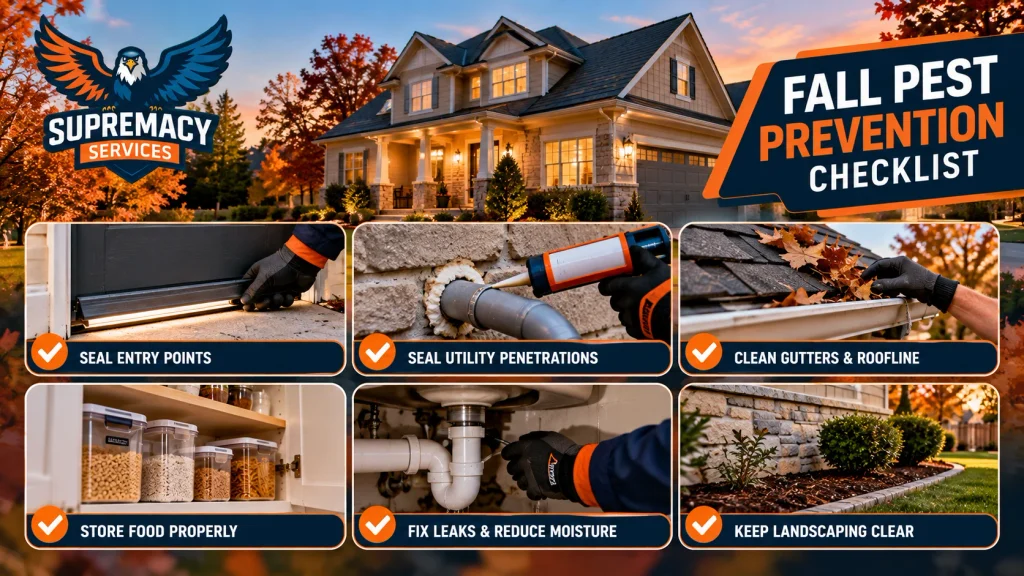
Fall Pest-Proofing Checklist
Outside the house
- Inspect exterior doors.
- Replace damaged door sweeps.
- Check window screens.
- Examine utility penetrations.
- Look for visible foundation gaps.
- Inspect accessible soffit and fascia areas from a safe location.
- Check garage-door seals.
- Remove unnecessary clutter against the structure.
- Address leaking outdoor plumbing.
- Keep garbage properly contained.
- Investigate obvious rodent openings before sealing them.
Inside the house
- Store pantry foods securely.
- Clean crumbs and food residue.
- Avoid leaving pet food accessible unnecessarily.
- Fix plumbing leaks.
- Reduce excessive clutter.
- inspect beneath sinks.
- Check behind accessible appliances.
- monitor garages and storage areas;
- investigate new droppings or gnawing;
- note where and when pests appear.
Important: don’t blindly seal an active animal inside
If scratching, droppings or other evidence suggests an animal is already inside the attic or wall system, simply closing the first hole you find can create another problem.
Determine whether the opening is active and what is using it first.
This is especially important when the problem could involve wildlife rather than insects.
Supremacy’s existing attic guide similarly recommends identifying occupancy before permanently closing active animal openings. Supremacy Services
Does Perimeter Pest Control Help During Cold Weather?
Exterior pest management can be useful when pest pressure originates around the structure, but treatment should be matched to the pest and property rather than treated as a universal solution.
Perimeter strategies can complement:
- structural exclusion;
- moisture correction;
- sanitation;
- harborage reduction;
- pest identification;
- targeted interior treatment where appropriate.
Supremacy already has a dedicated perimeter pest-control service page. This article should introduce the concept and transfer commercial intent there instead of competing for its main keyword. Supremacy Services
Seeing recurring ants, roaches, spiders or other crawling pests around the exterior? Explore Supremacy’s perimeter pest-control approach for protecting common entry areas around DFW homes.
DIY vs. Professional Pest Control
Not every winter pest sighting requires professional treatment.
DIY prevention can make sense when:
- you see an occasional harmless insect;
- the entry point is obvious and safely accessible;
- a screen needs repair;
- weather stripping needs replacement;
- food or pet-food storage needs improvement;
- minor clutter or sanitation is contributing;
- a simple moisture problem can be corrected.
Consider professional inspection when:
- pest activity repeatedly returns;
- you cannot identify the pest;
- cockroaches appear in multiple life stages;
- rodents are heard inside walls or the attic;
- droppings repeatedly appear;
- the infestation involves inaccessible spaces;
- you cannot determine the entry route;
- exclusion requires roofline work;
- DIY treatment repeatedly fails;
- multiple pest problems appear to be connected.
Texas regulates structural pest-control work performed commercially. The Texas Department of Agriculture states that businesses and individuals performing structural pest control for compensation are subject to licensing requirements. Texas Agriculture
What Does Professional Cold-Weather Pest Control Include?
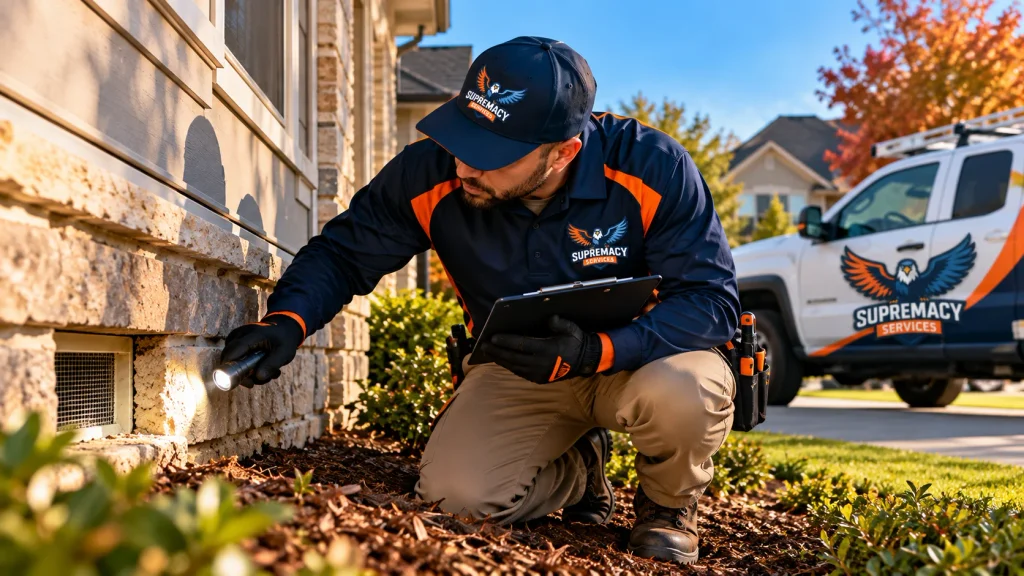
The appropriate process depends on the pest, but professional pest management should begin by understanding the problem rather than simply spraying whichever insect is visible.
A property-specific process may involve:
1. Pest identification
Determine what pest is actually present.
2. Activity inspection
Identify where evidence is concentrated.
3. Entry-point assessment
Check relevant structural vulnerabilities.
4. Conducive-condition assessment
Look for food, moisture, shelter or environmental conditions supporting activity.
5. Appropriate control
Select methods suitable for the pest and location.
6. Exclusion or prevention
Address practical entry points where appropriate.
7. Monitoring
Determine whether activity continues.
This distinction is particularly important because a rat infestation, German cockroach infestation and occasional overwintering insect problem should not receive the same treatment strategy.
What About Pest-Control Costs?
There is no useful single price for a “winter pest problem.”
Cost depends on what is actually happening.
A minor general-pest treatment is fundamentally different from:
- cockroach remediation;
- rodent trapping;
- structural exclusion;
- wildlife removal;
- termite treatment;
- bed-bug treatment.
Factors that can affect the service required include pest type, infestation severity, treatment area, property layout, entry-point repairs and whether ongoing service is appropriate. Supremacy Services
What Cold-Weather Pest Problems Are Commonly Confused?
A winter invader vs. an established infestation
An insect hiding in a wall for winter is not automatically reproducing inside the structure.
Cockroaches vs. occasional outdoor invaders
Repeated small cockroaches around a kitchen deserve different attention from one large outdoor cockroach that wandered inside.
Rats vs. squirrels
Nighttime attic activity tends to make rodents stronger suspects, while daytime activity can point toward squirrels—but physical evidence should confirm the diagnosis. Supremacy already covers this distinction in detail. Supremacy Services
Pest noises vs. house noises
Temperature changes can also cause building materials, ductwork and plumbing systems to make sounds.
Do not diagnose rodents solely from a single unexplained noise.
Frequently Asked Question
Why do bugs suddenly appear in my house when it gets cold?
Some insects seek protected places as outdoor conditions change, while others may already be living around the structure and simply become more noticeable indoors. Food, moisture, shelter and accessible entry points can all contribute.
Do bugs come inside because my house is warm?
Warmth can be part of the attraction, but it is not the only reason. Buildings also provide shelter, moisture, food and protected cracks or voids where pests can survive.
What pests should North Texas homeowners watch for in fall and winter?
Rodents, cockroaches, spiders and various occasional invading insects can become noticeable. The exact pest pressure depends on the property and species rather than temperature alone.
Does freezing weather kill all bugs?
No. Different insects survive winter differently. Some die, while others overwinter as eggs or another life stage, become dormant, shelter outdoors or use protected structures.
Why am I seeing bugs near my windows during winter?
Some insects that entered cracks or wall voids earlier can become active during warmer or sunnier periods and move toward windows and light.
Why do I hear scratching in my attic when it’s cold?
Rats, mice, squirrels or other animals may use protected structural spaces. Time of activity, droppings, gnawing, nesting material and entry points are more useful diagnostic clues than sound alone.
Should I spray every bug I see indoors during winter?
Not necessarily. First identify the pest. Exclusion, sanitation, moisture correction or simple physical removal may be more appropriate for some occasional invaders, while established infestations require pest-specific management.
When should I call a pest-control professional?
Consider an inspection when pests repeatedly return, you cannot identify them, rodents are active inside the structure, cockroaches appear established, entry points are inaccessible or previous DIY efforts have not addressed the source.
Keep Cold-Weather Pests From Becoming an Indoor Problem
When temperatures drop in North Texas, pest activity does not simply disappear.
Some pests become less active. Others seek protected overwintering sites. Rodents remain active. Established indoor pests can continue using food, water and shelter regardless of the season.
The best response is therefore not simply to spray whatever appears.
Identify the pest. Find the entry route. Remove the conditions supporting it. Correct practical structural vulnerabilities. Then use pest-specific treatment when necessary.
For Dallas and DFW homeowners dealing with recurring indoor pest activity, Supremacy Services can inspect the property, identify likely pest pressure and determine whether general pest control, perimeter treatment, rodent exclusion or another targeted service is appropriate.
Pests showing up as North Texas temperatures fall? Explore Supremacy Services’ Dallas-Fort Worth pest-control options or request an inspection to identify what is getting inside and why.

