
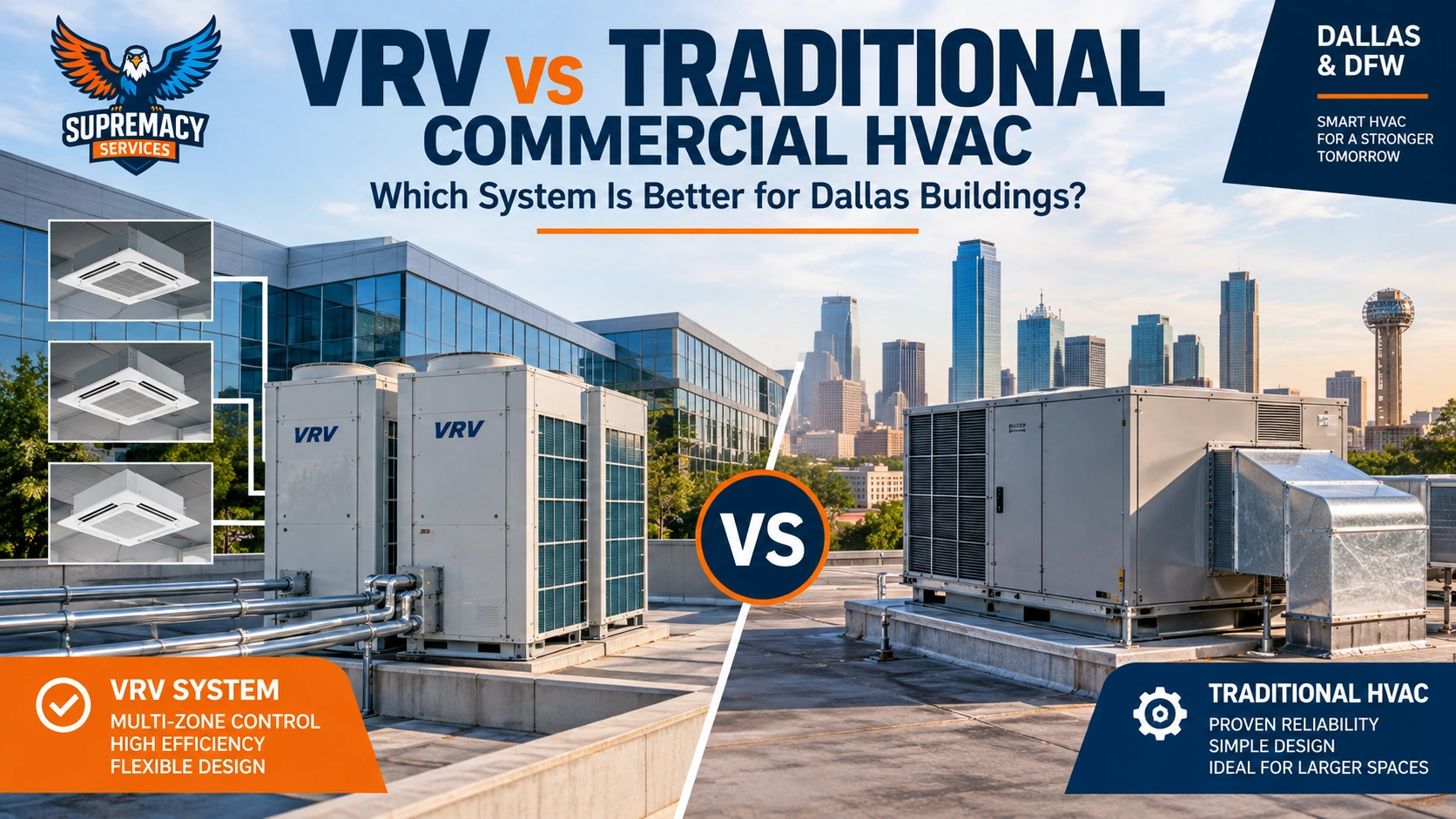
For Dallas commercial buildings, VRV vs traditional HVAC is not a question with one universal winner. VRV systems can be especially attractive when a building needs independent temperature zones, variable loads, limited ductwork or simultaneous heating and cooling. Traditional commercial systems—including packaged rooftop units and conventional split or central systems—may make more sense when simplicity, existing infrastructure, familiar servicing or a lower-complexity replacement is the priority.
The right choice depends on the building rather than the technology alone.
For Dallas property owners, facility managers and developers, the most useful comparison includes cooling loads, zoning, ventilation, installation constraints, controls, maintenance requirements, upfront investment and long-term operating needs.
VRV vs Traditional Commercial HVAC: Quick Comparison
| Factor | VRV/VRF System | Traditional Commercial HVAC |
|---|---|---|
| Temperature control | Excellent individual-zone control | Depends heavily on system and zoning design |
| Capacity control | Variable-speed/modulating | Varies from staged to variable-capacity |
| Ductwork | Often substantially reduced | Usually more dependent on duct distribution |
| Simultaneous heating/cooling | Available with heat-recovery configurations | Usually requires additional system design |
| Retrofit flexibility | Often useful where large ducts are difficult | Advantageous when usable ducts already exist |
| Controls | Sophisticated multi-zone controls | Can range from simple thermostats to advanced BAS |
| Installation complexity | Requires VRV/VRF-specific design and commissioning | Often more familiar to commercial HVAC contractors |
| Ventilation | Usually requires a separate ventilation strategy | Often integrated more directly with air-handling equipment |
| Best fit | Multi-zone, variable-load buildings | Many warehouses, retail spaces and simpler commercial layouts |
| Final selection | Requires building-specific engineering | Requires building-specific engineering |
The important point is that “traditional HVAC” covers several technologies. A modern variable-air-volume system is very different from a basic single-zone rooftop unit. Therefore, system selection should compare actual proposed designs rather than technology labels alone.
What Is a Commercial VRV HVAC System?
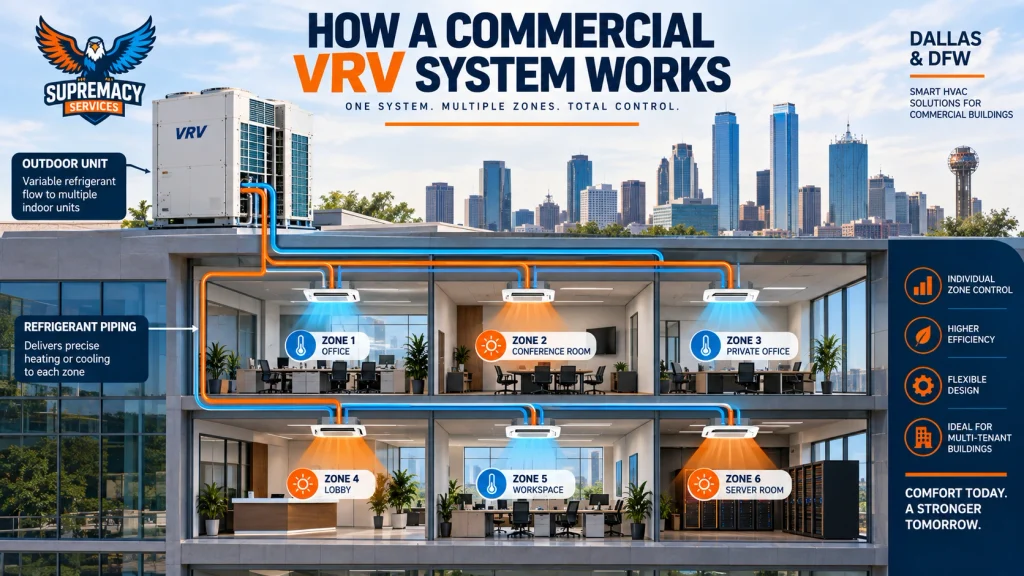
A VRV system—Variable Refrigerant Volume—is a multi-zone HVAC system that varies the amount of refrigerant supplied to individual indoor units according to demand.
VRF, or Variable Refrigerant Flow, is the generic industry term. VRV is terminology associated with Daikin.
The U.S. Department of Energy defines commercial VRF equipment as split-system equipment incorporating variable-capacity compression and multiple individually controlled indoor fan-coil units connected through common refrigerant piping and communications.
Instead of sending conditioned air through one large duct network to every part of a building, VRV/VRF systems move refrigerant to individual indoor units serving separate zones.
That architecture creates one of VRV’s main advantages: different areas can respond more closely to their individual loads.
For example, a Dallas office building may have:
- conference rooms with intermittent occupancy;
- west-facing offices receiving substantial afternoon solar heat;
- interior spaces with little solar exposure;
- server or equipment rooms requiring cooling for longer periods;
- vacant offices needing little conditioning.
Rather than treating every area as though its load were identical, VRV allows the system to respond zone by zone.
How Does Traditional Commercial HVAC Work?
Traditional commercial HVAC may refer to several system types, including:
- packaged rooftop units;
- commercial split systems;
- central air-handling systems;
- variable-air-volume systems;
- heat pumps;
- furnace-and-air-conditioning combinations.
ASHRAE notes that commercial building HVAC selection varies with building size and class. Smaller office buildings commonly use packaged unitary or split equipment, while larger buildings may use combinations of packaged, split and centralized systems.
That distinction matters.
A VRV vs rooftop unit comparison, for example, is more meaningful than simply saying VRV versus “central air.”
Packaged Rooftop Units
Rooftop units, commonly called RTUs, combine major HVAC components into equipment installed on the roof and distribute conditioned air through ductwork.
They are widespread in retail, restaurants, offices, warehouses and other commercial properties.
Their strengths can include straightforward replacement when a building already has rooftop curbs and ducts, relatively familiar service procedures and centralized equipment locations.
Conventional Split or Central Systems
Commercial split and central systems separate equipment into indoor and outdoor components and distribute heating or cooling through ductwork, air handlers or terminal equipment.
The configuration can range from relatively simple to extremely sophisticated.
Is VRV More Energy Efficient Than Traditional HVAC?
VRV can reduce energy use in the right building, but VRV should not automatically be described as more efficient than every conventional commercial HVAC system.
VRV systems can gain efficiency advantages from several design characteristics.
1. Variable-Capacity Operation
An inverter-driven compressor can adjust output as building demand changes rather than operating only at full capacity or off.
This is particularly useful in buildings where loads vary significantly throughout the day.
2. Individual Zone Control
Conditioning an unused conference room and a fully occupied office identically can waste energy.
VRV systems allow individual zones to respond separately, reducing unnecessary conditioning when the system is properly designed and controlled.
3. Reduced Dependence on Large Supply Ducts
VRV distributes heating and cooling primarily through refrigerant piping rather than using large duct systems to transport all thermal energy.
The U.S. Department of Energy has identified reduced fan energy and avoidance of duct thermal losses as potential advantages of VRF and ductless heat-pump technologies.
Ventilation air still has to be properly provided; VRV does not eliminate that requirement.
4. Heat Recovery
Certain heat-recovery VRV systems can move energy between zones.
For example, if an interior equipment room requires cooling while perimeter offices need heating, an appropriately designed heat-recovery system may redistribute heat rather than simply rejecting all of it outdoors.
That capability can be useful in buildings with simultaneous heating and cooling loads.
Why Dallas Climate Makes System Selection Important
Dallas/Fort Worth has a substantial cooling season.
National Weather Service 1991–2020 climate normals show normal DFW high temperatures of approximately 95.6°F in July and 95.8°F in August. The same climate dataset reports an average of roughly 20 days reaching 100°F per year.
Commercial cooling equipment therefore needs to handle prolonged warm-weather operation without sacrificing comfort or reliability.
But Dallas still experiences meaningful winter heating requirements.
That makes part-load performance, heat-pump capability, zoning and system controls relevant alongside peak cooling capacity.
A system should consequently be selected from a proper building load analysis—not simply from square footage or the capacity of the equipment being replaced.
VRV vs Rooftop HVAC Units
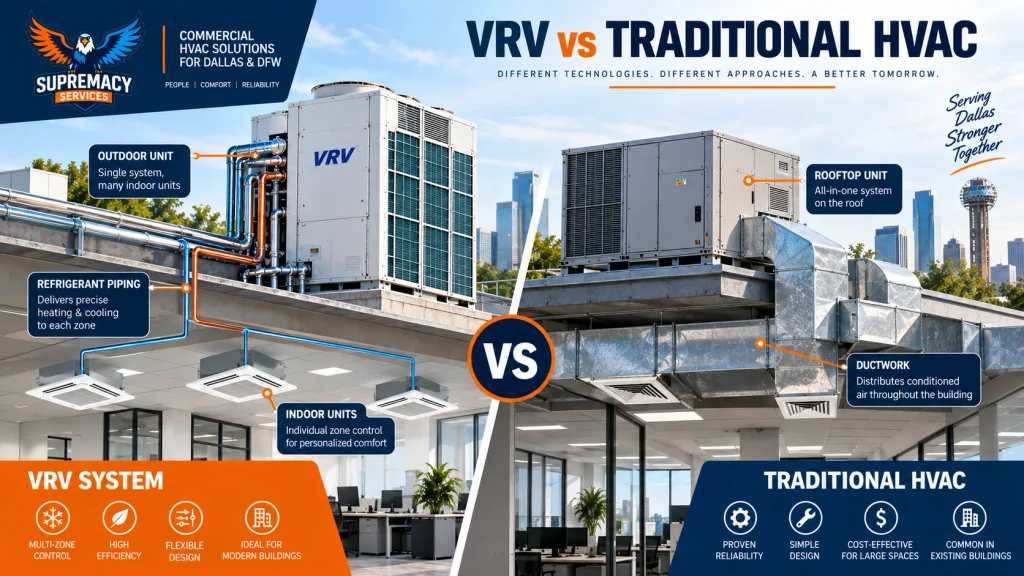
For many Dallas commercial properties, the practical decision is not VRV versus an abstract “traditional HVAC system.” It is VRV versus packaged rooftop units.
| Question | VRV | Rooftop Unit |
|---|---|---|
| Many independent zones? | Strong candidate | Requires zoning/multiple units or additional controls |
| Existing usable ductwork? | May not need much of it | Can make RTU replacement attractive |
| Large open floor area? | Possible, but benefits may be smaller | Often practical |
| Limited interior duct space? | Strong advantage | Can become challenging |
| Simple equipment replacement? | Usually more redesign | Often easier if infrastructure already matches |
| Heat recovery between zones? | Available on suitable systems | Not normally inherent in basic RTUs |
| Individual tenant control? | Strong capability | Depends on configuration |
| Dedicated ventilation needed? | Yes | Can often be incorporated through RTU design |
| Specialized commissioning? | Particularly important | Also important, generally more familiar |
When Rooftop HVAC May Make More Sense
A conventional packaged system can remain a practical choice when:
- the building has large, relatively uniform spaces;
- existing ductwork is correctly sized and in good condition;
- rooftop equipment can be replaced without major redesign;
- independent room-level zoning provides little value;
- straightforward serviceability is a major priority;
- the project budget does not justify extensive HVAC reconfiguration.
Warehouses, certain retail stores and other open commercial spaces may fall into this category.
When VRV May Make More Sense
VRV deserves closer consideration when:
- the building contains many independently occupied rooms;
- different zones experience substantially different loads;
- tenant spaces require individual temperature control;
- installing large new ducts would be disruptive;
- a renovation has limited ceiling or shaft space;
- building usage changes frequently;
- heat recovery between simultaneously heating and cooling zones could be useful.
Which Dallas Commercial Buildings Are Good Candidates for VRV?

VRV is particularly worth evaluating in buildings where zoning and changing loads create problems for conventional single-zone equipment.
Multi-Tenant Offices
Different tenants may operate different hours, use different equipment and prefer different temperatures.
Independent zoning can give building managers much finer control than treating an entire floor as one thermal zone.
Medical and Professional Offices
Rooms with different occupancy schedules and equipment loads can benefit from more granular control.
HVAC design for medical environments may involve additional ventilation, filtration, pressure or code requirements, however, so VRV alone should never be treated as the complete mechanical solution.
Hotels and Hospitality Properties
Guest rooms naturally create highly variable loads because occupancy changes continuously.
Individual room control can therefore be valuable.
Retail and Mixed-Use Buildings
A restaurant, retail store and office suite within the same property can have dramatically different internal loads and operating schedules.
A multi-zone system can help accommodate those differences.
Renovations and Older Buildings
Retrofitting large ductwork into an existing structure can require substantial ceiling, chase and structural space.
Smaller refrigerant piping can create useful design flexibility where duct installation is difficult.
Buildings With Strong Solar Exposure Differences
Dallas buildings with substantial glazing can experience dramatically different loads depending on orientation and time of day.
A west-facing office may need significant afternoon cooling while another portion of the property has a much smaller load.
Independent zones help the HVAC system respond to those differences.
When Is Traditional HVAC the Better Practical Choice?
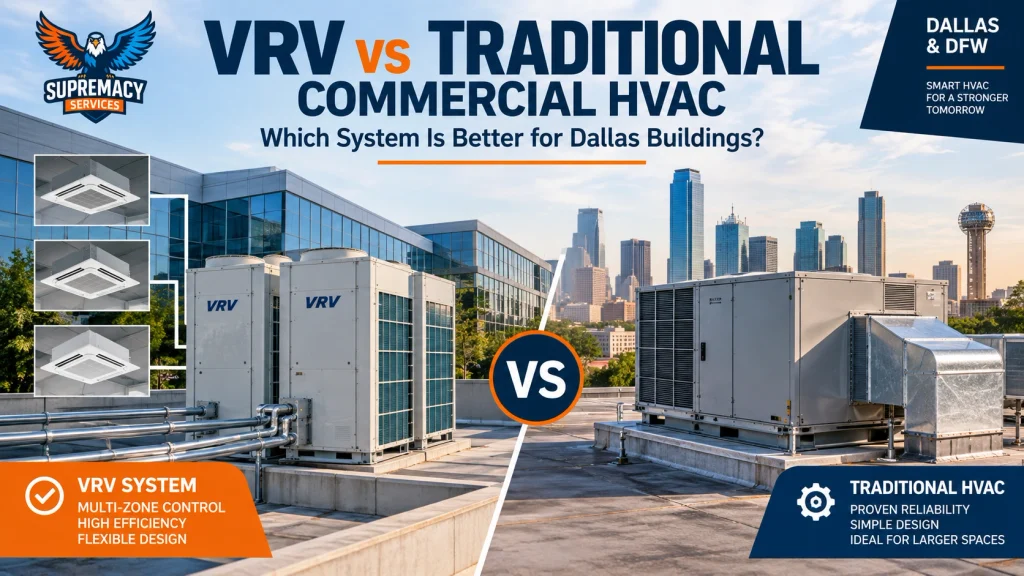
VRV is not automatically the appropriate upgrade simply because it is newer technology.
Traditional commercial HVAC can remain the more practical design when the building has:
- relatively uniform loads;
- extensive serviceable ductwork;
- large open spaces;
- an existing rooftop configuration that supports straightforward replacement;
- limited need for individual-zone control;
- operational staff already familiar with the installed system architecture.
Replacing functioning infrastructure purely to adopt a different HVAC technology can also change project economics substantially.
The better question is:
What problem is the HVAC replacement supposed to solve?
If the main problem is aging rooftop equipment but the duct system, zoning strategy and building layout remain appropriate, a high-efficiency conventional replacement may deserve serious consideration.
If the existing system creates persistent hot/cold zones, poor tenant control or difficult duct constraints, VRV becomes more compelling.
What Are the Disadvantages of VRV?
A credible VRV comparison needs to include its limitations.
More Specialized Design
VRV performance depends heavily on correct:
- load calculations;
- equipment selection;
- refrigerant piping;
- branch configuration;
- controls;
- electrical installation;
- refrigerant charge;
- commissioning.
ASHRAE maintains a dedicated guideline for the design, installation and commissioning of VRF systems, illustrating the importance of treating these systems as engineered networks rather than simply collections of indoor units.
Technician Expertise Matters
Troubleshooting inverter compressors, electronic expansion valves, communications networks and multiple indoor units can require VRV-specific diagnostic experience.
Property owners should consider long-term service capability during system selection—not after installation.
Ventilation Still Has to Be Designed
VRV indoor units primarily address heating and cooling.
Commercial buildings still need a ventilation strategy that satisfies the project’s applicable ventilation and indoor-air requirements.
Depending on the building, this may involve dedicated outdoor-air equipment or another engineered ventilation solution.
Refrigerant-System Design Requires Care
Because refrigerant piping may extend throughout occupied areas, refrigerant quantity, room volume, system architecture and applicable safety requirements must be evaluated during engineering and installation.
Controls Can Become Complex
Sophisticated zoning is valuable only when the controls are properly configured and building operators understand them.
Poor setup can undermine the advantages the system was designed to provide.
VRV vs Traditional HVAC Cost: What Should Dallas Building Owners Compare?
There is no responsible single “Dallas VRV cost” that applies to every commercial building.
A quote should reflect the actual project.
Major cost factors include:
- building size and calculated loads;
- number of temperature zones;
- number and type of indoor units;
- outdoor equipment configuration;
- refrigerant piping distances;
- electrical upgrades;
- controls and building-management integration;
- ventilation requirements;
- accessibility;
- roof or structural work;
- removal of existing equipment;
- commissioning;
- permitting and project-specific code requirements.
A VRV proposal may require greater initial design and controls investment than a simple like-for-like rooftop replacement.
But first cost alone is an incomplete comparison.
Owners should evaluate lifecycle considerations including energy consumption, maintenance, tenant comfort, zoning flexibility, future modifications, equipment accessibility and expected operating patterns.
Ask Contractors for Comparable Proposals
When comparing bids, request enough detail to determine whether contractors are pricing equivalent scopes.
Your comparison should identify:
- equipment capacities;
- efficiency ratings;
- zoning;
- ventilation;
- controls;
- electrical work;
- refrigerant piping;
- duct modifications;
- permits;
- commissioning;
- warranties;
- maintenance requirements;
- exclusions.
A cheaper proposal may simply contain a smaller scope.
Can You Replace a Traditional Commercial HVAC System With VRV?
Yes, many commercial buildings can be converted from conventional HVAC to VRV, but it is not necessarily a direct equipment swap.
A retrofit assessment should examine:
Existing Ductwork
Some ducts may become unnecessary for space conditioning, while portions may remain useful for ventilation.
Electrical Capacity
Outdoor and indoor equipment, controls and associated components require an electrical design appropriate to the proposed system.
Refrigerant Piping Routes
Technicians need feasible routes between outdoor equipment, branch components and indoor units.
Condensate Drainage
Every indoor unit producing condensate needs proper drainage.
Outdoor Equipment Location
Roof and ground locations must account for equipment access, clearances, structural considerations and manufacturer requirements.
Ventilation
Removing a conventional air-distribution system cannot mean accidentally removing the building’s outdoor-air strategy.
Controls
Tenant scheduling, centralized monitoring and building automation requirements should be established before installation.
What Should a Professional Commercial HVAC Assessment Include?
Before recommending VRV or conventional HVAC, a commercial assessment should evaluate more than the age of the existing equipment.
Look for a process that considers:
- building use and occupancy;
- thermal zones;
- operating schedules;
- heating and cooling loads;
- envelope and glazing;
- existing equipment;
- duct condition and layout;
- ventilation requirements;
- electrical infrastructure;
- equipment access;
- controls;
- maintenance access;
- future expansion plans.
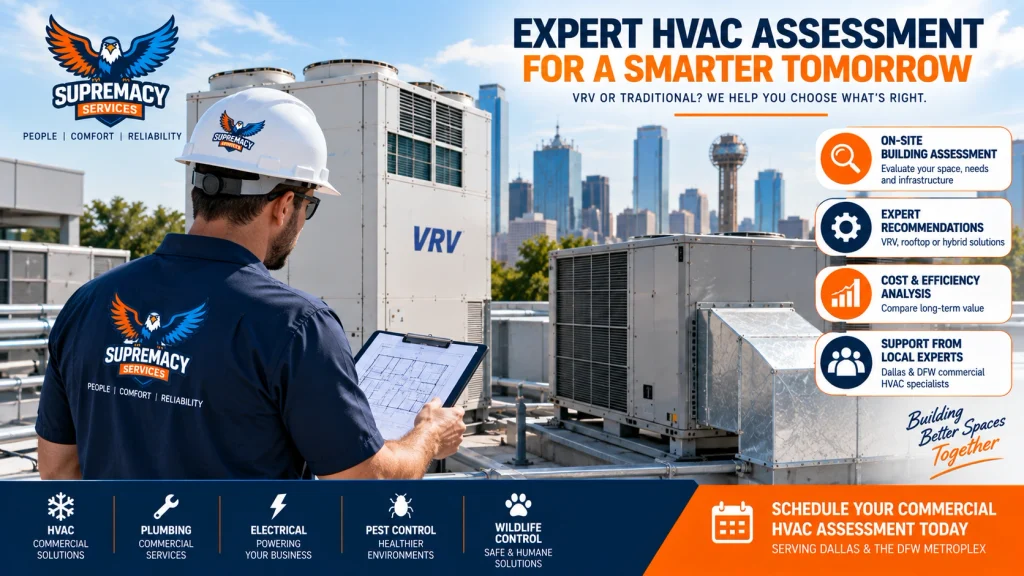
Supremacy Services describes its HVAC installation process as including consultation, site assessment and evaluation of building layout, insulation, window orientation and North Texas climate loads before equipment recommendations.
That is the type of information needed for a meaningful VRV-versus-conventional comparison.
DIY vs Professional Commercial HVAC Decisions
There are useful steps a building owner or facility manager can perform before calling a contractor.
You Can Document
- rooms with recurring comfort complaints;
- existing equipment model information;
- monthly operating schedules;
- tenant occupancy patterns;
- areas that are frequently vacant;
- equipment or server rooms with high internal loads;
- planned renovations;
- historical repair problems.
Leave Engineering and Refrigerant Work to Qualified Professionals
Texas regulates air-conditioning and refrigeration contracting through the Texas Department of Licensing and Regulation. Contractors performing covered installation, repair or maintenance work must meet applicable state licensing requirements.
For a commercial property, improper sizing or installation can affect far more than comfort—it can affect equipment reliability, operating costs and the performance of multiple occupied zones.
How to Choose Between VRV and Traditional Commercial HVAC
Use this five-step decision framework.
Step 1: Identify the Building’s Actual Problems
Are you trying to solve:
- high operating costs?
- repeated equipment failures?
- inconsistent temperatures?
- inadequate zoning?
- tenant complaints?
- lack of ceiling space?
- failing ducts?
- expansion requirements?
Do not select technology before defining the problem.
Step 2: Map the Thermal Zones
Identify spaces with substantially different:
- occupancy;
- orientation;
- schedules;
- equipment loads;
- temperature requirements.
The greater the variation, the more valuable granular zoning may become.
Step 3: Assess Existing Infrastructure
Determine whether the building already has usable:
- ductwork;
- rooftop curbs;
- electrical service;
- controls;
- equipment locations.
Existing infrastructure can materially change retrofit economics.
Step 4: Compare Lifecycle Requirements
Evaluate more than purchase price.
Compare:
- installation scope;
- expected energy use;
- maintenance;
- controls;
- service availability;
- zoning flexibility;
- future modifications;
- comfort requirements.
Step 5: Obtain a Building-Specific Design
The final decision should come from calculated loads and actual building conditions rather than rules such as “VRV always saves money” or “rooftop units are always cheaper.”
VRV vs Traditional HVAC: Which Is Better for Your Dallas Building?
For multi-zone offices, mixed-use properties, hotels, renovations and buildings with widely varying loads, VRV can offer compelling control and design flexibility.
For open commercial spaces, buildings with good existing ductwork or projects needing straightforward like-for-like equipment replacement, conventional rooftop or split systems may remain highly practical.
The decision therefore looks more like this:
Consider VRV when: zoning, part-load operation, architectural flexibility and individual space control are major priorities.
Consider conventional commercial HVAC when: the existing distribution system remains appropriate, loads are comparatively uniform and simplicity of replacement is more valuable than extensive zone-level control.
For many Dallas buildings, neither technology should be selected until the contractor understands how the property actually operates.
Frequently Asked Questions
Is VRV the same as VRF?
Technically, the underlying system concept is the same. VRF means Variable Refrigerant Flow, while VRV is terminology associated with Daikin’s Variable Refrigerant Volume systems.
Is VRV good for commercial buildings?
Yes, VRV can be particularly useful in commercial buildings with multiple zones, varying occupancy schedules or different heating and cooling loads. Suitability still depends on the specific building.
Is VRV better than a rooftop HVAC unit?
Not universally. VRV generally provides more granular zoning, while packaged rooftop units can be highly practical for open spaces and buildings with existing usable duct infrastructure.
Can VRV heat and cool different rooms simultaneously?
Certain heat-recovery VRV/VRF configurations can provide simultaneous heating and cooling to different zones when properly designed.
Does VRV require ductwork?
VRV uses refrigerant piping to distribute most heating and cooling, so large space-conditioning ducts may be reduced. The building still needs an appropriate ventilation system.
Can VRV replace an existing commercial HVAC system?
Often, yes. However, the retrofit requires assessment of refrigerant piping routes, electrical capacity, ventilation, condensate drainage, equipment locations and controls.
Is VRV appropriate for Dallas weather?
VRV can be suitable for Dallas, but equipment selection and system design must account for actual building loads and manufacturer operating specifications. Dallas’ long cooling season makes proper cooling design particularly important.
Does VRV require specialized maintenance?
VRV systems contain inverter-driven compressors, electronic controls, communication networks and multiple indoor units, so technicians familiar with VRV/VRF diagnostics are valuable.
How do I know which commercial HVAC system my building needs?
Start with a professional load and building assessment. The contractor should consider layout, occupancy, operating schedules, existing infrastructure, ventilation, zoning and future building use before recommending equipment.
Get a Commercial HVAC Assessment in Dallas
Choosing between VRV and traditional commercial HVAC should not begin with a brand or equipment brochure. It should begin with the building.
Supremacy Services provides commercial HVAC and VRV services across Dallas and the DFW Metroplex. A building assessment can help determine whether VRV, rooftop equipment or another commercial HVAC configuration better matches your property’s loads, zoning requirements, infrastructure and operating goals.

