

A VRF HVAC system cost in Dallas does not have one reliable flat installation price. The final project cost depends on the building’s heating and cooling loads, required capacity, number and type of indoor zones, heat-pump versus heat-recovery design, refrigerant piping, controls, ventilation requirements, electrical work and installation complexity.
That is why comparing VRF proposals only by tonnage or square footage can be misleading.
A small multi-zone project and a large commercial building may both use Variable Refrigerant Flow technology, but their equipment, piping, controls and labor requirements can be dramatically different.
For Dallas property owners, developers and facility managers evaluating VRF, the better question is:
What determines the installed cost of a VRF system, and what should be included in a professional estimate?
This guide breaks down those factors so you can evaluate a VRF proposal more intelligently.
What Is a VRF HVAC System?
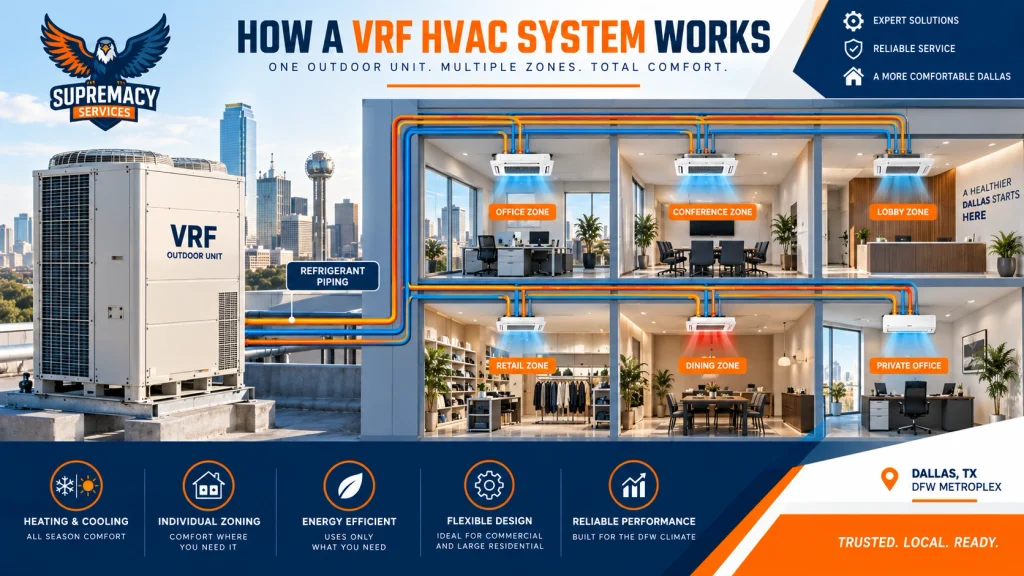
VRF, or Variable Refrigerant Flow, is a multi-zone HVAC technology that varies refrigerant flow to multiple indoor units according to the heating or cooling demand of individual zones.
Instead of relying on one large air handler to distribute conditioned air through extensive ductwork, VRF systems typically connect one or more outdoor units to multiple independently controlled indoor units.
The U.S. Department of Energy defines VRF equipment as systems incorporating variable-capacity compression, multiple indoor fan-coil units, common refrigerant piping and individual controls.
You’ll also encounter the term VRV, or Variable Refrigerant Volume.
VRV is Daikin’s terminology for its variable-refrigerant technology, while VRF is the broader term commonly used across the HVAC industry.
What you’re actually paying for
A complete VRF project can include:
- outdoor condensing units;
- multiple indoor fan-coil units;
- refrigerant piping;
- branch components or selector boxes;
- condensate drainage;
- thermostats and zone controllers;
- centralized controls;
- building-management-system integration;
- ventilation equipment;
- electrical work;
- equipment supports;
- engineering and system design;
- installation labor;
- refrigerant testing and charging;
- startup and commissioning.
Consequently, equipment price alone does not tell you what the finished project will cost.
How Much Does a VRF HVAC System Cost in Dallas?
There is no defensible universal Dallas VRF price per ton or per square foot that applies to every property.
Older industry studies can provide useful context, but they should not be presented as current Dallas contractor pricing.
For example, a U.S. General Services Administration study comparing VRF with a variable-air-volume system modeled an initial VRF cost of $24 per square foot versus $21 per square foot for the comparison system. That historical study is useful for understanding the potential first-cost premium, but it is not a 2026 Dallas price guide.
Current projects require individual estimates.
For homeowners, developers and commercial property managers, the most useful approach is therefore to break the quote into major cost categories.
| Cost component | Why it affects your VRF budget |
|---|---|
| Outdoor equipment | Capacity, number of systems and technology selected |
| Indoor units | Number, capacity and style of conditioned zones |
| Refrigerant piping | Building size, routing and distances between components |
| Heat recovery | Requires additional system components and design |
| Controls | Individual, centralized and building-management controls vary significantly |
| Electrical work | Existing electrical infrastructure may require modification |
| Ventilation | Outside-air requirements may require separate equipment |
| Labor | Accessibility and building complexity affect installation time |
| Existing HVAC removal | Retrofit projects may require demolition and disposal |
| Engineering/design | Larger or complex projects require more extensive planning |
| Commissioning | Testing and configuration are essential to proper VRF operation |
The result is that two Dallas buildings with similar square footage can receive very different VRF proposals.
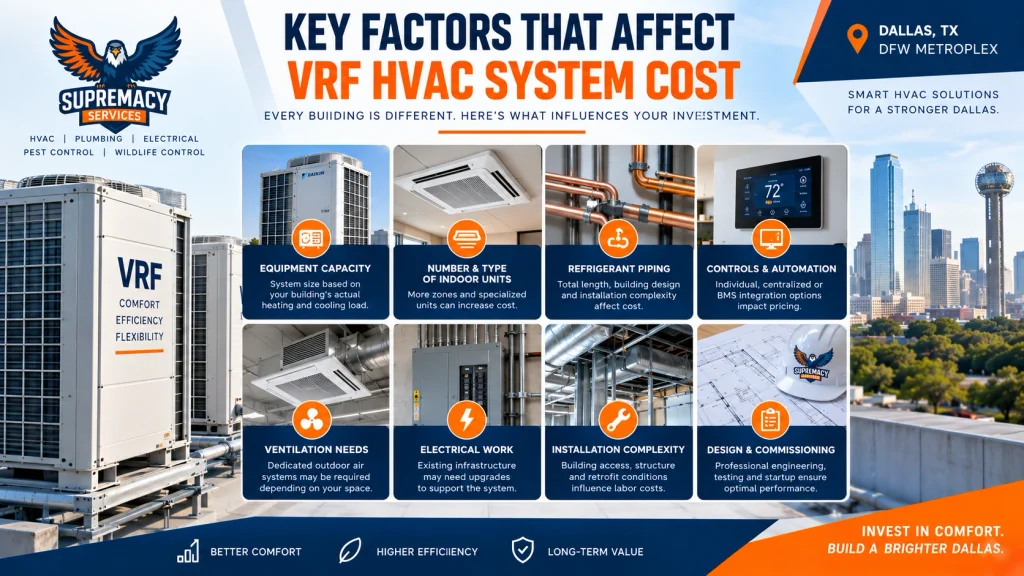
The 8 Biggest Factors Affecting VRF Installation Cost
1. Required HVAC capacity
The first major variable is the building’s actual heating and cooling load.
Square footage matters, but it is not enough to determine equipment size accurately.
A proper HVAC design should also consider factors such as building orientation, insulation, glazing, occupancy, internal heat gains, ventilation and how individual spaces are used.
Oversizing equipment simply because Dallas experiences hot summers is not a substitute for a proper load assessment.
2. Number of HVAC zones
One of VRF’s defining advantages is independent zone control.
That capability also influences project cost.
A building divided into 20 independently controlled spaces requires substantially more indoor equipment, controls and installation work than a similarly sized open-plan building requiring only a handful of zones.
Ask contractors to clearly identify:
- number of proposed zones;
- indoor unit serving each zone;
- capacity assigned to each zone;
- thermostat/control strategy.
3. Type of indoor units
VRF systems can use several indoor-unit configurations.
Common examples include:
- ceiling cassettes;
- concealed ducted units;
- wall-mounted units;
- floor-mounted units.
Selection should be based on the architecture and use of the space rather than appearance alone.
A concealed ducted indoor unit, for example, may require additional ductwork and ceiling access compared with some exposed configurations.
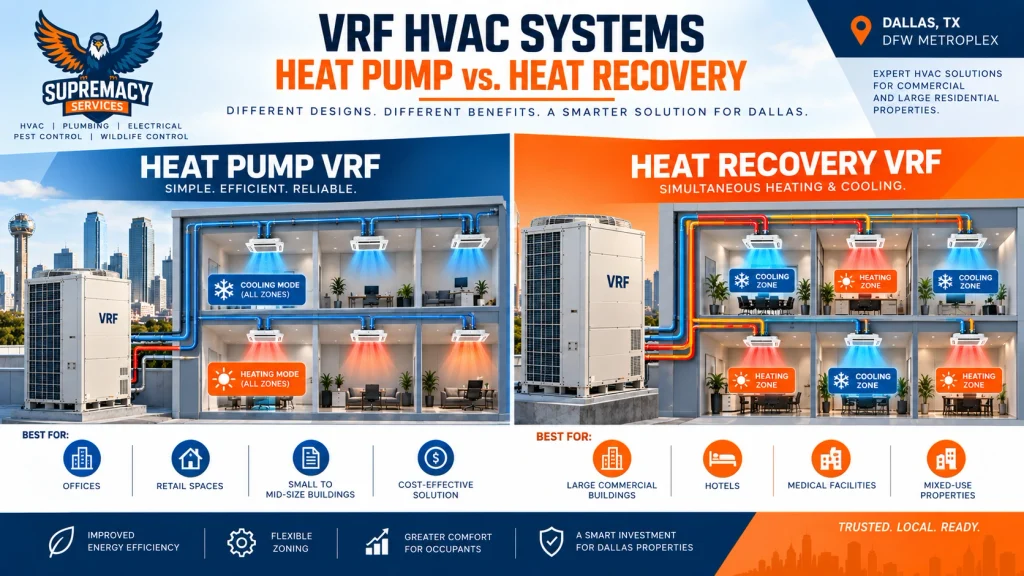
4. Heat Pump vs. Heat Recovery VRF
This distinction can materially affect project design and cost.
Heat-pump VRF generally operates connected zones in the same overall heating or cooling mode.
Heat-recovery VRF can be designed to provide simultaneous heating and cooling to different zones.
That can be particularly useful in buildings where internal rooms, perimeter spaces and sun-exposed areas experience different loads.
Heat recovery requires additional components and system design, so property owners should verify whether the capability is genuinely needed rather than assuming the more complex system is automatically preferable.
5. Refrigerant piping
VRF depends on a carefully engineered refrigerant piping network.
Piping cost depends on:
- total piping length;
- pipe diameter;
- vertical separation;
- number of branches;
- accessibility;
- building construction;
- equipment location.
Manufacturer installation documentation establishes specific piping requirements according to system configuration and connected capacity.
A multi-story retrofit with difficult ceiling access may therefore cost considerably more to install than an open new-construction project.
6. Controls and building automation
VRF controls can range from individual room controllers to sophisticated centralized management platforms.
Larger commercial projects may also integrate the HVAC system with a Building Management System.
For example, manufacturer interfaces can provide BACnet integration that allows compatible building-management platforms to monitor and control multiple indoor-unit groups.
Controls should therefore appear as a clearly defined part of a commercial VRF proposal.
7. Ventilation requirements
VRF primarily handles space heating and cooling.
That does not mean ventilation can be ignored.
Depending on the building and application, dedicated outside-air or energy-recovery equipment may be incorporated into the overall HVAC design.
This is particularly important when comparing a VRF proposal against an existing packaged or central HVAC system that currently handles both conditioning and outside air.
8. Installation conditions
Retrofit conditions frequently create costs that are difficult to estimate from square footage alone.
Potential complications include:
- limited ceiling access;
- occupied-space installation;
- difficult rooftop access;
- long refrigerant runs;
- electrical modifications;
- existing HVAC demolition;
- condensate routing;
- architectural restoration;
- restricted installation hours.
A contractor needs to inspect these conditions before producing a meaningful final proposal.
Does VRF Cost More Than Traditional HVAC?
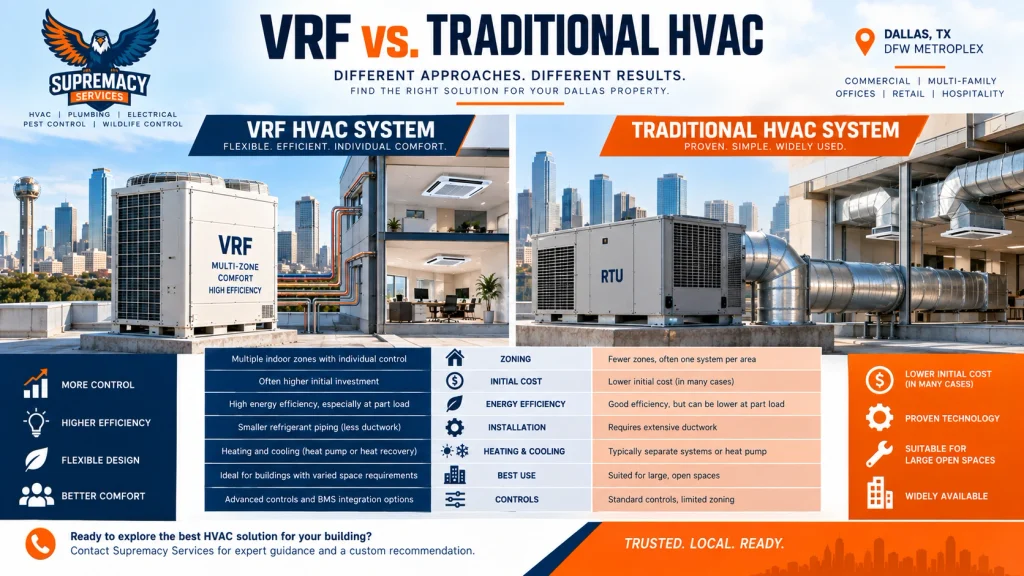
The GSA has identified high first cost as one potential barrier to VRF adoption. However, it also found that certain retrofit applications can narrow that cost difference, particularly where existing buildings have limited room for major ductwork changes.
That distinction matters.
A simple comparison such as:
VRF equipment price vs. rooftop-unit equipment price
does not capture the cost of the complete HVAC project.
A better comparison is:
| Consideration | VRF | Conventional ducted HVAC |
|---|---|---|
| Individual zoning | Major design strength | Depends on system/design |
| Large duct requirements | Often reduced | Often greater |
| Refrigerant piping | More extensive | Usually less extensive |
| Controls | More sophisticated | Varies |
| Heat recovery | Available on appropriate systems | Requires different design approaches |
| Retrofit flexibility | Can be attractive where duct space is limited | Highly project-dependent |
| Installation expertise | Specialized | Broadly available |
| Initial cost | Can be higher | Often lower, but not universally |
| Best choice | Building-dependent | Building-dependent |
The correct decision should therefore come from a building-specific life-cycle and design comparison, not equipment price alone.
When Can VRF Make Sense for a Dallas Building?
VRF deserves serious consideration when a property requires extensive zoning, has varying loads across different spaces, lacks room for large ductwork modifications or would benefit from flexible part-load operation.
Examples can include:
- multi-tenant offices;
- hotels;
- schools;
- medical offices;
- mixed-use properties;
- restaurants with distinct conditioning zones;
- renovated commercial buildings;
- multi-story buildings;
- larger residences with extensive zoning requirements.
The GSA has specifically identified independent temperature control and limited space for ductwork changes as characteristics that can make buildings candidates for VRF evaluation.
That does not mean every such building should use VRF.
It means those properties deserve a proper comparison.
Dallas Climate Considerations
Dallas cooling loads make system selection and sizing particularly important.
A VRF system should be designed from the property’s calculated loads rather than selected from a generic square-foot estimate.
Equipment selection should account for the manufacturer’s published operating data and the project’s actual design conditions.
The location of outdoor equipment also matters.
Adequate clearances, airflow, service access and manufacturer installation requirements need to be incorporated into the design.
For a commercial property, the HVAC contractor should also evaluate how ventilation, occupancy patterns and controls interact with the VRF system rather than treating the outdoor unit as an isolated equipment purchase.
What Should a Dallas VRF Quote Include?
A professional VRF proposal should give you enough information to understand what you are buying.
Look for the following:
Equipment
- manufacturer and model family;
- outdoor unit capacity;
- indoor unit types;
- number of indoor units;
- heat-pump or heat-recovery configuration.
Design
- system zoning;
- load-sizing methodology;
- equipment locations;
- refrigerant piping strategy;
- condensate drainage;
- ventilation strategy where applicable.
Controls
- individual room controls;
- centralized controller;
- remote monitoring where proposed;
- building-management integration where applicable.
Installation
- equipment;
- labor;
- refrigerant piping;
- insulation;
- drains;
- electrical scope;
- supports and penetrations;
- demolition;
- startup.
Commissioning
The contractor should explain how the installed system will be tested and commissioned.
A complex VRF network should not simply be powered on and considered finished.
Warranty and maintenance
Ask:
- What manufacturer warranty applies?
- What labor warranty applies?
- What maintenance is required?
- Who handles manufacturer-specific diagnostics?
- What isn’t included in the proposal?
Getting these answers before signing a contract makes competing bids easier to compare.
Can You Install a VRF System Yourself?
VRF installation is not an appropriate DIY project.
The system requires equipment selection, refrigerant piping, electrical work, controls, pressure testing, evacuation, charging and commissioning according to manufacturer requirements.
Texas also regulates air-conditioning and refrigeration work.
The Texas Department of Licensing and Regulation states that contractors installing, repairing or maintaining air-conditioning, refrigeration or heating systems must hold the appropriate TDLR licensing, subject to applicable statutory exemptions.
For a property owner, that makes contractor credentials an important part of comparing bids—not just price.
What Professional VRF Installation Should Include

A well-planned project generally progresses through several stages.
Step 1: Property assessment
The contractor evaluates the building layout, existing HVAC infrastructure and project objectives.
Step 2: Load assessment and zoning
Heating and cooling requirements are determined and the building is divided into appropriate control zones.
Step 3: System selection
The contractor determines whether VRF is appropriate and selects the necessary outdoor and indoor equipment.
Step 4: Piping and controls design
Refrigerant routes, branch components, condensate drainage and controls are planned.
Step 5: Installation
Equipment, piping, electrical components, controls and related systems are installed.
Step 6: Testing and commissioning
The completed system is tested, configured and commissioned according to the equipment manufacturer’s requirements.
Step 7: Owner handoff
Property owners or facility personnel should receive operating guidance, relevant documentation and maintenance recommendations.
Questions to Ask Before Accepting a VRF Quote
Use this checklist when comparing Dallas contractors:
- What heating and cooling load calculation was performed?
- Why is this VRF configuration recommended?
- Is this heat pump or heat recovery?
- How many independent zones are included?
- What indoor-unit types are being installed?
- Is ventilation included?
- Are electrical modifications included?
- Are controls included?
- Is BMS integration included?
- Does the price include removal of existing equipment?
- What commissioning procedures are included?
- What manufacturer and labor warranties apply?
- What future maintenance will the system require?
- Which items could create change-order costs?
A detailed proposal is far more useful than a single total with little explanation.
VRF vs. VRV: Does the Name Affect Cost?
Not by itself.
VRV and VRF describe the same basic variable-refrigerant concept; VRV is Daikin’s terminology, while VRF is the generic industry term.
Cost differences are better evaluated by comparing the actual equipment, capacity, controls, indoor-unit configuration, installation requirements and support available for the proposed system.
Major manufacturers offer different approaches and product families, so contractors should design around the building rather than selecting equipment solely because of the label.
Don’t Compare VRF Quotes on Price Alone
A lower bid is not necessarily equivalent to a higher bid.
Before comparing totals, verify whether both proposals include the same:
- capacity;
- number of zones;
- indoor units;
- heat-recovery capability;
- controls;
- ventilation scope;
- electrical work;
- demolition;
- commissioning;
- warranties.
A proposal that excludes controls, electrical modifications or ventilation equipment may appear substantially cheaper while representing a different scope of work.
How to Get an Accurate VRF System Cost in Dallas
The most reliable way to determine VRF system cost in Dallas is through a property-specific assessment.
The contractor needs to understand the building’s loads, zoning requirements, existing infrastructure, equipment locations, piping routes, ventilation needs and control strategy before developing an accurate proposal.
Supremacy Services provides VRV/VRF system installation for properties throughout Dallas and the DFW Metroplex.
Frequently Asked Questions
How much does a VRF HVAC system cost in Dallas?
There is no reliable flat Dallas price that applies to every VRF installation. Capacity, number of zones, indoor units, piping, controls, electrical work, ventilation and installation conditions all affect the final project cost.
Is VRF more expensive than traditional HVAC?
VRF can have a higher upfront cost than some conventional HVAC systems, although the difference varies substantially by project. Buildings requiring extensive zoning or difficult ductwork modifications may produce a different cost comparison.
Can VRF work in a house?
Yes. VRF/VRV technology is available for residential applications, particularly larger homes requiring multiple zones. Smaller houses may have simpler HVAC alternatives that should also be evaluated.
What is the difference between VRF and VRV?
VRF means Variable Refrigerant Flow. VRV means Variable Refrigerant Volume and is terminology associated with Daikin’s technology. Both refer to the same general HVAC concept.
Does VRF provide heating and cooling?
Yes. VRF heat-pump systems can provide heating and cooling, while suitable heat-recovery configurations can provide simultaneous heating and cooling to different zones.
How many zones can a VRF system have?
There is no universal number because system limits vary by manufacturer, equipment family and design. The required number of independently controlled spaces should be determined before equipment is selected.
Is VRF suitable for Dallas commercial buildings?
It can be. Properties requiring extensive zoning, part-load operation or reduced reliance on large ductwork can be good candidates for VRF evaluation. The system should still be compared with other HVAC alternatives for the specific building.
What makes a VRF system expensive?
Major cost drivers include capacity, number of indoor units, heat-recovery configuration, refrigerant piping, controls, electrical requirements, ventilation equipment and installation complexity.
How do I compare VRF installation quotes?
Compare the equipment capacity, zones, indoor units, controls, ventilation, electrical scope, commissioning and warranties—not just the final price.
Get a Building-Specific VRF Estimate in Dallas
There is no single VRF system price that accurately represents every Dallas property.
The best proposal is built around the actual building: its loads, zones, architecture, controls, ventilation requirements and existing HVAC infrastructure.
If you’re evaluating VRF for a commercial property, renovation or multi-zone home, contact Supremacy Services for a Dallas VRF/VRV installation assessment and project-specific estimate.

