

A healthy air conditioner should fade into the background of your home—not announce itself every time it starts.
So, if your AC suddenly begins banging, buzzing, rattling, squealing, grinding, clicking, or whistling, it is worth paying attention. Some air conditioner noises come from relatively minor issues such as a loose panel. Others can indicate a failing fan motor, damaged blower assembly, electrical problem, airflow restriction, or compressor issue that should be diagnosed before it causes a more expensive breakdown.
For Dallas homeowners, unusual AC noise can become particularly urgent during periods of heavy cooling demand. When your system runs for long stretches, worn components and small mechanical problems can become much more noticeable.
If you’re wondering, “Why is my AC so loud?”, this guide explains the most common noises, what they may mean, what you can safely check yourself, and when it is time to call a professional for AC repair in Dallas, TX.
Is a Loud Air Conditioner Normal?
Some HVAC sounds are completely normal.
You may hear a soft rush of air through the vents, a low hum from the outdoor condenser, or a brief click when the thermostat starts or stops a cooling cycle.
What generally isn’t normal is a new, unusually loud, persistent, or worsening sound.
Pay particular attention when:
- The noise suddenly appeared.
- Your AC is louder than it was last season.
- You hear metal-on-metal grinding.
- The outdoor condenser shakes or vibrates excessively.
- You hear repeated clicking but the system does not start.
- There is loud buzzing near electrical components.
- Airflow from the vents has become unusually noisy.
- Cooling performance has dropped at the same time.
- The system frequently turns on and off.
- You notice burning odors, smoke, leaking water, or another abnormal condition along with the sound.
Supremacy’s Dallas AC repair technicians diagnose mechanical, electrical, airflow, refrigerant, and control-system problems rather than simply replacing parts based on symptoms.
8 Common Reasons Your AC Is Making Loud Noises
The type of noise often provides an important clue about where the problem is occurring.
1. Banging or Clanking: A Loose or Damaged Component
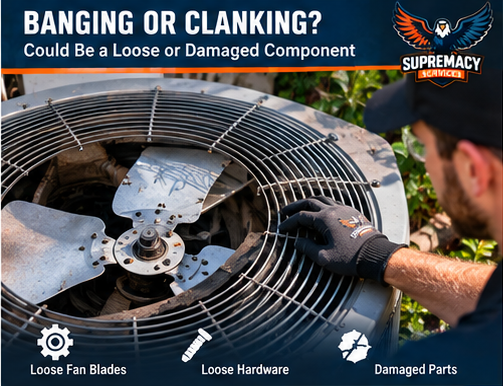
A loud banging noise is one of the sounds homeowners should not ignore.
It can sometimes indicate that a component inside the blower or outdoor condenser has become loose or damaged.
Possible causes include:
- A loose fan blade
- A damaged blower wheel
- Loose mounting hardware
- A component striking the cabinet
- Worn motor mounts
- Internal compressor problems
If the banging sounds metallic or becomes louder as the system runs, turn the system off and have it inspected.
Continuing to operate equipment with a loose rotating component can turn a relatively localized repair into damage affecting other parts of the HVAC system.
When to call a Dallas HVAC technician
Call for service when the banging is persistent, severe, or accompanied by vibration or reduced cooling.
2. Buzzing: Electrical or Outdoor Condenser Problems
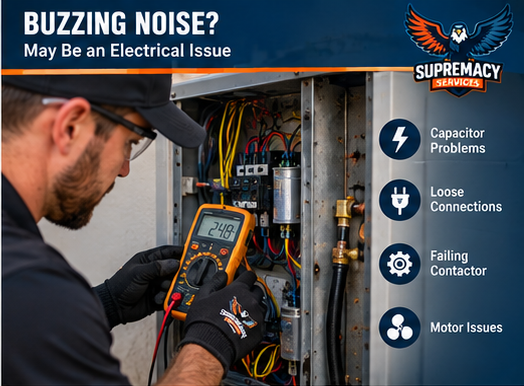
A faint electrical hum can be normal. Loud or abnormal buzzing is different.
Buzzing may be associated with:
- Loose electrical connections
- A failing contactor
- Capacitor problems
- Fan motor issues
- Debris interfering with the condenser fan
- A compressor struggling to start
- Excessive vibration
Electrical HVAC components should not be opened or repaired as a DIY project.
If the noise comes from the electrical section of the unit—or you notice a burning smell, smoke, repeated breaker trips, or scorching—switch the system off and arrange professional service.
For Dallas homeowners experiencing an AC that will not cool correctly in addition to buzzing, Supremacy provides professional AC repair and diagnostics.
3. Rattling: Loose Panels, Debris or Aging Components
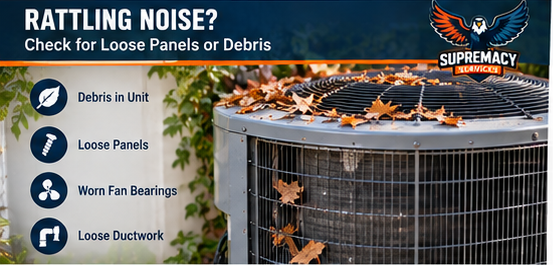
Rattling is one of the most common noisy-AC complaints.
Sometimes the cause is simple.
Leaves, small twigs, or other debris may have entered the outdoor condenser area. A cabinet panel or fastener may also have loosened.
In other cases, rattling can indicate deterioration inside the equipment.
Possible causes include:
- Loose access panels
- Loose screws or fasteners
- Debris near the condenser fan
- Worn fan bearings
- Loose ductwork
- A deteriorating blower assembly
What you can safely check
With the equipment turned off, look around the outside of the condenser for visible leaves or debris. Keep landscaping and loose objects away from the equipment.
Do not remove electrical covers or reach through the condenser grille.
If the rattle appears to originate inside the equipment, schedule a professional inspection.
4. Squealing or Screeching: Motor or Bearing Trouble
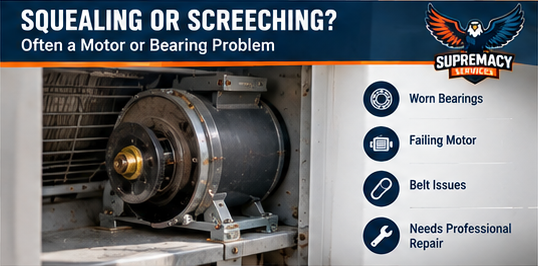
A high-pitched squeal can be hard to ignore—and that is probably a good thing.
Depending on the HVAC system design, squealing or screeching can be associated with the blower motor, condenser fan motor, bearings, or another moving component.
Possible causes include:
- Worn motor bearings
- A failing blower motor
- A condenser fan motor problem
- Friction between moving components
Occasional startup sounds vary between systems, but continuous screeching while the AC runs deserves attention.
Catching a failing motor early may prevent the system from stopping completely during a hot Dallas afternoon.
5. Grinding: Shut the System Down
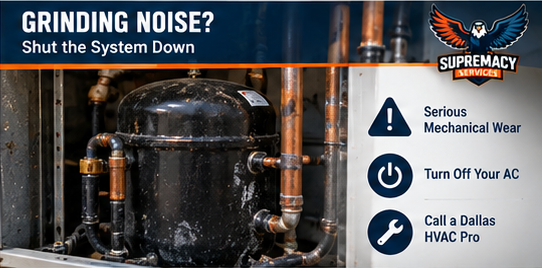
Grinding is among the more serious AC noises.
Metal-on-metal grinding can indicate a motor bearing or rotating component is badly worn or damaged.
If you hear persistent grinding:
Turn your air conditioner off and schedule professional HVAC service.
Running the equipment may allow additional mechanical damage to occur.
Dallas homeowners can schedule professional diagnostics through Supremacy’s HVAC Repair in Dallas service.
6. Clicking: Normal at Startup, Abnormal When It Continues
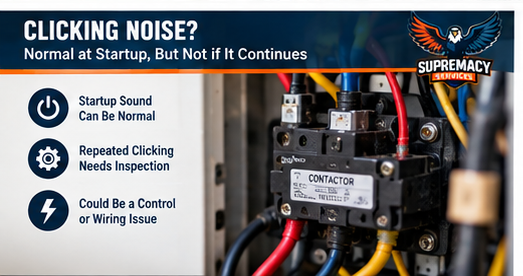
One or two clicks when an air conditioner turns on or shuts down can be normal.
Repeated clicking is another matter.
If your system clicks repeatedly but fails to start, potential problems can include:
- Electrical control problems
- Thermostat or wiring issues
- A failing contactor
- A component struggling to start
The key distinction is frequency.
A single startup click may be normal. Persistent clicking—especially when the AC isn’t cooling—should be investigated.
7. Whistling: Restricted Airflow or Duct Problems
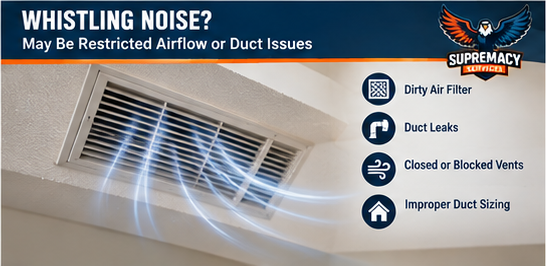
Not every noisy AC problem originates inside the air conditioner.
Sometimes the duct system is responsible.
Whistling may occur when air is being forced through an opening or restriction.
Common possibilities include:
- A dirty air filter
- Restricted return airflow
- Closed or blocked vents
- Air leaking through duct joints
- Improperly sized ductwork
- Excessive system static pressure
This matters because restricted airflow affects more than acoustics. It can reduce comfort and force the HVAC system to work under less-than-ideal operating conditions.
Supremacy’s Dallas ductwork service focuses on properly sized and balanced duct systems designed to reduce problems such as whistling, rattling, and excessive air-rush noise.
Learn more about HVAC Ductwork Installation in Dallas.
8. Loud Humming: Motor, Contactor or Compressor Trouble
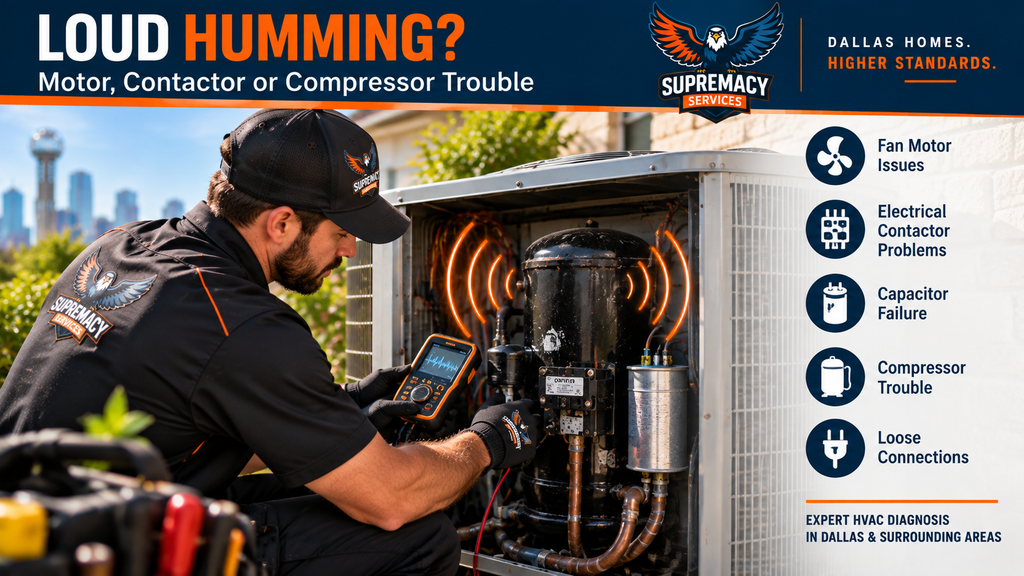
HVAC equipment naturally produces some humming.
The warning sign is when that hum becomes significantly louder than normal, especially if the unit struggles to start.
A technician may need to inspect the:
- Fan motor
- Electrical contactor
- Capacitor
- Compressor
- Electrical connections
- Voltage and current draw
Avoid repeatedly restarting a system that hums but fails to operate correctly. A professional diagnosis can identify the underlying cause instead of allowing the equipment to repeatedly struggle through unsuccessful starts.
AC Noise Troubleshooting Guide
| AC Sound | Possible Cause | How Urgent Is It? |
|---|---|---|
| Banging | Loose fan, blower component or internal mechanical issue | High |
| Buzzing | Electrical component, motor or condenser problem | Moderate–High |
| Rattling | Loose panel, debris, ductwork or worn component | Moderate |
| Squealing | Motor, bearings or moving component | Moderate–High |
| Grinding | Severe mechanical wear or motor problem | High |
| Clicking | Controls, thermostat, wiring or contactor | Moderate |
| Whistling | Restricted airflow or duct leakage | Moderate |
| Loud humming | Electrical, motor or compressor-related issue | Moderate–High |
Important: Sound alone cannot provide a definitive diagnosis. Several HVAC failures can produce similar noises, which is why professional testing is often necessary.
Why Does My AC Sound Louder Inside the House?
If the outdoor condenser seems normal but your home suddenly sounds like a wind tunnel, the problem may be on the indoor side of the HVAC system.
Dirty or restrictive air filter
A severely clogged filter restricts airflow. The blower then has to move air through a smaller effective opening, which may create noticeable airflow noise.
Check the filter and replace it if it is visibly dirty, using the correct filter type for your equipment.
Closed or blocked vents
Closing too many supply registers can alter airflow and increase noise.
Furniture, curtains, rugs, and other objects can also obstruct registers or return grilles.
Ductwork problems
Undersized ducts, poorly designed transitions, loose sections, and leakage can all contribute to HVAC noise.
A professional can measure static pressure and airflow rather than guessing based only on how loud the vents sound.
Supremacy incorporates static-pressure balancing into its Dallas ductwork work to support quieter, less restrictive HVAC performance.
Why Is My Outside AC Unit Suddenly So Loud?
Your outdoor condenser contains several major components, including the compressor, condenser fan and fan motor.
Because these parts operate mechanically and electrically, a significant increase in condenser noise should not automatically be dismissed as “an old AC.”
Common causes can include:
- Loose fan components
- Fan motor wear
- Debris contacting the fan
- Compressor problems
- Loose cabinet hardware
- Electrical components struggling to operate
- Excessive vibration
A technician can isolate the noise and test the affected components.
Why Does My AC Make a Loud Noise When It Starts?
A brief startup sound doesn’t necessarily indicate failure. Compressors and motors draw additional power when starting, and some systems are naturally more noticeable than others.
However, a new hard-starting sound, violent shake, loud buzz, repeated click, or bang at startup warrants investigation.
Potential causes can include electrical-start components, loose mechanical parts, motor issues, or compressor problems.
The important question isn’t simply:
“Does my AC make noise?”
It is:
“Has the sound changed from how this system normally operates?”
A sudden change is often more diagnostically meaningful than volume alone.
Can a Dirty AC Filter Make the System Loud?
Yes—particularly when the noise is related to airflow.
A heavily restricted filter can make the return grille or ductwork sound louder and can reduce the amount of air moving through the HVAC system.
Check your filter when you notice:
- Whistling near the return
- Louder-than-normal airflow
- Reduced airflow from supply vents
- Longer cooling cycles
- Uneven indoor temperatures
Replacing a dirty filter is one of the simplest homeowner maintenance steps.
If the noise continues with a clean filter, the underlying problem may involve duct restrictions, blower performance, system balance, or another mechanical issue.
Can You Fix a Loud AC Yourself?
There are several safe checks Dallas homeowners can perform before requesting service:
- Check whether the air filter is dirty.
- Make sure supply and return vents are unobstructed.
- Look for visible debris around the outdoor condenser.
- Check whether an exterior cabinet panel appears obviously loose.
- Listen carefully and identify whether the sound comes from the indoor unit, vents, or outdoor condenser.
- Note when the sound occurs—startup, shutdown, continuously, or intermittently.
However, avoid opening electrical compartments, touching capacitors, dismantling motors, accessing refrigerant components, or reaching inside operating equipment.
HVAC systems combine high-voltage electricity, fast-moving mechanical parts, and pressurized refrigerant systems. Advanced diagnosis belongs with a qualified HVAC technician.
When Should I Turn My AC Off Immediately?
Some sounds justify shutting the equipment down rather than continuing to troubleshoot.
Turn the system off and arrange professional service if you experience:
- Loud metal-on-metal grinding
- Severe banging or violent vibration
- Smoke
- A burning electrical odor
- Repeated breaker trips
- A fan visibly striking another component
- Loud buzzing while the system fails to start
- A rapidly worsening mechanical sound
If you’re unsure whether continued operation is safe, stopping the system until it can be inspected is generally the more cautious choice.
When to Call a Dallas HVAC Professional
You don’t need to call a technician because your AC makes any sound.
You should call when the noise indicates that the system’s behavior has changed or when basic homeowner checks don’t solve the problem.
Professional AC diagnosis is particularly appropriate when:
- The noise suddenly becomes louder.
- Cooling performance drops.
- The AC begins short cycling.
- The equipment shakes excessively.
- The system won’t start.
- The noise returns after changing the filter.
- The problem appears electrical.
- Grinding, screeching or heavy banging occurs.
- Your AC repeatedly requires repairs.
Supremacy provides professional AC repair and HVAC diagnostics throughout Dallas and surrounding DFW communities, with an emphasis on identifying the root cause before repair work begins.
Should I Repair or Replace a Loud Air Conditioner?
Noise by itself doesn’t automatically mean you need a new AC.
A loose panel on an otherwise healthy system is very different from a major mechanical failure on an aging system with repeated breakdowns.
Consider the broader picture:
Repair may make sense when:
- The system is otherwise reliable.
- The problem is isolated to a serviceable component.
- Cooling performance remains strong.
- Repair history is minimal.
- The repair is financially reasonable compared with replacement.
Replacement may deserve consideration when:
- The system is older and increasingly unreliable.
- Major components are failing.
- Repairs are becoming frequent.
- Cooling is inconsistent.
- Energy consumption has risen substantially.
- The equipment has difficulty keeping your Dallas home comfortable.
If replacement becomes the better long-term option, explore Supremacy’s Air Conditioner Installation in Dallas and HVAC Installation in Dallas services.
How Professional HVAC Maintenance Can Help Prevent Noisy AC Problems

Many noisy-system problems develop gradually.
Routine HVAC maintenance gives a technician an opportunity to identify abnormal vibration, deteriorating components, airflow restrictions, electrical issues, and performance changes before they become an emergency breakdown.
For Dallas cooling systems, professional preventive maintenance is particularly valuable before periods of sustained summer operation.
A maintenance visit may include checks of:
- Electrical connections
- Motors and moving components
- Condenser condition
- Indoor and outdoor coils
- Drainage
- Refrigerant-system performance
- Temperature differential
- Airflow
- Filters
- Thermostat operation
- Overall system performance
Preventive service cannot guarantee that a component will never fail, but it can help uncover developing problems before they turn into disruptive repairs.
Why Dallas Homeowners Choose Supremacy for Noisy AC Diagnostics
When an air conditioner starts making strange noises, replacing a random component isn’t enough. The source of the sound needs to be identified.
Supremacy’s approach emphasizes root-cause HVAC diagnostics for Dallas homes.
Accurate Diagnostics
Our technicians evaluate the relevant mechanical, electrical, airflow and cooling-system components to identify what is actually causing the problem.
Upfront Pricing
You receive clear repair information before approved work begins.
Dallas & DFW Service
Supremacy serves Dallas and surrounding Metroplex communities with heating, cooling, plumbing, electrical and home-service solutions.
24/7 Availability
AC problems don’t always happen during convenient business hours. Supremacy provides round-the-clock service availability for urgent home comfort problems.
AC suddenly grinding, banging, buzzing or refusing to start?
Contact Supremacy Service or request professional Dallas AC repair.
Frequently Asked Questions About Loud Air Conditioners
Why is my AC suddenly so loud?
A sudden increase in AC noise can result from loose components, debris, fan or blower problems, motor wear, electrical faults, airflow restrictions, duct problems, or compressor issues. If the sound is new and persistent, professional diagnosis is recommended.
Why does my AC sound like a jet engine?
Very loud rushing-air noise can be associated with high airflow velocity, restricted returns, dirty filters, duct sizing issues, or blower-related problems. A technician can measure airflow and system static pressure to determine the cause.
Why is my AC making a loud buzzing noise?
Buzzing may be associated with electrical components, a fan motor, contactor, capacitor, loose components, or compressor operation. Loud buzzing combined with failure to start should be professionally diagnosed.
Is a rattling AC dangerous?
Not necessarily. A rattle may be as simple as a loose cabinet panel or debris. However, internal rattling can also indicate a loose or deteriorating mechanical component, so persistent rattling should be investigated.
Should I turn off my AC if it is making a grinding noise?
Yes. Persistent grinding can indicate serious mechanical wear. Shutting the system down can help avoid additional damage until a technician inspects it.
Can dirty ductwork make my AC noisy?
Duct-related noise is more commonly associated with airflow restrictions, leakage, loose duct sections, poor sizing, or excessive air velocity than simply the presence of dust. Professional airflow and static-pressure testing can help identify the actual problem.
How much does it cost to fix a noisy AC in Dallas?
The cost depends on the source of the noise. A loose panel and a failed motor or compressor are very different repairs. A professional diagnostic inspection is the most reliable way to determine the problem and obtain an accurate repair estimate.
Who should I call for a loud AC in Dallas?
For unusual AC noises, cooling problems, short cycling, or system failures in Dallas, contact a qualified HVAC professional. Supremacy provides professional air conditioner repair in Dallas, TX and comprehensive Dallas HVAC repair.
Stop a Strange AC Noise Before It Becomes a Bigger Problem
Your air conditioner doesn’t have to be completely broken to tell you something is wrong.
A new buzz, bang, rattle, squeal, whistle, click, or grinding sound may be the first warning that a component is loose, airflow is restricted, or part of the system is beginning to fail.
Start with the safe basics: check your filter, make sure vents aren’t blocked, inspect the area around the outdoor condenser, and determine where the sound is coming from.
If the noise is severe, persistent, electrical, or accompanied by poor cooling, don’t wait for the system to stop working entirely.

