Commercial bed bug treatment does not automatically mean shutting down an entire business for days. A well-planned response starts by confirming the pest, identifying where activity is occurring, containing potentially affected belongings and choosing treatment methods appropriate for the affected areas.
For Dallas hotels, apartment communities, offices, healthcare facilities and other businesses, the goal is not simply to kill the bed bugs that can be seen. It is to control the infestation while limiting unnecessary movement of people and possessions, protecting unaffected areas and verifying that treatment worked.
Bed bugs can occur in clean, well-maintained properties. The CDC notes that cleanliness does not determine whether bed bugs are present, and they can occur in hotels, apartments, dormitories, transportation and other environments where people spend time or sleep.
Table of Contents
- What Is Commercial Bed Bug Treatment?
- Does a Business Have to Close for Bed Bug Treatment?
- Which Businesses Can Develop Bed Bug Problems?
- What Are the Signs of Bed Bugs in a Business?
- What Should a Business Do Immediately?
- How Does Professional Commercial Bed Bug Treatment Work?
- Heat Treatment vs. Targeted Bed Bug Treatment
- How Can Treatment Be Completed With Less Disruption?
- How Much Does Commercial Bed Bug Treatment Cost?
- DIY vs. Professional Commercial Bed Bug Control
- How Can Businesses Prevent Another Bed Bug Introduction?
- Commercial Bed Bug Treatment in Dallas and DFW
- Frequently Asked Questions
What Is Commercial Bed Bug Treatment?
Commercial bed bug treatment is a structured pest-management program designed to identify, contain, eliminate and monitor bed bugs in a business or managed property.
Unlike treating a single bedroom in a detached home, commercial situations may involve occupied rooms, employees, customers, adjacent units, housekeeping operations, shared furniture or continual movement of luggage and personal belongings.
Effective management therefore starts with investigation rather than indiscriminate spraying.
The EPA recommends an Integrated Pest Management—or IPM—approach to bed bugs. IPM can combine inspection, monitoring, physical controls, heat, encasements and appropriately selected pesticides rather than depending on one control method alone.
For a business, the practical sequence is usually:
- confirm that the pest really is a bed bug;
- determine which areas may be affected;
- contain potentially infested materials;
- select an appropriate treatment strategy;
- treat affected areas;
- inspect and monitor afterward; and
- correct operational practices that could contribute to further spread.
Found evidence of bed bugs at a Dallas-area business? [Request a commercial pest assessment from Supremacy Services] before moving furniture or potentially affected belongings between areas.
Does a Business Have to Close for Bed Bug Treatment?
Not necessarily. Whether operations must stop depends on where the infestation is located, its extent and the treatment method being used.
A single affected hotel room, apartment unit, employee rest area or office may require a very different response from activity detected across multiple adjoining spaces.
The objective should be to isolate the affected area without unnecessarily disrupting parts of the building that inspection shows are not involved.
However, treatment instructions take priority over convenience.
For example, occupants cannot remain in an area while professional whole-room thermal treatment is underway. Pesticide applications may also have specific re-entry requirements established by the product label and treatment professional.
Businesses should therefore avoid assuming either extreme:
- “The entire building has to close,” or
- “Everyone can stay where they are.”
The correct scope should follow inspection and the treatment plan.
Which Businesses Can Develop Bed Bug Problems?
Bed bugs are particularly associated with environments where people sleep, rest or regularly transport personal possessions.
The CDC identifies homes, apartments, hotels, shelters, dormitories, cruise ships, buses and trains among environments where bed bugs may occur. Bed bugs can also be transported on luggage, clothing and personal belongings.
Commercial properties that may need a bed bug response plan include:
- hotels and motels;
- multifamily apartment communities;
- assisted-living or healthcare environments;
- college or dormitory housing;
- shelters;
- offices with employee lounges or upholstered furniture;
- transportation-related facilities;
- property-management portfolios; and
- other properties with frequent movement of people and belongings.
Hotels and hospitality properties
Hotels face a distinct challenge because new guests and luggage continually enter the property.
A bed bug discovery therefore requires more than treating the visible insect. Management needs to understand where activity is occurring, whether adjacent areas warrant inspection and how housekeeping and maintenance personnel should handle potentially affected materials.
Multifamily properties
Apartments and other attached housing require careful investigation because one resident’s report does not necessarily reveal the entire extent of the problem.
EPA guidance specifically emphasizes management participation in bed bug IPM programs in multifamily housing.
Offices and workplaces
Finding a bed bug in an office does not automatically mean that an established infestation exists there.
Bed bugs can hitchhike on belongings, and EPA school guidance makes an important distinction: one bed bug is not necessarily an infestation; inspection and monitoring are required.
That same principle is useful for businesses.
Confirm first. Escalate the treatment response according to the evidence.
What Are the Signs of Bed Bugs in a Business?
Physical evidence is more reliable than relying on unexplained bites alone.
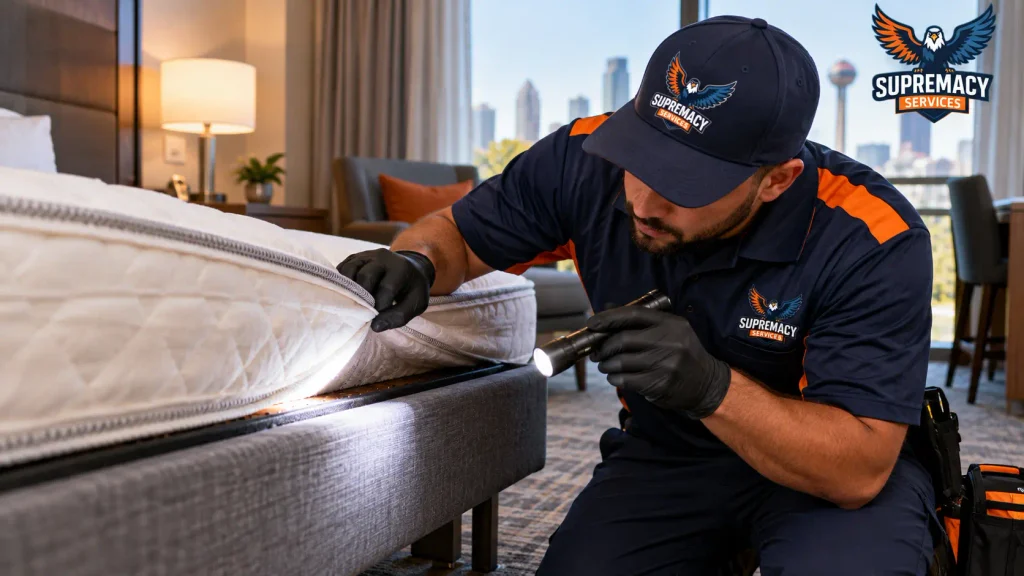
Potential evidence includes:
- live bed bugs;
- dark fecal spotting;
- rusty or reddish stains;
- shed skins;
- pale eggs or eggshells; and
- concentrations of evidence in cracks, seams or furniture.
The CDC also notes that bite reactions can take time to appear and differ substantially between people, so a skin reaction by itself cannot reliably establish that a workplace has bed bugs.
Where should staff inspect?
Depending on the type of property, inspection may concentrate around:
- mattress seams and box springs;
- bed frames and headboards;
- upholstered chairs and couches;
- furniture joints;
- baseboards and nearby cracks;
- luggage-storage areas;
- employee lockers or storage areas when exposure is suspected; and
- nearby rooms or units when the situation warrants expansion of the inspection.
For detailed identification guidance, Supremacy’s existing Signs of Bed Bugs Besides Bites guide should handle the broader identification search intent.
What Should a Business Do Immediately?
If a suspected bed bug is discovered, the first objective is controlled investigation—not panic.
1. Preserve the evidence
If practical, safely capture the suspected insect in a sealed container or take clear photographs.
Correct identification helps prevent an expensive response to the wrong pest.
2. Avoid moving furniture
Do not immediately drag upholstered furniture, mattresses or other suspected items through hallways or unaffected rooms.
Moving infested possessions without containment can make the situation more difficult to manage.
3. Contain movable belongings
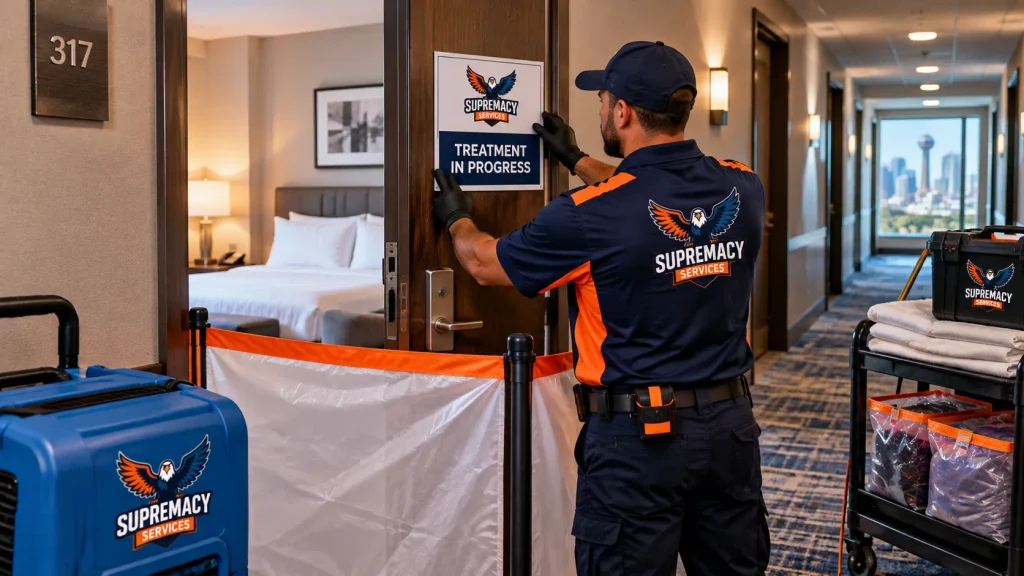
Potentially affected items should be handled according to the treatment provider’s instructions.
EPA guidance recommends sealed bags when moving potentially infested items between areas so insects are not inadvertently transported during preparation.
4. Document where the evidence was found
Record:
- room or unit;
- exact location;
- date and time;
- item where evidence was found;
- photographs, where available; and
- any related reports.
This information can help the pest professional determine where inspection should begin.
5. Arrange professional identification or inspection
Treatment should follow evidence.
Texas regulates structural pest-control businesses and pest-management professionals that perform this work for customers through the Texas Department of Agriculture’s Structural Pest Control Service.
How Does Professional Commercial Bed Bug Treatment Work?
A commercial treatment program should be tailored to the building rather than applied as a generic spray-and-leave service.
Step 1: Inspection and identification
The technician confirms the pest and looks for evidence around likely harborages.
The inspection may then expand according to what is found.
The EPA’s federal bed bug strategy recommends confirming an infestation before control begins because bed bugs can be confused with insects such as carpet beetles, cockroach nymphs and booklice.
Step 2: Determine the treatment zone
The presence of one insect does not automatically tell you how far an infestation extends.
The professional may need to determine:
- whether activity is localized;
- whether adjoining rooms or units require inspection;
- whether furniture has been moved;
- whether belongings could have transported bed bugs elsewhere; and
- whether multiple areas show independent evidence.
This step is critical to minimizing disruption.
Treat too little and the infestation may persist.
Treat far more than the evidence supports and the business may absorb unnecessary operational disruption.
Step 3: Preparation and containment
Preparation requirements depend on the selected treatment.
They may involve:
- handling heat-sensitive items;
- bagging or isolating certain possessions;
- laundering appropriate fabrics;
- reducing excessive clutter;
- providing access around furniture;
- keeping cleaned items separated from untreated ones; and
- temporarily removing occupants from treatment areas.
EPA recommends keeping potentially infested materials contained and avoiding unnecessary movement into other areas.
Step 4: Treatment
Treatment could involve one or several methods.
Common professional tools may include:
- controlled thermal treatment;
- steam;
- vacuuming;
- encasements;
- monitoring devices;
- targeted EPA-registered pesticides; and
- other measures incorporated into an IPM program.
EPA specifically recommends using pesticides as one component of a broader bed bug strategy rather than relying on pesticides alone.
Step 5: Follow-up and monitoring
Treatment is not complete simply because staff no longer see bugs the next morning.
Monitoring helps determine whether activity continues.
EPA specifically identifies interceptors and other monitoring devices as tools for helping determine whether bed bugs have actually been eliminated.
For a business, documentation of inspections, treatments and follow-up findings is particularly useful because multiple employees or managers may be involved in the response.
Heat Treatment vs. Targeted Bed Bug Treatment
No single treatment strategy is automatically best for every commercial property.
| Factor | Professional heat | Targeted/IPM program |
|---|---|---|
| Treatment area | Can treat rooms or larger designated spaces | Can target specific harborages and affected areas |
| Eggs | Lethal heat can kill eggs when required temperatures reach them | Effect depends on methods/products used |
| Residual activity | None | Some registered pesticides can provide residual activity |
| Occupancy during treatment | Treated area must be vacated | Depends on treatment and product label |
| Preparation | Required | Required |
| Monitoring | Still important | Important |
| Repeat visits | May still be required depending on results | Often incorporated into the program |
| Best application | Depends on infestation and property | Depends on infestation and property |
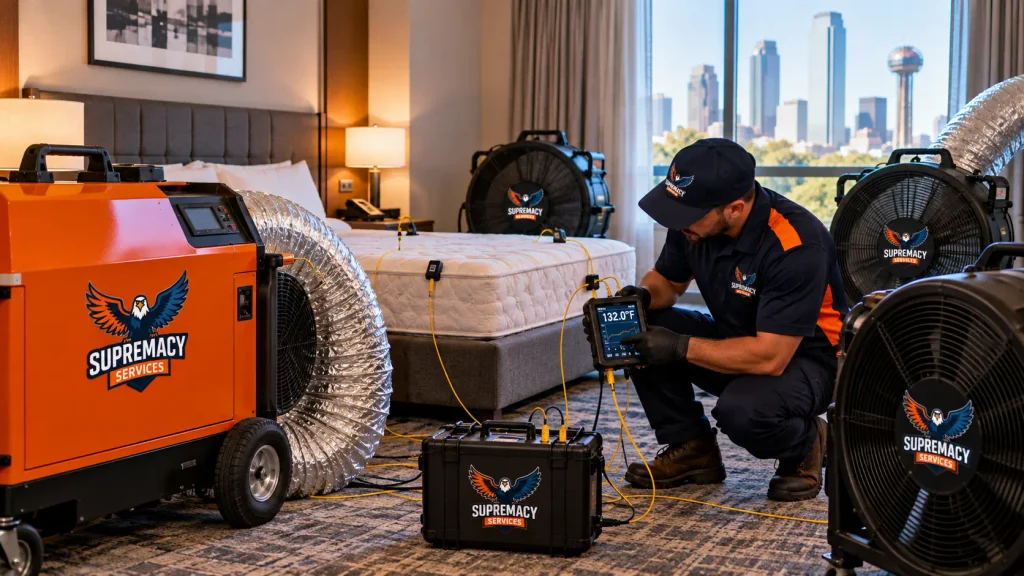
EPA guidance states that heating infested areas to at least 120°F for 90 minutes can kill eggs, but effective professional heat treatment depends on lethal temperatures reaching the actual hiding locations—not merely heating the open air in a room.
This is why whole-room thermal remediation requires specialized equipment, air movement and temperature monitoring.
A Dallas business considering thermal remediation can review Supremacy’s dedicated Bed Bug Thermal Treatments DFW service information rather than using this article as the service page.
How Can Commercial Bed Bug Treatment Be Completed With Less Disruption?
The best way to reduce disruption is not to rush treatment.

It is to determine the correct treatment scope before work begins.
Use inspection to avoid unnecessary treatment
A confirmed insect in one room should trigger a systematic assessment.
It should not automatically trigger treatment of every square foot of the property without evidence.
Isolate affected areas when appropriate
When operationally and technically appropriate, management may temporarily remove an individual room, unit or section from use while unaffected areas continue normal operations.
Whether this is appropriate depends on the inspection findings and treatment strategy.
Schedule around operations
Commercial treatment can sometimes be coordinated:
- after checkout periods;
- between tenant occupancies;
- after office hours;
- during low-traffic periods; or
- around housekeeping and maintenance schedules.
Supremacy’s commercial pest-control page specifically positions flexible scheduling as part of its commercial service model.
Control the movement of belongings
Randomly relocating furniture, uniforms, linens or personal items can undermine containment.
Employees need clear instructions explaining:
- what may be moved;
- what must remain in place;
- what must be bagged;
- what requires laundering;
- and where treated materials should be stored.
Create one point of contact
For hotels, apartment communities and larger facilities, one facilities or management contact should ideally coordinate with the pest-management company.
This reduces contradictory instructions and creates a clearer record of affected locations, completed treatments and follow-up inspections.
Need to control bed bugs without turning the entire property upside down? [Talk with Supremacy Services about a commercial bed bug inspection] to determine the affected area and appropriate treatment scope before scheduling service.
How Much Does Commercial Bed Bug Treatment Cost?
There is no responsible universal price for commercial bed bug treatment.
A 20-room hotel with evidence limited to one confirmed room is fundamentally different from a multifamily building where evidence appears in several units.
Commercial pricing can depend on:
| Cost factor | Why it matters |
|---|---|
| Number of affected rooms | More treatment zones require more labor and equipment |
| Property layout | Adjoining units and complex layouts may expand inspection requirements |
| Infestation extent | Established activity can require broader intervention |
| Treatment method | Heat, targeted treatment and combined programs have different resource requirements |
| Furniture and contents | Dense furnishings can make inspection and treatment more involved |
| Preparation requirements | Commercial properties may require coordinated staff preparation |
| Scheduling | After-hours or operational constraints can affect project planning |
| Monitoring/follow-up | Continued inspection may be part of the treatment program |
| Reintroduction risk | Hotels and other high-turnover facilities may require stronger monitoring procedures |
For that reason, commercial treatment should be quoted from the actual scope of work rather than extrapolated from residential per-room or whole-home pricing.
Supremacy’s existing Commercial Pest Control Cost in Dallas article should continue to own broader commercial pest-control pricing intent, while its dedicated bed bug cost guides handle residential cost searches.
DIY vs. Professional Commercial Bed Bug Control
Businesses can take useful containment and monitoring steps, but established commercial infestations usually warrant professional involvement.
| DIY/Staff Action | Appropriate role |
|---|---|
| Document suspected evidence | Useful |
| Capture a specimen safely | Useful for identification |
| Restrict unnecessary furniture movement | Useful |
| Follow laundering instructions | Useful when part of treatment plan |
| Reduce clutter carefully | Useful |
| Vacuum designated areas | Can support an IPM plan |
| Apply random pesticides | Poor strategy |
| Use foggers indiscriminately | Not recommended |
| Attempt improvised whole-room heating | Dangerous/inappropriate |
EPA specifically warns that DIY whole-room heating using thermostats, propane space heaters or fireplaces does not work reliably and can be dangerous.
Businesses should also remember that pesticide use is governed by product labeling and Texas structural pest-control requirements.
Professional intervention is especially appropriate when:
- bed bugs are confirmed in occupied commercial property;
- evidence occurs in multiple areas;
- the property contains adjoining rooms or units;
- guests, tenants or patients could be affected;
- prior treatment has failed;
- professional heat treatment is being considered; or
- management cannot confidently determine the infestation boundaries.
How Can Businesses Prevent Another Bed Bug Introduction?
No prevention system can guarantee that a bed bug will never be carried into a property.
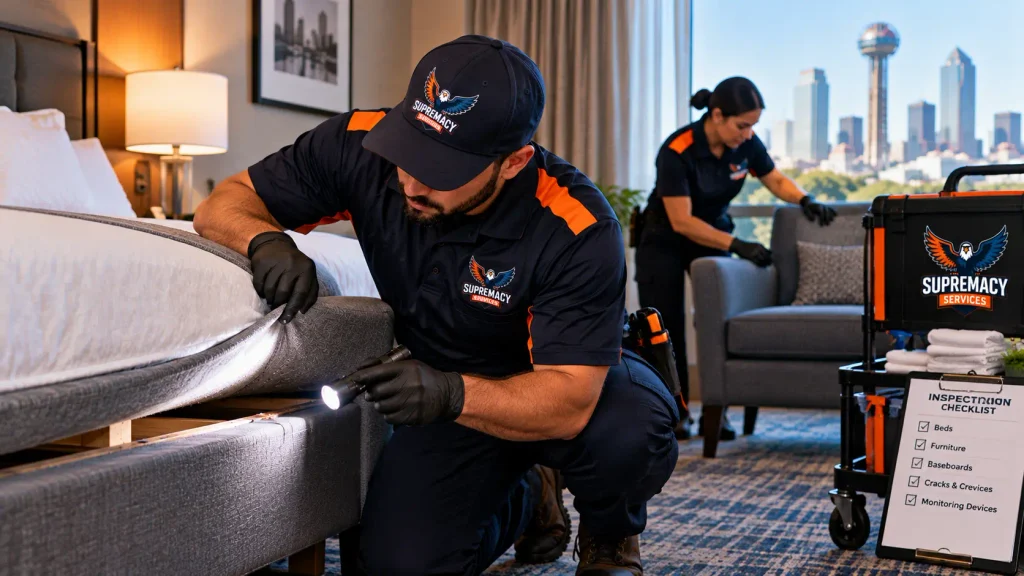
Businesses can, however, make introductions easier to detect and less likely to become established infestations.
Train the people most likely to see early evidence
For hospitality and housing properties, this can include:
- housekeeping staff;
- maintenance employees;
- property managers;
- unit-turn teams; and
- supervisors.
Staff do not need to become entomologists.
They need to recognize suspicious evidence and know whom to report it to.
Establish a written response procedure
Employees should know what happens after a suspected bed bug is discovered.
A useful protocol defines:
- who receives the report;
- how evidence is preserved;
- whether the area is removed from use;
- what items must not be moved;
- who contacts pest management;
- who communicates treatment instructions; and
- how follow-up results are documented.
Inspect secondhand furniture
Bed bugs can hitchhike in furniture and other belongings.
Avoid bringing used upholstered furniture into the property without appropriate inspection.
Monitor high-risk areas
Monitoring does not prevent every introduction, but it can help reveal activity before an infestation becomes obvious.
Do not stigmatize customers, tenants or employees
Bed bugs are not evidence of poor hygiene.
The CDC specifically notes that cleanliness does not determine whether a location has bed bugs.
A calm, standardized response is usually more useful than trying to identify who supposedly “caused” the problem.
What Can Be Mistaken for a Commercial Bed Bug Problem?
Before treatment, make sure the insect is correctly identified.
Potential confusion can include:
- carpet beetles;
- cockroach nymphs;
- booklice;
- fleas;
- unrelated stains on furniture;
- other small insects; and
- skin irritation from causes unrelated to bed bugs.
EPA’s federal strategy specifically cautions that bed bugs can be difficult to distinguish from some other common insects.
The best evidence is an identified specimen or characteristic physical evidence—not a photograph of an unexplained bite.
Commercial Bed Bug Treatment in Dallas and DFW
Dallas businesses have the same fundamental bed bug challenge as businesses elsewhere: people and belongings move continually between buildings.
A commercial response should therefore focus less on generic seasonal pest pressure and more on inspection, containment, treatment logistics and monitoring.
Texas adds one practical consideration: businesses should use appropriately licensed structural pest-management providers when regulated pest-control work is being performed.
The Texas Department of Agriculture’s Structural Pest Control Service licenses and regulates professionals who apply pesticides in and around structures.
Supremacy Services provides pest-control and bed-bug services throughout Dallas and the surrounding DFW Metroplex. Its existing service pages cover commercial pest management, general bed bug control and thermal remediation; this guide is intended to help facility managers understand the treatment process before requesting service.
Frequently Asked Questions
Can a business stay open during bed bug treatment?
Sometimes. The answer depends on the treatment area and method. A specific room or section may be taken out of service while unrelated areas remain operational. People must leave areas undergoing professional thermal treatment and must follow any pesticide-label re-entry requirements.
Does finding one bed bug mean the whole building is infested?
No. One correctly identified bed bug warrants investigation, but it does not establish the size of an infestation. Inspect and monitor before determining the treatment scope.
How do hotels eliminate bed bugs?
Professional hotel bed bug management typically combines inspection, containment, treatment of confirmed areas and follow-up monitoring. The precise method may include heat, physical controls, pesticides or an integrated combination.
Can bed bugs spread between hotel rooms or apartments?
Bed bugs can move or be transported with furniture, luggage, clothing and other possessions. When activity is confirmed, surrounding areas may warrant inspection depending on the circumstances.
Can offices get bed bugs?
Yes, bed bugs can be transported into workplaces on belongings. However, finding a single hitchhiking insect does not necessarily mean an established office infestation is present.
Is commercial bed bug heat treatment effective?
Professional heat can kill bed bugs at all life stages when lethal temperatures reach the insects and eggs for the required exposure. Proper equipment, air circulation and temperature monitoring are important.
How long does commercial bed bug treatment take?
There is no universal treatment duration. Timing depends on property size, affected areas, treatment method, preparation requirements and whether follow-up service is needed.
Should a business throw away infested furniture?
Not automatically. Furniture may sometimes be incorporated into a treatment plan. Moving or discarding potentially infested furniture without a containment plan can create additional problems.
How much does commercial bed bug treatment cost in Dallas?
There is no reliable standard commercial price. Cost depends on the number of rooms or areas involved, infestation extent, treatment method, furniture, preparation, operational scheduling and follow-up requirements.
Who regulates professional pest-control companies in Texas?
The Texas Department of Agriculture’s Structural Pest Control Service regulates structural pest-control businesses and licensed pest-management professionals performing regulated services in and around buildings.
Need Commercial Bed Bug Treatment in Dallas-Fort Worth?
A bed bug report does not automatically mean your entire building needs to shut down or that every room requires the same treatment.
The first step is determining what was found, where activity exists and how far the problem extends.
Supremacy Services provides commercial pest management and professional bed bug treatment across Dallas and the DFW Metroplex.
If your hotel, apartment property, office or commercial facility has confirmed or suspected bed bug activity, schedule a commercial inspection with Supremacy Services to determine the appropriate treatment scope before the problem spreads further.