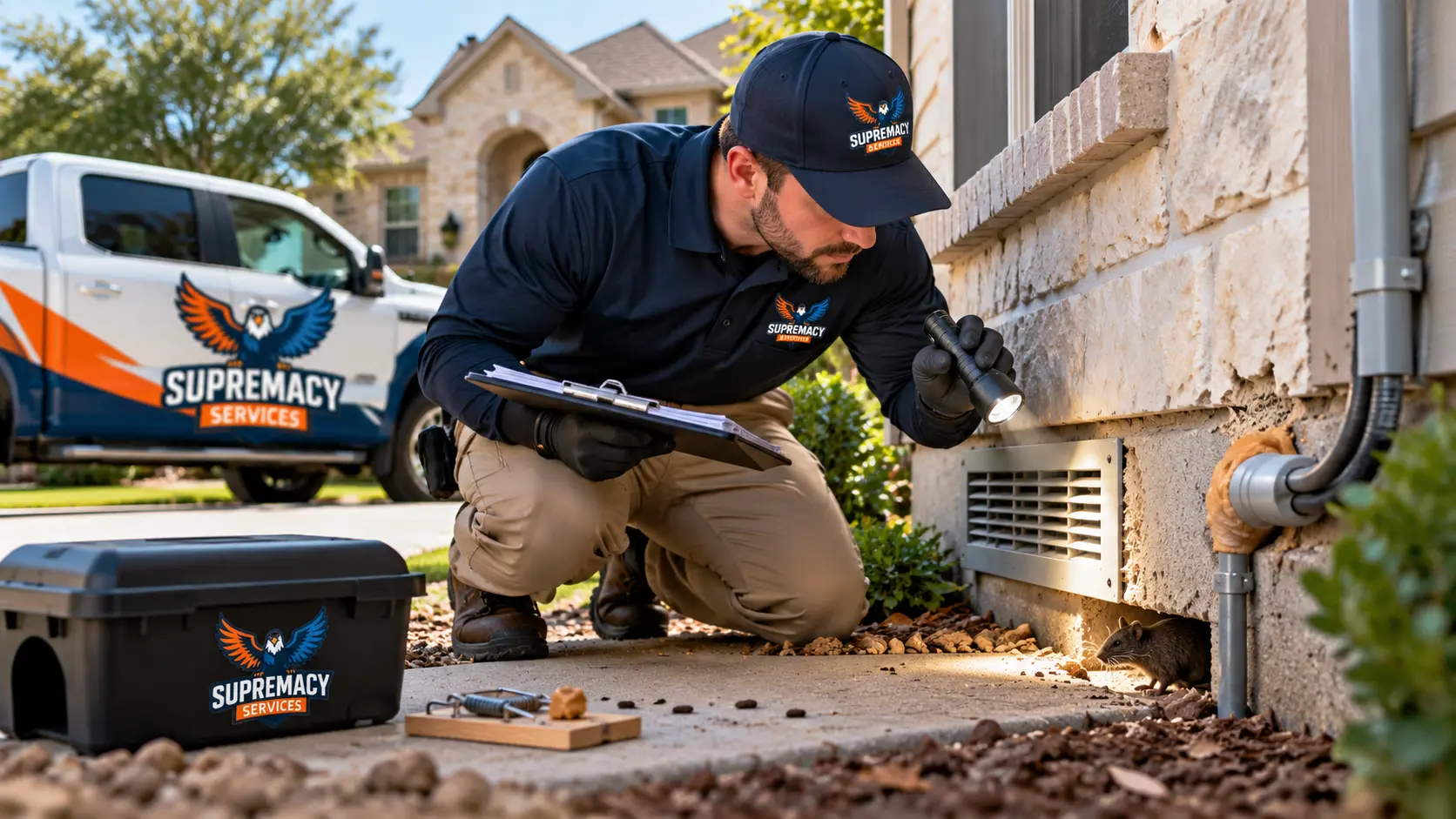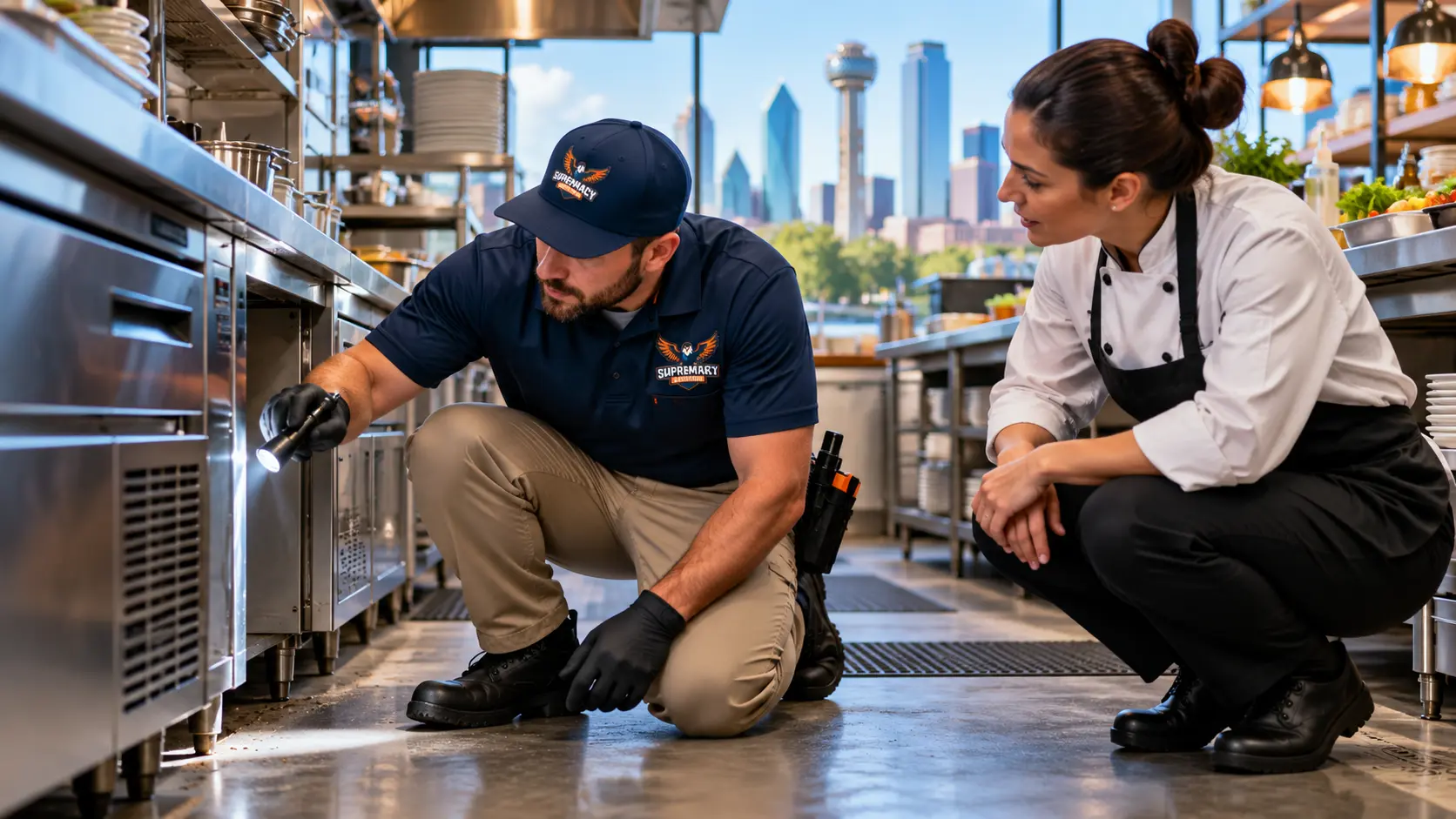
For restaurant Pest Control Dallas or grocery store, pest control is not simply a matter of treating insects after someone sees them. Food businesses need an ongoing system for preventing entry, eliminating food and water sources, monitoring activity, correcting sanitation or structural conditions, documenting findings, and treating active pests appropriately.
That is especially important in food environments because receiving doors, kitchens, drains, storage rooms, dumpsters, cardboard shipments and frequent deliveries continuously create new opportunities for cockroaches, rodents, flies, ants and stored-product pests.
Texas food-establishment guidance specifically addresses controlling insects and rodents, eliminating entry points and harborage areas, and properly locating insect-control devices.
For Dallas businesses, the best approach is therefore a facility-specific Integrated Pest Management, or IPM, program rather than relying on periodic spraying alone.
Table of Contents
- Why pest control is different in food businesses
- What pests create the greatest problems
- Where pest problems usually begin
- What a restaurant or grocery pest-control program should include
- Restaurant vs. grocery-store pest risks
- What Texas food businesses need to know
- How often should food businesses receive pest control?
- DIY vs. professional commercial pest control
- How Dallas businesses can reduce pest pressure
- What to expect from a commercial pest-control provider
- Frequently asked questions
Why Pest Control Is Different in Food Businesses
Restaurants and grocery stores require more than conventional reactive pest treatment because food, water, warmth, deliveries, waste and customer traffic can continuously reintroduce pest pressure.
A restaurant might eliminate one cockroach harboring area only for another introduction to occur through a delivery, cardboard case or neighboring tenant. A grocery store may have excellent sanitation on the sales floor while receiving areas, compactor zones or damaged packaged goods create problems elsewhere.
That is why effective food-business pest control focuses on the whole facility rather than treating the location where an insect happened to be seen.
The U.S. Environmental Protection Agency describes Integrated Pest Management as an approach that combines knowledge of pest biology with monitoring, prevention and appropriate control methods while minimizing unnecessary risk to people, property and the environment.
For a food facility, that generally means asking four questions:
| Question | Why it matters |
|---|---|
| What pest is present? | Different pests require different controls. |
| Where is it entering or breeding? | Treating the visible insect alone may not solve the source. |
| What condition is supporting it? | Water, food residue, clutter, damaged doors or drains can sustain activity. |
| What corrective action will prevent recurrence? | Exclusion, sanitation, repairs and monitoring are often as important as treatment. |
Managing a food-service or retail facility? See how Supremacy approaches commercial pest control across Dallas-Fort Worth.
What Pests Create the Greatest Problems for Restaurants and Grocery Stores?
Food businesses can encounter many pests, but several deserve particularly close attention.
Cockroaches
Cockroaches are particularly concerning around kitchens, food-storage areas, equipment, plumbing penetrations and other warm or moist environments.
Simply treating the insect that is visible may not address activity behind equipment, inside cracks, near plumbing or in other concealed harborages.
Warning signs can include:
- live or dead cockroaches;
- droppings;
- egg cases;
- repeated activity near drains or equipment;
- activity appearing after closing;
- sightings in more than one part of the building.
A single sighting should prompt investigation rather than an assumption that the problem is isolated.
Texas DSHS guidance notes that even insect presence can become a food-establishment compliance issue and emphasizes evaluation of whether the establishment is effectively controlling pest activity.
Rodents
Mice and rats may gain access through structural openings, loading areas, utility penetrations or doors that do not seal properly.
Possible signs include:
- droppings;
- gnaw marks;
- damaged packages;
- nesting material;
- greasy rub marks;
- unexplained noises;
- disturbed stored goods;
- damaged exterior seals.
Rodent control should therefore include both population control and exclusion—finding and addressing how animals are getting into the building.
FDA food guidance emphasizes protecting outer openings against insect and rodent entry through measures such as closing gaps and maintaining tight-fitting doors and windows.
Flies
Different fly species may point toward different underlying conditions.
Drain-associated activity may indicate organic buildup or moisture. Other flies may be tied to waste handling, produce, food residue or exterior conditions.
The important lesson is that repeatedly killing adult flies without identifying where they are developing often produces only temporary improvement.
Ants
Ant problems may begin outdoors but become persistent when workers find reliable food or moisture indoors.
Instead of relying only on contact sprays, the better approach is identifying the species, locating trails and entry points, reducing attractants and choosing a treatment method appropriate to the specific ant.
Stored-Product Pests
Grocery stores, bakeries, food warehouses and restaurants that store dry ingredients can also encounter insects associated with grains, flour, cereals, spices, nuts, pet foods and other packaged goods.
When this happens, inspection needs to extend beyond the building itself to inventory condition, damaged packaging, shelf residues, stock rotation and receiving procedures.
Where Pest Problems Usually Begin
For a food business, pest control should be organized around risk zones, not just rooms.
1. Receiving and Delivery Areas
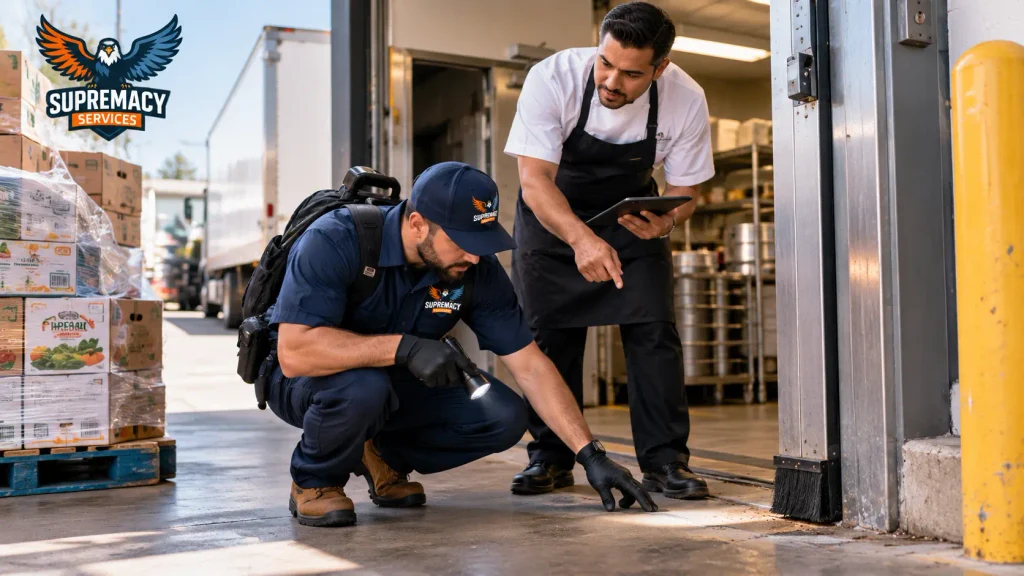
Receiving docks and back doors are frequent points of introduction because merchandise, pallets, reusable containers and cardboard regularly enter the building.
Inspect for:
- damaged door seals;
- gaps around dock doors;
- pests or evidence on incoming goods;
- accumulated cardboard;
- spilled food;
- doors remaining open longer than necessary.
2. Dry Storage
Storage rooms combine food, packaging and hiding areas.
Products should be inspected for damage and pest activity, and inventory practices should make cleaning and inspection possible.
3. Commercial Kitchens
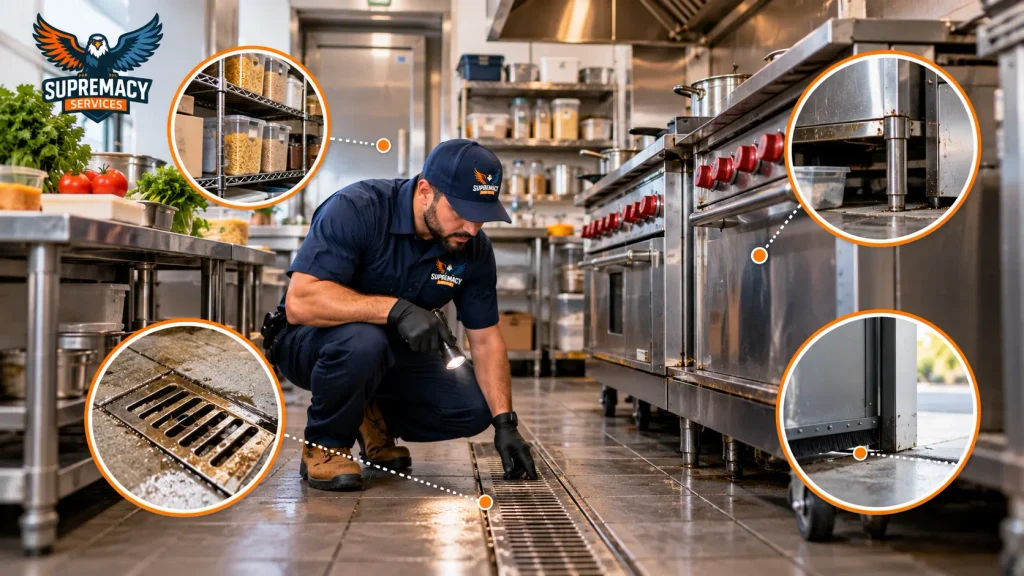
Cooking lines, equipment voids, plumbing penetrations and hard-to-clean areas may provide warmth, moisture and food residue.
Movable equipment should not create permanent blind spots where grease and debris accumulate unnoticed.
4. Floor Drains and Plumbing Areas
Moisture is one of the most important conditions to investigate when pest activity repeatedly returns.
Check for:
- leaks;
- standing water;
- organic buildup;
- damaged plumbing;
- condensation;
- poorly maintained drains.
5. Waste and Dumpster Areas
Waste areas can sustain flies, rodents and other pests before they ever enter the building.
The exterior should therefore be part of the pest-management program, not an afterthought.
6. Employee Break Areas
A spotless commercial kitchen does not eliminate the risk posed by crumbs, open snacks or overflowing waste in staff spaces.
7. Grocery Produce and Floral Areas
Produce deliveries, moisture and organic material create a different pest profile from a conventional retail aisle.
8. Bakery and Bulk-Food Areas
Flour, grains and other dry ingredients require careful stock inspection and cleaning because spilled material can remain in equipment seams and shelving.
9. Exterior Walls and Utility Penetrations
Pipes, conduits, damaged seals and structural gaps can create direct pathways indoors.
This is why exclusion should be part of routine commercial pest management.
What Should a Restaurant or Grocery Pest-Control Program Include?
A strong food-business pest-control program should combine inspection, identification, monitoring, sanitation recommendations, exclusion, targeted treatment, documentation and follow-up.
Facility Inspection
The provider should understand how the facility operates before designing the service.
That includes:
- food preparation;
- receiving;
- storage;
- employee areas;
- customer areas;
- waste handling;
- mechanical spaces;
- building exterior;
- neighboring pest pressures.
Pest Identification
“Bug problem” is not a useful diagnosis.
Treatment should be based on the pest involved and evidence found during inspection.
Monitoring
Monitoring helps reveal trends before pests become obvious to customers or staff.
Depending on the pest and facility, a professional may use appropriately selected monitoring devices in suitable locations.
Importantly, insect-control equipment must itself be installed correctly. FDA Food Code guidance says devices used to electrocute or stun flying insects should not be installed over food-preparation areas or in locations where insect fragments can contaminate exposed food or food-contact items.
Exclusion
Exclusion means making it harder for pests to enter.
Examples include identifying:
- door gaps;
- damaged sweeps;
- penetrations around plumbing or utilities;
- cracks and openings;
- improperly protected exterior openings.
Sanitation and Corrective Recommendations
A pest-control technician cannot compensate indefinitely for a condition that continually supports an infestation.
A useful service report should therefore identify conducive conditions such as:
- food debris;
- moisture;
- clutter;
- damaged packaging;
- unsealed openings;
- waste-management problems.
Targeted Treatment
Chemical treatment is one tool, not the entire program.
EPA’s IPM framework emphasizes using appropriate combinations of preventive and control measures rather than defaulting to indiscriminate pesticide application.
For food establishments, any pesticide use also needs to be consistent with product labeling and applicable requirements.
Documentation and Trend Tracking
Service documentation is particularly valuable for commercial facilities because it creates continuity.
Records may document:
- areas inspected;
- pest evidence;
- monitoring results;
- corrective recommendations;
- treatments performed;
- recurring problem locations;
- follow-up needs.
Over time, that can turn disconnected service visits into an actual pest-management program.
Restaurant vs. Grocery-Store Pest Risks
Both environments handle food, but their pest risks are not identical.
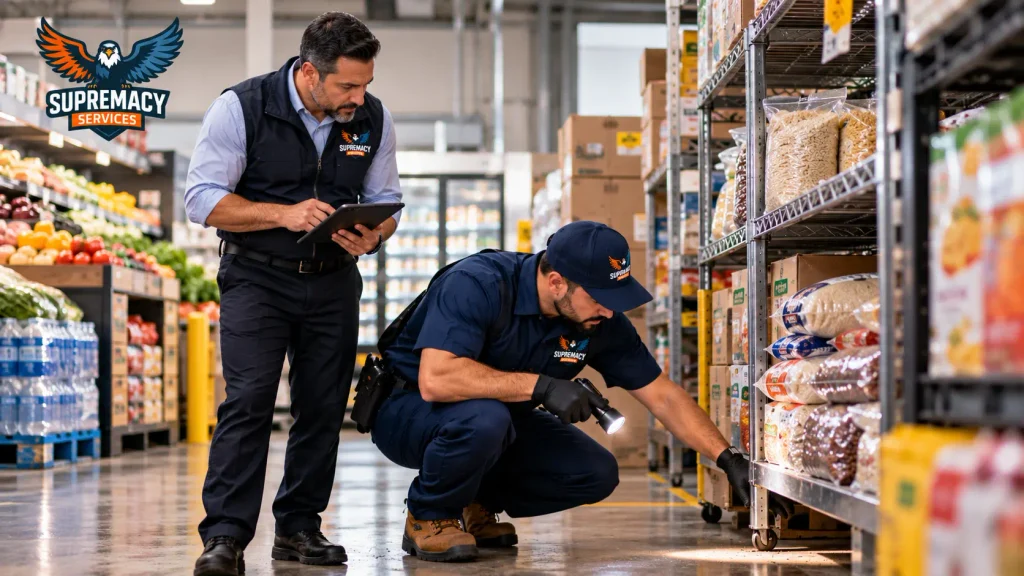
| Area | Restaurant | Grocery store |
|---|---|---|
| Cooking grease | High concern | Usually localized |
| Floor drains | Often numerous in kitchen areas | More concentrated in prep/service departments |
| Receiving | Frequent | Very high volume |
| Cardboard | Moderate to high | Often very high |
| Produce | Depends on concept | Major department risk |
| Dry-food inventory | Moderate | Extensive |
| Customer traffic | High | High |
| Bakery | Concept-dependent | Common specialized department |
| Compactors/dumpsters | Important | Often substantial volume |
| Stored-product pests | Possible | Greater range of susceptible merchandise |
Restaurants
A restaurant program should pay particular attention to kitchens, bars, beverage stations, dishwashing areas, drains, grease areas, back doors, storage and dumpsters.
Grocery Stores
A grocery-store plan usually needs a broader departmental approach because the building may include produce, bakery, deli, meat or seafood areas, dry grocery, loading docks, storage, compactors and large amounts of packaged inventory.
That makes communication between pest-control personnel and department managers especially important.
What Texas Food Businesses Need to Know
Texas does not treat pests in restaurants and grocery stores as merely a cosmetic concern.
The Texas Food Establishment Rules establish minimum standards for retail food establishments, and DSHS states that these establishments include restaurants and grocery stores. Local jurisdictions enforce food rules within their authority.
Texas inspection guidance specifically evaluates whether insects, rodents and other animals are absent and whether operators are taking measures such as eliminating entry points and harborage areas.
The City of Dallas also maintains food-establishment requirements addressing protection of food and food-related items from contamination by insects and rodents.
That does not mean every business should follow an identical treatment schedule or automatically apply pesticides on a fixed calendar.
It means management needs a functioning pest-prevention and control system.
Use properly licensed professionals
Texas regulates structural pest-control providers. The Texas Department of Agriculture states that businesses performing structural pest control for compensation must be licensed, and its pest-control category specifically includes pests in restaurants, stores and other buildings.
Before hiring a provider, a business can verify current licensing information through TDA’s Structural Pest Control Service resources.
How Often Should Food Businesses Receive Pest Control?
There is no single service interval that is appropriate for every restaurant or grocery store. Frequency should be based on facility risk, pest history, monitoring data, sanitation conditions, building characteristics and ongoing pest pressure.
A high-volume restaurant with recurring cockroach activity may require a different level of monitoring and follow-up from a small, well-sealed specialty food store with no active infestation.
Factors that can justify more intensive service include:
- confirmed pest activity;
- repeated introductions;
- extensive food handling;
- long operating hours;
- multiple kitchens or food departments;
- neighboring pest pressure;
- loading docks or frequent deliveries;
- large waste volumes;
- documented structural deficiencies.
Businesses should therefore avoid choosing a schedule simply because “monthly” or “quarterly” sounds standard.
The service frequency should follow the risk.
If recurring pest pressure is affecting a Dallas restaurant, grocery store or other commercial property, request a facility assessment and a pest-management plan built around the building’s actual risk areas.
DIY vs. Professional Commercial Pest Control
Employees play an essential role in pest prevention, but an active or recurring pest problem in a food establishment is usually not a good place for improvised pesticide use.
Tasks employees can handle
Staff should be trained to:
- report sightings promptly;
- clean food spills;
- maintain waste areas;
- inspect incoming goods;
- reduce unnecessary cardboard;
- keep doors closed;
- identify water leaks;
- maintain accessible cleaning zones;
- follow stock-rotation procedures;
- record recurring pest observations.
When professional help makes sense
Professional evaluation is appropriate when:
- cockroaches or rodents are confirmed;
- activity continues after sanitation corrections;
- the source cannot be identified;
- pests are appearing in food-handling areas;
- multiple areas of the facility are affected;
- structural exclusion is needed;
- management needs consistent monitoring and documentation;
- pest activity is recurring between attempted treatments.
Texas requires commercial structural pest-control businesses performing services for compensation to meet state licensing requirements.
How Dallas Businesses Can Reduce Pest Pressure
Professional pest control works best when facility management and the pest-control provider work together.
Daily
- Clean spills promptly.
- Keep food appropriately contained.
- Empty waste before it becomes a pest source.
- Report pest sightings.
- Keep receiving and exterior doors closed when not actively in use.
- Address obvious standing water.
Weekly
- Inspect hard-to-reach areas.
- Check storage for damaged packages.
- Remove unnecessary cardboard.
- Review recurring pest observations.
- Inspect waste and exterior zones.
Routinely
- Check door sweeps and seals.
- Repair plumbing leaks.
- Inspect utility penetrations.
- Review pest-monitoring trends.
- Correct structural openings.
- Review receiving practices with staff.
After Deliveries
Pay particular attention to incoming cartons, pallets, produce and other goods.
Pests can be introduced even into a clean facility, so receiving procedures form an important line of defense.
After Construction or Maintenance
A new plumbing penetration, damaged door, remodel or equipment installation can create pest access where none previously existed.
When building work changes the envelope of the structure, inspect the affected area before assuming the pest-control system remains intact.
What Should Dallas Businesses Expect From a Commercial Pest-Control Provider?
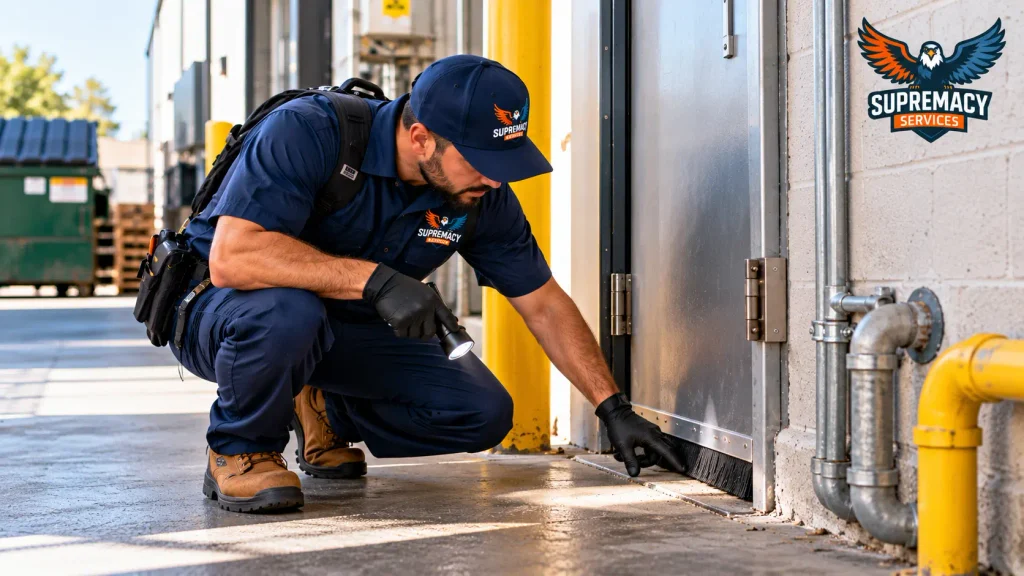
A professional food-business program should begin with questions and inspection—not automatically with spraying.
Supremacy’s current commercial program describes a process built around facility assessment, a customized management plan, treatment and monitoring, and digital reporting.
For a restaurant or grocery store, a productive provider relationship should establish:
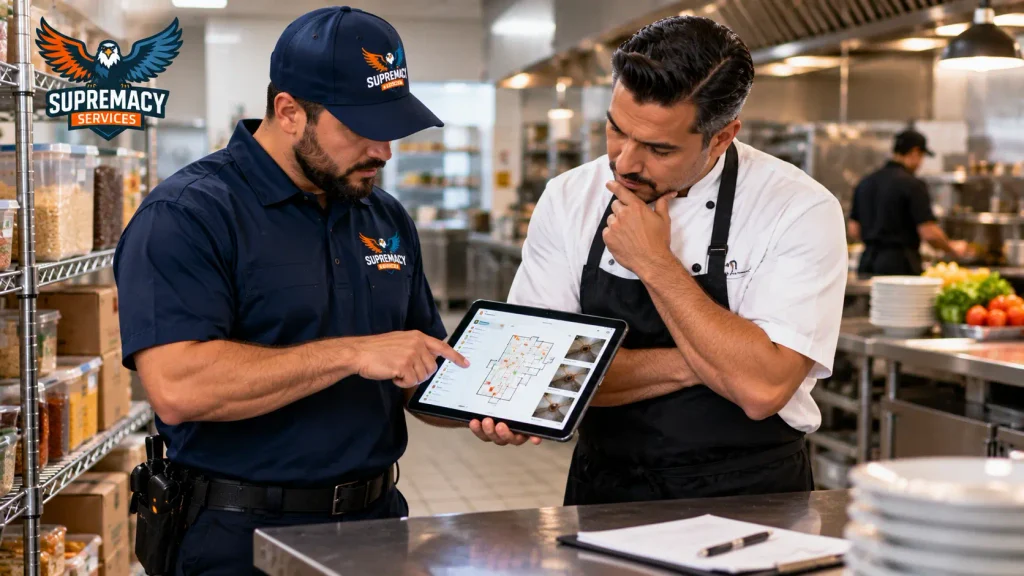
- Who reports sightings.
- Who receives service reports.
- Which areas require routine inspection.
- What constitutes an urgent finding.
- Which corrective actions belong to facility management.
- When the technician should return or escalate treatment.
- How recurring activity will be tracked.
That communication matters because pest control in a food business is a shared process.
The technician can identify a damaged door sweep, for example, but management still needs to ensure that repair occurs. Conversely, employees may see insects but need a pest professional to identify the species and source accurately.
A Practical Restaurant and Grocery Pest-Control Checklist
Before considering your program complete, ask:
- Are pest sightings documented and reported quickly?
- Are receiving areas inspected?
- Are exterior doors properly sealed?
- Are plumbing leaks corrected?
- Are drains and moisture-prone areas maintained?
- Are food spills cleaned promptly?
- Is cardboard managed instead of allowed to accumulate?
- Are waste areas clean and included in inspections?
- Are pest-monitoring devices checked routinely?
- Are findings documented?
- Are structural entry points corrected?
- Are recurring problem areas receiving follow-up?
- Is the pest-control provider appropriately licensed?
- Can management explain what corrective action followed the last significant pest finding?
If several answers are “no,” the weakness may be in the pest-management system, even if the building currently appears pest-free.
Frequently Asked Questions
Do restaurants in Dallas need professional pest control?
Food establishments must control pest presence and meet applicable food-safety requirements, but regulations should not be interpreted as requiring every facility to purchase an identical private service plan. Many businesses use professional pest management because ongoing monitoring, identification, exclusion and treatment require specialized expertise.
What pests are most common in commercial kitchens?
Cockroaches, flies, ants and rodents are among the pests commercial kitchens need to watch closely. The actual problem depends on food sources, moisture, building condition, sanitation, deliveries and surrounding conditions.
How often should a Dallas restaurant receive pest-control service?
There is no universal schedule that fits every restaurant. The right frequency depends on pest history, monitoring results, building conditions, operating environment and risk level.
Can restaurant employees spray pests themselves?
Employees should prioritize sanitation, reporting, food protection and correcting conducive conditions. Pesticide use in food environments requires particular care and must comply with product labeling and applicable regulations. Recurring or significant activity is a strong reason to involve a properly licensed pest-management professional.
Does seeing one cockroach mean a restaurant has an infestation?
Not necessarily, but it warrants investigation. One sighting may indicate an isolated introduction or concealed activity. Inspection and monitoring are more reliable than guessing from the number of insects seen.
Why do cockroaches keep returning after treatment?
Repeated activity can occur when harborages, moisture, food sources, structural openings or repeated introductions remain unresolved. Treatment works best when those contributing conditions are addressed as part of an IPM program.
Are grocery stores at risk for different pests than restaurants?
Yes. Grocery stores may have additional risk associated with large receiving operations, produce, bakeries, dry packaged goods, bulk storage, compactors and extensive inventory.
What should be included in a commercial pest-control service report?
Useful documentation can include areas inspected, evidence observed, monitoring findings, treatment performed, conducive conditions, corrective recommendations and follow-up needs.
Can pest-control devices be placed anywhere in a commercial kitchen?
No. Placement matters. FDA food guidance specifically restricts the positioning of insect-control devices where dead insects or fragments could fall onto exposed food, equipment or food-contact items.
Build Pest Prevention Into Your Food-Safety Routine
The most effective commercial pest control for restaurants and grocery stores is preventive, documented and specific to the facility.
A successful program does not depend solely on how often someone sprays.
It depends on how well the business controls entry points, sanitation, moisture, storage, waste, deliveries, monitoring and corrective action—and how quickly management responds when activity appears.
For Dallas and DFW food businesses experiencing recurring cockroaches, rodents, flies, ants or other pest pressure, Supremacy Services can assess the facility and develop a commercial pest-management strategy around its operating environment.
Request a Dallas-Fort Worth commercial pest-control assessment from Supremacy Services and build a prevention plan around your restaurant, grocery store or food facility.