
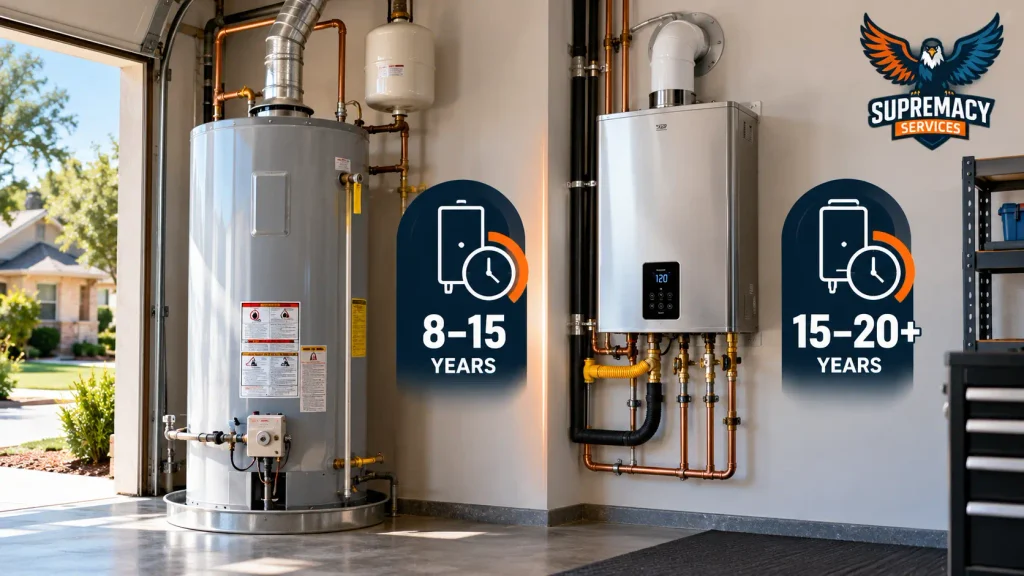
A traditional storage water heater will often provide roughly 8–15 years of service, while a properly maintained tankless water heater may operate for 15–20 years or longer. The U.S. Department of Energy has cited roughly 10–15 years for storage systems and more than 20 years for tankless equipment, while manufacturer guidance commonly places conventional tank systems around 8–12 years. Actual service life depends on the equipment, installation, household demand, maintenance and water conditions.
For Dallas and other North Texas homeowners, age alone should not decide whether a water heater needs replacement. An older unit that remains structurally sound and performs reliably may still have useful life left, while a younger heater exposed to scale, corrosion, poor installation or neglected maintenance can fail much sooner.
Dallas water conditions also deserve attention. City information has reported Dallas water hardness in the range of approximately 120–155 mg/L as calcium carbonate, placing much of that range around the moderately hard-to-hard boundary. Mineral accumulation does not mean your water heater will automatically fail early, but it makes scale and sediment management relevant to long-term performance.
Table of Contents
- How many years should a water heater last?
- Water heater lifespan by type
- Why do some North Texas water heaters fail sooner?
- Does Dallas hard water shorten water heater life?
- How can you tell how old your water heater is?
- What are the warning signs of an aging water heater?
- Should you repair or replace an old water heater?
- Can maintenance make a water heater last longer?
- DIY vs. professional water-heater maintenance
- What does professional water-heater service include?
- What Dallas homeowners should know about replacement
- Frequently asked questions
How Many Years Should a Water Heater Last?
For planning purposes, homeowners can often expect a conventional storage water heater to serve for roughly a decade or somewhat longer, while tankless systems generally have a longer potential service life.
The Department of Energy’s Energy Saver guidance states that most storage water heaters last approximately 10–15 years and tankless systems can last more than 20 years. Rheem’s 2026 homeowner guidance gives a somewhat more conservative estimate of 8–12 years for traditional tanks and 15–20+ years for tankless systems.
Those numbers are useful planning ranges—not expiration dates.
A heater does not automatically become unsafe or unusable on its tenth birthday. At the same time, homeowners should not assume that a tank will provide 15 trouble-free years simply because another homeowner’s did.
Its condition matters more than the calendar alone.
Water Heater Lifespan by Type
| Water-heater type | General planning range | Main aging concerns |
|---|---|---|
| Conventional storage tank | Roughly 8–15 years | Tank corrosion, sediment, anode deterioration, burner/heating-element issues |
| Tankless | Often 15–20+ years | Mineral scale, heat-exchanger condition, controls, burner components |
| Heat pump water heater | Similar general category to electric storage systems | Tank condition plus air filter, condensate and heat-pump components |
| Older specialty/alternative equipment | Varies substantially | Model, construction, water chemistry and parts availability |
These ranges should not be treated as manufacturer warranties or guarantees.
ENERGY STAR notes that contemporary heat-pump water heaters require modest servicing that may include air-filter and condensate-line maintenance, and that many current models carry six- or ten-year limited equipment warranties. Warranty duration and useful service life are not the same thing.
Which Lasts Longer: Tank or Tankless?
Tankless water heaters generally have the longer potential service life.
A tankless heater avoids storing dozens of gallons of continuously heated water inside a steel vessel. That removes the storage tank itself as a major failure point.
Tankless equipment still ages, however.
Heat exchangers can accumulate mineral deposits, sensors and controls can fail, and burners, valves or electrical components can require service.
“Tankless” does not mean “maintenance-free.”
Why Do Some North Texas Water Heaters Fail Sooner?
Two identical water heaters installed on the same day can reach very different ages.
Important factors include:
1. Water conditions
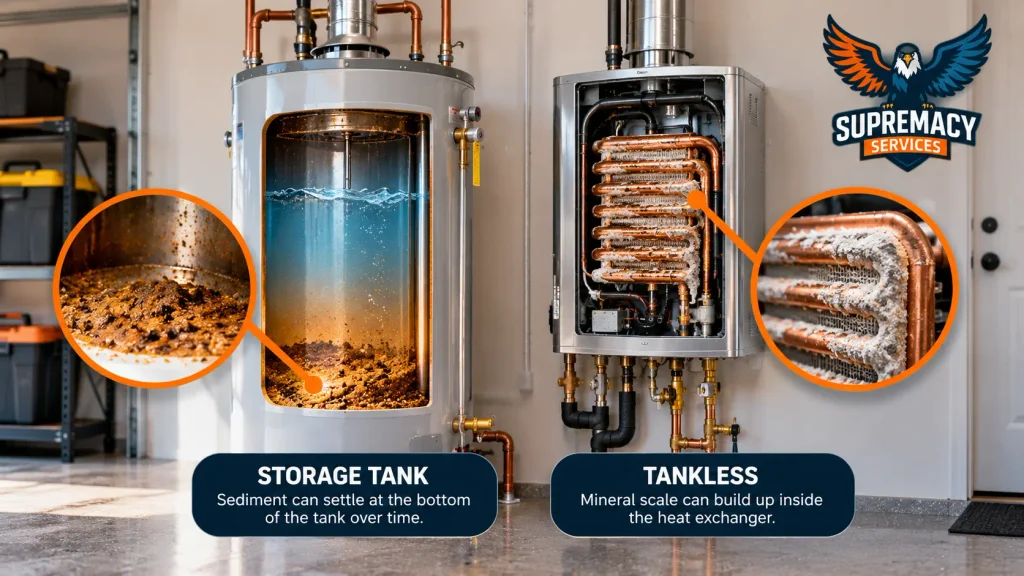
Minerals can settle in a storage tank or deposit scale inside tankless heat exchangers.
2. Maintenance history
A heater that has never been inspected, flushed or serviced may age differently from one maintained according to manufacturer instructions.
3. Household demand
A unit serving a large household with frequent back-to-back hot-water use may operate much more heavily than one serving a one- or two-person household.
4. Installation quality
Sizing, gas supply, electrical connections, venting, drainage, pressure conditions and manufacturer clearances can all influence performance.
5. Equipment design and quality
Different models use different tank linings, heat exchangers, controls, anodes and components.
6. Operating conditions
High operating temperatures, abnormal pressure conditions and continual heavy demand can place additional stress on water-heating equipment.
7. Location
A unit installed where a leak can go unnoticed may create a much larger problem when the tank eventually fails.
Does Dallas Hard Water Shorten Water Heater Life?
Mineral-rich water can contribute to sediment and scale accumulation, which is one reason Dallas homeowners should pay attention to maintenance—but hardness alone does not determine exactly how long a heater will last.
A City of Dallas memorandum has reported local water hardness of approximately 120–155 mg/L as CaCO₃.
In a storage tank, minerals and debris can settle toward the bottom.
Excess accumulation may interfere with heat transfer and can be associated with symptoms such as:
- popping or rumbling sounds;
- longer heating cycles;
- reduced usable hot-water performance;
- sediment discharged during draining;
- additional stress on components.
Tankless heaters face a somewhat different problem. Mineral deposits can form within the heat exchanger and water passages.
Rheem’s maintenance guidance specifically notes that storage tanks can accumulate sediment while tankless systems can develop mineral deposits inside their heat exchangers.
The appropriate maintenance interval should therefore come from the water-heater manufacturer’s instructions and an assessment of actual site conditions—not from a blanket internet rule.
How Can You Tell How Old Your Water Heater Is?
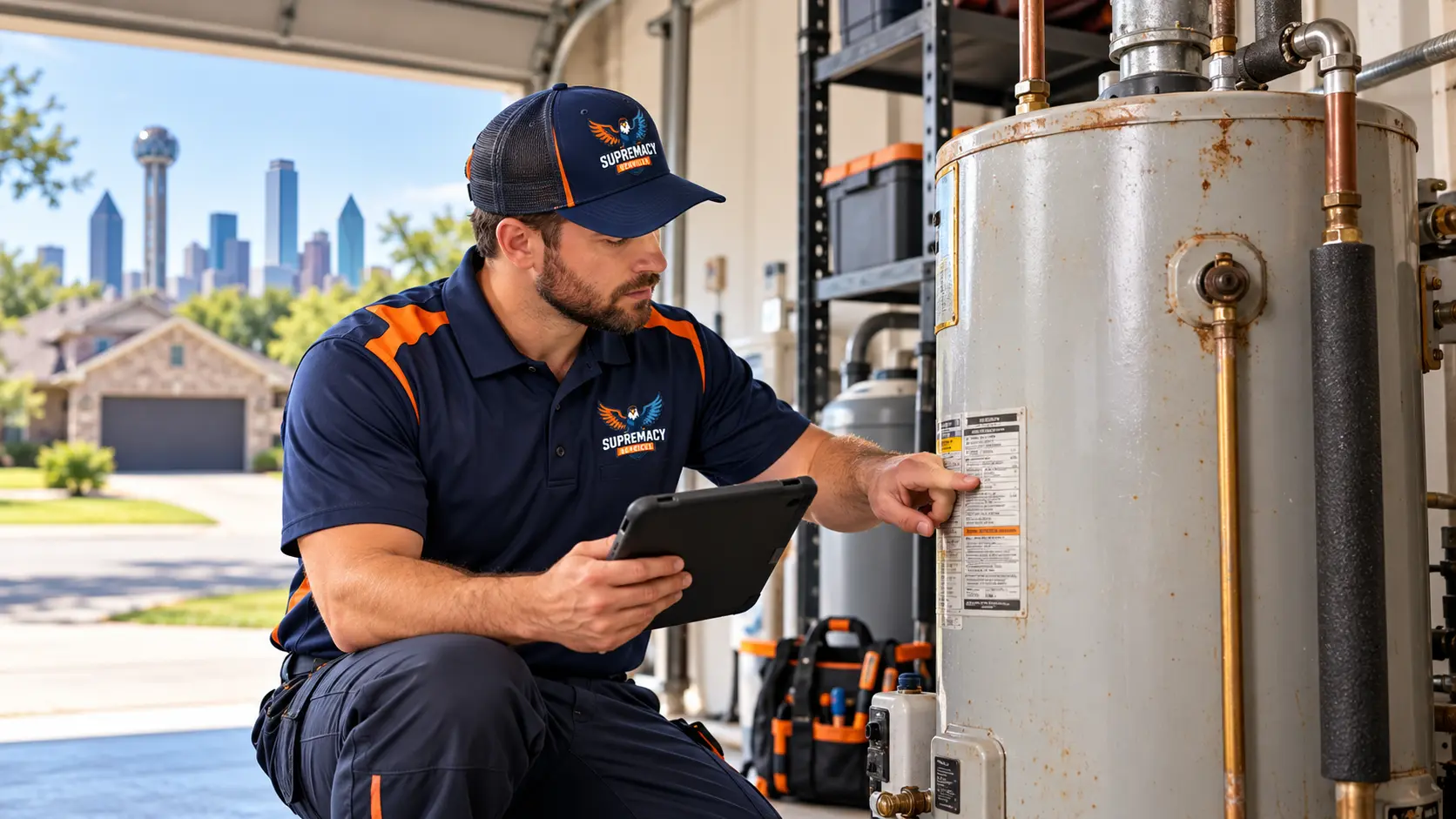
Start with the manufacturer’s data plate. It usually contains the model number, serial number and other equipment information needed to determine the manufacturing date.
Unfortunately, manufacturers do not all encode dates the same way.
A homeowner can:
- Locate the rating/data plate on the heater.
- Write down the manufacturer, model and serial number.
- Check the manufacturer’s official serial-number lookup or documentation.
- Review installation invoices, home-purchase records or permit records when available.
- Ask a plumber to identify the equipment during an inspection if the date remains unclear.
Do not guess based solely on the heater’s appearance.
A clean-looking water heater can be old, while surface rust around an external fitting may sometimes originate from a connection rather than the storage tank itself.
What Are the Warning Signs of an Aging Water Heater?
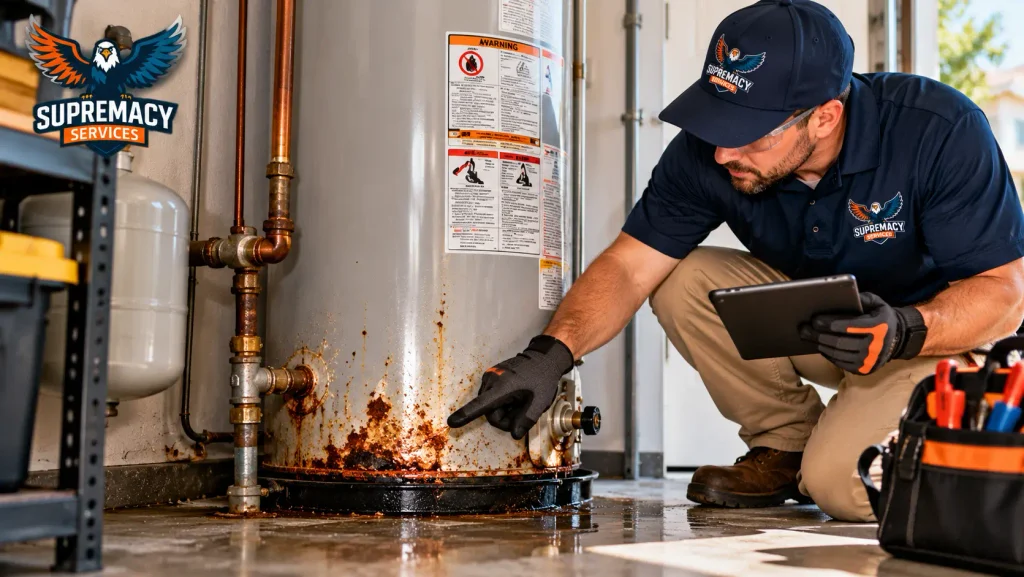
Age matters most when it appears together with changes in performance, leakage, corrosion or repeated repairs.
Watch for:
- water collecting around the base;
- visible tank corrosion;
- rust-colored hot water;
- hot water running out sooner than before;
- inconsistent water temperature;
- unusual popping or rumbling;
- repeated ignition or burner problems;
- failing electric heating elements;
- recurring service calls;
- unexplained deterioration in performance;
- corrosion at valves or connections.
A Leak at the Tank Deserves Special Attention
If the steel storage vessel itself has corroded through, replacing external parts will not restore the integrity of the tank.
But not every puddle beside a water heater means the tank has failed.
Water can also come from:
- supply connections;
- drain valves;
- relief-valve discharge;
- condensate;
- nearby plumbing;
- expansion-related problems.
That is why identifying the actual leak source matters before deciding on replacement.
Not sure whether the tank or a repairable component is leaking? Have Supremacy inspect the water heater before deciding between repair and replacement.
An Old Water Heater Is Not Always the Reason You Have Less Hot Water
A common mistake is to assume that declining hot-water performance automatically means the heater has reached the end of its life.
Several other problems can produce similar symptoms.
| Symptom | Possible cause |
|---|---|
| Hot water runs out quickly | Undersized tank, sediment, failed element, dip-tube issue or unusually high demand |
| Water never gets hot enough | Thermostat/control issue, heating element, burner problem or incorrect setting |
| Hot water fluctuates | Controls, mixing problem, excessive simultaneous demand or tankless sizing issue |
| Popping/rumbling | Sediment accumulation in some storage systems |
| Discolored hot water | Corrosion, sediment or another plumbing issue |
| Water around heater | Tank leak, fittings, valve, condensate or nearby plumbing |
A diagnosis is more useful than replacing equipment simply because it is old.
Should You Repair or Replace an Old Water Heater?
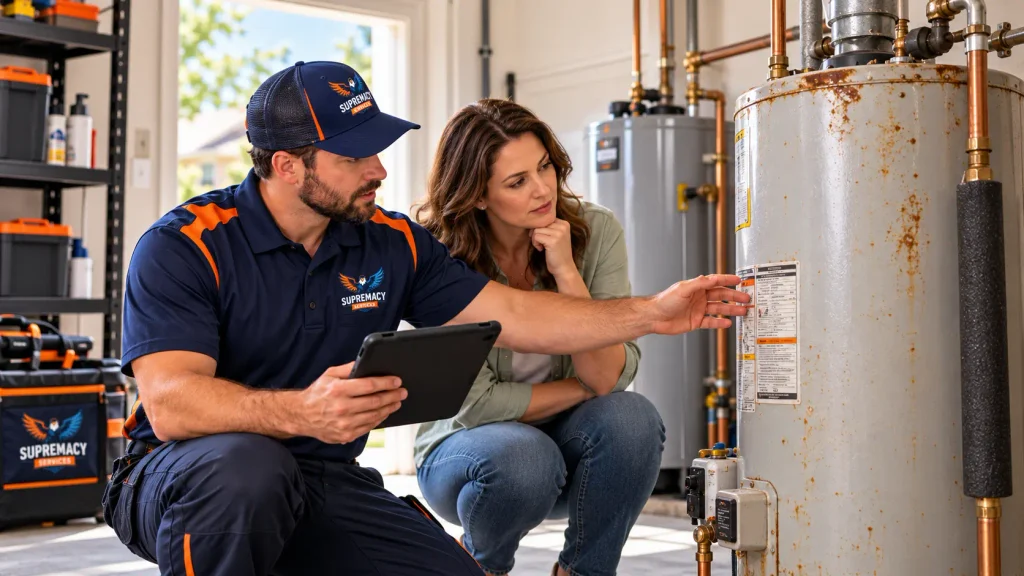
Replacement becomes more compelling when an aging heater combines structural deterioration, declining reliability and repeated repair needs.
Consider these questions.
How old is the equipment?
A relatively young unit with an isolated replaceable component may be a sensible repair candidate.
A storage tank already near or beyond its normal expected service range deserves closer evaluation.
Is the tank itself leaking?
A compromised storage tank is fundamentally different from a leaking fitting or replaceable valve.
Is the problem isolated?
A thermostat, heating element, igniter or other serviceable component may justify repair if the rest of the equipment remains in good condition.
Have repairs become frequent?
Repeated repairs can change the economics even when each individual repair remains technically possible.
Does the heater still meet household demand?
A functional but undersized system may still be the wrong system for the home.
Would replacement require infrastructure changes?
Moving from:
- tank to tankless;
- electric to gas;
- gas to electric;
- conventional electric to heat pump;
may affect venting, electrical capacity, gas piping, condensate drainage, space requirements or other project details.
That is why the correct comparison is not simply:
repair price vs. appliance price.
It is:
remaining service potential + repair scope + installation requirements + household demand + long-term operating goals.
How Much Does Replacing an Old Water Heater Cost?
There is no responsible single Dallas price that applies to every replacement.
Project cost can change according to:
- tank vs. tankless equipment;
- fuel type;
- equipment capacity;
- efficiency level;
- installation location;
- access;
- venting requirements;
- gas-pipe capacity;
- electrical requirements;
- drainage or condensate requirements;
- code corrections;
- permit requirements;
- relocation;
- removal of old equipment.
For that reason, this article should not publish a generic “Dallas average” as though it were a Supremacy quote.
A site-specific assessment is more useful.
Supremacy’s existing water-heater service page describes a process that includes system diagnostics, sizing, installation and performance verification.
If your heater is approaching the end of its expected life, request a water-heater assessment before an emergency replacement forces the decision. Compare repair, tank replacement and tankless options for your DFW home.
Can Maintenance Make a Water Heater Last Longer?
Proper maintenance can help address conditions that contribute to premature wear, but it cannot reverse corrosion or guarantee a specific lifespan.
Useful maintenance may include, where applicable:
- inspecting for leaks and corrosion;
- checking connections;
- following manufacturer flushing procedures;
- addressing sediment accumulation;
- inspecting or servicing anode protection where the design permits;
- maintaining combustion and venting components on fuel-fired units;
- descaling tankless equipment where required;
- checking valves and safety components;
- maintaining heat-pump-water-heater filters and condensate drainage;
- investigating unusual noises or performance changes early.
ENERGY STAR recommends referring to the manufacturer’s operation and maintenance instructions for the installed unit rather than assuming every water heater has the same maintenance requirements.
Should Every Tank Be Flushed Once a Year?
Not necessarily as a universal rule.
The correct procedure and interval can vary by manufacturer, model, equipment condition and water quality.
An older tank with significant sediment may also behave differently from a relatively new system.
Always follow the manufacturer’s instructions and use professional judgment when the tank’s condition is uncertain.
DIY vs. Professional Water-Heater Maintenance
Some homeowner observations are straightforward.
Reasonable homeowner checks
You can usually:
- look for visible leakage;
- note unusual sounds;
- check whether hot-water capacity has changed;
- record the model and serial number;
- inspect the surrounding floor for moisture;
- review the manufacturer’s manual;
- keep the surrounding area accessible.
Work better left to a qualified professional
Professional service is appropriate when the task involves:
- gas piping;
- combustion;
- venting;
- electrical circuits;
- internal controls;
- relief-valve concerns;
- tank leakage;
- replacement;
- code compliance;
- diagnosing pressure problems;
- unfamiliar flushing/descaling procedures.
Hot water, electricity, pressurized vessels and fuel gas create risks that are very different from ordinary appliance cleaning.
What Does Professional Water-Heater Service Include?
The exact scope depends on the equipment and the complaint, but a useful inspection can include:
- Confirming the heater’s age and model
- Inspecting for leakage and corrosion
- Evaluating hot-water performance
- Checking visible connections and valves
- Looking for sediment or scale-related symptoms
- Evaluating gas, venting or electrical requirements where applicable
- Checking whether the current heater is appropriately sized
- Identifying whether the complaint originates in the heater or elsewhere in the plumbing system
- Explaining repair versus replacement options
- Reviewing installation requirements if replacement is recommended
Supremacy’s current replacement page says its water-heater diagnostic process evaluates items including sediment buildup, anode condition, burner performance and tank integrity.
What Dallas Homeowners Should Know About Water-Heater Replacement
Plumbing Work May Require a Permit
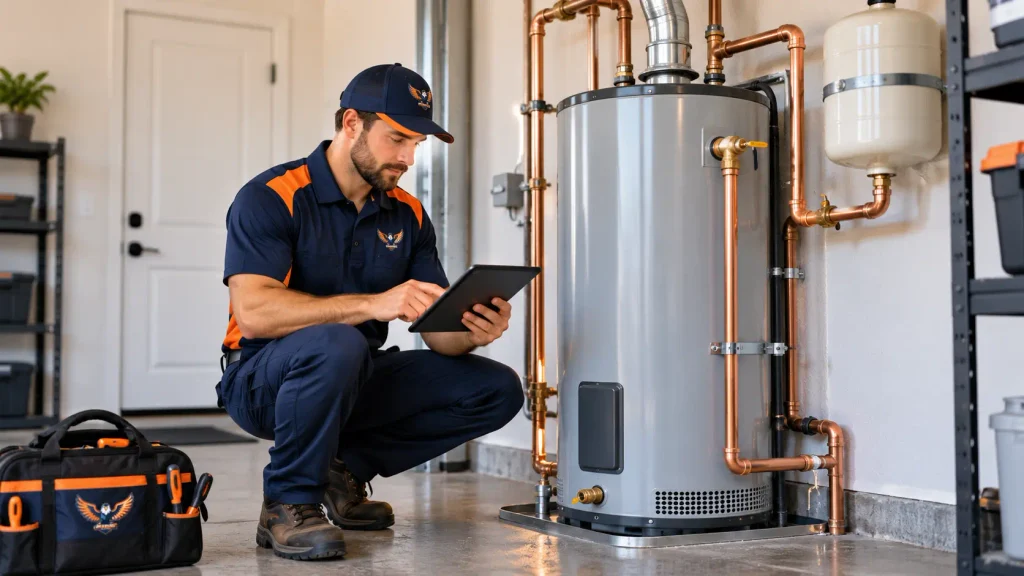
Dallas’s current Planning & Development guidance identifies water-heater installation, modification or repair among plumbing work for which a trade permit may be required, with applicable permits handled through registered professionals. Homeowners should verify the requirements for their specific project and jurisdiction rather than assuming every DFW municipality follows identical procedures.
Dallas currently references the 2021 International Plumbing Code with local amendments among its adopted construction codes.
DFW is not one permitting authority. Plano, Frisco, Richardson, Allen, Fort Worth and other municipalities may have their own procedures.
Do Not Wait for the Calendar Alone
A 9-year-old tank showing active corrosion deserves a different response from a 9-year-old heater with no leakage and consistent performance.
Likewise, a 13-year-old tank should not be assumed to have several years remaining simply because it still heats water today.
For older equipment, the practical question becomes:
How much remaining reliability are you comfortable depending on?
That matters especially when a tank sits:
- in an attic;
- above finished living space;
- inside a closet;
- near stored belongings;
- anywhere a leak could cause significant property damage.
Preventive replacement may make more sense in a high-consequence location than it would in a low-risk location with excellent drainage.
Should You Replace a Water Heater Before It Fails?
Sometimes. Preventive replacement is most reasonable when the heater is old, deterioration is visible, reliability is declining or a tank failure would create substantial water-damage risk.
You may want to plan replacement before failure when:
- the storage tank is nearing the upper end of its expected service life;
- corrosion is increasing;
- repairs are becoming frequent;
- hot-water performance is declining;
- you are already remodeling the mechanical area;
- you want to convert to tankless or heat-pump equipment;
- an unplanned leak would create expensive damage;
- you would rather compare equipment calmly than make an emergency decision.
You may reasonably continue monitoring a heater when:
- the unit remains within its normal service range;
- there is no evidence of tank deterioration;
- performance remains reliable;
- maintenance is current;
- a professional inspection finds no reason for immediate replacement.
What Should You Consider When Choosing the Next Water Heater?
Do not choose solely on tank capacity or sticker price.
Compare:
Household hot-water demand
Consider simultaneous showers, laundry, dishwashing and other peak use.
Storage versus tankless
Storage systems provide a reservoir of hot water; tankless systems heat water on demand but are limited by rated flow and temperature rise.
First Hour Rating
For storage heaters, First Hour Rating helps describe how much hot water the system can deliver during a high-demand hour.
Fuel and utility infrastructure
Changing technology may require gas, electrical, venting or drainage work.
Installation space
Tankless equipment can save floor space, while heat-pump water heaters need appropriate installation conditions.
Efficiency
ENERGY STAR and DOE efficiency information can help compare technologies and qualifying products.
Expected ownership period
The value of paying more for higher-efficiency or longer-lived equipment can depend partly on how long you expect to remain in the property.
Quick Checklist: Is Your Water Heater Near the End of Its Life?
Consider scheduling an inspection when several of these apply:
- Storage heater is around a decade old or older
- Manufacturer date is unknown
- Water appears around the tank
- Tank shows visible corrosion
- Hot water runs out faster than it used to
- Temperature is inconsistent
- Heater makes unusual noises
- Repairs have become frequent
- Equipment has not been maintained according to manufacturer guidance
- The installation location would make a leak particularly damaging
One checked box does not automatically mean replacement.
Several together make professional evaluation more worthwhile.
Frequently Asked Questions
Is a 10-Year-Old Water Heater Old?
For a conventional storage water heater, 10 years is old enough that condition and replacement planning deserve attention. Some tanks operate longer, while others fail earlier. Inspect its maintenance history, tank condition and performance rather than replacing it solely because it reached its tenth birthday.
Can a Water Heater Last 20 Years?
Yes, but the likelihood depends heavily on the system. Tankless water heaters commonly have longer expected service lives and can reach 20 years or more under appropriate conditions. A conventional storage tank lasting 20 years would be beyond the typical range and should not be assumed to have substantial remaining life.
How Long Do Gas Water Heaters Last?
Conventional gas storage heaters generally fall within the broader storage-water-heater range of roughly a decade, with actual lifespan varying by installation, maintenance, usage and tank condition.
How Long Do Electric Water Heaters Last?
Traditional electric storage water heaters are also generally in the roughly decade-plus category. Heating elements are replaceable; deterioration of the steel storage tank is a different issue.
How Long Do Tankless Water Heaters Last?
Many tankless systems can provide roughly 15–20 years or longer when correctly installed and maintained. Mineral scale and maintenance still matter, especially in locations with harder water.
Does Hard Water Ruin Water Heaters?
Hard water does not determine an exact failure date, but dissolved minerals can contribute to sediment in storage tanks and scale inside tankless heat exchangers. Dallas has reported moderately hard to hard water conditions, making appropriate maintenance relevant.
Should I Replace My Water Heater Before It Starts Leaking?
It can make sense when an aging tank shows corrosion, declining reliability or sits in a location where a leak would cause extensive damage. Age alone should not be the only factor.
Is It Worth Repairing a 12-Year-Old Water Heater?
Possibly, but the decision should consider the specific failure, tank integrity, repair history, replacement cost and remaining expected service life. A minor replaceable component is different from a corroded or leaking tank.
How Do I Find Out How Old My Water Heater Is?
Locate the model and serial number on the manufacturer’s data plate and use the manufacturer’s official documentation or serial-number lookup. Installation paperwork or permit records may also help.
Final Takeaway: Plan Around Condition, Not Just Age
Most conventional water heaters should be viewed as equipment with a service life measured roughly in decades rather than something expected to last indefinitely.
For North Texas homeowners, the most useful approach is to combine:
age + condition + maintenance + performance + water conditions + consequences of failure.
If your storage water heater is approaching or exceeding its expected service range, start planning before a leak makes the decision for you.
A professional inspection can determine whether you are dealing with an isolated repair, maintenance issue, undersized heater or an aging system that is genuinely approaching replacement.
Have an older water heater in Dallas or the DFW Metroplex? Supremacy Services can inspect the existing system, identify repairable problems and help you compare replacement options based on your home’s hot-water demand and existing infrastructure.

