
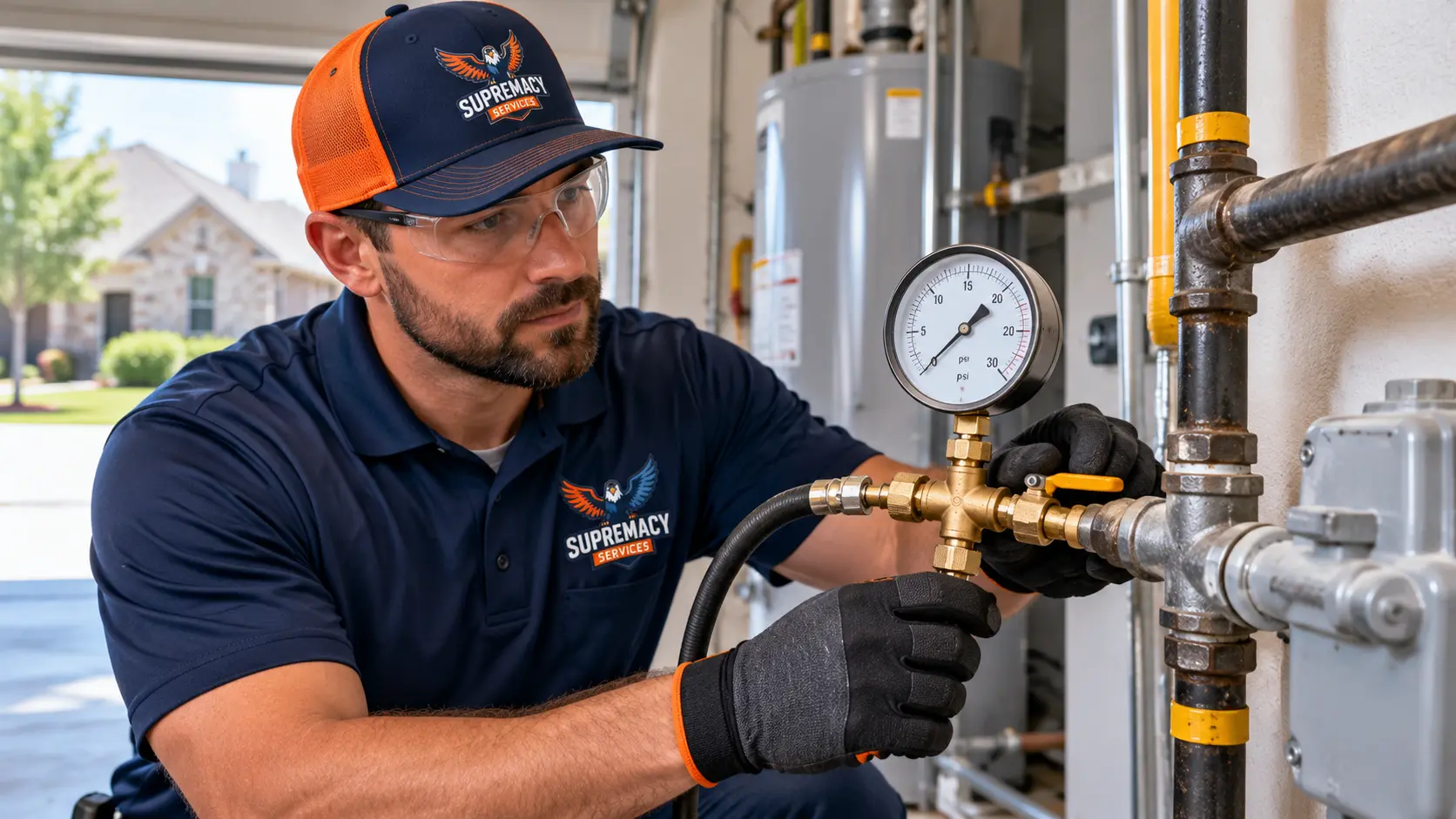
Gas line pressure testing is a safety procedure used to check whether a home’s gas piping system can hold a specified pressure without leaking. For Dallas homeowners, a pressure test may be necessary after gas line installation or repairs, before certain inspections, or when gas service needs to be restored.
A qualified plumbing professional conducts the test using appropriate equipment, isolates sensitive appliances, monitors the system for pressure loss, and determines whether repairs or further inspection are needed.
If your gas service has been disconnected, passing the required inspection may be necessary before your utility will restore service.
This guide explains when gas pressure testing is needed, how it works, what Dallas requires, and what homeowners should expect.
Important safety warning: If you smell gas, hear a hissing sound near gas piping, or suspect an active gas leak, leave the building immediately. Do not operate electrical switches, use a phone inside, start equipment, or attempt a pressure test. From a safe location, call 911 and your gas utility’s emergency number.
Table of Contents
- What Is Gas Line Pressure Testing?
- When Is a Gas Line Pressure Test Required?
- How Does a Professional Gas Pressure Test Work?
- Dallas Gas Pressure Testing Requirements
- How Long Does a Gas Pressure Test Take?
- What Happens If a Gas Line Fails?
- How Much Does Gas Pressure Testing Cost?
- Gas Pressure Testing vs. Gas Leak Detection
- Can Homeowners Pressure Test Their Own Gas Lines?
- Preparing for a Gas Line Inspection
- Frequently Asked Questions
- Schedule Professional Gas Line Assistance
What Is Gas Line Pressure Testing?
Gas line pressure testing is a procedure that checks the integrity of a gas piping system by applying an approved test medium at a specified pressure and observing whether that pressure remains stable for the required period.
The purpose is to identify piping systems that may have leaks, defective connections, or other problems before they are placed into service or returned to operation.
A typical residential gas system may supply several appliances, including:
- Gas furnaces and heating systems
- Water heaters
- Gas ranges and cooktops
- Clothes dryers
- Fireplaces
- Outdoor grills and kitchen appliances
The piping and fittings connecting these appliances must be properly installed and maintained.
Why is pressure testing important?
A gas piping leak can create a serious fire or explosion hazard. Pressure testing provides a controlled way to evaluate the piping system before gas is introduced or service resumes.
A successful pressure test helps demonstrate that the tested piping held pressure under the test conditions. However, it does not replace appliance safety checks, operating-pressure verification, or any other inspections required by the authority having jurisdiction.
A pressure test is not a guarantee that a gas system will remain leak-free indefinitely.
When Is a Gas Line Pressure Test Required?
Gas line pressure testing is commonly associated with new piping installations, alterations, repairs, inspections, and certain gas service restoration situations.
Not every gas service interruption automatically requires a full pressure test. The specific requirements depend on why service was interrupted, the condition of the piping, and the rules of the local inspection authority and gas utility.
1. After installing new gas piping
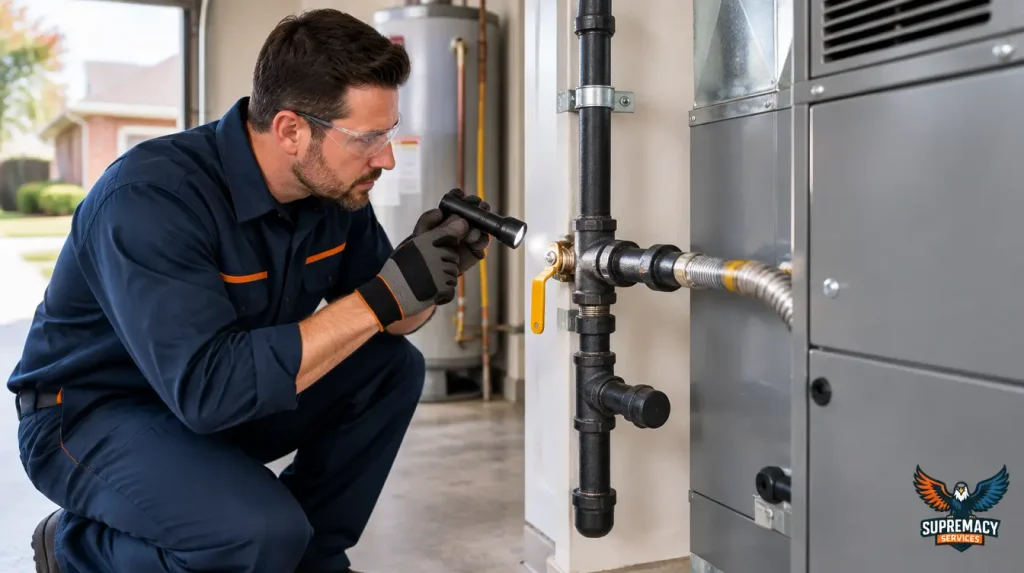
If you install a new gas line for a stove, water heater, furnace, fireplace, or outdoor kitchen, the new piping generally requires testing as part of the applicable installation and inspection process.
The test helps verify that the installed piping and its connections meet the relevant requirements before use.
2. Following gas line repairs or modifications
When a gas line is repaired, extended, or altered, testing may be required to verify the integrity of the affected piping.
The scope of testing depends on the work performed and applicable requirements.
For homeowners considering repairs, Supremacy Services provides gas line repair and diagnostic services in Dallas, including pressure testing and leak inspections.
3. Before restoring disconnected gas service
A gas utility may require inspection approval before restoring service after certain disconnections.
In Dallas, a plumbing permit and inspection may be required depending on the circumstances surrounding the interruption.
Examples that warrant checking the requirements include:
- Service disconnected because of a suspected gas leak
- Gas piping damaged during renovation
- Piping altered while a property was vacant
- Service restoration delayed pending a safety inspection
- A utility requiring clearance before reconnection
Contact the utility and Dallas Planning & Development to establish the exact requirements for your property.
4. During a home renovation
Projects involving relocated gas appliances or new piping can trigger testing and inspection requirements.
For example, converting an electric range to gas may involve installing a new gas supply line. Similarly, an outdoor kitchen project may require a new branch line, correctly sized piping, and inspection.
5. When a gas system has a suspected problem
A professional may recommend pressure testing when evaluating a suspected piping leak.
However, if there is an active gas odor or other immediate danger, emergency procedures take priority over scheduling a routine test.
How Does a Professional Gas Pressure Test Work?
A professional gas pressure test involves preparing the system, isolating equipment that must not be exposed to test pressure, applying the appropriate test medium, monitoring the gauge, and evaluating the result.
The precise method depends on the piping system, applicable code, and inspection requirements.
Step 1: Review the gas piping system
The plumber identifies the piping sections involved, checks accessible connections, and determines which appliances and components must be isolated.
The inspection may include visible signs of corrosion, damage, improper connections, or previous alterations.
Step 2: Isolate appliances and sensitive equipment
Gas appliances, regulators, and other components may not be designed to withstand the pressure used to test the piping.
The technician must isolate or disconnect these components as required by the applicable code and equipment instructions.
This is one reason homeowners should not attempt to pressurize their own gas piping.
Step 3: Connect approved testing equipment
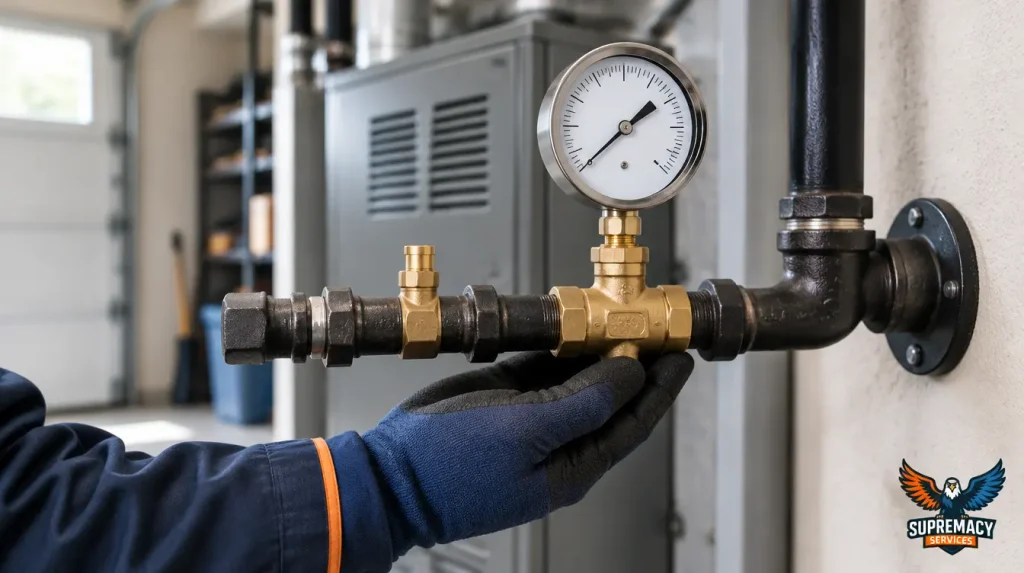
The technician connects suitable pressure-measuring equipment to the isolated piping system.
The test medium and pressure must comply with the applicable requirements. Professional fuel gas piping tests commonly use air or an approved inert medium rather than natural gas.
Oxygen must not be used as a pressure-testing medium.
Step 4: Monitor the pressure
After the system is properly prepared and pressurized, the technician observes the measuring instrument for the required test duration.
The pressure reading is evaluated according to the applicable procedure, including any necessary consideration of environmental conditions.
A pressure loss may indicate leakage or another condition requiring investigation.
Step 5: Investigate any failed test
If the system does not hold pressure as required, the plumber investigates the cause.
The problem may involve a defective fitting, damaged piping, an improperly sealed connection, or another issue.
The affected components must be corrected and the required testing repeated.
Step 6: Complete the inspection and restoration process
Where an official inspection is required, the appropriate inspector must witness or approve the test according to local procedures.
The contractor and utility then coordinate any remaining steps necessary before service can safely resume.
A passing test alone does not authorize a homeowner to reconnect gas service or bypass a utility lockout.
Dallas Gas Pressure Testing Requirements
The City of Dallas publishes specific guidelines for gas testing associated with establishing or re-establishing fuel gas service.
Its November 13, 2025 Gas Test Guidelines identify several important requirements for qualifying residential and commercial situations.
What does Dallas require?
For the gas tests covered by the published guidelines:
| Requirement | City of Dallas guidance |
|---|---|
| Test pressure | 3 psig |
| Minimum witnessed test duration | 15 minutes |
| Measuring equipment | Approved diaphragm test gauge |
| Inspector | City of Dallas plumbing inspector |
| Piping scope | Fuel gas piping beginning at the meter, including yard service and structures on the property |
| Appliance access | Inspector requires access to gas-supplied appliances |
| Permit | Plumbing permit required for the covered circumstances |
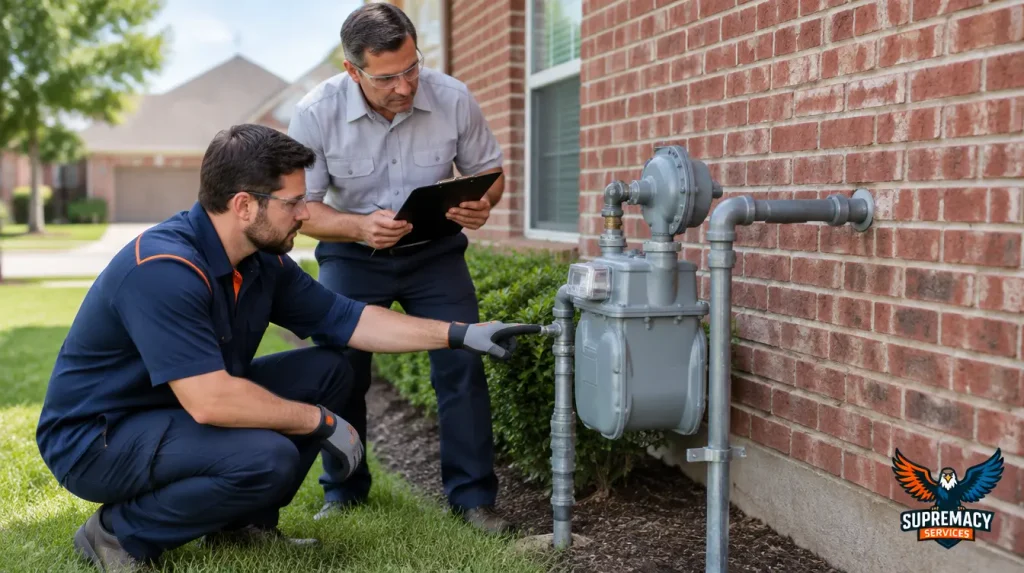
These are the requirements described in the City’s gas-service restoration guidance, not a universal testing procedure for every type of gas piping work.
The City also identifies qualifying conditions under which an owner-occupant may obtain a homeowner plumbing permit. A homeowner permit does not waive compliance with plumbing codes.
For complete details, review the City of Dallas Gas Test Guidelines.
Do Plano, Frisco, Allen, and other DFW cities follow the same rules?
Not necessarily.
Although many North Texas jurisdictions use related model plumbing and fuel gas codes, individual cities may have different adopted editions, amendments, permit procedures, inspection requirements, and utility coordination processes.
Homeowners in Plano, Frisco, Allen, Richardson, Garland, Irving, and surrounding communities should confirm the rules with their own municipality before scheduling work.
What about Texas licensing?
Texas regulates the plumbing trade through the Texas State Board of Plumbing Examiners.
Before hiring a plumbing contractor, homeowners can verify the contractor’s plumbing license and insurance information.
For natural gas piping, use professionals authorized to perform the work. Propane systems may be subject to additional licensing and safety requirements administered by the Railroad Commission of Texas.
How Long Does a Gas Pressure Test Take?
The required pressure-holding period may be relatively short, but the complete appointment often takes longer because the system must be prepared, isolated, tested, inspected, and returned to the appropriate condition.
For the situations covered by Dallas’s published gas test guidelines, the city inspector witnesses a minimum 15-minute test.
That does not mean the entire service appointment takes only 15 minutes.
Additional time may be needed for:
- Accessing the meter and piping
- Isolating gas appliances
- Setting up approved testing equipment
- Identifying and correcting leaks
- Coordinating the city inspection
- Completing utility restoration requirements
If a system fails, repair and retesting can extend the process.
Homeowners should ask whether the appointment includes only the initial test or also diagnostics, repairs, inspection coordination, and follow-up testing. Supremacy services
What Happens If a Gas Line Fails a Pressure Test?
A failed gas pressure test means the system did not satisfy the required test conditions. The piping must be investigated and any defects corrected before it can pass the required testing.
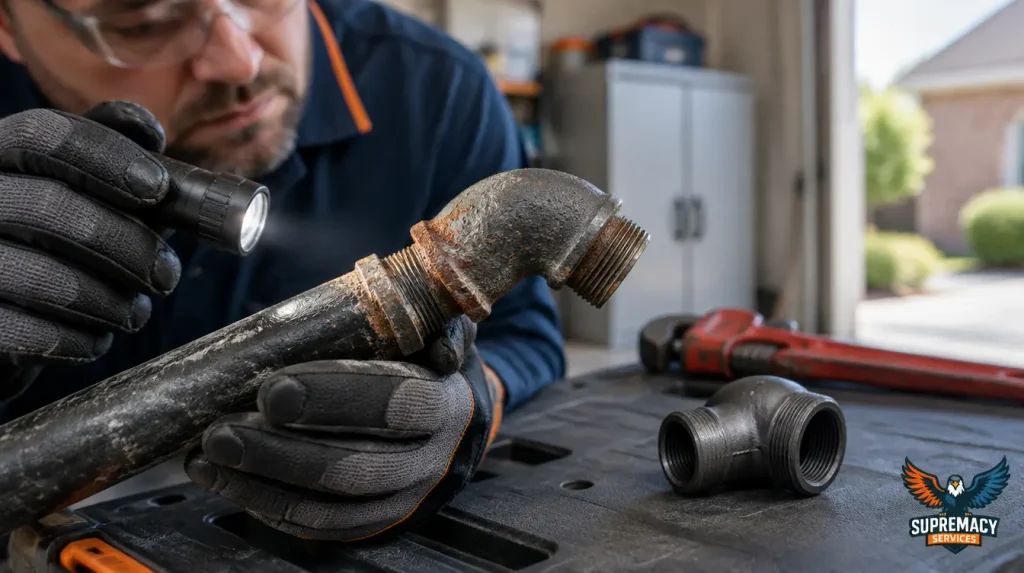
A failed result does not automatically mean every gas pipe in the house needs replacement.
Common reasons a gas pressure test may fail
Loose or defective connections
Threaded joints, fittings, and other connections can develop leaks because of damage, improper installation, or deterioration.
Corroded piping
Metal piping may deteriorate over time, particularly where corrosion protection is inadequate or moisture exposure occurs.
Damaged gas lines
Construction, excavation, remodeling, or accidental impact can damage piping.
Problems with previous modifications
Improperly installed branches, incompatible components, or defective connections can create leak points.
Test setup problems
Incorrect isolation, unsuitable equipment, or another procedural issue may affect the result and must be ruled out by the professional conducting the test.
Does a failed pressure test mean the entire gas line must be replaced?
No. The necessary repair depends on the condition and extent of the problem.
| Finding | Potential professional response |
|---|---|
| Isolated leaking fitting | Repair or replace the affected fitting |
| Damaged pipe section | Replace the damaged section |
| Multiple deteriorated sections | Evaluate partial or more extensive replacement |
| Defective recent alteration | Correct the installation and retest |
| Unclear source of pressure loss | Perform further diagnostics |
After the repair, the system must undergo the required testing and approval process.
If you have been told your property failed a gas pressure test, Supremacy Services can help evaluate the piping and discuss gas line repair options.
How Much Does Gas Pressure Testing Cost in Dallas?
Gas line pressure testing costs depend on the system, the reason for testing, the required inspection, and whether repairs are necessary.
There is no single reliable flat price that applies to every Dallas home.
Factors affecting the cost
| Cost factor | Why it matters |
|---|---|
| Number of gas piping branches | More connections and sections may require additional preparation |
| Accessibility | Concealed or difficult-to-reach piping can complicate diagnostics |
| Test scope | A limited section and a whole-property test involve different work |
| Appliance isolation | Additional appliances may require more preparation |
| Permit and inspection | Municipal fees and coordination can affect the total |
| Failed test | Leak detection, repairs, and retesting may add costs |
| Service restoration | Utility requirements may involve additional coordination |
Questions to ask before accepting a quote
- Does the price include the initial pressure test?
- Is leak diagnosis included if the test fails?
- Are repairs quoted separately?
- Are permit and inspection fees included?
- Does the contractor coordinate with the city or gas utility?
- Will retesting cost extra?
- What documentation will I receive?
The Texas State Board of Plumbing Examiners recommends obtaining clear written estimates and understanding the scope of work before hiring a plumbing contractor.
Avoid relying on an advertised test price without knowing whether it includes inspection, leak repairs, and any required follow-up visit.
Gas Pressure Testing vs. Gas Leak Detection
Gas pressure testing and gas leak detection are related services, but they answer different questions.
Pressure testing evaluates whether a piping system holds pressure under defined conditions. Leak detection helps identify where gas may be escaping.
| Feature | Pressure testing | Leak detection |
|---|---|---|
| Main purpose | Evaluate piping integrity | Locate a suspected leak |
| Typical equipment | Pressure gauge and approved test setup | Gas detection instruments, approved leak-detection methods |
| Common situation | New installation, repair verification, service restoration | Gas odor, suspected leak, failed test |
| Identifies exact leak location? | Not necessarily | Intended to locate the source |
| May require city inspection? | Yes, in applicable circumstances | Depends on the work and circumstances |
A plumber may use both approaches during the same project.
For example, a pressure test may reveal that the piping cannot hold pressure. The technician then performs additional diagnostics to identify the defective connection or damaged section.
After the problem is corrected, the required testing is repeated.
What if your gas appliance is not working?
A furnace that fails to ignite or a stove burner that does not light does not necessarily mean the home’s piping has a leak.
Possible explanations include an appliance malfunction, an interrupted gas supply, a closed valve, an ignition problem, or another equipment issue.
Professional diagnosis helps distinguish appliance problems from piping problems without exposing the homeowner to unnecessary risks.
Can Homeowners Pressure Test Their Own Gas Lines?
Gas pressure testing is not a recommended DIY project.
Although Dallas has a limited homeowner-permit pathway for qualifying residential properties, that does not make gas pressure testing a suitable task for an untrained homeowner.
Improper testing can damage components, produce misleading results, or create dangerous conditions.
Why professional testing matters
A qualified professional understands:
- Applicable fuel gas code requirements
- Appropriate test pressure and duration
- Proper appliance and regulator isolation
- Suitable test instruments and media
- How to evaluate pressure readings
- Required repair and retesting procedures
- Permit and inspection coordination
Homeowners should never use oxygen to pressure-test gas piping, attempt to defeat a meter lock, or reconnect service that the utility has disconnected for safety reasons.
If you suspect an active gas leak, evacuate and contact emergency services rather than attempting to locate or test the leak yourself.
Preparing for a Gas Line Inspection
Homeowners can help make a scheduled inspection more efficient without handling the gas piping themselves.
Homeowner preparation checklist
- Confirm whether the property needs a permit or city inspection.
- Ask the contractor which parts of the gas system will be tested.
- Provide access to the gas meter and accessible piping.
- Make gas appliances accessible for inspection.
- Tell the plumber about recent renovations or appliance replacements.
- Share any notice received from the gas utility.
- Ask who will coordinate inspection approval and service restoration.
- Request written documentation of the findings and repairs.
Do not disconnect appliances, remove caps, adjust regulators, or manipulate gas valves in preparation for the appointment.
What should you receive after testing?
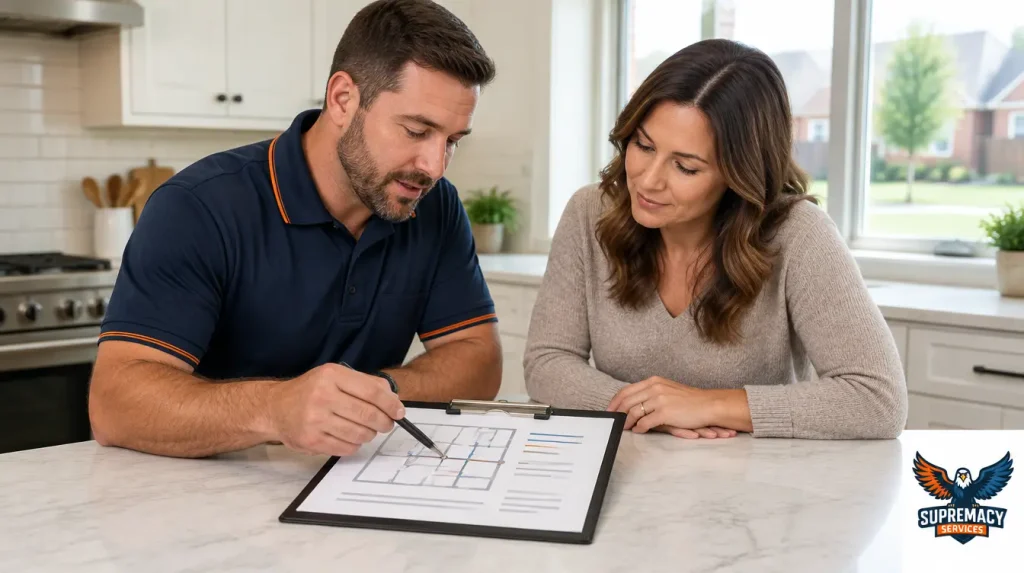
Depending on the work performed, useful documentation may include the test result, repair details, permit or inspection status, and instructions for any remaining utility coordination.
If a defect is found, request an explanation of the problem and a written estimate before authorizing non-emergency repairs.
Frequently Asked Questions
1. Is gas line pressure testing required in Dallas?
It is required in certain circumstances, including gas service establishment or restoration situations covered by the City’s published guidelines. Other installations, alterations, or repairs may have their own testing and inspection requirements.
2. What pressure is used for a residential gas test in Dallas?
Dallas’s November 2025 gas-service testing guidelines specify 3 psig for the tests they cover, witnessed by a city plumbing inspector for at least 15 minutes. Different testing circumstances may be governed by other requirements.
3. Can a gas line pass a pressure test and still have a problem?
Yes. A pressure test evaluates the tested piping under specific conditions. It does not replace appliance inspections, combustion safety checks, or all other gas system diagnostics.
4. Does a gas pressure test find the exact location of a leak?
Not necessarily. A failed test indicates a problem with the system or test conditions. Additional leak-detection procedures may be needed to identify the exact source.
5. Can gas be turned back on immediately after a passing test?
Not always. If a city inspection or utility authorization is required, those steps must be completed before service restoration. A passing test does not override a utility disconnection.
6. Can a gas pressure test damage a furnace or water heater?
Improper testing can damage components that are not rated for the test pressure. Professionals isolate or disconnect appliances and sensitive equipment according to applicable requirements.
7. Does every gas appliance replacement require a whole-house pressure test?
Not necessarily. Requirements depend on whether piping is altered, the nature of the work, local codes, and utility requirements. Ask the permitting authority and qualified contractor what applies to your project.
8. What should I do if my house fails a gas pressure test?
Have a qualified professional identify the cause, correct the defect, and perform the required retest. Do not restore gas service until applicable inspection and utility requirements have been satisfied.
9. Do I need gas pressure testing for an outdoor kitchen?
New gas piping installed for an outdoor grill or kitchen generally requires appropriate testing and may require permits and inspections. Confirm the requirements before construction.
Schedule Professional Gas Line Assistance in Dallas
Gas line pressure testing is an important part of evaluating piping safety after installations, repairs, and certain service interruptions. For Dallas homeowners, understanding the inspection process can help prevent delays and unexpected costs.
Whether you are replacing a gas appliance, dealing with a failed inspection, or trying to restore disconnected service, the first step is identifying the testing and repair requirements that apply to your property.
Supremacy Services provides gas line diagnostics, pressure testing, and repair services for Dallas and the DFW Metroplex.
If your property needs professional gas piping evaluation, visit our Dallas gas line repair and testing service or call 945-777-3345 to discuss your situation.
For suspected active gas leaks, evacuate and contact emergency services and your gas utility first.

