
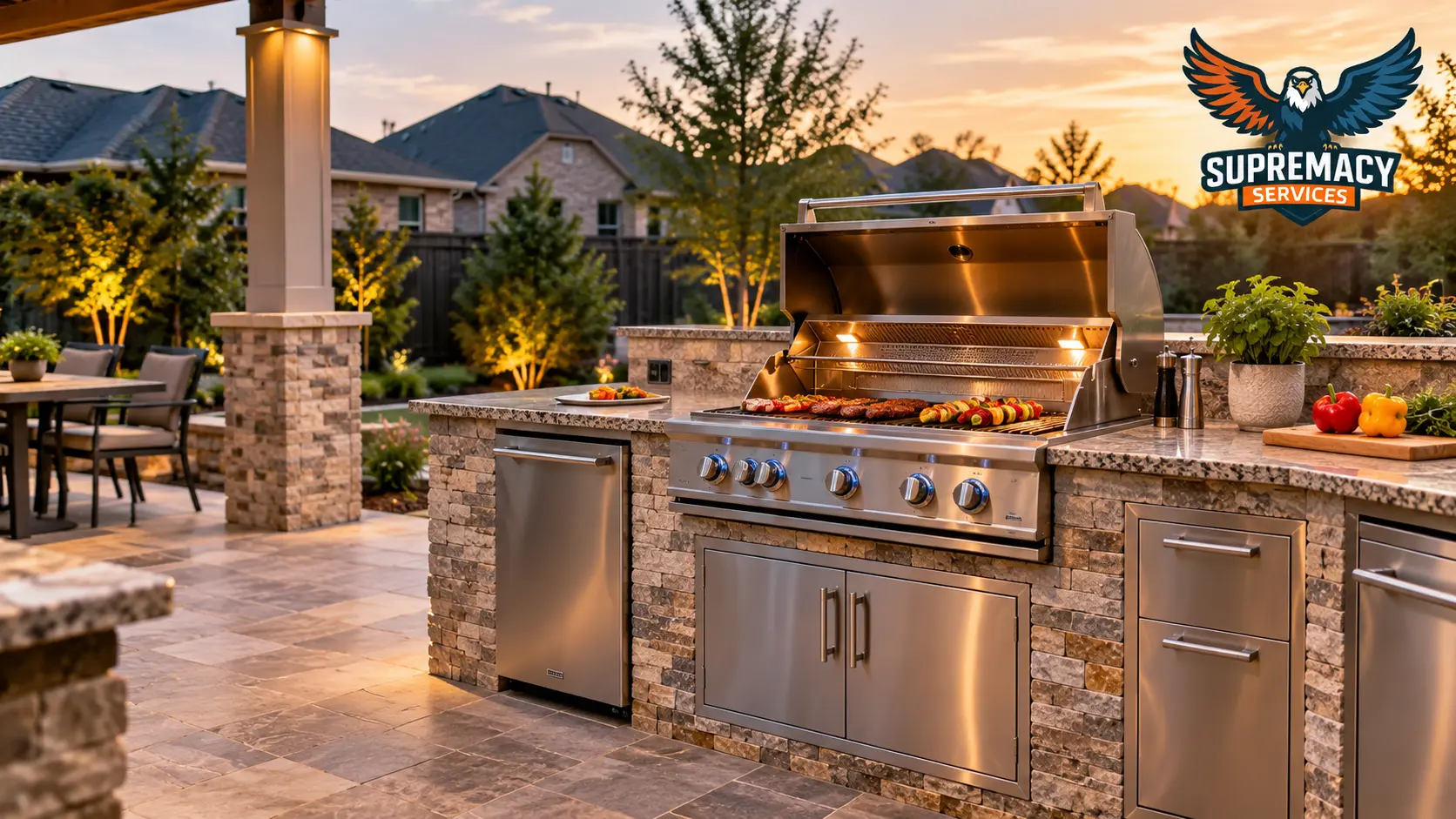
Yes, you can run a new natural gas line to an outdoor kitchen in Dallas, provided the installation is properly designed, permitted, inspected, and completed in accordance with applicable gas and plumbing codes.
Whether you’re installing a built-in grill, outdoor pizza oven, or complete backyard cooking station, a permanent natural gas connection can eliminate the need to regularly replace propane cylinders.
However, outdoor kitchen gas line installation in Dallas involves more than connecting a pipe to your existing gas supply. The available gas capacity, appliance requirements, underground utilities, piping materials, and local permitting requirements all influence how the project should be completed.
Here’s what Dallas homeowners should understand before adding a gas line to their outdoor kitchen.
Table of Contents
- Can You Connect an Outdoor Kitchen to Your Home’s Gas Supply?
- Do You Need a Permit in Dallas?
- How Is an Outdoor Gas Line Installed?
- How Much Does Installation Cost?
- What Type of Gas Piping Can Be Used?
- Natural Gas vs. Propane
- Can Your Existing Gas System Handle Another Appliance?
- Can You Install an Outdoor Gas Line Yourself?
- Common Installation Problems and Warning Signs
- What Should Dallas Homeowners Consider?
- How to Prepare for Installation
- Frequently Asked Questions
Can You Connect an Outdoor Kitchen to Your Home’s Existing Gas Supply?
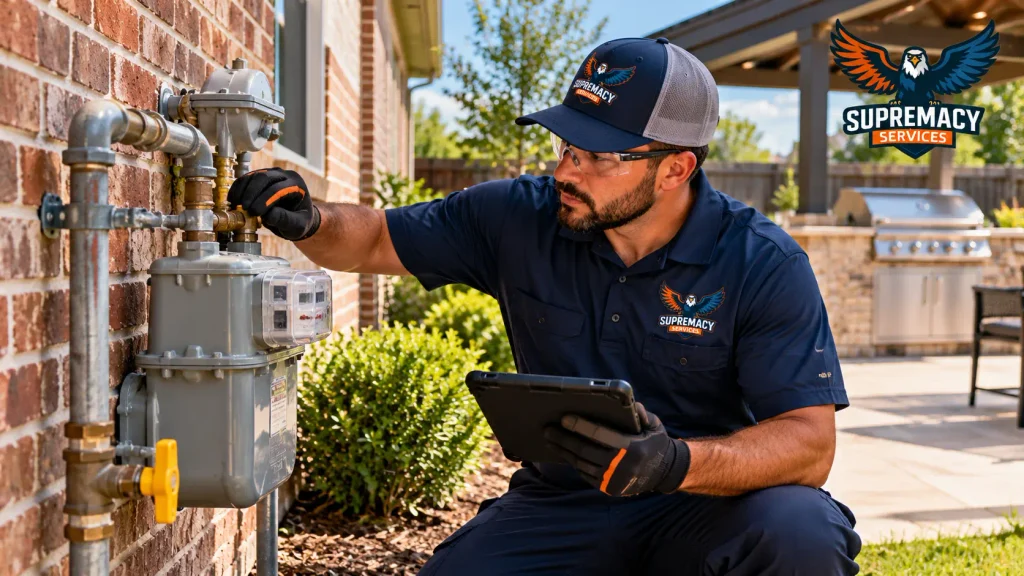
In many Dallas homes, an outdoor kitchen can be supplied by extending the existing natural gas distribution system. Whether this is feasible depends on the gas system’s capacity, the outdoor appliances being installed, and the proposed piping route.
A professional must determine whether the current installation can support the additional gas demand without affecting other appliances.
Outdoor appliances that may use natural gas
Common examples include:
- Built-in natural gas grills
- Outdoor pizza ovens designed for natural gas
- Side burners and outdoor cooktops
- Natural gas fire pits
- Outdoor fireplaces
- Specialty cooking appliances approved for natural gas
Not every outdoor appliance is compatible with natural gas. Some are designed exclusively for propane, while others require a manufacturer-approved conversion kit.
Always verify the appliance’s fuel type and installation requirements before purchasing equipment or planning the gas line.
Where does the new gas line connect?
Depending on the existing system, a qualified installer may determine that a new branch can connect to an appropriately sized section of the home’s gas piping.
In other situations, the project may require larger piping, a different connection point, or coordination with the gas utility.
The correct connection point cannot be determined solely by identifying the nearest existing gas pipe.
Considering a permanent natural gas connection for your backyard kitchen? Supremacy Services can be contacted to discuss gas-line service availability and an assessment of your proposed outdoor installation.
Do You Need a Permit to Run a Gas Line to an Outdoor Kitchen in Dallas?
Yes, a new permanent fuel-gas piping installation in Dallas generally requires a plumbing permit and applicable inspections. Homeowners should confirm the exact requirements with the City of Dallas before work begins.
The City of Dallas identifies gas piping as part of plumbing work subject to its permitting framework. Its plumbing plan-review checklist also calls for information about the layout, size, and materials of underground yard gas piping where applicable.
What does the City of Dallas require?
Depending on the scope, the project may involve:
- Reviewing the outdoor kitchen layout and proposed gas-pipe route.
- Identifying applicable plumbing permits and any additional construction approvals.
- Having the appropriate authorized person obtain the permit.
- Installing the piping according to approved requirements.
- Completing required testing and inspections before the gas line is placed into service.
Dallas has specific rules concerning who may obtain plumbing permits. The city’s guidance also describes limited homeowner-permit circumstances, so homeowners should not assume that every gas-piping project is eligible for DIY permitting.
What about Plano, Frisco, Allen, and other DFW cities?
Requirements may differ between municipalities.
A homeowner in Frisco should confirm requirements with Frisco’s building department rather than assuming the City of Dallas process applies. The same principle applies to Plano, Allen, McKinney, Richardson, and other North Texas communities.
Why do permits and inspections matter?
Gas-line inspections help establish that the installation satisfies applicable safety and code requirements before operation.
An unpermitted installation may create complications during property sales, insurance reviews, or future renovations, in addition to presenting safety concerns.
How Is a New Gas Line Installed for an Outdoor Kitchen?
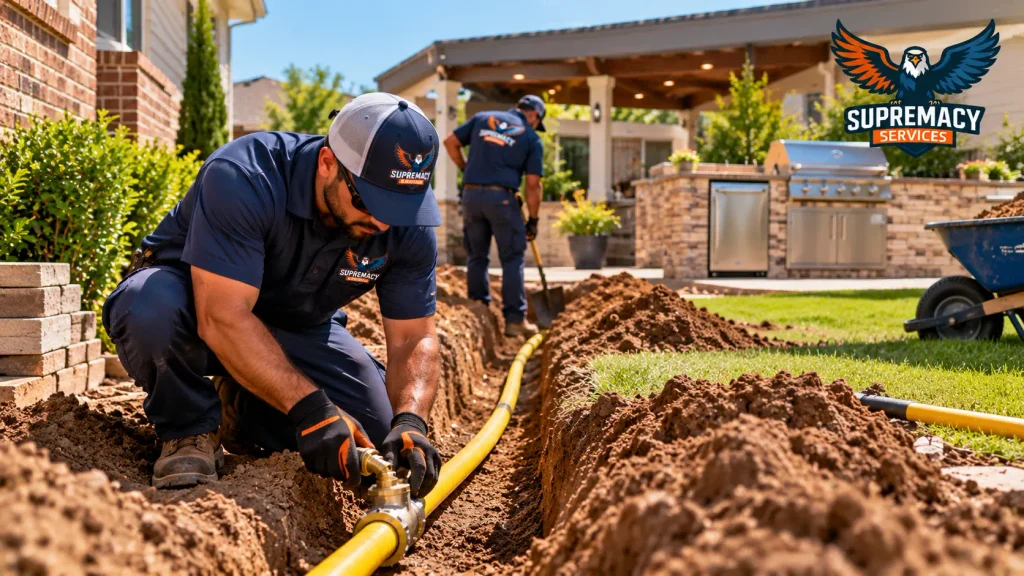
Professional outdoor gas line installation typically begins with a site assessment and system design, followed by permitting, piping installation, required testing, and final appliance connection.
Step 1: Evaluate the existing gas supply
The installer reviews the gas meter, existing piping, connected appliances, and additional demand from the outdoor kitchen.
Step 2: Plan the piping route
The proposed route is assessed for distance, obstacles, underground utilities, property features, and the location of outdoor appliances.
Step 3: Obtain required permits
The authorized installer or eligible permit applicant arranges the applicable approvals before beginning regulated work.
Step 4: Install the gas piping
Approved materials and installation methods are used. Underground installations may require excavation, appropriate protection, and inspections before trenches are backfilled.
Step 5: Test and inspect the system
The installation undergoes the required pressure testing and inspections. The testing procedure is determined by the applicable code and inspection authority.
Step 6: Connect and commission appliances
Approved connections, shutoff provisions, and appliance checks are completed before the outdoor kitchen is put into operation.
Does the gas line have to be buried?
Not necessarily.
The appropriate installation depends on the route, site conditions, permitted piping method, and appliance location.
A gas line running across an open yard may be designed as an underground installation. Other projects may allow properly protected aboveground piping.
The installer must determine the applicable requirements for burial depth, corrosion protection, supports, transitions, and physical protection. Homeowners should not select a trench depth or piping material without a code-compliant design.
How Much Does It Cost to Install an Outdoor Kitchen Gas Line in Dallas?
The cost depends on the distance from the existing gas supply, available capacity, installation method, excavation requirements, appliance connections, and permit or inspection costs.
A short, accessible extension can involve substantially less work than a buried line crossing a finished backyard.
Because verified Dallas-specific installation quotes were not available for this article, assigning a fixed dollar range would risk misleading homeowners.
Factors that influence installation costs
| Cost factor | Why it matters |
|---|---|
| Distance to outdoor kitchen | Longer runs generally require more materials and labor |
| Underground trenching | Excavation and restoration increase project scope |
| Concrete or paved surfaces | Routing around or restoring hardscaping can add complexity |
| Existing gas-pipe capacity | Undersized piping may require additional work |
| Number of appliances | Multiple appliances increase the total gas demand |
| Permit and inspection requirements | Administrative and inspection work affects the project |
| Appliance compatibility | Regulators, connectors, or approved conversion components may be needed |
| Yard accessibility | Restricted access can complicate installation |
Is it cheaper to install a gas line before building the outdoor kitchen?
Often, yes.
Coordinating gas piping before installing patio finishes, masonry counters, or outdoor kitchen cabinetry can reduce the need to remove completed construction.
For homeowners planning a larger backyard renovation, the gas-line design should be coordinated with the outdoor kitchen contractor before the final layout is built.
How can homeowners get an accurate estimate?
Request a site-specific assessment that identifies the proposed connection point, pipe route, appliances, required permits, testing, and any anticipated surface restoration.
Planning an outdoor kitchen in Dallas or the surrounding DFW area? Contact Supremacy Services to discuss your gas-line installation needs and request information about available assessment and installation services.
What Type of Gas Piping Can Be Used for an Outdoor Kitchen?
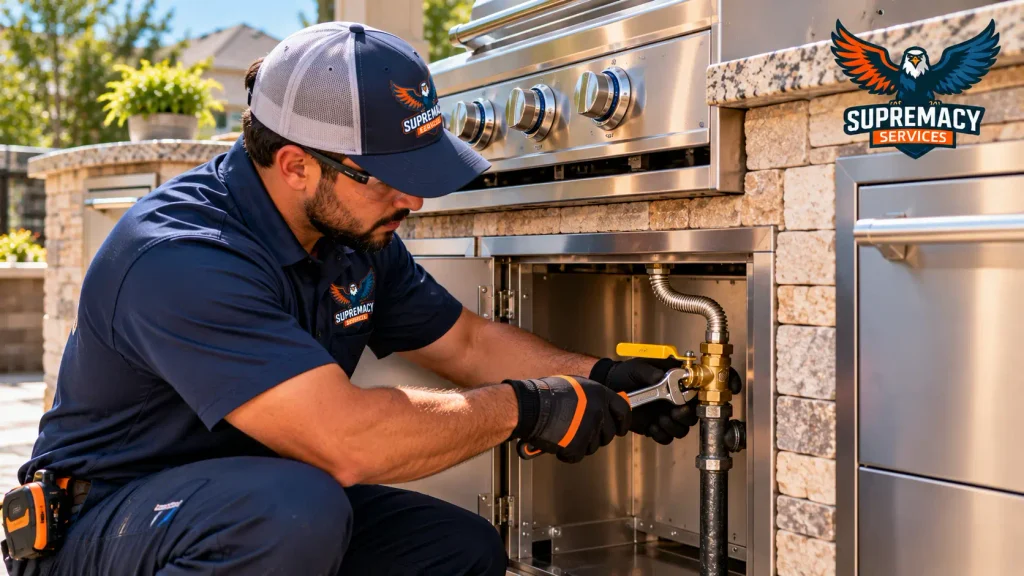
Gas piping must be approved for the particular fuel, pressure, location, and installation method.
Different products have different limitations, and not every material suitable for indoor gas distribution is appropriate for direct burial or outdoor exposure.
| Piping material | Potential application | Important consideration |
|---|---|---|
| Black steel pipe | Certain aboveground gas piping installations | Corrosion protection and exposure requirements must be addressed |
| Polyethylene gas pipe | Approved underground gas distribution applications | Requires approved transitions and appropriate installation methods |
| Corrugated stainless steel tubing (CSST) | Certain gas distribution systems | Must follow listing, bonding, protection, and manufacturer requirements |
| Other approved gas piping | Applications permitted by local code | Suitability depends on the specific product and installation |
Homeowners should not substitute ordinary water piping, garden hoses, or unapproved flexible connectors for permanent fuel-gas piping.
Can you use a flexible gas hose for an outdoor grill?
An approved appliance connector may be suitable for a specific connection when the appliance instructions and applicable code allow it.
However, an appliance connector is not automatically approved as a substitute for permanent gas piping across a yard or through a building structure.
The connection method should be selected by the qualified installer.
Natural Gas vs. Propane: Which Is Better for an Outdoor Kitchen?
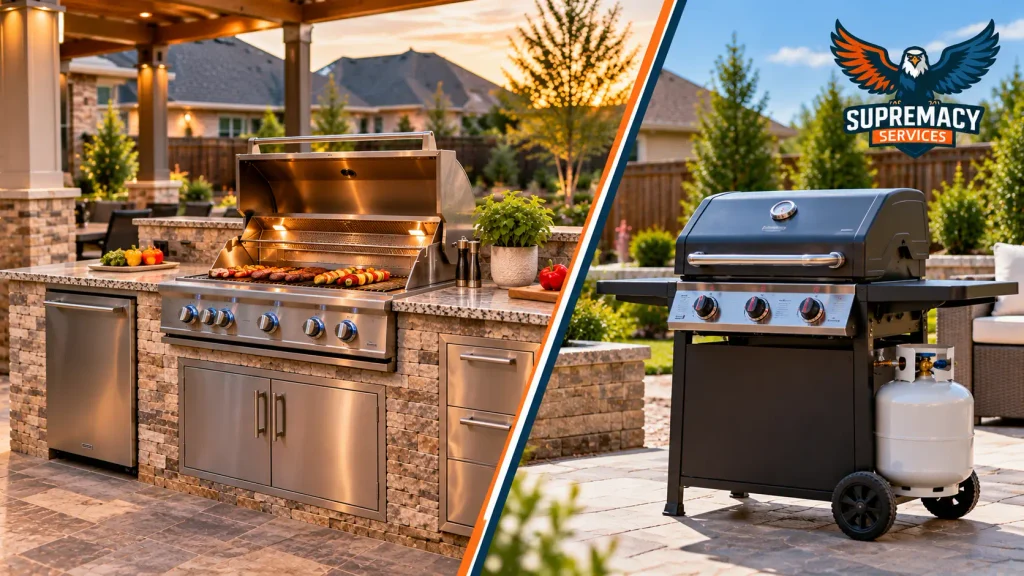
Natural gas can be convenient for a permanent outdoor kitchen connected to an existing utility supply. Propane may be more practical for portable grills or locations without an available natural gas connection.
| Feature | Natural gas | Propane |
|---|---|---|
| Fuel supply | Connected to gas utility infrastructure | Stored in a cylinder or tank |
| Cylinder replacement | Not normally required | Required when fuel is depleted |
| Installation | May require permanent gas piping and permits | Depends on appliance and tank arrangement |
| Portability | Usually associated with fixed appliances | Common for portable grills |
| Appliance compatibility | Requires natural-gas-rated equipment | Requires propane-rated equipment |
| Best suited for | Permanent outdoor kitchens | Portable or independently supplied equipment |
Can a propane grill be converted to natural gas?
Only if the manufacturer expressly approves the conversion for that exact appliance model and provides an appropriate conversion procedure or kit.
Natural gas and propane appliances may use different regulators, orifices, and operating pressures. Simply connecting a propane grill to a natural gas line is unsafe.
For a new built-in outdoor kitchen, choosing the fuel type before purchasing appliances can prevent compatibility problems.
Can Your Existing Gas System Handle an Outdoor Grill and Kitchen?
Not always. Even when a home already has natural gas service, the existing system may not have sufficient capacity for additional outdoor appliances.
A professional evaluates the combined appliance demand and determines whether the meter, regulator arrangement, and piping can supply the required gas flow.
Why appliance BTU ratings matter
Gas appliances are commonly rated by their maximum fuel input in British thermal units per hour (BTU/h).
An outdoor kitchen containing a grill, side burner, and pizza oven may have a greater combined gas demand than a single grill.
The installer considers the rated input of each appliance, existing connected loads, pipe lengths, allowable pressure drop, and other relevant design requirements.
What happens if the gas line is too small?
An inadequately sized gas supply can contribute to performance problems such as:
- Reduced burner performance
- Inconsistent appliance operation
- Problems when several gas appliances operate simultaneously
- Failure to maintain required appliance inlet pressure
These symptoms are not proof of undersized piping. Regulators, appliance components, and other system conditions may produce similar problems.
A qualified professional should diagnose the actual cause.
Can You Install an Outdoor Kitchen Gas Line Yourself?
Permanent gas piping is not a suitable trial-and-error DIY project. In Dallas, homeowners should use appropriately qualified professionals and confirm the applicable permit requirements before beginning work.
The Texas State Board of Plumbing Examiners regulates plumbing licenses and registrations in Texas. The board distinguishes between the work authorized for different license and registration categories.
What homeowners can safely handle during planning
Homeowners can help prepare by choosing the outdoor kitchen location, collecting appliance specifications, identifying preferred equipment, and coordinating the construction schedule.
Actual gas-piping design, regulated installation, pressure testing, and commissioning should be handled by qualified personnel operating within applicable licensing and permit requirements.
Why professional installation matters
Improper gas piping can lead to leaks, fire hazards, unreliable appliance operation, and costly corrective work.
Professional installation also provides a process for checking code compliance, coordinating inspections, and confirming that the system is appropriate for the intended appliances.
Common Outdoor Gas Line Problems and Warning Signs
Outdoor gas systems face conditions that differ from those inside a home. Exposure, physical damage, shifting surfaces, and poorly protected components can create problems over time.
Common issues to watch for
- Visible corrosion or deterioration of exposed piping
- Physical damage to gas lines, valves, or connectors
- Loose or damaged appliance connections
- Burners that repeatedly fail to operate properly
- Unusual appliance shutdowns
- Signs of damage after landscaping or excavation work
Some problems are related to the appliance rather than the gas line. A clogged burner or faulty ignition component, for example, is different from a gas-supply leak.
What should you do if you smell gas near your outdoor kitchen?
Stop using the equipment immediately. Do not operate switches, use flames, attempt repairs, or investigate the leak yourself.
Move people away from the affected area and contact your gas utility’s emergency service or 911 from a safe location. Do not resume use until the system has been evaluated and cleared by the appropriate professionals.
Do not rely on smell alone to determine whether a gas system is safe.
What Should Dallas and North Texas Homeowners Consider Before Installation?
Dallas-area outdoor kitchens may be affected by backyard layouts, underground infrastructure, expansive soils, outdoor exposure, and seasonal weather conditions.
1. Expansive North Texas soils
Some North Texas properties contain expansive clay soils that change volume as moisture conditions vary.
For buried piping, the installer should account for site conditions and use appropriate installation methods and materials. Soil characteristics alone do not establish that a particular gas line is damaged.
2. Existing underground utilities
Backyards may contain buried electrical lines, irrigation systems, communication cables, and other infrastructure.
Before excavation, the project should include appropriate utility-locating procedures. Texas homeowners and contractors can use Texas 811 for utility locate requests, while recognizing that some privately owned lines may require separate locating.
3. Patios, concrete, and landscaping
An outdoor kitchen built on an existing patio may require a different piping route than a new kitchen installed before hardscaping.
Early coordination can help reduce disruption to landscaping and completed surfaces.
4. Outdoor appliance placement
The gas line should be planned alongside the grill’s required clearances, ventilation, cabinet construction, and manufacturer installation instructions.
Outdoor kitchens with roofs, partial enclosures, or adjacent structures require particular attention to appliance suitability and placement.
5. Future outdoor kitchen expansion
If you expect to add a pizza oven, side burner, or other gas appliance later, discuss those plans during the initial design.
Future equipment should not simply be connected without confirming the system’s capacity and code requirements.
How to Prepare for an Outdoor Kitchen Gas Line Installation
Before contacting a gas-line professional, collect the information that will make the assessment more useful.
Homeowner planning checklist
0 of 7 completedChoose the proposed outdoor kitchen locationList every planned natural gas applianceCollect appliance model numbers and BTU input ratingsIdentify whether the patio or outdoor kitchen is already builtNote concrete, landscaping, or other obstacles along possible routesAsk about permitting, inspections, and utility coordinationRequest a written scope covering piping, connections, testing, and restoration
Having these details ready can help the installer assess the project, explain possible routing options, and provide a more complete estimate.
Frequently Asked Questions About Outdoor Kitchen Gas Lines in Dallas
1. Can I run a natural gas line from my house to an outdoor grill?
Yes, a qualified professional can evaluate whether a new branch can be added to your home’s gas system. The installation must have adequate capacity and meet applicable permitting, piping, and inspection requirements.
2. Do I need a permit for an outdoor gas grill hookup in Dallas?
A new permanent gas-piping installation generally requires a plumbing permit and applicable inspection. Confirm the precise requirements with the City of Dallas, particularly when the project includes additional outdoor structures.
3. How deep does an outdoor gas line need to be buried in Texas?
The required cover depends on the adopted code, approved piping system, location, and installation conditions. A qualified installer should confirm the applicable depth rather than relying on a universal measurement.
4. Can I connect multiple appliances to one outdoor gas line?
Potentially, yes. A properly designed gas system can supply multiple appliances if the piping and available gas capacity meet their combined requirements.
5. Is natural gas cheaper than propane for an outdoor kitchen?
Operating costs depend on local fuel prices, equipment efficiency, and consumption. Natural gas eliminates routine cylinder exchanges, but the upfront cost of installing permanent piping must also be considered.
6. Can an outdoor gas line be installed under a concrete patio?
Depending on the site and applicable code, a compliant piping route may be possible beneath or around a patio. The installer must evaluate protection, access, construction methods, and inspection requirements.
7. How long does outdoor kitchen gas line installation take?
The schedule depends on permitting, route complexity, excavation, inspection availability, and whether other contractors are involved. Ask for a project-specific timeline rather than assuming every installation can be completed in one day.
8. Can I use my existing propane grill with a new natural gas line?
Only if the manufacturer approves conversion of that exact model and the conversion is performed using the required components and procedures. Many propane grills are not convertible.
9. Do I need a larger gas meter for an outdoor kitchen?
Not necessarily. A professional must evaluate the additional appliance demand and existing system capacity. If utility-side changes are needed, coordination with the gas provider may be required.
10. Who should install a gas line for an outdoor kitchen in Dallas?
Use a properly qualified gas-piping professional working within Texas licensing requirements and the applicable municipal permitting process. Confirm the contractor’s credentials and project scope before authorizing work.
Plan Your Outdoor Kitchen Gas Line With Supremacy Services
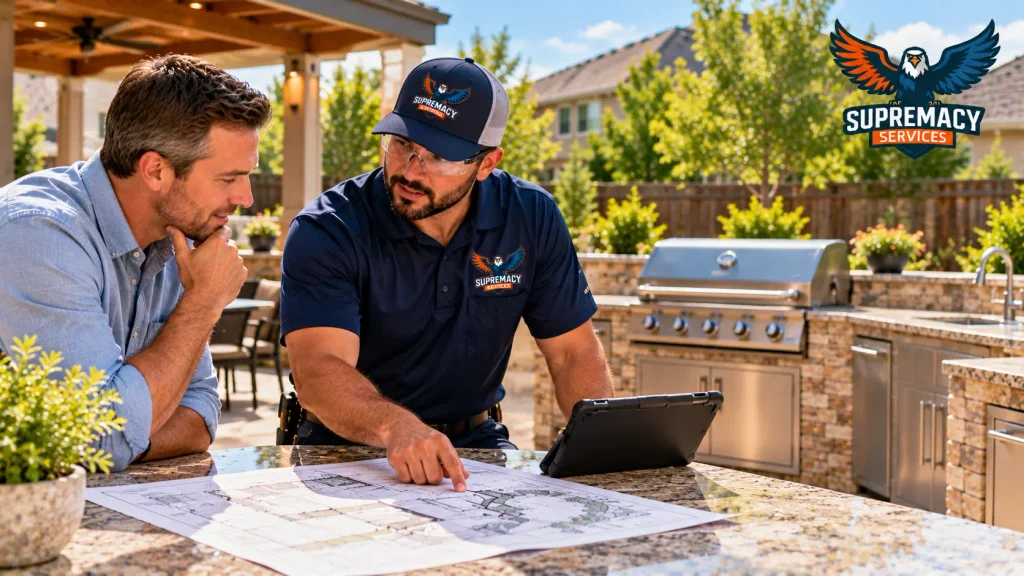
A permanent natural gas connection can make a Dallas outdoor kitchen more convenient, especially when the design includes a built-in grill or multiple gas appliances.
The most important step is planning the gas supply before construction is finalized.
Pipe sizing, appliance compatibility, routing, permits, and inspections should all be addressed before the new system is put into service.
Ready to plan a natural gas connection for your outdoor kitchen?
Contact Supremacy Services to discuss your project, confirm available gas-line services in your area, and request information about the next steps for a professional assessment.

