
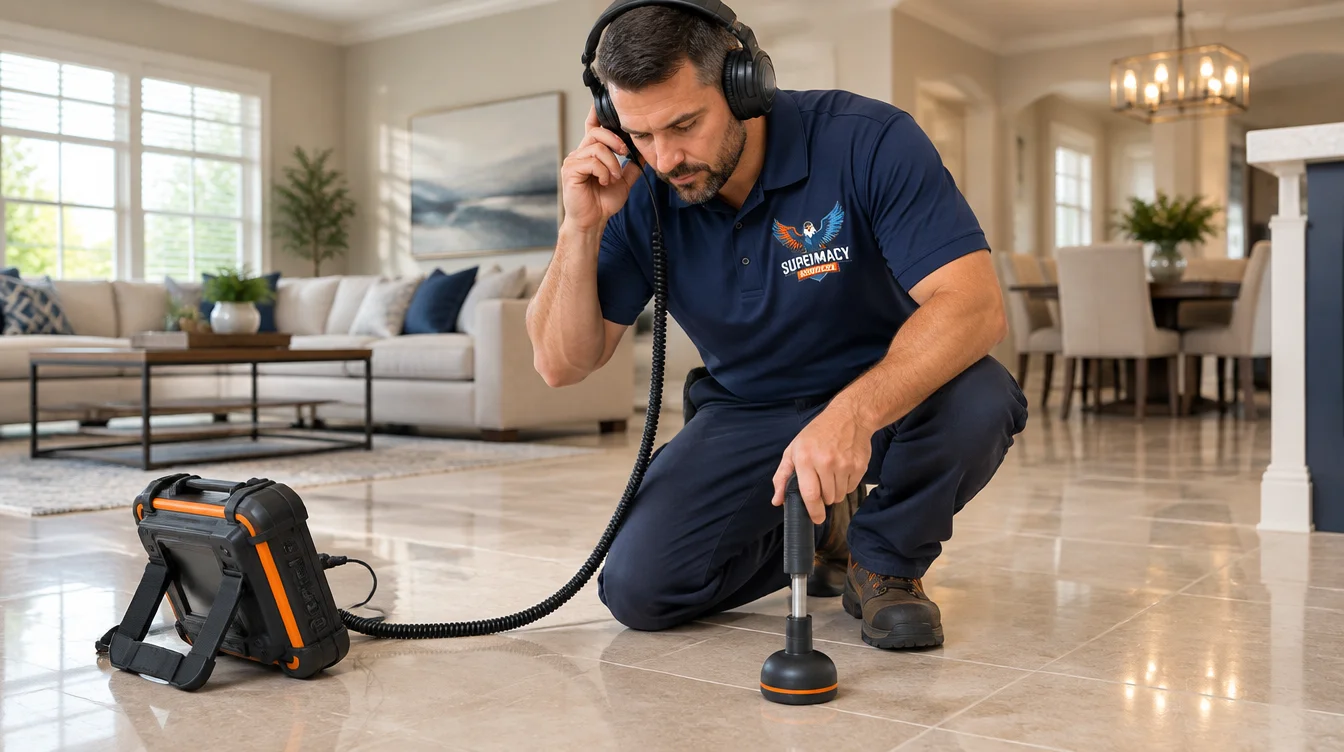
Plumbers can often detect a slab leak without breaking concrete by using acoustic listening devices, electronic leak detectors, infrared thermal cameras, and pressure testing. These tools help identify leaking pipes beneath a home’s foundation before deciding whether any concrete needs to be opened for repairs.
For Dallas homeowners, this means a suspected leak under a kitchen, bathroom, or living room floor does not automatically require tearing up the foundation just to find the problem.
The important distinction is between locating a leak and repairing it. Modern diagnostic equipment can often identify the likely source without demolition, but some repairs may still require access through the slab.
Here is how professional slab leak detection works, what each tool can reveal, and what to expect when a plumber investigates a hidden leak beneath your North Texas home.
Table of Contents
- What Is a Slab Leak?
- How Do Plumbers Find Slab Leaks Without Breaking Concrete?
- Which Slab Leak Detection Method Works Best?
- What Happens During a Professional Slab Leak Inspection?
- What Are the Warning Signs of a Slab Leak?
- What Causes Slab Leaks in Dallas Homes?
- Can Homeowners Check for Slab Leaks Themselves?
- How Much Does Slab Leak Detection Cost?
- What Happens After a Slab Leak Is Found?
- Can Slab Leaks Be Prevented?
- Frequently Asked Questions
What Is a Slab Leak?
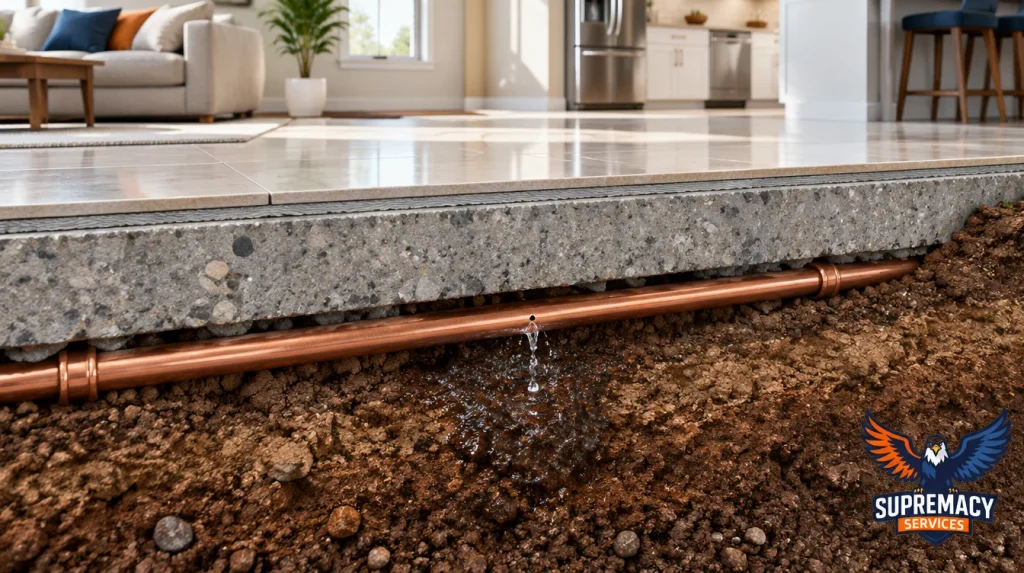
A slab leak is a water leak involving plumbing beneath or within a home’s concrete slab foundation.
Many slab-on-grade houses have water supply lines routed beneath the foundation. If one of these pipes develops a hole, crack, or failed connection, water can escape into the surrounding soil or beneath the concrete.
Slab leaks can involve either hot or cold water supply lines. Drainage pipes beneath a foundation can also fail, although plumbers use different diagnostic methods to investigate those problems.
A slab leak may remain hidden because the damaged pipe is not directly visible. Water can travel through soil, follow pipe trenches, or migrate through flooring materials before signs appear inside the house.
That means the location of a damp floor is not always the location of the leaking pipe.
Why detecting a slab leak early matters
An undetected leak may lead to:
- Higher water bills from continuous water loss
- Damp flooring, carpet, or baseboards
- Damage to interior finishes
- Moisture-related mold problems
- Soil erosion or changes in moisture conditions beneath the foundation
- Additional plumbing damage if the underlying pipe problem continues
A plumbing leak does not automatically mean a foundation has suffered structural damage. However, prolonged water movement beneath a slab warrants prompt investigation.
How Do Plumbers Find Slab Leaks Without Breaking Concrete?
Professional plumbers typically combine several diagnostic methods rather than relying on one tool.
The process begins by confirming whether the plumbing system is losing water. The plumber then isolates sections of piping and uses specialized equipment to narrow down the suspected leak location.
1. Acoustic Leak Detection: Listening for Water Escaping Underground
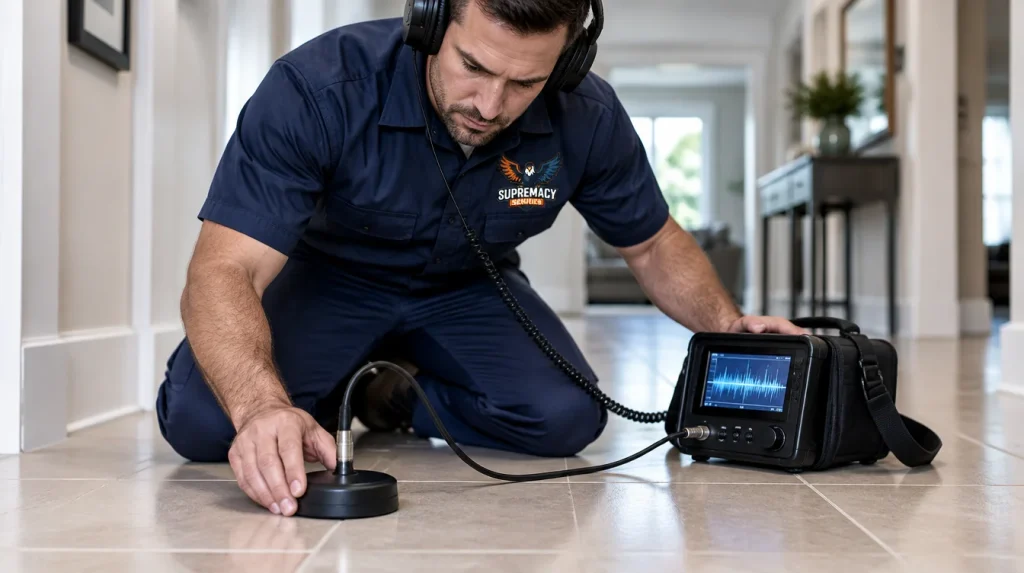
Acoustic leak detection is one of the most useful methods for locating leaks in pressurized pipes beneath concrete.
When water escapes through a crack or opening, it can produce vibrations and sound. Specialized listening equipment amplifies these signals so a trained technician can investigate areas where the leak may be occurring.
How it works:
- The plumber confirms that the suspected water line is pressurized.
- Sensitive microphones or acoustic sensors are positioned at accessible locations.
- The technician listens for sounds associated with escaping water.
- Readings are compared at different points along the suspected pipe route.
- The plumber narrows the investigation to the most likely leak area.
Acoustic equipment is particularly useful when a pressurized supply pipe produces a detectable leak sound.
However, detection conditions vary. Small leaks, low water pressure, thick concrete, surrounding soil, and background noise can make acoustic signals difficult to interpret.
Important: The loudest detected sound does not always identify the exact point of the leak because sound can travel through pipes and structural materials.
2. Infrared Thermal Imaging: Identifying Temperature Differences
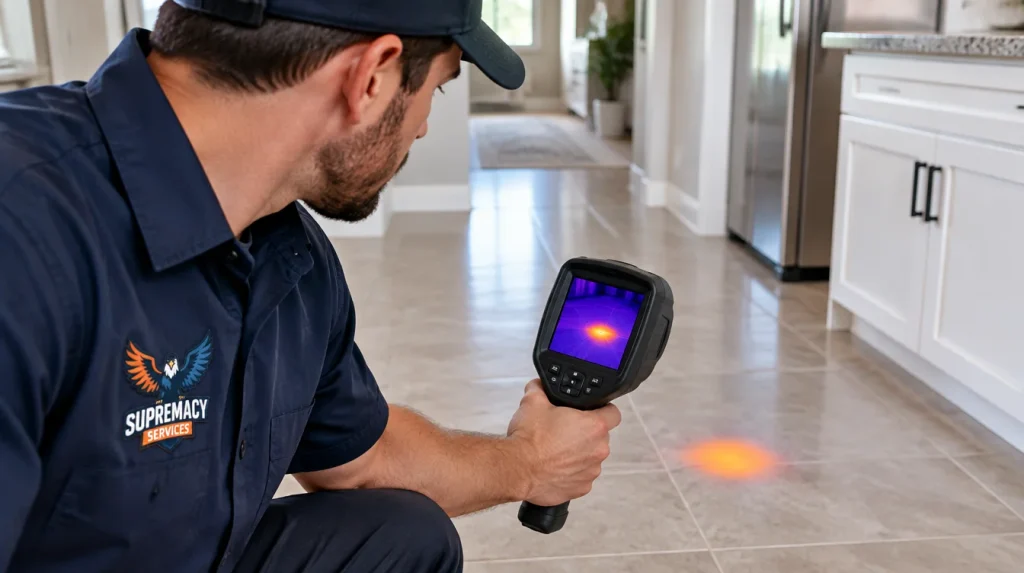
Infrared cameras help plumbers identify temperature variations across floors and other building surfaces.
They are especially useful when investigating a suspected hot-water leak beneath a slab.
If heated water escapes from a pipe, it may warm surrounding materials. A thermal camera can reveal unusual temperature patterns that suggest where further testing is needed.
What a plumber looks for:
- Unexpected warm areas on tile or other flooring
- Temperature patterns following a possible pipe route
- Differences between adjacent floor surfaces
- Thermal changes that appear when hot water is flowing
Thermal imaging does not allow a plumber to see directly through concrete or photograph a pipe hidden underground.
Instead, it measures surface infrared radiation and displays temperature differences.
A warm floor can also result from sunlight, heating equipment, or normal hot-water piping. Therefore, thermal imaging findings should be confirmed with additional tests.
3. Electronic Leak Detection: Amplifying Hidden Leak Signals
Electronic leak detection systems use sensitive sensors and signal processing to help identify sounds or vibrations associated with water escaping from a pipe.
Depending on the equipment, the technician may use ground microphones, contact sensors, or other listening devices.
The equipment helps distinguish possible leak sounds from ordinary household noise.
For example, a technician may compare readings near a kitchen floor, hallway, and bathroom to determine where the strongest consistent leak signal appears.
Electronic listening equipment is often part of an acoustic detection system rather than an entirely separate diagnostic technology.
It is most useful when combined with knowledge of the plumbing layout and pressure-test results.
4. Pressure Testing: Confirming That a Pipe Is Leaking
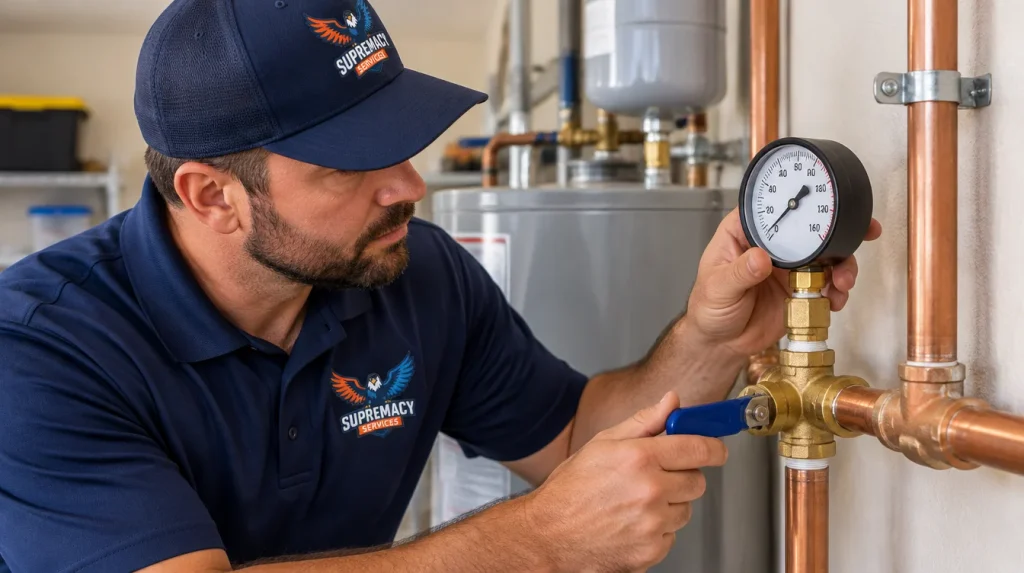
Pressure testing helps determine whether a section of plumbing can maintain pressure when isolated under controlled conditions.
A plumber may connect a suitable pressure gauge, isolate a plumbing section, and monitor the readings using an appropriate testing procedure.
A pressure drop can indicate leakage, although temperature changes, trapped air, and other testing conditions must be considered.
Pressure testing answers an important question: Is this plumbing section losing pressure?
It does not, by itself, reveal the exact location of the damaged pipe.
For that reason, plumbers often use pressure testing before acoustic or thermal investigation.
Different procedures apply to potable water supply piping and drainage systems. A hydrostatic drain test should not be confused with pressure testing a pressurized water supply line.
5. Moisture Mapping and Pipe Tracing
Sometimes the first clue is not a sound or temperature change but an unusual moisture pattern.
A plumber may use moisture meters to examine flooring, baseboards, or other accessible materials.
Moisture readings help identify affected areas and document the extent of water migration.
Pipe tracing may also help identify the likely route of concealed plumbing when suitable access and equipment are available.
These techniques are useful supporting methods, but moisture alone cannot prove that a slab leak exists.
For example, water from a leaking appliance connection can spread across a floor and resemble moisture from beneath the foundation.
Suspect a hidden leak beneath your foundation? Supremacy Services offers professional water leak detection in Dallas and the DFW Metroplex, including acoustic and infrared diagnostic methods designed to reduce unnecessary disruption.
Which Slab Leak Detection Method Works Best?
There is no single detection method that works best for every home.
The appropriate equipment depends on the pipe material, leak size, water pressure, floor construction, and whether the suspected leak involves a hot-water line, cold-water line, or drain.
| Detection method | Primary purpose | Main limitation |
|---|---|---|
| Acoustic listening | Locate sounds from escaping pressurized water | Background noise and weak signals |
| Infrared thermal imaging | Identify unusual surface temperature patterns | Cannot directly see through concrete |
| Electronic acoustic sensors | Amplify and analyze leak-related sounds | Requires interpretation and confirmation |
| Pressure testing | Confirm leakage in an isolated plumbing section | Does not locate the leak by itself |
| Moisture mapping | Identify and document affected materials | Moisture may originate elsewhere |
| Pipe tracing | Help establish concealed pipe routes | Does not independently confirm leakage |
Can plumbers detect every slab leak without opening the floor?
No. Non-invasive equipment can often identify a suspected leak location, but it cannot guarantee a conclusive diagnosis in every situation.
Some leaks are too small or quiet for reliable acoustic detection. Others occur in complicated pipe layouts or beneath materials that interfere with readings.
When testing is inconclusive, a plumber may recommend additional investigation or limited access to confirm the source.
The goal is to minimize unnecessary demolition, not promise that concrete will never need to be opened.
What Happens During a Professional Slab Leak Inspection?
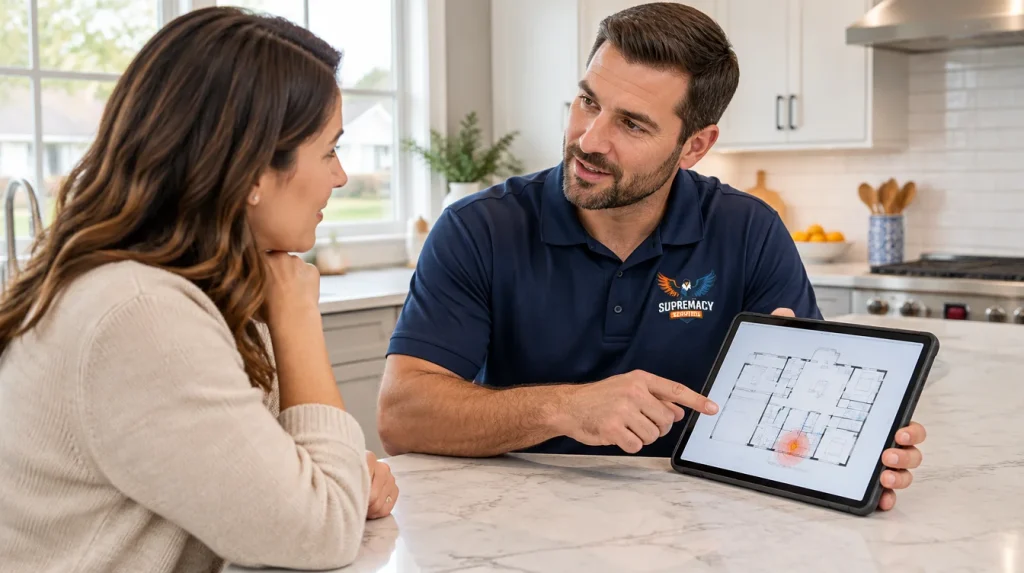
A professional inspection generally follows a structured process.
Step 1: Discuss symptoms and inspect accessible plumbing
The plumber asks when the problem started and whether you have noticed rising water bills, damp flooring, unusual sounds, or changes in water pressure.
Accessible fixtures, toilets, appliance connections, and water heater components may be checked first.
This helps rule out simpler explanations before investigating the foundation.
Step 2: Check the water meter and isolate plumbing sections
With all water-using fixtures off, the plumber may examine the water meter for evidence of ongoing flow.
Isolation valves can help determine whether the suspected leak is inside the building’s plumbing system, along the incoming service line, or associated with another connected system.
Step 3: Test the suspected water line
The technician selects an appropriate test based on whether the suspected problem involves pressurized supply piping or drainage piping.
Pressure or other system-specific tests help confirm whether the suspected section is leaking.
Step 4: Use acoustic and thermal equipment
After narrowing the investigation, the plumber scans likely pipe routes and affected areas.
Acoustic readings, thermal patterns, and moisture measurements may be compared to improve confidence in the suspected location.
Step 5: Mark the suspected leak area
If the evidence is sufficiently consistent, the plumber may mark the likely leak location on the floor or document it in an inspection report.
The marked location represents the best-supported finding from the available tests, not necessarily an exact measurement of the pipe opening.
Step 6: Explain the findings and repair options
The homeowner should receive an explanation of:
- Which plumbing section appears to be leaking
- Which tests were performed
- How confidently the leak has been located
- Whether further investigation is needed
- Which repair approaches may be feasible
- Whether concrete removal or other access is expected
Ask for a written estimate before authorizing invasive repair work.
What Are the Warning Signs of a Slab Leak?
The most common warning signs include unexplained water consumption, warm or damp floors, and the sound of running water when fixtures are turned off.
Watch for the following symptoms.
An unexplained increase in your water bill
A continuous supply-line leak can waste water even when nobody is using a faucet.
Compare recent bills with your normal usage and investigate sudden changes that cannot be explained by irrigation, guests, or other activities.
Warm spots on the floor
An unusual warm area may indicate a leaking hot-water line beneath the slab.
However, normal hot-water piping and sunlight can also warm flooring, so this symptom is not definitive.
Damp flooring or recurring moisture
Moisture beneath carpet, loose flooring, or persistent dampness near baseboards can indicate a hidden leak.
Other possible causes include appliance leaks, condensation, exterior water intrusion, and drainage problems.
Running-water sounds when fixtures are off
A continuous hissing or rushing sound may suggest that water is moving through a pipe unexpectedly.
A plumber can investigate whether the sound comes from a leak, running toilet, or another plumbing component.
Reduced water pressure
A significant leak may contribute to pressure loss, but low pressure can also result from clogged fixtures, pressure-regulating valve problems, or municipal supply conditions.
Cracks or movement in flooring
Cracks and uneven floors deserve attention, but they do not prove a slab leak.
Foundation movement can have several causes, including soil moisture changes and structural conditions unrelated to plumbing.
If you notice multiple warning signs, arrange a plumbing inspection rather than assuming the foundation must be excavated.
What Causes Slab Leaks in Dallas Homes?
Slab leaks can develop for several reasons, including pipe deterioration, mechanical damage, installation problems, and movement around buried plumbing.
Pipe corrosion and deterioration
Some older homes contain metallic water lines that may deteriorate over time.
The rate of deterioration depends on factors such as pipe material, water chemistry, installation conditions, and exposure to surrounding materials.
Foundation and soil movement
Expansive clay soils occur in parts of North Texas.
These soils can shrink or swell as moisture conditions change. Movement around a foundation or buried pipe can place additional stress on plumbing, especially where piping lacks sufficient flexibility or protection.
Not every Dallas slab leak is caused by expansive soil, and soil movement alone does not establish why a particular pipe failed.
Installation-related problems
Pipes may be vulnerable when they are improperly supported, damaged during construction, or installed in contact with abrasive materials.
Stress at joints and bends can also contribute to failures.
Water pressure and repeated stress
Excessive water pressure or repeated pressure fluctuations can place additional stress on plumbing components.
A professional can measure household pressure and determine whether corrective equipment or adjustments are needed.
Can Homeowners Check for Slab Leaks Themselves?
Homeowners can perform basic checks to identify possible hidden water loss, but locating a leak beneath concrete usually requires professional equipment and interpretation.
A simple water meter check
- Turn off faucets, showers, and water-using appliances.
- Make sure toilets are not refilling and irrigation is off.
- Check the water meter for ongoing movement.
- Record the reading.
- Avoid using water for a suitable observation period.
- Check the meter again.
If the reading changes while no water is intentionally being used, investigate further.
The EPA recommends checking the meter during a period without water use and comparing readings after two hours.
A changing meter reading suggests water loss but does not identify whether the leak is beneath the slab, in an irrigation system, or elsewhere.
What homeowners should avoid
Do not break concrete based only on a warm floor, a damp patch, or a single meter observation.
Avoid operating unfamiliar valves, disconnecting pressurized plumbing, or conducting improvised pressure tests.
If water is actively flooding the home, use the main shutoff valve if it is safe and accessible, and arrange urgent plumbing assistance.
If water is approaching electrical equipment, stay clear of the affected area and seek appropriate emergency assistance.
How Much Does Slab Leak Detection Cost?
Slab leak detection costs vary based on the complexity of the plumbing system, the tests required, the property’s accessibility, and whether the investigation involves one suspected pipe or several possible sources.
There is no universal fixed price for every Dallas property.
A straightforward investigation of an accessible residential water supply system may require less work than a complex diagnosis involving multiple plumbing zones or uncertain moisture sources.
Factors that affect the price
| Cost factor | Why it matters |
|---|---|
| Size and layout of the home | Larger properties may require more investigation |
| Number of suspected pipe sections | Additional isolation and testing may be necessary |
| Type of plumbing | Supply lines and drains require different tests |
| Flooring and foundation construction | Some materials make readings harder to interpret |
| Accessibility | Concealed valves or pipe routes complicate testing |
| Diagnostic equipment required | Multiple methods may be necessary |
| Emergency scheduling | Urgent service may have different pricing |
| Documentation requirements | Detailed reports may involve additional work |
Before booking, ask whether the quoted diagnostic fee includes pressure testing, acoustic investigation, thermal imaging, written findings, and any follow-up visit.
Also confirm whether the detection charge is separate from repair costs.
Does insurance cover slab leak detection?
Coverage depends on your specific insurance policy, the cause of the damage, and the terms applying to leak detection, access, and repairs.
Some policies may distinguish between damage caused by escaping water and the cost of repairing the failed pipe itself.
Contact your insurer and review the policy before assuming any particular expense will be reimbursed.
If your water meter indicates ongoing water loss but you cannot find a visible leak, consider scheduling a professional hidden water leak inspection before authorizing concrete removal.
What Happens After a Slab Leak Is Found?
Finding the leak is only the first stage. The next decision is how to repair or replace the affected plumbing.
The appropriate approach depends on the pipe’s condition, location, accessibility, and whether other sections are likely to fail.
Option 1: Localized slab access and pipe repair
The plumber may recommend opening a limited section of flooring and concrete to reach the damaged pipe.
This can be appropriate when the leak is well located and the surrounding piping is otherwise suitable for repair.
Concrete removal, plumbing work, and restoration should be planned carefully.
Option 2: Rerouting the water line
In some homes, a new water line can be routed through an accessible wall, ceiling, or other suitable pathway rather than reopening the slab.
This may avoid some foundation disturbance but can require work on interior finishes.
Option 3: Replacing a larger section of piping
If several pipes have deteriorated or repeated leaks have occurred, replacing a larger section of the plumbing system may be more practical than repeatedly repairing individual failures.
The decision should follow an assessment of pipe condition and installation requirements.
For additional information about repair approaches, see Supremacy Services’ water line repair and replacement services in Dallas.
Does the concrete always need to be broken for repairs?
No. Some repairs can be completed by rerouting or replacing plumbing through another accessible path.
However, other repairs require localized slab access.
A non-invasive diagnosis does not guarantee a non-invasive repair.
Can Slab Leaks Be Prevented?
Not every slab leak can be prevented, particularly when pipes are aging or concealed beneath an existing foundation.
However, homeowners can reduce avoidable risks and identify developing problems sooner.
- Monitor monthly water consumption for unexplained changes.
- Repair visible plumbing leaks promptly.
- Have unusual water pressure evaluated.
- Investigate recurring dampness rather than covering it with new flooring.
- Maintain appropriate drainage around the home.
- Avoid major, uncontrolled changes to soil moisture around the foundation.
- Consider water-use monitoring or automatic shutoff devices where appropriate.
- Have repeated leaks assessed for broader pipe deterioration.
The EPA notes that leak detection and flow monitoring devices can identify unusual water use and help reduce water waste and damage.
A note about Dallas-area foundation conditions
Homes throughout Dallas, Plano, Frisco, Richardson, Allen, and surrounding communities can have different foundation designs, plumbing materials, and soil conditions.
Avoid assuming that every floor crack indicates a water leak or that every slab leak is caused by foundation movement.
A plumbing diagnosis should establish whether a pipe is leaking. A separate foundation assessment may be appropriate when there is evidence of structural movement.
Frequently Asked Questions
1. Can plumbers find a slab leak without digging?
Yes. Plumbers can often locate a suspected slab leak using acoustic equipment, pressure testing, thermal imaging, and other diagnostic tools without digging or breaking concrete. Some cases still require limited access for confirmation or repair.
2. Can a thermal camera see water leaking through concrete?
No. A thermal camera measures surface temperature differences. It may identify patterns associated with a hot-water leak, but it cannot directly see water or pipes through solid concrete.
3. How accurate is electronic slab leak detection?
Accuracy depends on the leak, pipe material, pressure, building construction, background noise, and technician interpretation. Combining electronic listening with other diagnostic tests generally provides stronger evidence than relying on one reading.
4. Can a slab leak cause a high water bill?
Yes. A leak in a pressurized water supply line may cause continuous water loss. However, running toilets, irrigation leaks, and other plumbing problems can also increase water consumption.
5. Can you have a slab leak without visible water?
Yes. Water may escape into soil beneath the foundation without immediately reaching the interior floor. An unexplained meter reading or running-water sound may be an earlier clue.
6. How long does it take to detect a slab leak?
The time varies with the home’s plumbing layout, accessibility, leak characteristics, and number of tests required. A simple diagnosis may be completed in one visit, while complex cases can require additional investigation.
7. Is slab leak detection the same as slab leak repair?
No. Detection establishes whether and where a leak is likely occurring. Repair involves accessing, rerouting, or replacing the affected plumbing.
8. Can a slab leak be mistaken for another plumbing problem?
Yes. Leaking appliances, toilets, irrigation lines, drainage pipes, condensation, and exterior water intrusion can produce similar symptoms. Proper diagnosis helps distinguish these issues.
9. Should I turn off my water if I suspect a slab leak?
If water is actively escaping or causing damage, shutting off the main water supply may help limit further loss when it is safe to do so. For less obvious symptoms, contact a plumber for guidance and avoid disturbing unfamiliar plumbing equipment.
10. Who should inspect a suspected slab leak in Dallas?
A properly licensed plumbing professional with suitable leak detection equipment should evaluate suspected under-slab plumbing leaks. Ask about the testing process, written findings, and whether the provider handles both detection and repair.
Get Professional Slab Leak Detection in Dallas and DFW
A suspected slab leak does not mean your entire floor needs to be demolished.
Acoustic listening equipment, infrared thermal imaging, and appropriate plumbing tests can often help locate a hidden water leak before invasive work begins.
The best approach is to confirm that a leak exists, narrow down its location, and understand the available repair options before making changes to the foundation.
Supremacy Services provides professional water leak detection for homeowners across Dallas and the surrounding DFW Metroplex.
Schedule Water Leak Detection With Supremacy Services
Find out what is happening beneath your floor and which next step makes sense for your home.

