
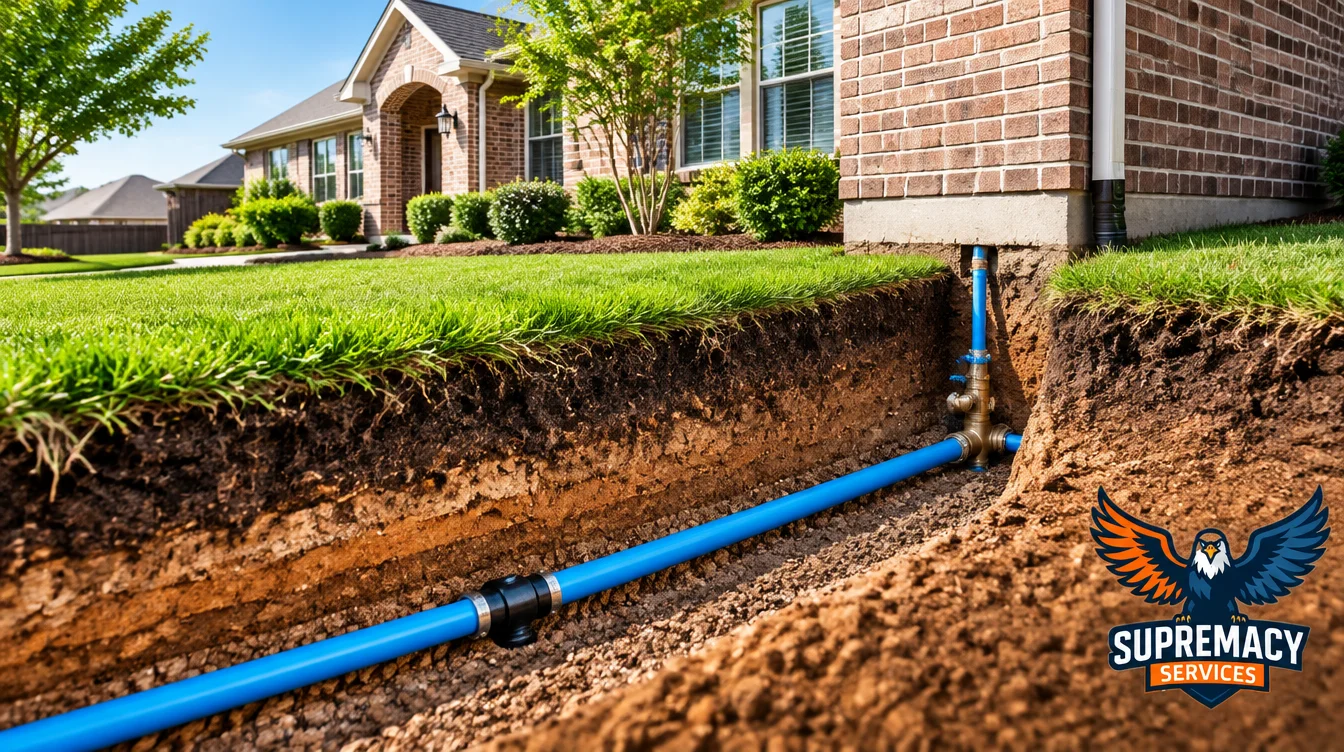
Residential water lines in Dallas and North Texas are often buried relatively shallow compared with water pipes in colder parts of the country. However, there is no single burial depth homeowners can safely assume for every property. The correct depth depends on the applicable plumbing code, the type of water line, the installation location, soil cover, and local requirements.
Some City of Dallas residential rehabilitation specifications call for water service lines to be installed between 12 and 18 inches below finished grade. That is a project-specific specification, not a universal rule governing every residential water line in Dallas.
If you’re planning landscaping, installing a fence, investigating a water leak, or replacing an underground pipe, the safest approach is to verify the line’s location and applicable requirements before excavation.
Table of Contents
- How deep are residential water lines buried?
- What determines water line burial depth?
- What are Dallas plumbing code requirements?
- Why does proper burial depth matter?
- How can you find your underground water line?
- What happens if a water line is too shallow?
- How much does it cost to expose or rebury a water line?
- Can homeowners dig around water lines themselves?
- What happens during professional water line work?
- Frequently asked questions
- When to contact Supremacy Services
How Deep Are Residential Water Lines Typically Buried in North Texas?
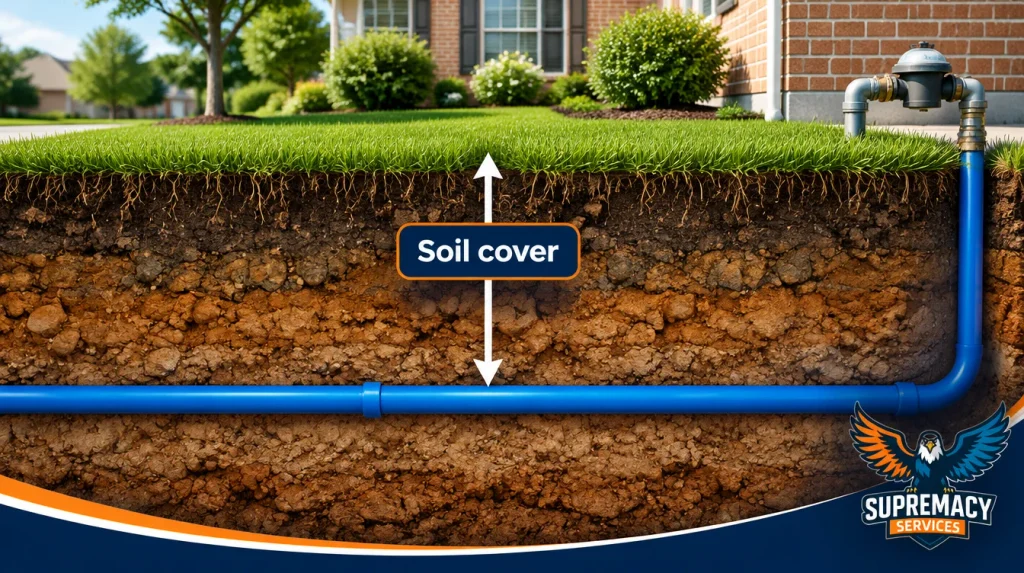
For residential properties in North Texas, a shallow service line may be found around 12–18 inches underground, but this should be treated as a possible installation depth rather than a verified regional average or guaranteed code requirement.
Other installations may be deeper because of the municipality, construction design, changes in ground elevation, utility crossings, or the property’s history.
The only reliable way to determine the depth of an existing line is to consult relevant records and have the line properly located or exposed by qualified personnel.
Water service lines vs. municipal water mains
Not every underground water pipe serves the same purpose.
| Type of water line | Purpose | Depth consideration |
|---|---|---|
| Municipal water main | Supplies water to multiple properties | Governed by utility engineering and construction standards |
| Residential water service line | Connects the utility supply to the home | Depends on adopted codes and approved installation |
| Private yard water line | Supplies an outdoor fixture or detached structure | Depends on pipe use, installation and applicable code |
| Irrigation piping | Supplies lawn and landscape irrigation | Separate system with its own installation requirements |
A city water main running beneath a roadway may be considerably deeper than the smaller service pipe entering your house.
This distinction matters because the depth of a municipal main cannot be used to predict how deep your residential service line is buried.
What Determines How Deep a Residential Water Line Is Buried?
Several factors influence the burial depth of underground water pipes in Dallas and surrounding communities.
1. Local plumbing code and installation standards
Plumbing codes establish requirements for safe installation, including protection from freezing, physical damage, and unsuitable conditions.
The applicable rules depend on the city or jurisdiction and the type of installation. A homeowner in Dallas should not automatically assume that an installation requirement in Frisco, Plano, or another nearby municipality is identical.
2. Frost protection and cold weather
North Texas generally experiences milder winters than northern states, but freezing weather still occurs.
Buried water pipes receive some protection from the surrounding soil. A line that is inadequately covered, exposed near a foundation, or connected to unprotected above-ground plumbing may be more vulnerable during prolonged freezing conditions.
Burial depth is only one part of freeze protection. Pipe exposure, insulation, installation design, and local code requirements also matter.
3. North Texas clay soil
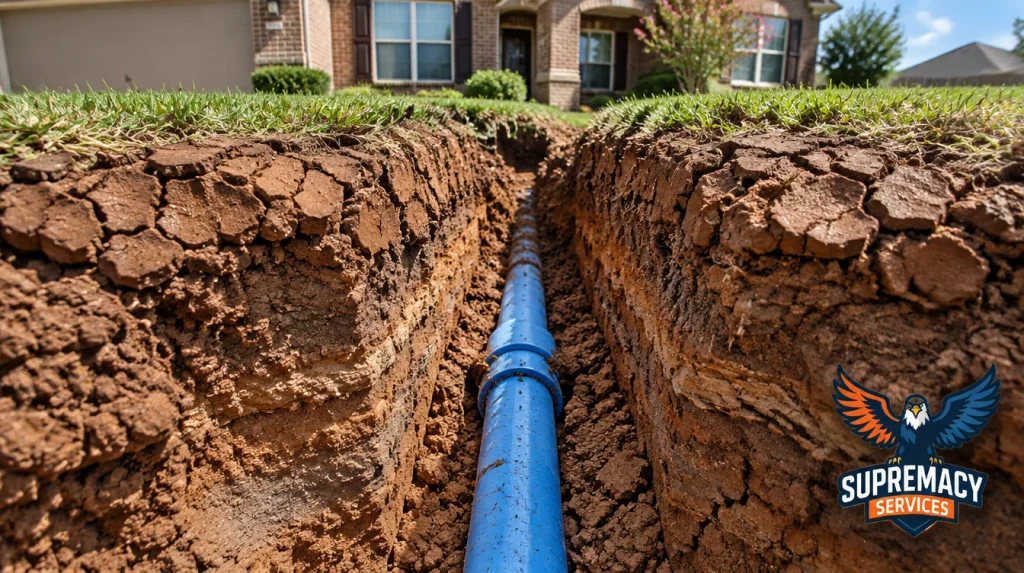
Many Dallas-area properties have expansive clay soils that shrink as they dry and swell as they absorb moisture.
These changes can contribute to ground movement around buried utilities. Depending on pipe material, joints, installation conditions, and soil movement, underground water lines may experience additional stress.
A deeper installation does not automatically eliminate soil-related damage. Proper bedding, backfill, and pipe selection are also important.
4. Landscaping and changes in ground elevation
A water line originally installed with adequate cover may have less soil above it after landscaping or grading work.
Potential changes include:
- Removing soil to level a yard.
- Excavating for a retaining wall.
- Regrading around a driveway.
- Installing a drainage channel.
- Erosion around an exposed section of pipe.
The depth of cover is measured from the current finished ground surface to the relevant point on the pipe, not simply from the ground elevation when the home was built.
5. Underground utility crossings
Water service lines may need to cross or run near sewer pipes, drainage systems, electrical conduits, gas lines, and other buried infrastructure.
Required separation and protection can influence their route and elevation.
When homeowners should consider professional help: If a water line has become exposed, has inadequate cover, or may have been damaged during excavation, a plumbing professional can assess its condition and determine whether repair, protection, or replacement is appropriate.
What Are the Water Line Burial Depth Requirements in Dallas?
Dallas uses adopted construction and plumbing codes with local amendments. The City identifies the 2021 International Plumbing Code and its Dallas amendments among its adopted construction standards, effective May 12, 2023.
That does not mean every existing residential service pipe must be exactly the same depth.
A useful example appears in the City of Dallas’ residential rehabilitation construction specifications, which identify a 12–18-inch depth range for service lines and valves. Those specifications apply to their stated construction program and should not be substituted for the general plumbing code or a project’s approved plans.
How to verify the required depth for your property
Before installing or replacing a residential water service line:
- Identify the municipality and permitting jurisdiction.
- Confirm which plumbing or residential code applies.
- Ask whether local amendments specify minimum cover or frost protection.
- Determine whether the work involves a private service line or utility-owned infrastructure.
- Have the planned installation reviewed by a qualified plumbing contractor.
For current code information, consult the City of Dallas construction codes and ordinances.
Do not confuse an 811 excavation-notification threshold with a required water-line burial depth. They address different issues.
Why Does Proper Water Line Burial Depth Matter?
Correct installation depth helps protect a residential water supply line from avoidable damage and supports long-term reliability.
Protection against accidental excavation
Shallow pipes can be struck by landscaping equipment, fence-post digging, or other yard improvements.
Even relatively small projects can damage underground utilities if their locations are unknown.
Protection from freezing
Soil cover moderates temperature changes around buried piping. Inadequate cover can increase exposure during freezing conditions, particularly near transitions from underground to above-ground plumbing.
Protection from physical loads
Properly installed and backfilled piping is better protected from some surface activities. Where a line passes under a driveway or another load-bearing area, its installation must account for the applicable design requirements.
Protection from soil movement
In expansive soil, proper pipe bedding, backfill, and routing help manage the conditions surrounding the water line.
Burial depth alone does not determine whether a pipe will resist soil movement or leakage.
How Can You Find an Underground Water Line Before Digging?
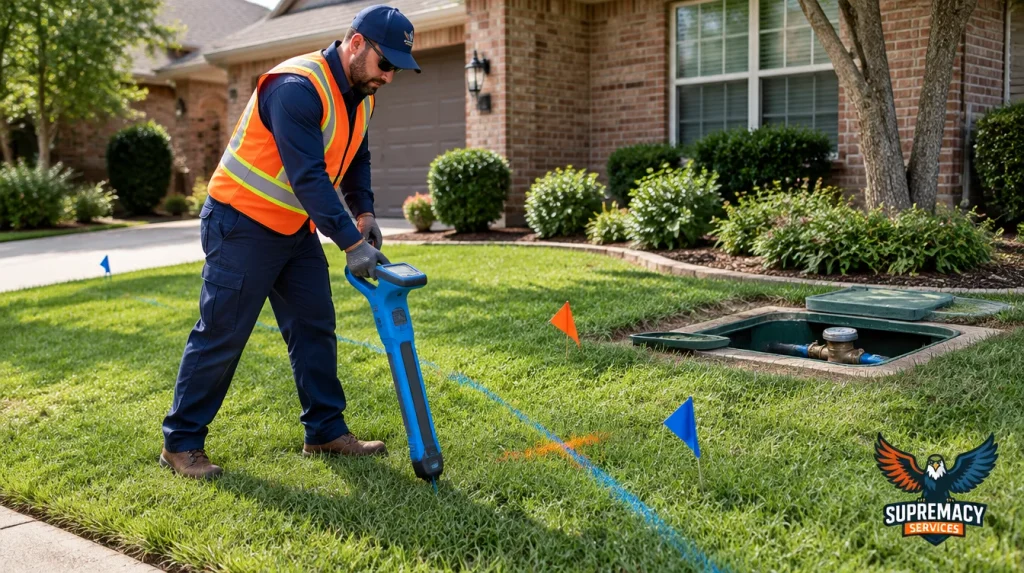
The safest starting point is to contact Texas811 before excavation and determine whether the specific water line is covered by utility locating services.
Texas811 coordinates notification to participating utility owners. It does not guarantee that privately owned lines, including some sections between a meter and a home, will be marked. Private locating may be necessary.
Step-by-step: Finding a buried water service line
Step 1 — Identify the water meter and service entry
Locate the meter box and where the water service enters the building. These provide useful reference points, but the pipe may not follow a straight route.
Step 2 — Submit a Texas811 request
Contact Texas811 at least two working days before excavation and wait for the required responses and markings.
Step 3 — Arrange private utility locating when needed
Ask whether the residential service line is privately owned and whether a separate locator is required.
Step 4 — Confirm actual depth safely
Utility markings identify approximate horizontal locations, not reliable burial depths. Qualified personnel may need to use careful exposure methods to establish the pipe’s depth.
Texas811 advises homeowners to request utility locations even for shallow digging or hand excavation. Its service is free for participating utility notifications, although private line locating can involve additional charges.
Important: Never assume a pipe is safe to dig over because you believe it is buried 18 inches or deeper.
What Happens if a Residential Water Line Is Buried Too Shallow?
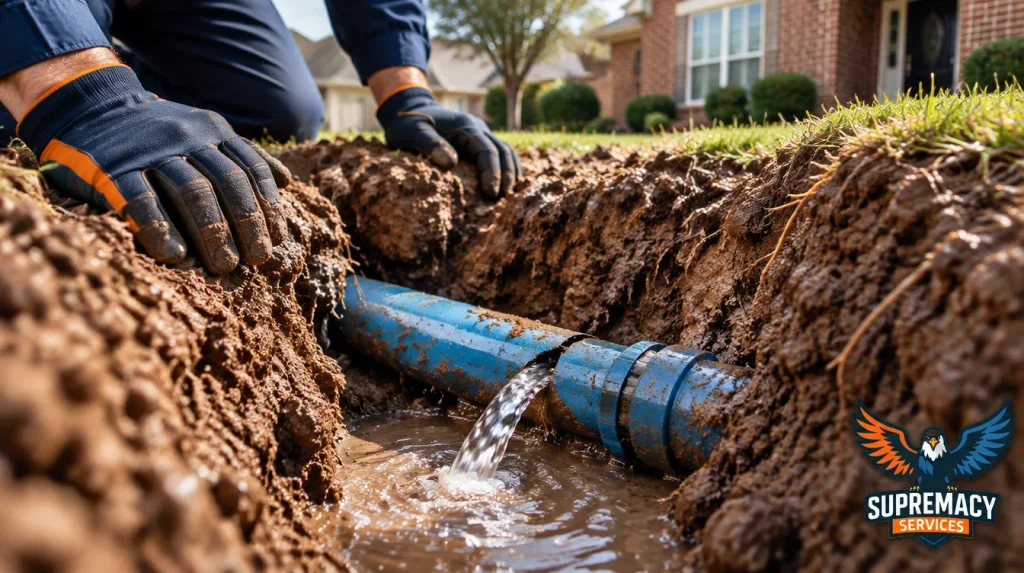
A shallow water line is not automatically defective. The concern is whether the line meets applicable requirements and is adequately protected for its location and use.
Potential warning signs include:
- Pipe becoming visible after erosion or landscaping.
- Repeated leaks in the same underground section.
- Water appearing in the yard when irrigation is off.
- Unexplained water meter movement while fixtures are shut off.
- Low water pressure or unexpected pressure changes.
- Damage discovered after fence, driveway, or landscape work.
These symptoms do not prove the line is too shallow. They may indicate a leaking joint, deteriorated pipe, underground break, irrigation problem, or another plumbing issue.
Can a shallow water line be repaired without replacing it?
Sometimes. If the pipe is in good condition and the problem is limited to a small damaged section, a localized repair may be sufficient.
If the line has repeated failures, widespread deterioration, unsuitable materials, or an installation that cannot be adequately protected, replacement or rerouting may be more practical.
The decision should follow inspection rather than depth alone.
If you suspect an underground leak or damaged water supply pipe, contact Supremacy Services to discuss professional water line inspection and repair options in Dallas and the DFW Metroplex.
How Much Does It Cost to Expose or Rebury a Water Line in Dallas?
The cost depends on the length and depth of the excavation, pipe condition, site accessibility, utility conflicts, and whether the line needs repair or replacement.
There is no reliable flat price for simply making a residential water line deeper. A plumber first needs to determine whether additional cover is required and whether the existing pipe can remain in place.
| Cost factor | Why it matters |
|---|---|
| Burial depth | Deeper excavation may require more labor, equipment, and safety precautions |
| Length of exposed pipe | Longer work areas generally require more excavation and restoration |
| Soil conditions | Dense or difficult soils can affect excavation methods |
| Driveways and sidewalks | Concrete removal and restoration can add substantial work |
| Underground utilities | Nearby gas, electrical, sewer, and communications lines complicate excavation |
| Pipe condition | Damaged or deteriorated pipe may need replacement |
| Permits and inspections | Requirements depend on the municipality and scope of work |
| Landscaping restoration | Sod, irrigation, paving, and planted areas may need restoration |
Is it cheaper to repair a shallow line or replace it?
Repair may be less disruptive when the problem is isolated and the remaining pipe is sound.
Replacement becomes worth comparing when the line has widespread deterioration, recurring failures, or an installation that needs substantial correction.
Some properties may be suitable for trenchless replacement, which can reduce surface excavation. However, trenchless methods still require proper utility clearance, installation design, and sometimes access pits.
Supremacy Services describes both traditional excavation and trenchless options on its Dallas water line repair and replacement page.
Planning to repair, relocate, or replace an underground water line? Request an assessment from Supremacy Services to understand the condition of your existing pipe and the available repair methods before excavation begins.
Can Homeowners Dig Around Buried Water Lines Themselves?
Homeowners may perform some landscaping or excavation work themselves, but they should never rely on a guessed water-line depth.
Texas811 recommends contacting the service before every digging project, including shallow excavation and hand digging. A locate request does not eliminate the need to work carefully near marked utilities.
Texas 811
Before digging, check the following
- Submit a Texas811 locate request.
- Allow the required waiting period and confirm utility responses.
- Identify whether private utility locating is needed.
- Review the marked utility routes.
- Avoid using mechanical excavation near marked utilities without appropriate precautions.
- Determine whether the project requires a plumbing permit or licensed contractor.
- Know how to shut off the water supply if a line is damaged.
What should you do if you accidentally hit a water line?
Stop digging immediately. Keep people away from unstable or flooded excavation areas and do not attempt to repair an unknown utility line.
If it is safe and accessible, shut off the appropriate water supply valve. Contact the water utility if its infrastructure may be involved, and arrange qualified repair of damaged private plumbing.
If gas or electrical infrastructure might also have been damaged, leave the area and contact the appropriate emergency service or utility.
What Happens During Professional Underground Water Line Work?
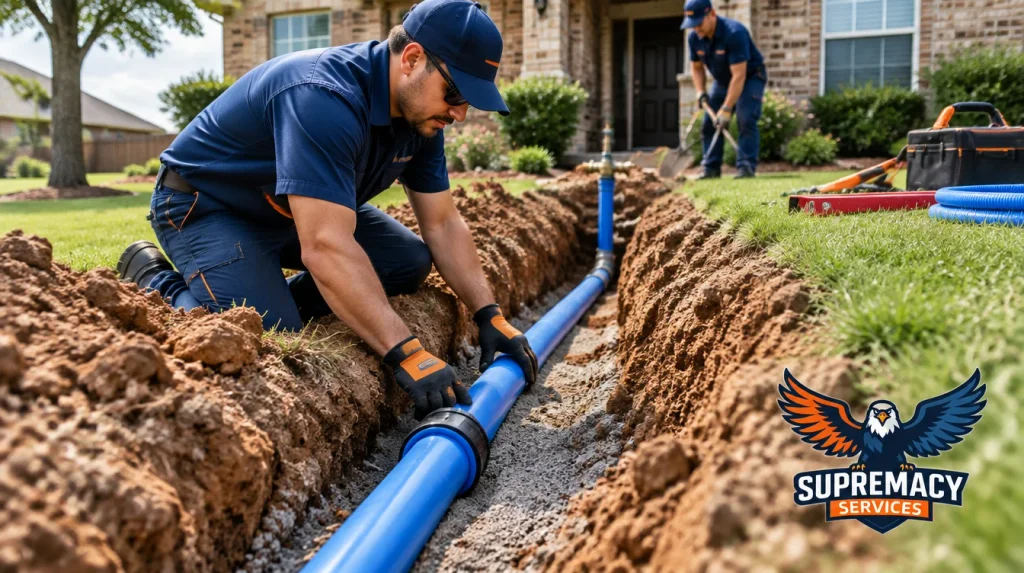
A professional assessment should establish what is wrong with the water line before recommending excavation or replacement.
The process generally includes:
1. Reviewing the symptoms
The plumber asks about water pressure, meter readings, unexplained moisture, previous repairs, and recent landscaping or excavation.
2. Locating the affected line
Available records, utility locating, appropriate leak-detection equipment, and controlled exposure may be used to identify the pipe route and problem area.
3. Assessing depth and condition
The plumber determines whether the line has adequate cover, whether the pipe itself is damaged, and which local requirements apply.
4. Selecting a repair method
Options may include a localized repair, rerouting, conventional excavation and replacement, or a suitable trenchless technique.
5. Completing testing and restoration
Following the applicable installation requirements, the contractor tests the repaired or newly installed water line, completes required inspections, and restores the excavation area according to the agreed scope.
The goal is not simply to bury the pipe deeper. It is to establish a reliable water supply line installed and protected appropriately for the property.
Frequently Asked Questions About Buried Water Lines in Texas
1. How deep are water lines buried in Dallas, Texas?
Some Dallas residential construction specifications identify a 12–18-inch depth range, but this is not a universal standard for all homes. Actual water-line depth depends on the installation, applicable codes, and site conditions.
2. Are residential water lines always buried at least 18 inches deep?
No. Homeowners should not assume every existing service line has at least 18 inches of cover. Verify the actual installation and current local requirements before excavation.
3. Can a water line freeze underground in North Texas?
Yes. Underground pipes can freeze under sufficiently cold conditions, especially where cover is inadequate or the line is exposed. Burial depth, weather duration, insulation, and installation details affect the risk.
4. How do I know where my water line runs through my yard?
Start by identifying the meter and service entry, then contact Texas811. A private utility locator may be needed for the service line on your property. Never assume the pipe follows a straight path.
5. Does Texas811 tell you how deep water pipes are buried?
No. Utility markings generally identify approximate horizontal locations, not exact burial depth. Actual depth must be established through appropriate investigation.
6. Can I plant a tree above an underground water line?
Avoid planting trees directly over known underground utilities. Root growth, future excavation, and access for maintenance can create problems. Verify utility locations and select planting locations accordingly.
7. Can I install a fence over a buried water line?
Fence posts can damage underground utilities. Contact Texas811, determine whether private locating is necessary, and confirm the proposed post locations before digging.
8. Who is responsible for the water line between the meter and my house?
Responsibility often falls to the property owner for the private service line, but the exact boundary depends on the utility provider’s rules and the service arrangement. Check with your local water utility.
9. Should I replace a water line because it is buried too shallow?
Not automatically. A professional should first establish whether the line meets applicable requirements, whether it can be adequately protected, and whether its condition justifies repair or replacement.
Need Help With an Underground Water Line in Dallas?
Understanding how deep residential water lines are buried is useful when planning home improvements, investigating leaks, or considering water service replacement.
But knowing a typical depth is not the same as knowing the condition of your home’s actual water line.
If you’re experiencing unexplained wet areas, pressure problems, recurring underground leaks, or concerns about a shallow or exposed pipe, professional assessment can help identify the cause and the appropriate solution.
Supremacy Services provides water line repair and replacement for homeowners throughout Dallas and the DFW Metroplex. Its published services include underground leak diagnostics, traditional excavation, and trenchless replacement options where suitable.
Explore Supremacy Services’ Water Line Repair and Replacement Options

