
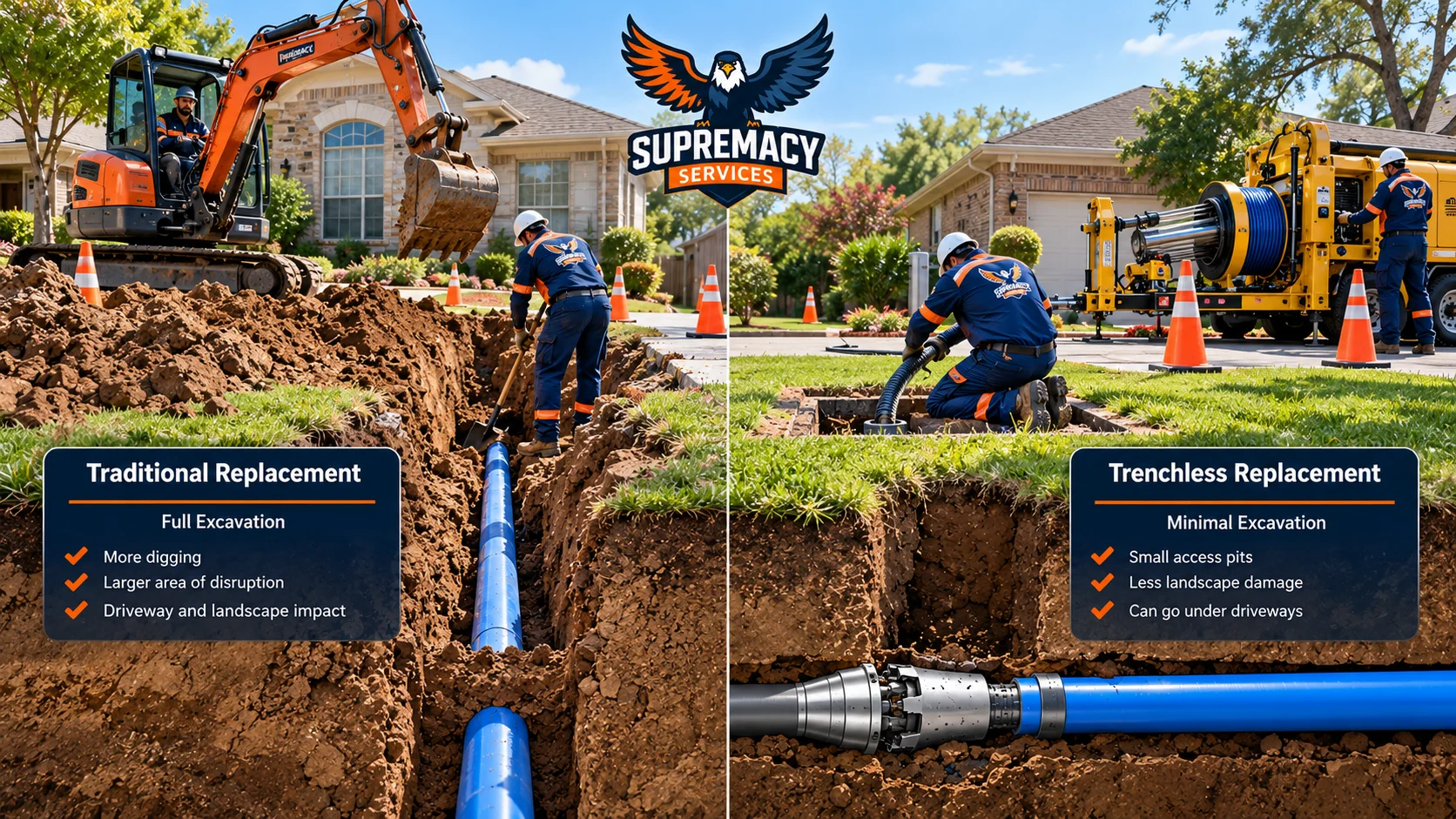
Trenchless vs. traditional water line replacement: which is better for a Dallas home? Trenchless replacement is often worth considering when you need a new underground water line but want to limit damage to your driveway, lawn, or landscaping. Traditional excavation may be the better choice when the pipe is shallow, easy to access, severely obstructed, or requires multiple exposed connections.
Neither method is automatically cheaper or more reliable. The right choice depends on the existing pipe, its route, nearby utilities, ground conditions, and the amount of surface restoration required.
For Dallas and DFW homeowners, the most useful comparison is not simply how much digging each method involves. It is the total cost of installing a suitable new water line safely, including excavation, connections, testing, and restoring the property afterward.
Table of Contents
- What is trenchless water line replacement?
- What is traditional water line replacement?
- Trenchless vs. traditional: key differences
- Which method costs less in Dallas?
- Which method causes less property damage?
- When is trenchless replacement not possible?
- Dallas soil and underground utility considerations
- Does your water line need repair or replacement?
- What happens during water line replacement?
- How to choose the right replacement method
- Frequently asked questions
- Get professional water line replacement help
What Is Trenchless Water Line Replacement?
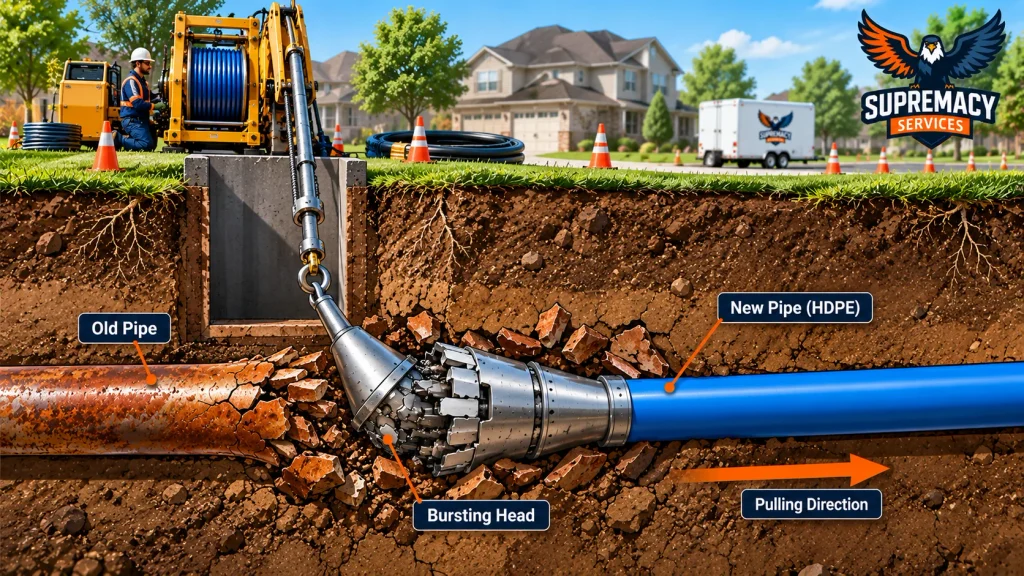
Trenchless water line replacement is a method of installing a new underground water pipe without excavating a continuous trench along the entire pipe route. Instead, contractors use specialized equipment and limited access excavations to install the replacement line.
It is sometimes described as water line replacement without digging, although that description is not entirely accurate. Most trenchless installations still require access pits or excavation at connection points.
The U.S. Environmental Protection Agency recognizes several trenchless approaches to water infrastructure replacement, including pipe bursting and horizontal directional drilling.
Pipe bursting
Pipe bursting replaces an existing underground pipe by pulling a specialized tool through it.
As the tool advances, it breaks or splits the existing pipe and moves the surrounding material outward while drawing the new pipe into position.
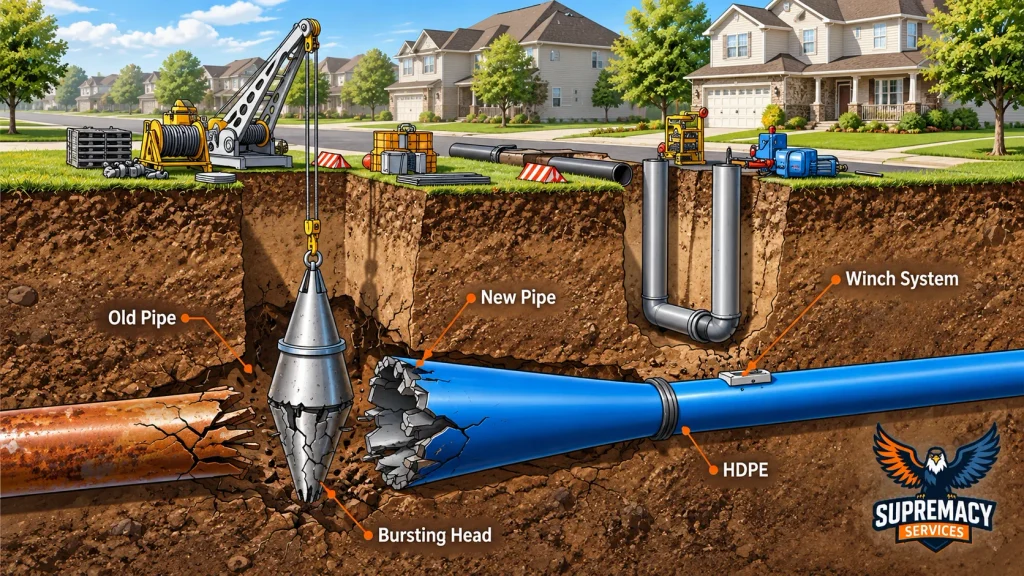
Illustration of the pipe-bursting process. The old pipe is displaced as a new pipe is pulled into its route.
Pipe bursting can be useful when the existing water line follows a suitable route and the surrounding conditions allow the equipment to operate safely.
However, nearby utility lines, incompatible pipe materials, existing repair fittings, or inadequate clearance can make the method unsuitable.
Horizontal directional drilling
Horizontal directional drilling, often abbreviated as HDD, installs a new pipe along a planned underground route using specialized drilling equipment.
Unlike pipe bursting, it does not necessarily follow or destroy the existing water line.
This method may be considered when a replacement line needs to pass beneath an established driveway, landscaped area, or other obstruction.
A contractor must first assess the underground utility layout, available working space, drilling route, and appropriate installation depth.
Is trenchless replacement completely excavation-free?
No. Even trenchless projects commonly need excavation where the new line connects to the water supply and the home’s plumbing.
The main advantage is reducing the amount of continuous excavation between those points.
That distinction matters when comparing estimates. A trenchless proposal should explain exactly where digging will occur and what surfaces will need restoration.
Considering replacement but unsure whether trenchless installation is possible? Supremacy Services provides water line repair and replacement services in Dallas, including trenchless and traditional approaches. A site assessment can help determine which method is appropriate for your property.
What Is Traditional Water Line Replacement?
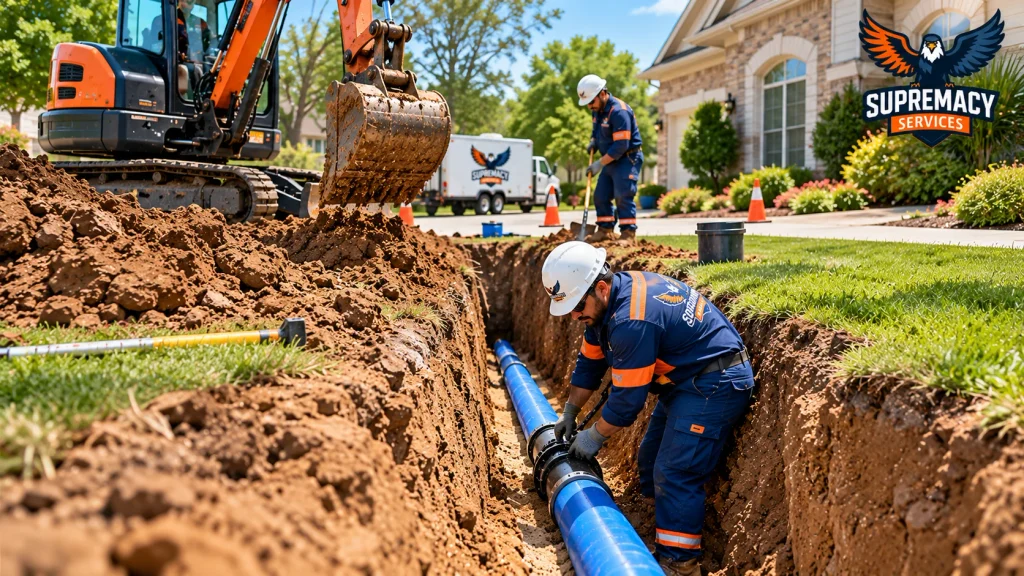
Traditional water line replacement, also called open-trench or open-cut replacement, involves excavating along the pipe route to expose and replace the underground water line.
A contractor typically identifies the affected route, arranges utility locating, excavates the necessary area, removes or disconnects the old pipe, and installs a suitable replacement.
After the new line is connected and tested, the excavation is backfilled and the disturbed surfaces are restored according to the project scope
Advantages of traditional replacement
Traditional excavation provides direct access to the existing pipe and surrounding soil.
That access can be particularly valuable when:
- The old water line contains several damaged sections.
- Multiple fittings or connections require replacement.
- The pipe route must be changed.
- The existing line is shallow and easy to reach.
- Underground obstructions make trenchless installation impractical.
- The contractor needs to inspect or correct pipe bedding and surrounding conditions.
Traditional replacement may also be economical for a short, accessible pipe section where little landscaping or pavement needs to be disturbed.
Disadvantages of traditional replacement
The biggest disadvantage is the amount of excavation.
Depending on the pipe route, work may affect grass, planting beds, irrigation lines, walkways, patios, or driveway surfaces.
Traditional excavation can also involve more soil removal, backfilling, and surface restoration.
For homeowners with extensive landscaping or finished outdoor spaces, restoration may become a substantial part of the overall project.
Trenchless vs. Traditional Water Line Replacement: Key Differences
Both methods can install a new water line. Their main differences involve how the pipe is accessed, what equipment is used, and how much surrounding property is disturbed.
| Comparison | Trenchless replacement | Traditional replacement |
|---|---|---|
| Excavation | Limited access pits or entry/exit points | Excavation along the required pipe route |
| Landscaping impact | Usually less surface disturbance | Often more extensive disturbance |
| Driveway disruption | May avoid cutting across the driveway | May require cutting and restoring pavement |
| Equipment | Specialized pulling or drilling equipment | Excavation and conventional pipe-installation equipment |
| Pipe access | Limited direct access along the route | Direct access to the exposed pipe |
| Obstructions | Some conditions can prevent installation | More flexibility to expose and remove obstacles |
| Cost | Higher specialized equipment cost may be offset by reduced restoration | Excavation may cost less initially but restoration can add expense |
| Suitability | Depends heavily on pipe and site conditions | Often suitable when direct access is needed |
| Restoration | Usually concentrated around access points | May extend along much of the pipe route |
Which method is better overall?
Trenchless replacement is generally more attractive when preserving existing surfaces is a priority and the site is technically suitable.
Traditional replacement can be more practical when the water line is readily accessible or when the existing underground conditions require extensive direct excavation.
The EPA notes that trenchless replacement is particularly effective for longer uninterrupted pipe runs, while connections and fittings can require additional excavation.
Which Method Costs Less in Dallas?
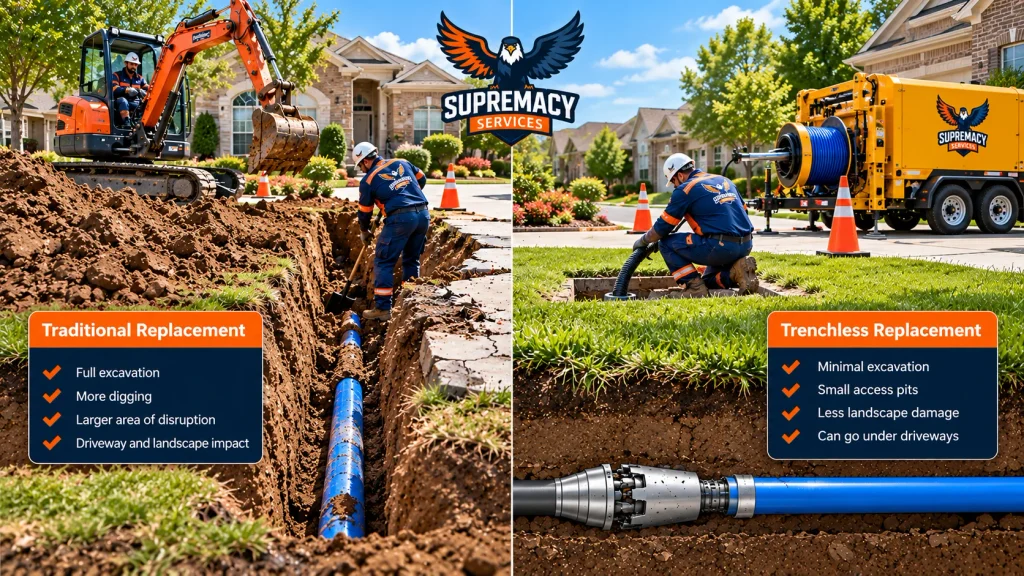
Neither trenchless nor traditional water line replacement is consistently cheaper.
Trenchless replacement can reduce excavation and surface restoration costs, but it requires specialized equipment and expertise. Traditional replacement may have a lower installation cost on an accessible route, but digging and restoring finished surfaces can increase the final bill.
For Dallas homeowners, a meaningful estimate should include the entire project rather than only the cost of installing the new pipe.
What affects water line replacement cost?
| Cost factor | Why it matters |
|---|---|
| Pipe length | Longer runs generally require more materials and labor |
| Pipe depth | Deeper lines can complicate excavation and access |
| Existing pipe material | May affect removal or pipe-bursting feasibility |
| Soil conditions | Can influence excavation, drilling, and pipe installation |
| Underground utilities | May require additional locating and protective measures |
| Driveways and patios | Demolition and restoration can increase costs |
| Replacement pipe material | Material and connection requirements affect pricing |
| Permits and inspections | Applicable local requirements must be included |
| Site access | Restricted working space may require specialized equipment |
| Restoration | Lawn, irrigation, paving, and landscaping repairs affect total cost |
Example: comparing two replacement estimates
Consider a Dallas home with a leaking water line running beneath a landscaped front yard and part of a concrete driveway.
A traditional replacement quote might involve excavating the affected route, removing part of the driveway, installing the new pipe, and restoring the concrete and lawn.
A trenchless quote might require specialized drilling or pulling equipment but avoid cutting a continuous path through the driveway.
The trenchless installation could have higher specialized labor or equipment costs while requiring less surface restoration.
The better value depends on the actual estimates and what each contractor includes.
What should a water line replacement quote include?
Ask for an itemized written estimate that identifies:
- Replacement method and proposed pipe route
- Pipe material, diameter, and approximate length
- Excavation and access locations
- Existing pipe abandonment or removal plan
- Required connections and fittings
- Utility locating and any private-line locating
- Permits and inspections where applicable
- Pressure testing and commissioning
- Backfilling and surface restoration
- Exclusions, warranty terms, and possible change-order conditions
Do not assume the cheapest initial quote represents the lowest final project cost.
The Texas State Board of Plumbing Examiners recommends obtaining multiple written estimates and confirming what work and warranty terms are included.
Texas State Board of Plumbing Examiners
Need help comparing replacement options? Request a water line assessment from Supremacy Services and ask which installation method fits your property’s conditions.
Which Method Causes Less Property Damage?
Trenchless replacement generally causes less surface disturbance because it avoids excavating the full length of the replacement route.
This can be especially valuable when an underground water line runs beneath an established lawn, concrete driveway, paved walkway, or landscaped garden.
Landscaping and lawns
Traditional excavation can require removing grass, plants, and soil along the pipe route.
Trenchless work may preserve more of the landscaping, although access pits and equipment placement can still affect parts of the yard.
Concrete driveways and walkways
If a water line crosses beneath a driveway, trenchless installation may avoid cutting through the pavement.
However, the contractor must verify that the installation route and underground clearances are suitable.
Foundations and nearby structures
Neither method should be selected solely because it appears less invasive.
Pipe bursting can create outward ground displacement, and drilling requires careful route planning. Nearby foundations, buried utilities, and soil conditions must be evaluated before work begins.
The EPA identifies ground movement and nearby underground infrastructure as important limitations of some trenchless techniques.
When Is Trenchless Water Line Replacement Not Possible?
Trenchless replacement may not be appropriate when the existing pipe or surrounding ground conditions prevent safe installation.
Common limitations include:
1. Closely spaced underground utilities
Gas lines, electrical conduits, telecommunications cables, sewer pipes, and irrigation systems may occupy nearby underground space.
Some trenchless techniques require enough clearance to avoid damaging those systems.
2. Incompatible existing pipe materials
Certain existing pipe materials are more difficult to burst or otherwise replace using a particular trenchless technique.
A contractor must identify the material before choosing the equipment and installation method.
3. Significant bends or obstructions
A pipe route with sharp changes in direction, restrictive fittings, or obstructions may prevent successful pipe bursting.
Directional drilling may offer an alternative in some situations, but it requires a suitable new route.
4. Limited access for equipment
Trenchless installation still requires room for equipment, new pipe handling, and access excavations.
Small yards, confined side passages, and obstructed work areas may limit available options.
5. Unsuitable ground conditions
Soil movement, nearby structures, hard obstructions, and the condition of the existing pipe corridor can affect trenchless feasibility.
6. Multiple connections requiring excavation
Where a replacement route includes several connections or fittings, the amount of necessary excavation may reduce the practical advantages of trenchless work.
A contractor should explain the specific technical reason when recommending against trenchless replacement rather than simply saying it cannot be done.
Dallas Soil and Underground Utility Considerations
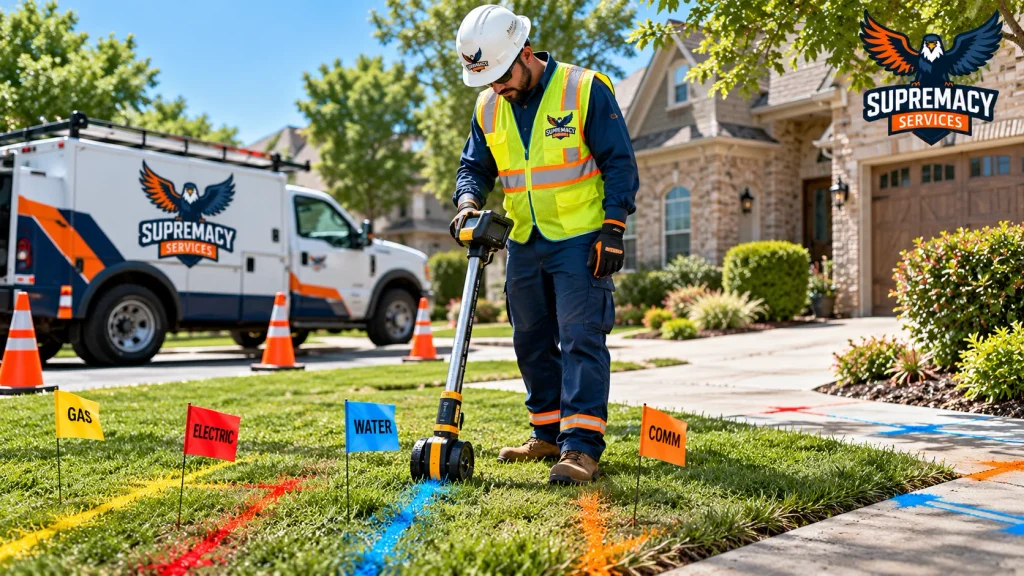
Dallas-area water line replacement requires attention to local ground conditions, existing construction, and the location of underground infrastructure.
Expansive clay soils
Expansive clay is a relevant consideration in parts of North Texas because changes in soil moisture can cause swelling and shrinking.
These changes may contribute to movement around buried structures and utilities.
However, soil conditions vary across the DFW Metroplex. A particular home’s soil composition, pipe depth, and installation conditions should be evaluated rather than assuming every water line failure is caused by clay movement.
Older homes and previous plumbing repairs
In established Dallas neighborhoods, a water service line may have undergone repairs or modifications over time.
Previous couplings, changes in pipe material, and undocumented routing can complicate replacement planning.
Identifying the existing pipe material and tracing the route are important steps before selecting a method.
Underground utility locating
Before excavation, underground utilities must be identified.
Texas811 states that excavation requests must be made at least two business days before digging, excluding weekends and holidays. Contractors should also account for private utilities that may not be marked through the standard public utility locating process.
Permits and plumbing requirements
Permit and inspection requirements can vary by municipality and project scope.
Homeowners in Dallas, Plano, Frisco, Allen, and other DFW communities should confirm the requirements that apply to their address and the proposed work.
The Texas State Board of Plumbing Examiners recommends verifying the responsible plumber’s credentials and checking local permit and inspection requirements before hiring.
Does Your Water Line Need Repair or Replacement?
Not every underground water line leak requires replacing the entire pipe.
A localized repair may be appropriate when the damaged area is limited and the remaining pipe is in suitable condition.
Full replacement becomes more attractive when the pipe has repeated leaks, widespread deterioration, or conditions that make additional failures likely.
Warning signs of an underground water line problem
Watch for:
- An unexplained increase in water usage
- Reduced water pressure throughout the home
- Persistently wet ground during otherwise dry weather
- Water pooling in the yard
- A water meter showing usage when all fixtures are off
- Repeated leaks along the same water line
- Unusual sounds of running water when fixtures are closed
These symptoms do not prove that the underground supply line is damaged. Indoor plumbing leaks, irrigation problems, pressure regulators, and other plumbing faults can produce similar symptoms.
Repair vs. replacement decision
| Situation | Potential next step |
|---|---|
| One isolated leak, otherwise sound pipe | Consider localized repair |
| Multiple leaks along the same aging pipe | Evaluate full replacement |
| Damaged pipe beneath a driveway | Compare trenchless and excavation options |
| Severe corrosion or widespread deterioration | Replacement may be preferable |
| Low pressure without a confirmed leak | Diagnose pressure and supply issues first |
| Wet yard near an irrigation line | Inspect irrigation before assuming a main water line leak |
If the problem has not been diagnosed, begin with professional leak detection rather than selecting a replacement method prematurely.
What Happens During Water Line Replacement?
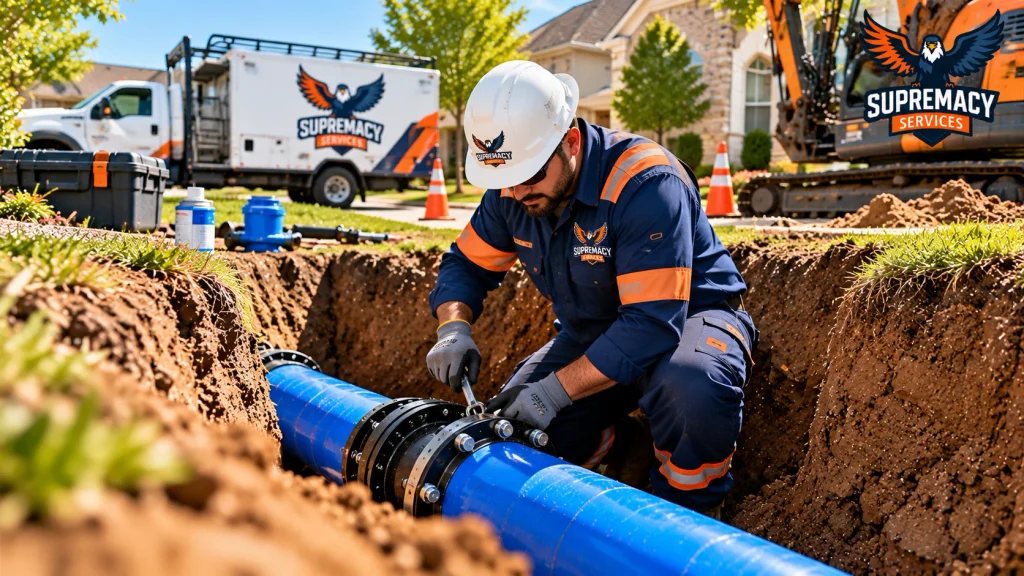
A professional water line replacement generally follows a structured process, although the exact steps depend on the chosen installation method.
Step 1: Inspect and diagnose
Confirm the leak location, assess the existing pipe, and determine whether repair or replacement is appropriate.
Step 2: Plan the replacement route
Identify underground utilities, assess soil and access conditions, and choose a suitable pipe material and installation method.
Step 3: Prepare the work area
Complete required notifications, permits, and utility locating. Arrange water shutoff and excavate access points or the required trench.
Step 4: Install the replacement pipe
Install the new line using the selected method and complete the necessary water supply and building connections.
Step 5: Test and restore service
Perform required pressure and leak testing, complete applicable flushing or other commissioning procedures, and restore water service.
Step 6: Backfill and restore the property
Complete required inspections, backfill excavations, and restore the affected surfaces according to the agreed scope.
How long does water line replacement take?
The duration depends on the pipe length, excavation requirements, utility clearances, inspections, and complexity of the installation.
A straightforward residential project may be completed much faster than a replacement involving extensive driveway excavation or difficult underground conditions.
Trenchless methods can reduce excavation and restoration work, but they are not automatically faster in every situation.
Ask the contractor for a project-specific schedule, including how long the home’s water supply is expected to be interrupted.
How to Choose the Right Replacement Method
The best replacement method is the one that safely installs an appropriate new pipe while accounting for the property’s actual conditions and total project cost.
Use the following checklist when comparing contractor recommendations.
Water line replacement decision checklist
0 of 7 checkedHas the contractor confirmed that full replacement is necessary?Has the existing pipe material and route been identified?Have underground utilities and private lines been considered?Are both trenchless and traditional options technically feasible?Does the estimate include all excavation and restoration?Are pipe materials, connections, and testing specified?Are permits, inspections, and warranty terms explained?
Copy checklist
Can you replace a water line yourself?
Underground water line replacement is generally not a suitable DIY project.
The work may involve pressurized potable water connections, underground utilities, excavation safety, approved plumbing materials, and local permit requirements.
A homeowner can document symptoms, review water bills, identify visible wet areas, and obtain estimates. Actual underground replacement should be evaluated and performed by appropriately qualified professionals in accordance with applicable requirements.
How can homeowners reduce future water line problems?
Although no maintenance routine can prevent every underground pipe failure, homeowners can take sensible precautions.
Monitor unusual water usage, investigate persistent pressure changes, repair known leaks promptly, and keep records of previous water line repairs.
Before major landscaping, fencing, or driveway projects, identify the locations of buried utilities. Avoid assuming underground lines follow a straight or predictable path.
Frequently Asked Questions
1. Is trenchless water line replacement better than digging?
Trenchless replacement is often better when preserving landscaping, driveways, or paved areas is important. Traditional excavation may be preferable when direct pipe access is necessary or trenchless installation is technically unsuitable.
2. Is trenchless water line replacement more expensive?
Not always. Trenchless work may require more specialized equipment, but reduced excavation and restoration can offset those costs. Compare complete written estimates rather than installation costs alone.
3. Can a water line be replaced without digging up the yard?
Often, much of the yard can remain undisturbed. However, trenchless installation typically requires some excavation for access pits and pipe connections.
4. Can trenchless replacement work beneath a concrete driveway?
It may be possible to install a replacement water line beneath a driveway using a suitable trenchless method. Feasibility depends on the route, nearby utilities, pipe depth, and site conditions.
5. Does pipe bursting work on every type of water pipe?
No. Pipe material, fittings, bends, existing obstructions, and surrounding ground conditions affect whether pipe bursting is suitable.
6. How long does a new underground water line last?
Service life depends on the pipe material, installation quality, operating conditions, and surrounding environment. A contractor should explain the proposed material and applicable manufacturer information rather than promising a universal lifespan.
7. Will homeowners lose water during replacement?
Water service generally must be interrupted during at least part of the replacement and connection process. The contractor should explain the expected outage and whether temporary service arrangements are practical.
8. Does Dallas require a permit for water line replacement?
Permit requirements depend on the property, work scope, and applicable local rules. Confirm current requirements with the relevant municipal authority before beginning replacement.
9. Can a leaking water line be repaired instead of replaced?
Yes, some localized leaks can be repaired. Replacement may be more appropriate when the existing pipe has repeated failures, extensive deterioration, or other serious defects.
10. How do I know whether trenchless replacement will work at my home?
A qualified contractor should evaluate the pipe material, route, condition, depth, nearby utilities, soil, and access points. Those findings determine which methods are feasible.
Get Professional Water Line Replacement Help in Dallas
Choosing between trenchless and traditional water line replacement should begin with an accurate diagnosis, not a preference for one installation method.
A method that preserves your landscaping may offer excellent value when conditions are suitable. In other situations, conventional excavation provides the access needed to complete the work properly.
Supremacy Services provides water line repair and replacement services for Dallas and the DFW Metroplex, with trenchless and traditional options described on its service page.
If you are dealing with an underground water leak, repeated water line failures, or a replacement recommendation, request a professional assessment before committing to major excavation.
Explore water line repair and replacement options with Supremacy Services to discuss the condition of your water line and the installation approach that may fit your property.

