
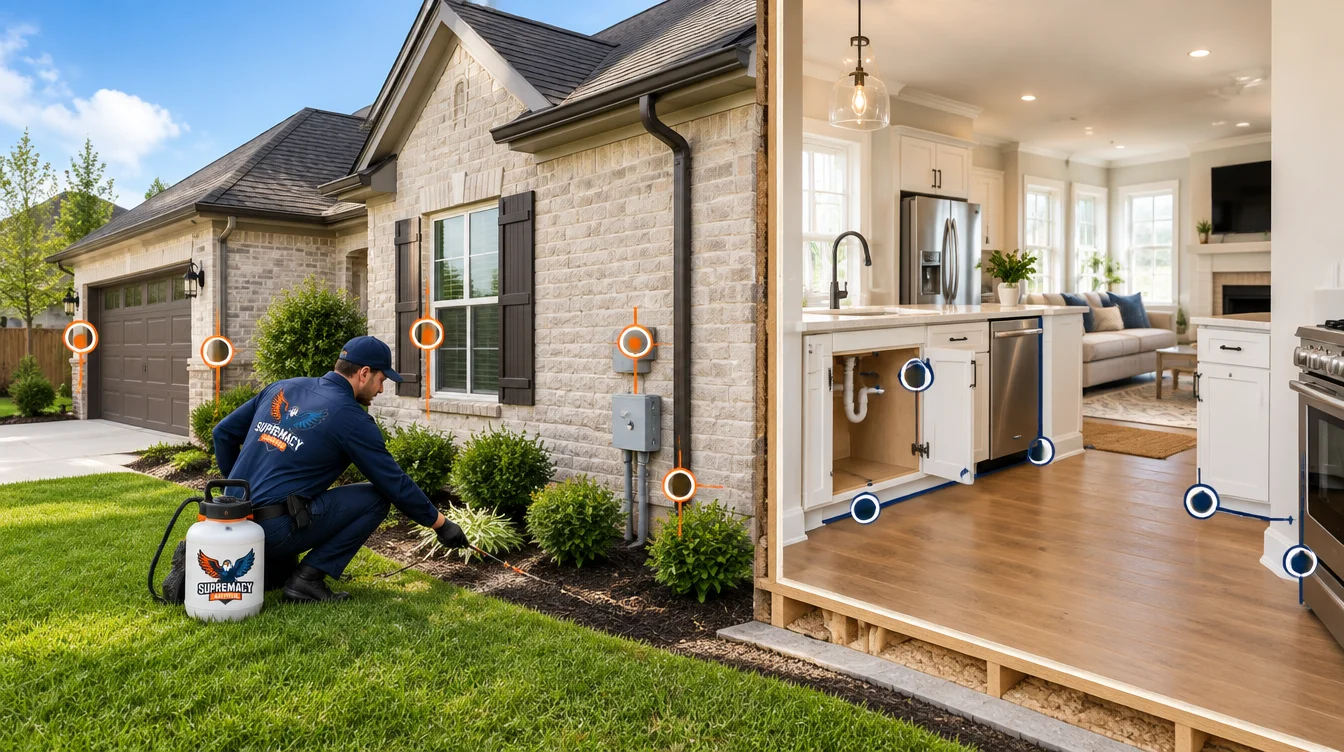
Pest control should be applied where the pest is entering, hiding, nesting or traveling—not automatically throughout every room of the house.
For many Dallas-Fort Worth homes dealing with occasional ants, spiders, cockroaches or other pests entering from outdoors, exterior treatment around appropriate entry and harborage areas can form an important part of the control strategy. Interior treatment becomes more relevant when pests are already established inside, the source is indoors, or activity is concentrated in areas such as kitchens, bathrooms, wall voids or other specific locations.
In some situations, the correct answer is both.
The important question isn’t simply interior vs. exterior pest control. It is: Where is the pest problem actually coming from, and which treatment locations are appropriate for that pest and product?
This guide explains how Dallas-Fort Worth homeowners can think about treatment zones, when indoor treatment may be necessary and why professional pest management should start with inspection rather than indiscriminate spraying.
Table of Contents
- Where Should Pest Control Be Applied?
- Interior vs. Exterior Pest Control
- Where Is Exterior Pest Control Applied?
- Where Is Interior Pest Control Applied?
- Which Pests Need Interior or Exterior Treatment?
- Does Pest Control Need to Spray Inside Every Visit?
- Why Inspection Comes Before Treatment
- DIY vs. Professional Pest Treatment
- What Dallas Homeowners Should Expect
- How to Reduce Pest Activity Between Treatments
- Frequently Asked Questions
Where Should Pest Control Be Applied?
Pest control should be concentrated around the pest’s actual activity, entry routes, harborages and other locations identified during inspection. Treatment may involve exterior areas, targeted interior locations, structural voids, or a combination of these areas.
The correct location depends on several questions:
- What pest is present?
- Is it primarily entering from outdoors or established indoors?
- Where is activity being observed?
- Where is the pest hiding or nesting?
- What food, moisture or shelter is supporting it?
- How is it entering the structure?
- What does the pesticide label permit?
- Can sanitation, exclusion, trapping or another non-chemical method solve part of the problem?
This is consistent with an Integrated Pest Management (IPM) approach.
Rather than relying solely on pesticide application, IPM combines identification, prevention, sanitation, structural correction, monitoring and appropriately selected treatments.
For example, sealing an opening that ants repeatedly use may be more useful long term than repeatedly spraying visible ants without addressing the route into the house.
Interior vs. Exterior Pest Control: What’s the Difference?
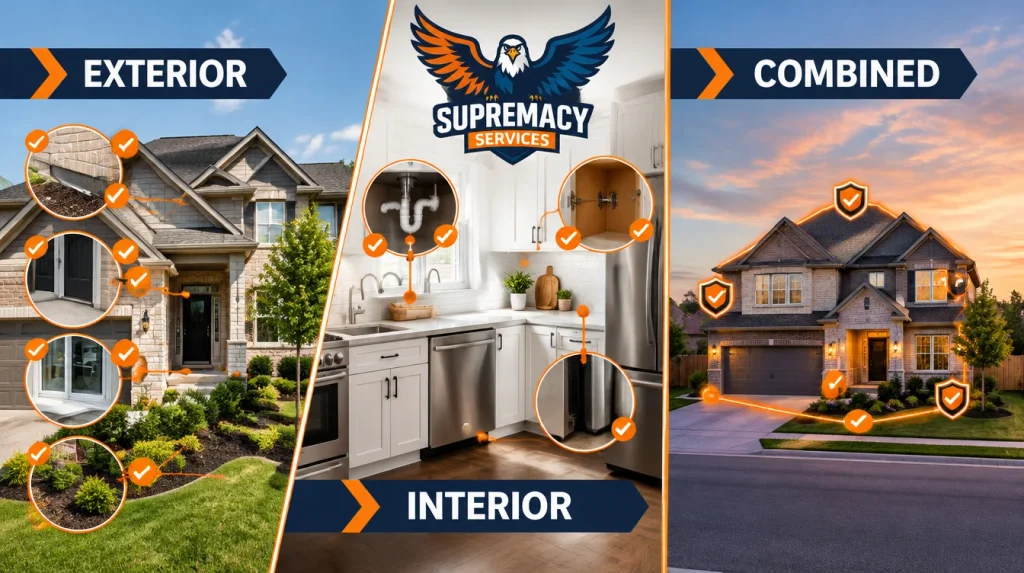
Exterior pest control concentrates on pest pressure before or as pests enter the structure, while interior pest control targets activity that has already developed inside or requires access to a specific indoor harborage.
| Exterior treatment | Interior treatment |
|---|---|
| Targets activity around the structure | Targets established or specific indoor activity |
| May focus on foundations and entry areas | May focus on cracks, crevices and pest harborages |
| Helps address pests approaching from outdoors | Useful when the source or infestation is indoors |
| Often pairs well with exclusion | Often pairs with sanitation, baiting or monitoring |
| May reduce the need for routine indoor applications | Should be targeted to the pest and affected area |
| Appropriate location depends on product label | Appropriate location depends on product label |
Neither approach is universally “better.”
A German cockroach infestation around a kitchen and an occasional spider entering around an exterior doorway are fundamentally different pest problems and should not automatically receive the same treatment.
Is exterior treatment usually enough?
Sometimes.
When pests originate outdoors and there is no established indoor infestation, exterior management plus exclusion and sanitation may address much of the pest pressure.
Supremacy’s existing Perimeter Pest Control service is specifically structured around exterior areas such as foundations and common transition points into the home.
Trying to stop recurring pests before they move indoors? Explore Supremacy Services’ perimeter pest-control options for Dallas-Fort Worth homes.
Where Is Exterior Pest Control Applied?
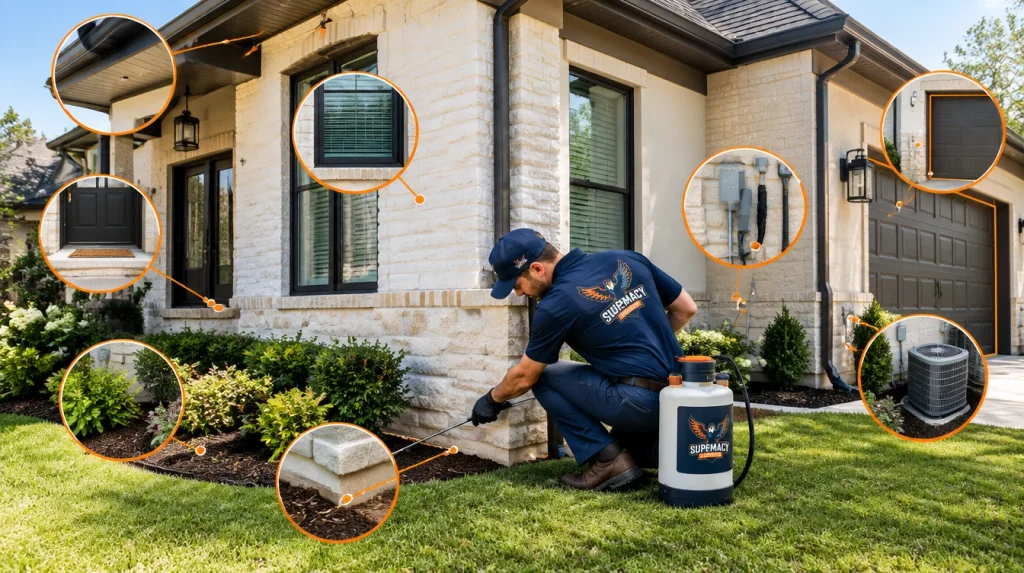
Exterior pest control is generally directed toward relevant pest activity and potential transition points around the structure rather than indiscriminately treating every outdoor surface.
Depending on the pest, property and product label, a professional may inspect or potentially treat areas such as:
Foundation and structural perimeter
The area immediately surrounding a foundation can be important because crawling pests may travel alongside the structure before finding openings.
A technician should look for activity as well as conditions that encourage it.
Doors and thresholds
Exterior doors, garage doors and poorly sealed thresholds can become transition points between outdoor and indoor environments.
Treatment alone is not necessarily the solution. A damaged door sweep may need to be repaired.
Windows and frames
Gaps around windows can provide access for certain crawling insects.
Again, exclusion can be as important as treatment.
Utility and plumbing penetrations
Air-conditioning lines, pipes, cables and other penetrations can create openings through the building envelope.
These locations deserve inspection when pest activity appears nearby.
Eaves, soffits and roofline areas
These areas can be relevant to spiders, wasps and certain other pests.
Treatment method and access requirements vary substantially by pest.
Garages
A garage sits directly between outdoor and indoor environments in many North Texas homes.
Technicians may examine:
- garage-door seals;
- wall penetrations;
- storage areas;
- moisture;
- exterior doors;
- cracks or openings;
- areas where pest activity has been reported.
Landscaping next to the structure
Vegetation, accumulated debris, moisture and other protected areas near the building can provide pest harborage.
That does not mean every landscape area should automatically be sprayed. The objective is to identify and correct conditions contributing to the problem.
Where Is Interior Pest Control Applied?
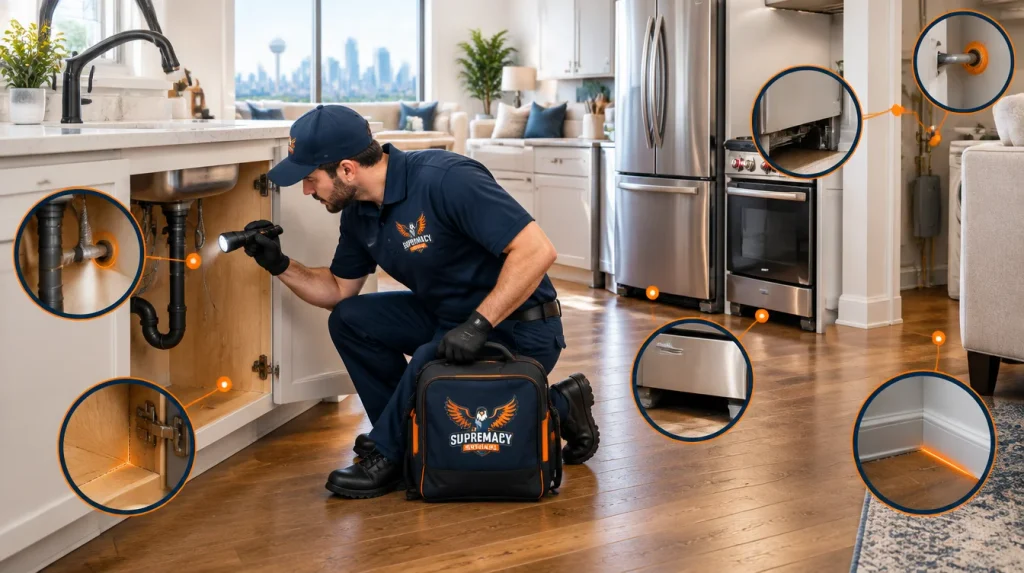
When indoor treatment is necessary, it should generally be targeted toward pest activity and appropriate harborages—not automatically broadcast across floors, walls and occupied living areas. Supremacy services
EPA recommends using non-chemical methods where possible and minimizing unnecessary pesticide use. When pesticides are used, the product label determines where and how a product may legally be applied.
Common areas requiring inspection include:
Kitchens
Kitchens can provide food, water and shelter.
A professional may inspect:
- underneath sinks;
- plumbing penetrations;
- cabinet voids;
- appliance areas;
- cracks and crevices;
- areas where droppings, insects or other evidence has appeared.
The appropriate control method may involve sanitation, exclusion, monitoring, baits or other targeted treatments rather than general spraying.
Bathrooms and laundry areas
Moisture can make bathrooms and utility areas attractive to some pests.
Leaking plumbing, damp cabinetry or penetrations around pipes should be addressed rather than relying exclusively on pesticide treatment.
Cracks and crevices
Small structural gaps can provide hiding places or travel routes.
Depending on the pest and label, these may be appropriate targeted treatment locations.
Wall voids
Some pest problems involve concealed areas rather than exposed room surfaces.
Supremacy also offers its WallShield system for compatible properties, which is designed around treatment pathways within wall systems rather than routine spraying across occupied interior surfaces.
Attics and garages
Pest evidence in an attic should first be identified.
Scratching or droppings, for example, could indicate rodents or wildlife—problems requiring a different strategy from ordinary insect control.
Bedrooms and furniture areas
Bed bugs are an important exception to the idea that exterior treatment can solve most household pest problems.
Bed bugs are associated with indoor harborages such as beds, furniture and nearby cracks. They require a pest-specific inspection and treatment plan rather than a standard exterior perimeter application.
Which Pests Need Interior or Exterior Treatment?
The pest species and source of activity should determine the treatment zone.
| Pest/problem | Exterior focus | Interior focus | Important consideration |
|---|---|---|---|
| Occasional ants entering home | Often | Sometimes | Find trails, nests and entry points |
| Outdoor spiders | Often | Sometimes | Reduce harborage and prey around structure |
| German cockroaches established in kitchen | Supporting role | Usually important | Indoor sanitation, monitoring and targeted control |
| American cockroaches entering from outdoors | Often important | Sometimes | Inspect moisture and entry routes |
| Scorpions entering structure | Often important | Sometimes | Exclusion and harborage reduction matter |
| Bed bugs | No standard perimeter solution | Yes | Requires specialized indoor strategy |
| Fleas | Depends on source | Depends | Pets and indoor/outdoor environments may both matter |
| Wasps | Usually | Only if indoors | Nest location determines approach |
| Rodents | Exclusion is critical | Trapping/monitoring may be needed | Not solved by ordinary insect spraying |
| Termites | Specialized | Specialized | Requires termite-specific inspection/treatment |
| Mosquitoes | Outdoor | Generally no | Focus on breeding/resting conditions outdoors |
This table is intentionally a decision guide rather than a treatment prescription. Exact applications depend on identification, inspection, the property and product labeling.
Does Pest Control Need to Spray Inside Every Visit?
No. Every pest-control visit does not automatically require indoor pesticide application.
If there is no indoor activity and the pest problem is being managed through exterior prevention, exclusion and monitoring, there may be little reason to apply pesticides throughout occupied rooms simply because a scheduled visit has arrived.
Likewise, an active indoor infestation should not be ignored merely because the property receives exterior service.
Treatment should follow the evidence.
A better question to ask your technician is:
“What pest evidence did you find, and why are you recommending treatment in this location?”
A professional should be able to explain the connection between the pest, the treatment location and the control strategy.
Why Inspection Comes Before Treatment
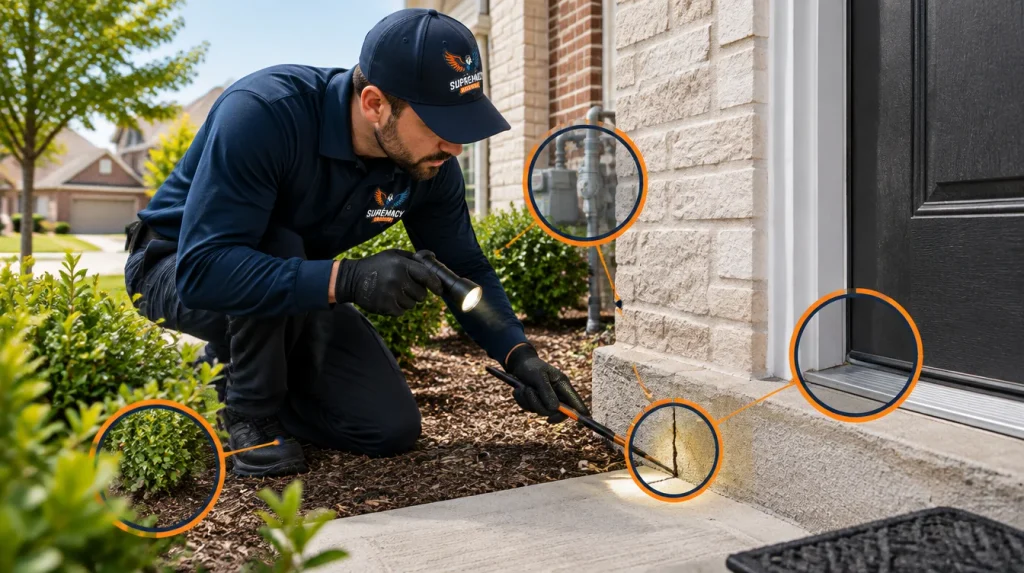
The first step in effective pest control should be identifying the pest and determining where the activity originates.
Without that information, homeowners can end up treating the wrong location repeatedly.
Consider three homes:
Home A: Ants are entering through a gap near a patio door.
The solution may emphasize exterior activity, entry-point correction and targeted treatment.
Home B: German cockroaches are established around kitchen appliances.
Exterior treatment alone would not address the entire infestation.
Home C: Scratching is coming from the attic.
Spraying the foundation for insects does not solve a possible rodent or wildlife problem. Inspection and exclusion may be required instead.
Texas A&M AgriLife’s pest-management guidance similarly emphasizes prevention and combining different control tactics rather than relying automatically on pesticide applications.
Should Dallas Homes Use Interior and Exterior Pest Control Together?
Some Dallas-Fort Worth homes benefit from combined interior and exterior pest management, particularly when an active indoor problem exists while pests also continue entering from outdoors.
The two treatment zones solve different parts of the problem.
An interior treatment may address existing activity.
Exterior management may reduce new pest pressure.
Exclusion can close access routes.
Sanitation and moisture correction can remove conditions supporting the infestation.
Monitoring then shows whether the strategy is working.
Dallas-Fort Worth considerations
North Texas homeowners encounter a broad range of household pests, but the correct treatment should still be based on the property rather than simply the region.
Important property conditions can include:
- gaps around doors and garage entrances;
- utility penetrations;
- landscaping contacting or crowding the structure;
- moisture around plumbing or irrigation;
- protected storage areas;
- attached garages;
- attic and roofline openings;
- outdoor cooking and dining areas;
- shared walls in townhomes or multifamily properties.
These are useful inspection points—not proof that a particular home requires pesticide application in every location.
Seeing pests both inside and around your home? Request a Supremacy pest-control assessment to determine whether your property needs perimeter protection, targeted interior treatment or a pest-specific solution.
What About Pest-Control Safety Inside the Home?
Pesticide applications should always follow the product label.
The Texas Department of Agriculture regulates structural pest-control businesses and applicators in Texas, while EPA regulates pesticide products at the federal level.
TDA advises consumers that pesticide-specific health and safety information varies by product and exposure and that application procedures specified by the label must be followed.
EPA also recommends reducing unnecessary pesticide use and incorporating non-chemical measures where practical.
That is another reason more treatment is not automatically better treatment.
The goal is to use an appropriate method in an appropriate location for an identified problem.
DIY vs. Professional Pest Treatment
Minor pest pressure can sometimes be reduced without professional pesticide application.
Homeowners can start with:
- identifying the pest;
- removing accessible food sources;
- storing food properly;
- managing garbage;
- fixing plumbing leaks;
- eliminating unnecessary standing water;
- reducing clutter;
- sealing appropriate structural gaps;
- repairing damaged screens;
- replacing worn door sweeps;
- reducing pest harborage near the structure.
EPA specifically recommends removing food, water and shelter as part of pest prevention.
When professional service makes more sense
Consider professional inspection when:
- you cannot identify the pest;
- pests repeatedly return;
- activity is occurring in multiple rooms;
- cockroaches appear established indoors;
- rodents are heard or found inside;
- termites are suspected;
- bed bugs may be present;
- nests are difficult or unsafe to access;
- activity appears to originate inside walls;
- DIY measures have not solved the problem.
Texas requires businesses providing structural pest control to be appropriately licensed, and the Texas Department of Agriculture regulates this industry.
What Should Dallas Homeowners Expect From Professional Pest Control?
A professional visit should involve more than deciding where to spray.
A sensible process looks like this:
1. Identify the pest
Different pests require different strategies.
2. Inspect the property
Look for activity, entry routes, moisture, food sources, harborages and structural conditions.
3. Determine the source
Is the problem primarily outdoors, indoors, inside structural voids or a combination?
4. Select appropriate controls
This can include:
- sanitation;
- exclusion;
- trapping;
- monitoring;
- baiting;
- physical removal;
- targeted pesticide treatment where appropriate.
5. Treat appropriate locations
Any pesticide application should follow the product label and be appropriate for the target pest and location.
6. Correct contributing conditions
Treatment without correcting the underlying conditions can leave the property vulnerable to recurring activity.
7. Monitor results
Recurring activity may indicate that another source, entry route or harborage remains.
How to Reduce Pest Activity Between Treatments
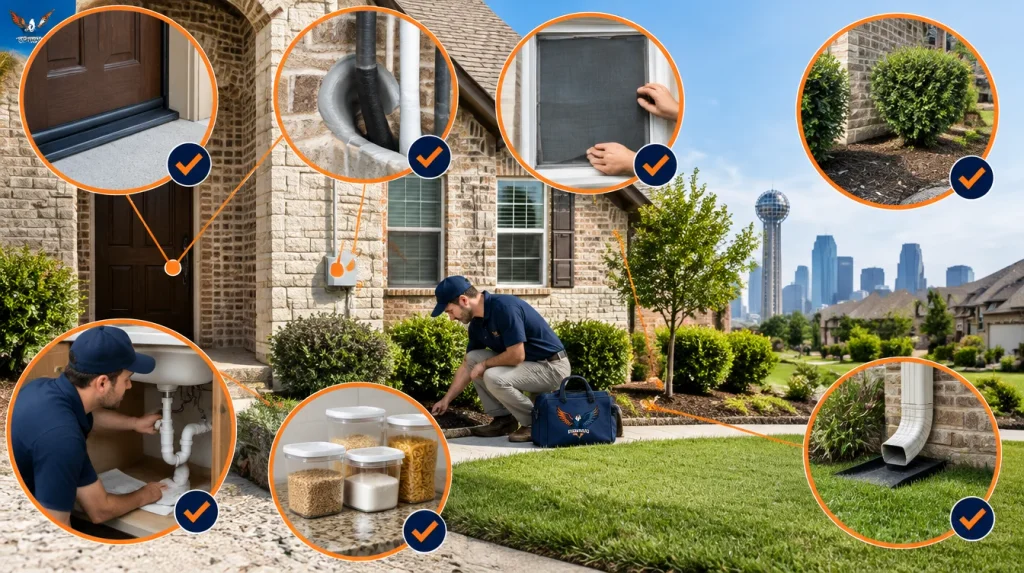
Professional pest control works best when homeowners also reduce the things pests need to survive.
Use this checklist:
- Keep food and pet food appropriately stored.
- Clean food residue and spills.
- Empty garbage regularly.
- Repair plumbing leaks.
- Eliminate avoidable standing water.
- Inspect door sweeps and weather seals.
- Repair damaged window screens.
- Discuss significant structural gaps with the appropriate professional.
- Keep unnecessary debris away from the structure.
- Watch for recurring activity in the same locations.
- Tell your pest-control technician exactly where pests have been seen.
The last point is particularly valuable.
A technician who knows where and when you are seeing pests has much better information for determining where inspection and treatment should be concentrated.
Frequently Asked Questions
Is interior or exterior pest control better?
Neither is universally better. Exterior pest control can help manage pests originating outside, while interior treatment is appropriate when pests are established indoors or require treatment of specific indoor harborages. Some infestations require both.
Does pest control need to spray inside my house?
Not necessarily. If there is no active indoor infestation, exterior prevention, exclusion and monitoring may be appropriate. Indoor treatment should be based on the pest, evidence, property conditions and product label.
Where do pest-control companies spray inside?
Treatment locations vary by pest. When pesticide treatment is appropriate, professionals may target permitted cracks, crevices, harborages or other pest-specific locations rather than indiscriminately spraying occupied surfaces.
Where should pest control be applied outside?
Depending on the pest and product, exterior management may focus around foundations, entry areas, doors, windows, utility penetrations, garages, eaves and relevant pest harborages. Not every location necessarily requires pesticide application.
Should pest control spray baseboards?
Routine baseboard spraying should not automatically be assumed to be necessary. Treatment should be based on the identified pest, its activity and the pesticide label.
Can exterior pest control stop bugs from entering?
Exterior pest management can reduce pressure from pests originating outdoors, particularly when combined with exclusion, sanitation and correction of conditions that attract or shelter pests. It cannot guarantee that every indoor infestation will be solved from outside.
What if I already have bugs inside?
The pest should first be identified and its source determined. Established indoor infestations may require targeted interior treatment, monitoring, sanitation or another pest-specific strategy alongside exterior prevention.
Do cockroaches require indoor pest control?
It depends on the cockroach and source. An established indoor German cockroach infestation typically requires an indoor-focused management strategy, while some other cockroaches may enter from exterior environments. Proper identification matters.
Is quarterly exterior pest control enough?
There is no universal treatment schedule or location appropriate for every property. The answer depends on pest pressure, infestation history, building conditions and what is actually included in the service.
When should I call a pest-control professional?
Professional inspection is particularly useful when pests repeatedly return, you cannot identify the pest, activity has spread, rodents or termites are suspected, bed bugs may be present, or straightforward sanitation and exclusion measures have failed.
The Best Treatment Location Is the One the Evidence Supports
The choice between interior and exterior pest control should not be based on habit.
It should be based on what pest is present, where it is coming from, where it is active and what treatment method is appropriate for that location.
For many Dallas-Fort Worth homes, exterior prevention can play a major role in controlling pests that originate outdoors. When an infestation is already established indoors, however, targeted interior management may also be necessary.
Inspection connects those two decisions.
If you’re seeing recurring pests inside or around your Dallas-Fort Worth home, request a pest-control assessment from Supremacy Services. A technician can identify the activity and determine whether your property needs exterior perimeter protection, targeted interior treatment or a specialized pest-control solution.

