
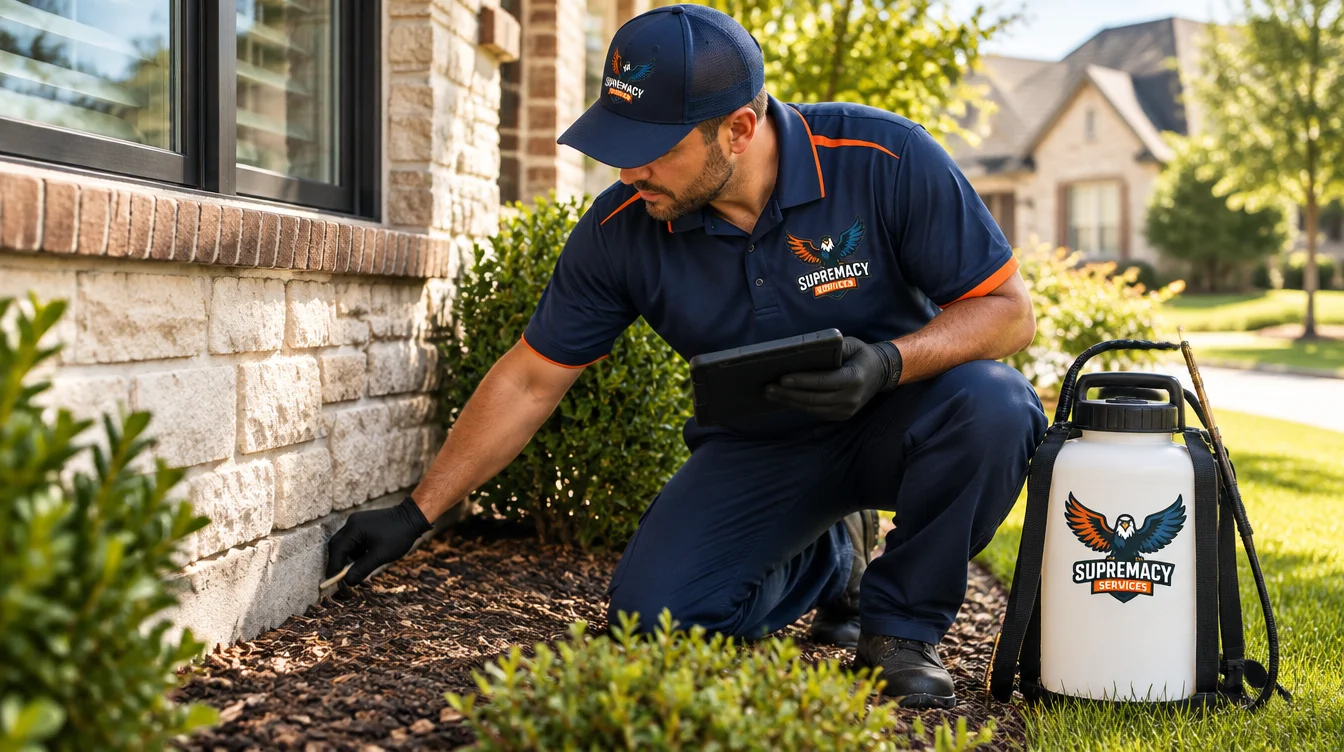
Yes, quarterly pest control can be worth it for many North Texas homes—especially properties that experience recurring ants, cockroaches, spiders, scorpions or other seasonal pest activity. But a three-month schedule should not be treated as a universal rule.
The better question is whether your property has enough recurring pest pressure to justify ongoing inspection, prevention and targeted treatment.
For some Dallas-Fort Worth homes, four scheduled visits a year can provide a practical balance between prevention and cost. Homes with an active infestation, heavy pest pressure or a specialized problem such as termites, bed bugs or rodents may need a completely different treatment schedule.
This guide explains what quarterly pest control actually means, what homeowners should expect, when it makes sense and when quarterly visits may not be enough.
Table of Contents
- What Is Quarterly Pest Control?
- Is Quarterly Pest Control Worth It in North Texas?
- Why Do North Texas Homes Need Ongoing Pest Management?
- What Should Quarterly Pest Control Include?
- Quarterly vs. One-Time Pest Control
- Quarterly vs. Monthly Pest Control
- How Much Does Quarterly Pest Control Cost?
- When Is Quarterly Pest Control Not Enough?
- Can You Handle Pest Prevention Yourself?
- How to Decide Whether Quarterly Service Is Right for Your Home
- Frequently Asked Questions
What Is Quarterly Pest Control?

Quarterly pest control generally means a scheduled professional pest-management visit about once every three months, or approximately four routine visits per year.
But the calendar alone does not determine whether a pest-control program is effective.
A well-designed recurring program should consider which pests are present, where they are entering, environmental conditions around the home and whether preventive measures such as sanitation, moisture correction or exclusion are also necessary.
That distinction matters.
Effective pest management is not simply a matter of repeatedly applying pesticide around a house. Integrated pest management, or IPM, combines prevention, monitoring and appropriate control methods to address the conditions that allow pests to become a problem.
For homeowners, that may involve a combination of:
- inspecting pest-prone areas;
- identifying current activity;
- treating appropriate exterior areas;
- removing webs or accessible pest harborage;
- identifying cracks and entry points;
- addressing food and moisture sources;
- monitoring changes between visits; and
- recommending additional treatment when a particular pest requires it.
The exact scope depends on the company, service agreement, pest and property.
Is Quarterly Pest Control Worth It in North Texas?
Quarterly pest control is most likely to be worth it when pests repeatedly return, your property has several potential pest-entry points or you want preventive professional monitoring rather than waiting for an infestation to develop.
It is less compelling when the problem was truly isolated and the underlying cause has already been corrected.
Think about quarterly pest control as preventive maintenance rather than four identical treatments.
Quarterly service tends to make sense when:
- ants repeatedly appear around kitchens, patios or foundations;
- cockroaches are periodically found around the structure;
- spider webs regularly return around eaves and exterior openings;
- scorpions or other occasional invaders are a recurring concern;
- landscaping or exterior conditions create ongoing pest pressure;
- your home has numerous utility penetrations, gaps or other possible entry points;
- previous one-time treatments solve the problem only temporarily; or
- you prefer regular professional inspection rather than reacting after pests become noticeable.
Quarterly service may be unnecessary when:
- the pest was a single isolated incident;
- an obvious entry point has been permanently corrected;
- the problem can be effectively controlled through sanitation, moisture management or exclusion;
- there is little evidence of recurring activity; or
- the pest requires a specialized treatment program rather than general quarterly service.
The pest species should ultimately influence the plan.
A few occasional ants around an exterior window should not automatically receive the same treatment schedule as an established German cockroach infestation.
Need help determining whether recurring service makes sense? Explore Supremacy Services’ residential pest-control options in DFW and request a property-specific assessment rather than choosing a schedule based on frequency alone.
Why Do North Texas Homes Need Ongoing Pest Management?
North Texas does not have a single short pest season.
Dallas-Fort Worth moves through hot summers, transitional spring and fall conditions and relatively mild periods during parts of winter. National Weather Service climate normals show substantial seasonal temperature changes across the year rather than a climate where pest considerations disappear after summer.
That does not mean every pest remains equally active all year.
Different conditions can favor different pest problems.
Warm-weather pressure
Warm conditions can increase activity from insects around landscapes, foundations, patios and other exterior areas.
Homeowners may notice:
- ants;
- spiders;
- mosquitoes;
- wasps; and
- other outdoor insects.
Moisture and shelter
Pests need resources.
Food, water and shelter around a property can make it easier for insects and rodents to establish themselves regardless of the calendar.
Leaking plumbing, standing water, exposed food, overflowing garbage, dense vegetation against the structure and clutter can all make pest prevention more difficult.
Cooler-weather movement
When exterior conditions change, some pests may seek protected locations.
That makes cracks, plumbing penetrations, garage gaps, damaged screens and other openings important components of pest management.
Quarterly service can create scheduled opportunities to reassess these conditions, but the service should adapt to what the technician actually finds.
What Should Quarterly Pest Control Include?
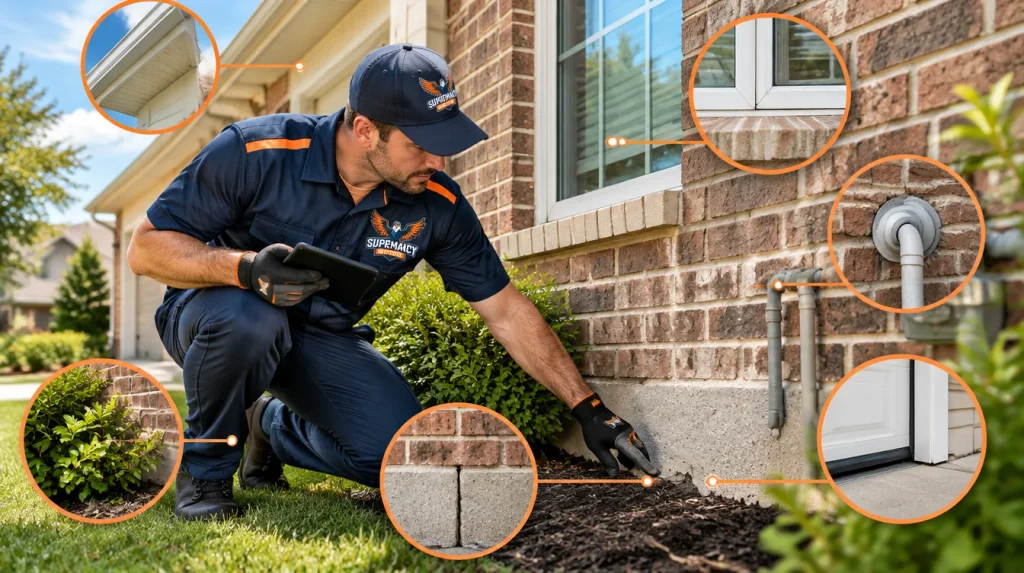
A useful quarterly pest-control program should involve more than automatically spraying the same areas every three months.
Exact services vary, so homeowners should verify the scope before enrolling.
A professional visit may include:
1. Inspection
The technician evaluates areas where pests are active or likely to enter.
That may include:
- foundations;
- doors;
- windows;
- utility penetrations;
- eaves;
- garage areas;
- landscaping near the structure; and
- known pest harborage.
2. Pest identification
Treatment should be based on what is actually present.
Ants, cockroaches, spiders, rodents, termites and bed bugs require different strategies.
Correct identification helps avoid spending money on treatment that does not address the real problem.
3. Exterior treatment where appropriate
Depending on the findings, pest, product label and service plan, treatment may be applied to appropriate exterior areas and entry points.
The objective should be targeted pest management—not unnecessary application.
4. Web and nest management
Some recurring services may include removal of accessible spider webs or certain pest harborage around the exterior.
Ask whether this is included rather than assuming it is.
5. Entry-point observations
A technician may identify gaps or conditions that could allow pests into the structure.
Some pest-control companies provide exclusion work; others recommend repairs separately.
6. Interior treatment when necessary
A preventive program does not necessarily require routine treatment throughout the home’s interior.
When indoor activity exists, treatment should be selected for the particular pest and situation.
7. Service documentation
Homeowners should know:
- what was found;
- what was treated;
- what products or methods were used;
- what conditions require attention; and
- whether follow-up is recommended.
In Texas, structural pest-control businesses and professionals providing pest-control services for hire are regulated through the Texas Department of Agriculture.
Quarterly vs. One-Time Pest Control
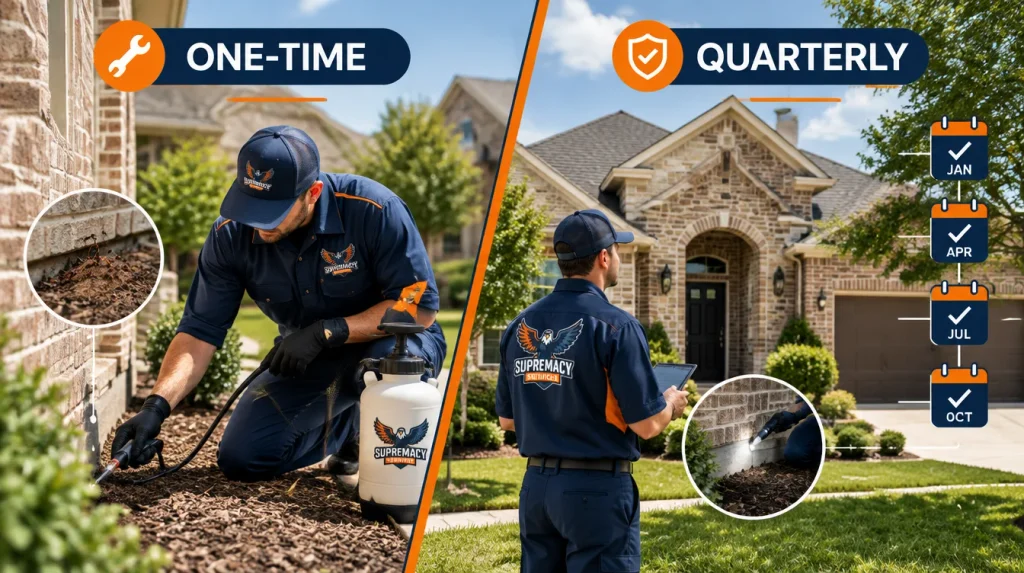
One-time pest control is primarily corrective; quarterly pest control is generally better suited to recurring monitoring and prevention.
| Factor | One-Time Service | Quarterly Service |
|---|---|---|
| Primary purpose | Address a current problem | Ongoing prevention and monitoring |
| Scheduled frequency | One visit/follow-up as specified | Roughly every three months |
| Best suited for | Isolated or clearly defined issue | Recurring general pest pressure |
| Monitoring | Limited | Repeated opportunities |
| Annual commitment | Usually lower | Higher |
| Prevention | Depends on scope | Usually a major objective |
| Specialized pests | May require separate program | May still require separate program |
A one-time service can be entirely appropriate.
Suppose wasps establish one accessible nest and the problem does not recur after proper treatment and prevention. A recurring general-pest contract may provide little additional value for that particular problem.
Now consider a house that repeatedly experiences ants, cockroaches and spiders at different times of year. Treating every occurrence as an unrelated emergency can become inefficient.
That is where a recurring program may make more sense.
Quarterly vs. Monthly Pest Control
Quarterly service generally provides fewer scheduled visits and may suit homes with moderate preventive needs, while monthly service provides more frequent monitoring and may be appropriate where pest pressure is substantially higher.
Neither schedule is automatically better.
| Situation | Quarterly May Fit | More Frequent Service May Fit |
|---|---|---|
| Routine prevention | ✓ | |
| Occasional general pests | ✓ | |
| Repeated activity between visits | ✓ | |
| Active severe infestation | ✓ | |
| Property with unusual pest pressure | Maybe | ✓ |
| Specialized pest | Separate assessment | Separate assessment |
| Stable home after exclusion/prevention | ✓ |
Service frequency should be adjusted to the actual problem rather than selected simply because one package has more visits.
More treatments are not automatically better pest management.
How Much Does Quarterly Pest Control Cost?
Quarterly pest-control pricing varies according to the pest, property, treatment scope, initial service requirements and what the service agreement includes.
Supremacy’s existing Pest Control Cost in North Texas: 2026 Pricing Guide cites current third-party Dallas market data placing quarterly general pest service around $100–$300 per visit for the example used in that guide.
That is a market-planning range—not a Supremacy Services price or guaranteed DFW average.
For detailed pricing analysis, homeowners should use the dedicated cost guide rather than this article.
More importantly, do not compare companies based only on the price of one quarterly appointment.
Ask:
- What pests are included?
- Is the initial service priced separately?
- Is interior treatment included when needed?
- Are return visits between scheduled appointments covered?
- Is inspection included?
- Does the technician remove webs or accessible nests?
- Is exclusion included or separately quoted?
- Are termites, mosquitoes, rodents or bed bugs excluded from general coverage?
- What is the cancellation policy?
- What is the total annual cost?
Compare annual value, not visit price
A $100 visit and a $150 visit are not directly comparable if their scopes are different.
The more useful comparison is:
Annual cost + pests covered + services included + callback terms + specialized-treatment exclusions.
Comparing recurring pest-control options? Ask Supremacy Services to assess your property and explain which treatment frequency fits the pest pressure instead of automatically selecting the most frequent plan.
When Is Quarterly Pest Control Not Enough?
Quarterly general pest control may not be enough when you already have an established infestation, pests continue appearing between visits or the problem requires specialized treatment.
Examples include:
German cockroaches
An established indoor cockroach infestation may require more intensive monitoring, baiting, sanitation and follow-up than a routine quarterly perimeter visit.
Bed bugs
Bed bugs require specialized inspection and treatment. Do not assume they are covered under ordinary recurring general pest service.
Termites
Termite inspections and treatments are a separate structural-pest-control category in Texas and should not be treated as simply another quarterly household pest.
Rodents
Rats and mice often require identification of entry points, trapping or other control measures and structural exclusion.
Simply treating insects around a foundation will not seal a roof gap used by rodents.
Mosquitoes
Mosquito management focuses heavily on breeding conditions and outdoor environments. Eliminating standing water is an important preventive measure.
Persistent activity between visits
If the same pest repeatedly returns long before the next appointment, the answer should not automatically be “wait until next quarter.”
The pest should be reassessed.
The treatment strategy, entry points, sanitation, moisture conditions, exclusion needs or service frequency may need to change.
Can You Handle Pest Prevention Yourself?
Yes. Homeowners can perform many important pest-prevention measures themselves, even when they use professional pest control.
EPA guidance emphasizes reducing the food, water and shelter pests need.
A practical homeowner checklist includes:
- keep food stored in sealed containers;
- remove food scraps promptly;
- empty garbage regularly;
- avoid leaving pet food out overnight;
- repair plumbing leaks;
- eliminate unnecessary standing water;
- maintain screens;
- inspect door sweeps;
- reduce clutter;
- keep vegetation from creating easy pathways into the structure; and
- seal appropriate cracks and penetrations where practical.
What about DIY pesticides?
If you choose to use a pesticide yourself, identify the pest first and follow the product label.
Repeatedly applying different products without understanding the pest or source can waste money and may fail to correct the conditions allowing activity to continue.
Professional help becomes more valuable when:
- you cannot identify the pest;
- activity repeatedly returns;
- multiple rooms are affected;
- rodents are entering the structure;
- you suspect termites;
- you suspect bed bugs;
- nests are inaccessible or hazardous;
- DIY measures have failed; or
- the problem requires specialized equipment or expertise.
How to Decide Whether Quarterly Service Is Right for Your Home
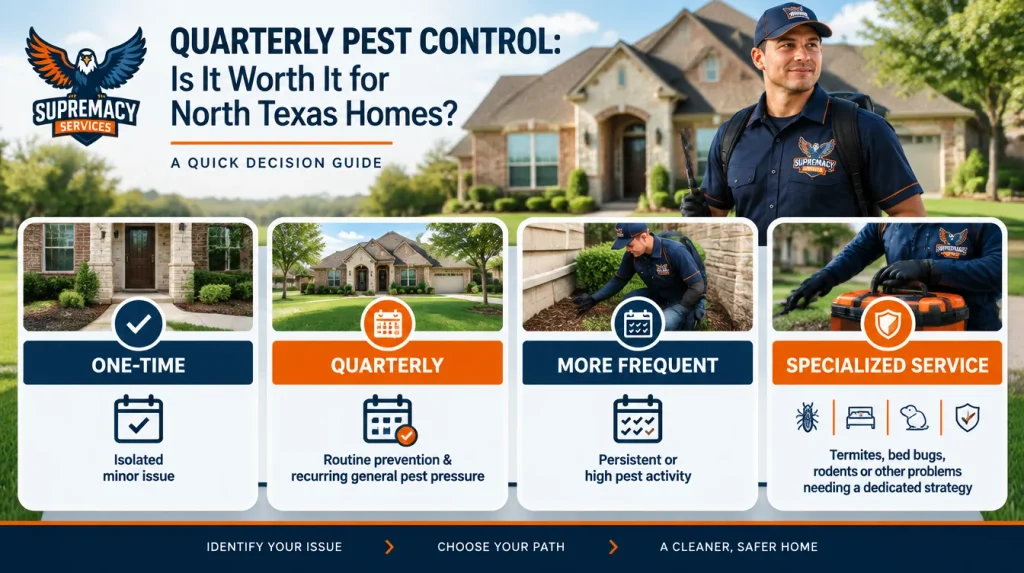
Do not begin with, “How many treatments can I buy?”
Begin with, “What problem am I trying to prevent?”
Use this checklist.
Quarterly pest control may be worth considering if:
☐ You experience pest activity during several parts of the year.
☐ Ants, cockroaches, spiders or other general pests repeatedly return.
☐ One-time treatments have provided only temporary relief.
☐ Your property has numerous pest-entry opportunities.
☐ You want professional monitoring before minor activity becomes a larger problem.
☐ The plan clearly explains what pests and services are covered.
☐ The annual cost makes sense compared with repeatedly purchasing individual services.
Reconsider the standard quarterly approach if:
☐ You have a severe active infestation.
☐ You suspect termites.
☐ You have bed bugs.
☐ Rats or mice are entering through structural openings.
☐ Pest activity consistently returns well before three months.
☐ The company cannot explain what each recurring visit actually includes.
☐ Your pest problem can be solved primarily by correcting one identifiable source or entry point.
The best service schedule is therefore property-specific and pest-specific.
Is Quarterly Pest Control Better Than Simply Spraying Every Three Months?

Not necessarily—and the distinction is important.
Integrated pest management focuses on prevention and using a combination of appropriate management methods.
That can include sanitation, physical exclusion, environmental changes, monitoring and targeted pesticide treatment where appropriate.
A quarterly appointment is therefore most valuable when it creates a recurring inspection-and-prevention cycle, not simply a recurring spraying schedule.
A homeowner should expect the strategy to change when the pest problem changes.
Questions to Ask Before Signing a Quarterly Pest-Control Agreement
Before committing to recurring service, ask the provider:
- Which pests are included?
- Which pests require separate treatment?
- What happens during each quarterly visit?
- Is the first treatment different from later visits?
- Are interior treatments performed only when needed?
- What happens if pests return between visits?
- Are follow-up visits included?
- Does the service include inspection for entry points?
- Is exclusion included?
- What is the total annual cost?
- Is there a service agreement or cancellation requirement?
- Is the company properly licensed for structural pest control in Texas?
These questions reveal far more about value than the words “quarterly pest control” alone.
Frequently Asked Questions
Is quarterly pest control enough in North Texas?
For many homes with routine general pest pressure, quarterly service can be a reasonable preventive schedule. However, an active infestation, repeated activity between visits or specialized pests may require more frequent or different treatment.
Do I really need pest control every three months?
Not necessarily. Pest-control frequency should reflect the pest, property conditions, previous activity and prevention needs. Some homes benefit from quarterly service; others need only targeted treatment or a different schedule.
Is quarterly pest control worth the money?
It can be when pests repeatedly return and the plan includes useful inspection, monitoring, prevention and appropriate treatment. Compare the total annual cost and coverage with the cost of repeatedly purchasing individual services.
How often is quarterly pest control?
Quarterly generally means approximately once every three months, resulting in about four scheduled visits per year.
Is monthly or quarterly pest control better?
Neither is universally better. Quarterly service may suit routine preventive needs, while more frequent service may be appropriate during an active infestation or when pest pressure remains high between visits.
What pests can quarterly pest control help manage?
General recurring programs often focus on common household pests such as ants, cockroaches, spiders and other occasional invaders. Coverage varies by provider, so ask specifically what is included.
Are termites included in quarterly pest control?
Do not assume so. Termite inspection and control are specialized services, and Texas regulates termite control as a distinct structural pest-control category.
Are rodents covered by quarterly pest control?
Coverage varies. Rodent problems often require trapping or other control methods plus structural exclusion, so they should receive a specific assessment rather than relying solely on routine insect treatment.
Should my house be sprayed inside every three months?
Not automatically. The treatment should reflect actual pest activity and the product label. Prevention, inspection, monitoring and exterior management can all be components of an effective pest-management program.
What if pests return before my next quarterly visit?
Contact the pest-control provider rather than simply waiting for the next scheduled appointment. Recurring activity may indicate that the pest, treatment strategy, entry points or service frequency needs to be reassessed.
The Bottom Line: Is Quarterly Pest Control Worth It?
For many North Texas homeowners, quarterly pest control can be a practical middle ground between waiting for infestations to appear and paying for much more frequent routine visits.
Its value, however, depends on what happens during those visits.
A good recurring program should be built around identifying pests, monitoring activity, reducing conditions that attract them, addressing entry points where appropriate and using targeted treatment when needed.
Quarterly service should also be flexible.
If pest activity increases, the plan may need additional attention. If the problem involves termites, rodents, bed bugs or another specialized pest, a different strategy may be necessary.
The goal is not to put your home on an arbitrary treatment calendar.
The goal is to keep pest pressure manageable with the appropriate amount of intervention.
Seeing recurring ants, cockroaches, spiders or other pests around your Dallas-Fort Worth home? Contact Supremacy Services for a pest-control assessment and determine whether quarterly service—or another treatment schedule—makes the most sense for your property.

